NSW Conducts Training with Lithuanian and German special operations forces 
From Lt.j.g Martin Carey, Feb. 28, 2025 

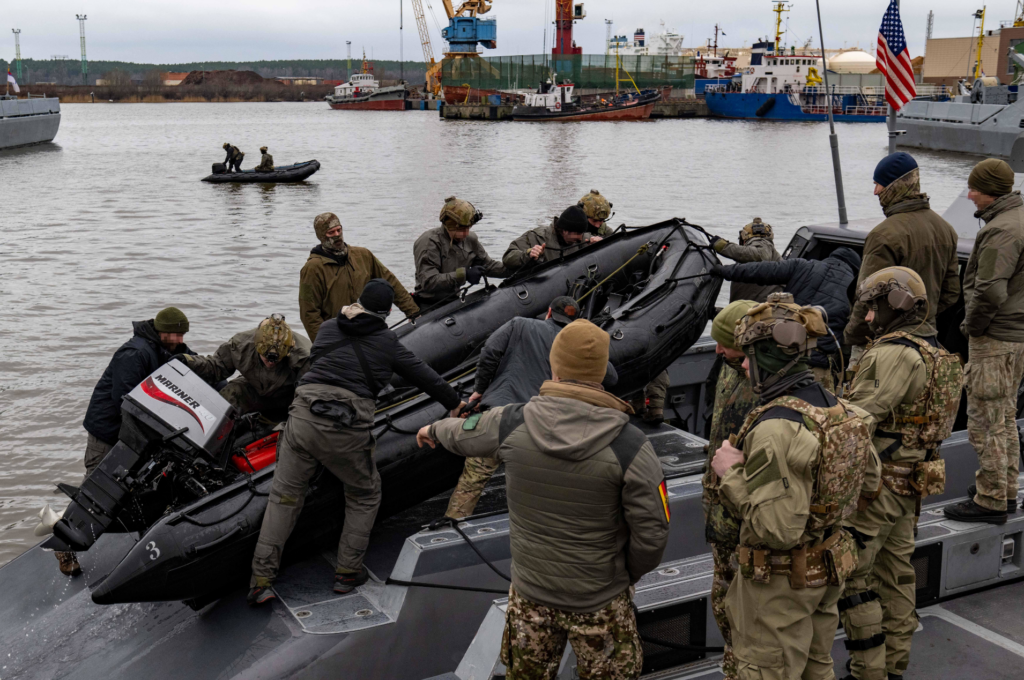
Strengthening NATO alliances, U.S. East Coast-based Naval Special Warfare Operators (SEALs) and U.S. Special Warfare Combat Crewmen (SWCC) recently conducted a two-week training exercise with Lithuanian and German Special Operations Forces. 
 
The exercise, which took place in the Baltic region, aimed to increase warfighting readiness and allied lethality through a series of challenging maritime operations, small boat tactics, and low-light weapons live-fire drills. The training event was designed to foster greater cooperation and interoperability between the participating nations, maintaining a strategic advantage in the region. 
 
“Exercises like this are crucial to ensuring we can operate seamlessly together to fight and win wars,” said CAPT V. Scott King, Commodore of Naval Special Warfare Group TWO. “By training alongside our Lithuanian and German counterparts, we’re not only enhancing our own warfighting readiness but also strengthening the bonds of friendship and cooperation that underpin our alliance.” 
 
Allied training exercises like this are vital to bolstering the collective defense capabilities of NATO nations and builds a stronger, more lethal alliance to address threats in the area. 
 
Throughout the exercise, the units focused on developing and enhancing their skills in maritime special operations, as well as advanced marksmanship and close quarters combat techniques. The special operations forces refined their ability to launch, operate and recover small raiding crafts from the well decks of the Combatant Craft Medium, one of Naval Special Warfare’s most versatile boats. The event culminated with a full-mission profile, bringing together all aspects of the training into a real-world scenario that showcased the special operations forces’ readiness in the maritime domain. 
 
“The training we conducted was both realistic and challenging,” said the senior Naval Special Warfare Operator on site. “We were able to learn from each other and share best practices. This type of cooperation is essential to achieving shared goals and maintaining elite levels of lethality.” 
 
Naval Special Warfare Group TWO produces, supports, and deploys the world’s premier maritime special operations forces to conduct full-spectrum operations and integrated deterrence in support of U.S. national objectives. For more information, visit https://www.nsw.navy.mil/ 


Phelan to Focus on Navy Recruiting, Shipbuilding

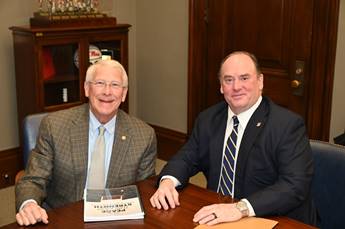
Sen. Roger Wicker, chairman of the Senate Armed Services Committee, met with Secretary of the Navy nominee John Phelan in January. Photo credit: Sen. Wicker’s office.

WASHINGTON — Businessman John Phelan, nominated by President Trump to be secretary of the Navy, appeared before the Senate Armed Services Committee on Feb. 27 and said he wants to focus on Navy recruitment and training, get shipbuilding back on track and set up an “accountable warfighting culture” is approved.

Sen. Roger Wicker (R-Mississippi), chairman of the committee, said Phelan had a “distinguished career in the private sector” although he has no Navy experience, and said “his background showcases his ability to manage complex business deals to drive efficiency and to deliver results. Our Navy will need someone with all three of those skills and more to get our Navy back on the right track.”

“I understand why some question why a businessman who did not wear the uniform should lead the Navy,” Phelan said, pledging to “step outside the status quo and take decisive action with a results-oriented approach.”

Wicker’s first question to Phelan was what he would do to improve Navy recruiting. The service met its goals last year, he said, but “only by lowering standards. Last year, nearly 20% of Navy recruits were considered category IV —  they tested below the 30th percentile on the military aptitude test.”

Phelan said some recruiting numbers have gone up, “which is a reflection of the president’s victory and return to the warfighting ethos,” and said he would take advantage of the upcoming 250th anniversary of the Navy to highlight the benefits of life in the service.

He also said the Navy should “do better from a digital perspective outreach” to young people, and take a page from the Marine Corps, which has worked with the same advertising company for three decades to build its brand.

Wicker said if Congress “threw a zillion dollars at the Navy” it still couldn’t build enough ships because the industrial base doesn’t have enough workers.

Phelan said he would visit the shipyards and spread best practices, including borrowing some from international shipyards, and also “telegraph demand” for shipbuilding to incentivize the private sector to invest in shipbuilding.

Echoing Wicker’s comment that some shipyard salaries are so low a welder could get the same salary working at a convenience store, Phelan said, “you can’t have those kinds of wage differentials for those kinds of jobs.”

Sen. Jack Reed (D-Rhode Island) asked about Secretary of Defense Pete Hegseth’s recent announcement that the Pentagon should be ready to cut 8% from the defense budget in each of the next five years in addition to laying off thousands of defense workers. Reed said such “disruptions” could jeopardize any gains the shipbuilders might make in recruiting workers.

Phelan said he is “not privy” to the details of the cuts, but “I do think the shipbuilding force is critical. If confirmed, will set with the secretary of defense and president and very quickly talk about that.”

Later, he said he understood the potential cuts to be “a planning tool — where would we cut if we need to cut?” that would move resources from nonlethal to more lethal activities.

“Do I view the construction of submarines and ships as lethal? The answer is yes, because we need to have these ships and we need to get them out there quickly,” he said.


Austal USA Hosts Acting Secretary of the Navy

Dr. Brett Seidle – VIP Tour

From Austal USA 

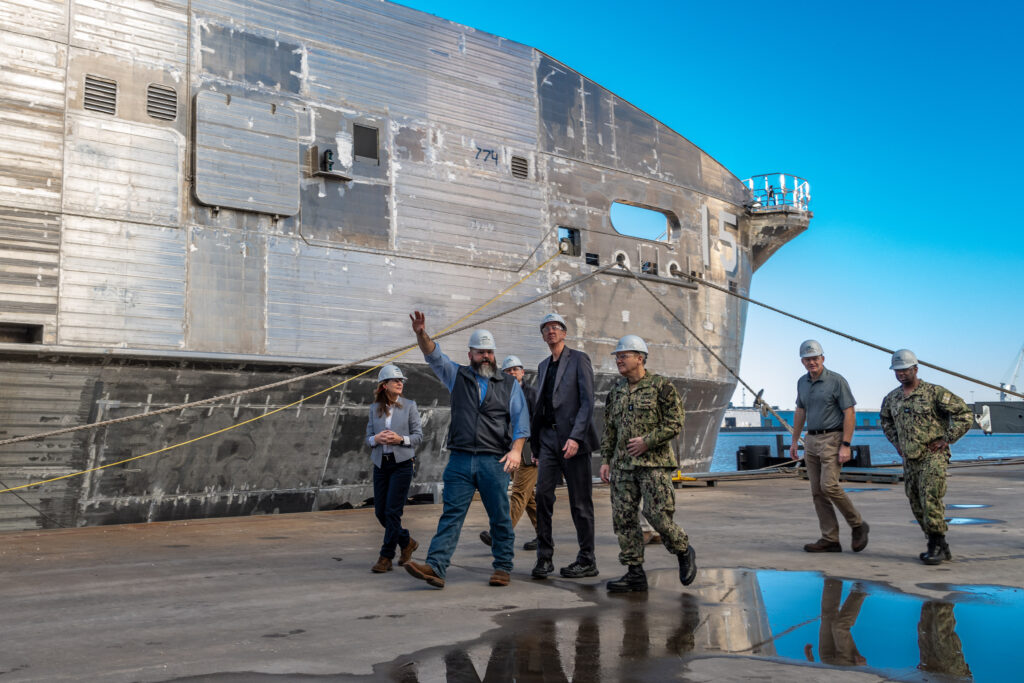
MOBILE, Ala. – Austal USA welcomed the Honorable Dr. Brett Seidle, acting Assistant Secretary of the Navy for Research Development and Acquisition (ASN RDA) at the company’s Mobile, Ala. shipyard yesterday. Dr. Seidle, joined by Rear Admiral Tom Anderson, Program Executive Officer Ships, toured the shipyard’s facility and discussed the company’s growing diversity of design and shipbuilding contracts with members of Austal USA’s senior leadership team.  During his tour, Dr. Seidle witnessed Austal USA’s talented workforce in action.  

This was Dr. Seidle’s first visit to Austal USA, providing him a firsthand look at the company’s state-of-the-art ship manufacturing facility, including separate steel and aluminum assembly lines.  During the tour, Dr. Seidle saw ten vessels under construction as well as aircraft elevators for U.S. Navy Ford-class aircraft carriers (CVN 80 and 81).  At Austal USA’s vessel completion yard, Dr. Seidle saw the future USS Pierre (LCS 38), the final ship of the class, scheduled for delivery in May.  

“We were honored to exhibit our talented workforce and modern facilities to Dr. Seidle and Admiral Anderson,” stated Austal USA President Michelle Kruger. “We’re proud of our success and diverse portfolio of work, and we look forward to continuing to be a key component of the Nation’s shipbuilding industrial base.” 

Austal USA, celebrating 25 years in Mobile, has delivered 32 ships to the Navy since 2009 and is constructing ships from six different programs. The company also has modules in production for both the Virginia and Columbia-class submarine programs.  In addition to Austal USA’s nearly one million square feet of existing enclosed manufacturing space, a new final assembly building to manufacture Navy and Coast Guard surface ships, and a dedicated submarine module production facility are both under construction.  When complete they will add over 600,000 square feet of indoor production area supporting 2,000 new jobs to the workforce. 


U.S. Navy awards GE Aerospace Performance Based Logistics Contract for Avionics

From GE Aerospace, Feb. 24, 2025 

CINCINNATI – February 24, 2025 – GE Aerospace has been awarded a contract to provide performance-based logistics (PBL) avionics support for the F/A-18, AV-8B and AH1-Z aircraft globally.  

“Supporting the safety and operations of our armed forces is one of the most important things we do,” commented Matt Burns, general manager of Avionics Systems for GE Aerospace. “This five-year contract builds on a series of previous PBL contracts with our team supporting 30 years of 99% availability for the U.S. Navy.” 

Under the contract, GE Aerospace will support stores management systems used in mission critical operations for the U.S. Navy fleets of F/A-18, AV-8B and AH1-Z aircraft globally. In addition to the supply, warehousing, and logistics management of the spares, GE Aerospace provides depot level repair of aircraft units and subassemblies and fleet support at major naval bases providing training and technical support.  

GE Aerospace’s stores management systems provide scalable architectures with redundant centralized or distributed stores management while maintaining standard stores station interfaces and safety critical release control.  Providing the tactical and operational ability to further protect troops while accomplishing their missions, GE Aerospace has delivered more than 5000 stores management systems to numerous fourth and fifth generation fixed-wing and rotary-wing military aircraft operators worldwide.  


Joint Maritime Information Center Meets with Cruise Ship Industry Officials on Red Sea Security

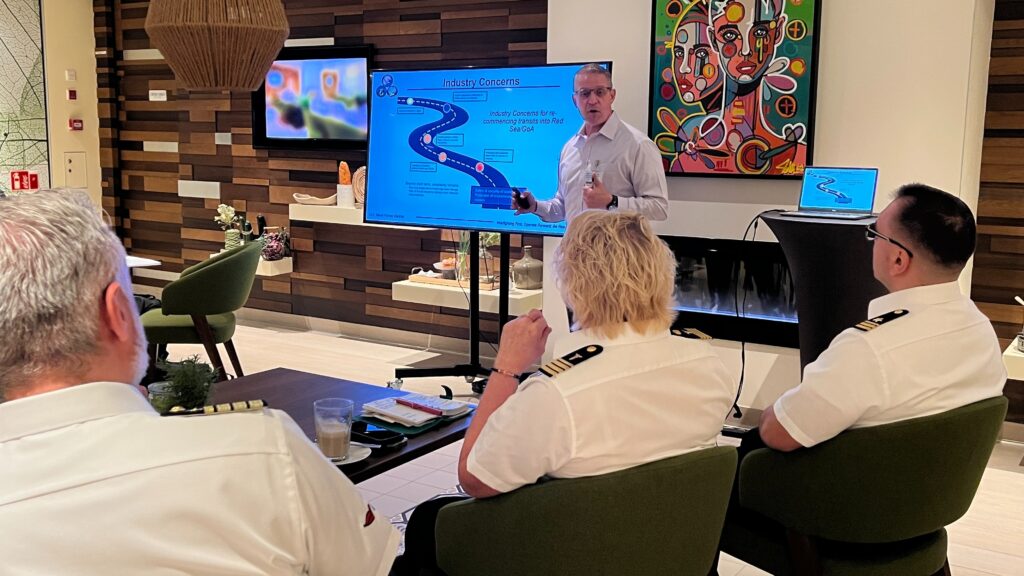
Joint Maritime Information Center director, U.S. Navy Capt. Lee Stuart, briefs cruise line personnel on the maritime security situation in the Middle East region during a visit to a cruise ship visiting Bahrain, Feb. 10, 2025. (U.S. Navy photo) 

From U.S. Fifth Fleet, Feb. 26, 2025 

MANAMA, Bahrain – The director of the Joint Maritime Information Center (JMIC) met with representatives of the cruise ship industry in both Bahrain and Dubai in February to discuss JMIC operations and purpose and to reassure industry officials of JMIC partner nations’ commitment to regional maritime security. 

U.S. Navy Capt. Lee Stuart, JMIC director, along with representatives of Combined Task Force (CTF) 153 of the Combined Maritime Forces, briefed ships’ masters, senior officers and corporate security managers on the current Middle East region maritime security situation, specifically in the Red Sea. CTF 153 is responsible for maritime security in the Red Sea, Bab al-Mandeb, and Western Gulf of Aden. 
 
“The Red Sea attacks highlighted the gap in understanding between commercial shipping and navies. JMIC aims to bridge that gap and increase cooperation to help keep mariners and passengers safe at sea,” said Stuart. 
 
Stuart also outlined JMIC’s role, composition, operations and range of information products, including its incident-specific Information Notes and monthly reports with rolling statistical analysis. 
 
“The cruise industry is highly competitive, rapidly growing, sets schedules years ahead and must keep passenger safety as paramount,” he said. 
 
Stuart also introduced JMIC’s Bridge Emergency Reference Cards, which guide bridge crews on actions to take before, during and after an incident. 
 
The deepening engagement comes as cruise operators and other commercial shipping operators cautiously evaluate the risk of returning to the Red Sea. 
 
“The cruise industry has some difficult decisions to make in response to the region’s complex and dynamic regional security situation,” Stuart said. “JMIC has a vital role to play in giving them reliable information to help their decision-making.” 
 
The Joint Maritime Information Center, initially formed in February 2024 to engage commercial shipping stakeholders regarding Houthi attacks in the Red Sea, recently became a permanent part of Combined Maritime Forces with a broader, region-wide mandate. 
 
Similar cruise industry engagements are planned for the future. JMIC also welcomes engagement from shipping industry stakeholders via its LinkedIn page at: https://www.linkedin.com/company/jmic. 


USS St. Louis Completes First Deployment to 4th Fleet 

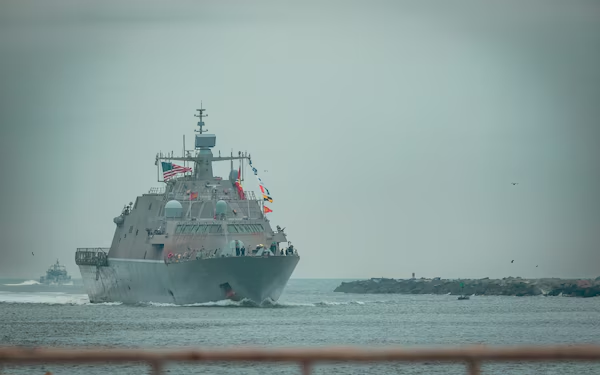
The Freedom-variant littoral combat ship USS St. Louis (LCS 19) arrives at Naval Station Mayport, Florida, after a deployment to the Caribbean Sea and eastern Pacific Ocean. (MC1 Brandon J. Vinson) 
 

From U.S. 4th Fleet, Feb. 25, 2025 

NAVAL STATION MAYPORT, Fla. — USS St. Louis (LCS 19), a Freedom-variant Littoral Combat Ship (LCS), returned to Naval Station Mayport this week, concluding its first deployment to the U.S. 4th Fleet Area of Responsibility (AOR). 

The eight-month deployment, which lasted from June 15, 2024 to February 24, 2025, marked a series of groundbreaking achievements that underscore the capabilities of the LCS platform and its growing contributions to naval operations. 

While assigned to TASK FORCE 45/Destroyer Squadron 40, operating primarily in the Caribbean Sea and Eastern Pacific Ocean, St. Louis, embarked Helicopter Maritime Strike Squadron (HSM) 50 Detachment 4, and U.S. Coast Guard Law Enforcement Detachments (LEDET) 105 and 407, disrupted and confiscated over $100 million worth of illicit contraband in five different operations, significantly hampering the activities of transnational criminal organizations. 
 
“From our first week in theater, the crew demonstrated its tactical acumen in locating and intercepting illicit traffickers. Most of these interdictions were conducted at night, requiring long days and late hours but the crew stayed immensely resilient. I am very proud of what the team accomplished,” said Cmdr. T.J. Orth, USS St. Louis’ Commanding Officer. 
 
In August, St. Louis transited the Panama Canal and operated in the Pacific Ocean for the first time, making history as the first FRE-variant LCS to travel as far south as Valparaíso, Chile when she participated in the 65th iteration of UNITAS, the world’s longest-running multinational maritime exercise. Alongside naval forces from 44 countries, the ship showcased its capabilities in maritime interoperability, enhancing ties with partner nations and furthering regional stability. 
 
After returning through the Panama Canal, St. Louis received new tasking to support U.S. Southern Command’s Joint Task Force-Bravo as that command responded to the deteriorating security situation in Haiti. St. Louis served as a fueling station and Search and Rescue force for 1st Battalion, 228th Aviation Regiment (AVN REGT) UH-60 Blackhawks conducting evacuations out of Haiti. To prepare, St. Louis and 1-228th AVN REGT conducted more than 50 deck landings. This successful integration expanded the ship’s operational versatility, paved the way for future joint missions, and underscored the potential for cross-branch collaboration in dynamic environments. 
 
To wrap up USS St. Louis’ first deployment, St. Louis Sailors showed their flexibility and capacity to rapidly deploy in support of Joint Task Force Operation Southern Guard onboard U.S. Naval Station Guantanamo Bay, Cuba. Sailors supported the expansion of the Maritime Operations Center (MOC) in preparing the MOC to receive up to 2,000 illegal aliens, erecting 50 tents and setting up several hundred cots in several days. Operation Southern Guard is highlighting effective interagency collaboration, as the Department of Homeland Security (DHS) oversees the operation. 
 
“We saw a lot of ‘firsts’ on this ship’s first deployment and it was amazing to see what this ship and crew was capable of. Looking back, this deployment demonstrated the growing potential for Freedom class LCS and the support they can provide not just in the Caribbean, but in the entire 4th Fleet AOR,” said Cmdr. Lee Shewmake, USS St. Louis’ executive officer. “There were many lessons learned that the crew took to heart and put in practice as deployment went on, and I believe that is what enabled our success over the past seven months.” 
 
“St. Louis demonstrated the great potential of the LCS Freedom class, not only in executing its assigned missions but also in breaking new ground for the community. The professionalism and dedication of this crew have laid a strong foundation for the future of LCS operations,” said Master Chief Roderick Bolton, St. Louis’ Command Master Chief. “USS St. Louis returns home with its crew proud of their achievements and eager to share lessons learned from this historic deployment. As the U.S. Navy continues to evolve, St. Louis has proven itself a capable and innovative platform, ready to meet the challenges of tomorrow.” 
 
USS St. Louis’ first deployment to 4th Fleet was a resounding success, marked by numerous milestones and contributions to naval strategy. The ship’s accomplishments highlight the flexibility and utility of the Littoral Combat Ship platform in tackling modern challenges. 


Leonardo DRS Gets $45M Navy Commitment to Bolster US Submarine Industrial Base 

ARLINGTON, Va., Feb. 24, 2025  ̶  Leonardo DRS, Inc. (NASDAQ: DRS) announced today that it has received a $45 million U.S. Navy Submarine Industrial Base (SIB) investment commitment through contracts with HII’s Newport News Shipbuilding. The investment is expected to expand the capabilities of DRS’s new, 140,000 square-foot naval propulsion manufacturing facility currently under-construction in Goose Creek, South Carolina, and includes capital equipment and other infrastructure enhancements. 

The $45 million SIB investment will serve as a catalyst for a 40,000 square-foot expansion of the facility in support of capabilities critical to current and future U.S. Navy nuclear submarines and aircraft carriers.  This investment builds on several Navy funded engineering contracts, including Newport News Shipbuilding, and from General Dynamics Electric Boat previously issued to Leonardo DRS.  These contracts, combined with internal investments, will strengthen steam turbine system design, manufacture, integration, and test capabilities, including steam turbine generators. 

“This significant investment is the result of extensive collaboration between Leonardo DRS, the U.S. Navy, and our shipbuilding customers. said Jon Miller, senior vice president and general manager of the Leonardo DRS Naval Power Systems business unit. “It signifies the depth of our combined resolve to address some of the most pressing challenges facing our nation’s submarine industrial base with respect to capacity needed to deliver critical capability on-time and on-budget for the warfighter.” 

The Leonardo DRS purpose-built facility is expected to open in 2026 and will grow the company’s naval propulsion capability and streamline its support of the Columbia Class submarine program. The company is currently producing the Columbia Class electric propulsion system components, including the main propulsion motor, the main propulsion drives, and main propulsion controller, and other components in addition to similar systems for international allied navies. The facility will support electric drive for next-generation naval platforms and enables an expansion of DRS’s organic capability. It represents a significant expansion in the company’s ongoing collaboration with the U.S. Navy and enhances the nation’s submarine industrial base.  


Truman returns to sea following repairs 

By USS Harry S. Truman (CVN 75) Public Affairs, Feb. 24, 2025 

MEDITERRANEAN SEA   –  The Nimitz-class aircraft carrier USS Harry S. Truman (CVN 75) is underway conducting routine flight operations in the U.S. Sixth Fleet area of operations, Feb. 24, after departing Souda Bay, Greece, on Feb. 23, following completion of an emergent repair availability (ERAV). 

“Our ship remains operationally ready to complete deployment with mission and purpose on full display by the entire crew,” said Capt. Chris Hill, commanding officer of Harry S. Truman. “We are out here launching and recovering aircraft, ready to ‘Give ‘em Hell’ with combat credible power.” 

The U.S. Navy’s ability to rapidly repair its warships anywhere in the world is a testament to our lethality and the warfighting advantage of relationships with Allies and partners. 

Led by Forward Deployed Regional Maintenance Center (FDRMC), Truman completed the five-day ERAV at Naval Support Activity (NSA) Souda Bay, Greece. In an all-hands effort, Sailors worked with FDRMC personnel, Norfolk Naval Shipyard, and local industry partner Theodoropoulos Group to assess damage, develop a repair plan, and restore weathertight integrity to the ship following the collision on Feb. 12. 

“FDRMC is focused on keeping our forward-deployed naval forces mission-ready across 5th and 6th Fleets, maintaining critical combat readiness for the ships and their Sailors,” said Capt. Mollie Bily, FDRMC commanding officer. “The rapid repair effort on Truman was a testament to our expeditionary maintenance expertise and the exceptional collaboration with our Norfolk Naval Shipyard teammates and industry partners.” 

Since deploying, Carrier Air Wing (CVW) 1 has flown over 5,500 sorties, including two self-defense strikes into Houthi-controlled Yemen territory and a large force strike against ISIS-Somalia targets in Northeast Somalia in coordination with U.S. Africa Command. The Harry S. Truman Carrier Strike Group continues to provide maritime security and regional stability in support of its component commanders. 

The carrier strike group includes the flagship USS Harry S. Truman (CVN 75); Carrier Air Wing (CVW) 1, with eight embarked aviation squadrons; staffs from CSG-8, CVW-1, and Destroyer Squadron (DESRON) 28; the Ticonderoga-class guided-missile cruiser USS Gettysburg (CG 64); and three Arleigh Burke-class guided-missile destroyers, USS Stout (DDG 55), USS The Sullivans (DDG 68), and USS Jason Dunham (DDG 109). 

HSTCSG’s mission is to conduct prompt and sustained combat operations at sea and maintain a forward presence through sea control and power projection capabilities. For more information, visit DVIDS at https://www.dvidshub.net/unit/CVN75


Navy CNO Franchetti Fired

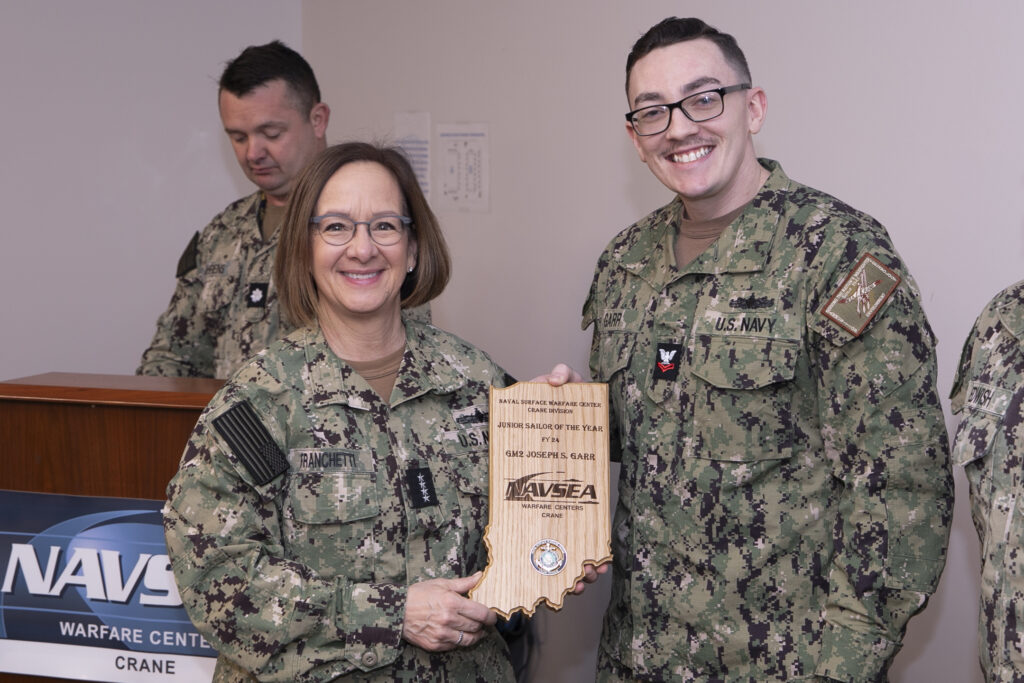
Chief of Naval Operations Admiral Lisa Franchetti presents an award to a Sailor at Naval Support Activity (NSA) Crane, in Crane, Indiana, Feb. 10, 2025. Photo Credit: U.S. Navy | Senior Chief Petty Officer Elliott Fabrizio

Secretary of Defense Pete Hegseth announced he was firing Chief of Naval Operations Admiral Lisa Franchetti on Friday, the same day as he relieved Air Force General Charles Q. Brown as chairman of the Joint Chiefs of Staff, according to the New York Times.

According to the Times and other reports, Hegseth said Franchetti and Air Force General James Slife, the service’s vice chief of staff, also fired, had “distinguished careers,” and “we thank them for their service and dedication to our country.”

Franchetti was the 33rd chief of naval operations, the first woman to be CNO and the first woman to serve on the Joint Chiefs of Staff. She entered the Navy after earning a degree in journalism at Northwestern University and joining the Naval ROTC program there.

She later commanded the destroyer USS Ross, commanded U.S. Naval forces in Korea, served as commander of the U.S. 6th Fleet in the Mediterranean and director of strategy, plans and policy for the U.S. Joint Chiefs of Staff.


The Navy’s Carrier Airwing Flies Further With Hercules’ New Tanker Approval

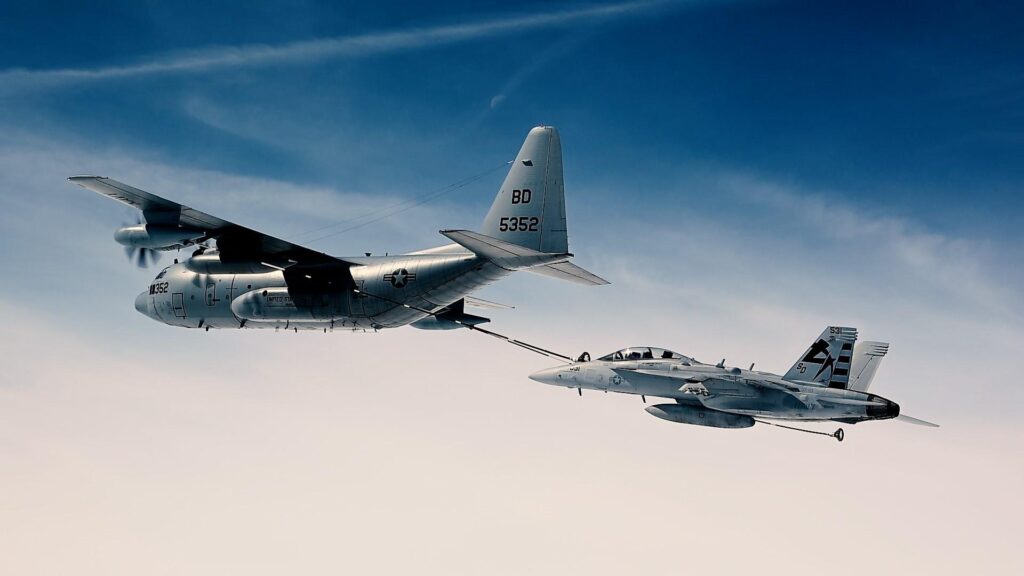
A U.S. Navy Reserve KC-130T refuels an EA-18G Growler in the skies over Naval Air Station Patuxent River in Maryland during testing that enabled the service’s fleet of Hercules aircraft to aerially refuel a significantly expanded number of aircraft in early 2025. The testing led by the Naval Air Warfare Center Aircraft Division significantly expands Hercules’ mission, as well as the mission of the U.S. Navy Reserves which exclusively operates the aircraft. (U.S. Navy photo by Erik Hildebrandt) 

From Naval Air Warfare Center Aircraft Division, Feb. 24, 2025 

PATUXENT RIVER, Md.  –- The Navy Reserve’s KC-130T Hercules fleet, upgraded with the NP200 propeller system, is cleared to aerially refuel a significantly wider range of aircraft across the carrier airwing following envelope expansion testing at the Naval Air Warfare Center Aircraft Division (NAWCAD) which concluded in early 2025. 

The test effort expands Hercules’ mission – and that of the Navy’s fleet reserve, which exclusively operates the aircraft – beyond its primary focus on logistics and cargo transport. 

“Prior to this testing we only had a single aircraft cleared for refueling from the upgraded KC-130T,” said NAWCAD’s developmental test wing Commodore Capt. Elizabeth Somerville. “This advanced capability gives us flexibility in any future conflict.” 

Naval aviation’s F-35B/C, F/A-18, EA-18. CH-53K, CH-47, H-60s and AV-8B were cleared for air-to-air refueling from KC-130T after testing by NAWCAD federal government engineers, testers, and military test pilots from Air Test and Evaluation Squadron (VX) 20 along with industry partners who worked to make sure Hercules could safely refuel the aircraft with its upgraded NP2000 propeller system. 

“If we look forward to any future fight, it’s going to take intense collaboration between all of the forces: Navy, Marine Corps, Air Force, Army, Coast Guard,” said Somerville. “Any resource that provides fuel airborne is going to be invaluable to all assets that are flying.” 

The test effort significantly increases naval aviation’s operational reach and flexibility, as well as several international allies, following a request by U.S. Pacific Fleet. 

The KC-130T Hercules is a multi-role, long-range, land-based tactical aircraft that provides logistical support to fleet operating forces. 

Check out a video of the test effort here: https://www.youtube.com/watch?v=triR4w11yR4 

NAWCAD employs more than 20,000 military, civilian and contract personnel. It operates test ranges, laboratories and aircraft in support of test, evaluation, research, development and sustainment of everything flown by the Navy and Marine Corps. Based in Patuxent River, Maryland, the command also has major sites in St. Inigoes, Maryland, Lakehurst, New Jersey, and Orlando, Fl