USS Tripoli Forward Deploys to Japan 
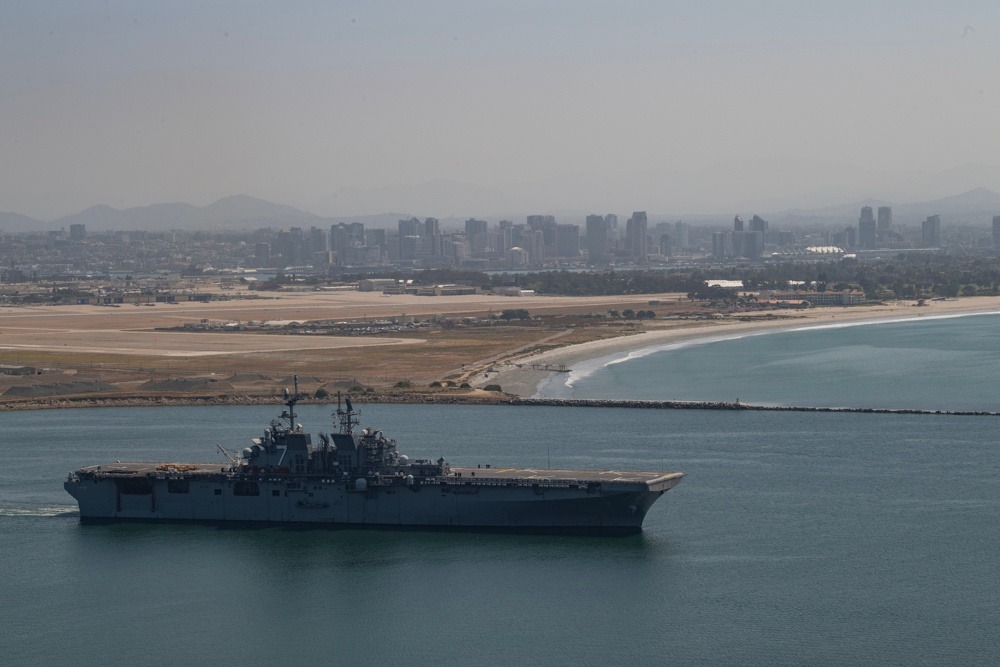
America-class amphibious assault carrier USS Tripoli (LHA 7) transits San Diego Bay, May 19, 2025. The ship departed Naval Base San Diego to complete a homeport change and join forward-deployed naval forces in Sasebo, Japan as part of a scheduled rotation of forces in the Pacific. (U.S. Navy photo by Mass Communication Specialist 1st Class Sara L. Eshleman) 

From Commander, Naval Surface Force, U.S. Pacific Fleet, May 19, 2025 

SAN DIEGO – The America-class amphibious assault ship USS Tripoli (LHA 7) departed Naval Base San Diego May 19 to forward deploy to Sasebo, Japan, as part of a scheduled rotation of forces in the Pacific. The Tripoli will replace the amphibious assault ship USS America (LHA 6), which will depart Sasebo and move to San Diego. 
 
“The Tripoli is ready to defend U.S. interests abroad and strengthen our long-standing partnership with Japan,” said Capt. Eddie Park, commanding officer of the Tripoli. “I am extremely proud to lead this hard-working and motivated team of Sailors and Marines overseas to support security, stability and prosperity in this vital region.” 
 
The forward presence of the Tripoli supports the United States’ commitment to the defense of Japan, enhances the national security of the United States and improves its ability to protect strategic interests. The security environment in the Indo-Pacific requires the most capable ships to enable rapid response times for maritime and joint forces. 
 
“The U.S. has a vital relationship with Japan, and their hospitality and professionalism are unmatched,” said the Tripoli’s executive officer (XO), Capt. Patrick Sullivan, whose previous assignment was deputy commander of Naval Surface Group Western Pacific in Sasebo. “I’m honored and excited to return as the XO of such a highly capable warship to honor our nation’s security commitment to Japan.” 
 
San Diego has been the Tripoli’s homeport since September 2020. Since then, the Tripoli supported multiple exercises including Valiant Shield, Iron Storm, Kamandag, Steel Knight, and the 31st Marine Expeditionary Patrol 22.2. The ship also completed numerous maintenance availabilities and earned various fleet and type commander excellence awards. 
 
“This crew has been diligently preparing to forward deploy since last year,” said Park. “I am fully confident in the crew’s abilities to execute any mission assigned to us.” 
 
The Tripoli was commissioned July 15, 2020, and is the second America-class amphibious assault ship built for the United States Navy. The ship is named after the U.S. Marine Corps victory against Tripoli at the Battle of Derna during the First Barbary War in 1805. 
 
The mission of Commander, Naval Surface Force, Pacific Fleet is to man, train, and equip the Surface Force to provide fleet commanders with credible naval power to control the sea and project power ashore

Navy Reserve Chief Looks Forward to KC-130J Aircraft 

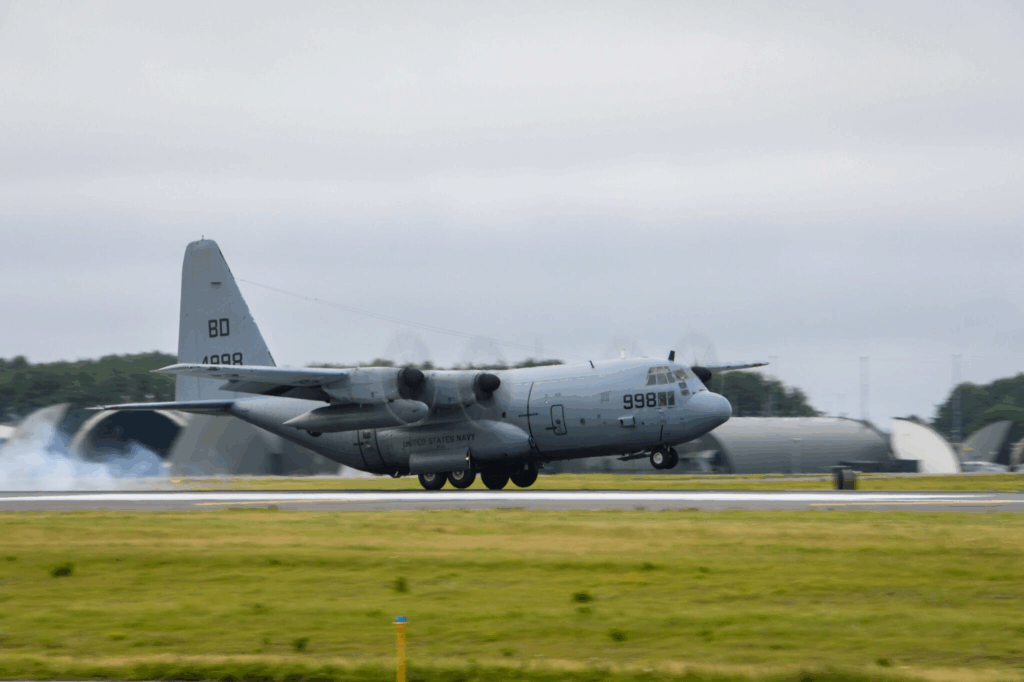
MISAWA, Japan (July 12, 2021) A C-130T Hercules, assigned to the Condors of Fleet Logistics Support Squadron (VR) 64, recovers at Naval Air Facility (NAF) Misawa. (U.S. Navy photo by Mass Communication Specialist 3rd Class Benjamin Ringers)

By Richard R. Burgess, Senior Editor 

ARLINGTON, Va. — The admiral in charge of the U.S. Navy Reserve Force expressed appreciation for congressional support in procuring KC-130J Super Hercules tanker/transport aircraft to modernize the force’s organic airlift fleet. 

“We are grateful for the strong bi-partisan alignment on this priority,” said Rear Admiral Nancy S. Lacore, chief of Navy Reserve, testifying May 20 before the House Appropriations Committee’s defense subcommittee. “We are grateful for the adds we got in 2024 [and] 2025 for the C-130. The C-130 is our number one equipment priority, and we are behind in that re-capitalization effort.” 

The Navy Reserve operates 27 C-130T/KC-130T Hercules aircraft with an average age of 34 years and a mission-capable rate of 40%. Lacore anticipates a mission-capable rate of 75% with a fleet of KC-130Js. 

We’re also anticipating a 75% mission-capable rate, which will go a long way,” Lacore said. “The plan was to be at 32 aircraft by 2030. We got one in 2024, two in 2025 and we’re super-grateful for them. Right now, in the out years, we need to be looking at six per year in order to get us to where we need to go.”  

Lacore said the C-130T Hercules “operates exclusively by the Reserve is the Navy’s only long-range, inter-theater airlift for oversize cargo. Its capability is in high demand from fleet commanders, particularly in the Indo-Pacific, playing a critical role in the contested logistics necessary to sustain a maritime fight. 

“For the past few months, Reserve C-130 crews have transported thousands of pounds of ordnance into the Red Sea fight, keeping our ships on station intercepting Houthi missiles, conduction precision strikes, and safeguarding global commerce,” she said. “When the fleet needs logistics, whether to deliver firepower or staying power, Navy Reserve answers the call.” 

She pointed out that the C-130T fleet “lacks the survivability necessary to operating in a contested environment. Recapitalizing with the KC-130J is critical to ensuring that we effectively and safely carry out the critical inter-theater logistics mission for the fleet in 2027 and well beyond that.” 

Lacore also noted the need for improved aerial refueling capability in the Pacific theater. 

“The PACFLT [U.S. Pacific Fleet] commander has already asked us to work on organic aerial refueling and we are doing that with the Tangos [KC-130Ts],” she said. “It’s a long haul; they’re not all plumbed for that, whereas the Juliets [KC-130Js] will come with that plumbing already established. We anticipate that at least two times the aerial refueling rate. And if we include ground refueling as well, we’re looking at probably eight times our refueling capability in theater, which is a huge win for us in the Pacific. 


Vigor Marine CM San Diego Completes USS Tripoli (LHA 7) 

Vessel’s early departure shows skill, commitment of San Diego team 

SAN DIEGO, Calif. (May 30, 2025) – Vigor Marine CM San Diego, a division of Vigor Marine Group, has successfully completed a Continuous Maintenance Availability on USS Tripoli (LHA 7), returning the vessel five days ahead of schedule. More than 250 skilled workers supported the effort to get the Tripoli back to the fleet ahead of schedule, allowing the vessel to commence its rotation to Japan.  

“This successful availability showed our skilled workers’ commitment to excellence and to the success of our customer, the U.S. Navy,” said Adam Beck, Head of Maintenance and Modernization Pacific for Vigor Marine Group. “We are aware of the importance of quality, on-time maintenance to the success of the warfighter and we are proud of our team for the work they do in support of our national defense.” 

This CMAV consisted of a comprehensive body of work, including platform repairs, tank repairs and preservation, bulkhead shaft seal repair, pump mechanical seals, service diesel generator repair, piping replacements, rotating machinery/pump overhaul and replacement, refrigeration compressor overhaul and various aircraft/cargo weapon elevator repairs. Work was completed at the CM San Diego shipyard from February through mid-May.  

“The expert team in San Diego not only completed this work ahead of schedule, they did it with a strong focus on working safely,” said Carlos Aguayo, President of Vigor Marine CM San Diego. “Our strong relationship with the Navy is founded on our commitment to their success and our safe, quality performance. We are grateful to be a partner of choice and look forward to further opportunities to support our valued customer.” 

Vigor Marine CM San Diego, formerly Continental Maritime of San Diego continues work on the USS Russell (DDG 59) DSRA, USS Momsen (DDG 92) and the planning for an upcoming SRA on the USS Sterett (DDG 104). This is the second time CM San Diego has been trusted with an availability on the Tripoli. The work not only supports the U.S. Navy, it provides hundreds of family wage jobs in San Diego, and thousands across the entire Vigor Marine Group footprint.  


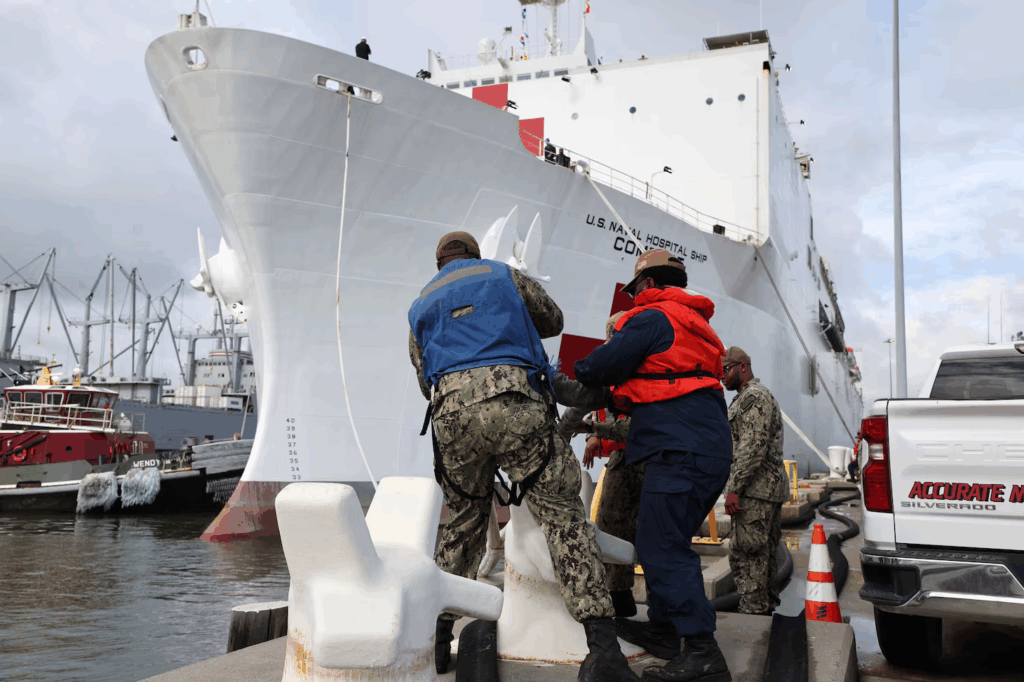
USNS Comfort Departs Norfolk in Support of Continuing Promise 2025 

by LaShawn Sykes – USN Military Sealift Command, May 30, 2025 

NORFOLK, Virginia (May 30, 2025) – The U.S. Navy Mercy-class hospital ship USNS Comfort (T-AH 20) departed Naval Station Norfolk to begin its summer deployment to the U.S. Southern Command area of operation in support of U.S. Naval Forces Southern Command/U.S.4th Fleet’s Continuing Promise 2025, May 30. 

 
After several months of detailed planning, Comfort is on-track to conduct mission visits to Grenada, Panama, Colombia, Ecuador, Costa Rica, and the Dominican Republic. 
 
“Continuing Promise has been conducted since 2007, with a mission to forge enduring partnerships by providing medical and humanitarian aid, thereby creating a lasting reputation for goodwill throughout the region,” said Capt. Ryan Kendall, commodore, Destroyer Squadron 40, and mission commander of Continuing Promise. 
 
The focus during each mission stop will be working alongside partner nation medical personnel to provide direct patient care and technical expertise in community clinics to improve medical readiness, strengthen partnerships, and enhance the combined capabilities of the U.S. Navy and partner nations to respond to public health disasters and humanitarian crises. 
 
The Continuing Promise team also includes a U.S. Army veterinary element from the 248th Medical Detachment (Veterinary Service Support), which will collaborate with host nation colleagues to provide direct public health education and animal care at local veterinary organizations in-country. U.S. Navy Seabees from Navy Mobile Construction Battalion 11 will assist in host nation led community engineering projects. U.S. Navy experts will host seminars and training exercises with host nation civilian officials and military professionals covering disaster preparedness and response. These exchanges aim to support host nation facilities, improve readiness, and empower local and national officials with the knowledge and experience to act with confidence during emergencies. 
 
The U.S. Fleet Forces Band, “Uncharted Waters,” will also support the Continuing Promise mission. The band will embark on USNS Comfort to conduct classes at community schools, collaborate with military and civilian musical organizations in partner nations, and entertain local communities with concerts at each mission stop. This cultural exchange aims to strengthen community ties and foster goodwill. 
 
Capt. Stephen P. Arles, commanding officer, USNS Comfort, expressed excitement about working with the band and professional medical team. He added, “This is the Comfort’s eighth deployment supporting Continuing Promise. The team is eager to collaborate with partner nations, exchange knowledge, and aid those in need, strengthening the legacy of the Continuing Promise mission.” 
 
USNAVSOUTH/FOURTHFLT is the trusted maritime partner for Caribbean, Central and South America maritime forces leading to improved unity, security and stability. 
 
For more information about the mission, please visit https://www.fourthfleet.navy.mil, and follow at https://www.facebook.com/NAVSOUS4THFLT, https://x.com/navsous4thflt, and https://instagram.com/usnavysouth4thflt/. 
 
For more news from Military Sealift Command, visit https://sealiftcommand.com/. 


USNAVSOUTH and Salvadoran Navy integrate Robotic and Autonomous Systems during FLEX 2025 

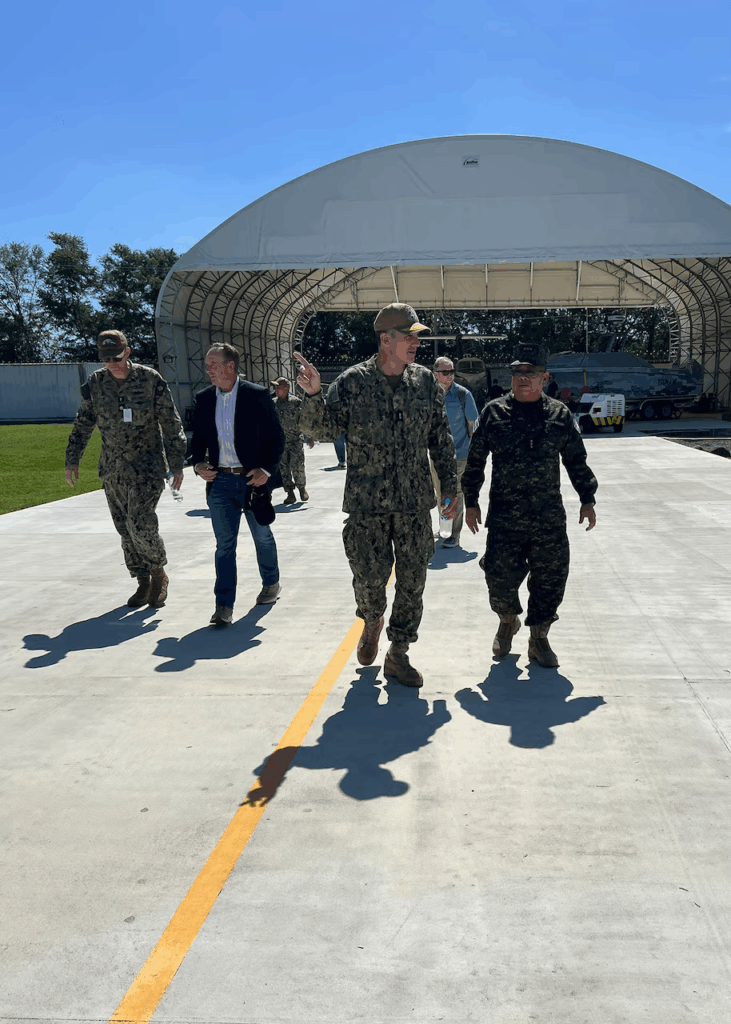
SAN SALVADOR, El Salvador (May 27, 2025) – Captain of the Salvadoran Navy, Capt. Omar Hernandez, left, and U.S. Naval Forces Southern Command / U.S. 4th Fleet Commander Rear Adm. Carlos Sardiello, right, receive a Tsunami unmanned surface vessel (USV) capabilities overview during the Hybrid Fleet Campaign (HFC) Fleet Experiment (FLEX)’s showcase event at CSL Comalapa near San Salvador, El Salvador, May 27, 2025. (U.S. Navy photo by MCC John R. Fischer) 
 

By USNAVSOUTH/4TH FLEET PUBLIC AFFAIRS, May 29, 2025 

SAN SALVADOR, El Salvador  –  SAN SALVADOR, El Salvador (May 27, 2025) — Cooperative Security Location (CSL) Comalapa, in coordination with the Salvadoran Navy, hosted the annual U.S. Naval Forces Southern Command / U.S. 4th Fleet Hybrid Fleet Campaign (HFC) Fleet Experimentation (FLEX) Event demonstrating combined/joint integration potential for unmanned systems during a showcase event in San Salvador, El Salvador, May 27. 
 
In its 25th year of operation and as one of only two forward operating locations in the United States Southern Command area of responsibility, CSL Comalapa’s mission to assist in the joint/combined regional mission of combatting transnational organized crime created the perfect opportunity to transition FLEX from partner nation observation to partner nation participation. 
 
“The intent of FLEX is twofold,” said USNAVSOUTH Commander Rear Adm. Carlos Sardiello, “To accelerate technological advancements through cooperation with industry and international partners, and to operationalize those advancements to increase maritime domain awareness to counter illicit traffic flow. As a cornerstone of the efforts to combat transnational organized crime, it is only fitting that CSL Comalapa be the first location to host FOURTH Fleet’s Hybrid Fleet Campaign FLEX Event outside the United States.” 
 
HFC is a learning campaign to retain and improve advantages using next-generation manned and unmanned systems. In 2025 the FLEX series is enabling scaled hybrid fleet operations from robotic and autonomous systems (RAS) experiments into months-long deployments integrated with partner nations. In turn, these deployments feed vast amounts of data to the 4th Fleet Maritime Operations Center (MOC). 
 
“Surface, aerial, and undersea autonomous systems stack together to give us highly effective maritime domain awareness,” said Cmdr. Jon Williams, the USNAVSOUTH technology and Innovation director. “But all of these systems are inherently independent. Part of what we’ve done here at Comalapa is an advanced data fusion. Each of these independent systems communicate together and provide an integrated feed that we monitor from the MOC in Mayport.” 
 
King Air manned aircraft teamed with Resolute Eagle unmanned aircraft systems (UAS), Tsunami unmanned surface vessel (USV), Minotaur data fusion, and Lema expeditionary solar power to operate with Salvadoran navy Task Force (TF) Tridente in various combinations from April 1 to May 23. 
 
Synchronization now happens in real time, connecting RAS, tactical teams, and operations centers enabling a common operating picture for highly effective operations. During FLEX, TF Tridente accomplished the interdiction and apprehension of narcotics smugglers with the assistance of this synchronized system. Practical tests showed the capability of single or combined systems to find, fix, track, assess, disrupt and pursue training targets from longer ranges and less exhaustion to manned interdiction crews. 
 
“El Salvador is a capable and willing partner,” said Dr. Christopher Heagney, the NAVAIR Fleet/Force Advisor to USNAVSOUTH, “accelerating new manned and unmanned technologies from Navy Laboratories and the acquisition community into the hands of Sailors will deliver more capability at lower cost and risk. Operating those systems in El Salvador helps us disrupt illicit traffic flows into the homeland while also providing a testbed to innovate with our partners.” 
 
USNAVSOUTH is working with the Creative Defense Foundation to better connect Congressional appropriators with Industry, operational, and acquisition communities. As Congress funds new pathways for rapid capability development and employment, the United States Southern Command area of responsibility is a perfect environment to innovate. 


First Augmented Reality Maintenance Systems Operational on Five Ships 

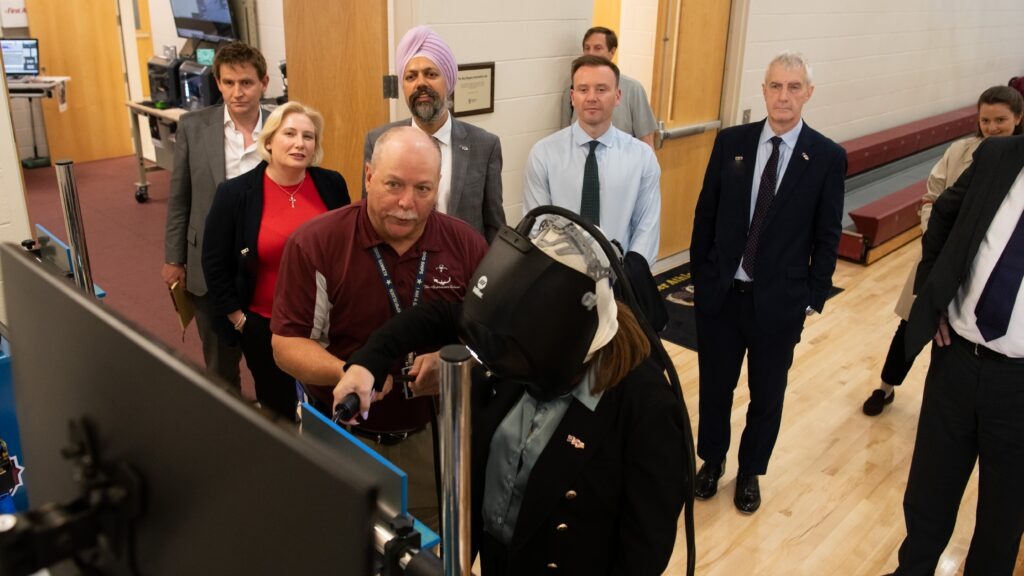
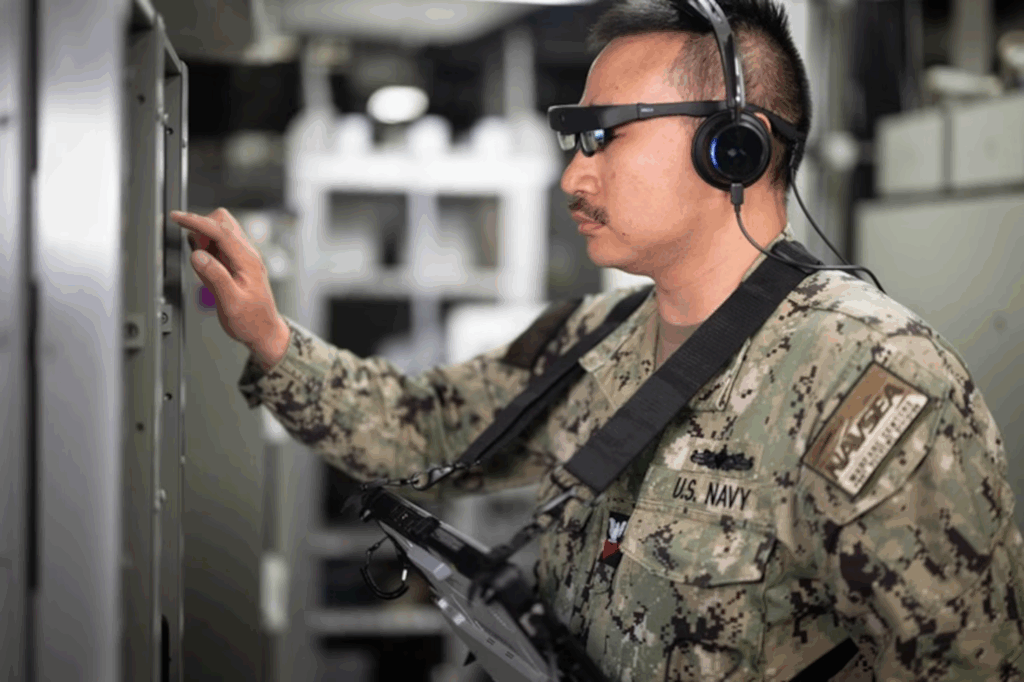
Naval Surface Warfare Center, Port Hueneme Division (NSWC PHD) Fire Controlman Petty Officer 1st Class Donald Tran demonstrates the Augmented Reality Maintenance System aboard USS Spruance (DDG 111) during a recent Combat Systems Assessment Team event at NSWC PHD. The technology could reduce the number of onboard technical assistance visits by connecting sailors and subject matter experts through augmented reality and audio. 

By Brian Varela, May 14, 2025 

Sailors are a ship’s first line of defense against system failures. But when the issue requires a subject matter expert (SME), repairs have often had to wait until a technician could travel to the ship. 
 
Enter ARMS, short for the Augmented Reality Maintenance System. ARMS enables sailors and Naval Surface Warfare Center, Port Hueneme Division (NSWC PHD) SMEs to instantly address system failures and eliminate the need for costly travel — and it’s now installed aboard five Navy ships. 
 
NSWC PHD’s Augmented Reality Maintenance System (ARMS) team recently outfitted five ships in less than a week with the unique and fully operational remote viewing instruments. 
 
The group installed the technology on USS Curtis Wilbur (DDG 54), USS Lenah Sutcliffe Higbee (DDG 123), USS Gridley (DDG 101), USS Fitzgerald (DDG 62) and USS Nimitz (CVN 68) with support from Naval Air Systems Command (NAVAIR) and Naval Information Warfare Systems Command (NAVWAR). NSWC PHD electronics engineer Matthew Cole and computer scientist Nick Bernstein led the effort between March 22 and 26. 
 
“Sailors are by trade operators and maintainers of their warships,” NSWC PHD Commanding Officer Capt. Tony Holmes said. “It’s never a matter of if, but when, systems aboard a ship will require some sort of troubleshooting and/or corrective maintenance to keep them operating. If outside help is required to resolve an issue, and that issue can be resolved by over-the-shoulder assistance via ARMS, that is a good thing.” 
 
This remote assistance not only empowers sailors to fix problems quickly and keep their systems operating, he explained, it also saves time and money by averting the need for an SME to fly out to the ship for onboard technical assistance. 
 
“The biggest win in this case is that the sailor fixed the problem, not the external SME,” Holmes added. “ARMS capability goes to the heart of enabling sailor self-sufficiency, and keeping our warships in the fight.” 
 
Prior to the recent installations, Bernstein — who is also the ARMS engineering lead — led a small NSWC PHD ARMS team to conduct short technical demonstration installations aboard three ships. The group used AR hardware with the same NAVAIR-developed ARMS software, Bernstein said. 
 
For the March installations, Bernstein and Cole worked with the internal and external ARMS team to equip the aircraft carrier and four guided-missile destroyers with the latest hardware and software to be used on their deployments. 
 
“These are the first operational, useable ARMS installs,” Bernstein said. 
 
Augmented reality 
 
ARMS is a remote viewing capability used to connect deployed sailors with subject matter experts (SMEs) at warfare centers, in Regional Maintenance Centers and other shoreside locations. Sailors wear a simplified AR headset that allows the SMEs to observe and troubleshoot any shipboard systems in real time by seeing and hearing from the sailor’s point of view. While wearing the headgear, the sailors can pull up technical manual excerpts, maintenance requirement cards, 3D images, design models or schematics to restore a system while the remote SMEs talk them through the process. 
 
The team aims to use the technology to reduce the number of visits command personnel make to ships to provide them with technical assistance. ARMS can also reduce the length of time NSWC PHD personnel spend aboard by diagnosing issues in advance. 
 
As a result, the fleet will receive faster support without waiting for technicians to arrive aboard. 
 
“Now, we can send the right expert with the right tools out to the ship, thereby saving time and money,” Cole said. 
 
Installation and test 
 
The five-day installation in March marked the end of one Interim Authority to Test (IATT) and the beginning of another. The Navy conducts IATTs as a first step to check within a specified time period that a new system works and to gather feedback for upgrades. 
 
The first IATT was scheduled to expire in March. However, NAVWAR Commander Rear Adm. Seiko Okano requested the original seven-month time frame to perform an operational ARMS capability be narrowed down to one month so the AR equipment could be installed aboard the five ships before they deployed from Naval Base San Diego, Bernstein said. 
 
The vessels were ported simultaneously for a one-week period in San Diego, so the group had to work fast. The ARMS installation team — which included NSWC PHD and Naval Information Warfare Center Pacific SMEs — installed each system in less than a day while also training sailors. 
 
During the current IATT, the team will monitor ARMS usage and solicit feedback to improve its capabilities and handling ahead of the full Authority to Operate. 
 
Gear changes 
 
Throughout the first IATT, ARMS utilized an AR/mixed reality headset that had been used commercially for remote collaboration and training. After the product was discontinued in October, the ARMS system switched to AR smart glasses to retain the hands-free goal of ARMS. 
 
The ARMS team is also looking at other potential headsets, including a 3D-printed alternative the command’s Engineering Development Lab is developing, Cole said. 
 
Since he first got involved with the program in fiscal year 2022, Bernstein has watched ARMS grow as it reached numerous milestones. He said he’s excited to see ARMS maturing as it’s fielded for operation aboard future ships. 
 
“It’s incredibly rewarding seeing this project transition to the fleet and stand on its own to support sailors and SMEs,” Bernstein said. 


HII Hosts UK House of Commons Defence Committee Members

From HII

NEWPORT NEWS, Va., May 27, 2025 (GLOBE NEWSWIRE) — HII (NYSE: HII) hosted members of the United Kingdom House of Commons Defence Committee at its Newport News Shipbuilding division last week. 

The visit was held in support of the trilateral Australia, United Kingdom and United States (AUKUS) partnership. HII continues its commitment to supporting AUKUS, which set in motion tasking across all three countries to determine the optimal pathway to provide Australia with conventionally armed, nuclear-powered submarines and a broader partnership on advanced capabilities. 

“The Committee were delighted to visit the HII yard and see the skill and endeavour on display,” said Tan Dhesi, chairman of House of Commons Defence Committee. “The AUKUS agreement is a vital tool for the strategic advantage of all three countries and the Committee is pleased to support it with our recently launched inquiry, ensuring it achieves its maximum potential.” 

Defence Committee members met with company leadership and saw facilities that support construction of Virginia-class nuclear-powered attack submarines. Additionally, they participated in a tour of the Newport News Shipbuilding Apprentice School that focused on HII’s workforce development expertise. 

Photos accompanying this release are available at: http://hii.com/news/hii-hosts-united-kingdom-house-of-commons-defence-committee-members-at-newport-news-shipbuilding/

“We greatly appreciate the Defence Committee’s engagement and the opportunity to showcase how HII’s decades of expertise directly support AUKUS objectives,” said Michael Lempke, president of the HII Mission Technologies division Global Security group and the leader of HII’s Australia and U.K. operations. “From building nuclear-powered submarines to fortifying industrial capacity across the U.S., U.K. and Australia, our efforts are closely aligned with the trilateral vision. These discussions are vital to strengthening the collaboration and driving the innovation that underpins AUKUS.” 

Industrial integration of submarine and shipbuilding capabilities between the U.S., U.K. and Australia is a critical component of the AUKUS partnership, enabling aligned defense production, workforce development, and supply chain collaboration to support shared security objectives. 

NNS is one of only two shipyards capable of designing and building nuclear-powered submarines for the U.S. Navy. HII is the founding member of the AUKUS Workforce Alliance (AWA), a dedicated partnership committed to preparing a skilled workforce in support of all steps of Australia’s optimal pathway to sovereign nuclear-powered submarines. The company was awarded a contract for the Australian Submarine Supplier Qualification (AUSSQ) pilot program to accelerate the identification and qualification of Australian suppliers and products into the United States submarine industrial base. 

About Defence Committee’s inquiry: https://committees.parliament.uk/work/9068/aukus/ 


Leidos Acquires Kudu Dynamics, Advancing AI Capabilities For Cyber Warfighters 

RESTON, Va. (May 28, 2025) – Leidos (NYSE:LDOS) announced today that it has acquired Kudu Dynamics, accelerating Leidos’ rapid scaling of artificial intelligence (AI)-enabled cyber capabilities for defense, intelligence and homeland security customers. 

Leidos’ extensive current AI-enabled cyber offerings arm users with the rapid capability and scale needed to automate vulnerability detection, enhance novel defenses, neutralize attacker advantages and evade adversary defenses. Acquiring Kudu Dynamics will accelerate Leidos’ strategy for AI-enabled offensive cyber, electromagnetic spectrum operations and vulnerability research.   

Founded in 2013, Kudu Dynamics has rapidly grown its work across the Department of Defense, leading the industry in automated targeting, scalable hardware reverse engineering and the generation of other non-kinetic effects. 

“Kudu’s ability to generate new cyber capabilities with AI perfectly complements our strategy to rapidly grow differentiated offensive cyber technology capabilities,” said  Leidos Chief Executive Officer Tom Bell. “This acquisition underlines Leidos’s commitment to continue to build smarter full-spectrum cyber capabilities, so that the U.S. and its allies dominate the cyber warfighting domain.” 

“We’re excited to deliver the next level of capabilities to our customers as we bring together the highly innovative cyber professionals and disruptive technologies of Kudu with the scale, resources and experience of Leidos,” said Kudu Dynamics’ Founder and CEO Mike Frantzen. “In Leidos, we’ve found a partner who shares our ethic of purposeful innovation in support of our nation’s most critical missions.” 

The Kudu Dynamics purchase marks Leidos’ first acquisition in two-and-a-half years. Increasing investment in the company’s already formidable cyber capabilities is among the five strategic growth pillars of its new NorthStar 2030 strategy, developed through a year of deep strategic thinking in 2024.   

The approximately $300 million all-cash acquisition closed May 23. 

Advisors 

Baird served as exclusive financial advisor to Kudu Dynamics on this transaction. 


NOAA’s PORTS System to Improve Maritime Safety in Pearl Harbor

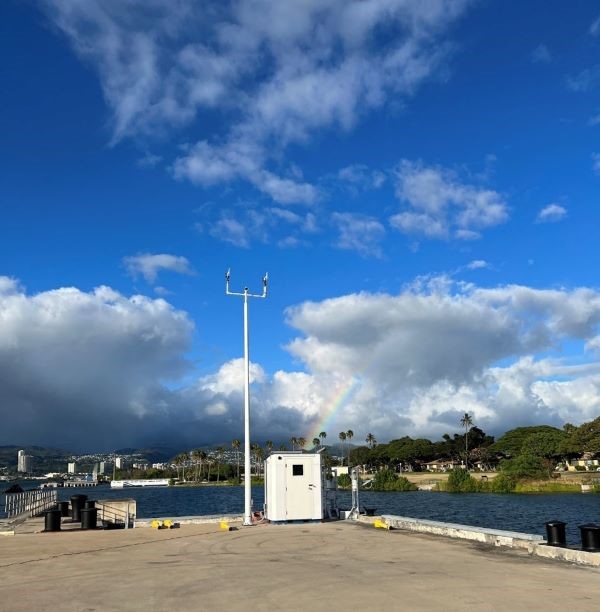
NOAA’s new Pearl Harbor-Honolulu PORTS stations collect and disseminate real-time observations of water levels, wind speed, atmospheric pressure and air and water temperatures used by mariners to navigate safely. (Credit: NOAA/CO-OPS)

Real-time observations will support U.S. commerce, naval interests in the region 

From Kimberly Rodgers, [email protected] , May 28, 2025 

May 28, 2025 

NOAA’s first Physical Oceanographic Real-time System, or PORTS, at Pearl Harbor-Honolulu, Hawaii, is now operational. Installed by NOAA’s National Ocean Service, data from the new publicly available observation system advances NOAA’s ability to better serve Hawaii’s coastal communities and secure maritime safety in the Pacific Islands. 

Pearl Harbor-Honolulu PORTS is NOAA’s 40th system in this national network of precision marine navigation sensors concentrated in busy U.S. seaports, and is the result of a partnership between NOAA and U.S. Navy Region Hawaii. Data from the system will be used to assist in the Navy’s planning and monitoring during daily operations and hazardous weather situations in Pearl Harbor and on Joint Base Pearl Harbor-Hickam — home to more than 55,000 military members and civilians, contributing more than $2 billion annually to the local economy. 

Commercial and local mariners traveling to Honolulu Harbor, the principal seaport of Hawaii, will also have access to these publicly available real-time observations. They will enable safer vessel movement, help determine the amount of cargo a vessel can carry and reduce transit delays for commercial traffic. Honolulu Harbor handles more than 11 million tons of cargo annually. National Weather Service forecasters in Honolulu will use PORTS water level observations to anticipate and communicate coastal flooding impacts to the community so preemptive actions can be taken. 

“With the launch of PORTS in Honolulu, we’re delivering mission-critical data to partners and decision makers — naval operations, commercial mariners and local agencies,” said Nicole R. LeBoeuf, director of NOAA’s National Ocean Service. “PORTS data will contribute to a safer and more efficient movement of vessels traversing Mamala Bay, entering and exiting Pearl Harbor and within Honolulu Harbor.”  

The Pearl Harbor-Honolulu PORTS consists of one water level and meteorological station located in Pearl Harbor (Ford Island) and a buoy-mounted current meter at Ford Island Channel, Lighted Buoy #1, sponsored by the U.S. Navy. The new stations will collect data on wind, air temperature, air pressure, and tidal currents to help mariners plan for safe docking in high winds, adverse weather, and heavy ship traffic.  

The system also integrates data from a long-standing NOAA National Water Level Observation Network station at Honolulu Harbor, as well as a Coastal Data Information Program wave buoy at the entrance to Pearl Harbor.  

PORTS is a successful public-private partnership program between NOAA and local partners that provides an integrated system of sensors concentrated in seaports. These sensors deliver accurate, real-time environmental data to commercial and other vessel operators. The PORTS program supports safe vessel movements in more than half of the top 175 U.S. seaports, including key coastal military installations. The safety and economic benefits of PORTS are well documented, including a 50% reduction in maritime accidents in seaports where real-time data is available. The data is publicly accessible online and can be integrated into vessel portable pilot units. The new Pearl Harbor-Honolulu PORTS® will be maintained by NOAA.  


USS Canberra Arrives in Bahrain

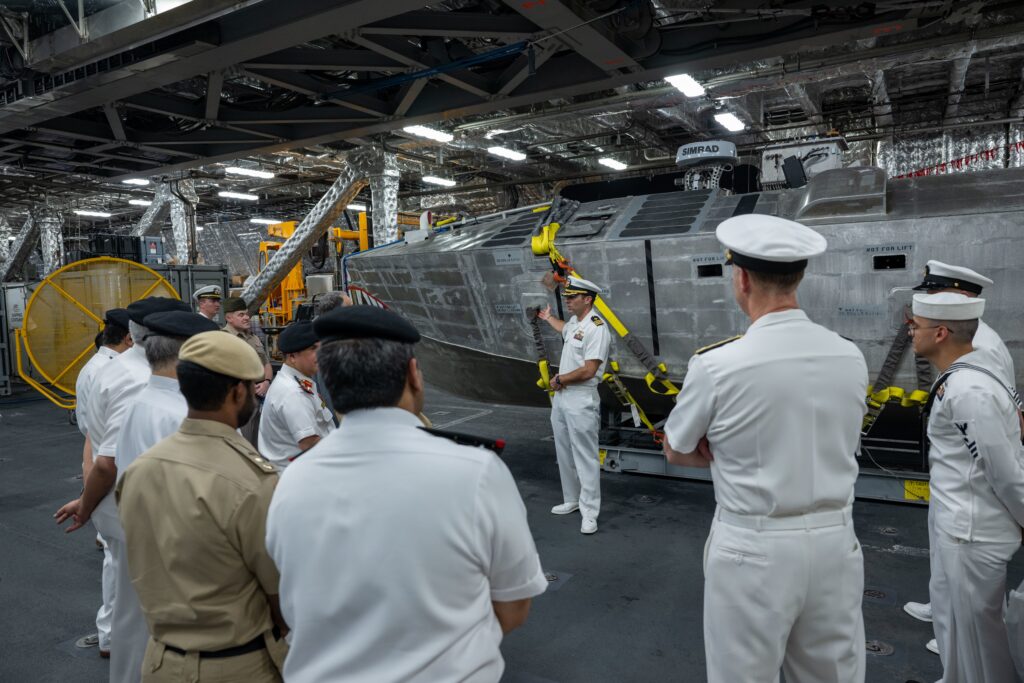
MANAMA, Bahrain (May 26, 2025) Cmdr. Bill Golden, commanding officer of USS Canberra’s (LCS 30) Blue Crew, discusses the mine countermeasures unmanned surface vehicle in the ship’s mission bay to Bahrain Defence Force officials in Manama, Bahrain. Canberra, an Independence variant of LCS, is deployed to the region to maintain regional maritime security in the Middle East region. (Photo by Chief Petty Officer Christopher ) 

From U.S. Naval Forces Central Command Public Affairs, May27, 2025 

MANAMA, Bahrain – The littoral combat ship USS Canberra (LCS 30) arrived at Naval Support Activity Bahrain, May 22, the first of four of the class expected to be stationed in the region. 

The crew hosted a tour of their ship on May 26, welcoming senior Bahraini defense officials, the U.S. ambassador to Bahrain, the honorable Steven Bondy, and commander of U.S. Naval Forces Central Command, Vice Adm. George Wikoff. 

“Today is about showcasing the United States’ continued commitment to maritime regional security in a broader sense, but in a specific sense, the friendship that we enjoy and never take for granted with the Kingdom of Bahrain,” Wikoff said. “We look forward to leveraging all the capabilities that this ship brings as a next-generation platform, working side-by-side with our Bahraini partners enforcing maritime security in the region.” 

The LCS is expected to replace the Avenger-class mine countermeasures ships which have operated forward in the region for decades. 

“Canberra’s arrival in Bahrain signifies our commitment to delivering advanced capabilities to further regional maritime security and maintaining our robust partnership with the Royal Bahrain Naval Force,” said the commanding officer of Canberra’s Blue Crew, Cmdr. Bill Golden. He previously served on a mine countermeasures ship forward deployed to Bahrain, USS Gladiator (MCM 11). “To see the differences between that platform and what Canberra offers is incredible.” 

Canberra is the first LCS to deploy with the mine countermeasures mission package. An integrated suite of unmanned maritime systems and sensors, it is designed to locate, identify, and destroy mines while increasing the ship’s standoff distance from the threat. 

Canberra, on its maiden deployment, is the first Independence-variant of the littoral combat ship to be deployed to the region. The ship left San Diego in March. 

The U.S. 5th Fleet area of operations encompasses nearly 2.5 million square miles of water area and includes the Arabian Gulf, Gulf of Oman, Red Sea, parts of the Indian Ocean and three critical choke points at the Strait of Hormuz, Suez Canal and Bab al-Mandeb.