SAN DIEGO –The Navy deployed two Arleigh Burke-class guided missile destroyers in mid-March to conduct border security objectives in support of the U.S. Northern Command southern border mission: the USS Gravely (DDG 107) to the Gulf of America and the Caribbean, and the USS Stockdale (DDG 106) to the Pacific Ocean. Earlier this summer, the USS Cole (DDG 67) relieved the USS Gravely after 83 days of service to the mission.
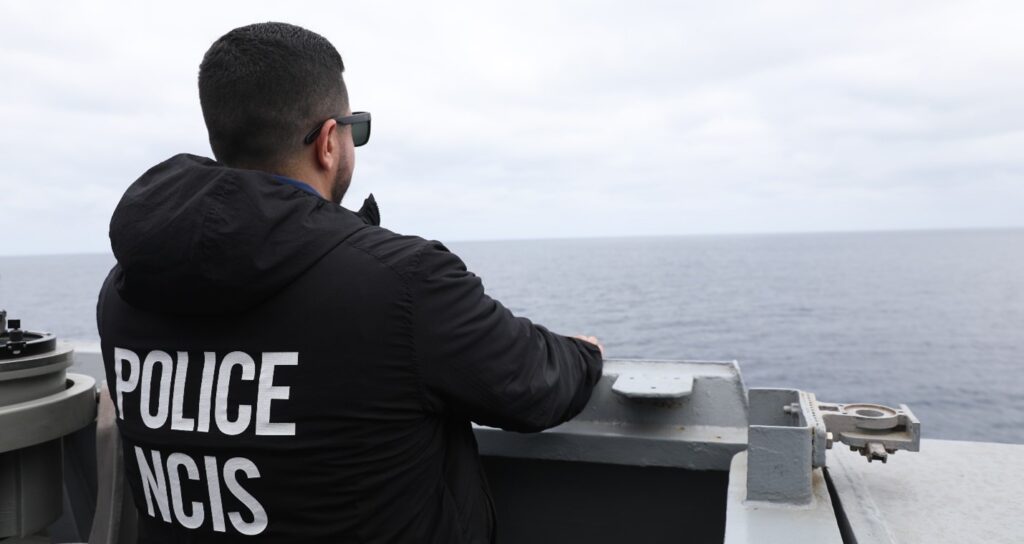
Among the crew onboard these ships have been NCIS Special Agents who provide law enforcement and counterintelligence capabilities related to counternarcotics and combating transnational organized crime.
These Special Agents collaborate with law enforcement and intelligence community partners to synthesize data that enhances Navy leadership’s understanding of the operational environment and increases the probability of successful counternarcotics interdictions.
Such counternarcotics interdictions have included, among others, the seizure of over 6,000 pounds of cocaine by the USS Gravely in May. A subsequent seizure netted over 11,000 pounds of cocaine and 7,200 pounds of marijuana. The USS Cole, partnering with the Royal Canadian Navy, was involved in the seizure of over 540 pounds of cocaine in June.
The ships operate with an embarked U.S. Coast Guard Law Enforcement Detachment (LDET) that, combined with NCIS Special Agents enhance maritime security and support interagency collaboration in the region through presence operations.
These deployments are unique in scope and duration compared to the traditional Special Agent Afloat deployments that NCIS has been conducting aboard U.S. Navy ships since the early 1970s. The Special Agent Afloat program deploys agents for year-long deployments aboard aircraft carriers, hospital ships, and amphibious assault ships. NCIS law enforcement and counterintelligence support to these ships enables the Navy to operate with optimal readiness and lethality to protect the United States and advance its interests globally.
World Shipping Council Condemns New Attacks in the Red Sea
LONDON, July 9, 2025 — “What we’re seeing unfold in the Red Sea is shocking and unacceptable. Seafarers are being killed while simply doing their jobs,” World Shipping Council President & CEO Joe Kramek said today in response to attacks on commercial ships in the Red Sea over the past few days.
“The World Shipping Council extends its deepest condolences to the families of those who have been lost, and our thoughts are with all those affected. These are devastating, deeply felt losses for the global shipping community,” Kramek said.
“We cannot allow attacks on commercial ships to become normalized or weaponized as political tools. The safety of those at sea, and the freedoms and rights of navigation, must be protected. We support the International Maritime Council Secretary-General’s call for dialogue, to ensure the safety of seafarers,” Kramek concluded.
USS George Washington Departs Manila, Continues Indo-Pacific Patrol
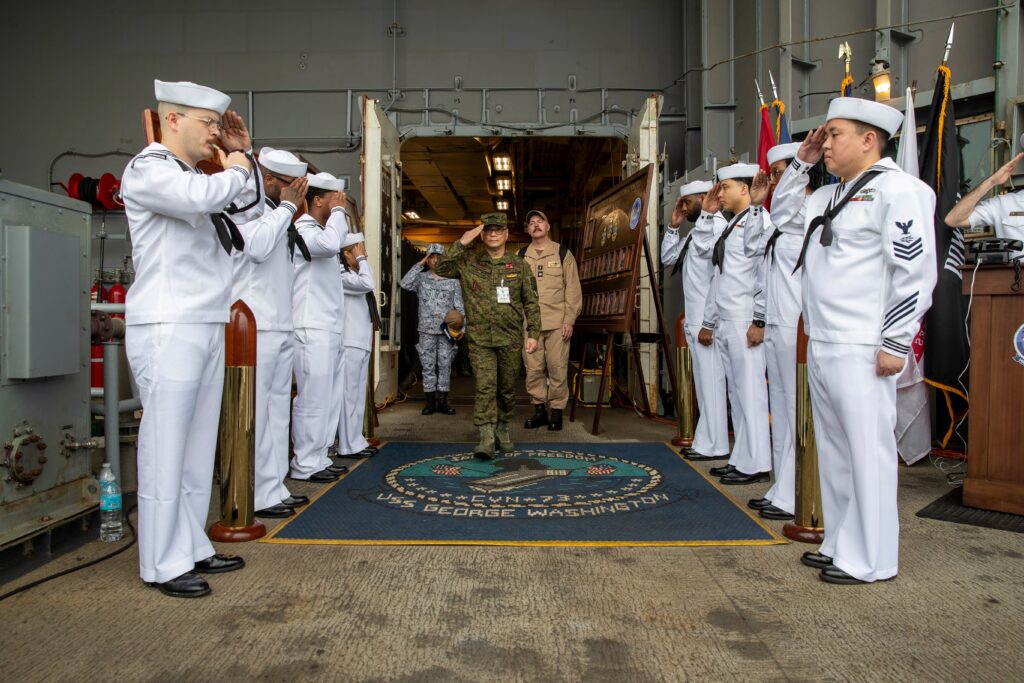
Armed Forces of the Philippines (AFP) Brig. Gen. Daniel D. Tansip, right, Chief of the AFP Chaplain Service, salutes sideboys following a tour aboard Nimitz-class aircraft carrier USS George Washington (CVN 73) while anchored off the coast of the Philippines, July 5, 2025. (U.S. Navy photo by MC2 Lillian Olen)
MANILA, Philippines – Nimitz-class aircraft carrier USS George Washington (CVN 73), the flagship of the USS George Washington Carrier Strike Group (GWA CSG), with Carrier Air Wing (CVW) 5 embarked, departed Manila, Philippines, following a scheduled port visit, July 7, 2025.
George Washington departed anchorage after four scheduled days of port visit in Manila for the crew to enjoy some rest, relaxation, and experience the Philippines with tours, community relations events, and key leader exchanges with allies and partners and members of the Armed Forces of the Philippines.
“These visits are incredibly important engagements with our allies and partners, but what I think we take away from them is the friendships that you make there,” said Capt. Tim Waits, commanding officer, George Washington. “These friendships help strengthen the bonds between our two countries and stress our commitment to shared goals for this region.”
Rear Adm. Eric J. Anduze, Commander, Task Force (CTF) 70/Carrier Strike Group (CSG) 5, visited Vice Admiral Jose M. Ambrosio Q Ezpeleta, Flag Officer in Command, Philippine Navy. The visit demonstrated the U.S. Navy and GWA CSG’s commitment to strengthening our bonds with allies and partners in the Indo-Pacific theater.
“We share with the Republic of the Philippines a strategic vision of a free, peaceful, and prosperous Indo-Pacific,” said Anduze. “Our cooperative activities advance our collective efforts to preserve regional stability.”
George Washington’s Morale, Welfare and Recreation (MWR) team organized tours for the crew, including Manila city tours, sightseeing tours of the Tagaytay Ridge, Pagsanjan falls, Villa Escudero, Puning Hot springs, aquariums and golfing trips. The command religious ministries department also coordinated several community relations events alongside the chaplains of the Armed Forces of the Philippines.
Ticonderoga-class guided-missile cruiser USS Robert Smalls (CG 62) and Arleigh Burke-class guided-missile destroyer USS Shoup (DDG 86) accompanied the George Washington and CVW 5’s departure, continuing a regularly scheduled patrol in the Indo-Pacific region.
CVW-5 consists of various squadrons operating F/A-18E and F/A-18F Super Hornets, F-35C Lightning IIs, E-2D Hawkeyes, CMV-22B Ospreys, EA-18G Growlers, and MH-60R and MH-60S Helicopters.
GWA CSG is on patrol in the U.S. 7th Fleet area of operations. George Washington is the U.S. Navy’s premier forward-deployed aircraft carrier, a long-standing symbol of the United States’ commitment to maintaining a free and open Indo-Pacific region, while operating alongside allies and partners across the U.S. Navy’s largest numbered fleet.
Fairbanks Morse Defense Awarded Contract for FM 175D Engine to Support U.S. Navy’s DDG(X) Program
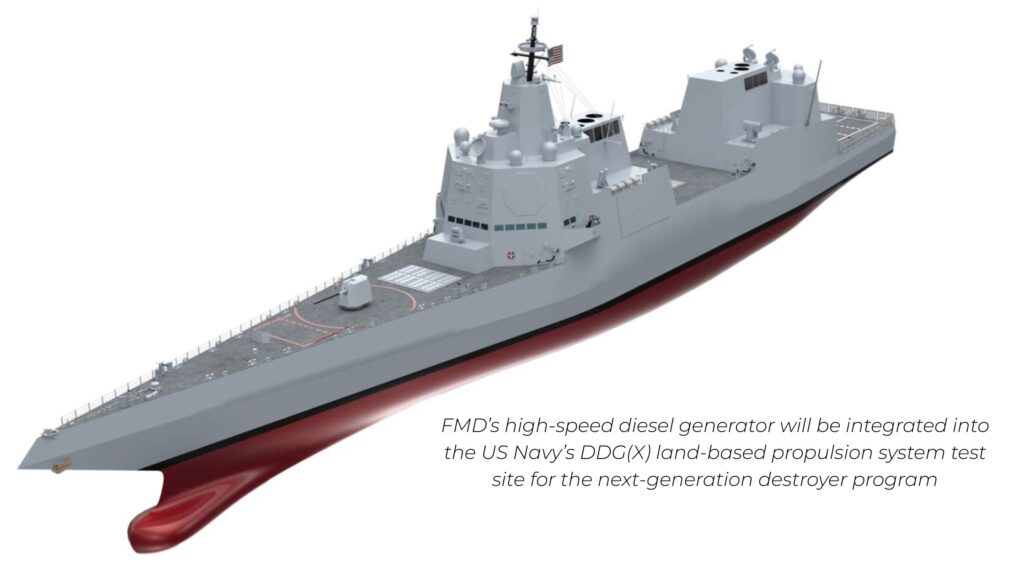
Fairbanks Morse Defense (FMD) has been awarded a contract to provide the U.S. Navy with an FM 175D high-speed diesel generator engine for integration into the DDG(X) land-based propulsion system test site, supporting the U.S. Navy’s goal of reducing design risks as it continues developing the next-generation platform.
“Fairbanks Morse Defense has a long history of delivering mission-critical power and propulsion solutions for the U.S. Navy,” said Mike Clark, Chief Operating Officer of Fairbanks Morse Defense. “The selection of the FM 175D for this important land-based test highlights the superior power density needed on modern surface combatants, ensuring the DDG(X) has the energy needed to operate advanced combat systems while maintaining operational efficiency.”
Designed to succeed the Flight II Ticonderoga-class cruisers and the Flight I/II Arleigh Burke-class destroyers, the platform is currently in the design and feasibility stage, with construction expected to begin in 2032.
As the Navy’s next-generation large surface combatant, DDG(X) will integrate a wider array of advanced systems, demanding unprecedented levels of power generation. The ship is designed with an Integrated Power System (IPS) to generate, convert, and distribute power for ship operations. The DDG(X) electrical plant is expected to deliver more than 75 megawatts of power for standard operations while enabling high-energy equipment, advanced sensors, and enhanced propulsion systems.
The FM 175D propulsion system generator set can produce 3.8 MW of power, which is considered among the best in class for power density. Unlike conventional high-speed engines, the FM 175D delivers significantly greater power while maximizing fuel efficiency, making it an optimal choice to reduce the life cycle costs of the DDG(X) platform. It has a power output range of 1,740 to 4,400 kilowatts and operates at 1,800 to 2,000 RPM.
Fairbanks Morse Defense launched the FM 175D into the United States in 2023 to meet the growing demand for high-density power system solutions in the naval defense industry. As the most power-dense engine available in the U.S. maritime sector, the FM 175D is well-proven in maritime defense and commercial applications worldwide, offering increased electrical output for modern naval operations and combat systems.
The FM 175D is available in 12, 16, or 20-cylinder configurations with a 175mm bore and is capable of driving mechanical propulsion systems or generators for onboard power generation.
Historic First – U.S. Nuclear-Powered Submarine Conducts Port Visit in Iceland
GRUNDARTANGI, Iceland – The Los Angeles-class attack submarine USS Newport News (SSN 750) conducted a port visit in Iceland, marking the first time a nuclear-powered submarine pulls into port on Iceland’s shores, July 9, 2025.
“Today’s port visit is a pivotal moment, underscoring our unwavering commitment to collective defense and Arctic security,” said Adm. Stuart B. Munsch, commander of U.S. Naval Forces Europe-Africa (NAVEUR/NAVAF). “Our submarine forces are advanced and vital to ensuring the security of our nations and our Alliance – patrolling the depths and providing a deterrent in an increasingly complex and contested world.”
USS Newport News’ arrival is a significant step from 2023, when Iceland welcomed the first U.S. nuclear-powered submarine into their waters.
“The United States and Iceland maintain the shared goal of low tension in the Arctic, with full awareness of Russia’s efforts to build its military presence in the region,” said Erin Sawyer, Chargé d’affaires a.i. at the U.S. Embassy in Iceland. “Deep coordination with our incredible NATO ally Iceland to achieve this historic visit demonstrates our commitment to freedom of navigation and the security of our allies in the region.”
The visit not only underscores shared security goals but also showcases the dedication and skill of the U.S. Navy’s submarine force.
“It is an incredible honor for our submarine and crew to make history today with our cherished Ally, Iceland,” said Cmdr. Eric McCay, commanding officer of USS Newport News. “The Sailors on USS Newport News are dedicated, top-performing submariners who are truly excited to be here. In 36 years, this ship has earned 3 Arctic Service Ribbons, a service medal awarded for service performed above the Arctic Circle – a true demonstration of our submarine’s commitment and dedication to safeguarding this region.”
Fast-attack submarines are multi-mission platforms enabling five of the six Navy maritime strategy core capabilities – sea control, power projection, forward presence, maritime security and deterrence. They are designed to excel in anti-submarine warfare, anti-ship warfare, strike warfare, special operations, intelligence, surveillance and reconnaissance, irregular warfare and mine warfare. Fast-attack submarines project power ashore with special operations forces and Tomahawk cruise missiles in the prevention or response to regional crises.
For over 80 years, NAVEUR/NAVAF has forged strategic relationships with Allies and partners, leveraging a foundation of shared values to preserve security and stability. Headquartered in Naples, Italy, NAVEUR/NAVAF operates U.S. naval forces in the U.S. European Command and U.S. Africa Command areas of responsibility.
RTX’s Raytheon demonstrates autonomous capabilities of its Barracuda mine neutralizer
Testing proves maturity as program moves closer to initial operational capability
From RTX
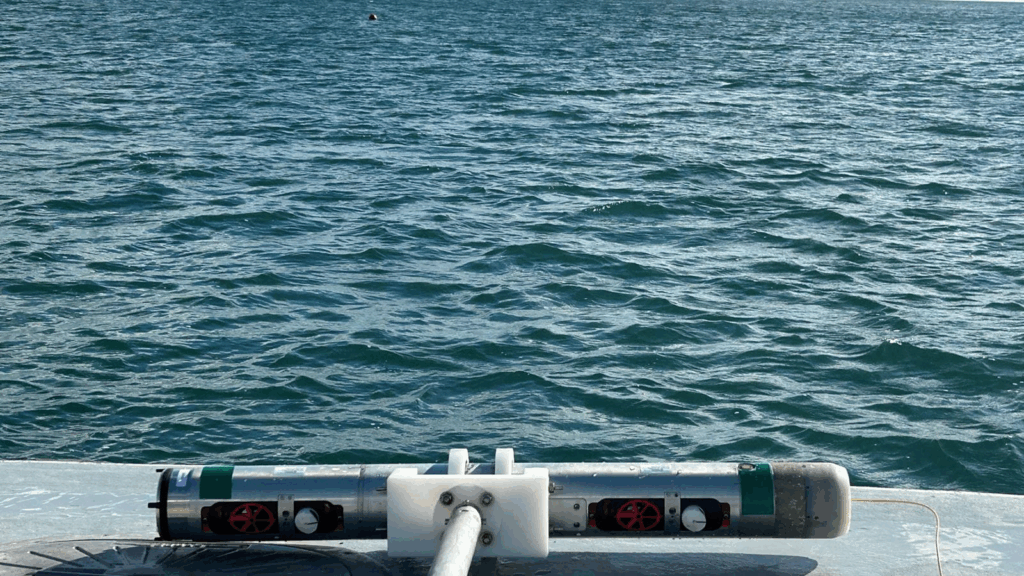
PORTSMOUTH, R.I. (July 8, 2025) — Raytheon, an RTX (NYSE: RTX) business, has successfully demonstrated its Barracuda mine neutralization vehicle in an untethered, semi-autonomous operation for the first time during recent open water testing in Narragansett Bay.
During the demonstration, Raytheon’s Barracuda proved its ability to autonomously navigate, communicate, detect and identify targets, and operate independently underwater.
“This recent testing demonstrates the significant strides we’ve made in advancing mine countermeasure technology,” said Barbara Borgonovi, president of Naval Power at Raytheon. “Barracuda’s capabilities will dramatically improve safety and efficiency for the U.S. Navy, keeping sailors out of harm’s way while effectively addressing underwater threats.”
Barracuda is the newest U.S. Navy program of record for mine neutralization. It is the first untethered, semi-autonomous mine neutralization system capable of tracking and identifying bottom, volume and near-surface mines with man-in-the-loop delivering a final decision for neutralization. The program started in research and development within Raytheon’s Advanced Technology business segment – a group of innovators that matures technologies that are incorporated into Raytheon products including franchise programs such as LTAMDS and SPY-6.
In line with the Navy’s acquisition plan, Raytheon’s Barracuda is on track to achieve initial operational capability and low-rate initial production by 2030.In addition to executing mine neutralization missions, the company is investing in developing a larger and more advanced variant to meet different mission sets such as subsea and seabed warfare.
USS Gabrielle Giffords Arrives in Seattle in Homeport Change
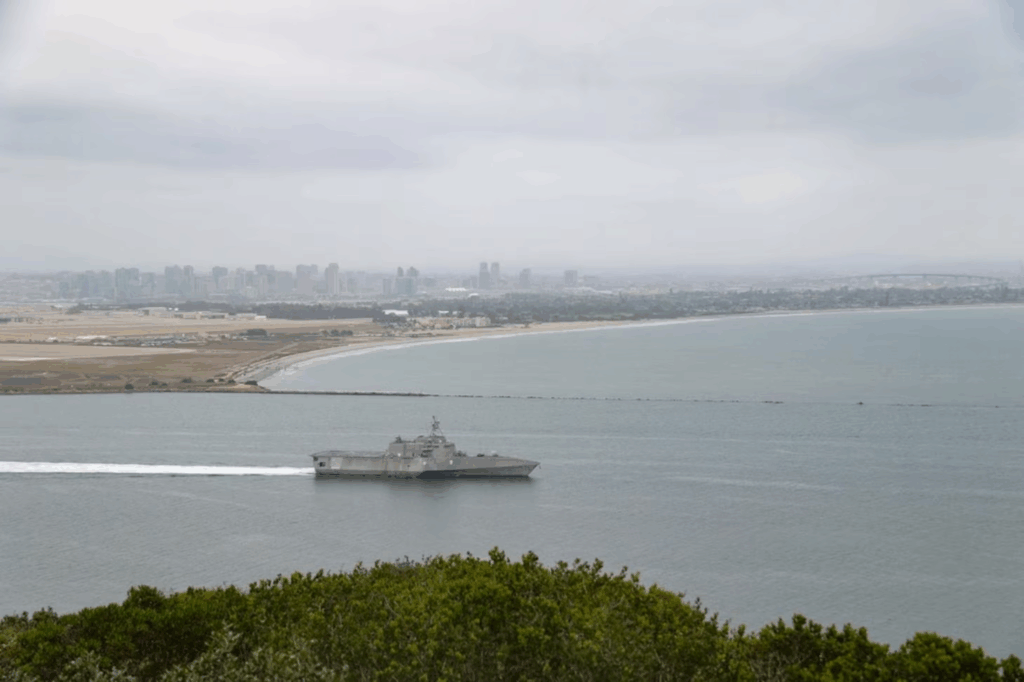
Independence-variant littoral combat ship USS Gabrielle Giffords (LCS 10) transits San Diego Bay past Point Loma, June 23, 2025. The ship recently returned from a deployment to the 7th Fleet area of operations (U.S. Navy photo by Mass Communication Specialist 2nd Class Kassandra Alanis)
From Commander, Naval Surface Force, U.S. Pacific Fleet, June 28, 2025
SEATTLE – The Independence-variant littoral combat ship USS Gabrielle Giffords (LCS 10) departed Naval Base San Diego June 23 and arrived at its new homeport of Seattle June 28, following an 18-month rotational deployment to the U.S. 7th Fleet area of operations.
While on deployment, the Gabrielle Giffords conducted presence operations and engagements with allies and partners throughout the region to maintain a secure and prosperous Indo-Pacific.
“Gabrielle Giffords has arrived safely in Washington, and we are grateful for a welcoming community.” said Capt. Jose Roman, commodore, Littoral Combat Ship Squadron One.
In the early months of 2024, the Gabrielle Giffords conducted operations with the Philippine Navy offshore patrol vessel BRP Gregorio del Pilar (PS 15) in the South China Sea. The Gabrielle Giffords, while part of Destroyer Squadron 7 in the U.S. 7th Fleet area of operations, increased interoperability with allies and partners and served as a ready-response force in support of a free and open Indo-Pacific region.
The Gabrielle Giffords participated in CARAT Thailand 2024 alongside the Royal Thai Navy and the Republic of Singapore Navy. CARAT, in its 30th iteration, promoted regional security cooperation, maintained and strengthened maritime partnerships, and enhanced maritime interoperability. It included anti-submarine warfare training, air defense exercises, and surface action group coordination.
The Gabrielle Giffords has both a Blue crew and a Gold crew, which alternate being “on-hull” aboard the ship and “off-hull” conducting training in San Diego. The ship successfully sustained a longer-than-usual deployment because of the hard work of both crews.
Littoral combat ships (LCS) are fast, optimally manned, mission-tailored surface combatants that operate in near-shore and open-ocean environments, deterring 21st-century threats. LCS integrate with joint, combined, manned, and unmanned teams to support forward presence, maritime security, sea control, and deterrence missions around the globe.
For more news from Commander, Littoral Combat Ship Squadron 1, visit https://www.surfpac.navy.mil/comlcsron1/ or follow on Facebook at www.facebook.com/COMLCSRONONE/
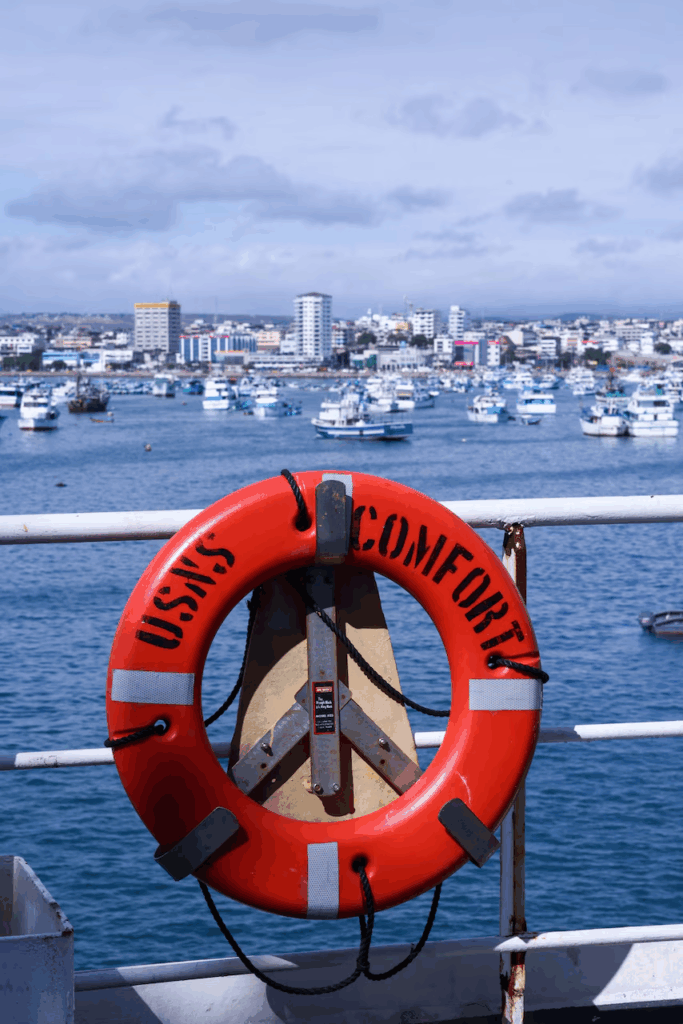
The Mercy-class hospital ship USNS Comfort (T-AH 20) arrived in Manta, Ecuador for the third mission stop of Continuing Promise 2025 (CP 25), July 4, 2025.
“We look forward to building upon our relationship with Ecuador through medical care and exchanges, community relations events, and experiencing the vibrant culture of Manta,” said Capt. Ryan Kendall, commodore, Destroyer Squadron 40 and CP 25 mission commander. “Our combined efforts to enhance readiness and strengthen our partnership will lead to a safer, more secure region.”
This visit marks the fifth Continuing Promise visit to Ecuador, as well as the fifth visit aboard Comfort. While in Ecuador, Comfort team will conduct direct patient medical care aboard Comfort and at various medical sites throughout the region. Services provided in conjunction with medical representatives from Ecuador will include general medicine, dentistry, optometry, ophthalmology, pediatric care, internal medicine, women’s health, cardiology, dermatology, physiotherapy, and various subject matter expert exchanges focused on humanitarian aid and disaster relief.
“We are pleased to welcome the USNS Comfort to Ecuador,” said Mr. Lawrence Petroni, Chargé d’Affaires, U.S. Embassy in Ecuador. “This ship’s visit to Manabí exemplifies the United States’ enduring partnership with Ecuador and our comprehensive approach to security cooperation. Beyond delivering essential medical care, the mission will fortify communities by supporting local programs that steer youth away from organized crime through service, education, and health initiatives. These efforts reinforce our shared commitment to lasting regional stability.”
In addition to medical and dental care, veterinarians from the U.S. Army 248th Medical Detachment Veterinary Service Support will conduct canine tactical combat care seminars as well as a cattle ranching symposium.
The Comfort team will also participate in community relations projects including beautification of Verdi Cevallos Hospital and Gil Pinto School, beach cleanups, and soccer and volleyball games to build camaraderie beyond the scope of medical aid.
“Being able to bring Sailors to experience these foreign interactions helps strengthen our team aboard the Comfort,” said Religious Program Specialist Seaman Apprentice Julian Ventura. “I hope these engagements that help foreign communities also help our Sailors find their purpose as we build relationships during Continuing Promise.”
Ventura shares a similar outlook to Steel Worker 2nd Class Jonas Bresette, who is assigned to Comfort from Naval Mobile Construction Battalion (NMCB) 11. NMCB 11’s, also known as Seabees, mission is focused on construction and engineering to support military operations and disaster relief efforts worldwide.
“After our recent work in Panama, the shift of dynamic will be focused on more hands-on training with our Ecuadorian counterparts, in addition to working alongside them,” said Bresette,
the detachment safety supervisor for NMCB 11. “I’m very excited to be able to explore the native culture and experience the city of Manta.”
In Ecuador, the Seabees plans to complete engineering and utilities projects at the Escuela Republica Del Ecuador and Unidad Educativa El Porvenir schools in Manta.
CP25 marks the 16th mission to the region since 2007 and the eighth aboard Comfort. The mission will foster goodwill, strengthen existing partnerships with partner nations, and encourage the establishment of new partnerships among countries, non-federal entities, and international organizations.
CP is committed to assisting host nation efforts to provide vital medical care in the South American region that have limited access and promoting independence in case of medical disasters and emergencies through subject matter expect exchanges.
U.S. Naval Forces Southern Command/U.S. 4th Fleet supports U.S. Southern Command’s joint and combined military operations by employing maritime forces in cooperative maritime security operations to maintain access, enhance interoperability, and build enduring partnerships in order to enhance regional security and promote peace, stability and prosperity in the Caribbean, Central and South American region.
Learn more about USNAVSOUTH/4th Fleet news and photos, visit facebook.com/NAVSOUS4THFLT, https://www.fourthfleet.navy.mil/, X – @ NAVSOUS4THFLT, and https://www.linkedin.com/company/u-s-naval-forces-southern-command-u-s-4th-fleet
Delaware Returns Home from Deployment
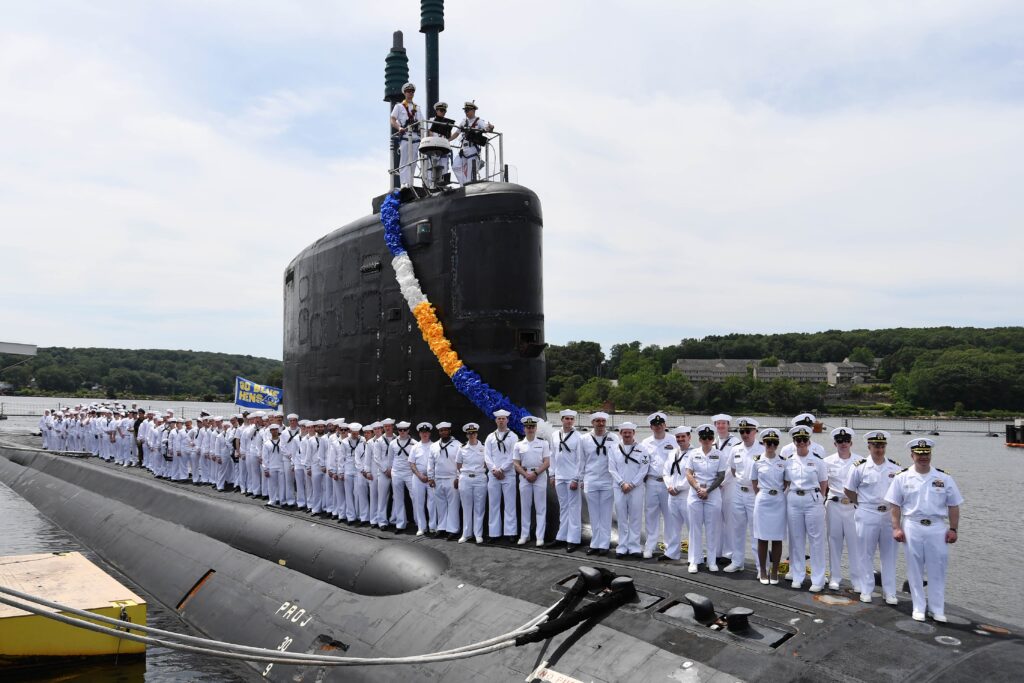
NAVAL SUBMARINE BASE NEW LONDON, Conn. (July 5, 2025) The crew of the Virginia-class fast-attack submarine USS Delaware (SSN 791) gathers top-side for a command photo as the boat returns to Naval Submarine Base New London, Conn., July 5, 2025, following a six-month deployment to the U.S. European Command area of responsibility. (U.S. Navy photo by MCC Darren M. Moore)
GROTON, Connecticut – The Virginia-class fast-attack submarine USS Delaware (SSN 791), under the command of Cmdr. Jason Patton, returned to Naval Submarine Base New London Saturday, July 5, completing a six-month deployment to U.S. European Command area of responsibility.
Cmdr. Jason Patton praised his crew and their commitment to projecting power across the globe.
“The crew of USS Delaware is a group of outstanding professional submariners,” said Patton, from Laramie, Wyoming. “We were deployed for 205 days and we spent 194 of those at sea accomplishing our nation’s tasking. That wouldn’t have been possible without teamwork, dedication, and tenacity from every Sailor onboard. I’m extremely proud of their accomplishments and lucky to be a part of such a great crew.”
Patton also credited the crew’s accomplishments to those who were not underway with them.
“I would be remiss for mentioning the crew’s accomplishments without acknowledging the world class support from our loved ones back home,” Patton said. “While we battled the rough seas and cold they fought through countless home emergencies, car problems, and parenting moments. We are grateful for their steadfast resolve and are ecstatic to be home with them again.”
Delaware steamed more than 42,000 nautical miles and made port calls to Haakonsvern, Norway.
During its deployment, Delaware completed the first-ever forward deployed submarine torpedo tube launch and recovery of a Yellow Moray (REMUS 600) unmanned underwater vehicle (UUV). The integration of robotic and autonomous systems is expected to enhance operational flexibility and capabilities of future submarine missions, providing the ability to extend reach at both shallower and deeper depths than a manned submarine can access.
Fifty-four personnel earned their submarine warfare devices – commonly referred to as “dolphins” – during the deployment and two Delaware Sailors had new babies.
Sonar Technician (Submarine) 3rd Class Landon Nichols, from Summerville, South Carolina, and his wife, Anna Nichols, were honored with the ceremonial first kiss on the pier.
Chief Electronics Technician (Nuclear) Douglas Ames, from Sudan, Texas, was awarded the ceremonial first hug with his wife, Jessica Ames.
Commissioned April 4, 2020, Delaware is the 18th Virginia-class attack submarine and is the seventh U.S. warship named after the first state of Delaware. Due to COVID -19 restrictions at the time, the official commissioning date was April 2, 2020, while the boat was underway, making it the first U.S. naval warship to be commissioned while submerged. It has a length of 377 feet with a beam of 34 feet and can operate at more than 25 knots submerged.
The Virginia-class of nuclear-powered fast attack submarines are designed for a broad spectrum of open-ocean and littoral missions. Fast-attack submarines are multi-mission platforms enabling five of the six Navy maritime strategy core capabilities – sea control, power projection, forward presence, maritime security and deterrence. They are designed to excel in anti-submarine warfare, anti-ship warfare, strike warfare, special operations, intelligence, surveillance and reconnaissance, irregular warfare and mine warfare. Fast-attack submarines project power ashore with special operations forces and Tomahawk cruise missiles in the prevention or response to regional crises.
Mobile Diving and Salvage Unit 2 Disestablished; Explosive Ordnance Disposal Mobile Unit 10 Established
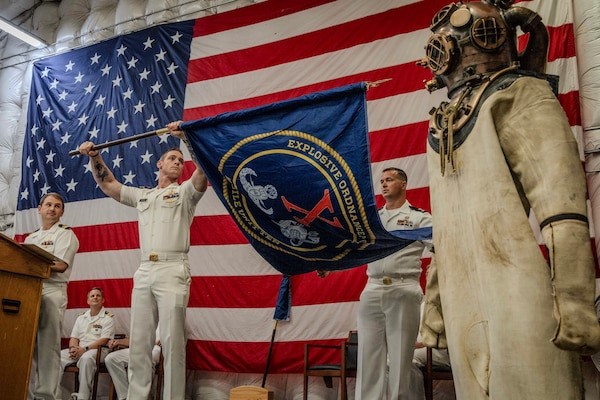
VIRGINIA BEACH, Va. — Cmdr. Garret Pankow, commanding officer of Mobile Diving and Salvage Unit (MDSU) 2, changes command with Cmdr. Jonathon Maurus, as he assumes command of Explosive Ordnance Disposal Mobile Unit (EODMU) 10 during a ceremony at Joint Expeditionary Base Little Creek-Fort Story, July 3, 2025. During the ceremony MDSU-2 was disestablished and EODMU-10 established, combining their warfighting capabilities. EODMU-10 is a subordinate command of Explosive Ordnace Disposal Group 2 and operates as part of Navy Expeditionary Combat Force providing skilled, capable, and combat-ready deployable Navy EOD and Navy Diver forces around the globe to support a range of operations. (U.S. Navy photo by Mass Communication Specialist 2nd Class Jackson Adkins)
From Lt.j.g. Martin Carey, July 3, 2025
VIRGINIA BEACH, Va. – The U.S. Navy marked the end of an era and the beginning of a new chapter during a ceremony July 3, as Mobile Diving and Salvage Unit (MDSU) 2 was formally disestablished and Explosive Ordnance Disposal Mobile Unit (EOD) 10 was established aboard Joint Expeditionary Base Little Creek-Fort Story.
The ceremony, attended by families, shipmates, and distinguished guests, celebrated the legacy of MDSU-2 – a unit synonymous with diving, salvage, and undersea response excellence – and welcomed the future of integrated expeditionary operations under EODMU-10.
Established in 1982, MDSU-2 was a cornerstone of U.S. Navy diving and salvage capability. Over the decades, its Sailors supported numerous historic and high-profile operations, including the 1986 recovery of Space Shuttle Challenger, the salvage of TWA Flight 800 in 1996 and Swiss Air Flight 111 in 1998, and the recovery of Space Shuttle Columbia in 2003.
Divers and EOD technicians from MDSU-2 also played critical roles in complex salvage operations around the globe, including the 1994 Eritrea Africa ship salvage, the 1999 USS Cole (DDG 67) recovery, and the multi-year recovery project of USS Monitor, a Civil War ironclad warship. The unit supported humanitarian assistance responses for Hurricane Katrina and Hurricane Sandy and led pioneering efforts in Arctic diving during Operation Nanook in 2010.
Commander Garrett Pankow took to the podium to deliver his final message as the commanding officer of MDSU-2.
“Today is bittersweet,” said Pankow. “We’re not only executing a time-honored transfer of command but also retiring a combat salvage unit with a legacy that spans the globe, and establishing a new EOD mobile unit. For half a century, MDSU-2 Salvors have operated with character and competency – from the Arctic Circle to the depths of the Red Sea.” He continued, “It has been the honor of my career to be the skipper of MDSU-2. The spirit and capability of MDSU-2 carries forward into EODMU-10, and all East Coast EOD mobile units, as we combine EOD and Salvage warriors at EOD mobile units; ready to support the fleet, anytime, anywhere.”
Commander Jonathon Maurus, from Dearborn, MI, will be the first commanding officer of EODMU-10.
“I am extremely honored and humbled to take the helm from Commander Pankow during this historic transition – while we close the chapter on MDSU-2, we carry forward its proud legacy as we stand up EOD Mobile Unit-10, ready to meet the Navy’s evolving mission with the same tenacity and excellence.”
Rear Adm. Brad Andros, Commander, Navy Expeditionary Combat Command, served as the ceremony’s guest speaker and stressed the significance of the redesign of the mobile diving and salvage force.
“The transition from MDSU-2 to EOD Mobile Unit-10 is not a loss – it is a consolidation of excellence,” said Andros. “This force redesign brings the full spectrum of EOD and MDSU capabilities under one commander, one unified command – bringing together our teams, our chief’s mess, our wardrooms. Our expeditionary forces must be ready for a future fight. We can no longer look at our niche capabilities as we did 10 or 20 years ago…our Navy Expeditionary Combat Forces will be needed for our full repertoire, full capability and full capacity.”
The establishment of EODMU-10 reflects a greater NECC effort to ensure readiness for the future fight and a deliberate approach to build a more sustainable and agile force. The unit will continue to leverage diving and salvage expertise while aligning under the broader Explosive Ordnance Disposal Group 2 enterprise.
As a critical component of the Navy Expeditionary Combat Force, Navy EOD forces clear explosive hazards to provide access to denied areas; they employ advanced tactics and technologies to exploit and secure the undersea domain for freedom of maneuver; they build and foster relationships with a constellation of capable and trusted partners; and they protect the homeland and our American way of life.