Fleet Master Chief John Perryman Selected as 17th Master Chief Petty Officer of the Navy
From the U.S. Navy Office of Information, Aug. 15, 2025
WASHINGTON — The Navy has announced the selection of Fleet Master Chief John Perryman as the 17th Master Chief Petty Officer of the Navy (MCPON).
Perryman, who currently serves as the senior enlisted leader for U.S. Fleet Forces Command, will relieve MCPON James Honea during a change of office ceremony scheduled for September at the Navy Memorial.
With decades of operational experience across the fleet, Perryman will play a vital role in advising Navy leadership, shaping enlisted policy, and maintaining warfighting readiness in an era of strategic competition.
Perryman enlisted in 1994 and rose through the ranks as an electronics technician submariner. His sea tours include USS Bremerton (SSN 698), USS Dolphin (AGSS 555), and USS Cheyenne (SSN 773). He served as command master chief aboard USS Hawaii (SSN 776) and at multiple flag-level commands, including Commander, Submarine Force U.S. Pacific Fleet; Commander, Submarine Group Seven; Commander, Submarine Force Atlantic; and U.S. Strategic Command.
UNITAS 2025 To Be Held Across Multiple Locations Along the East Coast of United States
MAYPORT, Fl. (Dec 18, 2024) – Depicted is the U.S. Navy’s UNITAS 2025 logo. (U.S. Navy graphic by Ens. Paul Archer)
From USNAVSOUTH/4TH Fleet Public Affairs, Aug. 14, 2025
MAYPORT, Fla. – U.S. Navy and Marine Corps, and participating nation forces are set to arrive at Naval Station Mayport, Fla., in support of UNITAS 2025 (66) the world’s longest-running multinational maritime exercise, scheduled to start September 15, 2025.
The U.S. Navy will host this year’s UNITAS featuring approximately 8,000 personnel from 25 allied and partner nations, including multiple ships, submarines, and aircraft (fixed wing and rotary). Forces will conduct operations off the East Coast of the United States and ashore in the vicinity of Naval Station Mayport, Fla., Marine Corps Base Camp Lejeune, N.C., and Naval Station Norfolk, Va. through October 6.
UNITAS, which is Latin for unity, united, or oneness, was conceived in 1959 when representatives at the first Inter-American Naval Conference in Panama agreed to conduct an annual maritime exercise with one another. The first UNITAS took place in 1960 with forces from Argentina, Brazil, Chile, Colombia, Ecuador, Peru, Uruguay, the United States, and Venezuela. This year marks the 66th iteration of the world’s longest-running annual multinational maritime exercise.
Including the United States, UNITAS 2025 will bring together 26 nations from all over the world to train forces in joint maritime operations that enhance tactical proficiency and increase interoperability. Participating nations include Argentina, Belize, Brazil, Canada, Chile, Colombia, Dominican Republic, Ecuador, El Salvador, France, Germany, Greece, Guatemala, Honduras, Italy, Mexico, Morocco, Netherlands, Jamaica, Japan, Panama, Paraguay, Peru, Singapore, Spain, and the United States
“In line with the Secretary’s guidance, and to bolster defense of the homeland and build on over six decades of success, UNITAS 2025 is a vital opportunity to demonstrate how our partners in the region work together to defend against hemispheric threats,” said Rear Adm. Carlos Sardiello, commander of U.S. Naval Forces Southern Command/U.S. 4th Fleet and commander, Task Force 138. “By bringing together 25 nations, we’re not just enhancing tactical proficiency and interoperability, we are demonstrating a prime example of regional burden-sharing; we’re reinforcing trust and unity crucial for ensuring we stand side by side against hemispheric threats.”
Following the UNITAS 2025 Opening Ceremony on September 15, the in-port phase of the exercise will feature subject matter expert exchanges, professional symposiums, ship rider exchanges, and operations meetings. During this time, Marines and Sailors will conduct training events in Mayport to include medical, cyber defense, and diving and salvage operations.
During the UNITAS 2025 Underway Phase, forces will participate in events testing all warfare operations, to include live-fire exercises such as a SINKEX, an amphibious ship-to-shore landing and force withdrawal in Camp Lejeune, North Carolina.
Additionally, unmanned and hybrid fleet systems will return to UNITAS for a second year as part of the testing and development of the U.S. Navy’s future hybrid fleet.
U.S. forces participating in UNITAS 2025 include the U.S. Navy’s Carrier Strike Group 2, Carrier Strike Group 4, Commander, Patrol and Reconnaissance Wing 11, Destroyer Squadron 40, Explosive Ordnance Disposal Mobile Unit 6, Expeditionary Strike Group 2, Helicopter Maritime Strike Squadron 48, SEAL Team 8, Special Boat Team 20, Theater Support Vessel 1 Prevail, Theater Support Vessel 4 Narragansett, Theater Support Vessel 5 Vindicator, USNS Leroy Grumman (T-AO-195), USS Arlington (LPD 24), USS Cooperstown (LCS 23), USS Harry S Truman (CVN 75), USS Oregon (SSN 793), USS Thomas Hudner (DDG 116), and Air Test and Evaluation Squadron 20. Marine Corps forces include the 2nd Marine Aircraft Wing; 2nd Marine Division; 2nd Marine Logistics Group, including Combat Logistics Battalion 22; the 26th Marine Expeditionary Unit Command Element; 4th Marine Division; B Company, 4th Light Armored Reconnaissance Battalion; Force Headquarters Group Augments; Marine Light Attack Helicopter Squadron 269; II Marine Expeditionary Force; II Marine Expeditionary Force Information Group; K Company (-), 3rd Battalion 23rd Marine Regiment; Littoral Craft Company D, 4th Amphibian Assault Battalion; Marine Air Control Group 28; Marine Forces Reserve; Marine Fighter Attack Squadron 251; Marine Fighter Attack Squadron 542; and Marine Wing Communications Squadron 48. The U.S. Coast Guard is represented by the Tactical Law Enforcement Team and a U.S. Coast Guard Maritime Security Response Team. U.S. Air Force units involved include Air Force Special Operations Command and the 107th Fighter Squadron. Exercises like UNITAS play a critical role in enhancing the combat readiness of U.S. service members, as well as those of our Allies and partners, by providing a platform for joint training and cooperation in complex maritime environments.
Following the successful completion of UNITAS 2025, senior leaders from participating countries will join in a series of high-profile events along the East Coast, celebrating a historic milestone: the United States Navy 250th birthday. This commemoration honors a legacy of protecting American interests, deterring aggression, and promoting prosperity and security, while also showcasing the Navy’s enduring commitment to defending the American way of life.
U.S. Naval Forces Southern Command/U.S. 4th Fleet is the trusted maritime partner for Caribbean, Central and South America maritime forces leading to improved unity, security and stability.
For more USNAVSOUTH/4th Fleet news and photos, visit facebook.com/NAVSOUS4THFLT, https://www.fourthfleet.navy.mil/, X – @ NAVSOUS4THFLT, and https://www.linkedin.com/company/u-s-naval-forces-southern-command-u-s-4th-fleet
Assistant Secretary of the Navy Visits MSC Ship
From Military Sealift Command, Aug. 13, 2025
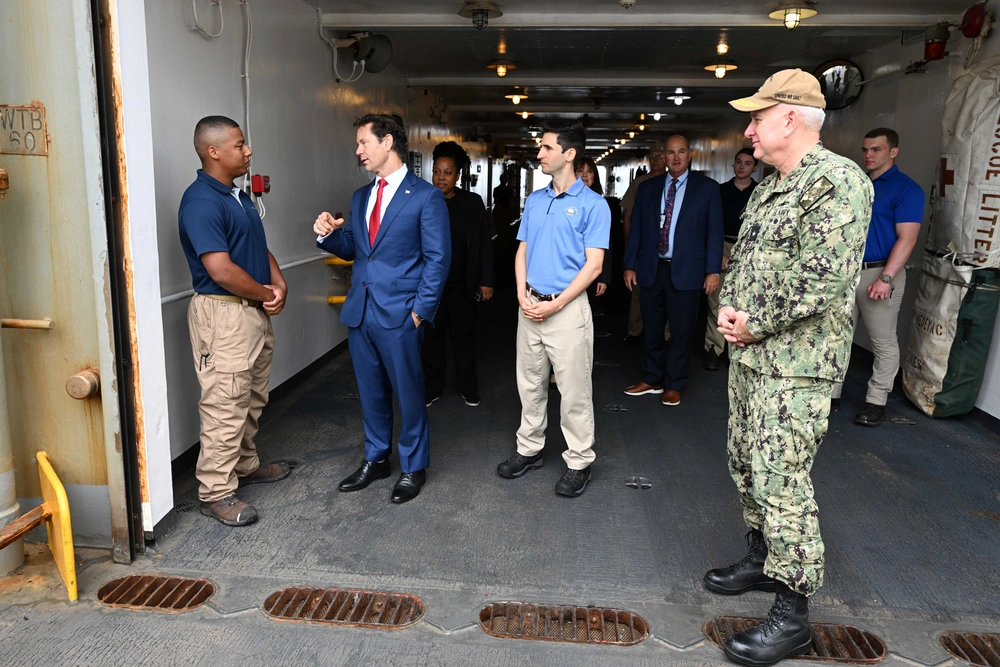
Assistant Secretary of the Navy (Manpower and Reserve Affairs), Mr. C Scott Duncan (second from left) addresses the crew of USNS Patuxent (T-AO 201) during a ship tour, aboard the ship Aug. 13, 2025. (U.S. Navy photo by Brian Suriani)
DARPA Christens Unmanned Ship Aimed at Revolutionizing Naval Capability
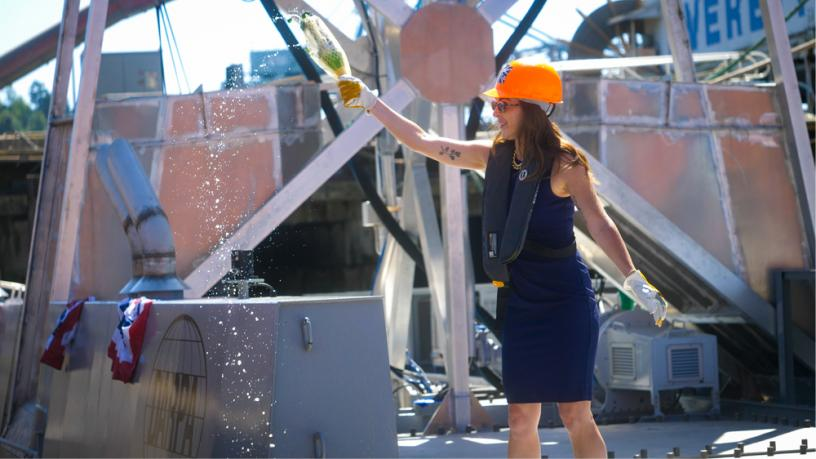
Ship sponsor Mattie Hanley follows naval tradition by breaking a bottle of spirits on the side of the USX-1 Defiant during the official christening ceremony in Everett, Wash., on Aug. 11, 2025. (DARPA photo by Spencer Bruttig)
Defiant demonstrates path to accelerate US shipbuilding and strengthen naval fleet
From Defense Advanced Research Projects Agency, Aug 11, 2025
DARPA has marked a traditional naval milestone with the christening of USX-1 Defiant, a first-of-its-kind autonomous, unmanned surface vessel designed from the ground up to never accommodate a human aboard. The ceremony took place Monday, Aug. 11, at Everett Ship Repair in Everett, Washington.
The demonstrator for the No Manning Required Ship (NOMARS) program, the Defiant, has a simplified hull design to allow rapid production and maintenance in nearly any port facility or Tier III shipyard that traditionally supports yacht, tug, and workboat customers.
The 180 foot-long, 240-metric-ton lightship is completing final systems testing in preparation for an extended at-sea demonstration of reliability and endurance.
“Defiant is a tough little ship and defies the idea that we cannot make a ship that can operate in the challenging environment of the open ocean without people to operate her,” said NOMARS Program Manager Greg Avicola, during the ceremony. “While relatively small, Defiant is designed for extended voyages in the open ocean, can handle operations in sea state 5 with no degradation and survive much higher seas, continuing operations once the storm passes. She’s no wider than she must be to fit the largest piece of hardware and we have no human passageways to worry about.”
The NOMARS program leapfrogs conventional thinking about unmanned ships, with a goal to minimize the need for “optionally manned” vessels and safely demonstrate the reliability and capability of fully unmanned systems to strengthen the nation’s defense industrial base.
“Defiant class vessels provide cost-effective, survivable, manufacturable, maintainable, long-range, autonomous, and distributed platforms, which will create future naval lethality, sensing, and logistics,” said DARPA Director Stephen Winchell. “Defiant will protect and expand the capabilities of manned ships, multiply combat power at low cost, and unlock new American maritime industrial capacity.”
After completing the at-sea demonstration, Defiant will be turned over to the U.S. Navy’s Unmanned Maritime Systems Program Office (PMS 406). DARPA is working closely with the Navy to identify a pathway to ensure capabilities and technologies demonstrated throughout the NOMARS program are accessible for rapid transition and integration, are scalable, and support international defense partnerships.
In the reconciliation bill, which passed in July of this year, Congress appropriated $2.1 billion “for development, procurement, and integration of purpose-built medium unmanned surface vessels.” Upon transition to PMS 406, Defiant will be the Navy’s first solely autonomous (vs. hybrid manned-unmanned) MUSV.
Expedition Reveals Thirteen Shipwrecks from WWII Battles off Guadalcanal
From Clifford Davis, Naval History and Heritage Command, Aug. 12, 2025
HONIARA, Solomon Islands — A multinational expedition led by the Ocean Exploration Trust aboard the Exploration Vessel (E/V) Nautilus has completed a groundbreaking archaeological survey of more than a dozen World War II era shipwrecks in Iron Bottom Sound, August 1, 2025.
During the 22-day mission, which included the visual identification of multiple historically significant vessels, the team surveyed 13 wreck sites, including four ships documented for the first time. Among the newly identified wrecks are the bow of the heavy cruiser USS New Orleans (CA 32) and the Imperial Japanese destroyer Teruzuki, both lost during intense naval battles in the Guadalcanal campaign.
Other vessels surveyed in high resolution include:
USS Vincennes (CA 44)
USS Astoria (CA 34)
USS Quincy (CA 39)
USS Northampton (CA 26)
USS Laffey (DD 459)
USS DeHaven (DD 469)
USS Preston (DD 379)
USS Walke (DD 416)
HMAS Canberra (D33)
Imperial Japanese Navy destroyer Yudachi
and an unidentified landing barge.
“It was wonderful to return to Iron Bottom Sound, where we discovered Japanese, Australian, and American warships over 34 years ago,” said Dr. Robert Ballard, President of Ocean Exploration Trust. “This expedition was special, allowing us to film these sites in a manner not possible back then, as well as document other ships, while at the same time sharing our work live to the entire world.”
The surveys were conducted using advanced underwater robotic systems, including remotely operated vehicles (ROVs) deployed from Nautilus, and an uncrewed surface vehicle (USV), DriX, operated remotely from a shore-based station in Honiara. The DriX system, developed by the University of New Hampshire, mapped over 1,000 square kilometers of seafloor, producing the highest-resolution maps of Iron Bottom Sound to date and identifying dozens of potential targets.
“The use of our uncrewed vessel allowed a tremendous increase in exploration efficiency as we were able to continuously map and identify potential targets while the Nautilus was deploying its ROVs,” said Dr. Larry Mayer, Director, Center for Coastal and Ocean Mapping at the University of New Hampshire. “This technological achievement, combined with the tremendous historical significance of our discoveries, made this one of the most rewarding missions I have ever participated in.”
Iron Bottom Sound, situated between Guadalcanal, Savo, and Nggela Islands, was the site of five major naval battles between August and December 1942. More than 111 vessels and 1,450 aircraft were lost during the campaign, with over 20,000 lives lost. Dozens of wrecks still remain undiscovered.
“NOAA Ocean Exploration is dedicated to increasing our understanding of the deep ocean through scientific discovery, technological advancements, and data delivery,” said Captain William Mowitt, NOAA Corps, acting director of NOAA Ocean Exploration. “This expedition highlights the importance of such cutting-edge technologies and the strong partnership component of the Ocean Exploration Cooperative Institute in not only making discoveries that advance science and resource management, but also engaging and educating the public on the wonders of what lies in our ocean depths.”
The expedition streamed over 138 hours of ROV dives live via NautilusLive.org, bringing real-time exploration to millions of viewers worldwide, including veterans, descendants, and historians. Using telepresence technology, more than 130 experts from the United States, Japan, Australia, New Zealand, and other nations contributed remote analysis and historical interpretation during operations.
“This expedition was a great opportunity to remember the valor and sacrifices of sailors who fought with extreme tenacity and skill, on both sides. Sailors don’t start wars, but they do what their governments ask, and in the waters of Iron Bottom Sound, they did their duty to the fullest. Yet, the end result of that terrible war brought not only freedom for the United States and Allies, but for Japan as well,” said Samuel J. Cox, Director, Naval History and Heritage Command, U.S. Navy Rear Admiral (retired). “This survey of the ships of the United States, Australia, and Japan will add immeasurably to the understanding of one of the most costly naval campaigns in history, a campaign that hopefully will never be repeated.”
“As we commemorate the 250th anniversary of the United States Navy, it is altogether fitting that we explore the wrecks of Iron Bottom Sound,” said Frank Thompson, Director of the Naval History and Heritage Command’s Collection Management Division, who represented the Navy aboard E/V Nautilus. “The battles in these waters cost the United States Navy dearly. Those that made the ultimate sacrifice for their country may lay far from home, but they are not, and never will be, forgotten”
This effort was made possible through collaboration with numerous organizations, including Ocean Exploration Trust; NOAA Ocean Exploration; U.S. Naval History and Heritage Command; the Solomon Islands government; the University of New Hampshire Center for Coastal and Ocean Mapping; University of Rhode Island; Solomon Islands National Museum; Kyoto University; Tokai University; the Defense POW/MIA Accounting Agency; Air/Sea Heritage Foundation; Major Projects Foundation; and the Royal Australian Navy Sea Power Centre.
The Government of the Solomon Islands issued the marine research permit through its Ministry of Education and Human Resources Development.
“The vast majority of our ocean lies in very deep waters that we know virtually nothing about,” said Dr. Daniel Wagner, Chief Scientist, OET. “These deep-sea explorations highlight how many extraordinary things are still hidden and waiting to be found in the great depths of our ocean.”
For imagery, video, and more information on the expedition, visit: www.NautilusLive.org
Navy Awards Raytheon $258 Million Contract for SM-2 Missiles
From RTX, Aug. 13, 2025
TUCSON, Arizona — The DoD recently announced that Raytheon has been awarded a $258 million contract for the engineering, manufacturing, and development of SM-2 Block IIICU All Up Rounds. This is a new contract for the follow-on integration and test phase of a development program we’ve been in contract for. Majority of work will be performed in Tucson, Arizona and is expected to be completed by September 2031.
“This contract signals the increased demand given the critical role these interceptors are playing for the U.S. and our allies,” said Barbara Borgonovi, president of Naval Power at Raytheon. “The SM-2 Block IIICU variant incorporates several upgrades and will provide the U.S. Navy with a more capable and versatile missile for modern naval defense operations.”
About SM-2:
SM-2 is a cornerstone of a ship’s layered defense. It provides firepower against high-speed, highly maneuverable anti-ship missiles and aircraft and protects naval assets that give warfighters greater operational flexibility.
The missile can be launched from the MK-41 Vertical Launcher System (VLS) and MK-57 Advanced VLS. It will remain a primary anti-air warfare effector for USN Aegis destroyers and cruisers for several more decades.
More than 12,000 SM-2 missiles have been delivered to the U.S. and allied customers. International customers include Australia, Canada, Germany, Japan, Korea, Netherlands, Spain and Taiwan. Chile and Denmark will be the two newest SM-2 missile customers.
The U.S. Navy confirmed it fired SM-2 to intercept anti-ship missiles and drones in the Red Sea in early 2024 to defend against attacks by Houthi rebels targeting commercial vessels transiting the waterway.
Leonardo DRS Completes First Open-Water Demonstration of Counter-UAS Equipment
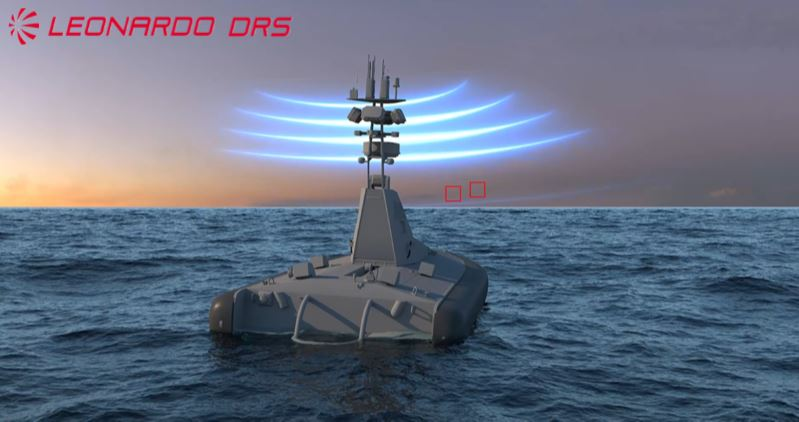
Concept USV with integrated Leonardo DRS MEP. (Leonardo DRS)
From Leonardo DRS, Aug. 12, 2025
ARLINGTON, Va., Aug. 12, 2025 ̶ Leonardo DRS, Inc. (NASDAQ: DRS) announced today that is has successfully completed its first series of open-water demonstrations of its advanced maritime Mission Equipment Package (MEP) for counterUAS (CUAS) naval fleet protection.
The DRS maritime MEP is a scalable C-UAS system based on DRS’s proven land-based mobile short-range air defense and C-UAS systems. This system is designed to be mounted on a range of small uncrewed surface vessels providing remote ship protection at varying distances, providing a real solution as the Navy looks to autonomous surface vessels to protect ships from air and surface threats.
The initial demonstrations were conducted under realistic sea conditions and demonstrated the MEP’s core integrated systems performance – the detection, identification and tracking of a UAS threat and counter-surface ship tracking. The mission equipment package used in the demonstration included a suite of DRS sensors and command-and-control technologies including the BlackLab passive radio frequency (RF) detection system, STAG electro-optic/infrared (EO/IR) gimbal with advanced thermal cameras, and a tactical data management system using DRS’s sensor fusion operating system and AI to support fusion and target recognition using RF and Optical modalities.
“The U.S. Navy faces the same evolving drone threats as our land forces, and we recognize the urgency of delivering a reliable solution to protect the lives of sailors,” said Cari Ossenfort, senior vice president and general manager of the Leonardo DRS Naval Electronics business unit. “By leveraging our proven expertise in mobile ground-based counter-UAS and short-range air defense systems, we have rapidly developed and demonstrated a maritime force protection capability that provides sailors with full-spectrum situational awareness and the tools to detect, track, and defeat threats at the tactical edge.”
The DRS Maritime MEP is designed for mission-flexibility through modularity and platform agnosticism. It is able to integrate advanced active and passive RF, EO/IR sensors, 4G/5G electronicwarfare systems, and scalable kinetic or nonkinetic effectors using its MOSA open system architecture embedded in the Leonardo DRS operating system.
The development and integration of the maritime Mission Equipment Package is an example of DRS’s deep experience as a leading innovator and integrator supporting a wide range of missions for the U.S. military and allies around the world. The company’s integration capability extends across all domains to support force protection, computer networking and C5I, as well as naval power and propulsion systems.
U.S. Central Command Bids Farewell to Gen. Kurilla, Welcomes Adm. Cooper
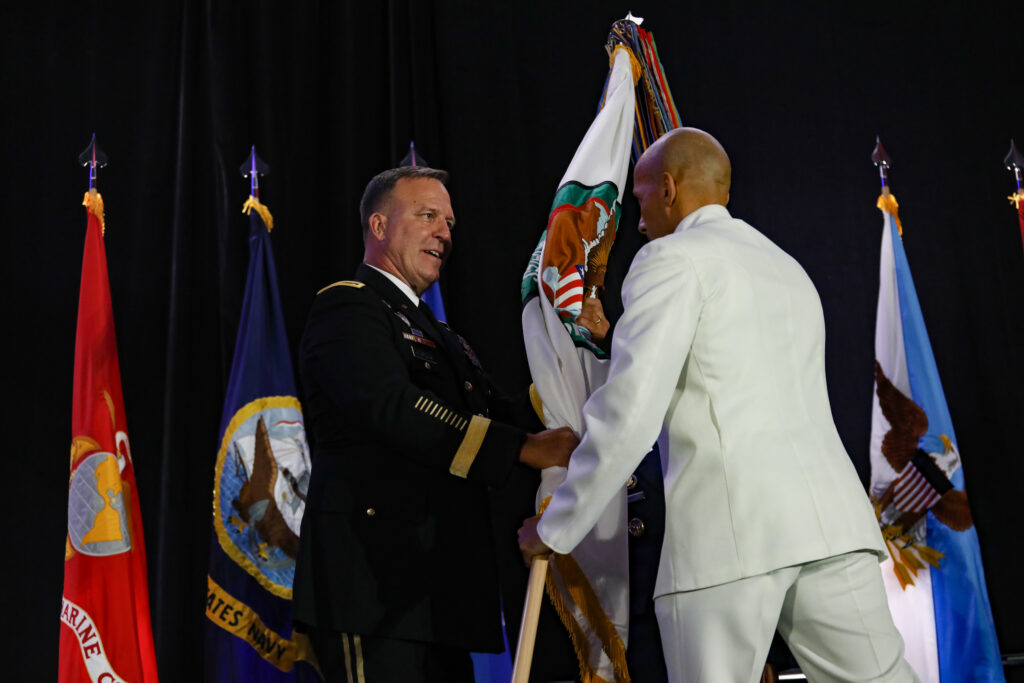
U.S. Central Command’s (USCENTCOM) Senior Enlisted Leader, Fleet Master Chief Derrick Walters passes the USCENTCOM flag to the outgoing commander of USCENTCOM, U.S. Army Gen. Michael Erik Kurilla, during a change of command ceremony, 8 August 2025. Multiple Department of Defense officials attended the event as well as distinguished defense leaders from partner nations around the world. (U.S. Central Command Public Affairs photo by Tom Gagnier)
From U.S. Central Command, August 8, 2025
TAMPA, Fla. — U.S. Army Gen. Michael Erik Kurilla, the outgoing commander of U.S. Central Command (CENTCOM), relinquished command today to U.S. Navy Adm. Brad Cooper during a change of command ceremony held at the Tampa Convention Center. Prior to assuming command, Adm. Cooper served as deputy commander of CENTCOM.
Multiple Department of Defense officials attended the event as well as distinguished defense leaders from partner nations around the world.
Gen. Kurilla assumed command of CENTCOM in April 2022. During his time as commander, he led U.S. military efforts in the Middle East maintaining regional stability and security as well as the enduring defeat of ISIS. He led the planning and execution of over 15 major combined combat operations, including Operations Rough Rider and Midnight Hammer.
“I know that under the leadership of Adm. Brad Cooper, with the support of the Defense Department and Joint Staff, the counsel and contributions of our allies and partners, and support of our headquarters and component teams, the Soldiers, Sailors, Airmen, Marines, Coastguardsmen, and Guardians of Central Command who serve this nation on the front lines of freedom will always succeed,” said Gen. Kurilla. “It has been the honor of my life to have been their commander.”
Adm. Cooper is a 1989 graduate of the U.S Naval Academy and holds a master’s degree in strategic intelligence from the National Intelligence University. As the commander of CENTCOM, Adm. Cooper will have oversight of all U.S. military missions throughout the 21-country area of responsibility which includes the Middle East and Central Asia.
“U.S. Central Command and the entire joint force have performed exceptionally well under the leadership of Gen. Kurilla, helping to bolster partnerships, increase lethality of U.S. forces, and defend Americans and civilians abroad,” said Adm. Cooper. “I am deeply grateful for the opportunity to lead America’s sons and daughters as we support the important mission of enhancing regional security and stability in the Central Command region.”
NAVSEA Leaders Discuss Advanced Technology Needs
WASHINGTON, DC (August 7, 2025) – Mr. Matt Sermon, Direct Reporting Program Manager, Maritime Industrial Base (MIB), participated in the Strategic Panel at the Maritime Innovation Forum: Advanced Manufacturing: Innovation for Maritime Readiness, that was held at the Capital Turnaround. (U.S. Navy photo by Laura Lakeway)
By NAVSEA Office of Corporate Communications, Aug. 7, 2025
WASHINGTON — Today, Naval Sea Systems Command (NAVSEA) leaders joined more than 360 industry representatives at the Maritime Innovation Forum to discuss the adoption of advanced technologies to improve shipbuilding and repair performance.
The Maritime Innovation Forum 2025 is a national initiative that showcases transformative technologies aligned with the U.S. Navy’s Advanced Manufacturing Strategy.
The forum included a keynote address from Vice Chief of Naval Operations, Admiral Jim Kilby as well as a panel discussion with senior leaders discussing the need to scale innovation. Tom Perotti, executive director and deputy chief engineer of NAVSEA engineering directorate, explained the importance of aligning advanced manufacturing solutions with authorities like Other Transactions (OTs) to quickly address capability gaps and readiness.
“To meet the speed and scale the Fleet demands, we must make advanced manufacturing a foundational capability across the entire shipbuilding enterprise,” said Perotti. “Through innovative tools and systems, scalable solutions and authorities like OTs, we are working to solve problems faster while building a more innovative and agile Navy.”
Matt Sermon, direct report program manager for the Maritime Industrial Base, echoed this forward-looking approach by highlighting recent successes with additive manufacturing.
“We’ve seen in just a few years that additive manufacturing can supply select parts for our ships now,” Sermon said. “What we want to see in a few more years are entire shipyards, workforce and supply chains integrated by advanced manufacturing processes, technologies and of course, AI.”
Throughout the forum, NAVSEA leaders discussed case studies where OT authorities have been successfully leveraged. Since 2020, NAVSEA has awarded more than 600 OT agreements to expedite needed ship construction, maintenance and modernization solutions. NAVSEA’s OT successes shared at the forum included the following:
LM2500 Gas Turbine Navy Common Core Controller (GTNC3): With over 300 LM2500 engines powering the surface Fleet, GTNC3 standardizes the control system across platforms. Developed under the Maritime Sustainment Technology and Innovation Consortium (MSTIC) OT, GTNC3 addresses longstanding variability in control architecture and strengthens long-term sustainment.
Strike Up/Down System (SUDS): This innovation supports rearming the MK41 Vertical Launch System at sea. SUDS was developed under the DoD Ordnance Technology Consortium OT and aims to reduce the need for ships to return to the port for rearming and preserve combat readiness.
High-Density Ribbon Fiber Optic Cable and Shipboard Tooling: This initiative increases fiber density by 12-fold, while maintaining compliance. Developed under the National Shipbuilding Research Program OT with contributions from Ingalls Shipbuilding, Newport News Shipbuilding and others, it enhances shipboard data transfer while simplifying installation.
These projects exemplify how OT agreements fill critical technical gaps across NAVSEA’s acquisition portfolio, delivering faster, more affordable and flexible solutions to the Fleet.
During the afternoon of the forum, there were presentations about innovative technologies in the areas of additive manufacturing and 3D printing, robotics and automation, coatings and surfaces, as well as next-generation digital tools, materials and processes. These presentations showcased high-impact technology that aligns with the Navy’s modernization goals and industrial expansion priorities.
Through these collaborative efforts, the Maritime Innovation Forum illustrated how technological innovation, alternative agreements and partnerships are directly strengthening the Navy’s maritime readiness and industrial base.
In closing remarks, Rear Adm. Pete Small, NAVSEA’s chief engineer and Warfare Centers commander, reiterated the importance of collaboration and emphasized NAVSEA’s commitment to scaling innovation that delivers results.
“This forum is a testament to what we can achieve when we come together to collaborate on innovative, scalable and real-world solutions to today’s most pressing shipbuilding and sustainment challenges,” said Small. “The demand is here, and NAVSEA is driving it forward with the help of partnerships, innovative technology and advanced manufacturing.”
USS Savannah Returns to Homeport After 12-Month Deployment
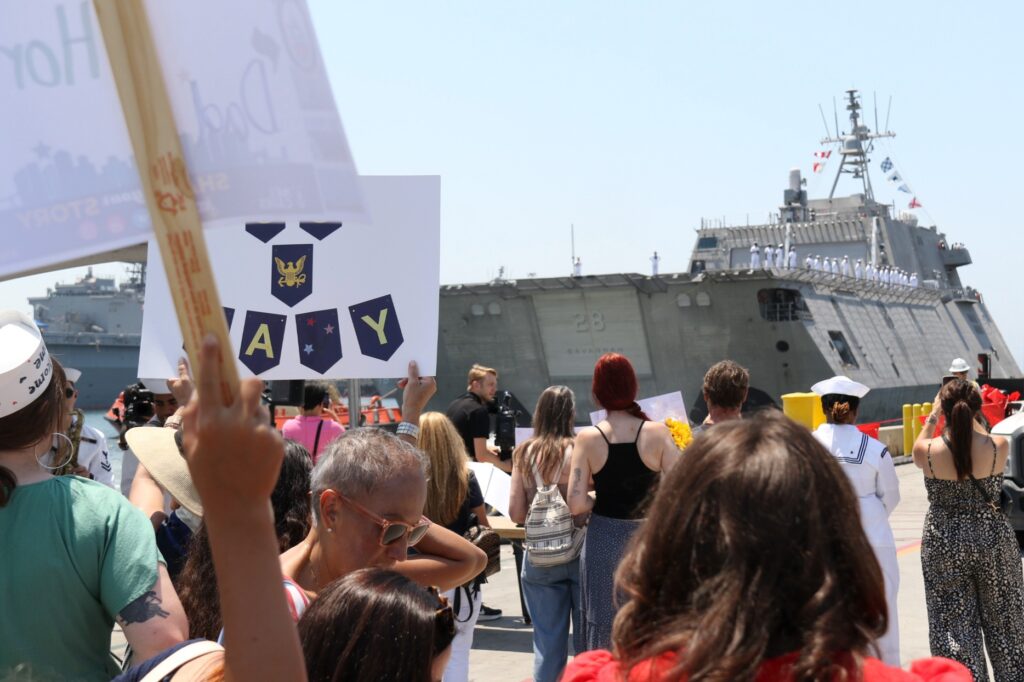
Families welcome the Independence-variant littoral combat ship USS Savannah (LCS 28) as it returns to Naval Base San Diego, Aug. 7, 2025. The Savannah returns to its homeport of San Diego following a 12-month rotational deployment to the U.S. 3rd and 7th Fleets. (U.S. Navy photo by Mass Communication Specialist 2nd Class Kassandra Alanis)
SAN DIEGO – The Independence-variant littoral combat ship USS Savannah (LCS 28) arrived at its San Diego homeport Aug. 7, following a 12-month rotational deployment throughout the U.S. 3rd and 7th Fleet areas of operation. The Savannah operates with a dual-crew, allowing the hull to stay in theater for longer durations.
“I’m honored to welcome home the crew of the Savannah after a long and challenging deployment,” said Capt. Jose Roman, commodore, Littoral Combat Ship Squadron 1. “This warship showed strength in presence in strategically vital waterways and worked closely with our allies and partners across the Indo-Pacific. I know the families here today are just as proud of their Sailors as I am.”
While on its maiden deployment, the Savannah conducted several multilateral exercises and port visits across the Indo-Pacific, including Cambodia, Singapore, Brunei, Palau, the Republic of the Philippines, and the Republic of the Marshall Islands, enhancing regional maritime cooperation and interoperability.
In October 2024, the Savannah sailed in coordination with Royal New Zealand Air Force (RNZAF) and Royal Australian Air Force (RAAF) P-8 maritime patrol aircraft in the South China Sea. The New Zealand-led multilateral patrol exercise fostered tactical proficiency and reinforced air-maritime integration with key regional partners.
Also in October, during a scheduled port visit to Muara, Brunei, the Savannah welcomed officers from the Royal Brunei Navy (RBN), and the Savannah’s Sailors participated in a sports day with their Bruneian counterparts, strengthening ties and fostering goodwill between navies.
“I’m incredibly proud of this crew, not only for their operational expertise over many months in a challenging environment, but for the leadership and commitment they displayed in working with our partner nations,” said Cmdr. Robert Schmidt, commanding officer of the Savannah. “These partnerships are vitally important to regional security, and this crew represented the best ideals of the U.S. Navy.”
In December 2024, during a port visit in Sihanoukville, Cambodia, the Savannah hosted Commander, U.S. Indo-Pacific Command Adm. Samuel Paparo and a delegation from the Royal Cambodian Navy for a tour of the ship and embarked MH-60R Seahawk helicopter. Discussions highlighted the strategic utility of the littoral combat ship and its contributions to maritime security in the region. The Savannah was the first U.S. Navy ship in eight years to conduct a port visit in Cambodia.
The port visit included the Savannah Sailors serving the community at a local food pantry and soup kitchen and participating in a friendly volleyball match with Cambodian naval personnel, reinforcing partnership and professional rapport.
“It was a great experience interacting with their sailors and realizing how much we had in common,” said Electronics Technician 3rd Class Giovanni Pennisi.
In May, the Savannah participated in Exercise Balikatan 2025, the 40th iteration of the premier annual defense exercise held between the Republic of the Philippines and the United States. The Savannah’s crew led five days of live-fire exercises; tactical maneuvering drills; search and rescue; casualty evacuation; and Visit, Board, Search and Seizure (VBSS) scenarios alongside the Philippine Navy, Philippine Coast Guard, Philippine Air Force, and the Japan Maritime Self-Defense Force.
The Savannah’s deployment exemplifies the Navy’s commitment to integrated deterrence, regional maritime security, and enduring alliances and partnerships throughout the Indo-Pacific.
Littoral combat ships are fast, optimally manned, mission-tailored surface combatants that operate in near-shore and open-ocean environments, winning against 21st-century threats. LCS integrate with joint, combined, manned and unmanned teams to support forward-presence, maritime security, sea control, and deterrence missions around the globe.