Navy’s Unmanned Vessels Key to $81 Million Cocaine Seizure in Caribbean 
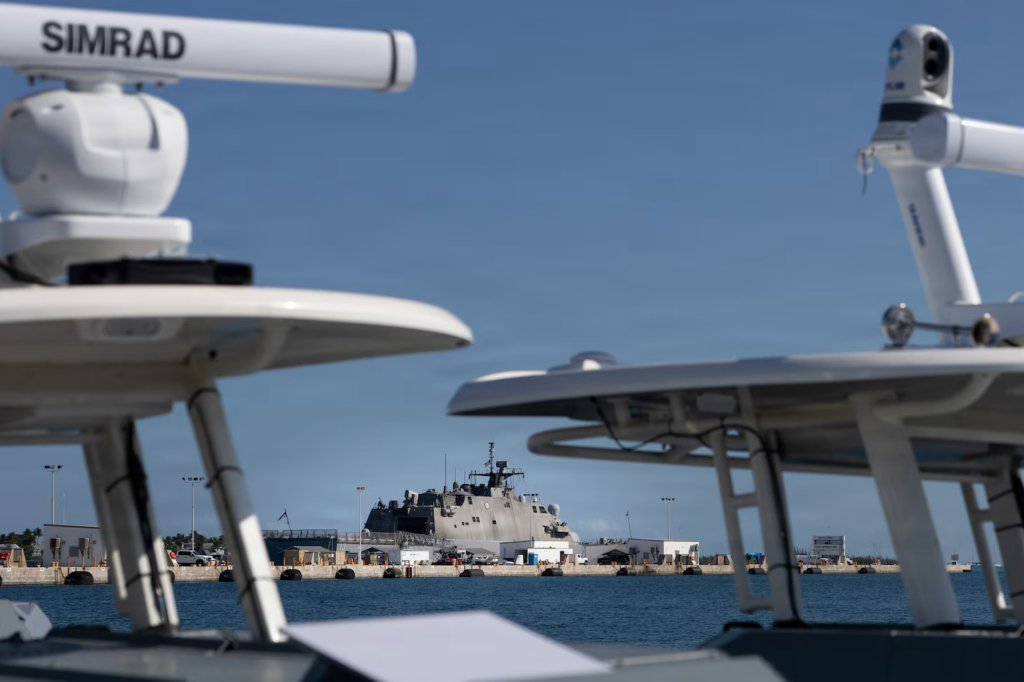
The Freedom-class variant littoral combat ship USS Wichita (LCS 13) sits pierside during the annual Fleet Experimentation (FLEX) 2026 event in Key West, Fla., April 29, 2026. Hosted by U.S. Naval Forces Southern Command/U.S. 4th Fleet April 24-30, the exercise integrates commercially developed unmanned systems and artificial intelligence with traditional manned naval platforms. FLEX 2026 features comprehensive collaboration across the Department of War and industry to demonstrate a sophisticated kill chain that successfully found, tracked and engaged captured drug boats. The campaign focuses on operationalizing advanced robotic and autonomous systems to combat transnational organized crime and patrol vast maritime regions. (U.S. Navy photo by Mass Communication Specialist 3rd Class Jasmin L. Aquino)

By Cmdr. John Williams, U.S. Naval Forces Southern Command / U.S. 4th Fleet 

June 3, 2026 

MAYPORT, Fla.   –  On October 16, 2025, a Long-Dwell Unmanned Surface Vessel detected and identified a target of interest designated by Joint Interagency Task Force South. The unmanned vessel tracked the target, coordinated with naval forces, and enabled a U.S. Navy ship to interdict the vessel, resulting in the significant drug seizure. 
 
Since January 2025, NAVSOUTH has been operating LD-USVs in the Central Caribbean and Eastern Pacific, supporting the regional effort to counter Transnational Criminal Organizations. These autonomous systems have become a critical force multiplier, enhancing maritime domain awareness and augmenting U.S. Navy and Coast Guard capabilities at a fraction of the cost of traditional assets. 
 
“This interdiction is the culmination of months of refining our tactics, techniques, and procedures for these advanced systems in the region,” said Rear Adm. Carlos Sardiello, commander of U.S. Naval Forces Southern Command /U.S. 4th Fleet. “The ability to detect a target, have that vessel identified by our team on the watch floor, and then coordinate with assets on scene to complete the interdiction is a testament to the hard work of our Sailors and our commitment to integrating unmanned systems into fleet operations.” 
 
NAVSOUTH’s unmanned operations are set to expand in 2026 with the integration of interceptor USVs, unmanned aerial vehicles, and high-altitude balloons. These assets will be deployed across the U.S. Southern Command area of responsibility to provide a multi-layered approach to maritime surveillance and counter-illicit trafficking. 
 
“The success we are seeing with these robotic systems allows us to expand our reach and support our mission requirements more effectively,” said Cmdr. Jon Williams, NAVSOUTH’s Technology and Innovation Director. “By layering unmanned surface and airborne systems, we create a highly effective maritime domain awareness network. Operating these systems at scale allows us to accelerate their development and integration across the entire Navy.” 
 
U.S. Naval Forces Southern Command/U.S. 4th Fleet supports U.S. Southern Command’s joint and combined military operations by employing maritime forces in cooperative maritime security operations to maintain access, enhance interoperability, and build enduring partnerships in order to enhance regional security and promote peace, stability and prosperity in the Caribbean, Central and South American region. 


NRL Receives Space Force Antenna to Expand Joint Space Test Capabilities In, From, and To Space 

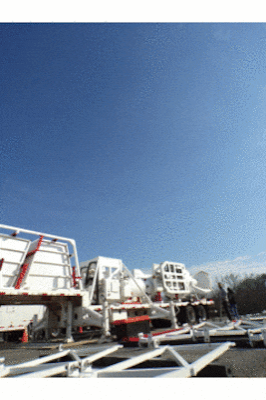
The U.S. Naval Research Laboratory (NRL) has received a satellite tracking antenna system from the U.S. Space Force’s (USSF) Space Systems Command’s (SSC) System Delta 81 (SYD 81) at Blossom Point Tracking Facility to support expanded joint testing and operational readiness for space systems, reinforcing collaboration between the naval and space communities, first quarter, calendar year 2026. (U.S. Navy photo by Sarah Peterson)

From Nicholas E. M. Pasquini, U.S. Naval Research Laboratory Corporate Communications 

June 10, 2026 

WASHINGTON – The U.S. Naval Research Laboratory (NRL) has received a transportable satellite tracking antenna system from the U.S. Space Force’s (USSF) Space Systems Command (SSC) System Delta 81 (SYD 81) to expand joint space testing, training and operational support capabilities at NRL’s Blossom Point Tracking Facility during the first quarter of calendar year 2026. 

The antenna system enhances the facility’s ability to support tracking, telemetry and command operations for emerging space technologies and future operational concepts. The capability will provide additional flexibility for experimentation, system evaluation and long-duration performance monitoring supporting both naval and joint space missions. 
 
Blossom Point Tracking Facility, operated by NRL, has long supported satellite command and control, communications experimentation and orbital research. Integrating the transportable system into the site’s existing infrastructure increases the facility’s capacity to support multi-band communications testing, interoperability assessments and advanced space experimentation. Analysis is underway to determine future experiments, exercises and operational events the system may support, as well as potential deployment locations to maximize mission utility. 
 
The transfer supports broader Department of War efforts to strengthen joint test and training infrastructure while improving collaboration across the naval and space communities. The system also supports SYD 81’s mission to develop and field capabilities that enable realistic test and training environments for the U.S. Space Force. 
The effort reflects ongoing collaboration between SSC, SYD 81 and NRL to improve operational readiness, expand flexible testing capability and accelerate the integration of emerging space systems into joint mission environments. The addition of the antenna provides increased access to stable, repeatable testing environments that support the evaluation of critical space-enabled capabilities for future operations. 
  
The Laboratory is the Navy and Marine Corps’ corporate laboratory, conducting a broad program of scientific research, technology development and advanced experimentation to support operational forces and maintain the nation’s technological advantage at sea, on land, in the air and in space. 


Coast Guard Repatriates 32 Aliens to Dominican Republic Navy Following Vessel Interdiction 

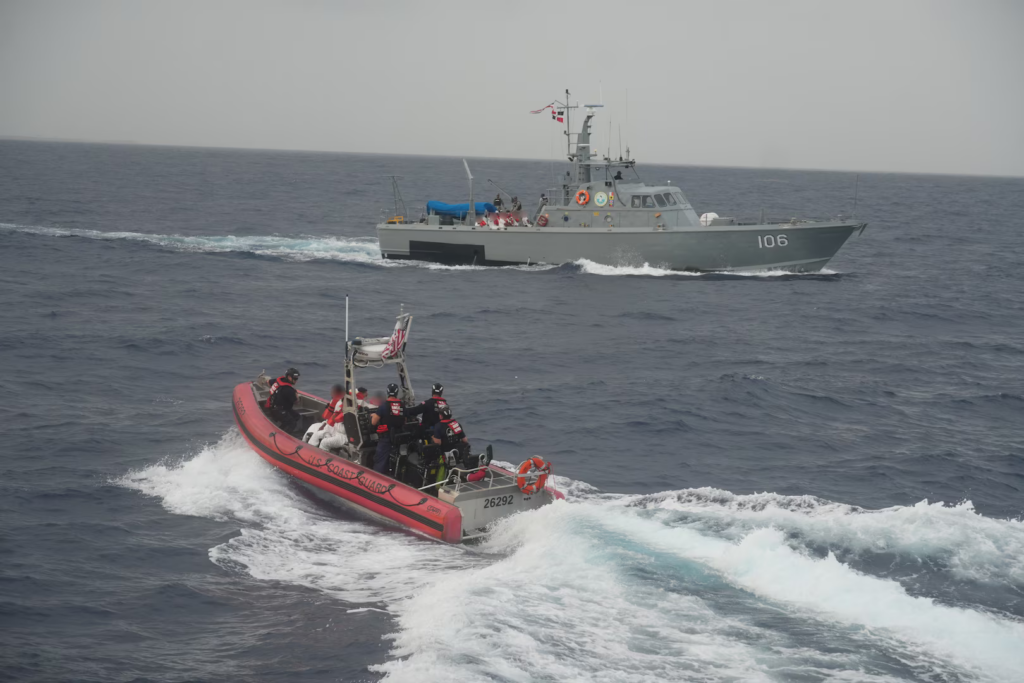
Coast Guard Cutter Heriberto Hernandez’s small boat transfers a group of people during the repatriation of 32 aliens to a Dominican Republic Navy vessel, June 7, 2026. The aliens were interdicted a day earlier off Desecheo, Puerto Rico, as part of Homeland Security Task Force – San Juan Region efforts to combat human smuggling and deter unlawful maritime migration.(U.S. Coast Guard photo)

From U.S. Coast Guard Southeast District, June 9, 2026 

SAN JUAN, Puerto Rico — The crew of Coast Guard Cutter Heriberto Hernandez repatriated 32 aliens to a Dominican Republic Navy vessel at sea, Sunday, following the interdiction of a makeshift vessel near Desecheo, Puerto Rico.    

This interdiction is part of the efforts of the Homeland Security Task Force – San Juan Region to combat human smuggling and deter unlawful maritime migration. 

Sector San Juan watchstanders received a report from the aircrew of a Customs and Border Protection aircraft of a grossly overloaded 20 to 30-foot makeshift vessel off Desecheo, Puerto Rico. With assistance from the Customs and Border Protection aircrew, the U.S. Coast Guard Cutter Heriberto Hernandez interdicted the suspect vessel. 

Following the interdiction, the crew safely embarked 36 Dominican Republic, three Haitian and one Uzbek nationals. 

“This successful outcome is due to the professionalism and unwavering resolve of our Coast Guard crews and Homeland Security Task Force partners stopping unlawful migration voyages at sea,” said Cmdr. Matthew Romano, Sector San Juan chief of response. “To anyone thinking of taking part in an unlawful maritime migration voyage, don’t take to the sea! These voyages are extremely dangerous and most often involve grossly overloaded and unseaworthy vessels that take on water and have no lifesaving equipment. Those caught taking part in an unlawful voyage could face possible prosecution or be repatriated to their country of origin or country from where the voyage originated.” 

This interdiction is part of the Homeland Security Task Force (HSTF) initiative established by Executive Order 14159, Protecting the American People Against Invasion. The HSTF is a whole-of-government partnership dedicated to eliminating criminal cartels, foreign gangs, transnational criminal organizations, and human smuggling and trafficking rings operating in the United States and abroad. Through historic interagency collaboration, the HSTF directs the full might of United States law enforcement towards identifying, investigating, and prosecuting the full spectrum of crimes committed by these organizations, which have long fueled violence and instability within our borders. In performing this work, the HSTF places special emphasis on investigating and prosecuting those engaged in child trafficking or other crimes involving children. The HSTF further utilizes all available tools to prosecute and remove the most violent criminal aliens from the United States. 

HSTF San Juan comprises agents and officers from the following federal partners: FBI, ICE-HSI, CBP (OFO, AMO and Border Patrol), the U.S. Marshals Service for Puerto Rico and the U.S. Virgin Islands, DEA, ATF, IRS, U.S. Coast Guard, U.S. Coast Guard Investigative Service, U.S. Postal Inspection Service, the Department of State, and the U.S. Secret Service, the Puerto Rico/U.S. Virgin Islands HIDTA, TSA, FAA, and the U.S. Attorney’s Offices for the Districts of Puerto Rico and the U.S. Virgin Islands. 

The HSTF also has the following state and local law enforcement partners as participating agencies: the Puerto Rico Police Department; the San Juan, Carolina, Guaynabo, Barceloneta, and Ponce Municipal Police Departments, the Puerto Rico National Guard – Counter Drug Program; the Puerto Rico Department of Corrections and Rehabilitation; the Puerto Rico Internal Revenue Service (Hacienda); the Puerto Rico Port Authority; and the Virgin Islands Police Department. 


Navy Accepts Delivery of USNS Sojourner Truth 

From the Navy Office of Information, June 9, 2026 

WASHINGTON – The U.S. Navy accepted delivery of USNS Sojourner Truth (T-AO 210), the sixth ship in the John Lewis-class fleet replenishment oiler program, from General Dynamics NASSCO in San Diego, June 9. 

Delivery marks the official transfer from the shipbuilder to the U.S. Navy, following completion of successful integrated sea trials. 

“USNS Sojourner Truth’s delivery marks another significant milestone for the Navy and the John Lewis-class program,” said John Lighthammer, Auxiliaries and Special Mission Ships program manager, Deputy Portfolio Acquisition Executive, Auxiliaries. “This ship represents the dedication and expertise of the shipbuilders, engineers, and program professionals who continue to deliver critical capability to the fleet.” 

T-AOs are operated by the Military Sealift Command and feature substantial volume for oil, significant dry cargo capacity, and aviation capability. T-AOs provide additional capacity to the Navy’s Combat Logistics Force and are a cornerstone of the Navy’s fuel delivery capability. 

Driving forward momentum through a stable and optimized production line, this ship class continues to make progress as it rapidly delivers critical capabilities to the fleet. This delivery follows the recent USNS Thurgood Marshall (T-AO 211) christening and the program will have an upcoming keel-laying ceremony for future USNS Harriet Tubman (T-AO 213), scheduled for June 18, representing the next major milestone in the Navy’s ongoing effort to modernize and expand its fleet replenishment capability in support of global maritime operations. 

In addition, General Dynamics NASSCO is in production on four additional T-AO vessels, with three more ships currently under contract. 

The delivery of T-AO 210 underscores the Navy’s commitment to building America’s Fleet of the Future. For 250 years, American naval power has projected strength globally, operating forward 24/7, 365 days a year. This operational tempo demands continuous capability, and the Fleet of the Future is our answer. 

The Portfolio Acquisition Executive (PAE) for Maritime is the single accountable organization for delivering surface ships for the U.S. Navy. This new centralized organizational construct will empower leaders with broader scope and greater authority to accelerate delivery of combat capability and ensure acquisition speed and discipline are driven by what the warfighter needs—when they need it. 


U.S. Navy Establishes NSA Stirling in Australia 

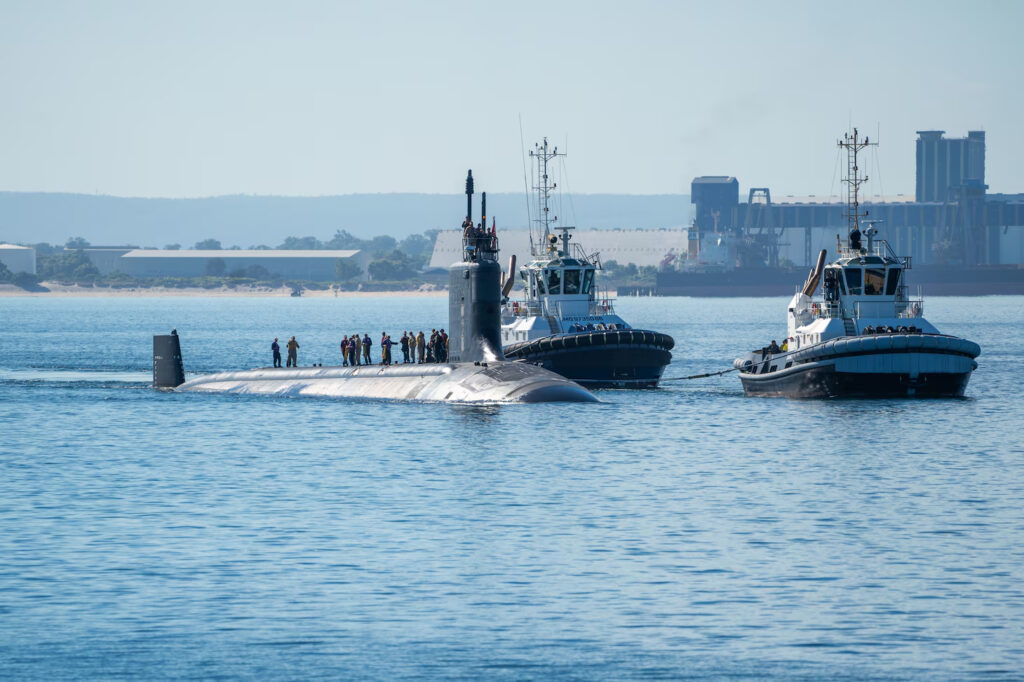
ROCKINGHAM, Western Australia, Australia (Feb. 25, 2025) The Virginia-class fast-attack submarine USS Minnesota (SSN 783) prepares to moor at HMAS Stirling, Western Australia, Australia, Feb. 25, 2025. Minnesota arrived in Western Australia kicking off the first of two planned U.S. fast-attack submarine visits to HMAS Stirling in 2025. Minnesota is currently on deployment supporting the U.S. 7th Fleet, the U.S. Navy’s largest forward-deployed numbered fleet, operating with allies and partners in preserving a free and open Indo-Pacific region. (U.S. Navy photo by Lt. James Caliva) 

From CNFJ/CNRJ Public Affairs, June 7, 2026 

PERTH, Australia – As of May 30, the U.S. Navy has established a new naval support activity in Perth, Western Australia, as part of AUKUS, the enhanced trilateral security partnership between Australia, the United Kingdom, and the United States. This move follows the trilateral Joint Statement on May 30 confirming that key milestones continue to be met for Submarine Rotational Force – West (SRF-West).

Naval Support Activity (NSA) Stirling will provide support services and programs for U.S. service members, civilian personnel, contractors, and their families assigned to SRF-West, which will support the rotational presence of U.S. and U.K. nuclear-powered fast-attack submarines at Australia’s HMAS Stirling base in Western Australia. 

“Establishment of NSA Stirling with our AUKUS partners demonstrates our command mission to support the Fleet, warfighter, and family,” said Vice Adm. Scott Gray, commander, Navy Installations Command. “By providing essential services to U.S. personnel and their families, NSA Stirling will enhance rotational submarine force readiness.” 

Navy Region Japan was tasked in October 2024 to stand up NSA Stirling. SRF-West is established with the approval of and at the invitation of the Australian Government. 

“We are currently in the early stages of establishing NSA Stirling,” said Rear Adm. Ian Johnson, commander of Navy Region Japan. “While there is still much work ahead, we are confident in our ability to accomplish this task through strong collaboration with our AUKUS partners.” 

NSA Stirling will provide robust support for U.S. service members, civilians, and their families, connecting U.S. personnel to quality housing, healthcare, childcare, and recreation to ensure their well-being during their assignment. 

The Department of War’s Joint Statement, AUKUS Defense Ministers’ Meeting can be found here: https://www.war.gov/News/Releases/Release/Article/4504769/joint-statement-aukus-defense-ministers-meeting/ 


HII Partner Bayou Metals Launches Dedicated Manufacturing Line to Speed Romulus USV Production 

SLIDELL, La. — HII, America’s largest military shipbuilder and a global leader in autonomous maritime systems, today announced that Bayou Metal Supply & Manufacturing, a strategic partner in the serial production of HII’s Romulus unmanned surface vessels (USVs), has launched a dedicated manufacturing line to support accelerated construction of the platform. 

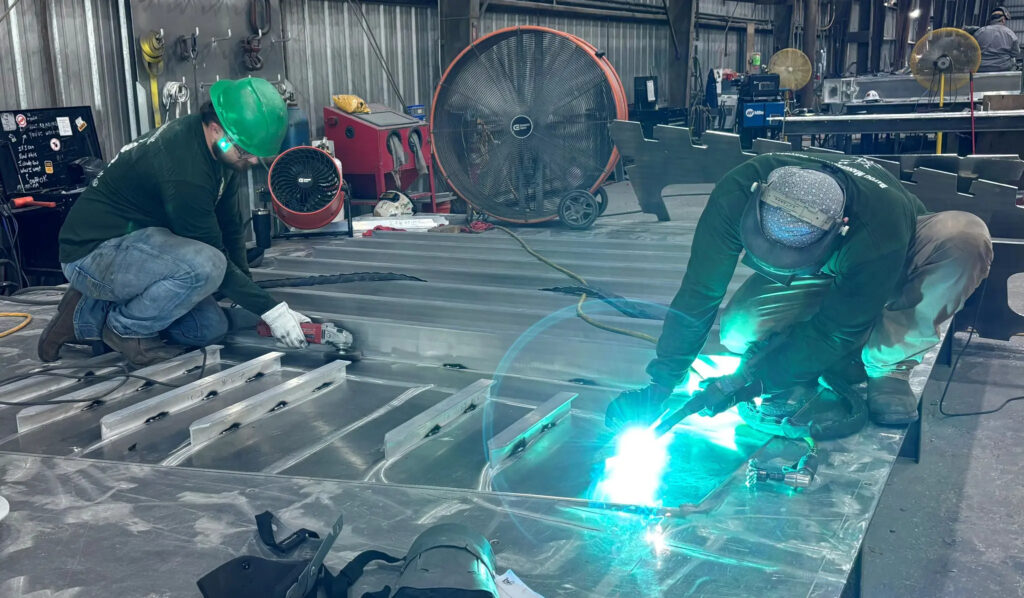
The new production line, located in Slidell, Louisiana, provides precision cutting, bending, welding, and assembly of major structural components into complete assembly units ready for shipment to Breaux Brothers Enterprises for final integration into the Romulus USV platform. 

Bayou Metals is playing a critical role on HII’s Romulus USV shipbuilding team as a strategic aluminum supply and fabrication partner. The company is providing marine-grade aluminum while establishing dedicated manufacturing capacity to meet the Romulus USV production schedule. 

“As we move from prototype to production, partnerships like Bayou Metals are essential to delivering capability at speed and scale,” said Andy Green, executive vice president of HII and president of HII’s Mission Technologies division. “Their ability to combine material supply with advanced fabrication strengthens our production model, reduces risk, and accelerates delivery the Romulus USV to the fleet.” 

William Stout, chief executive officer of Bayou Metal stated, “Bayou Metal is proud to continue its longstanding relationship with and support of industry leaders such as HII and Breaux Brothers. We remain committed to providing world-class service, quality materials, and trusted partnerships to the marine and shipbuilding sectors for years to come.” 

HII’s integrated coordination with Bayou Metals and other manufacturing partners ensures avoiding delays in securing materials and building parts. It also makes production more efficient by completing most of the setup work before final assembly at the shipyard. This model enhances throughput and supports faster, more repeatable serial production of Romulus vessels across multiple shipyards. 

In addition to improving manufacturing performance, the effort supports expansion of the U.S. shipbuilding industrial base by growing Gulf Coast manufacturing capacity and building a larger skilled workforce. 

HII recently announced plans for the production of four Romulus 151 vessels to be built by Breaux Brothers Enterprises in Louisiana, in addition to the vessel currently under construction. The announcement signals a rapid transition to initial production as HII accelerates delivery of autonomous surface capability to the U.S. Navy and allied partners. 

“Romulus represents a shift in how we deliver unmanned capability to the fleet,” Green said. “We are combining shipbuilding experience, scalable manufacturing, proven autonomy, and strong industry partnerships to move quickly from prototype to operational deployment.” 

Romulus USV: Built for Scale and Mission Flexibility 

Romulus is a modular family of AI-enabled USVs designed to support a wide range of missions, including intelligence, surveillance and reconnaissance (ISR), mine countermeasures, strike operations, counter-unmanned systems, and the launch and recovery of unmanned underwater and aerial vehicles. 

Engineered for serial, repeatable production, the platform combines endurance, global reach, and modular adaptability, enabling scalability across multiple vessel sizes while maintaining a common manufacturing and autonomy baseline. 


Secretary of War Announces Flag Officer Nominations 

From the Department of War, June 8, 2026 

Secretary of War Pete Hegseth announced today that the president has made the following nominations: 

Navy Vice Adm. Christopher S. Gray for reappointment to the grade of vice admiral, with assignment as deputy chief of Naval Operations for Sustainment, N4, Office of the Chief of Naval Operations/commander, Navy Sustainment, Pentagon, Washington, D.C. Gray is currently serving as commander, Navy Installations Command, Washington Navy Yard, Washington, D.C. 

Navy Rear Adm. Brad J. Collins for appointment to the grade of vice admiral, with assignment as commander, Navy Installations Command, Washington Navy Yard, Washington, D.C. Collins is currently serving as commander, Navy Region Hawaii, Joint Base Pearl Harbor-Hickam, Hawaii. 

Navy Rear Adm. Marc J. Miguez, for appointment to the grade of vice admiral, with assignment as commander, Third Fleet, San Diego, California. Miguez most recently served as Navy chief of Legislative Affairs, Pentagon, Washington, D.C. 

Navy Rear Adm. Paul C. Spedero, Jr., for appointment to the grade of vice admiral, with assignment as director, Joint Staff, Pentagon, Washington, D.C. Spedero is currently serving as vice director, Joint Staff, Pentagon, Washington, D.C. 

Navy Captain Patrick W. Finney for appointment to the grade of rear admiral (lower half). Finney is currently serving as Submarine Force Reserve Component director, Commander, Submarine Force Atlantic, Norfolk, Virginia. 

Navy Captain Robert C. Gerstemeier for appointment to the grade of rear admiral (lower half). Gerstemeier is currently serving as commanding officer, Navy Reserve, Commander, Navy Installations Command, Washington Navy Yard, Washington, D.C. 

Navy Captain Harold M. Kim for appointment to the grade of rear admiral (lower half). Kim is currently serving as commanding officer, Navy Reserve, Commander, U.S. Pacific Fleet Operations, Plans and Policy, Pearl Harbor, Hawaii. 

Navy Captain Andrew R. Needles for appointment to the grade of rear admiral (lower half). Needles is currently serving as Reserve chief of staff, Commander, Naval Forces Europe and Africa, Naples, Italy. 

Navy Captain Sara J. Taylor for appointment to the grade of rear admiral (lower half). Taylor is currently serving as commanding officer, Naval Reserve Headquarters, Commander, Naval Forces Europe and Africa, Naples, Italy. 


U.S. Army Crew Safely Rescued After Helicopter Lost at Sea

From U.S. Central Command, June 9, 2026 

TAMPA, Fla. — At 7:33 p.m. ET on June 8, two crew members from a U.S. Army AH-64 Apache were rescued by American forces after their helicopter went down near the coast of Oman while patrolling regional waters. 

The Soldiers were safely rescued within approximately two hours and are in stable condition. The cause of the incident is under investigation. 

Rescue efforts were led by U.S. Naval Forces Central Command and the 82nd Airborne Division, with support from U.S. Air Force and Navy units including U.S. 5th Fleet’s Task Force 59. 


General Dynamics NASSCO Christens the USNS Thurgood Marshall, the Seventh in the T-AO Program

From General Dynamics NASSCO, June 4, 2026 

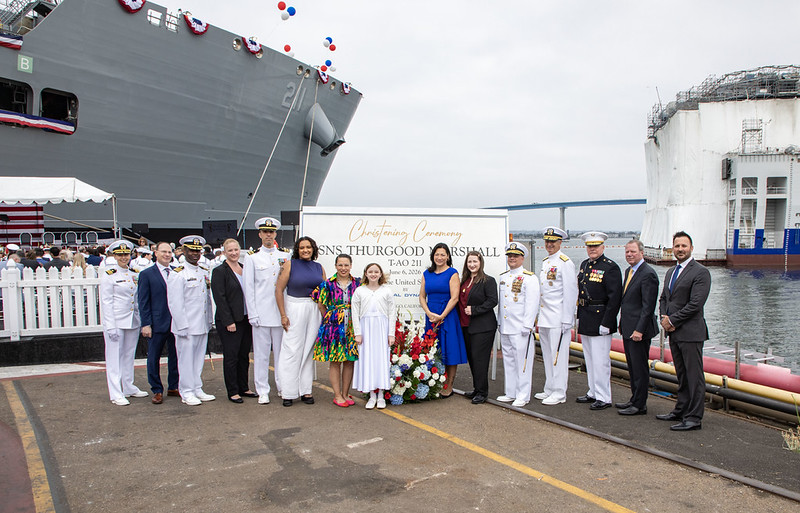
SAN DIEGO– General Dynamics NASSCO has christened and launched the USNS Thurgood Marshall (T-AO 211), the seventh ship in the fleet oiler program built for the U.S. Navy. The ship is named in honor of Thurgood Marshall, the first African American appointed to the U.S. Supreme Court, serving from 1967 to 1991. He was a prominent civil rights lawyer who argued and won the landmark Brown v. Board of Education case, which helped end racial segregation in public schools. 

Maj. Gen. David Bligh, Judge Advocate General of the Navy, representing the Secretary of the Navy, served as the principal speaker at the ceremony. 

“The General Dynamics NASSCO team has been a strong partner of our forces for decades, particularly in the design and construction of our Naval auxiliary ships,” said Bligh. “There is a vital link between our defense industrial base and the effectiveness of our fighting men and women around the world.” 

Remarks were also delivered by NASSCO President Dave Carver and representatives of the Navy. Following the remarks, ship co-sponsors Melonie Tibbs, Cecilia L. Marshall, and Alissa Kamens Marshall christened the vessel with the traditional champagne bottle break across the hull. 

“What we christen tonight is not just a ship — it’s the embodiment of American unity that will carry Thurgood Marshall’s legacy, and the legacy of America, all over the world,” said Carver. “His name on the hull of this ship reminds us that service takes many forms — and that truth, courage, and conviction must always guide our mission.” 

Fleet oilers serve as a supply lifeline for U.S. Navy vessels carrying out missions across the globe, including in the Western Pacific, Indian Ocean, and beyond. Crafted for underway replenishment, the oilers transfer fuel, lubricants, fresh water, and small amounts of dry cargo as part of the Navy’s combat logistics force. NASSCO designs all new vessels with double hulls to protect against oil spills and to enhance the durability of cargo and ballast tanks. The vessels measure 746 feet long, with a full load displacement of 49,850 tons. Each can carry 157,000 barrels of oil, along with significant dry cargo and aviation capability, and can reach a top speed of 20 knots. 

“To the men and women of General Dynamics NASSCO, your work directly contributes to this nation’s security,” said Vice Adm. Douglas Verissimo, representing the Chief of Naval Operations. “Your professionalism matters. You have not simply constructed a vessel — you have delivered operational capability and I truly thank you.” 

The first five ships in the class — USNS John Lewis (T-AO 205), USNS Harvey Milk (T-AO 206), USNS Earl Warren (T-AO 207), USNS Robert F. Kennedy (T-AO 208), and USNS Lucy Stone (T-AO 209) — have all been delivered to the Navy. The USNS Sojourner Truth (T-AO 210) recently completed successful sea trials and is set to be delivered on Tuesday, June 9, 2026. The USNS Thurgood Marshall (T-AO 211), USNS Ruth Bader Ginsburg (T-AO 212), USNS Harriet Tubman (T-AO 213) and USNS Dolores Huerta (T-AO 214) are currently under construction. 


Astrion Selected by U.S. Navy to Build, Integrate, and Sustain Maritime Autonomous Systems 

The hybrid fleet takes shape 

From Asttrion, June 2, 2026  

HUNTSVILLE, Ala., June 02, 2026 (GLOBE NEWSWIRE) — Astrion, a defense technology company building the integration and orchestration layer for modern warfare, has been selected as one of nine awardees on a $349.4 million indefinite-delivery/indefinite-quantity (IDIQ) contract awarded by Naval Information Warfare Center (NIWC) Pacific. The contract supports the development, integration, and sustainment of unmanned maritime systems through May 2034. 

The award reflects the growing importance of autonomous systems across the maritime environment and the increasing demand for mission-ready systems integration, testing, and sustainment capabilities. Through this contract, Astrion will provide technical solutions for the full lifecycle of unmanned maritime systems, from specification, design, and integration through testing, fielding, operations, and sustainment. 

“Robotic warfare is the future of armed conflict — on land, at sea, and in the air. Victory comes from the orchestration of multi-vendor autonomous systems into a force that fights as one,” said Tom Vice, chairman and CEO, Astrion. “The Navy is expanding the number, type, and tempo of autonomous systems faster than at any point in its history, and the harder problem is no longer building the platforms. It is orchestrating them. Astrion operates and maintains the Navy’s two Medium Displacement Unmanned Surface Vessels (MDUSVs) at sea today, and we bring the systems integration, test, and sustainment discipline that turns autonomous platforms into deployable combat capability. We are built for this work.” 

Astrion brings established experience in supporting the U.S. Navy’s unmanned maritime system initiatives, including the MDUSV program, which develops and deploys long-endurance unmanned surface vessels like Seahawk and Sea Hunter to demonstrate new technologies and support distributed maritime operations. 

Astrion’s work spans integration, test and evaluation, and sustainment of complex autonomous platforms in multi-vendor, government-owned environments. Astrion is known for delivering measurable improvements in maritime systems reliability, mission readiness, and lifecycle cost efficiency. Its experience and capabilities are critical to the efficient and affordable adoption of unmanned systems across the Navy.