USS Dwight D. Eisenhower Completes Planned Incremental Availability at Norfolk

From U.S. Fleet Forces Command
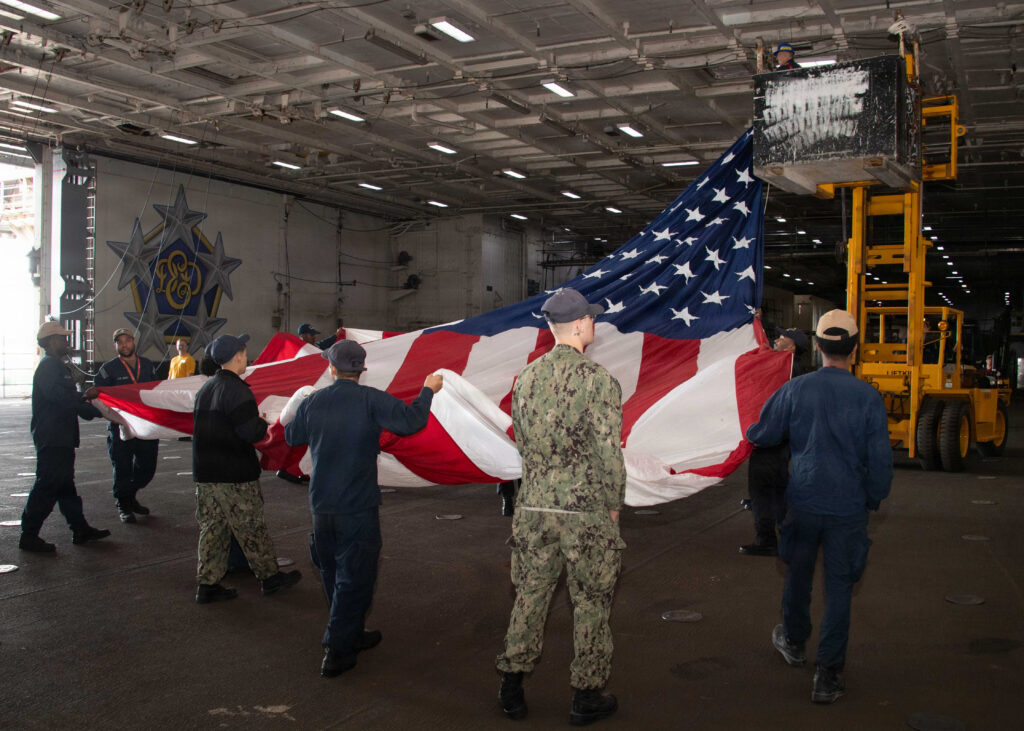
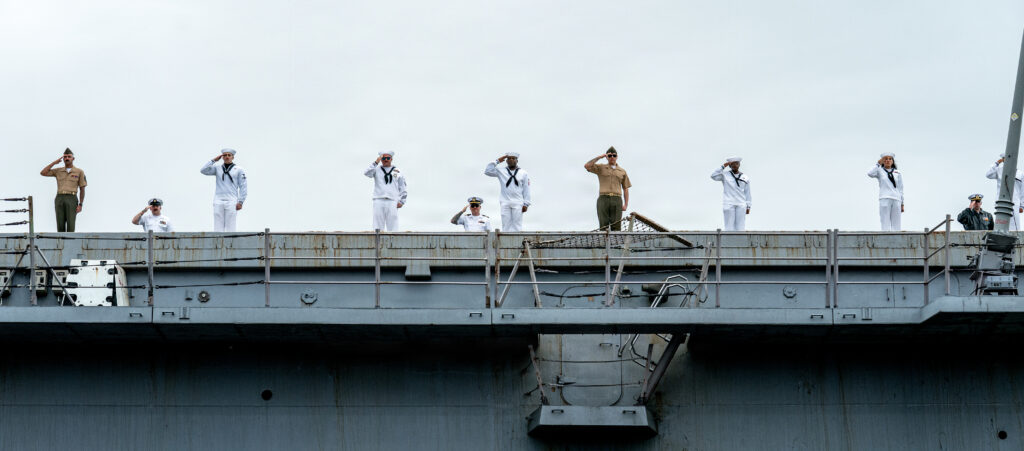
U.S. Navy Sailors hang the national ensign aboard Nimitz-class aircraft carrier USS Dwight D. Eisenhower (CVN 69), Apr. 6, 2026. Eisenhower was moored at Norfolk Naval Shipyard for a Planned Incremental Availability maintenance period, which it has now completed. Photo credit: U.S. Navy | Mass Communication Specialist Seaman Melina Rossi

USS Dwight D. Eisenhower (CVN 69) has completed sea trials, marking the successful early completion of its Planned Incremental Availability at Norfolk Naval Shipyard.

A PIA is a scheduled period for an aircraft carrier to undergo extensive maintenance, repairs and modernization to meet future operational demands, spanning a wide array of overhauls and inspections. Regularly scheduled maintenance maximizes the lifespan of Navy warships and ensures mission readiness.

“Mighty IKE” becomes NNSY’s second timely carrier delivery back to the fleet following USS George H.W. Bush (CVN 77) completing its PIA in November 2024.

“The primary drivers behind IKE’s successful availability are the NNSY, Ship’s Force, and contractor teams who ensure the ship is materially ready to fight,” said Project Superintendent, Cmdr. Jason Downs. “The entirety of the project team mustered more than 4,000 people daily, all with one common vision–deliver IKE, fully mission capable, back to the fleet before our commitment date. The highly skilled tradespeople and sharp engineering acumen are the heroes in the IKE FY25 PIA story.”

The project team proved resourceful in accomplishing work pier side while NNSY’s carrier dry dock continued its multiyear renovation as part of the Shipyard Infrastructure Optimization Program. NNSY firsts during this availability included installing a main seawater valve for a waterborne carrier, as well as performing nozzle block inspections of main engine high pressure turbines to scope repair to similar components in the fleet. For the first time at any of the nation’s four public shipyards, underwater carrier shafting inspections were performed to help gauge future dry dock work on IKE. “Lastly, we executed first-time catapult trough non-destructive test inspections and structural repairs, efforts that were pivotal to extending the life of this significant aircraft launch system,” added Downs.

During the PIA, the project team worked to prioritize new work and effectively manage workload with available workforce capacity, efforts that contributed to a timely delivery. By aligning resources with readiness priorities, more ships and submarines are available as needed for fleet tasking. “This team thoughtfully budgeted workload and workforce to execute more than 25,000 resource days of new work,” said Downs. “This team also meticulously managed to execute the required new work under budget, saving 2,000 resource days.”

“IKE represents the SECOND consecutive early finish of an aircraft carrier availability at Norfolk Naval Shipyard. Our NNSY project teams are now setting the corporate standard for aircraft carrier maintenance,” said Shipyard Commander Rear Admiral Kavon Hakimzadeh. “Thank you to everyone who drove to focus and finish this significant availability, meeting our commitment and enabling IKE to continue supporting our national defense.”

“Based on the current global security landscape, IKE’s early delivery is a critical national security imperative,” said Downs. “An aircraft carrier is one of the most powerful instruments of national will, and having one delayed in the shipyard creates a significant strategic gap at a time when US military presence is in high demand across multiple theaters.”

A Nimitz-class nuclear-powered aircraft carrier, Dwight D. Eisenhower serves as flagship for Carrier Strike Group 2. As one of the largest, most historic and multifaceted shipyards in the nation, Norfolk Naval Shipyard’s mission is to repair, modernize and inactivate Navy warships and training platforms to maximize readiness and availability for fleet tasking.
Blue Ridge Returns to Yokosuka After Spring Patrol

By Lt. Jaliya Wilson, U.S. 7th Fleet Public Affairs, April 27, 2026

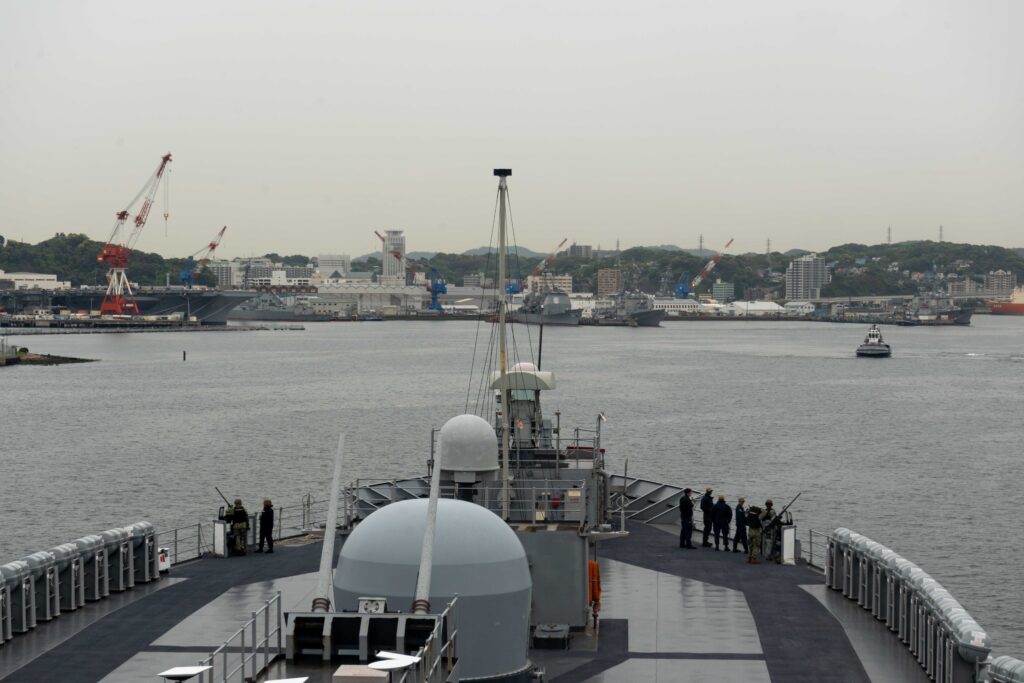
U.S. 7th Fleet flagship USS Blue Ridge (LCC 19) returns to Commander, Fleet Activities Yokosuka, Japan following a patrol in the Indo-Pacific region, April 23, 2026. Photo credit: U.S. Navy | Mass Communication Specialist 3rd Class Damian Cook

U.S. 7th Fleet flagship USS Blue Ridge (LCC 19) returned to Commander, Fleet Activities Yokosuka, Japan, April 23, marking the completion of the spring patrol in the Indo-Pacific region.

Blue Ridge departed for patrol March 8 and traveled 6,613 nautical miles, making port visits to Okinawa, Japan; Changi, Singapore; Manila, Philippines; and Laem Chabang, Thailand. 7th Fleet leadership also disembarked to conduct staff talks with military counterparts in Jakarta, Indonesia, and the commander hosted Philippine Navy, Royal Australian Navy and Japan Maritime Self-Defense Force leadership aboard Blue Ridge while underway.

“Each engagement with our partners and allies advances our fleet interoperability, readiness and lethality,” said Vice Adm. Pat Hannifin, commander, U.S. 7th Fleet. “Blue Ridge provides a unique capability to command and control forces from the sea, enhancing our military-to-military partnerships across the theater. We appreciate the hospitality of each of these port cities and their respective nations’ commitments to ensuring maritime security throughout the Indo-Pacific.”

During the port visits, 7th Fleet and Blue Ridge leadership met with foreign dignitaries, as well as local leaders, to discuss ways of improving operational readiness, advancing future military capabilities and enhancing relationships in the region.

7th Fleet, embarked aboard Blue Ridge, commands the world’s largest forward-deployed fleet. Its primary mission is providing operational command and control for forces in the Western Pacific and Indian Oceans while promoting regional stability and maritime security through engagements with allies and partners.

“This patrol was a huge success,” said Capt. Louis F. Catalina IV, commanding officer of Blue Ridge. “The hard work and commitment to excellence by our Sailors allowed us to meet every mission throughout a dynamic schedule. Their professionalism enabled the completion of 10 sea and anchor evolutions, four port visits, two big top receptions, and safe navigation alongside our Japanese, Australian, and Philippine allies during two group sail events. I am extremely proud to lead and serve alongside the Sailors who make up this talented team.”

U.S. 7th Fleet, the Navy’s largest forward-deployed numbered fleet, routinely interacts and operates with allies and partners in preserving a free and open Indo-Pacific.


HII’s Ingalls Shipbuilding is Awarded Frigate Lead Yard Support Contract

From HII

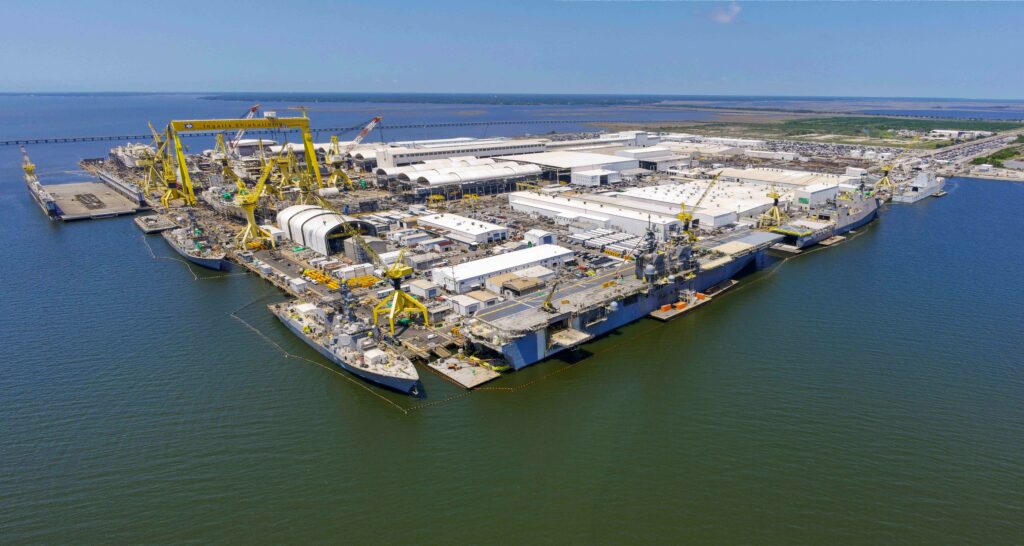
PASCAGOULA, Miss., April 28, 2026 (GLOBE NEWSWIRE) — HII (NYSE: HII) announced today that the U.S. Navy awarded its Ingalls Shipbuilding division a $283 million contract to perform FF(X) class frigate lead yard support activities for the new frigate class. The contract allows Ingalls Shipbuilding to procure long lead time material, execute design work and begin pre-construction activities for the first ship. 

“We are proud of our past performance in engineering, design and production of warships that meet U.S. military standards, a performance that gave the Navy confidence to select the national security cutter as the basis for the next small surface combatant and to choose Ingalls as the program’s lead yard,” said Brian Blanchette, Ingalls Shipbuilding president. “We are excited to partner with the Navy to bring these preproduction steps under contract to accelerate delivery of the frigates that our warfighters need.” 

Under this contract, Ingalls Shipbuilding will begin cutting and shaping raw material to support future phases of work on the main structure foundation and the overall construction sequencing plan of the first frigate. This new approach will enable a smooth transition from design to production at Ingalls Shipbuilding and eventually across the industrial base. 

In December 2025, the U.S. Navy selected Ingalls Shipbuilding to design and build the future FF(X), leveraging the stable and proven design of the Legend-class national security cutter (NSC). Ingalls previously delivered 10 NSCs to the U.S. Coast Guard and will use the same proven build sequence for the FF(X) program. The new frigates will be constructed alongside production lines that currently support DDG 51 Flight III destroyers, LHA assault ships, LPD Flight II amphibious transport docks, and modernization activities for the Zumwalt-class guided missile destroyers. 

To meet urgent Navy demand and support construction of next-generation platforms, Ingalls Shipbuilding has invested more than $1 billion in modernizing its infrastructure, facilities, and toolsets. HII as a whole is actively working to expand U.S. shipbuilding capacity by, among other things, increasing the number of distributed shipbuilding partners, collaborating with international manufacturers, and evaluating the addition of another U.S. shipyard. 

The Navy’s new class of smaller combatant ships, the FF(X), is a critical component of the Navy’s fleet of the future. The FF(X) will be a smaller, more agile surface combatant designed to complement the fleet’s larger, multi-mission warships and enhance operational flexibility around the globe. 


FRCE delivers first metal 3D printed parts to fleet 

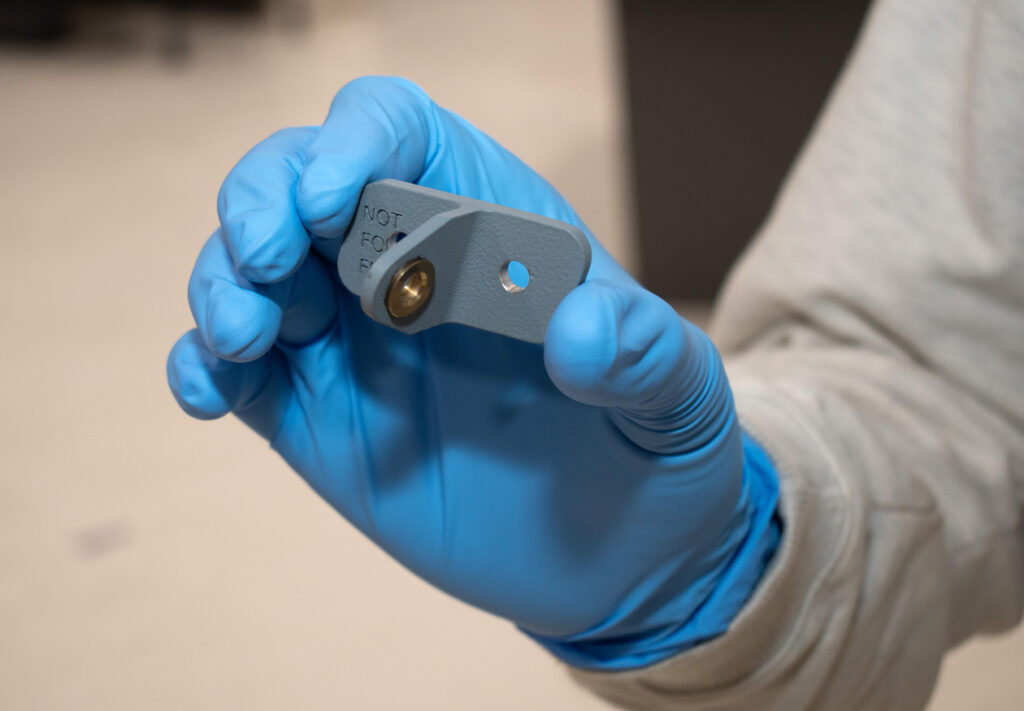
Fleet Readiness Center East (FRCE) recently delivered its first non-flight-critical metal additive manufactured aircraft parts to the fleet, boosting flight line readiness. An FRCE aircraft welder and metal additive operator showcases a sample metal additive manufactured pylon fitting for the AH-1Z Viper that the depot’s Advanced Technology and Innovation Team created for the H-1 Fleet Support Team. 

From Fleet Readiness Center East, April 27, 2026 

MARINE CORPS AIR STATION CHERRY POINT, N.C. — Fleet Readiness Center East (FRCE) is marking a new era of aircraft sustainment with the delivery of its first flight-certified metal additive manufactured parts to the fleet, significantly improving aircraft downtime and flight line readiness.   

A recent collaboration with the Naval Air Systems Command (NAVAIR) Additive Manufacturing Team and Fleet Support Teams has allowed the Advanced Technology and Innovation Team at FRCE to develop processes and obtain certification to use metal additive manufacturing to create its first non-flight-critical aircraft parts. 

Metal additive manufacturing works similarly to traditional 3D printing, but instead of applying plastic filament layer by layer, it uses high-powered lasers to weld thin layers of aluminum powder into a solid object. Since establishing capability, FRCE has used this process to manufacture and deliver three flight-worthy parts to the fleet: the weapons pylon fitting for the AH-1Z Viper, the repair fitting for the main landing gear on the V-22 Osprey, and a blanking plate for the C-130 Hercules. 

The integration of metal additive manufacturing marks a strategic shift in the command’s warfighter support. This capability is designed to enhance mission readiness by providing a more efficient and localized solution for parts procurement, effectively reducing maintenance lead times and ensuring aircraft remain flight ready. This on-demand manufacturing initiative is a central element of FRCE’s broader effort to modernize its support and enhance mission readiness. 

Beyond delivering its first flight-ready metal additive manufactured parts, FRCE reached a second milestone along the way: successfully completing the rigorous capability demonstration in under six months. This achievement serves as a formal validation of the depot’s metal additive manufacturing processes and confirms the 3D-printed metal parts made at the facility meet the same safety and quality requirements as traditionally manufactured parts. FRCE’s Advanced Technology and Innovation Team lead said this accomplishment was a group effort between many teams within NAVAIR. 

“We were challenged to complete the qualification, production and certification processes for these parts in six months, and we not only met but exceeded that standard,” the team lead said. “This is the fastest this sort of thing has ever been done within Naval Air Systems Command, and it shows that we are competitive with industry standards. This entire process has been a team effort between FRC East, our headquarters, the site in Lakehurst, and the Fleet Support Teams, working together to ensure these parts are ready and reliable for our troops.” 

The pylon fitting, a small but important attachment point for the aircraft’s weapon pylons, was the depot’s first flight-certified metal additive manufactured aircraft part. FRCE delivered the pylon fitting to the H-1 Fleet Support Team in early 2025, followed by the delivery of the landing gear repair fitting to the V-22 Fleet Support Team and the blanking plate to the C-130 Fleet Support Team later that year. 

In addition to the three flight-worthy parts, the FRCE has also used the metal additive manufacturing equipment to produce specialized tooling and support parts for the depot’s maintainers to use, allowing for more efficient repairs. 

Metal additive manufacturing provides the fleet with a time-saving solution for replacing worn and damaged parts that can be difficult to obtain through the traditional supply chains. FRCE Additive Manufacturing Team lead said producing the parts in-house and on demand improves flight line readiness by decreasing aircraft downtime. 

“If there’s a fight and the fleet needs these parts tomorrow, they won’t have time to wait for those parts through traditional supply chains,” the team lead said. “The fleet was having a hard time getting their hands on repair fittings for the V-22 main landing gear – it’s basically a doorstop for the landing gear door when it comes up. They turned to additive manufacturing and asked us if it was something we could make, so we took on that part, and a few others, as part of our capability demonstration. The goal is to give the fleet what they need when they need it, and we did just that.” 

FRCE will soon expand its metal additive manufacturing capabilities to include stainless steel, a stronger and more durable material than aluminum. This expansion will allow the depot to produce a wider range of flight-critical parts and support equipment for the fleet, further increasing flight line readiness. 


NSWCDD graduates first students from in-house Wartime Readiness Short Course

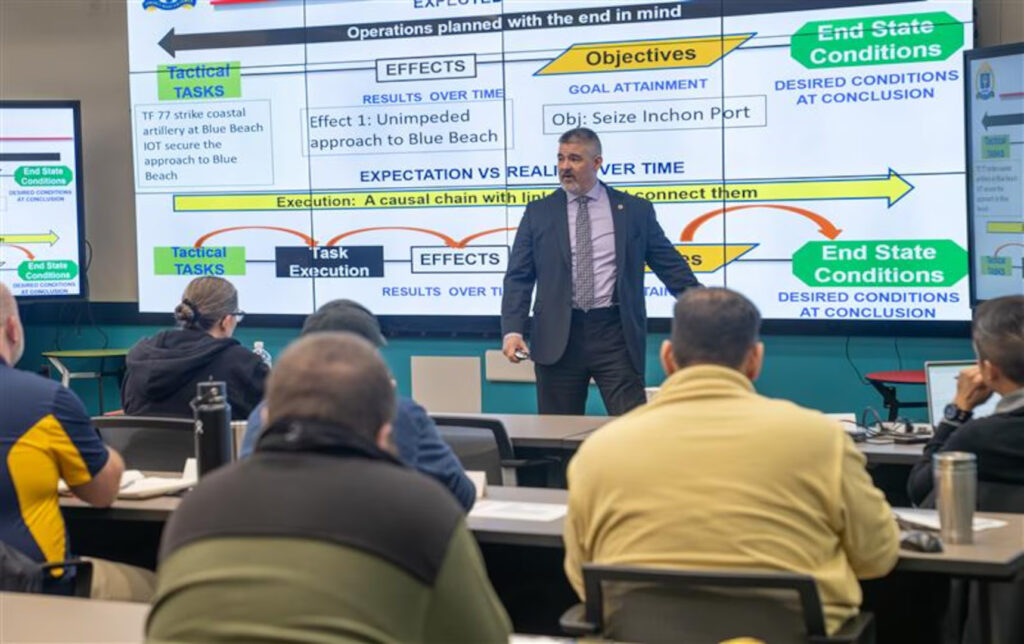
DAHLGREN, Va. – Professor C.A. “K-Jack” Krajacich, director of Maritime Staff Courses at the U.S. Naval War College, teaches the first Naval Surface Warfare Center Dahlgren Division (NSWCDD) Wartime Readiness Short Course to a room full of Sailors and civilians. The course is designed to provide perspective on how maritime operations centers support the fleet. (Matt Lyman/NSWCDD Photo)

By Matt Lyman, NSWCDD Corporate Communications, April 24, 2026 

DAHLGREN, Va.  –  The U.S. Navy, in times of competition, conflict, and contingency or combat operations, leverages Maritime Operations Centers to equip commanders and staff with the resources needed to execute responsibilities as a component, Fleet and/or Maritime Component Commander. 

Naval Surface Warfare Center Dahlgren Division is applying the Maritime Operations Center doctrine, and in concert with the U.S. Naval War College, offered the first NSWCDD Wartime Readiness Short Course at the Innovation Lab March 24-26, 2026, in Dahlgren, Virginia. 

Susan Botkin, the workforce development lead for NSWCDD, said the course ensures employees and military members understand how their work fits into larger Navy decision cycles and crisis-response frameworks. 

The inaugural class included about 24 students, comprised of Sailors and government civilians from NSWCDD and other Warfare Centers. They attended the course to begin building a common operational language across NAVSEA and the warfare center enterprise, enabling more effective collaboration, faster problem‑solving, and better alignment with Fleet priorities. 

“It’s essential because it strengthens the workforce’s ability to think, plan, and operate in the same environment our Fleet commanders face every day. NSWCDD’s technical excellence must be paired with operational understanding,” added Botkin.   

Instructors from the U.S. Naval War College taught the class, giving students direct access to professors who routinely teach senior officers preparing for command and major operational roles. This exposure accelerates learning, ensures our workforce receives instruction grounded in real‑world operational experience, and allows students to ask questions and get on-the-spot feedback. 

“The primary intended takeaway was a better understanding of how the Fleet plans and how the system commands accelerate support in a crisis.  Despite cultural and institutional differences, there are many similarities between what the SYSCOMs do and how the Fleet conducts missions,” said Eric Dukat, associate professor, director of operations at the College of Maritime Operational Warfare, Naval War College. 

That fact was not lost on the students who came from other Warfare Centers across the United States to attend the course. 

“For the Warfare Center Enterprise, this training was about moving from technical support to operational partnership. We are already experts at the how, but this course helped us better understand some of the why,” said Andria Wenz, the wartime readiness coordinator for NSWC Crane. 

Students will graduate from the short course with a deeper understanding of how the Navy plans, fights, and executes operations. They will have insight into the Maritime Operations Center construct and how decisions are made at the operational level. 

“By understanding MOC structures and the Navy Planning Process, we can go from being a reactive help desk to a proactive part of the Navy’s ‘Foundry’,” added Wenz. 

They will leave with a stronger ability to align their technical work with Fleet needs, improved communication skills when working with operators, sponsors, and senior leaders and a broadened perspective on how NSWCDD and other warfare center capabilities contribute to deterrence, crisis response, and wartime execution. 

“This signals to higher headquarters and to the Fleet that we take this seriously and that we are trying to prepare for crisis and/or conflict, because if we’re better, everyone’s better,” said Capt. Joe Oravec, commanding officer for NSWCDD. 

Increased activity across the globe, cyber threats, unmanned system proliferation, and the pace of technological warfare highlight the importance of preparing civilians to support the Fleet during crisis or conflict and have driven warfare centers, including NSWCDD, to refocus on Wartime Readiness. 

“Real-world events, the increased Navy presence around the world, rapid technological change and the fast-moving “era” of artificial intelligence, and contested maritime domains, have underscored the need for a workforce that understands operational readiness,” said Rob Ward, wartime readiness lead for NSWCDD. 

Students are expected to bring an enhanced toolkit back to their respective workspaces to help coworkers gain operational context and thus improve the quality and timeliness of technical solutions. 

They will also support more informed decision-making during tight deadlines from the Fleet, all while enhancing warfare center credibility. Setting the warfare centers apart as workforces, specifically committed to technical excellence, who are always willing to be there to support the Sailors and the Fleet. 

“Wartime Readiness is not just a short course; it is an investment in the Navy’s future. NSWCDD’s technical workforce plays a critical role in shaping the systems, tools, and capabilities the Fleet depends on,” said Ward. 

“To design for the fight, we must understand the fight. This training builds that bridge. It equips our workforce with the operational mindset needed to anticipate Fleet needs, accelerate innovation and deliver solutions that matter in the moments that matter most. By empowering our people with this knowledge, NSWCDD strengthens its role as a trusted, operationally relevant partner to the warfighter,” added Ward. 


USS San Antonio Returns to Norfolk from U.S. 4th Fleet Deployment

 NORFOLK, Va. (April 28, 2026) — Sailors assigned to the San Antonio-class amphibious transport dock ship USS San Antonio (LPD 17) man the rails upon the ship’s arrival to Naval Station Norfolk, Virginia, April 28, 2026, following an eight-and-a-half-month deployment supporting the Iwo Jima Amphibious Ready Group (IWO ARG) and the 22nd Marine Expeditionary Unit (MEU)-Special Operations Capable (SOC) mission in the U.S. 4th Fleet area of operations. During the deployment the San Antonio supported Operation Southern Spear, conducted counter-narcotics and embassy reinforcement operations, and provided foreign humanitarian assistance to Jamaica following Hurricane Melissa. (U.S. Navy photo by Mass Communication Specialist 2nd Class Derek Cole)

From U.S Fleet Forces Command, April 29, 2026 

NORFOLK, Va. – First-in-class San Antonio-class amphibious transport dock ship USS San Antonio (LPD 17) returned to its homeport in Norfolk, Virginia, April 28, 2026, after eight and a half months at sea supporting the Iwo Jima Amphibious Ready Group (IWO ARG) and the 22nd Marine Expeditionary Unit (MEU)-Special Operations Capable (SOC) mission in the U.S. 4th Fleet area of operations.

San Antonio, alongside USS Iwo Jima (LHD 7) and USS Fort Lauderdale (LPD 28), departed on Aug. 14, 2025. The three ships make up the IWO ARG and were among the first expeditionary naval assets called to support Operation Southern Spear. 

While on mission in the Caribbean, San Antonio’s Sailors and Marines worked seamlessly to support national-level tasking with joint services and naval assets in the region to accomplish Department of War-directed operations and the President’s priorities, which included Enhanced Counter Narcotics Operations designed to protect the homeland.   

“The performance of our Navy-Marine Corps team during Operation Southern Spear was nothing short of exceptional,” said Capt. Tom Uhl, San Antonio’s commanding officer.   

“Our deployment to the 4th Fleet area of responsibility required immense focus, and I stand continually impressed by this crew’s dedication to the mission,” said Uhl. “From the moment we left the pier, they leveraged their rigorous pre-deployment training to flawlessly execute enhanced counter-narcotics operations and seamlessly adapt to every contingency they faced in the region.” 

While in theater, San Antonio’s Sailors and Marines supported the U.S. Southern Command mission, Department of War-directed operations, and the President’s priorities to disrupt illicit drug trafficking and protect the homeland. The ship’s integrated team of Sailors and Marines stood ready as the backbone of support for Marines conducting embassy reinforcement in the region. The ship also executed contingency operations in the region, including disaster response efforts in Jamaica from Oct. 31 to Nov. 13, 2025, in the aftermath of Hurricane Melissa. San Antonio’s Sailors and Marines partnered with Joint Task Force (JTF) Bravo to provide foreign humanitarian assistance to those greatly affected by the hurricane. 

“The destruction wrought by Hurricane Melissa was devastating to see,” said Uhl. “Having just pulled into St. Croix for a resupply opportunity, we quickly got back underway in less than 24 hours and made best speed toward Jamaica.” ` A whole-of-force effort, San Antonio’s Sailors and Marines took the lead in the mission to provide – by sea, air, and land – water, food, supplies, and assistance into highly affected areas where damage prevented the logistical flow of aid. The careful mission planning aboard San Antonio, in concert with JTF Bravo and the 22nd MEU (SOC), enabled mission success. Using organic ARG-MEU air assets, San Antonio’s crew enabled its embarked Marines from the 22nd MEU (SOC) to airlift aid and personnel directly into Jamaica to augment JTF-Bravo’s ongoing efforts. 

“By quickly surging to respond to this mission, our Sailors and Marines provided a beacon of hope for the people whose lives were upturned by the storm,” Uhl said. “I am extremely proud of this integrated team for meeting our tasking head on to provide aid to our neighbors in need.” 

Central to most deployments, San Antonio also made several port calls, among them St. Croix, U.S. Virgin Islands, St. Kitts and Nevis, and Ponce, Puerto Rico. Sailors and Marines participated in several outreach projects across the community while in port. 

Community service projects are a cornerstone of every deployment and allow Sailors and Marines to connect with and give back to the community, while fostering vital relationships with partners and allies across the world as ambassadors of the United States. 

While in St. Kitts and Nevis, San Antonio’s Sailors and Marines had a unique opportunity to meet with leaders from the Caribbean Community and engage with the Prime Minister of St. Kitts and Nevis, Dr. Terrance Drew. The visit highlighted the strong diplomatic ties between St. Kitts and Nevis and the United States of America. 

During the deployment, San Antonio traveled nearly 49,000 nautical miles and conducted roughly 453 hours of flight operations. This deployment proved the wide range of capabilities and flexibility that the U.S. Navy-Marine Corps team provides the Nation’s leaders. 

“For more than 20 years, USS San Antonio has deployed across the globe in support of U.S. strategic interests, serving as a symbol of freedom and 250 years of American sea power,” Uhl said. 

While in port in Norfolk, the warship will perform previously planned maintenance and preservation work to prepare for follow-on tasking. San Antonio’s Sailors and Marines will also have the chance to reunite with family during this in-port period. 

“The most important, key enabler in the resilience and efficacy of our force is without a doubt the Navy and Marine Corps families who support us on the homefront,” said Uhl. “They are our strongest motivation to get through the hardest days, and our greatest source of excitement to return home.” 


Navy Commissions Submarine USS Idaho

By Navy Chief Petty Officer Darren Moore, Submarine Readiness Squadron 32 

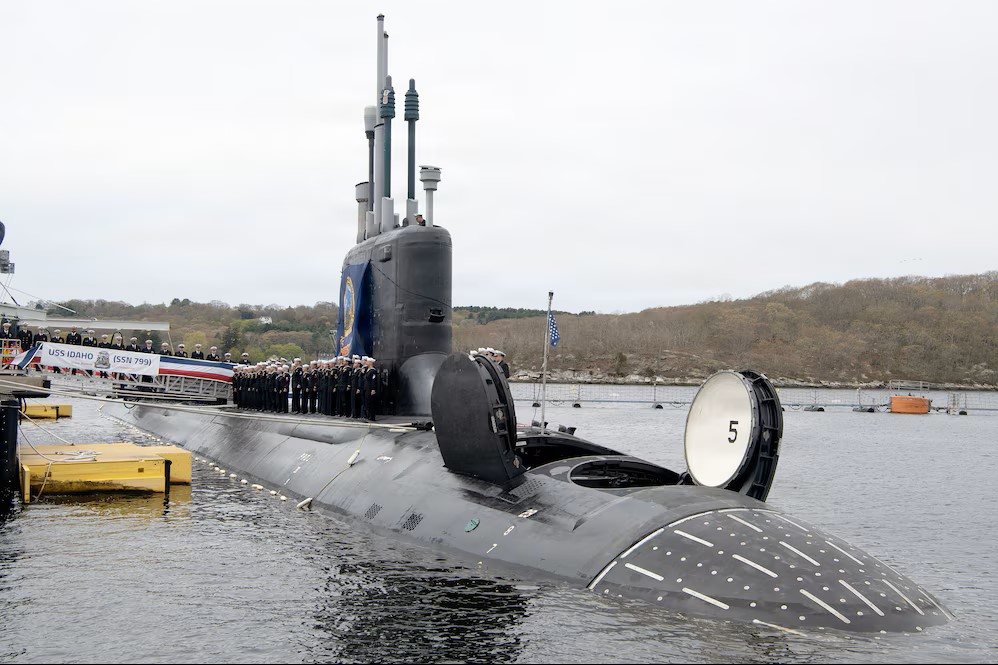
Sailors assigned to the Virginia-class fast attack submarine USS Idaho (SSN 799) man the rails during a commissioning ceremony at Naval Submarine Base New London in Groton, Conn. on April 25, 2026. Photo credit: U.S. Navy | John Narewski

The U.S. Navy commissioned the submarine USS Idaho in a traditional ceremony at Naval Submarine Base New London in Groton, Connecticut, April 25.  

The ceremony marked the culmination of a multiyear construction process and officially brought the USS Idaho into the fleet. It is the fifth Navy vessel named for the Gem State. The most recent predecessor, USS Idaho, was a battleship commissioned in 1919 that earned seven battle stars for its service during World War II, including action at Iwo Jima and Okinawa, Japan.  

Sen. James Risch of Idaho delivered the principal address as the ceremony’s keynote speaker.  

Hung Cao, acting Navy secretary, also delivered remarks, emphasizing the strategic importance of the new submarine.  

“We are a maritime nation, bordering on both the Atlantic and the Pacific . Our commerce depends on safe and secure sea lanes of communication,” Cao said. “President Trump’s commission to our military is simple: to achieve peace through strength. The USS Idaho joins the fleet ready to answer the call to action, in any ocean, at any time.”  

Navy Cmdr. Chad J. Guillerault, commanding officer of the Idaho, addressed the attendees, speaking on behalf of the crew and the submarine’s rich heritage.  

“The Idaho connection is more than a name, it is a legacy — a legacy built before us that is being reborn today,” Guillerault declared. “I am incredibly proud to be the commissioning captain of a vessel so steeped in tradition … and most importantly, honored to be the captain of a crew so mighty that they have outshone all those before them.”  

The ship’s sponsor, Teresa Stackley, gave the traditional order to “man our ship and bring her to life,” at which point the crew ceremonially ran aboard to man the submarine. 

“This moment is for you, Cmdr. Guillerault, and your crew,” Stackley said. “Please note that when you sail, my heart sails with you.”  

The Idaho is the 26th Virginia-class submarine and the eighth of the advanced Block IV configuration. The ship was christened on March 16, 2024, at the shipyard in Groton.  

As the newest submarine to join the fleet, the Idaho brings cutting-edge warfighting capability to the nation’s undersea forces. Virginia-class submarines feature enhanced stealth, sophisticated surveillance capabilities and special warfare enhancements to meet the Navy’s multimission requirements.  

These submarines are 7,800 tons, 377 feet in length and have a beam of 34 feet. They are powered by a nuclear reactor plant that will not require refueling during the planned life of the ship, reducing lifecycle costs and increasing operational availability.  

The commissioning of the USS Idaho reinforces the Navy’s commitment to maritime superiority and national security. For 250 years, American naval power has projected strength across the globe. That mission continues and intensifies with the addition of the nation’s most advanced undersea assets.


MQ-25A Stingray achieves successful first flight, advancing future of naval aviation

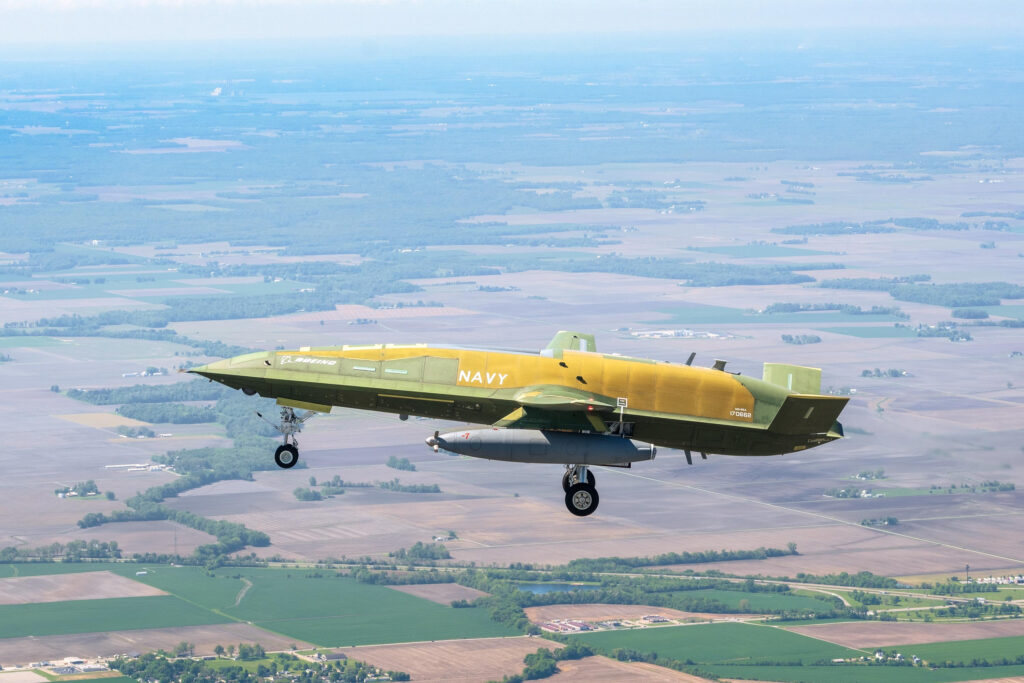
The Navy’s MQ-25A Stingray takes its first flight April 25 at Boeing’s facility at MidAmerica Airport in Mascoutah, Ill. The MQ-25 is the Navy’s first operational carrier-based unmanned aircraft. (Photo courtesy of Boeing)

From Naval Air Systems Command, April 27, 2026 

NAS PATUXENT RIVER, Md. — The U.S. Navy’s MQ-25A Stingray™ successfully completed its first test flight from Boeing’s facility at MidAmerica Airport in Mascoutah, Illinois, April 25, achieving a key step for unmanned carrier operations.  

The MQ-25A took off at 10:49 a.m. CDT and flew for approximately two hours. During the flight, U.S. Navy and Boeing Air Vehicle Pilots (AVPs) controlled the aircraft from the Unmanned Carrier Aviation Mission Control System MD-5 ground control station that includes Lockheed Martin’s MDCX™ system. The AVPs executed a series of maneuvers and tests, successfully validating the aircraft’s basic flight controls, engine performance, and handling characteristics.   

“Achieving this first flight underscores the strong partnership between the Navy and our industry partners,” said Rear Adm. Tony Rossi, who oversees the Program Executive Office for Unmanned Aviation and Strike Weapons (PEO (U&W)). “The MQ-25A is not just an aircraft; it’s the first step in integrating unmanned aerial refueling onto the carrier deck, directly enabling our manned fighters to fly further and faster. This capability is vital to the future of naval aviation.”  

The MQ-25A Stingray is the U.S. Navy’s first operational, carrier-based unmanned aircraft system, designed primarily to serve as an aerial refueling tanker. By taking over the refueling mission from crewed fighters, the MQ-25A will significantly extend the combat range and effective strike capability of the Carrier Air Wing.   

“I am incredibly proud of the team for working tirelessly over the last several months to achieve this milestone,” said Capt. Daniel Fucito, Unmanned Carrier Aviation program manager (PMA-268). “The successful first flight officially initiates the rigorous flight test program, which will focus on expanding the aircraft’s performance envelope and verifying all mission systems.”  

The MQ-25A integrated test team will continue ground control station integration, expanding the flight envelope, and verifying performance parameters prior to its ferry flight to Pax River later this year.  


Raytheon Proposes Next-Generation Jammer for Ground- and Ship-Based Defense

By Richard R. Burgess, Senior Editor 

ARLINGTON, Va. — Raytheon is demonstrating its Next-Generation Jammer Mid-Band (NGJ-MB) electronic attack arrays for ground-based or shipboard use, particularly in a counter-UAS (unmanned aerial system) role. 

The NGJ-MB currently serves in the airborne electronic attack role on the Navy’s EA-18G Growler electronic attack aircraft. Raytheon is looking at expanding its use in other domains. One reason is to use non-kinetic solutions to save on ammunition. 

“What we’re finding with high munitions usage, a lot of our customers are looking for non-kinetic options in products and capabilities to solve their problems,” said Camille Wilson, vice president for Requirements and Capabilities for the Raytheon Naval Power sector. 

“From a defense perspective, we need a number of different solutions,” Wilson said. 

She said that the NGJ-MB array itself can be used for such applications. 

“We’ve explored one array up to two, three, four arrays depending on what effect you need, what electric power out you need,” Wilson said. “With one array I could do a myriad of different things. I could use it on a vehicle. I could use a smaller system. If I wanted more capability and more power out or coverage, I could add more arrays. The interesting thing about the land-based variation that we’re looking at is I don’t have the same power and cooling constraints as I do on the airborne side, so there’s a lot more that we could do with it. There are a lot more configurations that we could use those arrays for.” 

Wilson was not at liberty to discuss “the full complement of capabilities for a ground-or-ship-based NGJ array, but what a lot of our customers are asking for is counter-UAS.” 

She noted that software changes on the NGJ-MB would be required for the counter-UAS role, but that “taking something that is in production, TRL-9 [Technology Readiness Level 9], that we know works, can we make a few software tweaks and optimize for a different mission set?”  

She said that in the counter-UAS role, the NGJ-MB could be used to jam or decoy drones. 

Raytheon has a demonstration system and is actively demonstrating the ground-based electronic attack capability, Wilson said. “We have multiple U.S. Government and departments and entities [with which] we’re discussing options for deployment. 


HII Builds on Manned-Unmanned Submarine Teaming Success with New Pentagon Deal Poised to Transform Undersea Warfare

New DIU Award further advances U.S. Navy’s ability to autonomously deploy and recover unmanned systems from submarines 

From HII

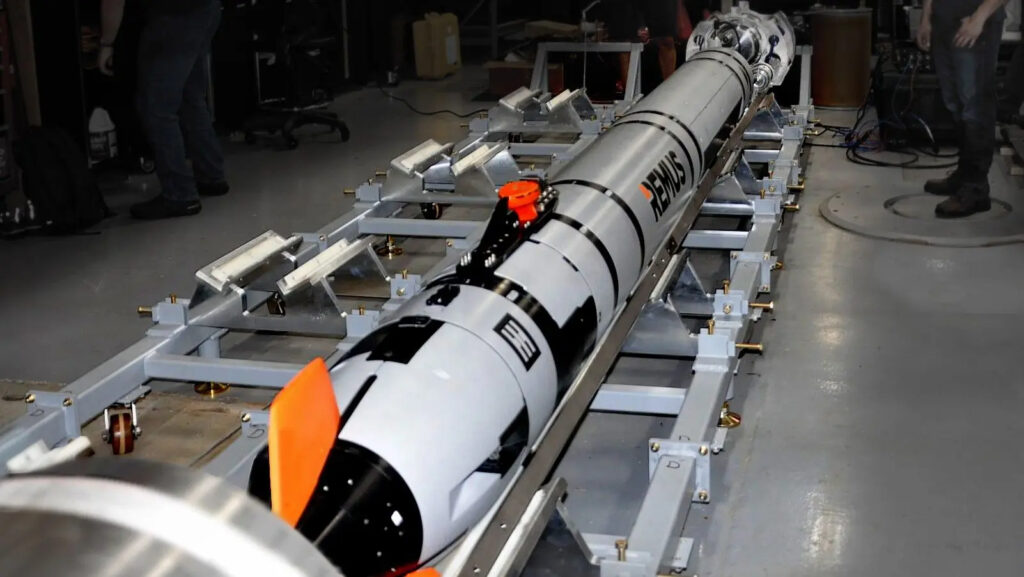
POCASSETT, Mass., April 27, 2026 (GLOBE NEWSWIRE) — HII (NYSE: HII), a global leader in unmanned and autonomous maritime platforms, has been awarded a contract by the Defense Innovation Unit (DIU) to deliver a submarine Torpedo Tube Launch and Recovery (TTLR) system. The system is designed to autonomously deploy and recover HII’s REMUS unmanned underwater vehicle (UUV) from U.S. Navy submarines. 

The DIU contract builds on HII’s 120-year leadership in undersea warfare as one of two builders of U.S. nuclear-powered submarines, as well as the world’s largest producer of UUVs, and on a series of recent milestone achievements in manned–unmanned teaming. HII is advancing fully integrated, autonomous maritime capabilities that expand the reach and enhance the effectiveness of the U.S. Navy and its allies. 

“This contract award reflects HII’s 25-year leadership in advancing autonomous unmanned maritime platforms and integrating them into submarine operations,” said Duane Fotheringham, president of the Unmanned Systems group in HII’s Mission Technologies division. “There is no company with more expertise in both the manned and unmanned sides of teamed operations. We look forward to continuing our strong partnership with the U.S. Navy to deliver the innovative solutions our forces urgently need in the subsea domain.” 

To date, HII has delivered more than 750 REMUS vehicles to over 30 countries, including 14 NATO members. More than 90% of those systems remain in service after more than two decades, underscoring their durability, reliability, and long-term lifecycle value. 

In June 2025, the U.S. Navy and Woods Hole Oceanographic Institution (WHOI) successfully advanced the ongoing Yellow Moray UUV capability, marking the first forward-deployed torpedo tube launch and recovery of an HII-built REMUS 600 UUV from the USS Delaware (SSN 791), a Virginia-class submarine constructed by HII. Delaware and an embarked unmanned undersea vehicle squadron (UUVRON-1) cadre, with WHOI support, conducted overseas operations that included three fully autonomous launch and recovery sorties conducted through the submarine’s torpedo tube without diver assistance. 

This demonstration represented a significant operational advancement in the autonomous teaming of manned and unmanned systems for intelligence, surveillance, and reconnaissance (ISR), as well as broader maritime missions. 

In July 2025, a joint team from HII, WHOI and the U.S. Navy’s Naval Undersea Warfare Center Division Newport completed the first recovery of the latest generation REMUS 620 into a Virginia-class submarine torpedo tube and shutterway test fixture at Seneca Lake, New York. 

During in-water testing, the REMUS 620 demonstrated advanced autonomous navigation and communication capabilities. The vehicle successfully docked with a shock and fire enclosure capsule (SAFECAP) within a submerged torpedo tube test fixture and executed reverse swim-out launch and safe separation procedures — validating critical operational functions for future deployment. 

These advancements reinforce HII’s role as a leading sea power company and a key innovator in manned-unmanned teaming across two core growth areas: nuclear-powered submarine design and construction, and autonomous unmanned systems. Integrating UUVs through standard submarine interfaces extends mission reach, enhances stealth, and reduces operational risk and crew burden.