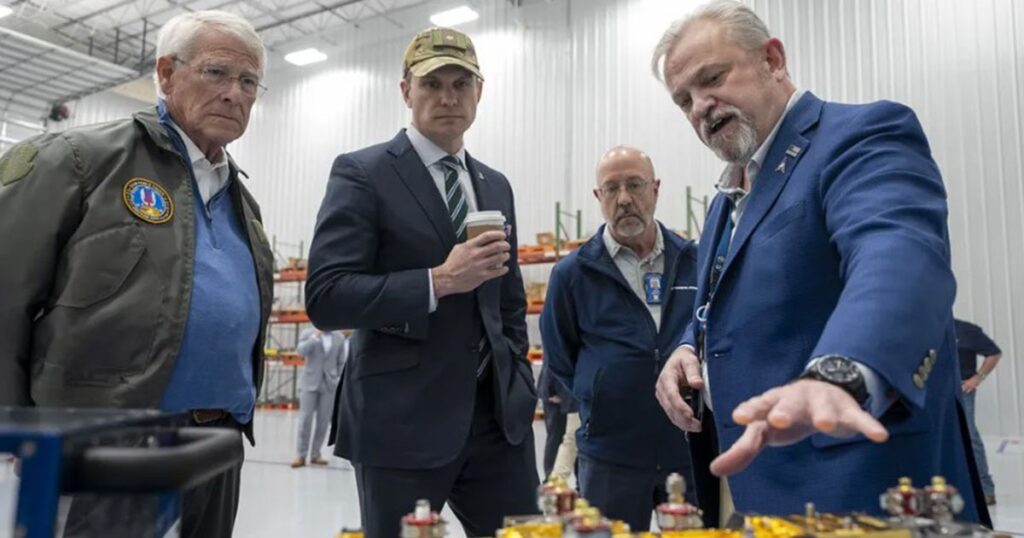
SECDEF Hegseth Tours General Atomics Manufacturing Facility
Pictured L to R: Senator Roger Wicker (R-Miss), Secretary of Defense Pete Hegseth, GA-EMS Vice President of Manufacturing Pete Rinaldi, GA-EMS President Scott Forney
Visit Emphasizes Directive to Expand Domestic Defense Industrial Base
From General Atomics Electromagnetic Systems
SAN DIEGO – 24 Mar 2025 – General Atomics Electromagnetic Systems (GA-EMS) hosted U.S. Secretary of Defense Pete Hegseth at its Manufacturing Center of Excellence in Tupelo, MS at the invitation of U.S. Senator Roger Wicker (R-Miss), the Chairman of the Senate Armed Services Committee. The visit punctuates Secretary Hegseth’s commitment to re-invigorate and expand the nation’s defense industrial base to rapidly deploy weapons technologies to support an expanding range of national security initiatives.
During his visit, Secretary Hegseth was briefed on GA-EMS’ manufacturing capabilities and expansive portfolio, with a focus on the company’s weapons systems including hypersonics, missiles and space-based tracking payloads; all of which facilitate a comprehensive, layered defense shield for early detection and rapid response in support of Golden Dome for America.
“It was great to host Secretary Hegseth in Mississippi as we engaged with some of our state’s best-in-class defense capabilities, including at General Atomics,” Chairman Wicker said. “The General Atomics facility in Tupelo has a nationally competitive workforce that conducts cutting-edge work in advanced military technologies. As Chairman of the Senate Armed Services Committee, I will always showcase Mississippi’s leading contributions for the warfighter and work to expand our state’s growing role in the defense industrial base.”
With over 750,000 square feet of manufacturing facilities located in Tupelo, Scott Forney, president of GA-EMS noted during the tour that the company’s commitment to and investment in research and development, its highly trained workforce, and its production capacity directly aligns with the Secretary of Defense’s stated goal of advancing “made in the U.S.” manufacturing capability to ensure the delivery of highly-capable, cost-effective weapons, specifically missile defense and hypersonics, to support the warfighter and advance America’s national interests. GA-EMS also has manufacturing facilities in Iuka, MS with strategic access to the Tennessee – Tombigbee Waterway and Gulf of America to facilitate the expansion of shipyard capacity to meet shipbuilding demand.
General Atomics was honored to host the Secretary of Defense and remains a committed partner to helping the Department of Defense deliver the most transformational and effective weapons to the warfighter at scale to support U.S. military operations.
MV Ocean Giant Conducting Cargo Offload to Support Operation Deep Freeze 2025
MCMURDO STATION, ANTARCTICA — The Military Sealift Command chartered ship MV Ocean Giant is conducting a cargo offload of supplies at McMurdo Station, Antarctica in support of the annual resupply mission Operation Deep Freeze 2025.
Ocean Giant arrived at McMurdo Station Jan. 26 and began the assembly and offload off a floating Marine Causeway System. The causeway, made-up of 24-foot pieces, replaces the ice-pier at McMurdo Station this year. Previously, an ice pier made up of rebar and frozen seawater, has been used for cargo offloads. Due to severe damage, the ice-pier is unusable this year.
Once the causeway was assembled and moved into place, Ocean Giant was able to moor and begin the cargo operations. The ship’s crew and members of Navy Cargo Handling Battalion ONE began the offload of 380 pieces of cargo, consisting of containers filled with mechanical parts, vehicles, construction materials, office supplies and electronics equipment, and mobile office units; supplies needed to sustain the next year of operations at McMurdo Station, Antarctica.
Once the offload is complete, Ocean Giant will be loaded with 360 containers of retrograde cargo for transportation off the continent. This includes trash and recyclable materials for disposal and equipment no longer required on the station. They will then depart McMurdo station, en route the United States.
Following Ocean Giant’s departure, MSC chartered ship MV Ocean Gladiator will arrive at the ice-pier, and will begin a cargo offload as well as retrieving the causeway.
“Operating in the remote and challenging environment of Antarctica is unique to the ODF mission,” said Marie Morrow, MSC’s representative in Antarctica. “Everyone involved has an important role to play and it is truly a joint mission. The ship operation takes teamwork and coordination from the ship’s crew, all elements of the Joint Task Force (United States Coast Guard, Army, Navy, Air National Guard), civilian contractors, and New Zealand Defense Force integrated into cargo operations. Everyone working on ODF has been a consummate professional and are committed to the success of the mission. I feel really fortunate to be a part of this year’s team.”
Operation Deep Freeze is a joint service, on-going Defense Support to Civilian Authorities activity in support of the National Science Foundation (NSF), lead agency for the United States Antarctic Program. Mission support consists of active duty, Guard and Reserve personnel from the U.S. Air Force, Navy, Army, and Coast Guard as well as Department of Defense civilians and attached non-DOD civilians. ODF operates from two primary locations situated at Christchurch, New Zealand and McMurdo Station, Antarctica. An MSC-chartered cargo ship and tanker have made the challenging voyage to Antarctica every year since the station and its resupply mission were established in 1955.
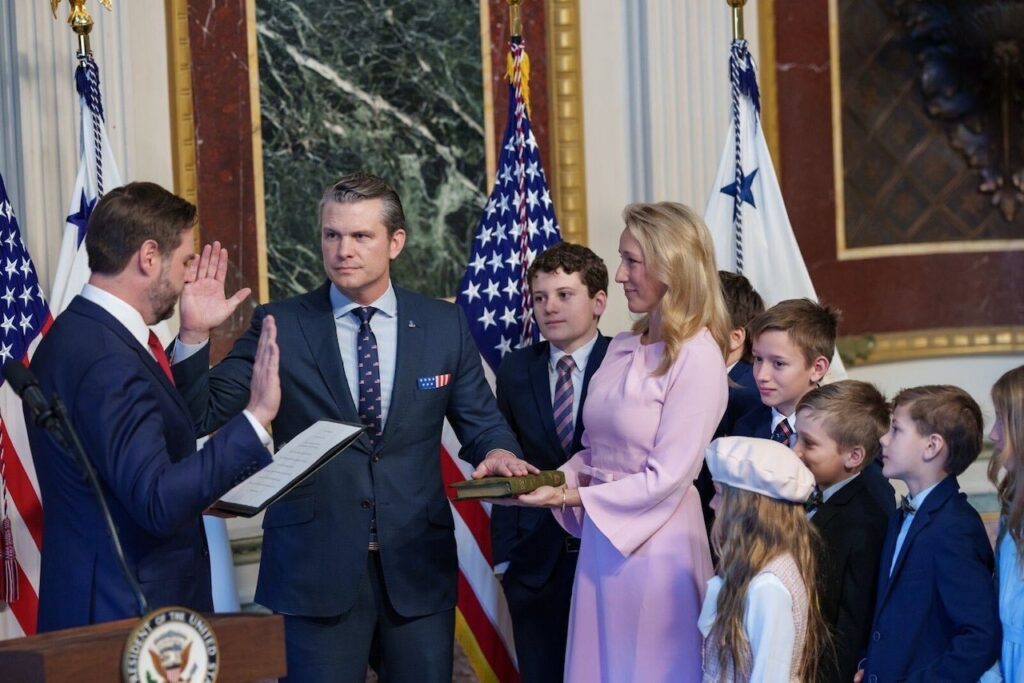
Secretary Hegseth’s Message to the Force
From U.S. Department of Defense Public Affairs, Jan. 25, 2025
ARLINGTON, Va. — The following message to the U.S. armed forces was released by the new Defense Secretary, Pete Hegseth:
“It is the privilege of a lifetime to lead the warriors of the Department of Defense, under the leadership of our Commander in Chief Donald J. Trump. We will put America First, and we will never back down.
The President gave us a clear mission: achieve Peace through Strength. We will do this in three ways — by restoring the warrior ethos, rebuilding our military, and reestablishing deterrence.
o We will revive the warrior ethos and restore trust in our military. We are American warriors. We will defend our country. Our standards will be high, uncompromising, and clear. The strength of our military is our unity and our shared purpose.
o We will rebuild our military by matching threats to capabilities. This means reviving our defense industrial base, reforming our acquisition process, passing a financial audit, and rapidly fielding emerging technologies. We will remain the strongest and most lethal force in the world.
o We will reestablish deterrence by defending our homeland — on the ground and in the sky. We will work with allies and partners to deter aggression in the Indo-Pacific by Communist China, as well as supporting the President’s priority to end wars responsibly and reorient to key threats. We will stand by our allies — and our enemies are on notice.
All of this will be done with a focus on lethality, meritocracy, accountability, standards, and readiness.
I have committed my life to warfighters and their families. Just as my fellow soldiers had my back on the battlefield, know that I will always have your back. We serve together at a dangerous time. Our enemies will neither rest nor relent. And neither will we. We will stand shoulder to shoulder to meet the urgency of this moment.
Like each of you, I love my country and swore an oath to defend the Constitution. We will do that each and every day, as one team. Together we will accomplish the President’s mission to deter war, and if necessary, defeat and destroy our enemies. Godspeed!”
Lawmakers Introduce SHIPS Act to Revitalize Shipbuilding, Commercial Maritime Industries
U.S. Merchant Marine Academy graduates throw their covers in celebration during the Merchant Marine Academy Commencement Ceremony in Kings Point, New York, June 22, 2024. Credit: U.S. Marine Corps | Staff Sgt. Kelsey Dornfeld
A bipartisan group of U.S. Senators and Representatives on Dec. 19 introduced introduced the Shipbuilding and Harbor Infrastructure for Prosperity and Security (SHIPS) for America Act, comprehensive legislation to revitalize the United States shipbuilding and commercial maritime industries.
The SHIPS for America Act was introduced by Sens. Mark Kelly (D-Arizona) and Todd Young (R-Indiana) and Reps. John Garamendi (D-California) and Trent Kelly (R-Mississippi). After decades of neglect, the United States has a weakened shipbuilding capacity, a declining commercial shipping fleet dwarfed by China and a diminished ability to supply the U.S. military during wartime, the lawmakers said.
They said the bipartisan proposal would restore American leadership across the oceans by establishing national oversight and consistent funding for U.S. maritime policy, incentivizing domestic shipbuilding, enabling U.S.-flagged vessels to better compete in international commerce, rebuilding the U.S. shipyard industrial base and expanding the mariner and shipyard workforce.
“We’ve always been a maritime nation, but the truth is we’ve lost ground to China, who now dominates international shipping and can build merchant and military ships much more quickly than we can,” said Kelly, a U.S. Navy veteran and the first U.S Merchant Marine Academy graduate to serve in Congress.
“The SHIPS for America Act is the answer to this challenge. By supporting shipbuilding, shipping, and workforce development, it will strengthen supply chains, reduce our reliance on foreign vessels, put Americans to work in good-paying jobs, and support the Navy and Coast Guard’s shipbuilding needs. I’m excited to introduce this comprehensive, fully paid for legislation today alongside my Republican and Democratic colleagues and our partners representing all parts of the industry, and together we’re going to work to get this effort across the finish line.”
“America has been a maritime nation since our founding, and seapower was a significant contributor to our rise to being the most powerful nation on earth. Unfortunately, the bottom line now is America needs more ships. Shipbuilding is a national security priority and a stopgap against foreign threats and coercion. Our bill will revitalize the U.S. maritime industry, grow our shipbuilding capacity, rebuild America’s shipyard industrial base, and support nationwide workforce development in this industry. This legislation is critical to our warfighting capabilities and keeping pace with China,” Young said.
The move drew support from a wide variety of maritime-related groups and is backed by the Navy League of the United States.
“The Navy League applauds the introduction of the SHIPS for America Act, a landmark legislative achievement that will comprehensively meet the needs of the U.S. merchant marine and bolster our shipbuilding industrial base,” said Mike Stevens, CEO of the Navy League.
“In today’s global threat environment, arguably the most perilous since the end of the Cold War, the United States must not only maintain the finest Navy, Marine Corps, and Coast Guard on the seas, but also ensure a robust U.S.-flag merchant marine and a resilient shipbuilding industrial base. These elements are crucial for safeguarding our national and economic security in the event of large-scale military conflict. The SHIPS for America Actaddresses these vital considerations and reaffirms that America is, and always will be, a maritime nation.”
The SHIPS for America Act would:
Coordinate U.S. maritime policy by establishing the position of Maritime Security Advisor within the White House, who would lead an interagency Maritime Security Board tasked with making whole-of-government strategic decisions for how to implement a National Maritime Strategy. The bill also establishes a Maritime Security Trust Fund that would reinvest duties and fees paid by the maritime industry into maritime security programs and infrastructure supporting maritime commerce.
Establish a national goal of expanding the U.S.-flag international fleet by 250 ships in 10 years by creating the Strategic Commercial Fleet Program, which would facilitate the development of a fleet of commercially operated, U.S.-flagged, American crewed, and domestically built merchant vessels that can operate competitively in international commerce.
Enhance the competitiveness of U.S.-flagged vessels in international commerce by establishing a Rulemaking Committee on Commercial Maritime Regulations and Standards to cut through the U.S. Coast Guard’s bureaucracy and red tape that limits the international competitiveness of U.S.-flagged vessels, requiring that government-funded cargo move aboard U.S.-flag vessels, and requiring a portion of commercial goods imported from China to move aboard U.S.-flag vessels starting in 2029.
Expand the U.S. shipyard industrial base, for both military and commercial oceangoing vessels, by establishing a 25 percent investment tax credit for shipyard investments, transforming the Title XI Federal Ship Financing Program into a revolving fund, and establishing a Shipbuilding Financial Incentives program to support innovative approaches to domestic ship building and ship repair.
Accelerate U.S. leadership in next-generation ship design, manufacturing processes, and ship energy systems by establishing the U.S. Center for Maritime Innovation, which would create regional hubs across the country.
Make historic investments in maritime workforce by establishing a Maritime and Shipbuilding Recruiting Campaign, allowing mariners to retain their credentials through a newly established Merchant Marine Career Retention Program, investing in long-overdue infrastructure needs for the U.S. Merchant Marine Academy, and supporting State Maritime Academies and Centers for Excellence for Domestic Maritime Workforce Training and Education. The bill also would streamline and modernize the U.S. Coast Guard’s Merchant Mariner Credentialing system.
U.S. 7th Fleet Holds Change of Command, Welcomes New Commander
By U.S. 7th Fleet Public Affairs, Feb. 15, 2024
YOKOSUKA, Japan – U.S. 7th Fleet held a change of command ceremony Feb. 15 at the Fleet Activities Yokosuka Theater.
Vice Adm. Fred W. Kacher relieved Vice Adm. Karl O. Thomas as the 54th commander of the world’s largest forward-deployed naval force, U.S. 7th Fleet.
“To the men and women of 7th Fleet, it has been my sincere honor to lead this forward deployed team as you demonstrated daily how professional navies operate to secure the maritime commons and uphold the rules based international order,” said Thomas. “To my counterparts in our ally and partner nations throughout the region, your professionalism and friendship has been the greatest reward as we operated as one seamless team. I remain inspired by your commitment to maintaining a free and open Indo-Pacific.”
Prior to commanding 7th Fleet, Thomas served as the assistant deputy chief of naval operations, plans, and strategy, a role Kacher also held. Thomas began his career as an E-2C Hawkeye aviator, and he commanded a carrier airborne early warning squadron, two aircraft carriers and the forward-deployed Carrier Strike Group in Japan. His follow-on assignment will be the deputy chief of naval operations for information warfare.
During the ceremony, Thomas emphasized the critical importance of his close relationships with fleet commander counterparts throughout the Indo-Pacific. Throughout his tenure, Thomas led numerous advanced dual-carrier operations, multilateral events, critical freedom of navigation operations, and Taiwan Straits transits, among other high-visibility exercises and operations with allies and partners from across the Indo-Pacific.
Vice Adm. Blake Converse, deputy commander, U.S. Pacific Fleet, spoke highly of Thomas’s visionary leadership and the importance of the rules-based international order in the Indo-Pacific.
“Our national command authority continues to recognize that this is the most important and consequential theater that we operate our forces in,” said Converse. “As such, we have grave responsibilities to deter aggression, to protect the international rules-based order, and to ensure freedom of navigation.”
Kacher began his career as a surface warfare officer aboard cruisers and destroyers. He was the first commanding officer of the Arleigh Buke class guided-missile destroyer USS Stockdale (DDG 106), and went on to serve as the commodore of Destroyer Squadron Seven, commander of Expeditionary Strike Group Seven; executive officer to the Supreme Allied Commander, Europe, and Commander, U.S. European Command; and chief of staff to Commander, Naval Surface Force, U.S. Pacific Fleet. He most recently served as the acting Superintendent of the U.S. Naval Academy.
“I could not be more humbled to lead the U.S. 7th Fleet,” said Kacher. “I am honored to re-join our forward deployed men and women as we operate combat credible naval forces in one of the most complex maritime regions in the world, and I look forward to engaging with our allied and partner navies in our shared commitment to a free and open Indo-Pacific.”
U.S. 7th Fleet is the U.S. Navy’s largest forward-deployed numbered fleet and routinely interacts and operates with allies and partners in preserving a free and open Indo-Pacific region.
For more news from Commander, U.S. 7th Fleet, visit https://www.c7f.navy.mil/.
USNS Brunswick Returns Home After 7 Years in the Western Pacific
Military Sealift Command’s sixth expeditionary fast transport vessel USNS Brunswick shifted its hub port in Saipan to Joint Expeditionary Base Little Creek – Fort Story, Virginia, Feb. 3.
NORFOLK, Va. ꟷ Military Sealift Command’s sixth expeditionary fast transport vessel USNS Brunswick (T-EPF 6) shifted its hub port in Saipan to Joint Expeditionary Base Little Creek – Fort Story, Va., Feb. 3. The evolution signified the completion of a seven-year forward deployment that began Jan. 30, 2017, in support of military logistics operations in U.S. 7th, 5th, and 3rd Fleets’ areas of operation.
While steaming more than 21,600 nautical miles in support of a variety of high visibility, multinational U.S. Navy and partner nation operations in several Pacific countries, including Australia, Canada, Japan, Malaysia, Peru, the Philippines, South Korea, Thailand, and the United Kingdom, Brunswick circumnavigated the globe, a first for the vessel and a first for an EPF.
Built for its speed and its capacity to support a wide range of operational maneuver and sustainment, relief operations in small or damaged ports, global fleet stations operations, flexible logistics support and rapid transport as an alternative to airlift, Brunswick’s performance remained rock-solid throughout its seven-year deployment.
2017
While supporting military logistics operations in U.S. 3rd Fleet, Brunswick participated in Operation Triggerfish 2017, conducted several port calls to Pohnpei and Chuuk in the Federated States of Micronesia and Guam, and hosted distinguished visitors such as Robert Riley, U.S. ambassador to Micronesia. This vital cargo and passenger operation fostered relationships with the islands visited and provided potential sites for future military infrastructure projects.
2018
Brunswick operated from Saipan in support of military operations throughout the western Pacific Ocean in 2018. While there, Brunswick visited places such as Guam, Yap, Thailand and Malaysia as part the 2018 Pacific Partnership, an annual mission focused on disaster preparedness and humanitarian assistance, conducted in the Indo-Pacific with more than 500 personnel from several Pacific countries, including Australia, Canada, Japan, Malaysia, Peru, the Philippines, South Korea, Thailand and the United Kingdom. The EPF also participated in several port visits to Lumut and Kuching and Malaysia. The crew took advantage of the opportunity to experience Malaysia’s rich culture and strengthen ties with the local population. Port visits such as these serve as an important element in the U.S. Navy’s theater security cooperation efforts by enhancing solid relationships with partner nations throughout the region.
2019
In addition to participating in its second Pacific Partnership in 2019, Brunswick, together with sister ship Fall River (T-EPF 4), conducted engineering projects, hosted medical events, and oversaw humanitarian assistance and disaster response training exercises throughout the pacific region.
EPFs, working together, bridge the gap between high-speed, low-capacity airlift, low-speed, and high-capacity sealift in order to provide for the movement of personnel, equipment, and supplies over operational distances and the sustainment of joint theater and multinational logistics that help to augment MSC’s combat logistics force. Additionally, Brunswick docked in the Lower Mortlock Islands to support local communities recovering from the aftermath of Typhoon Wutip, a Category 5 super typhoon that affected Guam, Federated States of Micronesia and the Northern Mariana Islands. The typhoon claimed the lives of 86 people and injured hundreds of others.
2020
The Brunswick crew was recognized in 2020 for their extraordinary support and contributions to the Typhoon Wutip relief efforts. U.S. Maritime Administration Administrator Rear Adm. (Ret.) Mark H. Buzby presented the crew with the Merchant Marine Medal for Outstanding Achievement. In addition, Brunswick supported the Valiant Shield 2020, a joint force training exercise to protect the Indo-Pacific. During the exercise, more than 11,000 Soldiers, Marines, Sailors, and Airmen synchronized to train in a real-world environment to demonstrate their readiness to respond to any contingency at a moment’s notice.
2021
Brunswick took part in Noble Jaguar, in 2021, an integrated naval exercise in and around Japan that included units from the III Marine Expeditionary Force (III MEF), along with elements of U.S. 7th Fleet.
2022
Brunswick, along with sister ships USNS Millinocket (T-EPF 3) and USNS Puerto Rico (T-EPF 11), in 2022, supported the CARAT exercise, Resolute Dragon, Koa Moana, Valiant Shield, and various other regional security cooperation exercises for III MEF.
2023
The expeditionary fast transport vessel played an instrumental role in exercises Talisman Sabre, Balikatan, Keen Sword and Kamandag for III MEF in 2023. Marines and other members of the U.S. military routinely embark on ships like Brunswick to transport cargo, equipment, and personnel expeditiously. Likewise, Brunswick supported I MEF for three months during its Marine Rotational Force – Southeast Asia deployment. EPFs provide warfighters flexibility as the ship’s storage capacity can be tailored to meet mission objectives.
While in U.S. 5th Fleet, Brunswick accomplished a humanitarian assistance mission that resulted in the movement of 836 evacuees from 18 nations, including 168 U.S. citizens, from the Port of Sudan to Jeddah, Saudi Arabia in support of the Department of State’s efforts to evacuate and assist U.S. citizens and other civilians during the civil war in Sudan.
Throughout this seven-year deployment, the superb work performed by the Brunswick crew helped to improve interoperability and foster trust and cooperation with partner nations, all of which is in keeping with the Navy’s goal to enhance regional preparedness for crisis response.
MSC operates approximately 120 non-combatant civilian-crewed ships that replenish U.S. Navy ships, conduct specialized missions, and strategically preposition combat cargo at sea around the world while moving military cargo and supplies used by deployed U.S. forces and coalition partners.
To learn more about MSC visit: https://sealiftcommand.com.
Furuno Electronics Complement New NSMV Training Vessel “Empire State VII”
Release from Furuno
*****
Orlando, FL - Philly Shipyard has delivered a new vessel purpose-built for training new cadets and officers who will ultimately crew both government and commercial-owned sealift ships. The 159.85-meter Empire State VII was built by TOTE Services, LLC under the NSMV (National Security Multi-Mission Vessel) program for the US Maritime Administration (MARAD) and boasts an incredible suite of quality Furuno marine electronics. The first of five new training vessels built in the United States for each of the state maritime academies in America, the Empire State includes a full training bridge and numerous training spaces, can accommodate over 600 cadets, and will be put into service at SUNY Maritime College in Fort Schuyler, N.Y. This remarkable training ship and instructional hub boasts a dual mission: facilitating the education of merchant mariners and providing vital aid in humanitarian and disaster relief operations during national crises.
The remarkable electronics suite aboard the Empire State includes redundant X-Band and S-Band Chart Radars, ECDIS stations, and multiple communications packages. The Furuno-built, industrial Linux-based operating system, dual redundant ethernet networks, and refined installation setup greatly simplified the project, allowing this sophisticated system to be ready to operate well ahead of schedule. Hundreds of hours were required to install and configure all of the Empire State’s components, and the new navigation and communications suite will provide a safe, steady, and versatile navigation and training workhorse for many years to come.
“The Empire State’s Integrated Navigation System is one of the largest and most comprehensive Furuno systems ever commissioned,” said Bill Haynes, Deep Sea Product Manager for Furuno USA, Inc. “Empire State sets a new standard for safety, functionality, and redundancy with dual bridges, three chart radars, ten multifunction workstations, Voyage Data Recorder, a complete acoustics suite, comprehensive Alert Management System, and dual GMDSS suites. Each workstation is ECDIS, RADAR, and CONNING capable, and both the navigation bridge and the training bridge have the tools they need to navigate safely and train our future navigation officers with the safest, most reliable, and functionally competent sensors and processors available.
“Furuno USA is very proud to have been selected to provide our equipment and services to support this fine vessel, and we’d like to thank the US Maritime Administration, TOTE Services, Philly Shipyard, and SUNY Maritime College for placing your trust in us.”
NSMV II, the second of the planned five vessels, is scheduled for delivery in 2024, and work is well underway for NSMV III and NSMV IV, with all five vessels to be completed and in service by 2026.
For more information on Furuno and their complete line of Marine Electronics, contact: Furuno U.S.A., 4400 N.W. Pacific Rim Blvd., Camas, WA 98607, or visit their website at www.FurunoUSA.com.
HII Donates Dry Dock Gate to Become Part of Sustainable Fish Reef
NEWPORT NEWS, Va., July 06, 2023 (GLOBE NEWSWIRE) — HII (NYSE: HII) announced today that its Newport News Shipbuilding division partnered with the Virginia Marine Resource Commission (VMRC) to donate and sink a former dry dock caisson gate offshore, giving it new life as part of an artificial reef.
The donation is aligned with HII’s sustainability efforts to protect our shared resources and reflects a corporate commitment to a sustainable, resilient and inclusive future.
Caisson gates are used at the harbor end of a dry dock, with pipes inside allowing for water from the James River to enter when NNS needs to flood the dry dock. This particular gate, originally put into service at NNS in 1967, was part of a dry dock no longer in use at the shipyard.
NNS crews worked to prepare the caisson gate, ensuring that it was environmentally ready to take on its new mission. That included stripping all loose paint, removing electrical items and ensuring all oils and solvents were removed. The gate was also ballasted for sinking to ensure it landed on the seabed properly.
In late June, the gate left NNS, was towed offshore and sunk. It is now taking on new life as part of the VMRC Tower Reef, which is already home to multiple barges, other vessels and subway cars.
“Donating this caisson gate to give it a new purpose was a natural choice for us,” said John Anderson, NNS senior dock master, who spearheaded the project. “We understand that nurturing and protecting our oceans isn’t just the right thing to do, it also makes good business sense as we serve our customer, shipbuilders and community.”
The donation directly supports Virginia’s Artificial Reef Program, which aims to replicate natural fish habitats as closely as possible and increase fishing opportunities for anglers.
“VMRC has been building and enhancing reefs for citizens of the commonwealth for over 40 years,” explained VMRC Commissioner Jamie Green, a strong proponent for the program. “We are excited to partner with NNS to utilize material that has such a rich history with the Hampton Roads area.”
This partnership is part of HII’s continued commitment to a sustainable future. The 2023 HII Sustainability Update is available here.
Contract for 2 NOAA research ships awarded to Thoma-Sea Marine Constructors, LLC.
NOAA Ship Fairweather is one of the current charting and mapping vessels in the NOAA fleet. Credit: NOAA
Release from NOAA
*****
Investments from the Inflation Reduction Act support Biden-Harris Administration’s Investing in America Agenda
NOAA will add two new ships to its fleet of groundbreaking research vessels. The agency selected Thoma-Sea Marine Constructors, LLC. for a $624.6 million contract to initially design and build two cutting-edge research vessels, with an option to purchase two more. The first two ships will be built in Houma, Louisiana, with an expected delivery date of 2027 and 2028.
The new ships will focus primarily on ocean mapping and nautical charting as part of NOAA’s mission to deliver tools and information to help mariners safely navigate the nation’s ports and harbors. Ships from around the world move $1.5 trillion worth of products in and out of U.S. ports every year and rely on navigation charts to do so safely. The new vessels will have additional capabilities to help assess and manage living marine resources and collect data for oceanographic monitoring, research and modeling activities.
“These state-of-the-art ships will ensure that we can continue to meet NOAA’s mission to support safe navigation, coastal resource management and the nation’s blue economy,” said NOAA Administrator Rick Spinrad, Ph.D. “I’m also proud that these new vessels will harness modern engines and design that will move NOAA forward in reducing its own emissions with an eye towards achieving a net-zero fleet.”
The ships will be designed to coordinate, acquire and process large data sets like those gathered from mapping the seafloor and characterizing marine habitats. They will also have the ability to deploy crewed survey work boats, scientific equipment and uncrewed systems, which enhance the work the ship does.
“This is another milestone in NOAA’s effort to recapitalize our aging fleet of ships,” said NOAA Corps Rear Adm. Nancy Hann, director of NOAA Marine and Aviation Operations and the NOAA Commissioned Officer Corps. “These ships are vital for mapping the United States Exclusive Economic Zone, enabling maritime commerce and responding to natural disasters, and will allow us to meet critical at-sea data collection requirements for the economic security, public safety and national security for many years to come.”
This contract was awarded following a request for proposals that was open June–October 2022.
The design and construction of these new ships is funded in part by the Inflation Reduction Act — a historic $3.3 billion investment to help communities, including tribes and vulnerable populations, prepare, adapt and build resilience to weather and climate events in pursuit of a climate-ready nation. The act also supports improvements to weather and climate data and services, and strengthens NOAA’s fleet of research airplanes and ships.
The research and survey ships operated, managed and maintained by NOAA Marine and Aviation Operations comprise the largest fleet of federal research ships in the nation. Ranging from large oceanographic research vessels capable of exploring the world’s deepest ocean, to smaller ships responsible for charting the shallow bays and inlets of the U.S. The fleet supports a wide range of marine activities, including fisheries surveys, nautical charting and ocean and climate studies. NOAA ships are operated by NOAA Corps officers and civilian professional mariners.
Climate, weather, and water affect all life on our ocean planet. NOAA’s mission is to understand and predict our changing environment, from the deep sea to outer space, and to manage and conserve America’s coastal and marine resources. See how NOAA science, services, and stewardship benefit your community: Visit noaa.gov for our latest news and features, and join us on social media.
U.S. Prevents Iran from Seizing Two Merchant Tankers in Gulf of Oman
By U.S. Naval Forces Central Command Public Affairs | July 05, 2023
GULF OF OMAN — On July 5, U.S. forces prevented two attempted commercial tanker seizures by the Iranian Navy after the Iranians had opened fire in one of the incidents near the coast of Oman.
Both of these incidents occurred in international waters.
At 1 a.m. local time, one Iranian naval vessel approached the Marshall Islands-flagged oil tanker TRF Moss in international waters in the Gulf of Oman. The Iranian vessel departed the scene when U.S. Navy guided-missile destroyer USS McFaul (DDG 74) arrived on station. Additionally, the U.S. Navy deployed surveillance assets, including MQ-9 Reaper and P-8 Poseidon maritime patrol aircraft.
Approximately three hours later, the U.S. Navy received a distress call from Bahamian-flagged oil tanker Richmond Voyager while the ship was more than 20 miles off the coast of Muscat, Oman, and transiting international waters toward the Arabian Sea. Another Iranian naval vessel had closed within one mile of Richmond Voyager while hailing the commercial tanker to stop.
McFaul directed course toward Richmond Voyager at maximum speed as the merchant tanker continued its transit. Prior to McFaul’s arrival on scene, Iranian personnel fired multiple, long bursts from both small arms and crew-served weapons. Richmond Voyager sustained no casualties or significant damage. However, several rounds hit the ship’s hull near crew living spaces. The Iranian navy vessel departed when McFaul arrived.
In May, the United States increased the rotation of ships and aircraft patrolling the Strait of Hormuz with partners following an uptick in Iranian merchant vessel seizures. The increased force presence supports multinational efforts under the International Maritime Security Construct and bilaterally with partner nations to deter threats to commercial shipping and reassure regional mariners.
“I couldn’t be prouder of the entire [U.S. Naval Forces Central Command] team, especially the exceptional effort by the McFaul crew, for immediately responding and preventing another seizure,” said Vice Adm. Brad Cooper, commander of U.S. Naval Forces Central Command, U.S. 5th Fleet and Combined Maritime Forces. “We remain vigilant and ready to protect navigational rights in these critical waters.”
Since 2021, Iran has harassed, attacked or seized nearly 20 internationally flagged merchant vessels, presenting a clear threat to regional maritime security and the global economy.