Marine Corps Lays Out Aggressive Modernization Efforts in Force Design Update
From Headquarters, U.S. Marine Corps, Oct. 23, 2025
HEADQUARTERS, MARINE CORPS – The Commandant of the Marine Corps, Gen. Eric M. Smith, published the 2025 Force Design Update, which lays out how the Marine Corps is aggressively pursuing modernization initiatives to ensure it remains a globally responsive, naval expeditionary force. These efforts are crucial for maintaining readiness and lethality in an era of rapidly evolving technology and increasingly capable adversaries.
“Force Design is the Marine Corps’ strategic priority, and this update makes clear both our progress and our direction,” said Gen. Smith. “We have strengthened formations, fielded new capabilities, and refined our concepts, but modernization remains a continuous campaign of learning and adaptation.”
The update highlights the value today’s Marine Corps provides to the Joint Force and the nation, characterized by MAGTFs that are balanced, multi-domain, combined arms, naval expeditionary formations.
This update also describes results of modernization already delivered across the Marine Corps. We have strengthened formations, fielded new capabilities, and refined our concepts. Forward-deployed Marines remain postured across multiple theaters, ready to conduct sea-denial and amphibious operations, seize key terrain, and enable joint and combined kill webs in support of naval and joint campaigning.
Additionally, the update describes where the Marine Corps will focus efforts to adapt faster than our adversaries, integrate seamlessly with the Navy and Joint Force, and remain ready for the future fight.
Marine Fighter Attack Squadron 542 Returns from Historic Deployment with F-35B
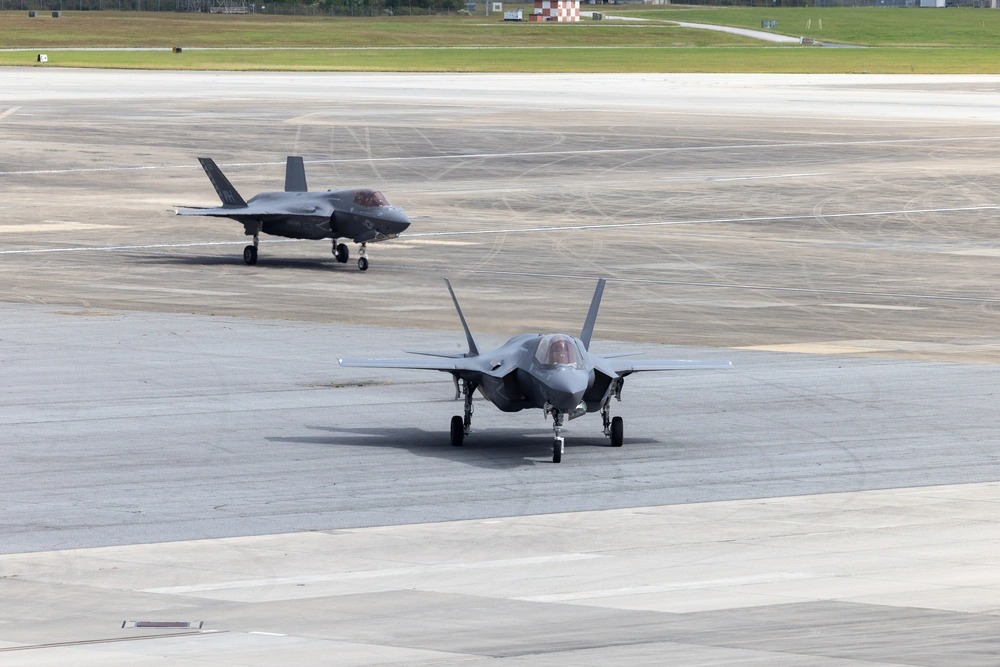
U.S. Marine Corps pilots with Marine Fighter Attack Squadron (VMFA) 542, Marine Aircraft Group 14, 2nd Marine Aircraft Wing, taxi F-35B Lightning II aircraft at Marine Corps Air Station Cherry Point, North Carolina, Oct. 8, 2025. Marines with VMFA-542 returned to MCAS Cherry Point following a deployment in the U.S. Central Command area of responsibility. (U.S. Marine Corps photo by Cpl. Landon Lingle)
MacDill AIR FORCE BASE, Fla. — Marine Fighter Attack Squadron 542 (VMFA-542), operating the F-35B Lightning II stealth fighter, has successfully returned from a historic five-month deployment to the U.S. Central Command (CENTCOM) area of responsibility, marking a major milestone in Marine Corps aviation and joint force integration.
During the deployment, VMFA-542 made a significant operational and strategic impact in the CENTCOM AOR. The squadron conducted Close Air Support, Armed Overwatch, and Defensive Counter-Air missions in support of Marine, Navy, Army, coalition, and partner nation forces. They advanced F-35 tactics, techniques, and procedures while demonstrating the aircraft’s flexibility in real-world operations.
The unit flew more than 1,099 combat sorties and accumulated over 4,736 mishap-free flight hours, providing essential support to CENTCOM’s integrated air operations. VMFA-542 not only enhanced deterrence, supported regional maritime security, and deepened interoperability through combined training with allied and partner air forces, but also led the way in USMC F-35 flight hours, maintaining a high Aircraft Mission Capable readiness rate, setting the standard for aviation units across the fleet.
“VMFA-542’s historic deployment has set new benchmarks for Marine Corps aviation, demonstrating that a forward deployed F-35B squadron can deliver unmatched combat power and readiness while seamlessly integrating with Joint Forces during a major regional crisis,” said LtCol Carlo F. Bonci, Executive Officer, Marine Fighter Attack Squadron 542.
As part of CENTCOM’s Air Component Ninth Air Force (Air Forces Central), VMFA-542 integrated into coalition air and defense operations. The addition of the F-35B Lightning II brought a major upgrade in tactical flexibility, intelligence gathering, and precision strike capabilities.
The F-35B is a fifth-generation stealth fighter uniquely capable of short takeoffs and vertical landings, providing the Marine Corps with operational agility across both air-to-air and air-to-ground missions.
This deployment underscores the Marine Corps’ commitment to maintaining readiness and effectiveness in complex environments while reinforcing partnerships with regional allies. VMFA-542 set a new standard for aviation units across the fleet, leaving a tangible impact on the CENTCOM mission recognized by joint and coalition commanders alike.
Japan, U.S. Forces Begin Multilateral Exercise ANNUALEX 2025
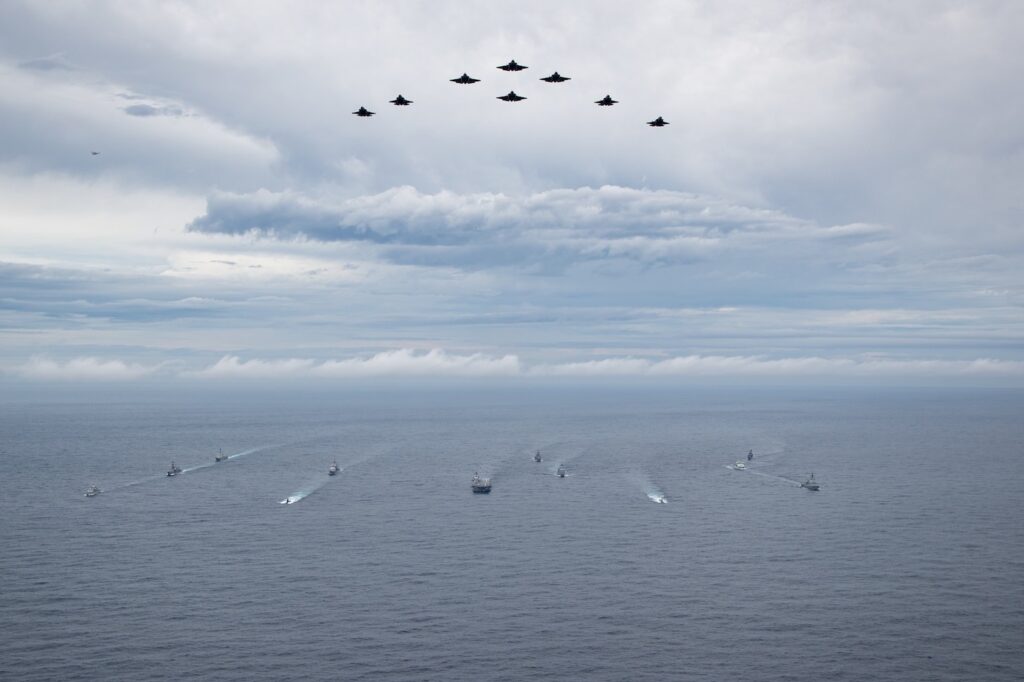
PHILIPPINE SEA (Oct. 20, 2025) – Japan Maritime Self-Defense Force, U.S. Navy and U.S. Marine Corps forces with Royal Australian Navy, Royal Canadian Navy, and French Navy sail and fly together in the Philippine Sea, Oct. 20, 2025 in support of Annual Exercise (ANNUALEX) 25. (U.S. Navy photo by Petty Officer 1st Class R. Ezekiel Duran)
PHILIPPINE SEA – The Japan Maritime Self-Defense Force (JMSDF), the U.S. Marine Corps, and U.S. Navy begin the multilateral exercise Annual Exercise (ANNUALEX) 2025 in the Philippine Sea, Oct. 20, 2025.
This year’s ANNUALEX focuses on enhancing the Japan and U.S. bilateral alliance within a multilateral context through maritime communication tactics, anti-submarine warfare operations, air warfare operations, replenishment-at-sea, and more. JMSDF Izumo-class helicopter-capable, anti-submarine warfare destroyer JS Kaga (DDH 184) leads the JMSDF participation in this year’s ANNUALEX.
Held every two years, ANNUALEX is led by the JMSDF to provide an opportunity to refine and build upon existing combat interoperability capabilities, enhancing readiness across all platforms. This serves as a deterrent against regional instability and aggression.
U.S. participating assets include the U.S. Navy Arleigh Burke-class guided-missile destroyer USS Shoup (DDG 86), Ticonderoga-class guided missile cruiser USS Robert Smalls (CG 62), P-8A Poseidon, Lewis and Clark-class dry cargo ships USNS Amelia Earhart (T-AKE 6), USNS Wally Schirra (T-AKE 8), fleet replenishment oiler USNS Tippecanoe (T-AO 199), a U.S. submarine, and U.S. Marine Corps F-35B Lightning II is assigned to Marine Fighter Attack Squadron (VMFA) 242.
Participating forces will also include the Royal Australian Navy (RAN) and Air Force (RAAF), Royal Canadian Navy (RCN) and Air Force (RCAF), French Navy (FN), and Royal New Zealand Air Force (RNZAF).
The previous ANNUALEX, held in November 2023, featured Carrier Strike Group 1, represented by its flagship Nimitz-class aircraft carrier USS Carl Vinson (CVN 70), during operations in U.S. 7th Fleet.
U.S. 7th Fleet is the U.S. Navy’s largest forward-deployed numbered fleet and routinely interacts and operates with allies and partners in preserving a free and open Indo-Pacific region.
AH-1Z Viper Aviation Mishap near Imperial Gables, California
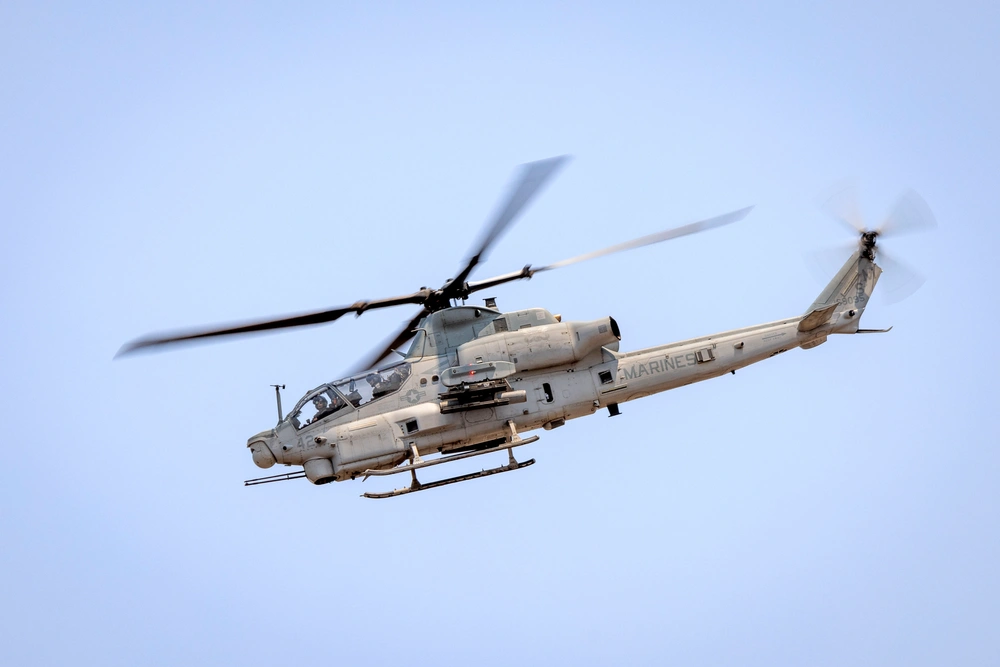
A U.S. Marine Corps AH-1Z Viper assigned to Marine Light Attack Helicopter Squadron (HMLA) 369, Marine Aircraft Group 39, 3rd Marine Aircraft Wing, flies during a Helicopter Outlying Landing Field training event at Marine Corps Base Camp Pendleton, California, Aug. 5, 2025. (U.S. Marine Corps photo by Lance Cpl. Seferino Gamez)
The following statement from the 3rd MAW was released on Oct. 17, 2025:
At approximately 7:05 p.m. PDT Oct. 16, 2025, an AH-1Z Viper assigned to Marine Light Attack Helicopter Squadron (HMLA) 369, Marine Aircraft Group 39, 3rd Marine Aircraft Wing, experienced an aviation mishap during routine operations near an unpopulated area of Imperial Gables, California. The crew of two pilots were transported to separate hospitals for medical treatment. The first pilot was transported to Pioneers Memorial Hospital, Brawley, California, and is confirmed deceased. The second pilot was transported to Desert Regional Medical Center, Palm Springs, California, and is in stable condition.
Maj. Gen. James B. Wellons, the commanding general of 3rd MAW, issued the following statement, “It is with profound sadness that I share the loss of a Marine from 3rd Marine Aircraft Wing and the “Gunfighters” while conducting a training flight in support of the Marine Corps Weapons and Tactics Instructor Course. This Marine made the ultimate sacrifice, and we are forever grateful for his selfless commitment and willingness to go into harm’s way. To the family, friends, and loved ones of our fallen Marine, we send our deepest condolences and offer our unwavering support during this time of grief.”
As a matter of policy, we will not release the identity of a deceased service member until 24 hours after all next of kin notifications have been completed.
Though we understand the inherent risks of military service, any loss of life is always difficult. The 3rd Marine Aircraft Wing stands firm in its commitment to supporting the families, friends, and fellow service members of our fallen Marine.
RTX’s Raytheon Begins Initial Production of SharpSight Surveillance Radar
Radar will deliver unmatched search and track capabilities for both land and maritime surveillance missions
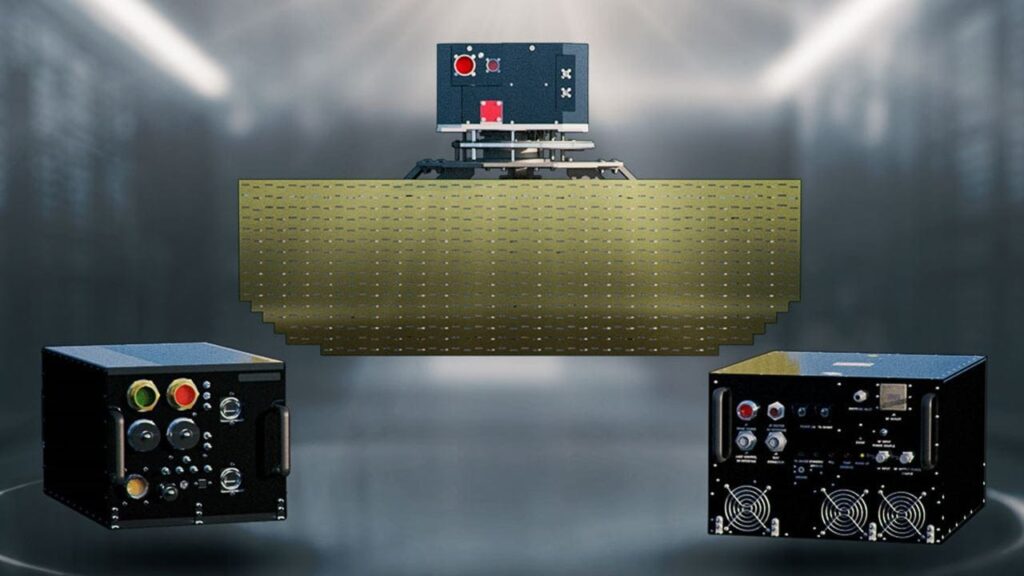
MCKINNEY, Texas (October 13, 2025) — Raytheon, an RTX (NYSE: RTX) business, has launched the initial production of its new SharpSight multi-domain surveillance radar. This next-generation system will provide high-altitude, real-time, high-resolution imaging with wide-area search and tracking for land and maritime surveillance, operating day or night in any weather condition.
SharpSight fuses the capabilities of two of Raytheon’s proven radar families – the Highly Integrated Synthetic Aperture Radar (HISAR) and the SeaVue Multi-Role Radar (SVMR) – and can be rapidly integrated on a variety of manned and unmanned systems. Its open architecture enables inexpensive, rapid upgrades, ensuring operators remain ahead of emerging threats.
“This radar represents the next step in Raytheon’s long legacy of intelligence, surveillance and reconnaissance innovation,” said Daniel Theisen, president of Advanced Products and Solutions at Raytheon. “By merging the proven capabilities of HISAR and SeaVue, we’re delivering a flexible, exportable and affordable radar system designed to outperform on the most demanding multi-domain surveillance missions.”
SharpSight is designed for high-altitude precision and persistence, enabling critical missions such as anti-surface warfare, border protection, coastal monitoring, search and rescue, long-range surveillance, and more. It conforms with the latest U.S. Government export policy guidance enabling these advanced intelligence, surveillance and reconnaissance capabilities to be offered to global partners and allies.
Eureka Naval Craft’s New Ultra High-Speed Catamaran Set to Revolutionize Army and Marine Expeditionary Operations
Bobcat offers rapid, resilient, and cost-effective access to contested coastlines, rivers, and islands; production-ready in U.S. shipyards.
WASHINGTON — Eureka Naval Craft today unveiled the AIRCAT Bobcat, a 57-foot, ultra high-speed catamaran landing craft designed to move personnel and materiel rapidly into littoral zones, up rivers, and through estuaries where ports and infrastructure are limited or denied.
Autonomous or optionally manned, the all-aluminum Bobcat can carry up to 10 tons of cargo or 36 troops. It has a top speed of 50 knots and a range of 350 nautical miles at an average speed of 38 knots, while range can be extended with additional modular fuel tanks.
“The Bobcat is quite literally the pick-up truck of the littorals and will revolutionize Army and Marine Corps expeditionary operations,” said Bo Jardine, CEO of Eureka Naval Craft. “It is the practical workhorse for modern ship-to-shore movement, and it is production-ready today.
“Bobcat can be produced rapidly and cost-effectively in multiple Tier 2 and Tier 3 U.S. shipyards with which we have collaborated, including Bordelon Marine in Houma, LA, and Shoreline Offshore in New Bedford, MA.”
Jardine explained that Eureka is scheduling Bobcat briefings, technical exchanges, and virtual demonstrations during AUSA week.
The Bobcat’s open-top deck can carry outsized and irregular loads, support modular weapons payloads, and enable offshore load and discharge alongside larger ships and port quaysides.
The vessel is fitted with both bow and stern ramps to provide rapid roll-on/roll-off capabilities. It is also equipped with SH Defense’s modular deck lock system to allow rapid securing of containers, mission modules, small vehicles, and other cargo.
With its catamaran design, the Bobcat can operate effectively in as little as 1.6 feet of water, and is capable of beaching and self-recovery. It is optimized for conveying personnel and materiel into littoral zones and for transit up rivers and estuaries.
Richard Byno, EVP of Defense at Eureka Naval Craft said: “The design supports ship-to-shore and island-to-island operations as well as inland-waterway operations. We have designed it for high-tempo forward operations with features to support sustained sorties and rapid turnaround in austere environments.”
For contested littoral operations, the low-profile craft with minimized visual signature can be fitted with a stabilized remote weapon station and a compact counter-UAS systems suite for self-protection. Appliqué armor can be added to the hull and superstructure as required for specific missions.
Byno emphasized the Bobcat’s field serviceability with main engines fitted on quick-change modular mounts at main deck level with standardized mechanical and electrical interfaces. Accessible service hatches and on-deck lifting provisions allow engine swaps and repairs without the need for specialized shore support equipment. Additionally, parts commonality with commercial energy-industry components simplifies spares and reduces mean time to repair – keeping the warfighter in the fight.
In a world where threats are increasingly complex and interconnected, Lockheed Martin is redefining the art of mission integration, accelerating the delivery of innovative solutions that strengthen deterrence and enable modern forces to stay ahead of ready.
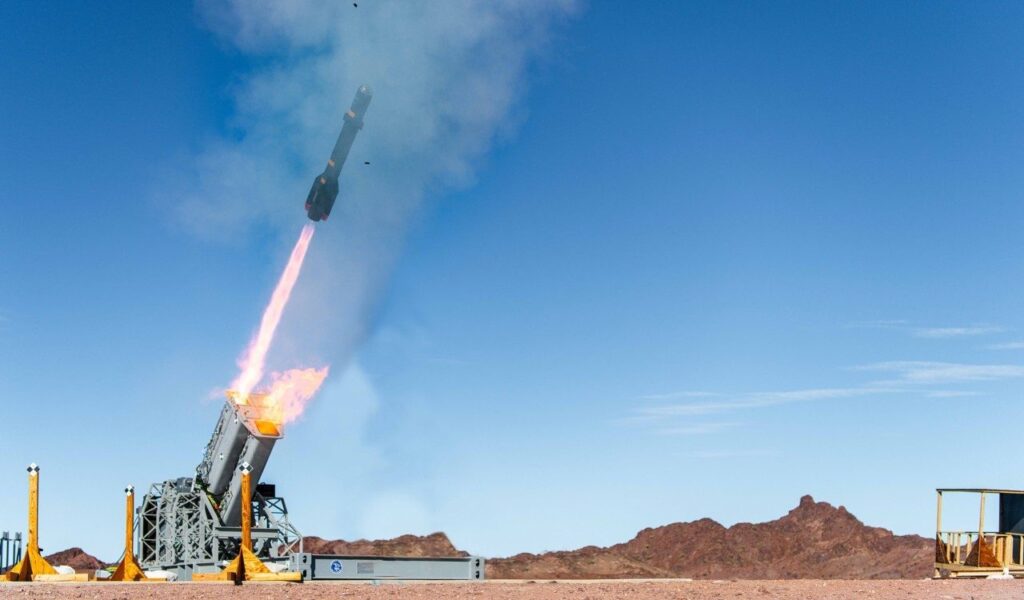
Lockheed Martin successfully conducted a JAGM Quad Launcher (JQL) ground-based demonstration, marking a significant development milestone for the vertical launching system (VLS). Held on August 28 at Yuma Proving Grounds in Arizona, the demonstration showcased the successful integration of the Joint Air-to-Ground Missile (JAGM) with the JQL, culminating in a first-time launch event.
The successful shot resulted in a direct hit on a stationary ground target and collection of real-time data of JAGM’s ignition, launch and flight from the launcher to target impact. The demonstration took place with the JQL positioned at a 45-degree angle, underscoring the system’s flexibility and potential for various operational applications.
Mission-focused Innovation
This demonstration is a testament to the collaborative efforts and agile forward-thinking of Lockheed Martin’s Missile & Fire Control and Rotary & Mission Systems teams. By leveraging cutting-edge technology and expertise from both teams, this demonstration paves the way for further advancements in JAGM’s VLS and Counter-Unmanned Aircraft Systems (C-UAS) capabilities.
“This pivotal milestone achievement showcases the versatility and adaptability of JAGM to provide a robust defense capability for multiple mission scenarios,” said Casey Walsh, program management director of Multi-Domain Missile Systems at Lockheed Martin Missiles and Fire Control. “By driving progress in areas like vertical launch and counter-UAS capabilities with JAGM, we’re helping to ensure that our users have the tools they need to stay innovative and ahead of emerging threats.”
With this demonstration being the first time a JAGM was flown from a cannister-based launcher, the integration of JAGM with the JQL system showcases its versatility to be adapted for multiple mission scenarios, providing a robust defense capability for both American forces and our allied partners.
The JQL system features four independent, modular composite cells, known as canisters, and one of the biggest benefits and features of the system is that it allows for rapid reload of individual canister cells based on existing JAGM procedures, enhancing its operational efficiency. The JQL system is equipped with a pivot fixture, which enables the ease of loading and launching of JAGM at angled or vertical orientations. The JQL’s vertical launch capability supports rapid 360-degree engagement against targets (maritime, air and ground) around the launching platform. The self-contained vertical missile gas management system provides enhanced safety to crew members and launching platforms
In addition, JQL’s modular design facilitates ease of installation onto any number of launching platforms: ships, patrol craft, vehicles and other various fixed-based applications. This design versatility also enables the JQL system to be adapted and scaled for multiple mission scenarios, providing a robust defense capability for armed forces. For example, the JQL system could be scaled down to one or two launch tubes, or multiple JQL systems could be mounted together on a platform to support a larger arsenal.
“By continuing to build upon our five decades of vertical launching systems expertise, we are excited to see our scalable, flexible launching solutions continue to successfully meet expeditionary capability needs,” said Edward Dobeck, director of Launching Systems at Rotary and Mission Systems. “The JQL launcher provides a combat-ready capability that meets multi-domain deployment objectives in a lightweight, easily transportable footprint that provides the same reliability expected of all our launching systems.”
As the JQL development and integration timeline moves forward, Lockheed Martin continues to push the boundaries of what is possible in vertical launch system development, driving innovation and advancement in the field.
The Future of Vertical Launch Capability
The success of the recent JQL ground-based demonstration paves the way for future advancements for both JAGM and the JQL system, including an upcoming vertical launch demonstration in November 2025. This demonstration will showcase the vertical launch capability of the JAGM at a 90-degree angle, as well as its application in Counter-Unmanned Aerial Systems (C-UAS) operations.
As the integration of JAGM with the JQL system evolves, it is expected to provide enhanced capabilities for users that require expedient multi-domain capabilities, enabling more effective and efficient operations in a variety of environments. With our focus on mission integration and innovation, Lockheed Martin is poised to play a leading role in shaping the future of global defense and security, delivering game-changing capabilities that enable modern forces to stay ahead of ever-evolving threats.
Marines Bid Farewell to the Assault Amphibious Vehicle
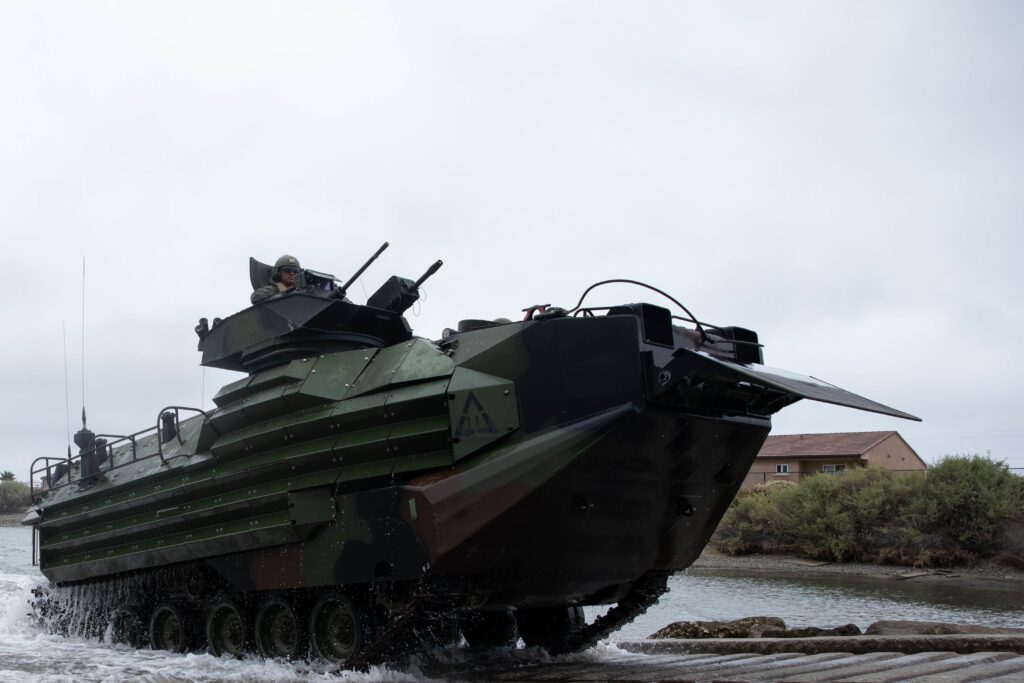
CAMP PENDLETON, Calif. (June 29, 2021) U.S. Marines with 3d Assault Amphibian Battalion, 1st Marine Division, emerge from the water in an AAV-P7/A1 amphibious assault vehicle (AAV) during water operations training at Marine Corps Base Camp Pendleton, California, June 29, 2021.(U.S. Marine Corps photo by Sgt. Jamin M. Powell)
MARINE CORPS BASE QUANTICO, Va. – The Assault Amphibious Vehicle was officially decommissioned during an AAV Sundown Ceremony at the Assault Amphibian School at Camp Pendelton, California, Sept. 26.
The ceremony honored both the vehicle’s 53 years of service to the Marine Corps and the Marines and Sailors who served with it, while marking the transition to the Corps’ next amphibious platform, the Amphibious Combat Vehicle. Col. Lynn W. Berendsen, commanding officer of the Assault Amphibian School, delivered remarks paying tribute to those who operated and maintained the AAV throughout its service.
The AAV replaced the Landing Vehicle, Tracked, which entered combat in August 1942 during the Solomon Islands Campaign. The LVT was the first vehicle capable of moving Marines from ship to shore and continue inland under fire. It proved decisive in battles like Tarawa, Inchon and later in during the Vietnam War where the following generations of amphibious vehicles carried Marines across beaches, rivers and flooded terrain.
The AAV was introduced in 1972, originally designated as the Landing Vehicle, Tracked, Personnel-7, featuring a water-jet propulsion system and a stern ramp that sped up ship-to-shore movement. Service life extension programs during the 1980s upgraded the vehicles with new engines, transmissions and weapon stations, after which it was redesignated the AAV-7A1. Over the decades, AAVs received additional upgrades to meet operational demands.
“The AAV-P7 has been many things, a ship to shore connector, an armored fighting vehicle, a troop carrier, a logistics platform and even sometimes a live boat,” said Berendsen. “Most importantly it was in a place where Marines made their mark in combat in service and in sacrifice.”
From Grenada and Somalia to the Persian Gulf and Iraq, the AAV carried Marines throughout combat, supported humanitarian missions, and amphibious landings. During its service, it transported personnel, delivered supplies, and provided protected mobility in both littoral and inland environments. Its legacy is not only in its capabilities but also in the countless Marines who operated it and relied on it to accomplish their missions.
“The AAV gave Marines both mobility and armored protection allowing them to close with the enemy and seize objectives at speed,” said Berendsen. “In the desert, just as in the Pacific beaches decades earlier, showed it was more than a connector, it was a fighting vehicle at the heart of the Marine Air Ground Task Force.”
The ACV, successor to the AAV, is an eight-wheeled armored personnel carrier built for expeditionary operations. With multiple variants for personnel transport, command and control, recovery, and fire support, the ACV integrates seamlessly with naval shipping and amphibious connectors. The introduction of the ACV supports the Marine Corps’ modernization efforts aligning with Force Design, advancing a lighter, faster, and more resilient force capable of operating in contested environments and contributing to joint and naval operations.
The final pass of three AAVs drove across the parade deck marked the close of a historic chapter and the Marine Corps’ continued evolution toward modern, expeditionary amphibious operations.
Secretary Phelan Welcomes Under Secretary of the Navy Hung Cao
Release From SECNAV Public Affairs, Oct. 3, 2025
Today, Secretary of the Navy John C. Phelan announced a wide-ranging cross departmental portfolio for the Under Secretary of the Navy (UNSECNAV) that unifies the Department’s most consequential levers for rebuilding warrior ethos and quality of service.
Secretary Phelan also congratulated Under Secretary of the Navy Hung Cao on his swearing-in by Secretary of War Pete Hegseth and warmly welcomed him back to the Department of the Navy.
“It is my pleasure to welcome Hung Cao to my Navy team; I look forward to having this experienced patriot lead on the highest priorities of the Secretary of War.” Secretary Phelan added, “I want to recognize with sincere gratitude, Dr. Brett Seidle, who over the past year has served as Acting Assistant Secretary of the Navy for Research, Development and Acquisition and has performed the duties of the Under Secretary of the Navy. His steady leadership in these roles has been vital to our Navy and our nation. Dr. Seidle has informed me of his intention to retire after twenty-five years of federal service following a smooth transition to Under Secretary Cao. The Department thanks him for his distinguished service and extends its best wishes for his future endeavors.”
As Secretary of War Hegseth told Flag and General Officers at Marine Corps Base Quantico earlier this week: “…at the War Department first and foremost we must restore a ruthless, dispassionate and common sense application of standards…Standards must be uniform, gender neutral and high. If not, they’re not standards. They’re just suggestions, suggestions that get our sons and daughters killed.”
“That is why I am putting my Under Secretary on the field to tackle the issues that affect the daily lives of Sailors and Marines,” said Secretary Phelan. “From his years in uniform and his record of leadership, he will cut through bureaucracy, drive real solutions and keep our people first.”
“Readiness starts at home and shows up on target,” Secretary Phelan said. “The Under Secretary’s new remit puts one quarterback and one playbook on the field to execute my gameplan for upgrading how we recruit, train, equip and take care of our people, so the Fleet stays the world’s premier, most lethal maritime force.”
“This is about speed, standards and service,” Phelan added. “When Sailors and Marines know their families are supported, housing is right, chow is quality and systems work the first time, morale rises, performance sharpens and the force delivers.”
Under the Secretary’s direction and consistent with governing statutes and the Department of the Navy priorities, the UNSECNAV will lead and synchronize the following lines of effort across the Department of the Navy:
Quality of Service: The UNSECNAV will drive rapid inspections and upgrades of family housing, recreational, healthcare and educational facilities on Navy and Marine Corps installations; tighten oversight of public-private ventures and modernize nutrition both ashore and afloat to align fueling the force with warfighter readiness.
Digital and Business Systems: As Chief Management Officer, the UNSECNAV will partner with the Department of the Navy Chief Information Officer to modernize unclassified Information Technology systems and critical Defense Business Systems. Cut downtime. Simplify processes. Get Sailors, Marines, civilians and families the tools they need fast.
Audit: The UNSECNAV will supervise the Auditor General and accelerate the Navy and Marine Corps to clean audit opinions, strengthening trust, transparency, speed of resourcing and accountability across the enterprise.
Recruiting: The UNSECNAV will visit, assess and raise Navy and Marine Corps recruiting standards, management and organization to meet and exceed end-strength. He will capitalize on the surge of Americans motivated to serve by President Trump’s call to revitalize strength and pride in our armed forces. In line with Secretary Hegseth’s charge, standards will be high, uniform and non-negotiable. They will not be suggestions. They will be the foundation of combat power.
Reserve Reform: The UNSECNAV coordinating with Assistant Secretary of the Navy for Manpower and Reserve Affairs, Chief of Naval Reserve and Deputy Commandant for Manpower and Reserve Affairs, will implement my plan for reserve reform that is already underway and produce actionable changes that integrate Reserve components as ready, lethal teammates with the active force maximizing the skills of Sailors and Marines and ensuring that reform translates into real capability.
Wellness & Suicide Prevention: The UNSECNAV will spearhead efforts across the Department to reduce mental health incidents and strengthen the performance of our force, serving as the primary representative to interagency and Department of War bodies on prevention, response and personnel readiness.
PCS, Families and Education Options: The UNSECNAV will represent the Department on the Permanent Change of Station Joint Task Force to streamline PCS orders, review on-base education and support homeschooling options so families can choose what works best for them.
Personnel Policy: The UNSECNAV will coordinate implementation of policies for service members impacted by the rescinded COVID-19 vaccine mandate and update
physical fitness standards, with a particular focus on combat units, so standards are clear, fair and combat-credible.
Guam as a Power-Projection Platform: As the Senior Defense Official for Guam, the UNSECNAV will review and assess island infrastructure and clear barriers, including energy and material challenges, so Guam delivers as a frontline power-projection platform for Indo-Pacific operations.
Standards and Warfighter Ethos: The UNSECNAV will implement Departmental direction on the elimination of divisive concepts and eradication of DEI initiatives within the Department of the Navy to keep time, talent and dollars on warfighting outcomes.
The UNSECNAV portfolio ties quality of service to combat power by design so we turn everyday friction points into force multipliers that show up on time and on target. We will fix faster, cut red tape and deliver better outcomes for families and commands. Minutes saved are minutes gained in the fight.”
“Our mission to defend the American homeland and put America first, starts in the homes of Sailors and Marines who stand the watch every day,” he continued. “When the basics work the first time, ships sail more, aircraft fly further, crews rearm and recover faster, lethality rises, risk falls and American sea power wins.”
“One Team, One Mission, One Vision is the way we operate, the way we win, the way we lead,” Secretary Phelan said. “With this move I am giving my Under Secretary the responsibility and the tools to fix what slows us down and to fuel what makes us unbeatable.”
VX-31 conducts its final AV-8B Harrier II Flight
From Naval Air Warfare Center Weapons Division, Sept. 30, 2025
CHINA LAKE, Calif. — Air Test and Evaluation Squadron (VX) 31, the Dust Devils, concluded the AV-8B Harrier’s service with a sundown ceremony Sept. 23, when the squadron flew the jet for the final time and shut it down on the China Lake flight line.
The final sortie, flown by Jim “Jimbo” Coppersmith, VX-31 technical director, brought veterans, Sailors, Marines, government civilians, industry partners and family members to the flight line to watch a traditional water salute and to say goodbye to a platform that served the fleet for more than four decades.
U.S. Marine Corps Lt. Col. Timothy “Little Buddy” Burchett, VX-31 commanding officer, described the Harrier as one of the most challenging and rewarding aircraft to fly.
“It’s the most fun airplane I’ve ever flown,” said Burchett. “There are no computers. It’s cables, pulleys and skill that keep that thing in the air.”
He called the Harrier “a uniquely Marine Corps aircraft” and praised the China Lake test team for keeping the program safe and mission capable to the finish.
“We did not coast into the finish line. It was a triumphant finish for the team partnership,” Burchett said.
Coppersmith highlighted the squadron’s role in strengthening the aircraft’s combat effectiveness and safety record through decades of testing at China Lake.
“It’s the most successful attack aircraft in Marine Corps history. No doubt about it,” he said. “We lost many great Marines along the way. Those treatments and those material fixes, the procedures we wrote, the engineering changes we made, saved lives and limbs.”
Burchett pointed to VX-31’s testing culture as a model for the entire community.
“You truly were the gold standard of testing,” he said.
Coppersmith closed his remarks by reflecting on the Harrier’s history at China Lake and the teamwork that kept it flying until the end.
“That jet right there flew its very first flight off the production line 33 years ago,” he said. “Today we completed AV-8B flight operations. We shut it down full mission capable, and it flew flawlessly. It’s a testament to what we’ve done to this aircraft as a team.”