Marine Corps fast-tracks contract for new Precision Attack Strike Missile
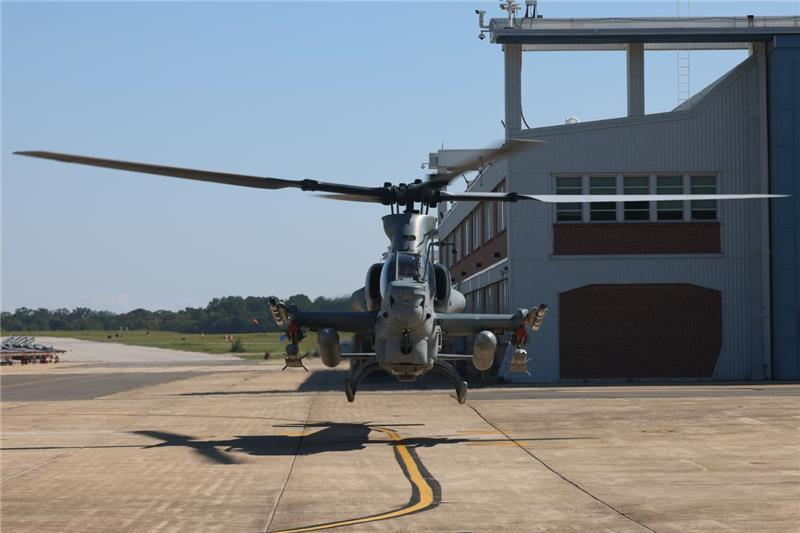
The Navy’s Air Test and Evaluation Squadron (HX) 21 launch a Long Range Attack Missile (LRAM) from an AH-1Z off coast of Virginia in late 2025. This demonstration paved the way for the Precision Attack Strike Munitions program (PASM), bringing cost-effective, long-range precision strikes to the USMC AH-1Z missions. (U.S. Marine Corps photo)
From Naval Air Systems Command, Jan 30, 2026
NAS PATUXENT RIVER, Md. — The Department of Navy announced the $86.2 million contract award of the Precision Attack Strike Munition to L3Harris Technologies Jan 30, a critical component of the Marine Corps’ vision for enhancing the lethality and survivability of its rotary-wing assets.
PASM will provide the Marine Corps with a cost-effective, longer-range, precision weapon that can deliver diverse effects (kinetic or non—kinetic) from AH-1Z aircraft in land and sea-based environments.
Over the past several years, the Marine Corps conducted a Joint Capability Technology Demonstration (JCTD) for the Long-Range Attack Munition (LRAM). The tests successfully proved the technology’s capability for a low-altitude, rotary-wing aircraft to perform offensive anti-surface warfare and maritime strikes. These demonstrations informed the department’s decision to award the contract.
“We are proud to partner with L3Harris Technologies to deliver a system that will provide a decisive advantage to Marine Corps pilots and support their missions worldwide,” said Rear Adm. Tony Rossi, who oversees the Program Executive Office for Unmanned Aviation and Strike Weapons (PEO (U&W)).
PEO (U&W)’s Direct and Time Sensitive Strike Weapons program office (PMA-242) awarded the contract under an Other Transaction Agreement/Authority (OTA) – a contract vehicle used by the government to streamline research and development and prototype development.
“The use of an OTA contract is a key part of this strategy, designed to rapidly prototype and field a capability that’s essential for operations in contested environments and against advanced adversaries,” said. Capt. Lindsey Buzzell, PMA-242 program manager.
Under the contract, L3Harris Technologies will deliver all units, manuals, training, support equipment, and test equipment for AH-1Z by end of fiscal year 2027.
PMA-242 is the Direct and Time Sensitive program office for the Navy and Marine Corps.
HII Hosts U.S. Marine Corps Leaders at Ingalls Shipbuilding
PASCAGOULA, Miss., Feb. 03, 2026 (GLOBE NEWSWIRE) — HII (NYSE: HII) hosted U.S. Marine Corps Gen. Bradford Gering, assistant commandant, and fellow U.S. Marine Corps officers at the company’s Ingalls Shipbuilding division Thursday. The Marines met with Ingalls leadership and toured the shipyard, including stops at two of the five amphibious warships currently under construction, Bougainville (LHA 8) and Harrisburg (LPD 30).
“We are honored to host Marine Corps leadership and showcase the critical role our Ingalls shipbuilders play in delivering the amphibious ships that support Navy and Marine Corps missions worldwide,” said Brian Blanchette, Ingalls Shipbuilding president. “The amphibious ship program remains a top priority for our team, and we value the opportunity to demonstrate the skill and dedication our shipbuilders bring to every ship we build.”
Ingalls has a long-standing history of building amphibious warships, and the collaboration between Ingalls Shipbuilding, the U.S. Navy and the Marine Corps was on full display during the visit.
Commenting on the tour, Gering highlighted the importance of amphibious warships.
“The Navy and Marine Corps team relies on these ships for a broad range of missions from peacekeeping and deterrence to combat operations and humanitarian assistance,” Gering said. “Programs like the LHA and LPD are vital to enabling Marine Corps readiness and ensuring our ability to respond quickly to emerging challenges.”
Ingalls currently has two LHAs under construction including Bougainville (LHA 8) and Fallujah (LHA 9) and three Flight II LPDs under construction including Harrisburg (LPD 30), Pittsburgh (LPD 31) and Philadelphia (LPD 32). Additionally, in September 2024, the Navy awarded Ingalls a contract for the construction of three San Antonio-class amphibious transport dock ships (LPD 33, LPD 34 and LPD 35) and a contract modification for the fifth America-class amphibious assault ship, Helmand Province (LHA 10).
CTF 68 Builds Maritime Advantage with NATO Allies During Exercise Freezing Winds 2025
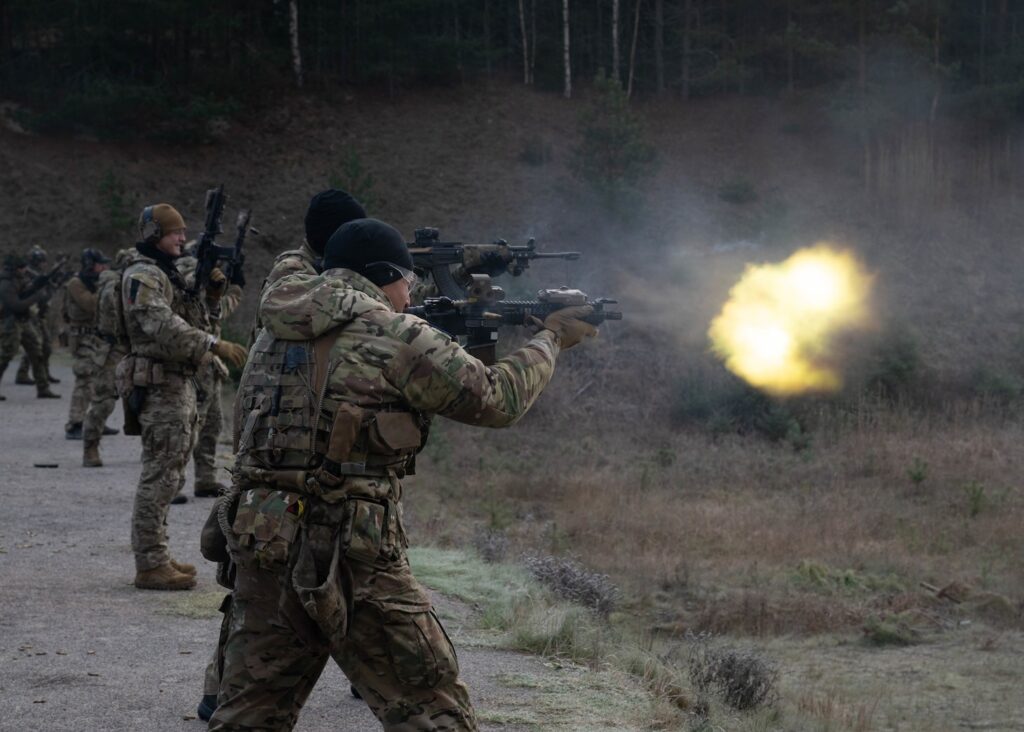
UPINNIEMI, Finland (Nov. 25, 2025) U.S. Navy explosive ordnance disposal technicians from Explosive Ordnance Disposal Mobile 8, Commander Task Group 68.1, and Finnish Navy sailors conduct a live-fire exercise as a part of Freezing Winds 25 in Upinniemi, Finland, Nov. 25, 2025. (U.S. Navy Photo by MC2 Juan J. Ruiz-Lazcano)
BALTIC SEA – U.S. Navy expeditionary forces assigned to Commander, Naval Expeditionary Combat Forces Europe-Africa/Commander, Task Force 68 (CTF 68) recently concluded operations in support of Exercise Freezing Winds 2025, a Finnish-led multinational training event designed to bolster collective readiness, interoperability, and security across the North Baltic Sea.
Operating in concert with NATO Allies and U.S. Marines from Marine Rotational Force – Europe, CTF 68 contributed command and control, explosive ordnance disposal, and maritime logistics support across multiple domains. The exercise served as a proving ground for joint force operations in cold-weather environments and underscored the U.S. Navy’s commitment to enhancing allied maritime security throughout the Baltic region.
“Operating alongside our NATO Allies and U.S. Marines in the challenging conditions of the Baltic Sea sharpens our readiness and reinforces our shared commitment to collective defense,” said Capt. Jeremy Wheat, commodore of Task Force 68. “This exercise strengthens our ability to respond as a unified force, no matter the environment or mission.”
A key focus during Freezing Winds was improving freedom of movement in contested environments, which was made possible in part by the efforts of explosive ordnance disposal technicians from Explosive Ordnance Disposal Mobile Unit (EODMU) 8, assigned to Task Group 68.1. Their role involved simulated route clearance, underwater searches, and demolition operations near critical infrastructure and maritime logistics nodes. All of which were part of scenarios designed to test real-world response to sea mines and unexploded ordnance in congested littorals.
“Our role during Freezing Winds was to ensure freedom of movement by mitigating explosive threats along resupply corridors and maritime infrastructure, especially in areas affected by simulated mining and unexploded ordnance,” said Lt. Luke Robertson, platoon officer-in-charge from TG 68.1. “Training with NATO Allies in these conditions enhances our ability to operate forward and respond to real-world threats in complex environments.”
To support these clearance efforts and maintain the tempo of operations, logistics teams from Navy Cargo Handling Battalion (NCHB) 5, assigned to Task Group 68.5, provided the connective tissue needed to move fuel, cargo, and personnel across the battlespace. Supporting the combined force, TG 68.5 conducted cargo handling, aerial port coordination, and fuel delivery under freezing conditions proving the battalion’s capacity to sustain forward-deployed operations in the High North.
“Our mission was to provide combat service support by moving fuel, cargo, and munitions anywhere they’re needed from high-latitude airfields to expeditionary seaports,” said Lt. Michael Flickinger, TG 68.5 site officer-in-charge. “The environment was challenging, but working side-by-side with Finnish and U.S. Marine logistics teams allowed us to validate scalable, mobile support concepts.”
Exercise Freezing Winds 2025 also contributed to NATO’s broader effort to boost defense readiness across the Baltic Sea, a vital region for global commerce and energy transit. The inclusion of expeditionary units from CTF 68 added a crucial logistics and access-focused dimension to high-end naval and amphibious training.
“The ability of our expeditionary units to integrate into Allied operations, as demonstrated in Freezing Winds, is what makes CTF 68 so unique,” Wheat added. “We bring scalable, responsive capability that extends the reach and impact of the entire naval force.”
Wheat said that in an era marked by renewed focus on strategic deterrence in the High North, exercises like Freezing Winds enabled CTF 68 to contribute directly to integrated defense posture and the Alliance’s maritime advantage.
Exercise Freezing Winds 2025 demonstrated the value of persistent, forward-deployed presence and reinforced the importance of logistics, access, and integration as enablers of joint and allied maritime advantage. “Through exercises like Freezing Winds, CTF 68 continues to maintain a persistent, forward-deployed presence delivering scalable expeditionary capabilities that advance Alliance readiness and regional stability,” said Wheat.
Commander, Task Force 68 commands all Navy Expeditionary Combat Forces in Europe and Africa and provides critical capabilities including logistics, explosive ordnance disposal, maritime engineering, port operations, and expeditionary security in support of U.S. 6th Fleet and NATO objectives.
Secretary of War Announces General Officer Nominations
From the Department of War, Jan. 20, 2026
Secretary of War Pete Hegseth announced Jan. 20 that the president has made the following nominations:
Marine Corps Lt. Gen. James H. Adams III for reappointment to the grade of lieutenant general, with assignment as director, Defense Intelligence Agency, Joint Base Anacostia-Bolling, Washington, D.C. Adams is currently serving as deputy commandant for Programs and Resources, Headquarters, U.S. Marine Corps, Pentagon, Washington, D.C.
Marine Corps Lt. Gen. Melvin G. Carter for reappointment to the grade of lieutenant general, with assignment as director’s advisor for Military Affairs, Office of the Director of National Intelligence, Washington, D.C. Carter is currently serving as deputy commandant for Information, Headquarters, U.S. Marine Corps, Pentagon, Washington, D.C.
Marine Corps Lt. Gen. Robert C. Fulford for reappointment to the grade of lieutenant general, with assignment as commanding general, II Marine Expeditionary Force, Camp Lejeune, North Carolina. Fulford is currently serving as deputy commander, U.S. European Command, Stuttgart, Germany.
Marine Corps Lt. Gen. Benjamin T. Watson for reappointment to the grade of lieutenant general, with assignment as commanding general, III Marine Expeditionary Force and commander, Marine Forces Japan, Okinawa, Japan. Watson is currently serving as deputy commandant, Training and Education, and commanding general, Training and Education Command, Quantico, Virginia.
Marine Corps Lt. Gen. Calvert L. Worth Jr. for reappointment to the grade of lieutenant general, with assignment as commander, U.S. Marine Corps Forces Command/commanding general, Fleet Marine Force Atlantic/commander, Marine Forces North, Norfolk, Virginia. Worth is currently serving as commanding general, II Marine Expeditionary Force, Camp Lejeune, North Carolina.
Marine Corps Maj. Gen. Joseph A. Matos III for appointment to the grade of lieutenant general, with assignment as deputy commandant for Information, Headquarters, U.S. Marine Corps, Pentagon, Washington, D.C. Matos is currently serving as commander, Marine Forces Cyberspace Command; commander, Marine Forces Space Command; commander, Joint Force Headquarters-Cyber; commander, Marine Corps Information Command, Fort Meade, Maryland.
Marine Corps Maj. Gen. Andrew M. Niebel, for appointment to the grade of lieutenant general, with assignment as deputy commandant for Installations and Logistics, Headquarters, U.S. Marine Corps, Pentagon, Washington, D.C. Niebel is currently serving as director, Logistics Division, Installations and Logistics, Headquarters, U.S. Marine Corps, Pentagon, Washington, D.C.
Groundbreaking Held for KONGSBERG’s Missile Manufacturing and Maintenance Facility
Release From Kongsberg Defense and Aerospace Inc.
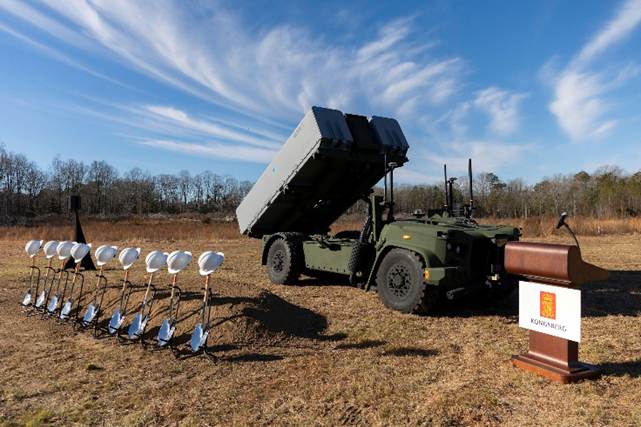
Jan. 16, 2026 – Kongsberg Defense and Aerospace, Inc. (‘KONGSBERG’) held a groundbreaking ceremony Friday for its first state-of-the-art US-based missile production facility in James City County, Va.
Speakers at the event included Kongsberg Defence and Aerospace (Norway) President Eirik Lie, James City County Board of Supervisors Chair Dr. John McGlennon, Virginia Secretary of Transportation Hon. Shep Miller, U.S. Representative Rob Wittman (VA-1) and Norwegian Ambassador to the United States Anniken Huitfeldt.
This facility, located in Toano, Va, between Richmond and Williamsburg and conveniently near Naval Station Yorktown, will help the company meet global demand for its precision strike missiles.
“This new KONGSBERG factory will provide additional production capacity, sustainment and in-country tech refresh capabilities for our Naval Strike Missile (NSM) and Joint Strike Missile (JSM) – both highly advanced, fifth generation cruise missiles capable of both maritime strike and land attack,” said Lie.
The United States Navy awarded KONGSBERG a multi-year procurement contract for NSM in 2024 for the Navy’s Over-the-Horizon weapon weapon system, as well as the Marine Corps’ NMESIS (Navy Marine Expeditionary Ship Interdiction System). The United States Air Force selected the JSM in 2024 for use on the F-35A Joint Strike Fighter.
“We are proud to invest in defense manufacturing in the United States and excited to onshore our world-class capabilities in James City County, Va. The state of Virginia, including the Virginia Economic Development Partnership and the Hampton Roads Alliance, have been integral in this process and we look forward to growing our presence in the US as we ramp up hiring,” said Heather Armentrout, KDA, Inc. president and general manager.
The KONGSBERG facility was announced in September 2024 and will create more than 180 jobs in the James City County area. It will inject more than $100 million in economic benefits, as well as create opportunities for local suppliers to support the production and manufacturing of these weapons.
Preparatory site work has commenced with construction expected to begin by Q2 2026. Missile manufacturing will begin in late 2027, ramping up to full rate production by the end of 2028.
The NSM has been selected by 14 countries and the JSM by 5 nations, including the US.
Tripoli Expeditionary Strike Group operates in 7th Fleet
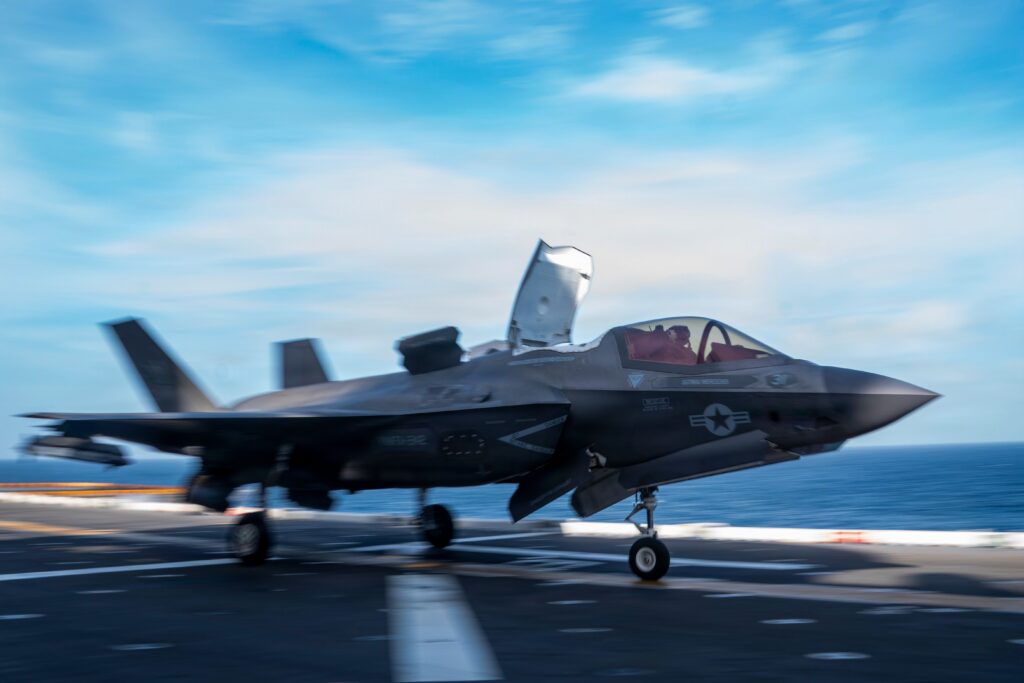
An F-35B Lighting II, attached to Marine Fighter Attack Squadron 242 takes off from the flight deck of America-class amphibious assault ship USS Tripoli (LHA 7) during flight operations in the South China Sea, Dec. 11, 2025. (U.S. Navy photo by Mass Communication Specialist Seaman Angel Conde)
U.S. 7th FLEET AREA OF OPERATIONS — The Tripoli Expeditionary Strike Group, composed of the 31st Marine Expeditionary Unit (MEU), America-class amphibious assault ship USS Tripoli (LHA 7), Ticonderoga-class guided-missile cruiser USS Robert Smalls (CG 62) and Arleigh Burke-class guided-missile destroyer USS Rafael Peralta (DDG 115), is conducting routine operations in the U.S. 7th Fleet area of operations, Dec. 11.
This marks Tripoli’s initial forward-deployed assignment as the flagship for the Tripoli Expeditionary Strike Group. The group’s presence promotes regional stability and maritime security in U.S. 7th Fleet.
“The Tripoli Expeditionary Strike Group is maintaining peace and security in the Indo-Pacific while assuring access to the seas for all nations,” said Rear Adm. Tom Shultz, commander of the Tripoli Expeditionary Strike Group. “As the only permanently forward-deployed expeditionary strike group, our Navy and Marine Corps team’s ability to operate in the air, on land, and sea, combined with anti-air warfare, anti-submarine warfare and anti-surface warfare capabilities allows us to support any contingency in the region.”
The 31st MEU brings the ability to conduct a variety of joint, maritime and amphibious multi-domain operations and activities. They are permanently positioned to provide a flexible and combat-capable force to contribute to deterrence, security, crisis response and multi-domain military operations in the Indo-Pacific.
“The 31st MEU is flexible and responsive. We’re forward deployed and have longstanding, habitual relationships with Amphibious Squadron 11, the Japan Ground Self-Defense Force’s Amphibious Rapid Deployment Brigade and Special Operations Command Pacific,” said Col. Chris Niedziocha, commanding officer of the 31st MEU. “Those relationships, coupled with the unit’s high operational tempo ensure the MEU is always ready to respond to crises and campaign with our allies or fight tonight.”
Embarked aboard Tripoli is a detachment of F-35B Lightning II aircraft from Marine Fighter Attack Squadron (VMFA) 242, which provides the Tripoli Expeditionary Strike Group more stealth and flexibility than any other aircraft. The Tripoli Expeditionary Strike Group is capable of conducting expeditionary warfare operations with Navy and Marine Corps capabilities to support theater contingencies that range from crisis response to full combat operations. U.S. 7th Fleet, the U.S. Navy’s largest forward-deployed numbered fleet, routinely interacts and operates with allies and partners in preserving a free and open Indo-Pacific region.
Secret Service’s New Trainer Courtesy of Presidential Helicopters Program Office
VH-3D helicopter, bureau number 159351, officially welcomed to the United States Secret Service James J. Rowley Training Center in South Laurel, Md. on January 12. (L to R) Col. Ryan Shadle, Commanding Officer, Marine Helicopter Squadron One, Mr. Miltom Wilson, United States Secret Service Assistant Director, Office of Training, and Col. Erica Mantz, Program Manager, Presidential Helicopters Program Office. Photo courtesy of United States Secret Service.
From Naval Air Systems Command, Jan. 16, 2026
LAUREL, Md. — In June 2025, the Presidential Helicopters Program Office (PMA-274) delivered and installed a retired and refurbished VH-3D helicopter, bureau number 159351 (BUNO 351), to the United States Secret Service (USSS). The agency received the aircraft at the James J. Rowley Training Center (JJRTC) in South Laurel, Maryland, fulfilling its need for a new training aircraft to continue effectively training its agents.
A team of industry and contract support assisted in the seamless transfer of the aircraft and ensured it was treated with top-shelf inspection, maintenance, demilitarization, and white-glove care. The aircraft was delivered to the USSS in quintessential showroom appearance with all tactical features needed for up-to-date training for President and Vice President of the United States (POTUS/VPOTUS) safety and protection.
The aircraft will be used by the USSS to conduct threat reaction and other tactical procedural training, improving agents’ skills to optimize their important protective mission.
BUNO 351’s journey began years before this delivery, in 2022, when the USSS and United States Marine Corps (USMC) started discussions about upgrading the organization’s training asset. Earlier in 2025, initial demilitarization efforts on BUNO 351 were performed by the PMA-274 maintenance department at the Presidential Helicopter Support Facility. The aircraft spent weeks in refurbishment along with having ground training features installed as requested by the USSS. Upon completion the aircraft was shipped to the JJRTC, where it replaced an unserviceable training aircraft.
The USSS explained that the unserviceable training asset was no longer equipped to safely provide needed space and layout for new members who were in training for protective details within the Secret Service. The old training aircraft, now removed from the JJRTC, was a retired U.S. Navy asset. It was painted to resemble Marine One, which is the call sign, or name, of the helicopter when POTUS is aboard.
Trainees can now work both inside and outside of the mock Marine One safely and more accurately for the Presidential and Vice Presidential protection missions they will provide. BUNO 351 also provides the added value of the proper seating configuration in alignment with the VH-92A Patriot helicopter, the latest model flown by Marine Helicopter Squadron One (HMX-1) in support of the presidential lift mission.
“Our teams have collaborated diligently to make this transfer possible,” said Col. Erica Mantz, PMA-274 program manager. “This effort to deliver BUNO 351 has greatly strengthened our partnership with the U.S. Secret Service and contract support team.”
The old U.S. Navy training helicopter was manufactured in October 1963 and has been used by countless special agents and Uniformed Division officers to practice protective movements. It has since been transported to Arizona for shredding and recycling.
“Not only is VH-3D BUNO 351 a significant improvement for our training requirements, our visitors to JJRTC have the opportunity to view a Marine One on tours of the training facility,” said Deputy Special Agent In Charge Troy Sarria. “The new helicopter draws even more attention as an officially retired and demilitarized VH-3D – once flying Presidents and Vice Presidents.”
PMA-274 not only transported the aircraft with industry partners, the program logistics and sustainment teams worked to ensure a comprehensive demilitarization and transfer process was complete end-to-end. An important step is to properly account for all government inventory with a seamless, clear transfer of possession to the USSS.
“We are grateful for the helicopter’s capability and awed by the quality of the final product,” added Sarria.
During the January dedication ceremony officially inducting the retired VH-3D as the USSS training asset, Mantz shared with attendees, “This aircraft served nearly 50 years, supporting nine U.S. Presidents throughout its distinguished history. Now 351 will continue to serve our great nation in a different, but equally important capacity.”
The retired 159351 VH-3D sits just feet away from half a mock Air Force One, dubbed Air Force One Half, aboard JJRTC. This placement is essential. The configuration of these two training assets mimics real-life events and leads to more effective and realistic training.
BUNO 351 served HMX-1 shy of 50 years before reaching its end of service life. The aircraft entered into service in July 1975 and was decommission in October 2024. This venerable aircraft carried nine presidents: Gerald Ford, Jimmy Carter, Ronald Regan, George H. W. Bush, Bill Clinton, George W. Bush, Barack Obama, Donald Trump, and Joe Biden.
PMA-274 provides safe, ready, high-performing, and affordable aircraft, capabilities, and support to HMX-1.
US Navy and Marines Select L3Harris T7 Robots to Enhance Ordnance Disposal Capabilities
The L3Harris large T7 robotic systems will provide U.S. Navy and U.S. Marines with enhanced dexterity and performance to safely execute explosive ordnance disposal missions. (L3Harris)
MELBOURNE, Fla., Jan. 14, 2026 — L3Harris Technologies (NYSE: LHX) has received an award to support the U.S. Navy and the U.S. Marines with 34 large T7™ robots that will deliver enhanced capabilities for explosive ordnance disposal (EOD) missions.
L3Harris T7 robots help keep troops out of harm’s way by neutralizing explosive threats from a safe distance. The company designed the robotic systems for high-risk missions, providing mobility, manipulation and intuitive control.
“Recognized by both the Navy and Marines for outstanding dexterity and performance, L3Harris T7 robotic systems will provide them a significant advantage for their most challenging EOD missions,” said Dave Kornick, President, Intelligence and Cyber, Space and Mission Systems, L3Harris. “We’re honored to continue working with the Department of War and our key partners in the U.K. and Australia, who also use the most advanced robotic technology available.”
Deliveries under this multi-year contract are scheduled to begin this year. L3Harris will also provide robotic system and comprehensive operator training.
This award follows a U.S. Air Force order for more than 100 robots in 2021. The Australian Defence Force and U.K. Ministry of Defence also use large T7 and medium-sized T4 robots to support their EOD missions.
CH-53K Program Enters Multi-Year Procurement Contract with GE
A U.S. Marine Corps CH-53K King Stallion helicopter assigned to Marine Heavy Helicopter Squadron (HMH) 461, Marine Aircraft Group 29 lifts a joint light tactical vehicle during a helicopter support team exercise at Marine Corps Base Camp Lejeune, North Carolina, Sep. 4, 2025. The helicopter support team operations enhanced the ability to coordinate safe rigging, loading, and lifting of vehicles by helicopter for precise and secure air transport. (U.S. Marine Corps photo by Sgt. Jorge Borjas)
NAS PATUXENT RIVER, Md. — A five-year, multi-year procurement (MYP) contract was signed on January 8 between the Department of War (DOW) and GE Aerospace for both new production and spare T-408 engines, along with associated sustainment services for the CH-53K King Stallion helicopter. The $1.4 billion contract covers five years, Lots 9-13, providing more than $174 million in savings over the Future Years Defense Program (FYDP).
The CH-53K program is critical to the Marine Corps’ strategic plan. It is replacing the CH-53E as the only marinized heavy-lift rotary-wing aircraft in the U.S. defense inventory.
“This multi-year procurement is a key indicator of the strong commitment to the CH-53K program, and the integral part that GE plays,” said Col. Kate Fleeger, program manager, H-53 Heavy Lift Helicopters Program Office (PMA-261). “The contract allows GE to manage supply chain health through a stable, predictable demand signal, ultimately achieving better pricing, passing those savings on to the government.”
Multi-year procurement is one of several contracting mechanisms that Congress permits the DOW to use in limited circumstances. MYP is used in lieu of an annual contract and provides the opportunity for significant savings. MYP contracts require congressional approval for each use, with the program meeting specific criteria to qualify for MYP.
“By committing to long-term contracts, we are simultaneously reducing cost and helping to strengthen our defense industrial base,” said Fleeger. “Ultimately, this multi-year procurement will significantly reduce risk to the CH-53K transition plan.”
Long-term, MYP contracts provide stability to industrial partners while incentivizing investment. That investment provides personnel and equipment needed for uninterrupted production for the years negotiated. It also allows the program office to improve production while reducing the administrative burdens of annual contracts.
There are currently 23 CH-53K aircraft in operation with the U.S. Marine Corps. The CH-53K King Stallion program is on track for its first Marine Expeditionary Unit (MEU) deployment in FY27.
PMA-261 manages the cradle to grave procurement, development, support, fielding and disposal of the entire family of H-53 heavy lift helicopters.
VMM-264 Reactivates Following Five-Year Hiatus
11 Dec 2025 | Capt. Jacob Ballard2nd Marine Aircraft Wing
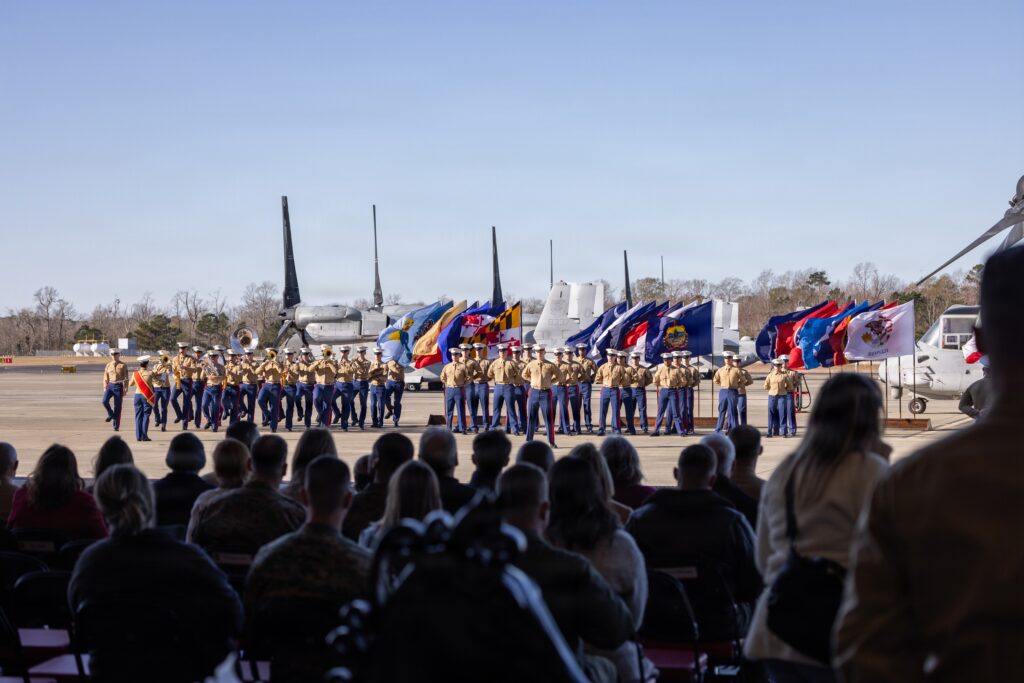
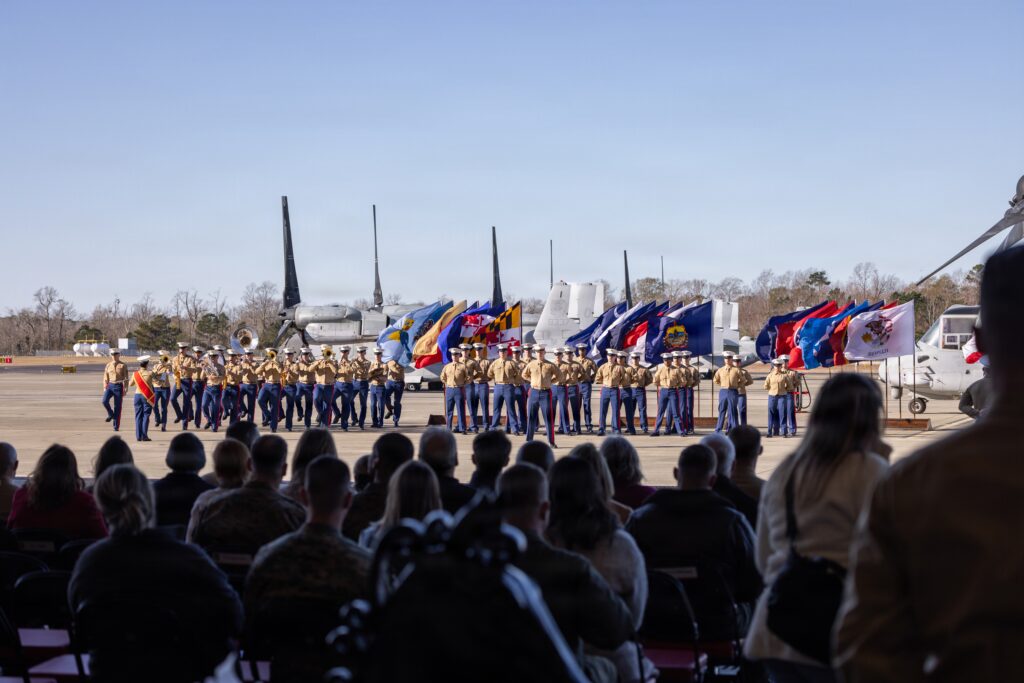
MARINE CORPS AIR STATION CHERRY POINT, N.C. —Marine Medium Tiltrotor Squadron (VMM) 264, 2nd Marine Aircraft Wing (MAW), was reactivated during a ceremony at Marine Corps Air Station New River, North Carolina, on Thursday.
VMM-264, known as “The Black Knights,” was deactivated on June 24, 2020, under Force Design initiatives. Throughout the squadron’s deactivation, the Marine Corps conducted an analysis of force management to ensure no operational commitments were unmet. This analysis identified the need for an additional VMM squadron on the east coast to provide sustained operational support to II Marine Expeditionary Force (MEF). This change within 2nd MAW reflects incremental adjustments to Force Design to meet the operational demands of the service.
During the reactivation ceremony, Col. Daniel Kaiser, commanding officer of Marine Aircraft Group 26 (MAG), spoke about the squadron’s history and its role in the MV-22’s early operational employment.
“VMM-264 carries a distinguished legacy, having been established in 1959 and providing decades of critical support to Marine Air-Ground Task Force (MAGTF) operations around the globe. Upon transitioning to the MV-22 Osprey in 2009, the squadron played a pivotal role in developing and advancing the MV-22 as the Marine Corps’ premier assault support platform.”
Kaiser went on to express excitement about the squadron’s return. “MAG-26 is proud to welcome this storied unit back into the fold and looks forward to the significant contributions the ‘Black Knights’ will bring in support of the ‘Carolina MAGTF.’”
The squadron will resume operating the MV-22 Osprey tiltrotor aircraft. The MV-22 Osprey is a multi-role tiltrotor aircraft developed by Bell Helicopter and Boeing, designed to support Marine Corps operations with enhanced versatility and speed. First introduced in the late 1990s, the MV-22 combines the vertical takeoff capability of a helicopter with the speed and range of a fixed-wing airplane. It is equipped to perform a wide array of missions, including troop transport, logistics support, and casualty evacuation. Due to its speed and range, the Osprey significantly reduces transit time in operational environments, making it a crucial asset for rapid deployment and maneuverability in the field.
In addition to the reactivation, the ceremony also served as an assumption of command, during which Lt. Col. Paul Lancaster formally assumed responsibility, authority, and accountability for VMM-264 as the commanding officer.
Lancaster expressed his pride in leading the reactivation. “I’m proud to lead the reactivation of a legacy assault support unit. This reactivation brings the necessary balance and capacity to the MV-22 community and supports the continued evolution of Marine Corps aviation.” He also recognized the efforts of those who made the reactivation possible: “Today’s ceremony honors the Marines and Sailors who worked tirelessly to build a world-class squadron, dedicated to operational excellence. It also honors the thousands of Marines and Sailors who wore the Black Knight patch previously.”
VMM-264 is a subordinate unit of 2nd MAW, the aviation combat element of II MEF.