Four Days In, Hegseth, Caine Say U.S. Making Decisive Progress in Iran

March 4, 2026 |  By Matthew Olay, DoW News 

During the War Department’s second press conference since the U.S. and Israel’s launch of Operation Epic Fury against the Iranian regime Feb. 28, Secretary of War Pete Hegseth and Air Force Gen. Dan Caine, chairman of the Joint Chiefs of Staff, today said America is making decisive offensive progress in the conflict. 

“I stand before you today with one unmistakable message about Operation Epic Fury: America is winning decisively, devastatingly and without mercy,” Hegseth told the media from the Pentagon’s press briefing room. 

“We are only four days into this, and the results have been incredible — historic, really. … Only the United States could lead this [mission]. … But, when you add the Israeli Defense Forces — a devastatingly capable force — the combination is sheer destruction for our radical Islamist Iranian adversaries,” Hegseth said. 

During his remarks, Caine reiterated that the U.S. and Israel’s joint, three-pronged mission in the region is to target and eliminate Iran’s ballistic missile systems, destroy the Iranian navy and ensure Iran cannot rebuild or reconstitute its combat capability or power —  including ensuring the country never obtains nuclear weapons. 

In terms of battle damage, Caine said there has been an 86% overall drop in Iran’s ballistic missile launches since the first day of fighting, and a 23% decrease in just the last 24 hours. Additionally, he added there has been 73% decrease in Iranian one-way attack drone shots fired from early on in the conflict. 

In terms of air power, Hegseth said that the U.S. and Israeli forces are poised to have complete control of Iranian air space within the next few days. 

“I hope all the folks watching understand what ‘uncontested airspace’ and ‘complete control’ means: It means we will fly all day [and] all night … finding, fixing and finishing the missiles and defense industrial base of the Iranian military; finding and fixing their leaders and their military leaders; flying over Tehran … [with] Iranian leaders looking up and seeing only U.S. and Israeli air power every minute of every day, until we decide it’s over — and Iran will be able to do nothing about it,” Hegseth said. 

At sea, U.S. Central Command announced yesterday that more than 20 Iranian navy vessels have been destroyed, including the sinking of an Iranian combatant ship in the Indian Ocean by a U.S. Navy fast attack submarine. 

It was the first time a U.S. submarine has used a Mark 48 torpedo to sink an enemy vessel since 1945, Caine noted. 

“I want to remind everybody that this is an incredible demonstration of America’s global reach. To hunt, find and kill an out-of-area deployer is something that only the United States can do at this type of scale,” he said. 

In discussing the Iranian regime’s predicament, Hegseth said he likens the situation to a football game, wherein Iran’s offense has already exhausted all of its scripted plays. 

“But now that the game has started and the [U.S. and Israeli] defensive blitz is on, [Iran doesn’t] know what plays to call, let alone how to get in the huddle and call those plays,” Hegseth said. 

He added, because so many of Iran’s senior leaders being killed on Operation Epic Fury’s first day, the military is unable to effectively communicate, let alone mount a coordinated and sustained offensive. 

“This was never meant to be a fair fight, and it is not a fair fight. We are punching [the enemy] while they’re down, which is exactly how it should be,” Hegseth said, adding that Epic Fury has already unleashed twice the air power as the initial “shock and awe” phase of Operation Iraqi Freedom in 2003. 

Looking ahead, Caine said that Centcom will continue to strike the regime’s infrastructure — including hunting and killing ballistic missile launchers and one-way attack capabilities — as well as continuing to attack Iran’s naval capabilities. 

“We are just getting started,” Hegseth said. 


Secretary of War Announces Marine Corps General Officer Nominations 

From the Department of War, Feb. 25, 2026 

Secretary of War Pete Hegseth announced today that the president has made the following nominations: 
 
Marine Corps Brig. Gen. Robert B. Brodie for appointment to the grade of major general. Brodie is currently serving as deputy commanding general, III Marine Expeditionary Force and commanding general, 3d Marine Expeditionary Brigade, Okinawa, Japan. 
 
Marine Corps Brig. Gen. Michael A. Brooks Jr. for appointment to the grade of major general. Brooks is currently serving as commanding general, Training Command, Quantico, Virginia. 
 
Marine Corps Brig. Gen. Simon M. Doran for appointment to the grade of major general. Doran is currently serving as commanding general, Marine Corps Warfighting Lab, Quantico, Virginia. 
 
Marine Corps Brig. Gen. Fridrik Fridriksson for appointment to the grade of major general. Fridriksson is currently serving as director, Manpower Management Division, Manpower and Reserve Affairs, Headquarters, Marine Corps, Quantico, Virginia. 
 
Marine Corps Brig. Gen. Garrett R. Hoffman for appointment to the grade of major general. Hoffman is currently serving as director, White House Military Office, Washington, D.C. 
 
Marine Corps Brig. Gen. Stephen J. Lightfoot for appointment to the grade of major general. Lightfoot is currently serving as commander, Naval Amphibious Forces Task Force 51 and commanding general, 5th Marine Expeditionary Brigade, Al Jasra, Bahrain. 
 
Marine Corps Brig. Gen. Michael E. McWilliams for appointment to the grade of major general. McWilliams is currently serving as commander, Joint Enabling Capabilities Command, U.S. Transportation Command, Norfolk, Virginia. 
 
Marine Corps Brig. Gen. David C. Walsh for appointment to the grade of major general. Walsh is currently serving as program executive officer, Air Anti-Submarine Warfare, Assault, and Special Mission Programs, Naval Air Systems Command, Patuxent River, Maryland. 


Joint Interagency Task Force Announces Counter-UAS Marketplace

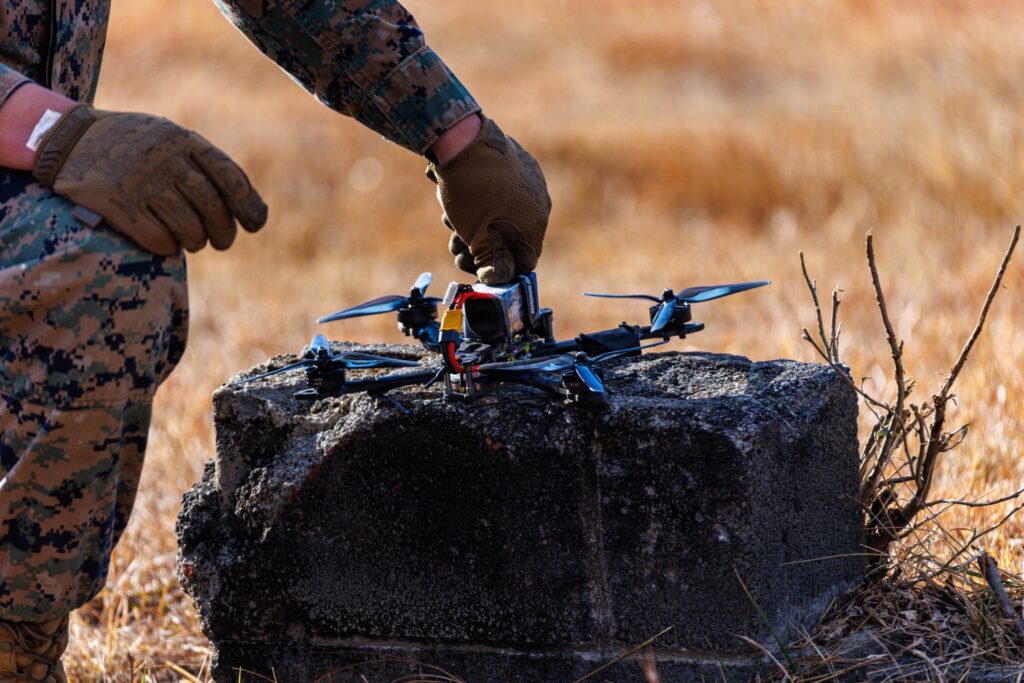
Marine Corps Lance Cpl. Bryen Z. Martinez, a military police officer assigned to the counter-unmanned aerial system’s counter-drone team, sets up a clay pigeon drone during a counter-UAS demo at The Basic School at Marine Corps Base Quantico, Va., Jan. 15, 2026.

By Joint Interagency Task Force 401, Feb. 24, 2026   

Joint Interagency Task Force 401 announced today that its revolutionary counter-unmanned aircraft systems marketplace has reached initial operational capability. 

The online platform, hosted on the common hardware systems electronic catalog, will revolutionize how the War Department and its interagency partners acquire critical counter-UAS technology.  

The marketplace streamlines the process for users to identify and procure the right equipment to meet their specific needs, featuring a growing catalog of validated counter-UAS systems and components, with plans to include performance data from the task force’s authoritative test and evaluation repository. It allows customers to compare systems based on real-world performance against a variety of threats and in different environments.  

“The JIATF 401 -UAS marketplace is a critical step forward in our whole-of-government approach to countering the threat of small drones,” said Army Brig. Gen. Matthew Ross, JIATF 401 director. “Our goal is to integrate sensors, effectors and mission command systems into a responsive, interoperable network that protects service members and American citizens alike.”  

The marketplace is built on an established indefinite delivery, indefinite quantity contract, enabling customers to place orders immediately and significantly reducing the lengthy contracting process typically associated with defense procurement. The common hardware systems website provides an intuitive interface for users to browse available equipment, review technical specifications and compare pre-negotiated contract options.  

“Building and maintaining the -UAS marketplace has been a collaborative effort focused on delivering a user-friendly and effective tool for the warfighter,” said Army Maj. Matt Mellor, the lead acquisitions specialist assigned to JIATF 401. “We’ve worked to create a platform that not only simplifies the procurement process but also provides the crucial data and expert support necessary for our customers to make informed decisions. This is about getting the best technology into the hands of those who need it as quickly as possible.”  

The marketplace is actively expanding its inventory to include all validated counter-UAS equipment not already designated as a program of record. The common hardware systems electronic catalog already lists over 1,600 items, demonstrating its capacity to support a comprehensive, growing selection of counter-UAS solutions.  

Access to the marketplace is available to users throughout the War Department and interagency partners via a common access card or other government-issued smart card.  


I MEF Marines Evaluate Fiber-Optic FPV Drones During DIU Challenge 

From 1st Lt. Logan Tompkins, Communication Strategy and Operations, I Marine Expeditionary Force

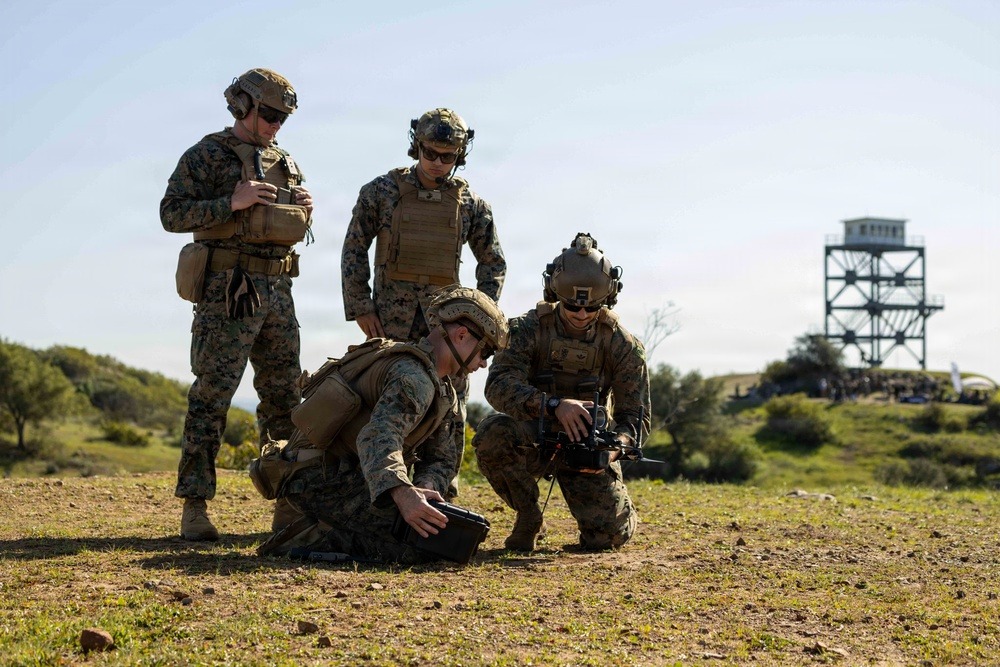
MARINE CORPS BASE CAMP PENDLETON, Calif. — U.S. Marines with I Marine Expeditionary Force partnered with the Defense Innovation Unit and industry professionals, Jan. 27-29, 2026, to evaluate first-person view small unmanned aircraft systems that use fiber optic cables, marking the U.S. Marine Corps’ first field evaluation of the technology for sUAS employment in contested environments. 

The three-day assessment focused on “ready now” FPV drone solutions designed to maintain command-and-control and video feeds when radio-frequency links are degraded. Unlike traditional unmanned aircraft systems that rely on wireless signals, fiber optic cables provide a physical data connection between the operator and the aircraft, reducing vulnerability to electronic warfare and enabling more reliable employment in denied environments. 

The evaluation brought together Marines from 3rd Light Armored Reconnaissance Battalion and 1st Light Armored Reconnaissance Battalion, with I MEF coordinating the event alongside DIU as part of Project G.I., a Department of War-wide effort intended to accelerate the fielding of solutions that address warfighter problem sets for the joint force. Participating vendors for the fiber-optic evaluation included Auterion, Kraken, ModalAI, Neros, and Nokturnal AI, with support from Contact Front Technologies. 

“Fiber-optic tethered FPV capabilities are required on today’s battlefield,” said Col. Michael Carroll, assistant chief of staff, G-9, I Marine Expeditionary Force. “By deliberately building trained cadres within the command, I MEF is positioned to scale pilots and capability rapidly, and to responsibly leverage every opportunity to integrate, evaluate and familiarize warfighters with proven systems.” 

During the event, Marines evaluated systems based on how quickly operators could transport, set up and employ the aircraft while wearing full combat equipment, as well as the durability of controllers, displays and supporting equipment. Marines also assessed how effectively each platform integrated with tactical command-and-control tools and how reliably the fiber optic cable performed during over-water control and data transmission. The over-water flights marked the U.S. Marine Corps’ first deliberate over-water evaluation of fiber-optic cable performance for FPV sUAS. 

The event also served as a hands-on integration point for participating companies, allowing engineers to observe operator workflows and receive direct feedback on usability, reliability and mission-driven requirements. Marines compiled observations and recommendations throughout the assessment to inform iterative improvements and future evaluations. 

“The pace of change in robotics and autonomous systems is unlike anything we’ve seen before. Capabilities are evolving daily, not over years,” said Maj. Steven Atkinson, I MEF DIU mission partner. “In that environment, there will never be a single ‘silver bullet’ system, which is why the Blue UAS List must be continuously updated with a diverse set of best-of-breed platforms and components. Through our partnership with DIU, I MEF brings together Marines from multiple units, MOSs, and backgrounds to do exactly that, ensuring the systems added to the Blue List are not only policy-compliant, but operationally lethal, interoperable, and survivable in contested environments.” 

Project G.I. launched in June 2025 with a prize funding pool to support live evaluations across multiple design reference missions. The project used an accelerated approach intended to move mature technology from proposal to hands-on testing in months rather than years. DIU designed the effort to involve operators early, stress systems against real operational constraints and rapidly iterate toward capabilities that can be integrated and scaled for units across the services. 

I MEF has played a leading role in the challenge by organizing field-based evaluations, bringing together Marines with recent operational experience and ensuring feedback from end users is captured, translated into actionable requirements and pushed directly to industry teams. Last summer, Marines assigned to I MEF partnered with DIU and vendors during a larger Project G.I. evaluation at Marine Corps Base Camp Pendleton, which combined familiarization training with scenario-based demonstrations and informed follow-on selection and development. 

The January event built on that momentum by concentrating on fiber optic cable performance, a capability increasingly associated with maintaining drone effectiveness under electronic attack. Marines assessed how FPV systems connected by fiber optic cables could support tactical kinetic-effects while sustaining control and video in environments where traditional links can be disrupted. 

“A fiber optic cable connected to an attack drone gives the ground force commander more options when it comes to precision fires in a GPS or communications-denied environment,” said 1st Lt. Kienan Morrissey, an intelligence officer with 3rd Light Armored Reconnaissance Battalion who directly supported the evaluations. “Operator-to-vendor feedback is critical in this phase of the evaluation to ensure drone systems are mission capable, continuously improved and lethal in the hands of the end users.” 

Insights from the evaluation will inform continued refinements as Project G.I. advances. As platforms complete compliance verification and cybersecurity review, selected systems are expected to move closer to procurement pathways and broader availability for DoW purchase and operation. 

I MEF provides combatant commanders a globally responsive, expeditionary, and fully scalable Marine Air-Ground Task Force, capable of generating, deploying, and employing ready forces and formations for crisis response, forward presence, major combat operations, and campaigns. 


Marine Corps to Retire Last AV-8B Harrier IIs in June

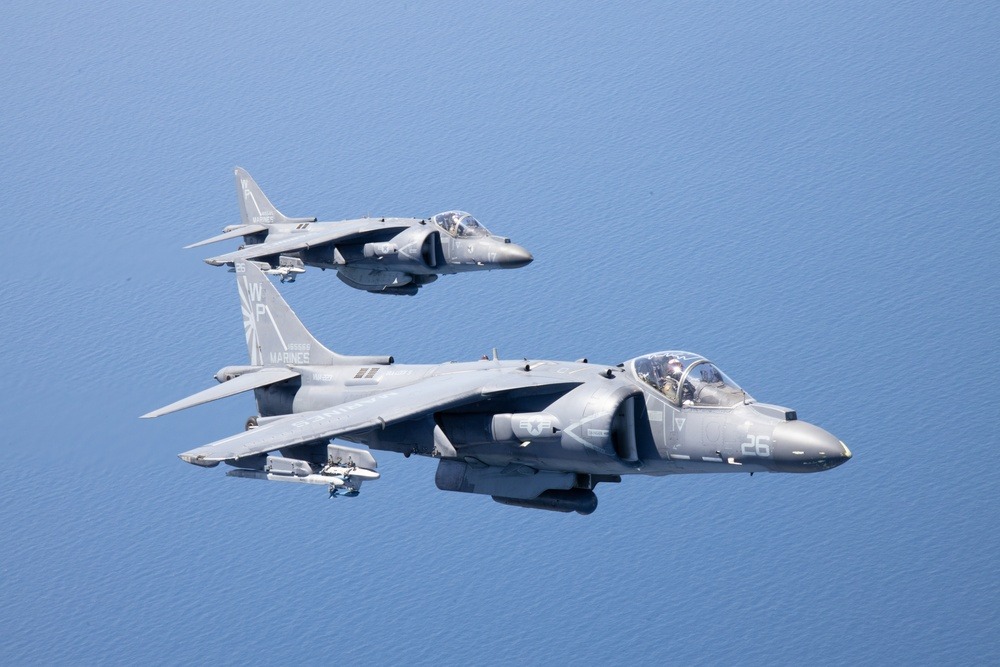
AV-8Bs of VMA-223 seen in flight in April 2023. (Marine Corps photo by Staff Sgt. Theodore Bergan)

By Richard R. Burgess, Senior Editor 

ARLINGTON, Va. — The U.S. Marine Corps plans to retire its last Boeing AV-8B Harrier II vertical-takeoff and landing attack jets this summer, according to the 2026 Marine Corps Aviation Plan released Feb. 10, 2026. 

The Corps operates only one remaining Marine attack squadron (VMA), VMA-223, which is based at Marine Corps Cherry Point, North Carolina. The squadron will conduct the last flight of a Harrier on June 3, during a series of ceremonies scheduled for June 1 through June 5. 

VMA-223 currently has a detachment of AV-8Bs assigned to the 22nd Marine Expeditionary Unit deployed on board the amphibious assault ship USS Iwo Jima (LHD 7). The Iwo Jima has been operating in the U.S. Southern Command’s area of responsibility in support of Operations Southern Spear and Absolute Resolve. This is the last scheduled deployment of the AV-8B. 

VMA-223 is scheduled to be redesignated a Marine fighter attack squadron in fiscal 2027 as it trains to fly the F-35B Lightning II short takeoff/vertical landing strike fighter. 

The Marine Corps began flying Harriers in 1971, beginning with the AV-8A and later AV-8C versions. The much-improved AV-8B Harrier II version entered service in January 1985. Further upgrades resulted in the night-attack AV-8B(NA) version, with many further upgraded with radar as the AV-8B Harrier II Plus version. 

AV-8Bs served in numerous combat operations, including Operations Desert Storm and Desert Shield, Operation Allied Force, Operation Odyssey Dawn, Operations Enduring Freedom and Iraqi Freedom, Operations Inherent Resolve and Resolute Support, and most recently in Operation Southern Spear. 

“Equipped with precision-guided munitions (PGMs), an advanced LITENING targeting pod, and LINK-16, the Harrier has a distinguished legacy of destroying surface targets and escorting friendly aircraft, providing the Marine Corps with a relevant and survivable fight-tonight capability,” the aviation plan said. 


U.S. Marine Corps Selects GA-ASI for MUX TACAIR Collaborative Combat Aircraft Program

GA-ASI’s YFQ-42A Platform to Support Next-Generation Expeditionary Air Operations 

From General Atomics Aeronautical Systems, Inc.

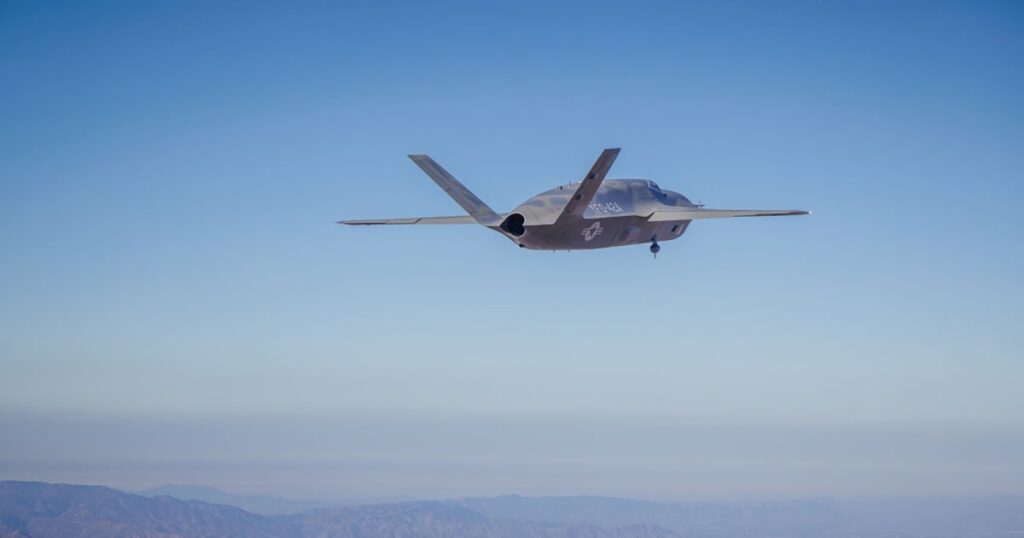
SAN DIEGO – 10 February 2026 – General Atomics Aeronautical Systems, Inc. (GA-ASI) was competitively selected by the U.S. Marine Corps (USMC) for evaluation in the Marine Air-Ground Task Force Uncrewed Expeditionary Tactical Aircraft (MUX TACAIR) Collaborative Combat Aircraft (CCA) program. The agreement integrates GA-ASI’s expertise in autonomy and uncrewed aircraft systems with a government-provided mission package, using the YFQ-42A platform as a surrogate to evaluate integration with crewed fighters.  

The contract initiates integration of a Marine Corps mission kit into the YFQ-42A surrogate platform for assessment within the Marine Air Ground Task Force (MAGTF).  

The USMC contract includes the rapid development of autonomy for the government-supplied mission kit — a cost-effective, sensor-rich, software-defined suite capable of delivering kinetic and non-kinetic effects — positioning the solution for use in expeditionary operations. This work will support evaluations of future MUX TACAIR capabilities.  

“This selection builds upon the GA-ASI autonomous systems in use today and demonstrates our commitment to delivering next generation capabilities for critical USMC missions,” said Mike Atwood, Vice President of Advanced Programs for GA-ASI. “Our FQ-42, combined with our proven autonomy architecture and integration expertise, positions us to rapidly deliver an affordable CCA solution that enhances the Marine Air-Ground Task Force’s operational effectiveness in contested environments.” 

GA-ASI was selected by the U.S. Air Force in April 2024 to build production-representative flight test articles for the CCA program. The YFQ-42A successfully conducted its maiden flight in August 2025, validating a “genus/species” concept for rapid, modular, and low-cost uncrewed fighter aircraft development. This approach enables a common core aircraft design that can be rapidly adapted for different mission sets and service requirements. 

The YFQ-42A is a purpose-built CCA platform developed as part of GA-ASI’s ongoing investment in next-generation autonomous combat aircraft. The aircraft’s modular design enables rapid integration of mission systems. GA-ASI’s autonomy architecture, demonstrated through multiple live flight tests, provides the foundation for human-machine teaming in complex combat scenarios. 


Marine Corps Passes Fiscal 2025 Financial Audit 

From Communication Directorate, Headquarters Marine Corps, Feb.9, 2026 

HEADQUARTERS, MARINE CORPS – For the third year in a row, independent auditors verified that the Marine Corps’ financial records are materially accurate, complete, and compliant with federal regulations and issued an unmodified opinion for Fiscal Year 2025. 

Three is a pattern of accountability. This repeat achievement reinforces the service’s reputation for accountability, discipline, and leadership. The first and only service to achieve a clean, unmodified audit opinion, the Marine Corps continues to lead department-wide efforts toward effective financial management and delivering accountability to the American taxpayer.  
 
The findings produced by the audit help the service to more efficiently and accurately plan, program, budget, and spend funds appropriated by Congress. 

The Marine Corps’ audit process enabled accurate global tracking and reporting of financial transactions, inventory of facilities, equipment and assets, and accounting for taxpayer dollars spent during the last fiscal year. The auditors also tested the Marines Corps’ network, key business systems, and internal controls. 

“Passing our third consecutive audit is a direct reflection of who we are as Marines,” said Gen. Eric M. Smith, Commandant of the Marine Corps. “Discipline, accountability, and stewardship are not administrative tasks; they are part of our warfighting culture. When the American people entrust us with their tax dollars, we owe them careful judgment and integrity in how those dollars are spent. Receiving our third consecutive clean audit opinion affirms that Marines take that responsibility seriously at every level, in every unit. I am beyond proud of the work by our Marines, Sailors, and civilians that made this possible.” 

Since becoming the first service to pass an annual financial audit, the Marine Corps took additional steps to stabilize its new accounting system and procedures. Independent public accountants contracted by the Department of War Inspector General audited all records. Financial management personnel also gained more hands-on experience, which set conditions for a smoother audit this year.  

With each additional audit year under our belts, we get smarter and adapt, finding new and better ways to get the job done,” said LtGen. James Adams III, Deputy Commandant for Programs and Resources. “But to be clear, the hurdle we pass is no less significant. A financial statement audit is a year-round effort that tests every aspect of how we manage money for the Marine Corps. The sustained focus of our team on doing the job right over time is impressive.” 

The auditor’s final report, enclosed in the Marine Corps’ Fiscal Year 2025 Agency Financial Report, highlights seven areas for the Marine Corps to improve upon, referred to as material weaknesses.  

The Marine Corps will continue to eliminate these weaknesses through systems improvement and internal controls. While doing this, the Corps will still prioritize the accurate counting and management of its global assets, a challenging task given the vast scope of its operations. By repeating and refining this process, the Corps aims to develop a more fluid and efficient enterprise resource planning system, ultimately positioning itself for long-term mission success and accountability. 

The Agency Financial Report for Fiscal Year 2025 is available at: https://www.pandr.marines.mil/ 


Israel MOD Signs $130M Deal with Elbit Systems to Integrate Israeli Systems on CH-53Ks

Release From Elbit Systems

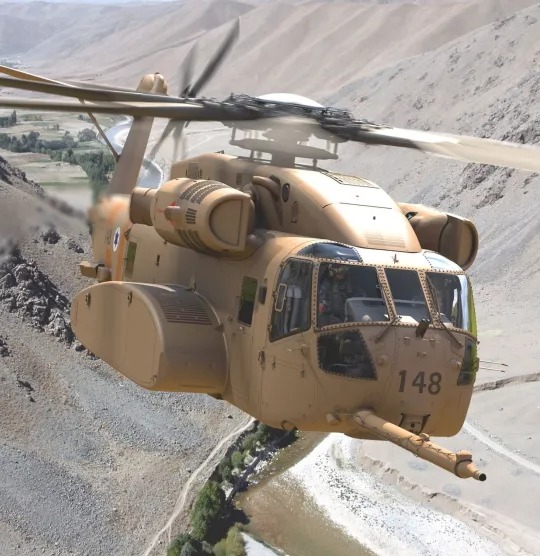
As part of the preparations for receiving the CH-53K “Pereh” helicopters, the Defense Procurement Directorate (DPD) within the Israel Ministry of Defense (IMOD) has signed a deal with Elbit Systems to integrate advanced Israeli technologies, including command and control, avionics, and electronic warfare systems, and the advanced anti-missile DIRCM system, on the 12 new helicopters expected to replace the IDF’s aging “Yas’ur” helicopters. The deal, led by the Deputy Director of the DPD for Air and Sea Procurement, is valued at approximately $130 million (over NIS 400 million). 

The CH-53K helicopters were purchased through a Foreign Military Sales (FMS) agreement signed several years ago between the IMOD and the U.S. government. The helicopters are manufactured by Lockheed Martin-Sikorsky and are currently in the assembly process at the main production facility in Connecticut. 

Upon completion of assembly, the helicopters are expected to move to a dedicated installation and production line established for adapting the American-configuration helicopters to Israeli systems tailored to the operational requirements defined by the Israeli Air Force (IAF). The integration of Israeli systems is expected to enhance the cockpit environment, enable flight in challenging conditions, and support the identification of safe landing zones and obstacles. 

Defense Minister Israel Katz: “This deal marks a major milestone in strengthening the IDF and securing the Israeli Air Force’s operational edge for years ahead. Integrating cutting-edge Israeli systems into the world’s most advanced heavy-lift helicopter ensures these platforms are fully adapted to Israel’s unique combat requirements. We remain committed to advancing domestic ‘blue-and-white’ defense production and incorporating Israeli industries into strategic programs, ensuring production independence, supply continuity, and operational superiority for our forces.” 

IMOD Director General Maj. Gen. (Res.) Amir Baram: “The CH-53K helicopters are a key part of the multi-year procurement program the Ministry is pursuing alongside the IDF for fighter squadrons, helicopters, tankers, and various armaments that will define the IDF’s force structure for the coming decade and beyond. Integrating Israeli technologies into the world’s most advanced heavy-lift helicopter demonstrates the technological edge of Israel’s defense industries and the significant potential of incorporating Israeli systems into cutting-edge aircraft platforms.” 

Elbit Systems President and CEO, Bezhalel (Butzi) Machlis: “We are honored to take part in the flagship project to upgrade the helicopter fleet and to support the complex needs of the Air Force, through Elbit’s most advanced systems, which will be integrated into the new CH-53K helicopters. These systems, representing the forefront of Elbit’s proven technology, are tailored to the Air Force’s requirements and provide an optimal advanced technological envelope for mission execution and for ensuring pilot safety.” 


Marines Establish Refueling Point in Indo-Pacific 

Feb. 6, 2026 |  By Marine Corps Lance Cpl. David Getz , 1st Marine Aircraft Wing,   

Marines assigned to Marine Wing Support Squadron 171 and Marine Fighter Attack Squadron 232 traveled to Tinian, one of the Northern Mariana Islands, to establish and operate a forward arming and refueling point during an aviation training relocation program aimed at developing expeditionary aviation capabilities and ensuring security throughout the Indo-Pacific region. 

“We are out here training to show we can set up a FARP anywhere quickly and provide support wherever the fight is happening,” said Marine Corps Sgt. Kuyler Brown, an expeditionary fuels technician assigned to the support squadron. 

The FARP was used to conduct simulated real-world scenarios that gave Marines on the ground experience operating a live FARP and pilots the ability to operate away from their main operating base while receiving continuous support. 

“Having a FARP allows us to stay in the fight,” Brown said. “It cuts down on flight time, keeps our jets in the air longer and shows we can set up anywhere and operate.”  

Tinian is located near Andersen Air Force Base, Guam, which provides the ability to rapidly refuel and support aircraft, making it a valuable training area for aviation training relocation operations and projecting power throughout the Indo-Pacific region.   

Conducting training from island locations like Tinian allows Marines to gain real-world experience practicing FARP assembly, disassembly and sustained aviation operations in austere environments — a key aspect of the expeditionary execution of a FARP.   

“This kind of training builds the Marines’ confidence not only in their own capabilities but in each other,” Brown said. “Our Marines know how to do their jobs, and exercises like this prove we can make it happen.”     

The successful setup and operation of the FARP at Tinian demonstrated Marine Wing Support Squadron 171’s ability to deploy and support aviation operations in austere environments. Training events like this give Marines the chance to develop their skills and remain ready to support future operations focused on ensuring a free and open Indo-Pacific region. 


RTX’s Raytheon Selected by DARPA to Develop Advanced Maritime Defense Technologies

Release From RTX

New capability will protect vulnerable vessels from threats at sea 

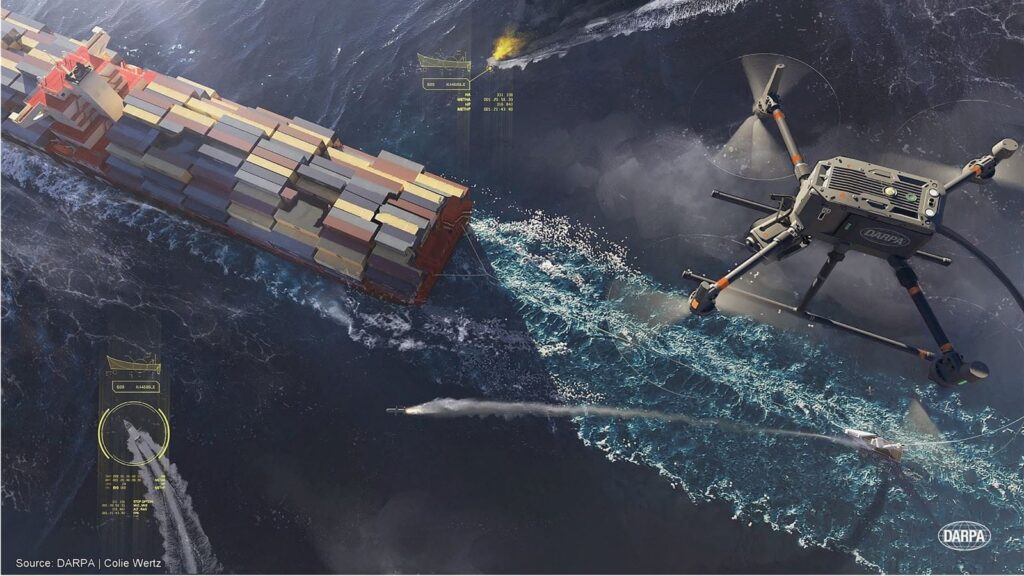
PORTSMOUTH, R.I., (February 2, 2026) — Raytheon, an RTX (NYSE: RTX) business, has been selected by the Defense Advanced Research Projects Agency (DARPA) to develop an advanced sensing and targeting system that will help defend vulnerable commercial shipping and naval logistics vessels against emerging threats such as unmanned surface vehicles (USVs). 

Under the contract, Raytheon’s Advanced Technology team will design, build, and demonstrate a system that consists of Electro-Optical/Infrared (EO/IR) sensors, advanced detection software, and robust command and control capabilities to enhance situational awareness and threat response. 

The system, which is being developed for DARPA’s Pulling Guard program, will deploy the sensors via a tethered drone connected to a semi-autonomous unmanned platform that is towed by commercial and naval logistics vessels. The sensors will provide real-time target tracking data to remote operators, enabling them to make rapid, informed engagement decisions.  

Phase one of the program will focus on simulated engagements to evaluate system performance and operator workflows. In phase two, the system will transition to integrating operational launchers and effectors for live operations. 

“Through this development, we are advancing critical security technologies for commercial shipping in regions like the Red Sea,” said Colin Whelan, president of Advanced Technology at Raytheon. “By integrating our proven expertise in command and control, high-performance sensing, and effectors, we will deliver a scalable, cost-effective solution that minimizes risks to both cargo and naval assets.”  

Beyond its primary focus of vulnerable ship protection, the technology Raytheon is developing has the potential to deliver broader capabilities across a wide range of naval and security operations, including automated overwatch for medium and large USVs and manned combatants operating in multiple theaters.