22nd MEU (SOC) Concludes 10-Month Deployment  
From II MEF Communication Strategy & Operations, June 1, 2026  

MARINE CORPS BASE CAMP LEJEUNE, N.C. – Marines and Sailors of the 22d Marine Expeditionary Unit (Special Operations Capable) began returning home in waves June 1, 2026, after completing a nearly 10‑month deployment in support of Operation SOUTHERN SPEAR and U.S. Southern Command’s priorities of countering illicit threats, strengthening regional partnerships, and protecting the homeland. 

The 22d MEU (SOC) is comprised of Battalion Landing Team 3/6, Combat Logistics Battalion 26, and Marine Medium Tiltrotor Squadron 263 (Reinforced). The unit was embarked aboard the Iwo Jima Amphibious Ready Group, which included USS Iwo Jima (LHD 7), USS San Antonio (LPD 17), and USS Fort Lauderdale (LPD 28). Initially slated for deployment to 5th and 6th Fleet, the ARG/MEU pivoted south shortly after departing Norfolk, answering SOUTHCOM’s call for a flexible, sea‑based formation capable of responding across the competition continuum. 

During the ten‑month deployment, the 22d MEU (SOC) executed five distinct MEU Mission Essential Tasks, demonstrating its operational flexibility. Embassy reinforcement missions in Haiti and Venezuela provided security during periods of regional instability; five Maritime Interception Operations disrupted illicit trafficking networks across the Caribbean Basin; integration with Special Operations Forces (SOF) during Operation Absolute Resolve showcased the MEU’s ability to set the theater for sensitive joint missions; and foreign humanitarian assistance operations in Jamaica highlighted the MEU’s capacity to rapidly project aid from the sea. Together, these accomplishments underscored the strategic value of a forward‑postured naval expeditionary force. 

“This deployment proved a fundamental truth about our naval expeditionary forces: nobody can do what a ARG/MEU can do organically, across all warfighting functions and all domains,” said Col. Tom “Banshee” Trimble, commanding officer of the 22d MEU (SOC). “I am incredibly proud of this blue‑green team. Watching them pivot from high‑stakes power projection one day, to embassy reinforcement and a massive humanitarian relief effort the next was nothing short of eye‑watering.  

The deployment included several operational milestones for the IWOARG/22d MEU (SOC) team. During Operation Absolute Resolve, the ARG/MEU operated alongside joint and interagency partners to open and set the theater for special operations forces. Additionally, the MEU enhanced security at U.S. embassies in Port‑au‑Prince, Haiti, and Caracas, Venezuela. The unit played a key security role on Mar. 14, 2026, during the raising of the American flag at the U.S. embassy in Venezuela, and months later executed a quick‑reaction force and casualty‑evacuation rehearsal in Caracas that included transporting the SOUTHCOM Commander via MV‑22B Osprey. 

“The Navy and Marine Corps team demonstrated its flexibility and operational reach,” said Capt. Chris Farricker, Commodore, Iwo Jima Amphibious Ready Group and commander, Amphibious Squadron Eight. “Together, the IWO JIMA ARG and 22D MEU (SOC) showcased the United States’ ability to maintain a persistent maritime presence and respond effectively from the sea to meet regional challenges, with zero reliance on foreign basing.” 

The ARG/MEU spent more than 90 percent of its deployment in the Central Caribbean Basin, steaming over 130,000 nautical miles. 

“Our ability to create our own training opportunities, both from the sea and ashore, was a critical factor in our sustained readiness,” said Col. Trimble. “Our Marines and Sailors built a logistical hub where none existed and improved Camp Santiago to the point that the BLT was able to employ nearly every weapon in its arsenal. That ensured we maintained our tactical edge through month ten.” 

When natural disaster struck the region, the ARG/MEU rapidly transitioned to humanitarian assistance operations. From Oct. 31 to Nov. 13, 2025, in partnership with Joint Task Force–Bravo, the 22d MEU (SOC) delivered large‑scale relief to Jamaica following Hurricane Melissa. Leveraging ARG shipping, organic aviation, and sea‑based sustainment, the force reached isolated communities cut off by storm damage. Working alongside the Jamaica Defence Force and the U.S. State Department’s Disaster Assistance Response Team, the MEU delivered more than 780,000 pounds of supplies, dispensed 6,190 pounds of fuel at forward refueling points, and mapped 72 hasty landing zones using organic intelligence and reconnaissance assets. 

Beyond crisis response, the 22d MEU (SOC) strengthened regional partnerships and reinforced deterrence across the Caribbean. Marines and Sailors conducted two military exchanges with the Trinidad and Tobago Defence Force, focusing on infantry skills, Tactical Combat Casualty Care, and live‑fire mortar employment. Regional interoperability expanded further through a major bilateral exercise in Ecuador and participation in Exercise Tres Kolos alongside French and Dutch forces in Martinique. 

As the 22d MEU (SOC) returns home, it sets the stage for the incoming 24th MEU, deploying as the 24th Littoral Combat Force, to continue SOUTHCOM’s mission in the Caribbean. This deliberate transition ensures the region maintains a continuous, capable, and ready ARG/MEU presence in the Western Hemisphere.  



Insitu Integrator VTOL Proves Long-Range Multi-INT Capability at Balikatan 2026

Integrator VTOL with FLARES ready to launch from FARP location

From Insitu 

BINGEN, WASH, June 2, 2026: Insitu, a Boeing company, successfully demonstrated its Integrator VTOL Uncrewed Aerial System (UAS) during Exercise Balikatan 2026, showcasing long-endurance, extended-range, multi-INT and AI-enabled battle management integration capabilities at density altitudes including above 12,000 feet and in heat indices reaching 107°F. 

Integrator VTOL delivered expeditionary performance and remote split operations in extreme heat and humidity while operating from unimproved, austere sites replicating Forward Arming and Refueling Positions (FARPs) at Balikatan 2026. 

During the exercise, Integrator VTOL: 

  • Completed a 22.4-hour sortie at 6,500–9,000 feet density altitude, returning with 1.5 hours of reserve fuel 

  • Performed extended Maritime Domain Awareness and ISR operations at 200 NM ranges with 6+ hours of time on station in a multi-INT configuration employing the IMSAR NSP-5 Synthetic Aperture Radar, cross-cueing a Hood Technologies multi-spectral EOIR6 gimbal  

  • Demonstrated detection of vessels at 35 NM through marine haze using Arkeus’ Warden passive Hyper-Spectral Optical Radar (HSOR), cross-cuing an onboard ACO9 narrow field of view gimbal.   

  • Used the small-packout FLARES VTOL system to execute landing and relaunch cycle from a covert austere position in just 38 minutes, demonstrating the agility required for USMC Expeditionary Advanced Base Operations (EABO) 

  • Detected, identified, and collected detailed imagery of vessels from combat-relevant stand-off ranges  

  • Employed a backpack-portable, battery-powered Ground Control Station at the FARP demonstrating truly mobile ground control 

  • Integrated safely into uncontrolled airspace using Boeing’s airspace management and deconfliction software, PLEO SATCOM, and advanced avionics 

  • Seamlessly integrated senor data with an AI-enabled battle management system (BMS), providing real-time actionable intelligence across a networked common operating picture  

“Integrator with FLARES VTOL offers significant range and endurance while carrying multiple-intelligence payload sets, and our recent demonstrations at Balikatan in extreme heat and high-density altitude conditions prove that it’s not just marketing,” said Diane Rose, Insitu CEO. “We brought our systems into some of the most challenging conditions, and they performed as designed. Integrator truly delivers Group 4–5 ISR and targeting capabilities at a fraction of the cost.” 

Integrator VTOL was operated by Insitu Field Services Representatives with decades of combined combat operations experience. Exercise evaluators praised Insitu’s team as “obvious professionals,” underscoring the company’s ability to support the warfighter. 

“I’m incredibly proud of our teammates for demonstrating operational excellence in harsh, demanding conditions,” added Rose. “From rucking the system into an austere FARP site, to operating in extreme heat while responding to dynamic tasking, our team showed the best of what our systems can offer.” 


24th Marine Expeditionary Unit Assumes the Watch as Littoral Combat Force-24

From II MEF Communication Strategy & Operations, May 29, 2026

PUERTO RICO — The 24th Marine Expeditionary Unit has officially assumed the mission as the premier tactical force-in-readiness within the U.S. Southern Command Area of Responsibility. Operating under the designation of Littoral Combat Force-24, the command offers tactical options via an agile Marine Air-Ground Task Force of over 1,300 Marines and Sailors to the theater. Commanded by U.S. Marine Corps Col. Ryan Lynch, LCF-24 is directly nested under Joint Task Force 84-2 to support Operation Southern Spear.

“The Marines and Sailors of LCF-24 are postured to execute all prescribed mission sets directed by our higher echelons of leadership; to deter the threats facing our hemisphere today,” said Col. Lynch. “Through our transition with the 22nd MEU, we have seamlessly assumed the watch. Our posture is active, our forces are integrated, and we are committed to standing as the regional security partner of choice.”

Operation Southern Spear and Mission Essential Tasks

While in theater, LCF-24 will serve as the immediate crisis response force for USSOUTHCOM. The MAGTF is certified to execute a wide array of mission essential tasks, including but not limited to Quick Reaction Force operations such as embassy reinforcement and the tactical recovery of aircraft personnel, while standing ready to support disaster relief activities.

While operating in the contested littorals, LCF-24 also provides the combatant commander a flexible force capable of conducting maritime interdiction operations against sanctioned activities and illicit trafficking. The MAGTF will actively defend the U.S. homeland by disrupting networks utilized by Designated Terrorist Organizations and narco-terrorists.

A Purpose-Built Force for the Littorals

Distinct from a standard Amphibious Ready Group/MEU deployment, LCF-24 is a purpose-built MAGTF engineered for distributed operations. The force maximizes its rapid littoral maneuver capabilities by operating from both shore-based nodes and amphibious transport dock USS Fort Lauderdale, which is exclusively aligned to support the MAGTF’s mission.

Nested Under National Strategy

The deployment of LCF-24 directly supports national defense priorities and the strategic objectives of USSOUTHCOM.

“Our success in Operation Southern Spear relies on our ability to out-maneuver and overmatch the illicit networks threatening the region,” said U.S. Marine Corps Lt. Gen. Calvert L. Worth, commanding general of II Marine Expeditionary Force. “Littoral Combat Force-24 provides the exact combination of precision capability and interoperability we need. They are not just a crisis response force; they provide options to the Combatant Commander and serve as a tool for building partner capacity and securing the advantage across all domains.”

Ultimately, this tactical execution nests directly within the theater-wide strategic objectives of U.S. Southern Command. The presence of LCF-24 serves as a powerful deterrent against malign state actors and reinforces the security of the homeland.

“The Western Hemisphere is no longer a permissive environment for narco-terrorists, criminal syndicates, or their state sponsors,” stated U.S. Marine Corps Gen. Francis L. Donovan, Commander of U.S. Southern Command. “With Littoral Combat Force-24 taking the helm of tactical operations, we are sending an unambiguous message: the United States is committed to defending our homeland and securing a prosperous, stable hemisphere alongside our enduring partners.”

As LCF-24 begins its tenure in the USSOUTHCOM AOR, the focus remains steadfast: defend the homeland, dismantle narco-terrorist networks, counter adversary disinformation, and ensure the United States remains the partner of choice for regional security.


ANELLO Photonics Miniaturizes Navigation Systems for Unmanned Systems

ARLINGTON, Va. — A Silicon Valley-based technology company is finding success in developing and producing small, silicon chip-based navigation systems ideal for unmanned systems operating in GPS-denied environments across land, air and sea. 

ANELLO Photonics, headquartered in Santa Clara, California, develops advanced navigation systems based on silicon photonics technology. The company integrates optical sensing and inertial navigation capabilities onto compact silicon chips to deliver high-performance positioning and guidance solutions.

Its core product, the SiPhOG (Silicon Photonic Optical Gyroscope), is a photonic integrated circuit that provides the functionality of a traditional fiber-optic inertial navigation system used in aircraft, ships, and submarines, while significantly reducing size, weight, power consumption, and system complexity.

“Fiber-optic gyros are high-end, navigation-grade sensors usually used for ICBMs, fighter jets, [and] submarines. They’re the gold standard, [and] often can navigate for weeks or months at a time,” said Dr. Kirstin Schauble, Vice President for Systems Engineering at ANELLO, in an interview with Seapower. “They’re fantastic sensors; the problem with them is that they are big, bulky, power hungry, and extremely expensive.” 

As such, fiber-optic gyros are impractical for small unmanned systems, particularly attritable systems.  

“We’ve taken the core physics behind traditional fiber-optic gyroscopes – systems that conventionally rely on numerous discrete optical components – and integrated them onto a compact silicon photonics chip,” said Schauble. “By integrating active and passive photonic elements onto a two by five millimeter chip , we’ve dramatically reduced the size and complexity of high-performance inertial navigation technology. The SiPhOG is also mass producible and highly robust, while still delivering the precision expected from traditional fiber-optic gyroscopes due to the significant innovations we’ve achieved in silicon photonics.”

Because the SiPhOG is relatively inexpensive, small, lightweight, and consumes little electric power, it is ideal for equipping swarms of autonomous systems such as unmanned aerial vehicles (UAVs), unmanned surface vessels (USVs) and unmanned underwater vehicles (UUVs).  

Schauble said the SiPhOG is ideal for Group 2/3 fixed wing drones, USVs, and 10-foot-to-200-foot vessels. 

“We’re able to bring high precision capability to lower-cost, lower size-weight-power form factors for smaller vessels that previously couldn’t afford FOG-level performance,” she said. 

The company’s Maritime Inertial Navigation System (INS) delivers precise and reliable navigation in GPS-denied or contested environments, enabling continuous positioning, heading, and motion tracking for autonomous maritime platforms.

ANELLO’s X3 IMU (Inertial Measurement Unit) integrates seamlessly into existing systems and can operate either independently or as part of a larger navigation architecture, according to Schauble. Designed with an open interface and modular architecture, the X3 supports flexible plug-and-play integration across a wide range of aerial autonomous applications.

According to a company press release, ANELLO was selected in January by the Department of War (DoW) for a $20 million award under the Accelerate the Procurement and Fielding of Innovative Technologies (APFIT) program to fast-track the procurement, production, and scaling of ANELLO’s GPS-denied navigation technology. 

ANELLO’s SiPhOG-based Maritime INS is integrated on several autonomous systems, including HavocAI’s USVs and BlackSea Technologies’ Chaser USV. 

Schauble said ANELLO’s workforce is expanding from its current 35-to-40 personnel. 

“We can’t build these things fast enough,” she said commenting on the flood of orders. 


HII, MetalCraft Marine Deliver Autonomous USV Prototypes for U.S. Marine Corps

From HII 
 

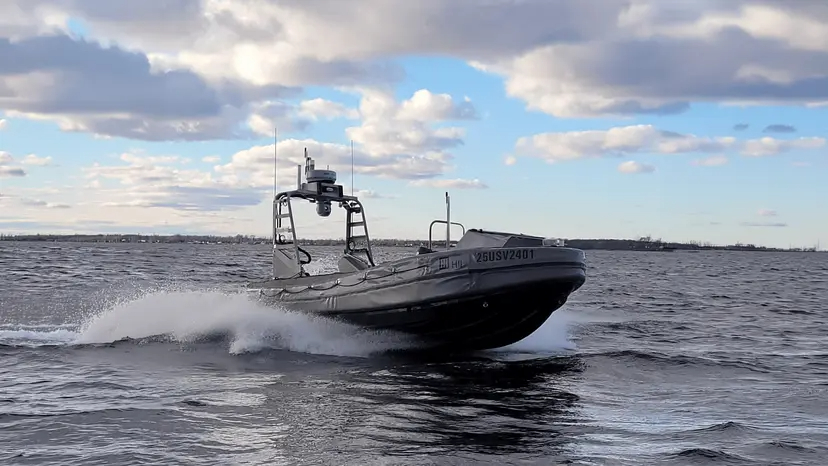
MCLEAN, Va., May 15, 2026 (GLOBE NEWSWIRE) — HII (NYSE: HII), in partnership with MetalCraft Marine, has delivered and sea tested two unmanned surface vessels (USV) awarded in a Defense Innovation Unit (DIU) contract for smaller form factor autonomous boat prototypes for the U.S. Marine Corps. 

The two ROMULUS-25 autonomous USVs were delivered in December 2025 and supported successful testing and demonstration of advanced autonomous mission behaviors at sea. 

“Successfully delivering on this prototype contract with the Defense Innovation Unit and the U.S. Marine Corps is a strong recognition of HII’s deep experience and the maturity of our proven autonomous technologies,” said Andy Green, executive vice president of HII and president of HII’s Mission Technologies division. “The ROMULUS-25, powered by our Odyssey autonomy suite, builds on thousands of hours of successful at-sea operations and demonstrates how scalable, AI-enabled unmanned systems can extend the reach, endurance, and effectiveness of naval forces.” 

The ROMULUS-25 is a 27-foot high-speed interceptor vessel designed to deliver up to 1,000 pounds of payload with a range of up to 1,000 nautical miles. Fully capable of autonomous operation, the vessel is powered by HII’s Odyssey AI-based autonomy system, which integrates multiple sensors and effectors to enable coordinated, cross-domain maritime operations in support of the U.S. Marine Corps, as well as U.S. and allied navies. 

Over the past five years, Odyssey autonomy has been validated through more than 2,200 hours of autonomous operations during government-led tests and exercises. 

Odyssey autonomy has been deployed on more than 30 platforms, accumulating over 12,000 hours of successful at-sea operations. Its modular open systems architecture (MOSA), service-based design enables integration with the HII Minotaur targeting network, enhancing mission-level operations and edge capabilities through AI-based contact recognition and identification. 

The ROMULUS-25 is part of HII’s broader family of USVs, which range from 7-foot micro-USVs to the ROMULUS-190, a 190-foot aluminum USV capable of carrying multiple containerized payloads. 

The successful execution of this award represents one of several ongoing commitments by HII and MetalCraft Marine to advance hybrid manned-unmanned fleet capabilities and enable next-generation autonomous operations in support of naval missions worldwide. 


U.S. Marine Corps Strengthens Arctic Readiness with Campaign – Alaska

From Communications Directorate, Headquarters Marine Corps, May 9, 2026 

WASHINGTON, D.C. -  The United States Marine Corps has launched “Campaign – Alaska,” a strategic initiative to enhance its operational capabilities in the Arctic. This campaign combines two key efforts: the Marine Rotational Force – Alaska (MRF – Alaska) and the establishment of a Supporting Arms Liaison Team – Alaska (SALT – Alaska). These initiatives will address the Arctic’s growing strategic importance in an era of global competition and ensure the Marine Corps is prepared for the extreme conditions of the High North. 

The 2026 National Defense Strategy prioritizes key terrain in the Western Hemisphere from the Arctic to South America as vital for homeland defense and strategic competition.  

The Commandant of the Marine Corps, Gen. Eric Smith, stated that “the Arctic is a region of growing strategic importance. The Marine Corps must be prepared to operate and win in its extreme conditions. MRF – Alaska and SALT – Alaska are critical to ensuring our Marines are forward postured, trained and equipped to project power globally, reaffirming our commitment as the Nation’s expeditionary force in readiness.” 

MRF – Alaska, under the direction of Marine Forces Northern Command (MARFORNORTH), will conduct persistent, multi-domain expeditionary training and experimentation in Alaska. By participating in Joint exercises like Arctic Edge and Red Flag, MRF – Alaska will provide a training venue to prepare the Fleet Marine Force for operating in arctic conditions. This will not only bolster homeland defense but also improve interoperability with Joint and allied forces, deter adversaries, and promote regional stability.  

“In this era of strategic competition, Alaska is critical to homeland defense and a vital theater for global power projection in the Arctic,” said Lt. Gen. Bobbi Shea, Commanding General, Marine Forces Northern Command. “The Marine Corps Campaign – Alaska is a deliberate and necessary step to ensure we provide the Joint Force with a combat-credible force to support the National Defense Strategy.”  

Complementing the rotational force, Marine Corps Forces Reserve (MARFORRES) is establishing SALT – Alaska, a permanent detachment of the 6th Air Naval Gunfire Liaison Company (ANGLICO) at Joint Base Elmendorf-Richardson (JBER). This builds on MARFORRES’ long-standing presence in Alaska, dating back to 1985. The SALT – Alaska detachment will be instrumental in expanding training and operational activities and will facilitate coordination with Joint Forces, allies and local communities. By fiscal year 2027, SALT – Alaska will provide a persistent Marine Corps presence in Alaska, ensuring continuity in Arctic operations and positioning the force for rapid expansion when needed.  

Campaign – Alaska is a deliberate, forward-thinking strategy to meet the challenges and opportunities of the Arctic. By combining persistent rotational training with a permanent liaison capability, the Marine Corps is creating a robust Arctic presence. This will enable the Corps to project power, defend the homeland, and deter adversaries in one of the world’s most demanding environments. 

Lt. Gen. Shea stated, “Alaska will only grow in strategic importance. The Marine Corps is committed to ensuring we are prepared to operate in the High North.” 


Bell to Provide Bell 505 Airframe for U.S. Marine Corps’ MARV-EL Program

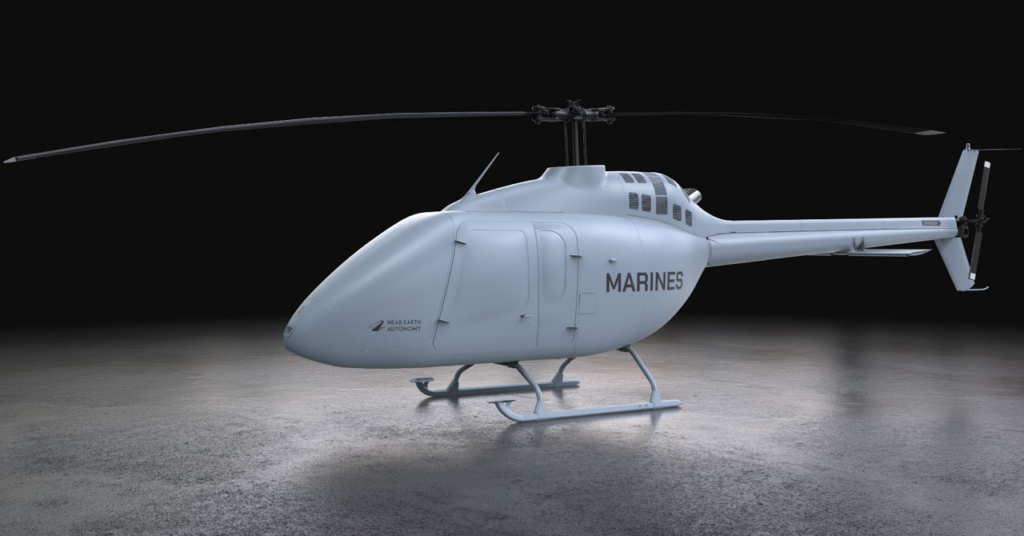
Bell Textron will provide its Bell 505 airframe for the U.S. Marine Corps’ MARV-EL uncrewed logistics aircraft program. Photo credit: Bell Textron

Bell Textron Inc., a Textron Inc. company, announced it was selected by Near Earth Autonomy (Near Earth) as a partner on the prototyping of an autonomous Bell 505 for the U.S. Marine Corps’ Aerial Resupply Vehicle – Expeditionary Logistics (MARV-EL) Increment 2 program.

The goal of the program is to prototype an uncrewed logistics aircraft ready for tactical-edge resupply in contested environments and serve as a middle-weight uncrewed logistics asset. 

“This platform will be a step forward in transforming the U.S. Marine Corps’ autonomous operations and how our warfighters navigate on the battlefield,” said Jason Hurst, Bell SVP, Engineering. “We’re leveraging our decades of experience with the U.S. Armed Forces and innovative product development applying it to the versatile Bell 505 for this program.”

The awarded contract will deliver an autonomous aerial logistics capability that exceeds MARV-EL performance threshold requirements and accommodates a wide range of payloads and standard containers. Bell will provide engineering support to the Near Earth team on modifications to the Bell 505 for autonomy integration and enhanced cargo handling. 

“Bell looks forward to continuing to build upon our relationship and prior autonomy development with Near Earth in support of the MARV-EL program,” added Hurst.  

In 2024, Bell revealed its Aircraft Laboratory for Future Autonomy (ALFA) platform – a step forward in its autonomous flight efforts. Bell and Near Earth collaborated to integrate an advanced perception system for flight demonstrations on the ALFA aircraft, working towards fully autonomous flight capability. 


Commandant Gives an Update on Marines Future

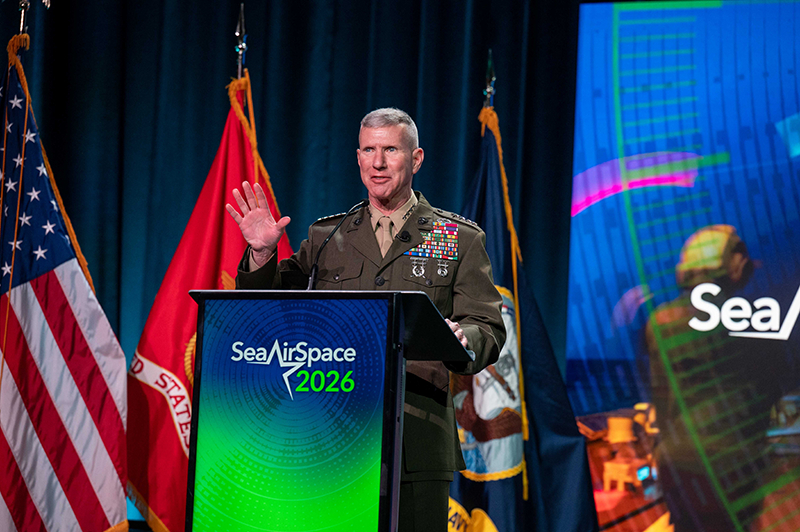
Marine Corps Commandant Gen. Eric Smith discusses the 250th anniversary of the U.S. Marine Corps. (Credit: Laura Hatcher)

By Vicky Uhland, Seapower Correspondent 

Marines don’t win wars; they win battles, said General Eric Smith, commandant of the U.S. Marine Corps, during the Tuesday afternoon session “250 Years Strong — Building the Marine Corps of Tomorrow.” 

“If you’re looking for a chain-mail fist, you’re looking at the U.S. Army,” he said. “If you’re looking to get popped in the nose, you’re looking at the Marine Corps.” 

Smith outlined how the Marines are evolving with the changing character of war. The amphibious ready group remains the crown jewel of the expeditionary force, he said, and is currently deploying a three-ship Marine expeditionary unit — one from the East Coast, one from the West Coast and one from Japan. “We could use 5.5 MEUs, but we are committed to an unwavering goal of a 3.0 MEU presence,” he said.   

Smith said the Marines are also optimizing maintenance schedules to get more out of ships, are targeting investments in service-life extensions and are moving forward with procurement of new, more capable ships.  

“Our current investment of 31 amphibious ships is not adequate,” he said, noting that the 2027 defense budget is a significant down payment on a generational investment in ships, but more money is needed.  

Another area of emphasis is littoral mobility, mainly in the Indo-Pacific, which Smith called the world’s most challenging environment due to scale and size.  

Smith said the Marines are also bolstering their logistics network.  

“For decades, we operated with uncontested logistics, but the days of being three steps away from an MRE” or other supplies are over, he said. “As the maritime environment becomes less permissive, the global positioning network comes in.”  

Smith said another challenge that “worries me greatly right now” is sufficient magazine depth, which can give commanders freedom of action and reduce operational risk. 

Smith also highlighted current areas of achievement, including a clean financial audit for the third year in a row, the only service agency to do so. Barracks 2030 is delivering modern, safe and comfortable living conditions for Marines, and the Marine Corps Total Fitness program is helping make warriors physically, mentally, spiritually and socially resilient, he said.  

Smith also answered some audience questions, including:  

What can industry do to improve Marine resilience? 

“Keep on budget. Don’t sell me what I don’t need. Give me what I’m asking for at a price I can afford,” Smith said. 

What in-house innovations are impressing you? 

The Drone Dominance task force in Quantico is doing an amazing job with drone technology, Smith said. “We’re still too expensive and haven’t learned all the lessons of Ukraine, but we’re getting faster and faster.”    


Bundle Buy a Welcome Investment, AWIBC Says 

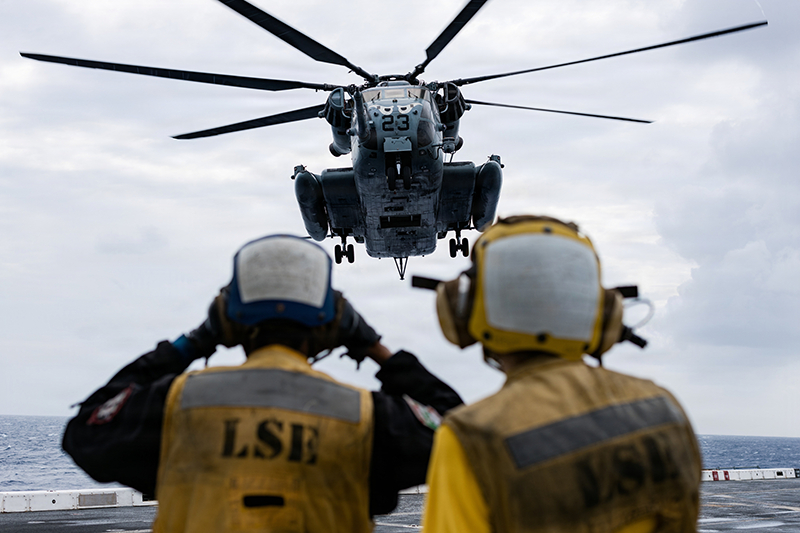
A CH-53E Super Stallion assigned to Marine Medium Tiltrotor Squadron (VMM) 163 (Reinforced), 11th Marine Expeditionary Unit, hovers over the flight deck of San Antonio-class amphibious transport dock ship USS Portland (LPD 27), during flight operations in the Pacific Ocean, April 10, 2026. CREDIT: U.S. Marine Corps | Lance Cpl. Luke Rodriguez 

The Amphibious Warfare Industrial Base Coalition (AWIBC) is a trade coalition of suppliers of systems, components, parts, and services toward the construction and sustainment of the U.S. Navy’s amphibious warfare ships. Recently, Paul Roden, chair of the AWIBC, responded to questions below from Senior Editor Richard R. Burgess.  

Has AWIBC membership increased or decreased over the last year? 

RODEN: The Amphibious Warship Industrial Base Coalition is a robust and growing organization. We continue to see strong interest from suppliers who recognize the importance of a unified voice in advocating for the stability of our nation’s defense industrial base that supports the men and women of our Navy and Marine Corps. 

Is the amphibious warship industrial base in better or worse shape than last year? 

RODEN: We are incredibly grateful for recent funding in support of amphibious warships, including the multi-ship buy for LPD 33, LPD 34 and LPD 35 as well as LHA 10. However, our most recent survey data shows that less than 10% of our suppliers are operating at full capacity due to inconsistent demand signals. As this new funding is placed on contract, it will help rejuvenate production lines and inject much-needed stability into the industrial base. 

With all of the efforts to shore up the shipbuilding workforce, how healthy is the workforce of the suppliers? 

RODEN: The most critical factor in the health of the industrial base workforce is stable and predictable funding. Our survey data shows a direct link between inconsistent demand and the challenge of maintaining a skilled workforce. With a clear and consistent demand signal from the government, we can unlock the full capacity of a domestic industrial base that is 100% committed to delivering the ships our warfighters need. 

How did the well-funded reconciliation law affect the amphibious warfare ship suppliers? 

RODEN: The funding for the bundle buy was a significant and welcome investment. That funding is helping to rejuvenate idle production lines and inject much-needed stability across the amphibious warship industrial base. More than 50% of suppliers agree that the multi-ship buy has added predictability, helping plan for on-time deliveries. It was a crucial investment for the suppliers in our coalition and we are grateful for that support. 

Are you seeing any improvements in amphibious warfare ship construction schedule stability? 

RODEN: While the recent funding was a significant and welcome commitment, true schedule stability can only come from consistent and predictable funding through multi-year appropriations. To the extent that many of our suppliers support new construction across both amphibious ships and other critical naval assets, stable funding benefits the entire shipbuilding industrial base committed to delivering America’s maritime dominance. 


Secretary of War Announces Marine General, Navy Flag Officer Nominations 

From the Department of War, April 15, 2026 

ARLINGTON, Va. — Secretary of War Pete Hegseth announced that President Donald J. Trump has made the following nominations: 

Marine Corps Lt. Gen. Roger B. Turner Jr. for reappointment to the grade of lieutenant general, with assignment as commander, U.S. Marine Corps Forces Pacific and commanding general, Fleet Marine Force Pacific, Camp H. M. Smith, Hawaii.  Turner is currently serving as commanding general, III Marine Expeditionary Force and commander, Marine Forces Japan, Okinawa, Japan. 

Marine Corps Maj. Gen. Keith D. Reventlow for appointment to the grade of lieutenant general, with assignment as director for Logistics, J-4, Joint Staff, Pentagon, Washington, D.C.  Reventlow is currently serving as commanding general, Marine Corps Logistics Command, Albany, Georgia. 

Marine Corps Maj. Gen. George B. Rowell IV for appointment to the grade of lieutenant general, with assignment as deputy commander, U.S. Indo-Pacific Command, Camp H. M. Smith, Hawaii.  Rowell is currently serving as director, J-5, U.S. Indo-Pacific Command, Camp H. M. Smith, Hawaii. 

Marine Corps Maj. Gen. Thomas B. Savage for appointment to the grade of lieutenant general, with assignment as deputy commandant, Training and Education, and commanding general, Training and Education Command, Quantico, Virginia.  Savage is currently serving as commanding general, 1st Marine Division, Camp Pendleton, California. 

Marine Corps Maj. Gen. James B. Wellons for appointment to the grade of lieutenant general, with assignment as deputy commandant for Programs and Resources, Headquarters, U.S. Marine Corps, Pentagon, Washington, D.C.  Wellons is currently serving as special projects officer to the Assistant Commandant of the Marine Corps, Pentagon, Washington, D.C.  

Marine Corps Col. Peter D. Houtz for appointment to the grade of brigadier general.  Houtz is currently serving as assistant judge advocate general of the Navy, Office of the Judge Advocate General, Office of the Secretary of the Navy, Washington Navy Yard, Washington, D.C. 

Navy Vice Adm. John F. Wade for reappointment to the grade of vice admiral, with assignment as senior military assistant to the Secretary of War, Pentagon, Washington, D.C.  Wade is currently serving as commander, Third Fleet, San Diego, California. 

Navy Rear Adm. Douglas L. Williams, for appointment to the grade of vice admiral, with assignment as director for Strategic Systems Programs, Washington Navy Yard, Washington, D.C.  Williams is currently serving as director for Test, Missile Defense Agency, Fort Belvoir, Virginia.