Marines Value Accountability, Are Eager to Deploy, Commandant Says

March 14, 2025 | By David Vergun, DoD News  

Marines don’t want to be constrained to a stateside location. They want to deploy, said Commandant of the Marine Corps Gen. Eric M. Smith, who spoke yesterday at Defense One’s “State of Defense 2025” digital event. 

If they don’t, then they won’t reenlist, Smith continued, noting that Marines are currently deployed to every geographic combatant command. 

To remain operationally ready, Marines must be taken care of properly, he said. They need to live in a decent barracks, they need to have a say in where their next duty station will be, and they need to receive pay commensurate with their service. 

Marines also value accountability, Smith said, mentioning the Marine Corps has passed the last two annual audits and will do so again. 

When Marines check in to a new unit, they’re issued a rucksack, shelter and other gear. When they check out, they’re expected to turn in all the gear they were issued. If they don’t, then they’re expected to go to the surplus store and purchase what is missing. That’s accountability, he said. 

“It’s just ruthless adherence to standards. I mean that there’s no secret to it, other than that’s how we make Marines,” Smith said. 

The Marine Corps has been meeting its recruiting mission “because we don’t fail. We put our best and brightest on recruiting duty, and we will reward them for successful completion, and we relieve them when they don’t make their mission,” he said. “We don’t know how to fail.” 

Smith said he hopes for a budget because a continuing resolution is detrimental to the Marine Corps’ modernization efforts. 

Also, the Marine Corps needs more amphibious ships, he said, so Marines can move about where they are needed. 

“Everything we do is about warfighting and lethality. That’s all we know. That’s who we are. Any additional funding that we would get will go toward operational readiness and lethality,” he said.


Marine Corps MQ-9 Reapers Enhanced With Advanced Payload Upgrade 

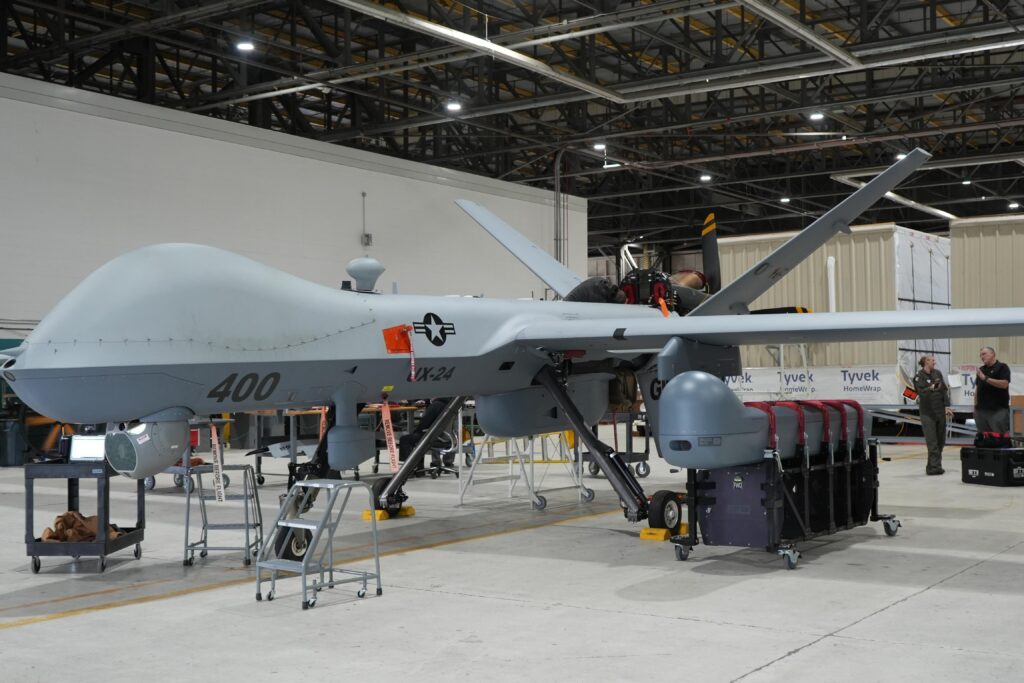
An MQ-9 Reaper is upgraded with SkyTower II Pod that will be deployed to Marine Corps’ squadron next year to enhance operational capability.  (U.S. Navy photo) 

From Naval Air Systems Command, March 10, 2025 

NAS PATUXENT RIVER, Md. — The Navy’s MQ-9 Reaper test squadron at Pax River received the first SkyTower II (STII) pod in preparation for the system’s initial operational capability (IOC) next year. 

Air Test and Evaluation (UX) 24 loaded the new pod onto the aircraft Feb. 25, conducting initial power on checks, the first step into integrating the new capability into the aircraft platform. 

“The program is excited to deliver SkyTower II for testing, marking a major milestone in our development journey,” said Capt. Dennis Monagle, Multi-Mission Tactical UAS program manager. “Over the past two years, we’ve partnered with GALT, a small business prime vendor, to rapidly develop this unique capability using middle-tier acquisition, accelerating innovation for the warfighter. With robust system and integration testing now underway, we remain on track to achieve initial operating capability this year, delivering critical capability to the U.S. Marine Corps and the joint forces.” 

STII is an airborne network extension pod that enhances cross-domain communication capabilities and links communications between disparate forces. It is required to execute the Intelligence, Surveillance, and Reconnaissance (ISR) concept of operations by providing tactically relevant operational communications and data sharing capabilities with many forces in support of the MQ-9 Reapers’ operational mission. 

UX-24 also completed a fit check of the MQ-9 in the large anechoic chamber at Pax River in late February. The team conducted a number of tests and hoisted the aircraft for the first time as a risk reduction for upcoming program efforts.  The tests proved the ability to safely hang the aircraft while providing power, cooling and satellite link with the aircraft for communications, command and control. 

Over the next several months, UX-24 will conduct final test events before delivering the upgraded MQ-9s to the fleet. 

 “The team has been able to accomplish a lot of work in a very compressed timeline by developing and executing these test plans for the chamber event and STII testing,” said Cmdr. Lauren Lawson, MQ-9 government flight test director.  ”The dedication shown and technical challenges they’ve overcome to conduct this critical testing to help develop the best product possible to support the Marines is truly commendable.”   

VMU-3 is currently flying MQ-9’s in theater today and will be the first to deploy with this new system in 2026. 

The MQ-9 Reaper provides Marines with a long-range ISR capability in support of maritime domain awareness and expeditionary advanced based operations in contested environments. 


President Says Military Recruiting Up, So Too Will Be American Shipbuilding, ‘Golden Dome’ 

March 5, 2025 | By C. Todd Lopez, DoD News

During his first address to a joint session of Congress, March 4, 2025, President Donald J. Trump said that the changes he’s made since his inauguration in January have enhanced recruiting within the U.S. military in ways that haven’t been seen in years.  

On his first day in office, the president signed an executive order ending diversity, equity and inclusion programs across the federal government. Less than a week later, newly sworn-in Defense Secretary Pete Hegseth drafted a message to the force that mirrored the president’s words, saying he would rebuild the U.S. military with a focus on lethality, meritocracy, accountability, standards and readiness.  

“Our service members won’t be activists and ideologues,” Trump said. “They will be fighters and warriors. They will fight for our country.”  

The president said the result of his executive order has filtered down into the armed forces, putting a new focus on merit and spurring renewed interest in serving.  

“I am pleased to report that in January, the U.S. Army had its single best recruiting month in 15 years and that all armed services are having among the best recruiting results ever in the history of our services,” Trump said. “What a tremendous turnaround. It’s really a beautiful thing to see people love our country again … they love our country, and they love being in our military again.”  

The president also said the United States will pursue a “Golden Dome,” similar to Israel’s own “Iron Dome” defense system, which is designed to protect against inbound missile attacks.  

“My focus is on building the most powerful military of the future,” Trump said. “As a first step, I’m asking Congress to fund a state-of-the-art, ‘Golden Dome’ missile defense shield to protect our homeland — all made in the USA.”  

The president said that President Ronald Reagan had wanted to build a similar system during his term, but the technology wasn’t available at the time to bring that project to fruition. But now, he said, that technology exists.  

“Israel has it, other places have it, and the United States should have it, too,” he said. “This is a very dangerous world. We should have it. We want to be protected. And we’re going to protect our citizens like never before.”  

Trump also promised an expansion of American shipbuilding in order to support both the U.S. military and the commercial sector. American shipbuilding is at a low point today, but the president promised new efforts to increase America’s shipbuilding efforts.  

“We are also going to resurrect the American shipbuilding industry, including commercial shipbuilding and military shipbuilding,” Trump said. “I am announcing tonight that we will create a new Office of Shipbuilding in the White House and offer special tax incentives to bring this industry home to America, where it belongs.”  

The president said the U.S. once had a great domestic shipbuilding industry, which has largely died down now. That will change, he promised.  

“We used to make so many ships. We don’t make them anymore, very much,” he said. “But we’re going to make them very fast, very soon.”  

The president also said he planned to take action to expand domestic production of rare earth elements, which are critical to U.S. defense.  

“Later this week, I will also take historic action to dramatically expand production of critical minerals and rare earths here in the USA,” he said.  

Rare earth permanent magnets, for instance, are not only essential components in a range of defense capabilities, including the F-35 Lightning II aircraft, Virginia and Columbia class submarines and unmanned aerial vehicles, but are also a critical part of commercial applications in the United States. They are also used to generate electricity for electronic systems in aircraft and focus microwave energy in radar systems.  

Finally, Trump said that the mastermind behind the terrorist attack at Abbey Gate during the August 2021 withdrawal from Afghanistan has been captured. Some 13 American service members were killed during that attack.  

“I am pleased to announce that we have just apprehended the top terrorist responsible for that atrocity, and he is right now on his way here to face the swift sword of American justice,” Trump said. 


Successful Test of Long-Range Precision Fires

Long Range Precision Fires (LRPF) was successfully executed at Yuma Proving Grounds (YPG) in Yuma, AZ, Nov 2024. The event was completed with an AH-1Z Viper launching a single weapon by way of a wireless application. 

From Naval Air Systems Command, Feb 13, 2025 

PATUXENT RIVER, Md. — Late last year, the Marine Corps successfully executed its first live employment test of a new Long Range Precision Fire (LRPF) capability. The event was successfully executed at Yuma Proving Grounds (YPG) in Yuma, Arizona,  where an AH-1Z conducted single launch by way of a wireless application via Marine Air-Ground Tablet (MAGTAB). 

The November test at YPG exceeded the threshold requirements with regards to position, navigation, and timing. This activity marks the first time a Marine Corps rotary-wing platform has employed a weapon system using a tablet-controlled device. 

“Assessments of current and future capability gaps of the fleets needs identified this LRPF initiative as a cost-effective, long-range precision weapon for use against maritime and land-based targets,” said Col Scott Shadforth, Director, Expeditionary Maritime Aviation – Advanced Development Team (XMA-ADT). 

This project is an Office of the Under Secretary of Defense for Research and Engineering (OUSD R&E) sponsored Defense Innovation Acceleration (DIA) project led by the XMA-ADT to evaluate cost-effective, long-range disparate effects in expeditionary and maritime environments. 


General Dynamics Land Systems successfully demonstrates ARV prototype to U.S. Marine Corps 

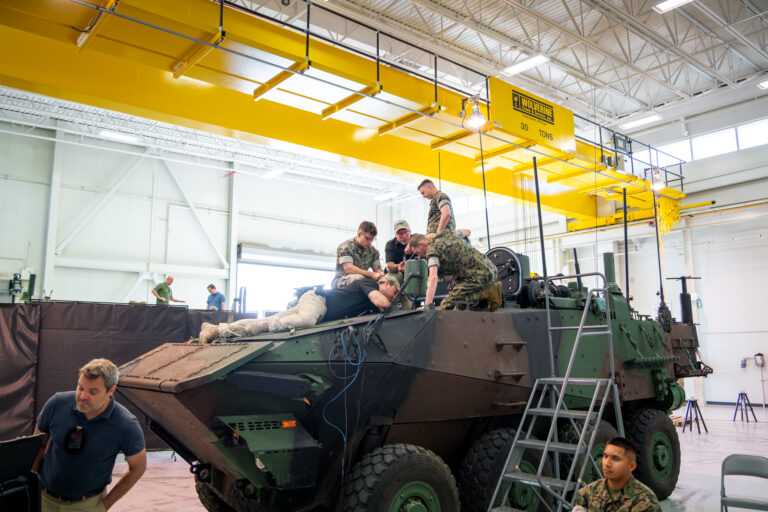
U.S. Marines from various Light Armored Reconnaissance battalions perform maintenance exercises with Field Service Representatives during a demo for the Advanced Reconnaissance Vehicle on June 14, 2024, at Detroit Arsenal. (Photo by David Jordan, Program Executive Officer Land Systems.)

On track to deliver SIL2.0 and 30mm variant of Advanced Reconnaissance Vehicle 

From General Dynamics Land Systems, Feb. 3, 2025 

 
STERLING HEIGHTS, Mich. – General Dynamics Land Systems announced today that it has successfully completed further testing of its Advanced Reconnaissance Vehicle (ARV) Command, Control, Communications, Computers/Unmanned Aerial Systems (C4/UAS) variant with the U.S. Marine Corps. The ARV is designed for the Marine Corps’ future Mobile Reconnaissance Battalions. 

Principal test locations from March to December 2024 included the Michigan Technological University Keweenaw Research Center (KRC) in Calumet, Mich., and the U.S. Army’s Ground Vehicle Systems Center (GVSC), Detroit Arsenal in Warren, Mich.  

General Dynamics Land Systems’ C4/UAS ARV variant is built to serve as the Marine Corps’ “quarterback” on the mobile and multi-domain battlefield. It connects to an array of onboard and off-board sensors, plus UAS and, in the future, ground and water robotic systems. The General Dynamics Land Systems design ensures growth margins and modular open architecture to rapidly incorporate new technology as it develops. In anticipation of potential future requirements, it also incorporates the company’s Next Generation Electronic Architecture, enabling artificial intelligence functionality and control of robotic systems. 

Marine Corps-directed and company-led tests and demonstrations in 2024 included land mobility, maintenance, logistics and training systems, as well as automotive and mission-profile performance assessments. 

A focus area in 2024 involved a maintenance and logistics capability assessment by Marines using the ARV. To this end, General Dynamics Land Systems has incorporated modern digital maintenance and prognostic monitoring systems in the ARV. In addition to Marine Corps-directed testing, General Dynamics Land Systems enhanced its demonstrations by introducing its next-generation Digital Training System (DTS), which eventually will enable ARV training at the individual, crew and unit levels for tactical operations and maintenance activities. 

“The testing and demonstration activities last year helped us collect additional data to ensure we can meet or exceed the Marine Corps’ requirements for ARV, especially in the critical area of maintenance, logistics and training,” said Richard Trotter, ARV Program Director at General Dynamics Land Systems. “We are confident we can achieve key performance requirements in these areas as we wholistically design the strategic ARV capability and competitively position ourselves for the next phase of the program.” 

Testing has included Marines from across the Light Armored Reconnaissance (LAR) and maintenance communities. 

“Partnering with the Marines in the ARV testing and demonstrations provides very valuable feedback,” said Marc Shepard, ARV Program Manager at General Dynamics Land Systems. “Their collaborative, constructive feedback is invaluable as we aim for a transformational, 21st century solution.” 

“We have said this before, and it is worth repeating: The ARV is highly mobile on land and in the water, allowing Marines to sense, communicate and connect to kill webs on the future battlefield like never before,” Trotter added. “Recent tests were some of the most extensive to date for us to trial our innovative technologies. We pride ourselves on delivering capabilities for today and also are thoughtful, deliberate and innovative about realizing the future vision of the Marine Corps. We look forward to continuing our long partnership with the Marines and contributing to their efforts to ensure that ARV is a transformational reconnaissance capability.” 

In 2025, General Dynamics Land Systems will complete manufacturing and delivery of an ARV-30mm prototype for testing and evaluation. The company also will deliver a second Systems Integration Lab (SIL) for the ARV program. The primary purpose of the SIL, designed to replicate the interior of the company’s C4/UAS vehicle, is to validate the integration of the Command, Control, Communications, Computers and Intelligence (C4/I) systems and software. It is envisioned that the SIL also will serve as an immersive experience for ARV mission operators and crew to train and simulate real-world missions with full, representative vehicle functionality.


Marine Corps Passes Fiscal 2024 Audit 

HEADQUARTERS, MARINE CORPS – For the second year in a row, independent auditors verified that the Marine Corps’ financial records are materially accurate, complete, and compliant with federal regulations and issued an unmodified opinion for Fiscal Year 2024. 

This repeat achievement reinforces the service’s reputation for accountability, discipline, and leadership; and this is only the second time such success has been achieved for a military service in Department of Defense history and twice attributed to the Marines.  
 
The findings produced by the audit help the service to more efficiently and accurately plan, program, budget, and spend funds appropriated by Congress. 

The Marine Corps’ audit process enabled accurate global tracking and reporting of financial transactions, inventory of facilities, equipment and assets, and accounting for taxpayer dollars spent during the last fiscal year. The auditors also tested the Marines Corps’ network, key business systems, and internal controls. 

“I am immensely proud of this historic achievement and the hard work done by the thousands of Marines, sailors, and civilians across the Marine Corps that made this happen,” said Gen. Eric M. Smith, Commandant of the Marine Corps. “Their efforts tell the American people that a dollar invested in the Marine Corps is a dollar well spent. Passing a second annual audit demonstrates our commitment to being good stewards of our nation’s tax dollars and is part of how we distinguish ourselves as a professional warfighting organization. Make no mistake, passing an audit makes us more ready to fight when our nation calls.” 

Since becoming the first service to pass an annual financial audit, the Marine Corps took additional steps to stabilize its new accounting system and procedures. Independent public accountants contracted by the Department of Defense Inspector General audited all records. Financial management personnel also gained more hands-on experience, which set conditions for a smoother audit this year.  

“The Marine Corps culture has always emphasized accountability to yourself, your fellow Marines, your unit, down to the lowest tactical levels,” said LtGen. James Adams III, Deputy Commandant for Programs and Resources. “But financial reporting for $49 billion in financial assets requires a holistic view from the ground level up to the highest service levels. The audit process demonstrates Marines’ inherent integrity – opening up and illuminating potential audit mistakes and inventory miscounts across the entire chain of command. That can be an uncomfortable experience for Marine leaders of all ranks. Now magnify that across an entire service. By educating all Marines on the importance of accurate counts, and through our use of independent audit and inspection teams, we were able to gain an accurate accounting of the resources entrusted to the Corps.” 

The auditor’s final report, enclosed in the Marine Corps’ Fiscal Year 2024 Agency Financial Report, highlights seven areas for the Marine Corps to improve upon, referred to as material weaknesses.  

The Marine Corps will continue to drive to eliminate these weaknesses through systems improvement and internal controls. While doing this, the Corps will still prioritize the accurate counting and management of its global assets, a challenging task given the vast scope of its operations. By repeating and refining this process, the Corps aims to develop a more fluid and efficient enterprise resource planning system, ultimately positioning itself for long-term mission success and accountability. 

The Agency Financial Report for Fiscal Year 2024 is available at: https://www.pandr.marines.mil/  


Marine Corps Updates F-35 Procurement, Transition Plan

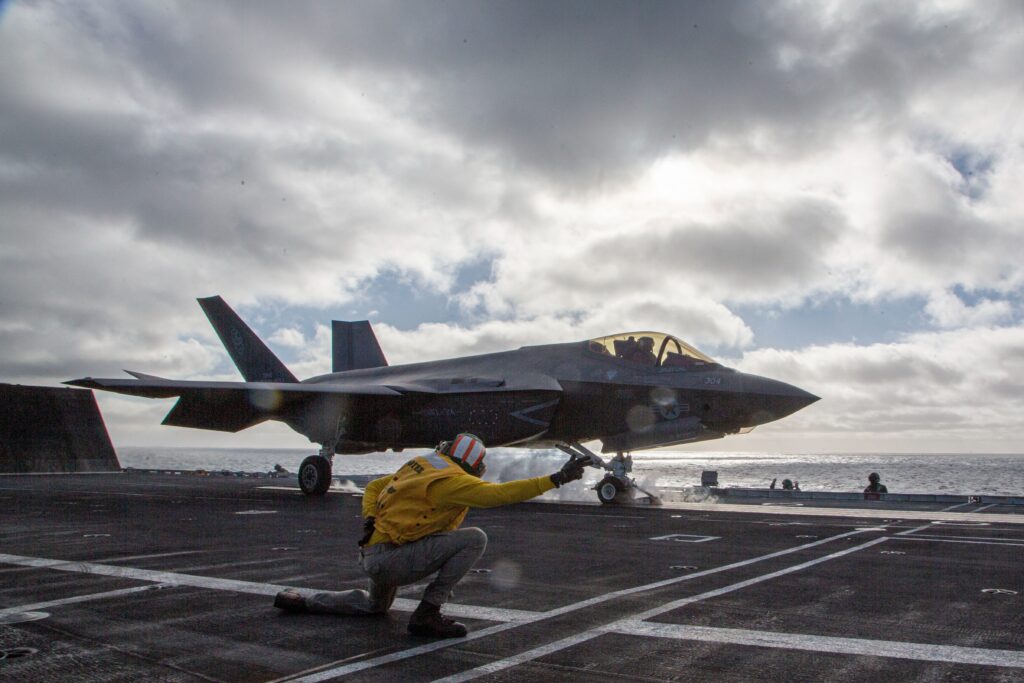
Marine Fighter Attack Squadron (VMFA) 314 launch and recover F-35C as they work to renew their carrier qualifications onboard the USS Abraham Lincoln (CVN 72) (U.S. Marine Corps photo by 1stLt. Charles Allen) 

By Richard R. Burgess, Senior Editor 

ARLINGTON, Va. — The U.S. Marine Corps has adjusted its procurement and transition plan for its F-35 Lightning II strike fighter fleet. While the overall program of record remains at 420 F-35s, the balance between the numbers of short takeoff and vertical landing F-35B and the carrier launch capable F-35C has changed, with the number of F-35Cs increasing  and the number of F-35Bs decreasing. 

According to the 2025 Marine Corps Aviation Plan released Feb. 3, the Corps plans to procure a total 280 F-35Bs and 140 F-35Cs, as compared with the earlier program of record of 353 F-35Bs and 67 F-35Cs. These numbers will allow the Corps to support 12 F-35B fighter-attack (VMFA) squadrons and eight F-35C VMFA squadrons. 

Before, the Corps had planned to support only four F-35C squadrons, VMFAs 314, 311, 251, and 115. With the change in the procurement profile, four other F/A-18 Hornet squadrons also will make the transition to the F-35C: VMFAs 232 and 323 and reserve VMFAs 112 and 134. 

Currently, all but two operational F-35 squadrons are allowed to be equipped with 10 aircraft, with the other two, both based at Marine Corps Air Station Iwakuni, Japan, being allowed 12 aircraft each. Under the new plan, all operational F-35 squadrons will be equipped with 12 aircraft each beginning in 2030. 

The Marine Corps F-35C squadrons will continue to support the TACAIR Integration Plan, in which they deploy as units of Navy carrier airwings. 


Secretary Hegseth’s Message to the Force

From U.S. Department of Defense Public Affairs, Jan. 25, 2025 

ARLINGTON, Va. — The following message to the U.S. armed forces was released by the new Defense Secretary, Pete Hegseth:   

“It is the privilege of a lifetime to lead the warriors of the Department of Defense, under the leadership of our Commander in Chief Donald J. Trump. We will put America First, and we will never back down. 
  
The President gave us a clear mission: achieve Peace through Strength. We will do this in three ways — by restoring the warrior ethos, rebuilding our military, and reestablishing deterrence.    
  
o    We will revive the warrior ethos and restore trust in our military.  We are American warriors. We will defend our country.  Our standards will be high, uncompromising, and clear. The strength of our military is our unity and our shared purpose.   
  
o    We will rebuild our military by matching threats to capabilities. This means reviving our defense industrial base, reforming our acquisition process, passing a financial audit, and rapidly fielding emerging technologies. We will remain the strongest and most lethal force in the world.  
  
o    We will reestablish deterrence by defending our homeland — on the ground and in the sky. We will work with allies and partners to deter aggression in the Indo-Pacific by Communist China, as well as supporting the President’s priority to end wars responsibly and reorient to key threats. We will stand by our allies — and our enemies are on notice. 
  
All of this will be done with a focus on lethality, meritocracy, accountability, standards, and readiness. 
  
I have committed my life to warfighters and their families.  Just as my fellow soldiers had my back on the battlefield, know that I will always have your back. We serve together at a dangerous time.  Our enemies will neither rest nor relent.  And neither will we.  We will stand shoulder to shoulder to meet the urgency of this moment.     
  
Like each of you, I love my country and swore an oath to defend the Constitution. We will do that each and every day, as one team.  Together we will accomplish the President’s mission to deter war, and if necessary, defeat and destroy our enemies. Godspeed!” 


3d Marine Littoral Regiment Fires the Marine Air Defense Integrated System (MADIS)

From 3d Marine Littoral Regiment, Jan. 25, 2025 

POHAKULOA TRAINING AREA, Hawaii – U.S. Marines with 3d Marine Littoral Regiment, 3d Marine Division, conducted a counter unmanned aerial system live-fire training event utilizing the Marine Air Defense Integrated System – a ground-based air defense capability, on January 25, 2025, to commemorate the addition of the MADIS and the months of operational testing and evaluation required to field this new weapon system. 

Lt. Col. Matthew E. Sladek, Commanding Officer, 3d Littoral Anti-Air Battalion, stated, “The fielding of the Marine Air Defense Integrated System to the Marines of 3d Littoral Anti-Air Battalion is the culmination of years of tireless work from government and industry teammates across the country. The delivery of the critical capabilities the system provides to 3d Littoral Anti-Air Battalion and by extension 3d Marine Littoral Regiment, makes the stand-in-force more survivable and lethal in the conduct of contested littoral operations against emerging aerial threats. As a career Low Altitude Air Defender Marine, it is truly amazing to have watched the Marine Air Defense Integrated System transition from an idea to a capability and with it, the modernization of Marine Corps short range air defense capabilities. Now the real work begins.” 

The MADIS is operated by the Marines of 3d LAAB’s Ground-Based Air Defense Battery. Giving low-altitude air defense Marines the ability to detect, track, identify, and engage various unmanned aerial systems with various missiles, air-to-air launchers, chain guns, machine guns, and simulated munitions – all of which are part of the MADIS weapon system.  

The MADIS live-fire event marked the first time this weapon system has been fired on a Hawaiian island since it’s fielding in December, attendees were able ask questions to commanders and subject matter experts about the fielding process and the operational value of the system. Training with the MADIS reinforces the Marine Corps’ threat-informed, concept-based approach to Force Design and modernization, and 3d MLR’s support to allies and partners in the Indo-Pacific region.   

Col. John G. Lehane, Commanding Officer, 3d MLR, emphasized the importance of the MADIS capability, stating, “Fielding of MADIS to the 3d Marine Littoral Regiment enhances our collective lethality, and provides remarkable tactical flexibility given them system’s reach, range and mobility. We are really excited to have this capability added to our already robust ability to coordinate air and missile defense actions, as it adds an organic layer to defeat a would-be adversary’s ability to attack our formations.” 

The addition of the MADIS – a highly mobile, short-range, surface-to-air defense weapon – provides 3d MLR an enhanced air and missile defense capability. A key component of the Marine Corps’ Force Design initiative, the mobile MADIS weapons system increases 3d MLR’s tactical flexibility by extending the range of the airspace which 3d MLR is able to sense and defend without support from the Joint Force. 

3d Marine Littoral Regiment is a dedicated U.S. Marine Corps unit specializing in amphibious and littoral warfare operations. Stationed on Oahu, Hawaii, and deployed throughout the Indo-Pacific region, 3d MLR is committed to promoting regional security and stability through strategic partnerships and collaborative efforts with partner nations and Allies. 


DOD Orders 1,500 Troops, Additional Assets to Southern Border

Jan. 22, 2025 | By Matthew Olay, DoD News 

The Defense Department is sending 1,500 active-duty service members and additional air and intelligence assets to the southern border to augment troops already conducting enforcement operations in that region, Acting Secretary of Defense Robert Salesses announced this afternoon via a statement to the media. 

The announcement came roughly 36 hours after President Donald J. Trump issued an executive order directing DOD to address the situation at the border.  

“On Monday, to protect the security and safety of United States citizens, President Trump declared that a national emergency exists at the southern border of the United States. The president directed me to take all appropriate action to support the activities of the secretary of homeland security in obtaining complete operational control of the southern border of the United States,” the statement reads.  

The Pentagon has since established a task force to oversee the expedited implementation of border-related executive orders; with U.S. Northern Command heading up the effort and being supported by U.S. Transportation Command, the National Guard Bureau, the military services and the Department of Homeland Security.  

The 1,500 additional active-duty service members authorized by Salesses will initially be put to work on the placement of physical barriers and other border missions within the next 24 to 48 hours, a senior military official told the media.  

The additional active-duty personnel includes 1,000 soldiers, as well as 500 Marines who had previously been on standby in Southern California to potentially help combat the Los Angeles County wildfires that broke out two weeks ago, the senior official said.  

With 2,500 active-duty personnel already in the region, the additional 1,500 troops will represent a 60% increase in active-duty forces since Trump was sworn in on Monday, Salesses remarks in his statement.   

“We anticipate that overall, on the southwest border, will provide real-time situational awareness of persons, vehicles, vessels and aircraft; and they’ll work with on operator-level maintenance, movement and staging of assets,” the senior military official said.  

In addition to the additional active-duty ground personnel, DOD will provide airlift support for flights operated by DHS to implement the deportation of more than 5,000 individuals detained by CBP at the border sectors in San Diego and El Paso, Texas, Salesses’ statement reads.  

Transcom is providing two C-130 Hercules and two C-17 Globemaster aircraft to assist in that support, the senior military official said.   

Additionally, the official added that there are UH-72 Lakota military helicopters that began flying today in support of CBP.  

DOD is also coordinating with the State Department to obtain diplomatic visas and provide host-nation notification for those individuals who are deported, a senior defense official said.  

DOD is also providing intelligence analyst support at the border.  

“We’re in the process of sourcing those requirements right now,” the senior military official said.  

“We also anticipate that there could be some additional airborne intelligence, surveillance and support assets that would move down to the border to increase situational awareness,” the official added.  

Regarding DOD’s future activity on the border, the senior defense official said that — while there are no specifics to release at the moment — there will be a number of additional border enforcement missions developing.  

“This is going to be a big priority for the department under the acting secretary and the secretary that will be coming on board,” the defense official said.  

“In short order, will develop and execute additional missions in cooperation with DHS, federal agencies, and state partners to address the full range of threats outlined by the at our nation’s borders,” Salesses’ statement reads.  

“President Trump directed action from on securing our nation’s borders and made clear he expects immediate results. That is exactly what our military is doing under his leadership,” the statement concludes.