U.S. Marine Corps Places First Polaris MRZR Alpha Order on New ULTV Contract 
From Polaris Government and Defense 

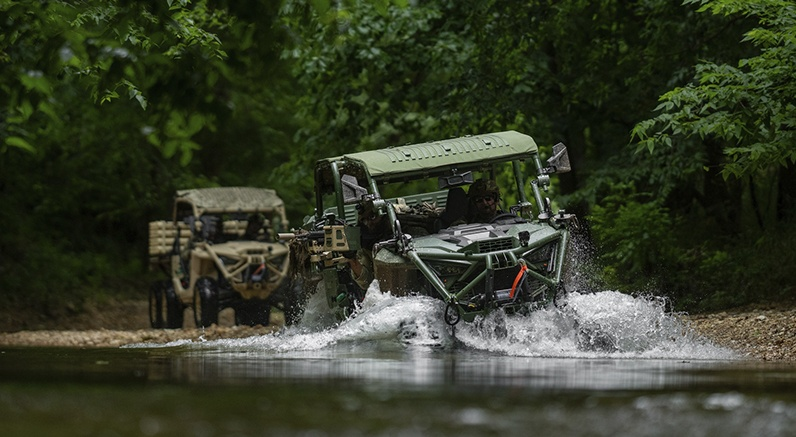
MINNEAPOLIS – June 24, Polaris Government and Defense 2026 – The United States Marine Corps (USMC) has placed its first delivery order to on the new Ultra-Light Tactical Vehicle (ULTV) contract, ordering more than 70 MRZR Alphas and numerous accessories vital to mission success. More than half the vehicles ordered were the new 5kW export power variant and the remaining were the standard, 1kW version – all are green, four-seat vehicles. 

Polaris accessories included in the order have been commonly incorporated on MRZR Alpha ULTVs for the Marines and include: 

  • Roof Kit – reversible roof kit with multicam-patterned camouflage on one side and olive drab on the other for mission planning flexibility while protecting occupants from exposure to the elements. 

  • Road March Kit – turn signals, horn, rear view and side mirrors to provide operators enhanced auditory and visual situation awareness during off-road administrative movements. 

  • Modular Cargo System – siderails and tailgate enclose the rear deck to contain cargo and provide many attachment points for securing gear and other vehicle accessories. The heavy-duty tailgate can also drop down for additional cargo space in the down position. Aircraft rails are built in for optional accessories, like integration of litter mounts. 

  • Fire Extinguisher – Class 5-BC fire extinguisher can be mounted to the roll cage in various spots, using a vinyl mount secured by two heavy duty Velcro straps with special rubber attached to ensure mount is securely fastened. 

  • Towbar Mount – specifically designed clamps mount a towbar provision for storage during non-use. 

“Polaris engineering and development efforts resulted in expanded accessories developed specifically for MRZR Alpha customers, like the Marines,” said Erin Telander, Defense program manager, Polaris Government and Defense. “That includes the ability to export 5kW of power directly from the vehicle itself, which the Marines will be able to leverage with their latest order.” 

The MRZR Alpha is Polaris’ most advanced light tactical vehicle, engineered to meet the evolving demands of expeditionary forces. Designed for enhanced payload capacity, tactical air transport and off-road performance, the MRZR Alpha enables rapid unit deployment and exceptional maneuverability across difficult terrain while reducing logistical demand due to the vehicle’s superior durability. 

The indefinite delivery, indefinite quantity (IDIQ) contract was awarded May 22, 2026, through Program Acquisition Executive Marine Corps (PAE-MC) and has a ceiling of up to $98M, with an order period of up to five years. This contract reinforces the value that Polaris brings to the warfighter – a responsive and engaged team with off-road engineering expertise, world-class manufacturing and a built-in global support network. 

Commercial platforms like the Polaris MRZR Alpha have been instrumental in accelerating delivery of highly mobile systems to the field. Polaris provides global parts availability through its existing worldwide network of dealers and distributors, empowering greater self-sufficiency for distributed forces. 


Allies Come Together in the Indo-Pacific: Valiant Shield 26

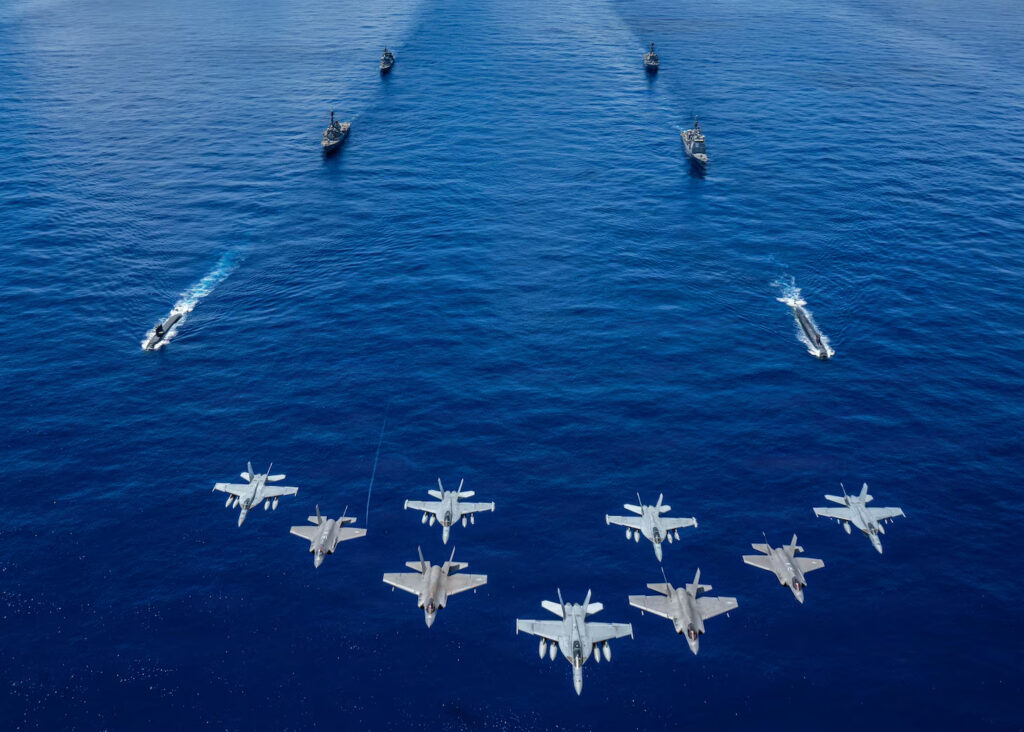
U.S. Navy aircraft, attached to Carrier Air Wing (CVW) 5, and U.S. Air Force F-35A Lightning IIs fly over U.S. Navy George Washington Carrier Strike Group as it sails in formation with Japan Maritime Self- Defense Force as part of Valiant Shield 2026 while underway in the Philippine Sea, June 21, 2026. (U.S. Navy photo by Mass Communication Specialist 2nd Class Tyler Crowley) 

From U.S. Pacific Command, June 22, 2026 

PEARL HARBOR, Hawaii – U.S. Pacific Command joint forces, along with allied and partner forces, are scheduled to participate in exercise Valiant Shield (VS26) 2026, June 22–July 1, in the Commonwealth of the Northern Mariana Islands, Guam, Japan, and at sea around the Mariana Islands Range Complex. 

VS26 is a multinational, biennial field training exercise focused on integrating interoperability training in a multi-domain environment. This training builds real-world proficiency in sustaining joint forces through detecting, locating, tracking, and engaging units at sea, in the air, in space, on land, and in cyberspace. 

Exercises such as VS26 allow forces across the Indo-Pacific the opportunity to integrate Navy, Marine Corps, Army, Air Force, Coast Guard, Space Force, and allies to train in precise, lethal, and overwhelming multi-axis, multi-domain effects that demonstrate the strength and versatility of the joint and combined force. With the involvement of U.S. Space Command and U.S. Transportation Command, VS26 is expanding the multi-domain cross-combatant command collaboration that is required for any large-scale exercise or operation. 

VS26 prepares the joint and combined force to rapidly respond to crises and contingencies across the spectrum of operations from humanitarian assistance and disaster response to armed conflict. 

“Valiant Shield demonstrates our enduring commitment to a free and open Indo-Pacific,” said Adm. Steve Koehler, Commander, U.S. Pacific Fleet. “Exercising advanced multidomain capabilities with our allies ensures we continue to seamlessly innovate and operate together, project combat power together, and prevail over any challenge — together.” 
 

VS26 assists U.S., allied, and partner forces in developing regional and global power projection capabilities. Integrated training provides a full range of options to succeed in defense of U.S. interests and those of like-minded nations around the world. 

This is the 11th iteration of Exercise Valiant Shield, which first began in 2006. While it began as a unilateral U.S. exercise, Valiant Shield has evolved with demands of the security environment, incorporating new technology and strategies to further enhance the lethality of the joint fighting force. Since 2024, Valiant Shield has become a multilateral joint field training exercise to further integrate allies and partners in the multi-domain environment. This iteration of Valiant Shield marks the second time the Japan Self-Defense Forces has heavily integrated in Valiant Shield planning and execution. 


Marine Corps Releases 2026 Installations and Logistics Enterprise Plan

From Headquarters, U.S. Marine Corps, June 24, 2026 

HEADQUARTERS, MARINE CORPS – The U.S. Marine Corps released the Marine Corps Installations and Logistics Enterprise (MCILE) 2026 plan, a comprehensive document that outlines the strategic vision for posturing and sustaining the force in an era of persistent global competition. Titled “The Reference A for Marine Corps Installations and Logistics,” the plan details how the Corps will generate, deploy, and sustain combat-credible forces to meet the challenges of a rapidly evolving security environment. 

MCILE 2026 serves as a “Reference A” for installations and logistics – a single, authoritative description of the current state, ongoing modernization efforts, and capability gaps across the MCILE.  

“We have a fundamental responsibility to deliver Marine forces that optimize the effectiveness and capabilities of the combatant commands. This plan is our commitment to ensuring the Marine Corps can fight and win tonight, while preparing for the demands of tomorrow,” said Lt. Gen. Stephen D. Sklenka, deputy commandant for Installations and Logistics. “A force is not combat credible if it cannot get to the fight and endure. MCILE 26 describes how we are building the installations and logistics enterprise required to project and sustain our forces against any threat.” 

The MCILE 2026 introduces its central strategy in the “3-1-5 Framework,” a combat-credibility model centered on the three principal moves of force projection – force mobilization and deployment, force closure, and force sustainment, – the one operational necessity of littoral mobility, and the five sustainment imperatives for a protracted fight: munitions, fuel, blood, water, and food.  

The plan identifies four focus areas: multidomain positional advantage, network resilience, resource discipline, and MCILE integration. Major initiatives include the Global Positioning Network (GPN) – a three-pronged approach to forward prepositioning afloat, ashore, and via contracted solutions; integrating with the Regional Sustainment Framework, which leverages allies, partners, and the defense industrial base for distributed maintenance and repair; improved integration with the Joint Logistics Enterprise; and continued investment in autonomous logistics systems such as the Autonomous Low-Profile Vessel and the Unmanned Logistics System-Air family of aerial resupply platforms. 

MCILE 2026 highlights modernization across advanced manufacturing, littoral mobility, medical support, the GPN, and logistics information technology, including the Maven Smart System, Visual Integrated Tactical Logistics-Battle Management Aid, and the Logistics Chain Management System. 

MCILE 2026 also describes the network of installations that serve as hubs of support for training, mobilization, sustainment, and the well-being of Marines, Sailors, and their families. The plan highlights installations portfolios and Barracks 2030, a service-level priority to improve living conditions for unaccompanied junior Marines, alongside other quality-of-life initiatives for service members and their families. MCILE 2026 also describes how installation protection is adapting to counter unmanned aerial systems, offensive cyber operations, and foreign collection efforts. 

The document is candid about where work remains. MCILE 2026 identifies capability gaps in force deployment and closure, forward sustainment, littoral mobility, and calls for continued investment to close them.  

MCILE 26 serves as a foundational and recurring reference document, updated annually to track the enterprise’s progress sustaining the force today while modernizing for the future fight. 

To read MCILE 26, please click here. 


U.S. Marine Corps Announces Full Transition to ODIN Reporting System 

WASHINGTON, D.C. -  The U.S. Marine Corps announced in MARADMIN 281/26 that it will fully transition its operational reporting to the Operational Data Integration Nexus (ODIN) on July 7, 2026. The move, authorized by Lt. Gen. Jay M. Bargeron, Deputy Commandant for Plans, Policies, and Operations, formally designates ODIN as the official and authoritative platform for operational reporting, marking a pivotal achievement in the Corps’ Force Design modernization efforts. 

ODIN, a digital application within the Maven Smart System (MSS), is a next-generation, data-centric decision support tool designed to replace legacy, manual processes and achieve decision superiority. Historically, Marine Corps operational reporting has relied on a document-centric process where units at each echelon manually create and consolidate narrative Situation Reports (SITREPs). This method consumed valuable operational time, created information silos, and hindered operational tempo. 

ODIN fundamentally transforms this workflow. By utilizing structured data inputs rather than narrative text, ODIN leverages Artificial Intelligence to automatically aggregate critical information such as personnel status, equipment readiness, and logistics posture into a centralized dashboard. This provides commanders with a single, continuously updated operational picture, moving the Marine Corps from being data-rich but information-poor to a state of information superiority. 

“ODIN is more than a reporting tool; it is a strategic asset that returns valuable time to our commanders,” said Lt. Gen. Bargeron. “By automating the flow of data from the tactical edge to strategic decision makers, we are equipping our Marines with the near real-time information required to outpace our adversaries and fight effectively in a distributed environment.” 

ODIN dramatically reduces administrative workloads by automating data entry through integration with authoritative databases, allowing leaders to focus entirely on warfighting and operational intent. The system contextualizes disparate data into actionable insights, enabling commanders to manage risk dynamically and operate inside the adversary’s decision cycle. Furthermore, ODIN establishes a state of collective consciousness across the force, enabling lateral data sharing between adjacent units and vertical transparency, keeping the Marine Corps fully aligned with Joint Staff data-centricity requirements for seamless integration with combatant commands. 

Once fully adopted, ODIN will serve as the Marine Corps’ single source of truth for operational data, marking a definitive end to manual, document-centric reporting. 


U.S. Marine Corps Expands Autonomous Fires Capability with Oshkosh Defense ROGUE-Fires Block 2 Award  

From Oshkosh Defense LLC, June 1, 2026 

OSHKOSH, Wis. – Oshkosh Defense LLC, an Oshkosh Corporation [NYSE: OSK] business, announced today it has received two delivery orders from the U.S. Marine Corps for the Remotely Operated Ground Unit for Expeditionary Fires (ROGUE-Fires) Block 2 Production, totaling $92M.  

Built on the battle-tested Oshkosh Defense Joint Light Tactical Vehicle (JLTV), ROGUE-Fires combines next-generation autonomy with the protection, mobility, speed, and off-road capability Marines rely on in austere environments. The JLTV’s proven transportability, operational interoperability and available sustainment provide a strong foundation for expeditionary fires missions and distributed operations.  

Oshkosh Defense was initially awarded the ROGUE-Fires contract in 2022, and the platform has since become the first semi-autonomous ground system fielded by the U.S. military. The ROGUE-Fires offers the only in production and fielded semi-autonomous ground system for offensive and defensive fires.  

The Block 2 configuration introduces Forterra’s next-generation autonomy and expanded weapon system integration to support Expeditionary Advanced Base Operations (EABO) and distributed long-range precision fires missions.  

“As the Marine Corps continues to modernize its force structure and operational capabilities, Oshkosh remains focused on delivering advanced ground mobility solutions that support mission success,” said Pat Williams, Chief Programs Officer at Oshkosh Defense. “With new technology integration and expanded weapon system flexibility, ROGUE-Fires Block 2 demonstrates Oshkosh’s ability to integrate advanced technologies onto proven tactical vehicles.”  

ROGUE-Fires, built on a Modular Open System Approach, provides the architecture that now supports integration with the MLRS Family of Munitions (MFOM) and rapid swapping of future payload weapon systems based on mission requirements. This modular approach provides Marines with greater operational flexibility across evolving expeditionary fires missions and beyond.  

Forterra’s AutoDrive autonomous driving system is built to support operations in contested and GPS-denied environments.  

Vehicle deliveries under the contract are expected to continue through 2031.  


Austal USA Grows Leadership Team

From Austal USA, June 4, 2026 

MOBILE, Ala. – Austal USA welcomed three new members to the company’s senior leadership team.  Michael Pruitt, Vice President of Surface Ship Programs; Michael Oberdorf, Vice President of Submarine Programs; and Andrew Hinkebein, Director of State and Local Government Relations. 

With over 25 years of experience directing large-scale shipbuilding activities, Michael Pruitt has managed multi-billion-dollar Navy surface ship portfolios at both Huntington Ingalls Industries and Northrup Grumman Shipbuilding.  He’s led cross-functional teams to deliver complex Naval and commercial programs. His expertise spans production efficiency, supply chain management, and workforce training development, with a proven track record of fostering safety, compliance, operational excellence, and risk mitigation across all stages of ship construction and delivery. 

Pruitt holds a Bachelor of Science in Business and is a certified Six Sigma Green Belt, bringing a strong foundation in business and process improvement to his new role. 

A qualified nuclear engineer with a master’s of science in electrical engineering and a Navy career that spanned over 30 years, retired Captain Michael C. Oberdorf brings deep expertise in nuclear submarine operations, Navy program funding, and strong relationships with senior leaders, making him uniquely positioned to drive growth in Austal’s submarine module business. He joins Austal USA from Bath Iron Works where he was senior director of operations demonstrating exceptional leadership in new construction programs. 

Oberdorf served as Shipyard Commander and Installation Commander at Portsmouth Naval Shipyard, leading a $1.5B organization of 6,700 personnel in submarine overhauls, modernization, and refueling. His Navy career includes key leadership roles at Norfolk Naval Shipyard and aboard USS RONALD REAGAN (CVN 76), where he was responsible for consistently improving safety, quality, and operational efficiency. 

As director of local and state government affairs, Andrew Hinkebein will lead the company’s engagement efforts with state and local governments, economic development organizations, community stakeholders, and strategic partners. He’ll also oversee Austal USA’s external communications initiatives. 

A United States Marine Corps veteran, Hinkebein brings extensive experience in the areas of government affairs, public policy, economic development, and maritime defense. Most recently, he served as director of government affairs for Bollinger Mississippi Shipbuilding, where he worked with federal, state, and local stakeholders to advance shipbuilding initiatives, workforce development efforts, infrastructure investments, and defense industrial base priorities. 

Hinkebein previously served as State Director for U.S. Senator Tommy Tuberville of Alabama, overseeing statewide operations and stakeholder engagement across Alabama. He also served on the staff of Senate Armed Services Committee Chairman Roger Wicker of Mississippi, where he worked on issues involving national defense, shipbuilding programs, economic development, and strategic investments supporting the nation’s defense industrial base. 

“These three highly experienced industry professionals each boast broad defense backgrounds that will contribute unique perspectives to their Austal USA leadership roles,” Austal USA President Gene Miller stated.  “We are excited to have them join our senior leadership team and look forward to having them help to grow Austal USA.” 


VMA-223 celebrates sundown as Marine Corps’ final Harrier squadron 

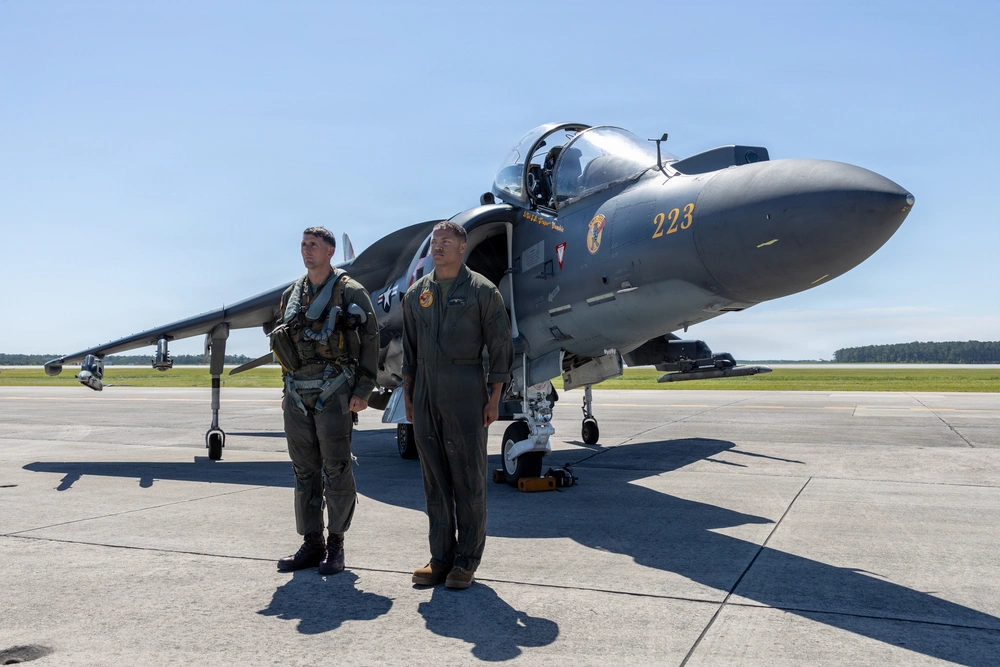
U.S. Marine Corps Lt. Col. John B. Cumbie, left, a native of Texas and the commanding officer of Marine Attack Squadron (VMA) 223, Marine Aircraft Group 14, 2nd Marine Aircraft Wing and Cpl. Myles J. Howard a native of Georgia, a fixed-wing aircraft mechanic with VMA-223, stand at attention in front of an AV-8B Harrier II at Marine Corps Air Station Cherry Point, June 3, 2026. The “sundown” of the AV-8B Harrier II, an iconic aircraft that has supported joint and Marine Corps operations for over 40 years, also represents the dawn of a new era; it paves the way for 2nd MAW’s full transition to the F-35B and C Lightning II. VMA-223 is the U.S. Marine Corps’ last operational Harrier squadron. (U.S. Marine Corps photo by Lance Cpl. Donovan Pimentel)

From Communication Strategy and Operations Office, 2nd Marine Aircraft Wing 

June 4, 2026 

MARINE CORPS AIR STATION CHERRY POINT, N.C. – Marine Attack Squadron (VMA) 223, known as “the Bulldogs”, celebrated the conclusion of nearly 40 years of operational history with the AV-8B Harrier II during a public ceremony at Marine Corps Air Station Cherry Point, Wednesday. The ceremony marked an important moment in time for VMA-223 and also signaled the end of an era for Marine Corps aviation as the service continues its transition to an all-5th generation tactical aircraft fleet.     

“The Bulldogs are extremely proud to conduct the final Harrier operations for the U.S. Marine Corps”, said Lt. Col. John B. Cumbie, commanding officer of VMA-223.  “As a platform that has continuously forward deployed across the globe, the Harrier will be remembered for its distinguished combat legacy, legendary Vertical/Short Take Off and Landing (V/STOL) capability, and the Marines and Sailors that made the community special.” 

Wednesday’s ceremony was attended by over 5,000 people. Attendees included senior Marine Corps leaders, state and local officials, active-duty service members, local community members, family and friends of VMA-223, and veterans with ties to the Harrier community. The ceremony included a five-aircraft formation flight and vertical landing that showcased the Harrier’s unique V/STOL capability.    

The Harrier platform has maintained a proud and storied legacy throughout its 55 years of service with the U.S. Marine Corps. In 1971, the Marine Corps accepted the first AV-8A into its inventory. In 1985, VMA-331, stationed aboard Marine Corps Air Station Beaufort, South Carolina, became the Marine Corps’ first operational AV-8B squadron. VMA-223 began flying the AV-8B in early 1987. Since its inception with the Marine Corps, the Harrier has been instrumental in numerous combat operations, including Operations Desert Shield and Desert Storm, Operation Allied Force, Operation Enduring Freedom, Operation Iraqi Freedom, Operation Odyssey Dawn, Operation Inherent Resolve, and operations during the Red Sea crisis. Time and again, the Harrier distinguished itself as a lethal, capable and versatile tactical air platform.  

Colloquially known as a “jump jet” for its ability to take off and land within short distances, the AV-8B is a V/STOL aircraft designed to support the Marine Air Ground Task Force commander by destroying surface targets and escorting friendly aircraft. The AV-8B’s lethality and V/STOL capability made it uniquely suited for deployments in support of Marine Expeditionary Units (MEUs). VMA-223’s final detachment of Harriers to support a MEU returned to Marine Corps Air Station Cherry Point last month after supporting operations with the 22nd Marine Expeditionary Unit in the Caribbean. 

In fiscal year 2028 VMA-223 is scheduled to reactivate as Marine Fighter Attack Squadron (VMFA)-223 and will begin flying the F-35B Lightning II. VMA-223 is the last Marine Corps squadron to operate the Harrier.  


13th MEU Completes Realistic Urban Training, Boosts Deployment Readiness 

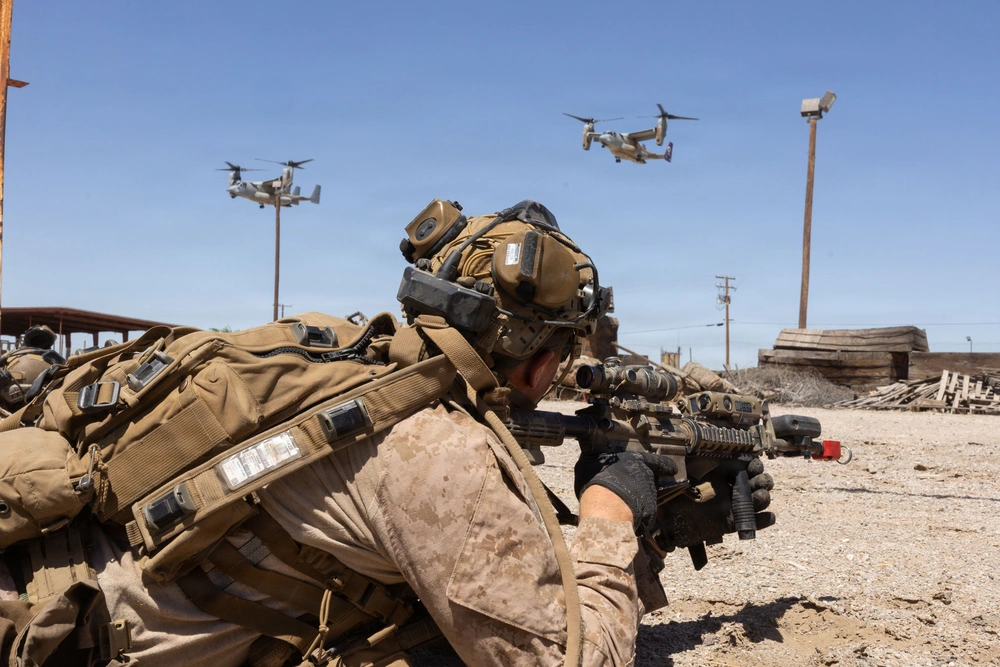
U.S. Marine assigned to Battalion Landing Team 2/4, 13th Marine Expeditionary Unit, provides security as MV-22B Ospreys prepare to land after conducting a simulated raid during Realistic Urban Training at Blythe, California, May 31, 2026. RUT is a critical pre-deployment exercise that enables the 13th MEU to integrate its command, aviation, ground and logistics combat elements, ensuring the force is prepared to respond rapidly and effectively to crises in unfamiliar, urban environments. (U.S. Marine Corps photo by Lance Cpl. Christian Cutter)  

From 13th Marine Expeditionary Unit Communication Strategy and Operations 

June 4, 2026 

YUMA, Ariz. – The 13th Marine Expeditionary Unit (MEU) successfully concluded Realistic Urban Training (RUT), a major pre-deployment exercise held from May 26 to June 3, 2026, across various locations in the Southwest United States. This rigorous evolution featured diverse training missions designed to forge tactical cohesion across the Marine Air-Ground Task Force and maximize operational effectiveness in complex urban environments. 

Throughout the exercise, over 1,000 Marines and Sailors from the 13th MEU’s Command Element, Battalion Landing Team 2/4, Marine Medium Tiltrotor Squadron 364 (Reinforced), Marine Fighter Attack Squadron 211, and Combat Logistics Battalion 13 integrated to form a cohesive MAGTF. The training took place in challenging and unfamiliar urban environments, including Glendale, Arizona, and Blythe and Glamis, California, providing realistic settings for complex, decentralized operations. While the MEU operated from Marine Corps Air Station Yuma, training also occurred at military installations across the Southwest. 

“Realistic Urban Training is a critical milestone that forges the individual elements of the 13th MEU into a unified, combat-ready MAGTF,” said Col. Richard Alvarez, commanding officer of the 13th MEU. “Operating in complex, austere and urban environments provides the realism necessary to develop the essential skills required for rapid crisis response around the globe. RUT has made the 13th MEU a better prepared, more lethal force.” 

During RUT, the 13th MEU executed several core missions essential for crisis response, including two expeditionary strikes, three amphibious raids, and two Tactical Recovery of Aircraft and Personnel (TRAP) missions. Both the Maritime Raid Force, comprised primarily of Reconnaissance Marines, and Battalion Landing Team 2/4 infantry elements conducted raids supported by the full MAGTF. 

The exercise showcased the full spectrum of the MEU’s aviation capabilities, employing the MV-22B Osprey, CH-53E Super Stallion, AH-1Z Viper, UH-1Y Venom, F-35B Lightning II, and KC-130J Super Hercules aircraft. These platforms supported a wide range of operations, including a forward arming and refueling point (FARP) and aviation delivered ground refueling (ADGR) that extend the reach and lethality of the MEU. 

By integrating its command, air, ground, and logistics elements, the 13th MEU has demonstrated its readiness to respond swiftly and effectively to any contingency. The successful completion of RUT validates the 13th MEU as a versatile expeditionary force prepared for future operations.


Secretary of War Announces Marine nominated for Brigadier General  

From the Department of War, June 4, 2026 

Secretary of War Pete Hegseth announced today that the president has made the following nominations: 
 
Marine Corps Col. Frank Diorio, Jr. for appointment to the grade of brigadier general. Diorio is currently serving as programs development branch head, Programs and Resources Department, Headquarters, U.S. Marine Corps, Pentagon, Washington, D.C.


Task Force Ashland’s Navy-Marine Corps team returns to San Diego after four months of operations in the Indo-Pacific 

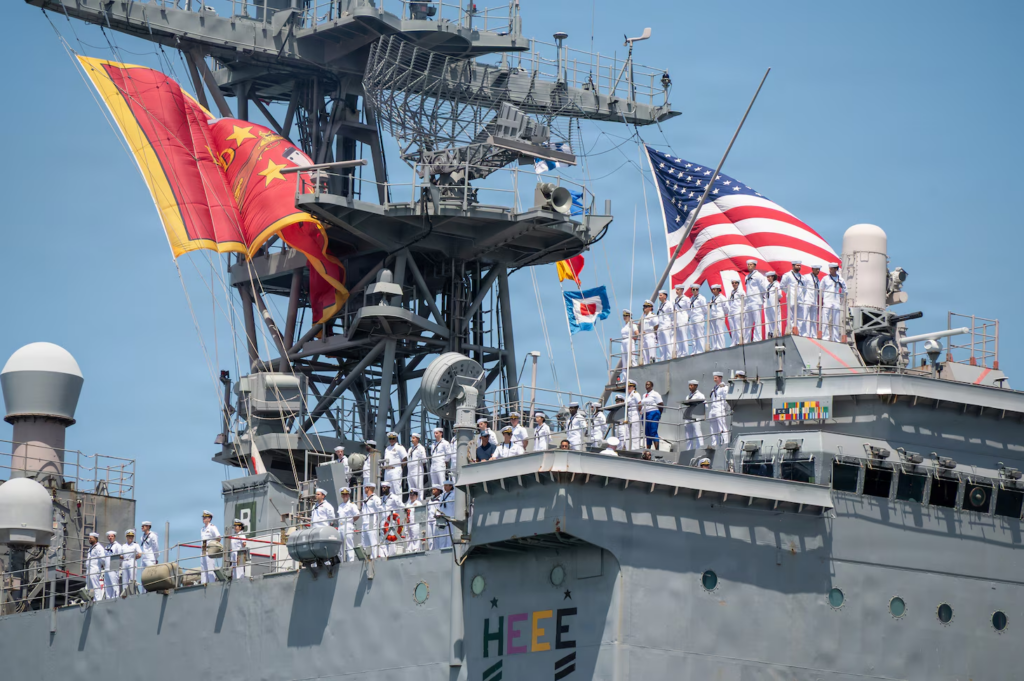
NAVAL BASE SAN DIEGO (Jun 1, 2026) Sailors assigned to Whidbey Island-class amphibious dock landing ship USS Ashland (LSD 48) man the rails as the ship returns to its homeport of Naval Base San Diego, June 1, 2026. USS Ashland returns to its homeport of Naval Base San Diego following operations in the U.S. 7th Fleet. (U.S. Navy photo by Mass Communication Specialist 2nd Class Aja Bleu Campbell)

From U.S. Third Fleet, June 1, 2026 

SAN DIEGO  –  Marines and Sailors of Task Force (TF) Ashland returned to San Diego aboard Whidbey Island-class dock landing ship USS Ashland (LSD 48), following four months of operations in the Indo-Pacific region, June 1, 2026. 

TF Ashland is composed of Ashland’s crew and a command element from the 15th Marine Expeditionary Unit (MEU); a ground combat element from 3rd Assault Amphibian Battalion, 1st Marine Division; and a logistics combat element from Combat Logistics Regiment 17, I Marine Logistics Group. Assault Craft Unit (ACU) 5 also deployed a detachment with two landing craft, air cushion to support amphibious operations. The task force departed San Diego aboard Ashland Jan. 24, 2026, demonstrating a flexible and scalable model of naval integration. 

“I couldn’t be prouder of the team’s work over these past four months at sea,” said U.S. Navy Cmdr. Adam Peeples, commanding officer of Ashland. “As our Sailors and Marines look back at their accomplishments, I hope they feel the same pride and satisfaction I do leading this team.”  

Throughout their underway, the Navy-Marine Corps team was a visible and engaged presence across the Indo-Pacific. The task force participated in a multitude of demanding exercises, including the 45th iteration of Exercise Cobra Gold in February, the largest joint military exercise in mainland Asia, and the 40th iteration of Exercise Balikatan in April, an annual exercise focused on the long-standing alliance between the Philippines and the United States. These exercises involved complex scenarios, such as combined-arms live-fire events, amphibious operations, and disaster response training, conducted alongside the Royal Thai Armed Forces, the Republic of Korea Marine Corps, and the Armed Forces of the Philippines.  

“Combining the 15th MEU, ACU-5 craft team, and Sailors of Beachmasters Unit (BMU) 1, the Grizzly Gators of Ashland built something truly greater than the sum of its parts — TF Ashland,” said Peeples. “Together, we tackled the challenges with flawless results and worked with our regional partners, building cooperation within the region and demonstrating our commitment to the most consequential theater.”  

While in port at Cebu, Philippines, Ashland completed a three-week ship repair and maintenance (SRMX) exercise, as part of its scheduled port visit. SRMX is designed to rehearse coordination and execution of ship damage repair from forward locations within the Indo-Pacific region, strengthening ties with the skilled workforce within allied and partner countries. 

Further showcasing its commitment to regional stability, TF Ashland participated in a multilateral exercise alongside Australian and Canadian forces, a multi-phase exercise focused on surface action group operations and interoperability with allied navies. By executing key components of distributed maritime operations, TF Ashland provided combatant commanders with a flexible force for credible deterrence and crisis response, which significantly enhanced regional capabilities and bolstered maritime security alongside our allies. 

“The 15th MEU executed as TF Ashland proved that a task-organized, scalable force can deliver credible combat power while continuing to strengthen relationships with our allies,” said U.S. Marine Corps Lt. Col. Matt Bride, the commander of troops for TF Ashland and the 15th MEU executive officer. “Whether executing complex, multinational exercises or demonstrating the forward-thinking principles of distributed maritime operations, our Navy-Marine Corps team consistently met every challenge with the professionalism and effectiveness that underpins the legacy of our respective organizations.” 

TF Ashland’s return marks the completion of operations that reinforced the United States’ commitment to peace through strength. 

Task Force Ashland is a flexible, purpose-built force designed to integrate with allies and partners or respond to crisis, in support of a free and open Indo-Pacific.