First Augmented Reality Maintenance Systems Operational on Five Ships 
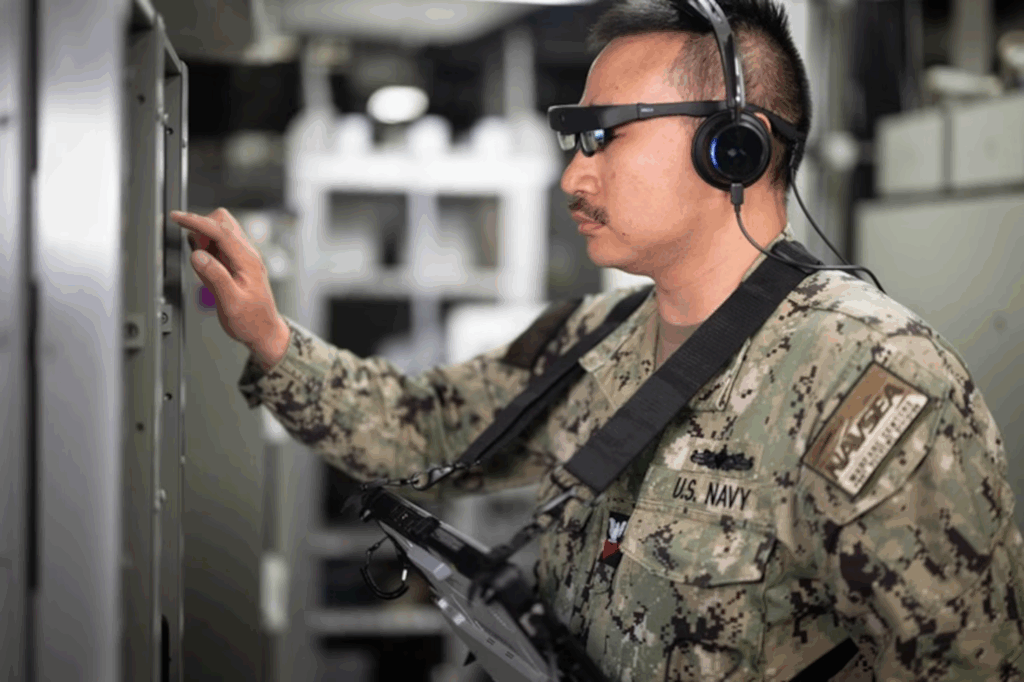
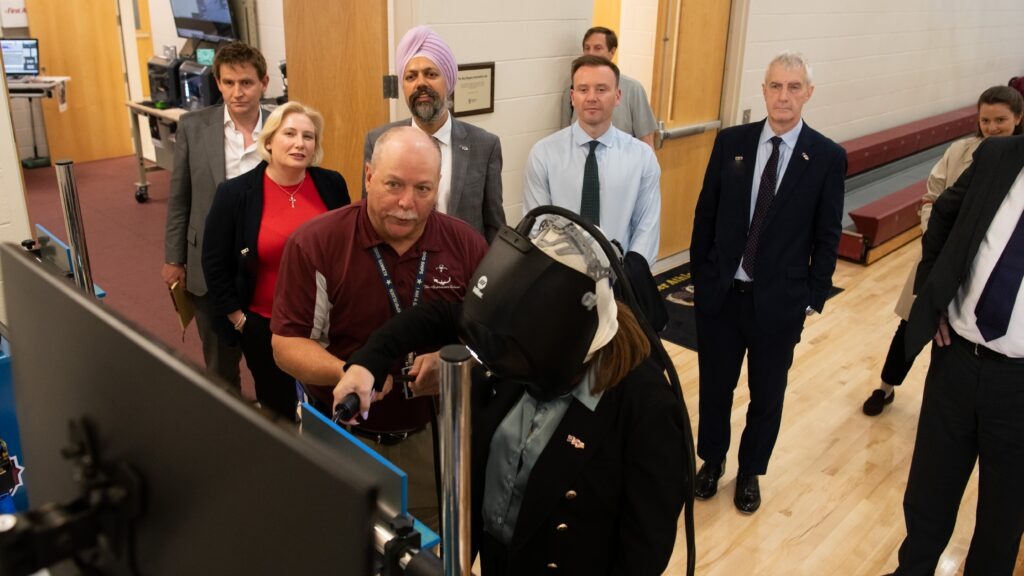
Naval Surface Warfare Center, Port Hueneme Division (NSWC PHD) Fire Controlman Petty Officer 1st Class Donald Tran demonstrates the Augmented Reality Maintenance System aboard USS Spruance (DDG 111) during a recent Combat Systems Assessment Team event at NSWC PHD. The technology could reduce the number of onboard technical assistance visits by connecting sailors and subject matter experts through augmented reality and audio. 

By Brian Varela, May 14, 2025 

Sailors are a ship’s first line of defense against system failures. But when the issue requires a subject matter expert (SME), repairs have often had to wait until a technician could travel to the ship. 
 
Enter ARMS, short for the Augmented Reality Maintenance System. ARMS enables sailors and Naval Surface Warfare Center, Port Hueneme Division (NSWC PHD) SMEs to instantly address system failures and eliminate the need for costly travel — and it’s now installed aboard five Navy ships. 
 
NSWC PHD’s Augmented Reality Maintenance System (ARMS) team recently outfitted five ships in less than a week with the unique and fully operational remote viewing instruments. 
 
The group installed the technology on USS Curtis Wilbur (DDG 54), USS Lenah Sutcliffe Higbee (DDG 123), USS Gridley (DDG 101), USS Fitzgerald (DDG 62) and USS Nimitz (CVN 68) with support from Naval Air Systems Command (NAVAIR) and Naval Information Warfare Systems Command (NAVWAR). NSWC PHD electronics engineer Matthew Cole and computer scientist Nick Bernstein led the effort between March 22 and 26. 
 
“Sailors are by trade operators and maintainers of their warships,” NSWC PHD Commanding Officer Capt. Tony Holmes said. “It’s never a matter of if, but when, systems aboard a ship will require some sort of troubleshooting and/or corrective maintenance to keep them operating. If outside help is required to resolve an issue, and that issue can be resolved by over-the-shoulder assistance via ARMS, that is a good thing.” 
 
This remote assistance not only empowers sailors to fix problems quickly and keep their systems operating, he explained, it also saves time and money by averting the need for an SME to fly out to the ship for onboard technical assistance. 
 
“The biggest win in this case is that the sailor fixed the problem, not the external SME,” Holmes added. “ARMS capability goes to the heart of enabling sailor self-sufficiency, and keeping our warships in the fight.” 
 
Prior to the recent installations, Bernstein — who is also the ARMS engineering lead — led a small NSWC PHD ARMS team to conduct short technical demonstration installations aboard three ships. The group used AR hardware with the same NAVAIR-developed ARMS software, Bernstein said. 
 
For the March installations, Bernstein and Cole worked with the internal and external ARMS team to equip the aircraft carrier and four guided-missile destroyers with the latest hardware and software to be used on their deployments. 
 
“These are the first operational, useable ARMS installs,” Bernstein said. 
 
Augmented reality 
 
ARMS is a remote viewing capability used to connect deployed sailors with subject matter experts (SMEs) at warfare centers, in Regional Maintenance Centers and other shoreside locations. Sailors wear a simplified AR headset that allows the SMEs to observe and troubleshoot any shipboard systems in real time by seeing and hearing from the sailor’s point of view. While wearing the headgear, the sailors can pull up technical manual excerpts, maintenance requirement cards, 3D images, design models or schematics to restore a system while the remote SMEs talk them through the process. 
 
The team aims to use the technology to reduce the number of visits command personnel make to ships to provide them with technical assistance. ARMS can also reduce the length of time NSWC PHD personnel spend aboard by diagnosing issues in advance. 
 
As a result, the fleet will receive faster support without waiting for technicians to arrive aboard. 
 
“Now, we can send the right expert with the right tools out to the ship, thereby saving time and money,” Cole said. 
 
Installation and test 
 
The five-day installation in March marked the end of one Interim Authority to Test (IATT) and the beginning of another. The Navy conducts IATTs as a first step to check within a specified time period that a new system works and to gather feedback for upgrades. 
 
The first IATT was scheduled to expire in March. However, NAVWAR Commander Rear Adm. Seiko Okano requested the original seven-month time frame to perform an operational ARMS capability be narrowed down to one month so the AR equipment could be installed aboard the five ships before they deployed from Naval Base San Diego, Bernstein said. 
 
The vessels were ported simultaneously for a one-week period in San Diego, so the group had to work fast. The ARMS installation team — which included NSWC PHD and Naval Information Warfare Center Pacific SMEs — installed each system in less than a day while also training sailors. 
 
During the current IATT, the team will monitor ARMS usage and solicit feedback to improve its capabilities and handling ahead of the full Authority to Operate. 
 
Gear changes 
 
Throughout the first IATT, ARMS utilized an AR/mixed reality headset that had been used commercially for remote collaboration and training. After the product was discontinued in October, the ARMS system switched to AR smart glasses to retain the hands-free goal of ARMS. 
 
The ARMS team is also looking at other potential headsets, including a 3D-printed alternative the command’s Engineering Development Lab is developing, Cole said. 
 
Since he first got involved with the program in fiscal year 2022, Bernstein has watched ARMS grow as it reached numerous milestones. He said he’s excited to see ARMS maturing as it’s fielded for operation aboard future ships. 
 
“It’s incredibly rewarding seeing this project transition to the fleet and stand on its own to support sailors and SMEs,” Bernstein said. 


Coast Guard offloads more than $211 million in illicit drug interdictions in the Eastern Pacific 

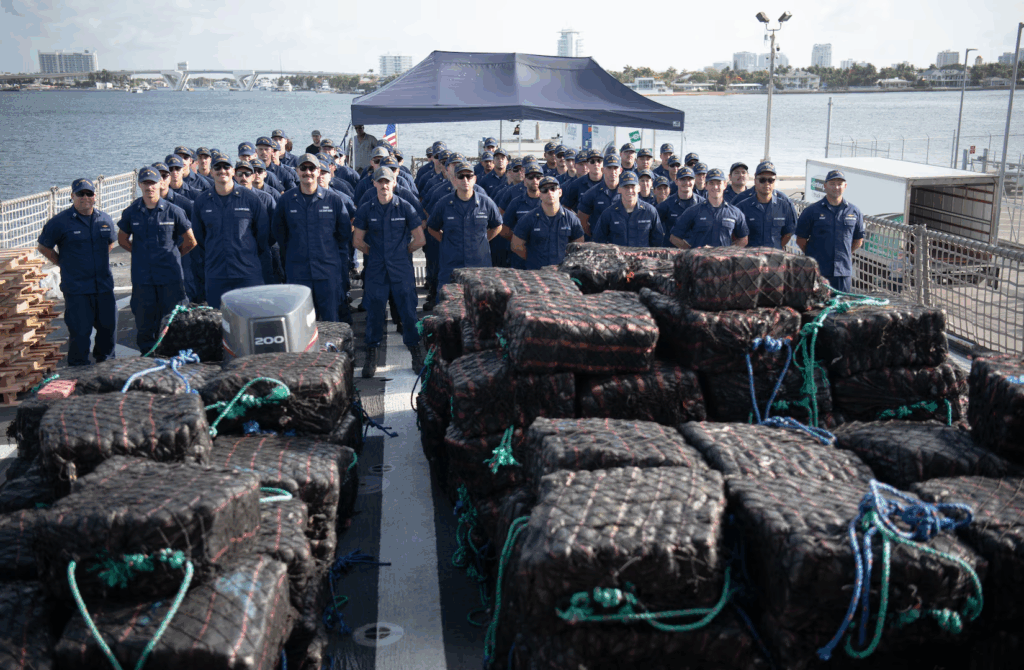
The crew of USCGC Thetis (WMEC 910) poses for a group photo behind more than 28,500 pounds of seized drugs worth more than $211 million at Port Everglades in Fort Lauderdale, Florida, May 29, 2025. The crew seized the illicit drugs in four separate interdictions during a patrol in the Eastern Pacific Ocean. (U.S. Coast Guard photo by Petty Officer 1st Class Diana Sherbs)

From U.S. Coast Guard 7th District, May 29, 2025 

MIAMI – U.S. Coast Guard Cutter Thetis’ crew offloaded more than 28,500 pounds of cocaine worth an estimated $211.3 million, Thursday, at Port Everglades.  

The seized contraband was the result of four interdictions in the Eastern Pacific by the crew of Coast Guard Cutter Thetis and an embarked MH-65 Dolphin helicopter crew from Helicopter Interdiction Tactical Squadron based out of Jacksonville, Florida.  

“I could not be more proud of this crew and what they accomplished this patrol,” said Cmdr. Ryan Kelley, commanding officer of the Coast Guard Cutter Thetis. “The Coast Guard is in the business of saving lives, and every kilogram of these drugs kept off our streets represents lives saved. The more than 33,000 pounds of drugs seized by Thetis this patrol also represents the determination of a crew who continues to find a way to improvise, adapt, and overcome to keep an aging cutter in the fight and accomplish this mission.”  

On May 3, a maritime patrol aircraft located two suspicious vessels approximately 170 miles west of Mexico. Thetis’ crew interdicted the vessels and seized 4,630 pounds of cocaine. The Coast Guard transferred 4,608 pounds of cocaine from this case to Ecuadorian government officials to aid them in their prosecution efforts.  

On May 5, an embarked helicopter crew aboard the Thetis observed a bale field approximately 475 miles southwest of Colima, Mexico. Thetis’ crew recovered 9,993 pounds of cocaine from the bale field.   

On May 6, a crew on an embarked helicopter aboard the Thetis detected two suspicious vessels throwing bales overboard approximately 575 miles southwest of Acapulco, Mexico. Due to an incoming storm, the air crew lost sight of the vessels but led the Thetis crew to three bale fields where 14,559 pounds of cocaine bales were recovered.   

On May 10, the Thetis crew spotted a bale field approximately 660 miles south of Acapulco, Mexico. Thetis’ crew recovered 3,984 pounds of cocaine from the bale field.  

The following crews also assisted with interdiction operations:  

  • Joint Interagency Task Force-South (JIATF-S)  

  • Helicopter Interdiction Tactical Squadron (HITRON) Jacksonville  

  • Eleventh Coast Guard District watchstanders  

Detecting and interdicting illicit drug traffickers on the high seas involves significant interagency and international coordination. Joint Interagency Task Force-South, in Key West, conducts the detection and monitoring of aerial and maritime transit of illegal drugs. Once an interdiction becomes imminent, the law enforcement phase of the operation begins, and control of the operation shifts to the U.S. Coast Guard for the interdiction and apprehension phases. Interdictions in the Eastern Pacific Ocean are performed by members of the U.S. Coast Guard under the authority and control of the Eleventh Coast Guard District, headquartered in Alameda, California.   

These interdictions relate to Organized Crime Drug Enforcement Task Forces’ Strike Force initiatives and designated investigations. OCDETF identifies, disrupts, and dismantles the highest-level criminal organizations that threaten the United States using a prosecutor-led, intelligence-driven, multi-agency approach. Additional information about the OCDETF program can be found at https://www.justice.gov/OCDETF.    

USCGC Thetis is a 270-foot medium-endurance cutter homeported in Key West under U.S. Coast Guard Atlantic Area Command.    

For breaking news, follow us on X (formerly Twitter). For additional information, find us on Facebook and follow us on Instagram.    

Make a difference on land, at sea or in the air with the Coast Guard. Visit GoCoastGuard.com to learn more about active duty and reserve, officer and enlisted opportunities. Information on how to apply to the U.S. Coast Guard Academy can be found here.   


HII Hosts UK House of Commons Defence Committee Members

From HII

NEWPORT NEWS, Va., May 27, 2025 (GLOBE NEWSWIRE) — HII (NYSE: HII) hosted members of the United Kingdom House of Commons Defence Committee at its Newport News Shipbuilding division last week. 

The visit was held in support of the trilateral Australia, United Kingdom and United States (AUKUS) partnership. HII continues its commitment to supporting AUKUS, which set in motion tasking across all three countries to determine the optimal pathway to provide Australia with conventionally armed, nuclear-powered submarines and a broader partnership on advanced capabilities. 

“The Committee were delighted to visit the HII yard and see the skill and endeavour on display,” said Tan Dhesi, chairman of House of Commons Defence Committee. “The AUKUS agreement is a vital tool for the strategic advantage of all three countries and the Committee is pleased to support it with our recently launched inquiry, ensuring it achieves its maximum potential.” 

Defence Committee members met with company leadership and saw facilities that support construction of Virginia-class nuclear-powered attack submarines. Additionally, they participated in a tour of the Newport News Shipbuilding Apprentice School that focused on HII’s workforce development expertise. 

Photos accompanying this release are available at: http://hii.com/news/hii-hosts-united-kingdom-house-of-commons-defence-committee-members-at-newport-news-shipbuilding/

“We greatly appreciate the Defence Committee’s engagement and the opportunity to showcase how HII’s decades of expertise directly support AUKUS objectives,” said Michael Lempke, president of the HII Mission Technologies division Global Security group and the leader of HII’s Australia and U.K. operations. “From building nuclear-powered submarines to fortifying industrial capacity across the U.S., U.K. and Australia, our efforts are closely aligned with the trilateral vision. These discussions are vital to strengthening the collaboration and driving the innovation that underpins AUKUS.” 

Industrial integration of submarine and shipbuilding capabilities between the U.S., U.K. and Australia is a critical component of the AUKUS partnership, enabling aligned defense production, workforce development, and supply chain collaboration to support shared security objectives. 

NNS is one of only two shipyards capable of designing and building nuclear-powered submarines for the U.S. Navy. HII is the founding member of the AUKUS Workforce Alliance (AWA), a dedicated partnership committed to preparing a skilled workforce in support of all steps of Australia’s optimal pathway to sovereign nuclear-powered submarines. The company was awarded a contract for the Australian Submarine Supplier Qualification (AUSSQ) pilot program to accelerate the identification and qualification of Australian suppliers and products into the United States submarine industrial base. 

About Defence Committee’s inquiry: https://committees.parliament.uk/work/9068/aukus/ 


Leidos Acquires Kudu Dynamics, Advancing AI Capabilities For Cyber Warfighters 

RESTON, Va. (May 28, 2025) – Leidos (NYSE:LDOS) announced today that it has acquired Kudu Dynamics, accelerating Leidos’ rapid scaling of artificial intelligence (AI)-enabled cyber capabilities for defense, intelligence and homeland security customers. 

Leidos’ extensive current AI-enabled cyber offerings arm users with the rapid capability and scale needed to automate vulnerability detection, enhance novel defenses, neutralize attacker advantages and evade adversary defenses. Acquiring Kudu Dynamics will accelerate Leidos’ strategy for AI-enabled offensive cyber, electromagnetic spectrum operations and vulnerability research.   

Founded in 2013, Kudu Dynamics has rapidly grown its work across the Department of Defense, leading the industry in automated targeting, scalable hardware reverse engineering and the generation of other non-kinetic effects. 

“Kudu’s ability to generate new cyber capabilities with AI perfectly complements our strategy to rapidly grow differentiated offensive cyber technology capabilities,” said  Leidos Chief Executive Officer Tom Bell. “This acquisition underlines Leidos’s commitment to continue to build smarter full-spectrum cyber capabilities, so that the U.S. and its allies dominate the cyber warfighting domain.” 

“We’re excited to deliver the next level of capabilities to our customers as we bring together the highly innovative cyber professionals and disruptive technologies of Kudu with the scale, resources and experience of Leidos,” said Kudu Dynamics’ Founder and CEO Mike Frantzen. “In Leidos, we’ve found a partner who shares our ethic of purposeful innovation in support of our nation’s most critical missions.” 

The Kudu Dynamics purchase marks Leidos’ first acquisition in two-and-a-half years. Increasing investment in the company’s already formidable cyber capabilities is among the five strategic growth pillars of its new NorthStar 2030 strategy, developed through a year of deep strategic thinking in 2024.   

The approximately $300 million all-cash acquisition closed May 23. 

Advisors 

Baird served as exclusive financial advisor to Kudu Dynamics on this transaction. 


NOAA’s PORTS System to Improve Maritime Safety in Pearl Harbor

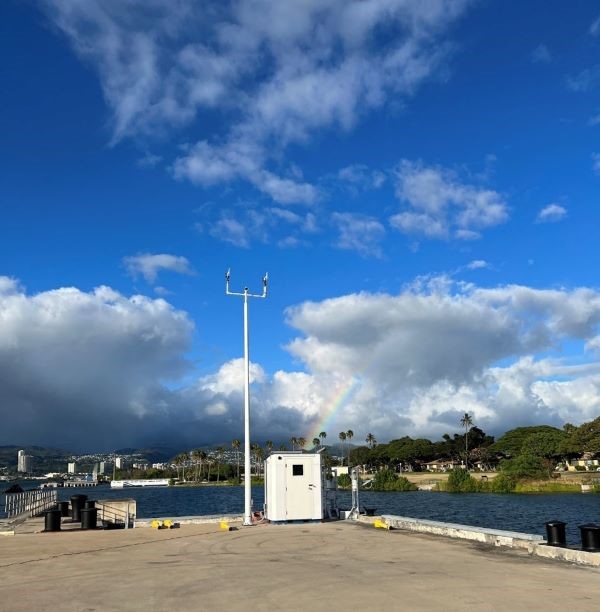
NOAA’s new Pearl Harbor-Honolulu PORTS stations collect and disseminate real-time observations of water levels, wind speed, atmospheric pressure and air and water temperatures used by mariners to navigate safely. (Credit: NOAA/CO-OPS)

Real-time observations will support U.S. commerce, naval interests in the region 

From Kimberly Rodgers, [email protected] , May 28, 2025 

May 28, 2025 

NOAA’s first Physical Oceanographic Real-time System, or PORTS, at Pearl Harbor-Honolulu, Hawaii, is now operational. Installed by NOAA’s National Ocean Service, data from the new publicly available observation system advances NOAA’s ability to better serve Hawaii’s coastal communities and secure maritime safety in the Pacific Islands. 

Pearl Harbor-Honolulu PORTS is NOAA’s 40th system in this national network of precision marine navigation sensors concentrated in busy U.S. seaports, and is the result of a partnership between NOAA and U.S. Navy Region Hawaii. Data from the system will be used to assist in the Navy’s planning and monitoring during daily operations and hazardous weather situations in Pearl Harbor and on Joint Base Pearl Harbor-Hickam — home to more than 55,000 military members and civilians, contributing more than $2 billion annually to the local economy. 

Commercial and local mariners traveling to Honolulu Harbor, the principal seaport of Hawaii, will also have access to these publicly available real-time observations. They will enable safer vessel movement, help determine the amount of cargo a vessel can carry and reduce transit delays for commercial traffic. Honolulu Harbor handles more than 11 million tons of cargo annually. National Weather Service forecasters in Honolulu will use PORTS water level observations to anticipate and communicate coastal flooding impacts to the community so preemptive actions can be taken. 

“With the launch of PORTS in Honolulu, we’re delivering mission-critical data to partners and decision makers — naval operations, commercial mariners and local agencies,” said Nicole R. LeBoeuf, director of NOAA’s National Ocean Service. “PORTS data will contribute to a safer and more efficient movement of vessels traversing Mamala Bay, entering and exiting Pearl Harbor and within Honolulu Harbor.”  

The Pearl Harbor-Honolulu PORTS consists of one water level and meteorological station located in Pearl Harbor (Ford Island) and a buoy-mounted current meter at Ford Island Channel, Lighted Buoy #1, sponsored by the U.S. Navy. The new stations will collect data on wind, air temperature, air pressure, and tidal currents to help mariners plan for safe docking in high winds, adverse weather, and heavy ship traffic.  

The system also integrates data from a long-standing NOAA National Water Level Observation Network station at Honolulu Harbor, as well as a Coastal Data Information Program wave buoy at the entrance to Pearl Harbor.  

PORTS is a successful public-private partnership program between NOAA and local partners that provides an integrated system of sensors concentrated in seaports. These sensors deliver accurate, real-time environmental data to commercial and other vessel operators. The PORTS program supports safe vessel movements in more than half of the top 175 U.S. seaports, including key coastal military installations. The safety and economic benefits of PORTS are well documented, including a 50% reduction in maritime accidents in seaports where real-time data is available. The data is publicly accessible online and can be integrated into vessel portable pilot units. The new Pearl Harbor-Honolulu PORTS® will be maintained by NOAA.  


USS Canberra Arrives in Bahrain

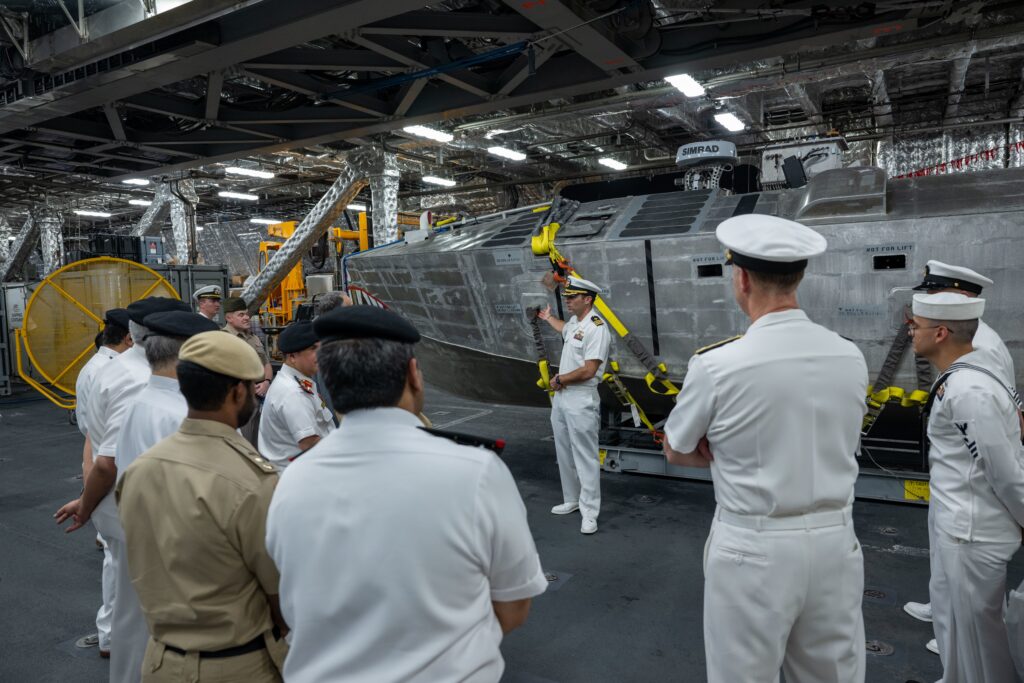
MANAMA, Bahrain (May 26, 2025) Cmdr. Bill Golden, commanding officer of USS Canberra’s (LCS 30) Blue Crew, discusses the mine countermeasures unmanned surface vehicle in the ship’s mission bay to Bahrain Defence Force officials in Manama, Bahrain. Canberra, an Independence variant of LCS, is deployed to the region to maintain regional maritime security in the Middle East region. (Photo by Chief Petty Officer Christopher ) 

From U.S. Naval Forces Central Command Public Affairs, May27, 2025 

MANAMA, Bahrain – The littoral combat ship USS Canberra (LCS 30) arrived at Naval Support Activity Bahrain, May 22, the first of four of the class expected to be stationed in the region. 

The crew hosted a tour of their ship on May 26, welcoming senior Bahraini defense officials, the U.S. ambassador to Bahrain, the honorable Steven Bondy, and commander of U.S. Naval Forces Central Command, Vice Adm. George Wikoff. 

“Today is about showcasing the United States’ continued commitment to maritime regional security in a broader sense, but in a specific sense, the friendship that we enjoy and never take for granted with the Kingdom of Bahrain,” Wikoff said. “We look forward to leveraging all the capabilities that this ship brings as a next-generation platform, working side-by-side with our Bahraini partners enforcing maritime security in the region.” 

The LCS is expected to replace the Avenger-class mine countermeasures ships which have operated forward in the region for decades. 

“Canberra’s arrival in Bahrain signifies our commitment to delivering advanced capabilities to further regional maritime security and maintaining our robust partnership with the Royal Bahrain Naval Force,” said the commanding officer of Canberra’s Blue Crew, Cmdr. Bill Golden. He previously served on a mine countermeasures ship forward deployed to Bahrain, USS Gladiator (MCM 11). “To see the differences between that platform and what Canberra offers is incredible.” 

Canberra is the first LCS to deploy with the mine countermeasures mission package. An integrated suite of unmanned maritime systems and sensors, it is designed to locate, identify, and destroy mines while increasing the ship’s standoff distance from the threat. 

Canberra, on its maiden deployment, is the first Independence-variant of the littoral combat ship to be deployed to the region. The ship left San Diego in March. 

The U.S. 5th Fleet area of operations encompasses nearly 2.5 million square miles of water area and includes the Arabian Gulf, Gulf of Oman, Red Sea, parts of the Indian Ocean and three critical choke points at the Strait of Hormuz, Suez Canal and Bab al-Mandeb. 


TRIDENT Training Center Opens

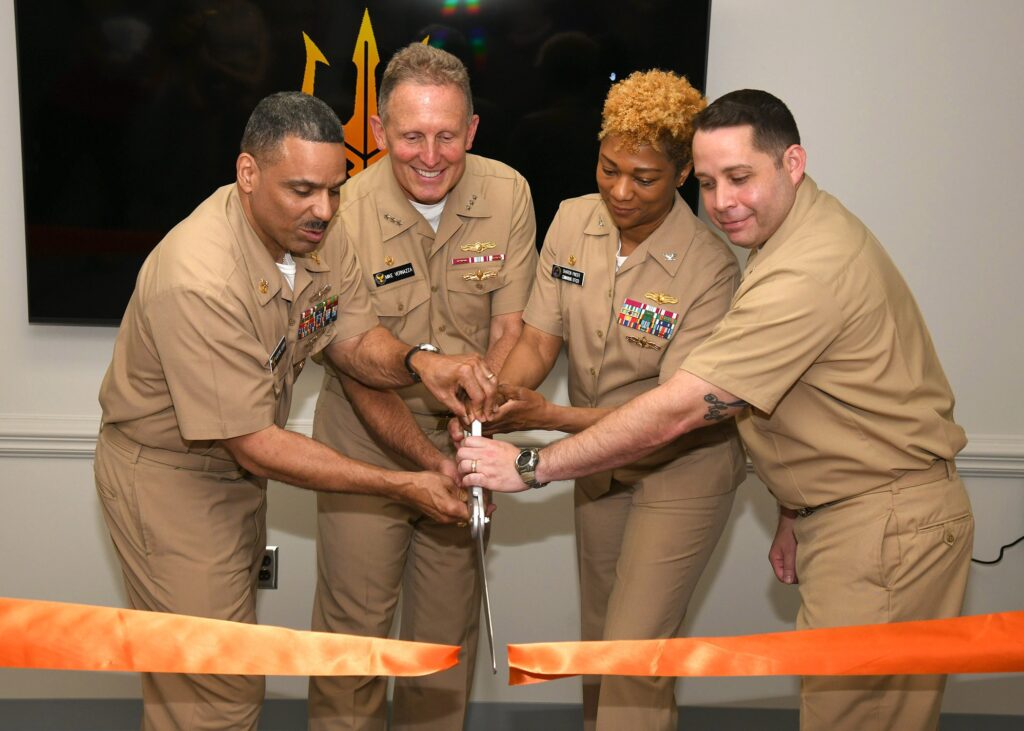
FORCM Augustine Cooper, Force Master Chief, Naval Information Forces, Vice Adm. Mike Vernazza, commander, Naval Information Forces, Capt. Sharon Pinder, Commanding Officer, Navy Cyber Defense Operations Command, and CMDCM(AW/SS) Jose M. Rivera, Command Master Chief, Navy Cyber Defense Operations Command, pose for a photo after a ribbon-cutting ceremony for the Navy Cyber Defense Operations Command’s TRIDENT Training Center on May 9. The 14,420 square foot center is specifically designed to support a wide range of activities, including individual and team-based scenarios, technical labs, demonstrations, mission rehearsals, cyber training, conferences, and professional development courses. (U.S. Navy Photo by Robert Fluegel / Released)

From NCDOC PAO Alexis Smith, May 27, 2025 

CHESAPEAKE, Va. - Navy Cyber Defense Operations Command (NCDOC) held a ribbon cutting ceremony on May 9, supported by Naval Information Forces (NAVIFOR) and Naval Network Warfare Command (NNWC) leaders to officially open TRIDENT – Technical Readiness in Defensive Cyber Operations {DCO} Education and Network Training – Center for NCDOC and NNWC personnel. 

Vice Adm. Mike Vernazza, commander, NAVIFOR and the Navy’s IBoss for Information Warfare, served as guest speaker. 
 
“This facility, in collaboration with our partners, provides hands on experience and training, real time sets and reps, and advanced mentorship from exceptional industry partners utilizing persistent access to lab and exercise environments with scenarios based on real world threats,” said Vernazza.  “As the Navy’s operational command for Defensive Cyberspace Operation, NCDOC’s mission is clear – to defend Navy networks and ensure warfighter readiness in cyberspace. This new training space directly aligns with that mission by enabling more dynamic, realistic, and collaborative cyber training, giving our teams the skills and agility that they will need to meet emerging threats.” 
 
The ribbon cutting ceremony is in honor of TRIDENT achieving a significant milestone, the successful execution of a remote Cyber Protection Team (CPT) mission and an operational recertification event. 
 
The 14,420 square foot center is specifically designed to support a wide range of activities, including individual and team-based scenarios, technical labs, demonstrations, mission rehearsals, cyber training, conferences, and professional development courses.  TRIDENT has actively supported the Cyber Competition Team, CPTs and Navy Red Team (NRT) through four Capture the Flag (CTF) events. 
 
These events allow the Sailors to practice and develop their skills in friendly competition against other teams across the DoD, U.S. Government, and the private sector.  The TRIDENT facility is also a space for Sailors, officers, and civilians to complete advanced cyber training ranging from vendor provided courses to internally developed training in support of NCDOC’s unique mission as DCO Task Force, sole Cyber Security Service Provider (CSSP) in the Navy, the Navy Cyber Defense Teams deployed afloat, and the Navy Hunt Team across enterprise networks. 
 
Additionally, NCDOC NRT, one of only 13 certified DoD Red Teams, can safely research, develop, and test various tools, exploits, and malware at TRIDENT, better preparing them to harden DoD Information Networks – Navy. 
 
TRIDENT has also been used to strengthen partnerships amongst the other stakeholders working to secure, operate, and defend Navy networks.  A Cyber Network Defense 5.2 training program between NCDOC and Naval Information Warfare Center Atlantic was hosted at the facility in April 2025. 
 
“NNWC Blue Team has also taken advantage of the facility to conduct enhanced capability establishing it as the nexus of training excellence for the Navy’s Secure, Operate, and Defend workforce.  The team received training from the National Security Agency representatives on their DarkEther network device data collection tool,” said Capt. Sharon Pinder, commanding officer, NCDOC. 
 
The TRIDENT ribbon cutting showcased a large orange ribbon, aligning the significance of the color orange in cybersecurity to the importance of the TRIDENT facility.  In industry, orange in cybersecurity represents teams who train and educate the frontline defenders against cyber threats. Cutting the orange ribbon represents TRIDENT’s role in fostering a culture of excellence in cybersecurity for the Navy and a conscious effort to provide ready, relevant learning to the warfighters charged with defending the networks to enable Assured Command and Control, Battlespace Awareness, Integrated Fires. 
 
NCDOC’s mission is to plan, coordinate, and conduct global DCO for the Navy’s largest warfighting ecosystem, the layered and interconnected networks and weapons systems linked across all warfighting domains through DoDIN-N.  Perform as Navy’s Cyber Security Service Provider (CSSP) in order to generate cyber intelligence, conduct proactive DCO on DoDIN-N to assure command and control, expand battlespace awareness, and facilitate integrated fires to win decisively in war. 
 
For more information on NCDOC, visit the command Facebook page at https://www.facebook.com/NavyCyberWarriors or the public web page at https://www.navifor.usff.navy.mil/ncdoc/. 


U.S. Coast Guard Cutter Stratton Commences Months-Long Indo-Pacific Patrol 

The Legend-class USCGC Stratton (WMSL 752) (background) sails alongside a Philippine Coast Guard vessel as Stratton arrives in Puerto Princesa, Philippines, May 16, 2025. (U.S. Coast Guard photo by Petty Officer 3rd Class William Kirk) 

From U.S. Coast Guard Pacific Area, May 24, 2025 

PUERTO PRINCESA, Philippines — The U.S. Coast Guard Cutter Stratton (WMSL 752) and its crew departed Puerto Princesa, Philippines, Monday, after in-port engagements and visits with the Philippine Coast Guard (PCG), the U.S. Ambassador to the Republic of the Philippines MaryKay Carlson, U.S. embassy staff, and PCG District Palawan senior leadership. 
 
Stratton’s visit to Puerto Princesa marked the first international port call of their months-long deployment to the Indo-Pacific region. 
 
Following their departure, Stratton’s crew conducted a bilateral Maritime Cooperative Activity (MCA) with the Armed Forces of the Philippines and the PCG within the Philippines’ exclusive economic zone. The MCA included exercises in maritime domain awareness, division tactics, maneuvering, and visit, board, search and seizure procedures. 
 
These engagements demonstrate the U.S. commitment to maritime governance that supports security, freedom and prosperity in the region. 
 
The U.S. Coast Guard serves as a unique instrument of national power, bridging defense, diplomacy and law enforcement to further national objectives and mutual interests with allies and partners like the Philippine Coast Guard. 
 
During the visit, Stratton’s commanding officer, Capt. Brian Krautler, welcomed Amb. Carlson, PCG Commandant Adm. Ronnie Gil Gavan, and senior PCG leaders aboard Stratton, highlighting U.S. Coast Guard interoperability with allies. 
 
“Our alliance with the Philippine Coast Guard has cultivated a close, collaborative maritime partnership—this is Stratton’s second deployment to the Philippines during my two years aboard as commanding officer,” Krautler said. “Our enduring partnership enables combined effects and cooperation across a broad spectrum of engagements and operations. Stratton’s deployment to the Indo-Pacific will further strengthen our relationships with allied coast guards and services throughout the region.” 
 
The U.S. Coast Guard works closely with regional allies to deliver a broad range of capabilities in support of a prosperous and secure Indo-Pacific. Multilateral operations like the at-sea MCA and in-port engagements enhance cooperation, improve interoperability and strengthen readiness. 
 
While moored, Krautler and Stratton’s leaders also met with the WESTCOM Commander PCG District Palawan for a pre-sail planning meeting to discuss bilateral search and rescue exercises (SAREX) to enhance cooperation. At-sea operations and exercises with the Philippine Coast Guard will strengthen the ability to execute coordinated maritime operations and enhance overall mission readiness.| 
 
The U.S. Coast Guard’s commitment to a prosperous and secure Indo-Pacific requires working closely with regional allies, allowing the service to improve its logistics flexibility to better deliver a broad range of capabilities. 
 
During the patrol, Stratton is scheduled to engage with regional partners and participate in joint operations aimed at enhancing maritime safety and security. Throughout its Indo-Pacific deployment, Stratton is assigned to Destroyer Squadron (DESRON) 15, the Navy’s largest DESRON and the U.S. 7th Fleet’s principal surface force. DESRON 15 regularly assumes tactical control of surface units operating in the area. 
 
Stratton’s port call to the Philippines marks the cutter’s third visit following stops in 2019 and 2023. Consistent U.S. Coast Guard national security cutter deployments to the region demonstrate the U.S. commitment to strong maritime governance that supports security, freedom and prosperity in the Western Pacific. 
 
Commissioned in 2012, Stratton is one of ten Legend-class national security cutters and one of four homeported in Alameda, California. National security cutters are 418 feet long, 54 feet wide and have a 4,600 long-ton displacement with a top speed of 28 knots, a range of 12,000 nautical miles and can hold a crew of up to 170. National security cutters routinely conduct operations throughout the Pacific, where their combination of range, speed and ability to operate in extreme weather provides mission flexibility. 
 
The namesake of U.S. Coast Guard Cutter Stratton is Capt. Dorothy Stratton, who led the service’s all-female reserve force during World War II. Dorothy Stratton was the first female commissioned officer in the Coast Guard and commanded more than 10,000 personnel. The ship’s motto is “We can’t afford not to.” 


NIWC Pacific Enhances India’s Maritime Security Capabilities

From Naval Information Warfare Center Pacific Public Affairs, May 22, 2025 

SAN DIEGO – The U.S. Navy is strengthening maritime security in the Indo-Pacific region through a $125 million initiative designed to enhance India’s maritime domain awareness. Naval Information Warfare Center (NIWC) Pacific is playing a central role in the Indo-Pacific Maritime Domain Awareness (IPMDA) program, a flagship effort under the U.S. Indo-Pacific Strategy. 

The IPMDA initiative aims to improve maritime awareness and regional coordination by providing partner nations with unclassified maritime situational awareness tools and data. A core component of the case is SeaVision, a U.S. Navy-managed platform that aggregates Automatic Identification System (AIS) and other vessel tracking data to enable secure, real-time maritime monitoring, according to Robert Lendvay, NIWC Pacific Foreign Military Sales Case Manager supporting the Navy’s International C4I Integration Program Office [PMW 740]. Lendvay has spearheaded the effort since January 2023. The initiative also integrates commercial satellite-based radio frequency (RF) detection capabilities from HawkEye 360, enabling partner nations to detect and monitor vessels operating without transponders. Together, these tools create a multi-layered operational picture that significantly enhances India’s ability to monitor its maritime domain and contribute to regional security objectives. 
  
The program’s inception began with a foundational meeting at NIWC Pacific in San Diego, where Lendvay, alongside the NIWC Pacific SeaVision Technical Assistance Field Team, hosted a high-level delegation from the Indian Navy and the Indian Ministry of External Affairs. This engagement was instrumental in defining the initial operational and technical requirements that laid the groundwork for the largest IPMDA-related case to date. 
  
Over the course of two years, Lendvay led detailed coordination efforts across the U.S. Department of State, the Defense Security Cooperation Agency, Navy International Programs Office, and other interagency partners to ensure the program met U.S. releasability standards and foreign disclosure policies. 
  
“These collaborative efforts ultimately resulted in the successful completion of the Congressional Notification process – a critical milestone,” said Lendvay. “This authorizes the U.S. Government to offer new and improved capabilities to India in support of IPMDA. This approval not only affirms the strategic trust placed in India as a key Indo-Pacific partner but also reflects the growing defense ties between members of the Quad alliance: the United States, Japan, Australia, and India.” 
  
“This initiative is a testament to the strong partnership between the U.S. and India and our shared commitment to a free and open Indo-Pacific,” said John Smith, a NIWC Pacific employee. “By providing India with advanced maritime domain awareness tools, we are enhancing their ability to monitor their maritime domain and contribute to regional security.” 
  
NIWC Pacific and PMW 740 have played a central role in managing the program’s development, working closely with commercial vendors and interagency stakeholders to define a technically sound and contractually executable acquisition strategy. The IPMDA initiative strengthens the region’s ability to detect and deter threats and reinforces collective maritime security objectives. 


Navy DDGs Successfully Engage SRBM and MRBM During Exercise Formidable Shield 2025 

ATLANTIC OCEAN – (May 20, 2025) Ensign Kayla Staknis, assigned to the Arleigh Burke-class guided-missile destroyer USS Bulkeley (DDG 84), observes the launch of a Standard Missile 3 to intercept a ballistic missile during At-Sea Demonstration (ASD) / Formidable Shield (FS) 2025. (U.S. Navy photo by Mass Communication Specialist 2nd Class Jonathan Nye)

From U.S. 6th Fleet Public Affairs, May 22, 2025 

NAPLES, Italy – U.S. 6th Fleet Arleigh Burke-class guided-missile destroyers USS Thomas Hudner (DDG 116) and USS Bulkeley (DDG 84) conducted two separate live-fire events as part of exercise At Sea Demonstration (ASD) / Formidable Shield (FS) 25. U.S. Navy destroyers are equipped with the Aegis weapons systems designed for ballistic missile defense. 

On May 15, 2025, Thomas Hudner successfully engaged a short-range ballistic missile (IAMD-T) target with an SM-6 missile. 

On May 20, 2025, Bulkeley and Thomas Hudner successfully engaged a medium-range ballistic missile target (ARAV-B) and a simulated target (EDTT) with an SM-3 missile. 

Throughout the exercise, Allied forces are participating in a series of live-fire events using NATO command and control reporting structures. 

The two destroyers’ successful missile intercepts demonstrated the lethality of U.S. Navy systems and the ability to operate seamlessly with Allied nations to maintain a stable security environment. It sends a strong message to any potential adversary by demonstrating combat credibility. 

ASD/FS 25 is the largest at-sea live-fire exercise in the European theater, hosted by U.S. 6th Fleet and executed by Naval Striking and Support Forces NATO. ASD/FS 25 includes a series of live-fire events against unmanned air and surface systems, subsonic, supersonic, and ballistic targets, incorporating multiple Allied ships, multi-nation/multi-service ground-based air defenses, and aviation forces working across battlespaces to deliver lethal effects, accomplish exercise objectives, and hone warfighting skills. 

The exercise commenced on May 3, 2025 and involves approximately 6,900 personnel from across the Alliance.