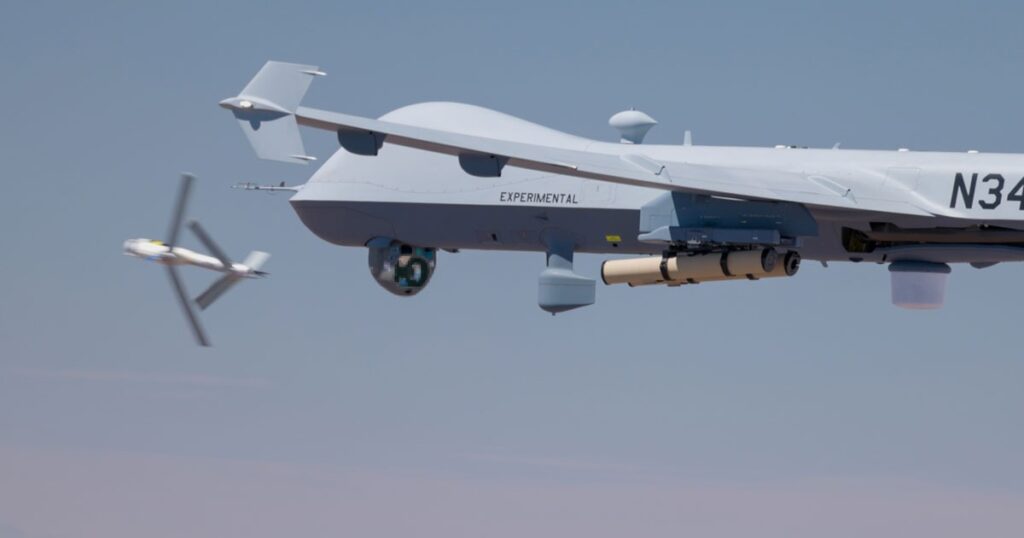
SAN DIEGO – 10 September 2025 – General Atomics Aeronautical Systems, Inc. (GA-ASI) and AeroVironment (“AV”) (NASDAQ: AVAV) collaborated on the air launch of a Switchblade 600 loitering munition (LM) from a GA-ASI Block 5 MQ-9A unmanned aircraft system (UAS). The flight testing took place from July 22-24 at the U.S. Army Yuma Proving Grounds Test Range. It marked the first time a Switchblade 600 has ever been launched from an unmanned aircraft.
“This cooperative effort showcased how combining different unmanned technologies could really provide value and effects to the warfighter,” said GA-ASI President David R. Alexander. “By using MQ-9A to carry the Switchblade, the MQ-9A is able to stand off farther from enemy weapons systems and increase the range of the SB600, which will provide greater access and options in contested airspace.”
After successfully integrating the SB600 with the MQ-9A, the team released two LMs: one with an inert warhead and the other with a high-explosive round. After launch, the team transferred control of the Switchblade from a user in the MQ-9A’s ground control station to a user on the ground nearer the operational area.
The test further validated GA-ASI’s ability to integrate and operate a variety of airborne launched effects on the battlefield – including both those built by GA-ASI and by partners such as AV – and how their use in conflict provides risk-tolerant options to commanders in contested operations.
USMC, CDAIO and DIU Partner for Acceleration of Palantir System
From Communications Directorate, Headquarters, U.S. Marine Corps, Sept. 10, 2025
WASHINGTON, D.C. — The U.S. Marine Corps, in partnership with Defense Innovation Unit (DIU), the DoD Chief Digital and Artificial Intelligence Officer (CDAO) and Army Research Lab, finalized a contract with Palantir Technologies Inc. for an enterprise Marine Corps license for Maven Smart System (MSS), a foundational, data-centric command and control (C2) platform. This contract provides all Marines – from tactical units within the Fleet Marine Force (FMF) to the Supporting Establishment – with access to the MSS platform, complete with embedded advanced AI capabilities and functionality across the spectrum of warfighting functions.
This partnership, finalized on August 15, 2025, is a key enabler for the Marine Corps’ ongoing modernization efforts, designed to deter conflict and, if deterrence fails, to defeat any adversary.
“As part of Force Design, we’ve made a deliberate effort to support maritime domain awareness and joint fires integration,” said Gen. Eric M. Smith, the Commandant of the Marine Corps. “This capability enhances intelligence, targeting, and battlespace awareness to aid in faster decision-making, allowing us to sense and make sense more quickly.”
MSS is a mission command application (MCA) and data integration platform that aggregates data across Service and Joint C2 technology stacks to share a live, synchronized view of the battlespace. MSS provides warfighters and decision-makers with real-time understanding in support of the overall Combined Joint All Domain Command and Control (CJADC2) mission. This enables rapid sensor-to-shooter engagements through a fully digital workflow, leveraging automation and AI-driven tools for advanced target management.
Notably, the Marine Corps contracted this C2 platform Service solution within five months of receiving a request from the FMF, through collaborative efforts with the CDAO and DIU. This contract accelerates the Marine Corps’ scaling and adoption of critical CJADC2 capabilities, ensuring the nation’s expeditionary force remains relevant and ready in an era of software-defined warfare. The Marine Corps will continue to use this system in their Exercise Lifecycle – for example, the I Marine Expeditionary Force (I MEF), based out of Camp Pendleton, California, most recently leveraged the system at Exercise BALIKATAN 25 and during their re-certification as a Joint Task Force Headquarters.
“The Marine Corps is at the forefront of adopting technologies that make our Marines more agile, adaptable, and responsive to any threat,” said Lt. Gen. Jerry Carter, the Deputy Commandant for Information. “Maven Smart System adds significant value to our ability to support the Joint Force and shows how the Marine Corps is demonstrating its ability to adapt to, harness, and drive the changing character of war. We continue to look for opportunities to leverage AI and other emerging capabilities at speed and scale.”
FMF units will have expanded access to MSS licensing down to the tactical level within each Major Subordinate Command (MSC) to ensure Marines have the tools to fight and win. Supporting Establishment elements will use licensing to support training, integration testing, and reach-back support.
Marines Test Drone Systems During Defense Innovation Unit Challenge
Sept. 10, 2025 | By Marine Corps 2nd Lt. Logan Tompkins
Marines assigned to I Marine Expeditionary Force partnered with the Defense Innovation Unit and industry leaders during phase two of the DIU’s Project GI challenge to evaluate commercial small unmanned aerial systems in realistic operational environments, Aug. 18-29.
The 12-day event brought together Marines assigned to 1st Marine Division — including operators, leaders and subject matter experts — to test vendor-loaned systems across multiple ranges. The training period included four days of Marine-led familiarization, followed by six days of scenario-based demonstrations. Assessments will directly inform War Department procurement decisions and accelerate the integration of resilient, cost-effective small UASs into the joint force.
“The GI challenge puts our Marines at the center of capability development. Their expertise, combined with the innovation of our industry partners, is shaping the next generation of unmanned systems,” said Marine Brig. Gen. Michael Nakonieczny, deputy commanding general of I Marine Expeditionary Force. “I MEF is proud to play a leading role in advancing technologies that directly enhance the lethality and survivability of our Marines.”
Marines evaluated systems against operational criteria, including setup, deployment time, weatherproofing, payload capacity and performance across varying terrain and climates. Evaluations emphasized how each system affected tactics, techniques and procedures during realistic combat scenarios.
“Robotics are revolutionizing the battlefield, and it’s no secret that first-person-view drones have become one of the most lethal and disruptive weapons worldwide,” said Marine Maj. Steven Atkinson, I Marine Expeditionary Force DIU event lead planner. “Our mission is to ensure America’s warfighters get the very best, battle-tested technology so they can be effective anywhere in the world.”
The challenge represents the second phase of a three-part competitive selection process. Phase one involved an initial screening in which the DIU reviewed vendor proposals and chose the most promising systems for further testing. Phase two brought those selected vendors to Marine Corps Base Camp Pendleton, California, for hands-on evaluation by the I Marine Expeditionary Force. A final phase three round will determine which systems advance to procurement, with winning platforms expected to be added to DOW’s “Blue UAS Cleared List” — drones compliant with current law and policy, validated as cybersecure and available for DOW purchase and operation — by March 15, 2026.
“Bottom-up refinement is something the Marine Corps has always valued. The ability for dedicated to test, stress and provide input on these products is exactly what was needed for this project and the service,” said Marine 2nd Lt. Kienan Morrissey, an intelligence officer assigned to 3rd Light Armored Reconnaissance Battalion who participated in the evaluation of the vendor-loaned small UAS platforms.
Marines stress-tested the systems in contested environment simulations, focusing on modern kill chain operations and first-person view effects capabilities. Vendors were required to provide at least three prototypes for testing, though some platforms received exemptions due to design characteristics or employment concepts.
Following evaluations, Marines conducted detailed debriefs to capture feedback that will guide procurement and influence future small UAS capability development across DOW. Units within I Marine Expeditionary Force will continue working with selected systems beyond the challenge to provide additional recommendations for improvement.
The DIU’s Project GI challenge represents one of the Marine Corps’ largest field-based industry engagements, focusing on emerging drone technology and directly supporting modernization priorities identified by Marine Corps and Pentagon leaders for operations against peer adversaries.
“Events like these ensure our Marines will have the best available tools at their disposal in the next conflict,” Morrissey said.
HII, Babcock to Integrate UUVs with Submarine Weapon Handling and Launch Systems
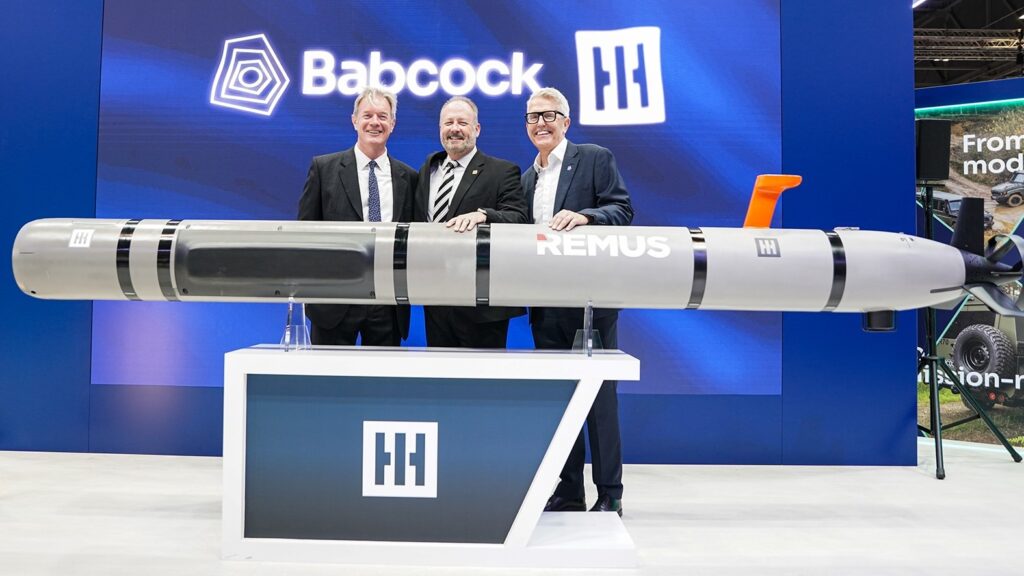
LONDON, Sept. 11, 2025 (GLOBE NEWSWIRE) — Today, Babcock International Group (Babcock) and HII (NYSE: HII), signed a memorandum of understanding to bring together HII’s REMUS unmanned underwater vehicles (UUVs) and Babcock’s world-leading submarine Weapon Handling and Launch Systems (WHLS). The goal of the collaboration is to deliver autonomous launch and recovery of UUVs via submarine torpedo tubes, strengthening the undersea advantage of allied navies. This is the first program of its kind within the Babcock Mission Systems business.
As UUVs become increasingly vital to future undersea operations, HII and Babcock seek to work together to jointly pursue future opportunities within the unmanned space. This joint initiative builds on Babcock and HII’s strategic partnership started in 2023, and the U.S. Navy’s first successful forward-deployed UUV launch and recovery via torpedo tube, using an HII REMUS. Babcock’s WHLS are currently in service with the submarine fleets of the United Kingdom, Canada, Australia, Spain and South Korea.
Chris Kastner, HII, president and chief executive officer, said: “This partnership demonstrates the promise of pairing Babcock’s handling and launch system technology with the capabilities of HII’s REMUS UUVs to strengthen the undersea advantage of our allies. I am proud of HII’s leadership in advancing autonomous maritime manned-unmanned teaming operations and excited about the opportunities this collaboration will unlock.”
Sir Nick Hine, Babcock, chief executive marine, said: “Partnering with HII, we’re combining over a century of expertise in surface and sub-surface systems to further explore marine technologies and strengthen defense capabilities — this is just the beginning of future collaborations across marine programs.”
Babcock has been responsible for the design, manufacture and support of submarine WHLS for the United Kingdom’s Royal Navy and overseas customers for more than 50 years. Together with HII’s autonomous REMUS, Babcock and HII can offer customers more capability through the integration of the latest UUV technology into existing and new build platforms.
The U.S. Navy’s milestone operation underscores a broader transformation in undersea warfare: the growing demand for integrated manned-autonomous operations that extend reach, enhance stealth, and reduce operational risk. HII and Babcock’s collaboration positions both companies, and their allied navy customers, to lead this transformation.
To date, HII has sold more than 700 REMUS vehicles to over 30 countries, including 14 NATO members. Notably, more than 90% of REMUS units delivered in the past 23 years remain in service, demonstrating platform durability and lifecycle value — critical in defense acquisition decision-making.
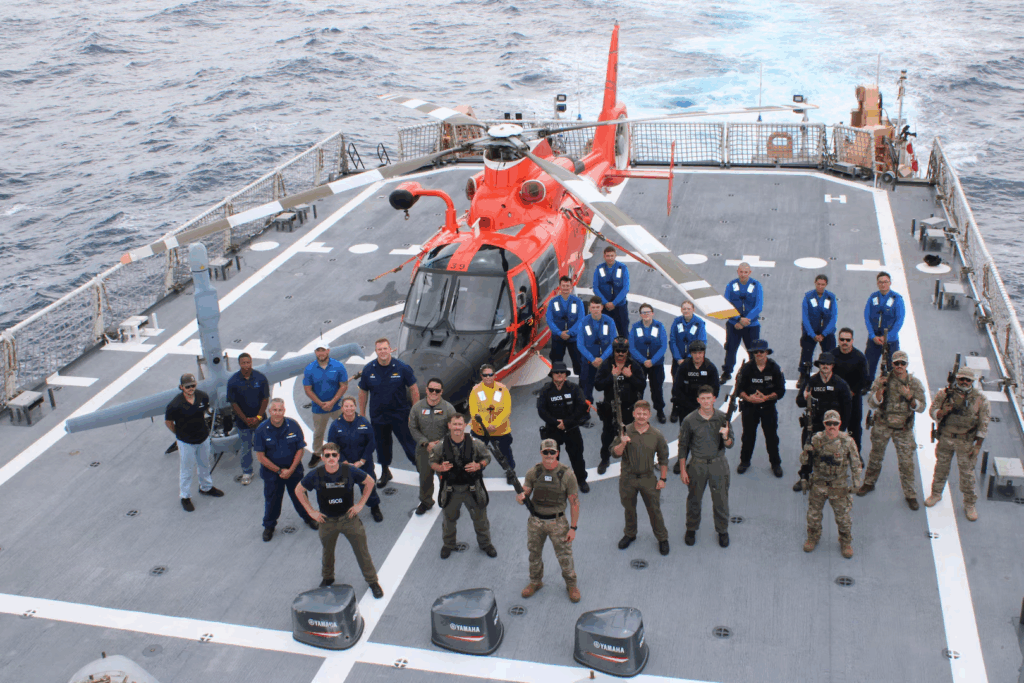
Coast Guard crews from the Coast Guard Helicopter Interdiction Tactical Squadron, Coast Guard Tactical Law Enforcement Team – South, Coast Guard Cutter Midgett (WMSL 757) helicopter tie-down members and unmanned aerial vehicle personnel pose for a group photo aboard Midgett from behind three bullet-damaged outboard engine cowlings while underway in the Eastern Pacific Ocean, Aug. 28, 2025. On Aug. 25, HITRON used airborne use of force to stop the non-compliant vessel, marking the unit’s 1,000th drug interdiction since the unit’s inception in 1999, which resulted in Midgett crew members seizing approximately 3,606 pounds of suspected cocaine worth an estimated $46 million and apprehending six suspected narco-traffickers. (U.S. Coast Guard photo)
From U.S. Coast Guard Headquarters, Sept. 10, 2025
JACKSONVILLE, Fla. — The U.S. Coast Guard’s Helicopter Interdiction Tactical Squadron (HITRON) achieved a significant milestone in its counter-drug mission, completing its 1,000th interdiction of suspected narco-trafficking vessels Aug. 25.
Since October 1, 2024, HITRON has interdicted $3.3 billion in illicit narcotics destined for the United States via maritime routes, a three-fold increase over its historic annual average of $1 billion.
“HITRON embodies the Coast Guard’s spirit of innovation and adaptability,” said Vice Adm. Nathan Moore, commander, U.S. Coast Guard Atlantic Area. “From its humble beginnings as a prototype program, it has evolved into a vital force in our counter-narcotics efforts. This milestone is a powerful reminder of the strategic value of this specialized unit in addressing the evolving complex maritime security challenges.”
On Aug. 25, a HITRON aviation detachment deployed aboard Coast Guard Cutter Midgett (WMSL 757) observed a suspected narco-trafficking vessel approximately 372 nautical miles southwest of Acapulco, Mexico in the early evening. The helicopter directed the vessel to heave to over the radio and with warning shots. When the vessel failed to comply, the crew used precision rifle fire from the helicopter to disable the vessel’s engine, in accordance with airborne use of force policy. A Coast Guard law enforcement boarding team from Midgett seized more than 3,600 pounds of suspected cocaine that was found aboard and jettisoned in the waters around the vessel, estimated to have a street value of $49 million.
HITRON is based in Jacksonville, Florida and a component of U.S. Coast Guard Atlantic Area Command. It was founded in 1999 as a classified prototype program to test the ability of Coast Guard aircraft to employ precision fire to disable narcotics smuggling vessels. With impressive early results, this team grew from the initial ten personnel to its current size of over 200 Active Duty, Reservists, and civilian members, including an exchange pilot from the United Kingdom’s Royal Navy. Since its founding, HITRON has interdicted $33.2 billion in illicit drugs during operations in the Eastern Pacific Ocean and Caribbean Sea, and over the past 26 years has averaged one interdiction every nine days.
Through Operation Pacific Viper, the Coast Guard is accelerating counter-drug operations in the Eastern Pacific Ocean, where significant transport of illicit narcotics continues from South America. In coordination with international and interagency partners, the Coast Guard is surging additional assets—cutters, aircraft and tactical teams—to interdict, seize and disrupt transshipments of cocaine and other bulk illicit drugs. These operations continue the Coast Guard’s efforts to protect the Homeland, project maritime law enforcement presence and disrupt transnational criminal organizations and cartels seeking to produce and traffic illicit drugs into the United States.
Visit GoCoastGuard.com to learn about active duty and reserve, officer and enlisted opportunities in the U.S. Coast Guard. Information on how to apply to the U.S. Coast Guard Academy can be found here.
Coast Guard Exercises Contract Option for 10 Additional Fast Response Cutters
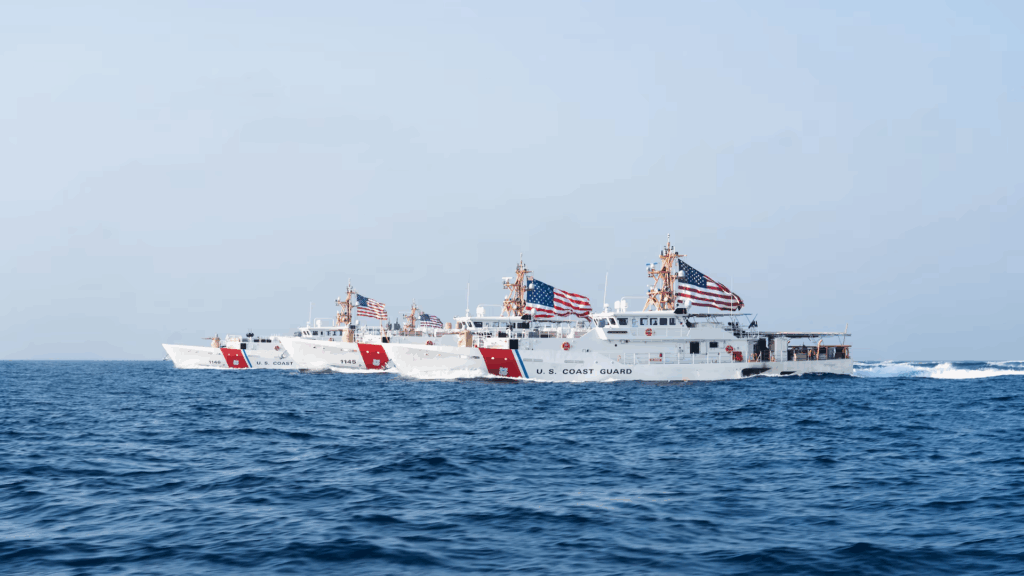
STRAIT OF HORMUZ (Aug. 22, 2022) From the left, U.S. Coast Guard fast response cutters USCGC Glen Harris (WPC 1144), USCGC John Scheuerman (WPC 1146), USCGC Emlen Tunnell (WPC 1145) and USCGC Clarence Sutphin Jr. (WPC 1147) transit the Strait of Hormuz, Aug. 22. The cutters are deployed to the U.S. 5th Fleet area of operations to help ensure maritime security and stability in the Middle East region. (U.S. Army photo by Spc. Noah Martin)
From U.S. Coast Guard Headquarters, Sept. 10, 2025
WASHINGTON — The U.S. Coast Guard has exercised a contract option with Bollinger Shipyards of Lockport, Louisiana, to fund initial construction on 10 additional Fast Response Cutters (FRCs), Tuesday. The $507 million option supports ongoing efforts to modernize the fleet and expand the Coast Guard’s global maritime mission.
The action made possible by the passage of Public Law 119-21, known as the One Big Beautiful Bill Act, increases the total number of FRCs ordered under the current agreement from 67 to 77. Supported by historic investments, this legislation provides nearly $25 billion – the largest single funding commitment in Coast Guard history – including $1 billion dollars for additional FRCs. The first FRC funded through this option is expected to be delivered in fiscal year 2028.
“As the first Coast Guard contracting action to execute over $100 million in reconciliation funds and the first reconciliation-funded action executed by a cutter program, this is a historic accomplishment for the Service,” said Rear Adm. Mike Campbell, the Coast Guard’s Director of Systems Integration and Chief Acquisition Officer. “Since its introduction to the fleet in 2012 as the successor to the 110-foot Island class patrol boat, the Fast Response Cutter has consistently proven its capabilities, adaptability and effectiveness in a wide range of maritime environments and Coast Guard missions.”
Sentinel-class FRCs are critical assets in the Coast Guard’s mission to control, secure and defend the U.S. border and maritime approaches. To date, 59 of these cutters are in service, replacing the aging fleet of 1980s-era Island-class 110-foot patrol boats. The Sentinel-class FRCs feature advanced command, control, communications, computers, intelligence, surveillance and reconnaissance equipment; over-the-horizon cutter boat deployment to reach vessels of interest; and improved habitability and seakeeping. Expanding the FRC fleet continues the Coast Guard’s modernization through Force Design 2028, an initiative introduced by Secretary of Homeland Security Kristi Noem to transform the Coast Guard into a more agile, capable and responsive fighting force.
The FRC fleet will complement the capabilities of the service’s national security cutters (NSCs), offshore patrol cutters (OPCs) and polar security cutters (PSCs) as an essential element of the Nation’s layered maritime security strategy.
Eureka Naval Craft Strikes New Shipbuilding Agreement with Bordelon Marine Shipbuilders
Partnership targets US Navy Modular Attack Surface Craft program and counter narco-terrorism operations
From Eureka Naval Craft, Sept. 10, 2025
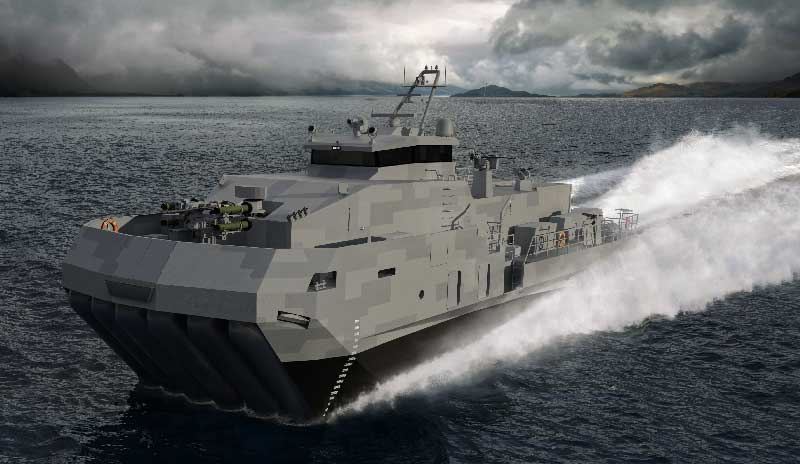
U.S. defense company Eureka Naval Craft is announcing a landmark agreement with Louisiana-based Bordelon Marine Shipbuilders to construct its state-of-the-art warships.
Both companies said the partnership is designed to support the administration’s shipbuilding agenda, significantly strengthening the nation’s military industrial base while aiming to create and safeguard thousands of highly skilled jobs. It directly supports the U.S Navy’s call, in July this year, for industry develop ideas for its Modular Attack Surface Craft (MASC) Program to adapt to evolving geopolitical and technological challenges (see notes to editors 1).
The memorandum of understanding will provide the production-ready AIRCAT Bengal-MC modular attack surface craft (MASC see notes to editors 2) and Jaguar landing craft to meet the requirements of the U.S. Navy, U.S. Army and U.S. Marine Corps. In addition, the vessel can be adapted to combat narco-terrorism for the Department of Homeland Security (DHS) and the Drug Enforcement Administration (DEA).
“The Bengal-MC is at the forefront of maritime technology, engineered for unmatched speed, extended range, exceptional payload capacity, and versatile modularity,” said Bo Jardine, CEO of Houston based Eureka Naval Craft. “As the US Navy has requested it is strategically designed to reinforce our defenses against China in the Indo-Pacific and counter Russian advances in the Baltic. Moreover the BengalMC’s speed, range, and payload capacity make it ideal for counter-narcotics operations. With the ability to chase down drug smuggling craft at 50 knots and carry boarding teams, vehicles, or relief supplies. The platform serves as a versatile homeland mission asset for the United States Southern Command (SOUTHCOM), DEA and DHS.”
Wes Bordelon, CEO of Bordelon Marine Shipbuilders, said: “This partnership brings a range of advantages to our country in line with the US Navy’s request for innovative ideas. This MoU can provide the rapid deployment and cost-effectiveness the Navy requires by using proven commercial technology Eureka has developed in the offshore market, with the AIRCAT vessels operating in West Africa. And we can do it right from our shipyard in Louisiana harnessing US suppliers nationwide ploughing investment back into the US economy.”
The 36-metre Bengal-MC’s versatile air-cushion catamaran design aligns directly with the U.S. Navy and Marine Corps’ MASC requirements. With a cruise speed of 38 knots and a sprint capability of up to 50 knots, it can carry heavy loads of troops, vehicles, and defense systems rapidly across long operational distances.
Jardine emphasized the importance of the vessel’s adaptable design, combined with SH Defence’s Cube modular mission deck system which allows operators to reconfigure the same hull within hours for anti-surface warfare, counterUAV, mine countermeasures, amphibious lift, humanitarian support, or counternarcotics patrols.
In addition, Jardine said the AIRCAT Bengal-MC has one of the most advanced autonomous navigation systems thanks to deploying technology developed with Australian defense company Greenroom Robotics. Greenroom has spent years developing its Advanced Maritime Autonomy (GAMA) Software system notably on a 57m decommissioned Armidale-class patrol boat, Sentinel, known as the Patrol Boat Autonomy Trial (PBAT) ensuring it is Unmanned Maritime Autonomy Architecture (UMAA) compliant.
“The Bengal-MC with its modular payload system, large aft deck, range and speed is ready to adapt to ever-evolving mission requirements to counter global threats. And it comes without the crippling costs and complex design requirements that have dogged naval shipbuilding programs for years,” said Mr. Jardine. “Unlike conceptual designs, these ships are mission-ready and production-ready now. They offer the services a proven and affordable path to fielding a MASC fleet. They will be built for America in America.”
The MoU with Bordelon Marine comes shortly after Eureka signed a similar deal with Singapore shipbuilder Strategic Marine (S) Pte Ltd to ramp up production of its AIRCAT Bengal-MC warship in Asia.
Leidos Australia Launches into Australia-Pacific Maritime Autonomy Domain with New USV
From Leidos, Sept. 9, 2025
MELBOURNE, Australia (9 September 2025) – Leidos has commenced the Australian build of Sea Archer, a next-generation small uncrewed surface vessel (USV). This marks a major step forward in bringing Leidos’ proven autonomous technology and maritime systems portfolio to the Indo-Pacific region while supporting AUKUS objectives and the Australian Defence Force’s mission needs.
The move into local manufacturing of autonomous vessels fast-tracks proven U.S. capability to Australia, harnessing Leidos’ 50-year heritage with the U.S. Navy and its record of more than 120,000 fully autonomous nautical miles at sea.
At the heart of Sea Archer is Leidos’ advanced autonomy platform, LAVA, which enables high-speed, long-range, and smart mission execution across diverse maritime environments. Seamlessly integrated with Leidos’ broader battle management technologies — including ADEPT and AlphaMosaic, which harness AI to support distributed, autonomous fleet operations — Sea Archer embodies the future of naval capability: intelligent, adaptable and affordable.
Built for speed, endurance and multi-mission payloads, Sea Archer can reach sprint speeds up to 40 knots and has a range of 1,500 nautical miles. With a flexible payload bay capacity of more than 900kg, Sea Archer can support a wide range of mission options, including strike, logistics resupply, ISR (intelligence, surveillance, and reconnaissance), and electromagnetic deception operations.
The Australian production of Sea Archer will use local capability across the supply chain — from build to payload integration, autonomy software design and ship maintenance — supporting a robust sovereign ecosystem, rapid production and sustainment. NSW Central Coast-based Oceans Rivers Lakes has been appointed to build the first aluminium vessel and construction is already underway.
Leidos Australia’s technical team will lead the integration of its autonomy software platform, which has already been successfully deployed across 12 different USV platforms.
Leidos Australia Chief Executive Paul Chase said, “Given Australia’s vast northern approaches, platforms with coverage, endurance and agility are critical. The capability to monitor large areas, detect security threats, navigate hazardous environments and provide continuous uncrewed support enhances our nation’s security posture, especially in today’s geostrategic environment.”
“We’re aiming to deliver a rapid production capability, and because of its easy-to-build aluminium hull, can have Sea Archer built at multiple shipyards across Australia. This approach will allow us to quickly deliver flexible, adaptable and affordable maritime solutions, using our fleet or customer vessels, to support mission needs,” he added.
Along with Sea Archer, Leidos’ Sea Systems portfolio includes operationally proven medium USVs—Sea Hunter, Sea Hawk, Ranger and Mariner—as well as a range of undersea systems including Sea Castle, Sea Spector and Sea Dart, a high-performance, low-cost, flexible and adaptable uncrewed undersea vessel. Sea Archer is currently undergoing sea trials in the U.S. and is expected to be mission-ready by 2026.
17th MCPON John Perryman Releases His Priorities
From the Navy Office of Information, Sept. 9, 2025
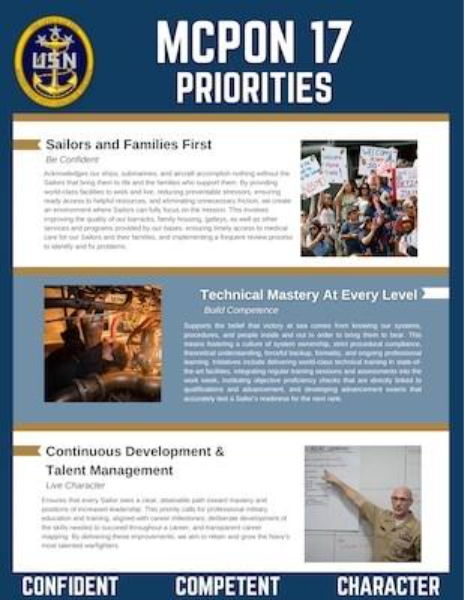
WASHINGTON – The 17th Master Chief Petty Officer of the Navy (MCPON), John Perryman, released his priorities to the Fleet following the Change of Office ceremony Sept. 8, 2025.
Aligning with Chief of Naval Operations Adm. Caudle’s priorities of keeping the Foundry, the Fleet, and the Fight,MCPON Perryman emphasized a vision rooted in a simple principle: Build Competence. Live Character. Be Confident. His key priorities center on Sailors and Families First, Technical Mastery, and Continuous Development and Talent Management.
“I am committed to removing distractions that don’t matter, delivering training that does, and spotlighting excellence wherever it’s found,” said Perryman.
In today’s world of rising tensions, the maritime domain remains critical to national defense. MCPON Perryman underscored that while ships, submarines, and aircraft are impressive, it is Sailors—and the families who support them—who bring them to life.
“Our Navy must be manned by world-class Sailors, led by the best warfighters at every level,” Perryman said. “You have my word—I will always fight for you, and for the families who stand beside you.”
MCPON Perryman expanded on his priorities in a video message released following the ceremony. An accompanied priority graphic is available on navy.mil and his official social media platforms.
HII Unveils AI-Enabled ROMULUS Family of USVs Powered by Odyssey to Strengthen the Fleet
NEWPORT NEWS, Va., Sept. 09, 2025 (GLOBE NEWSWIRE) — HII (NYSE: HII), America’s largest military shipbuilder and a global leader in autonomous maritime systems, today introduced ROMULUS, a modular, AI-enabled family of unmanned surface vessels (USVs) powered by HII’s Odyssey Autonomous Control System (ACS) software suite.
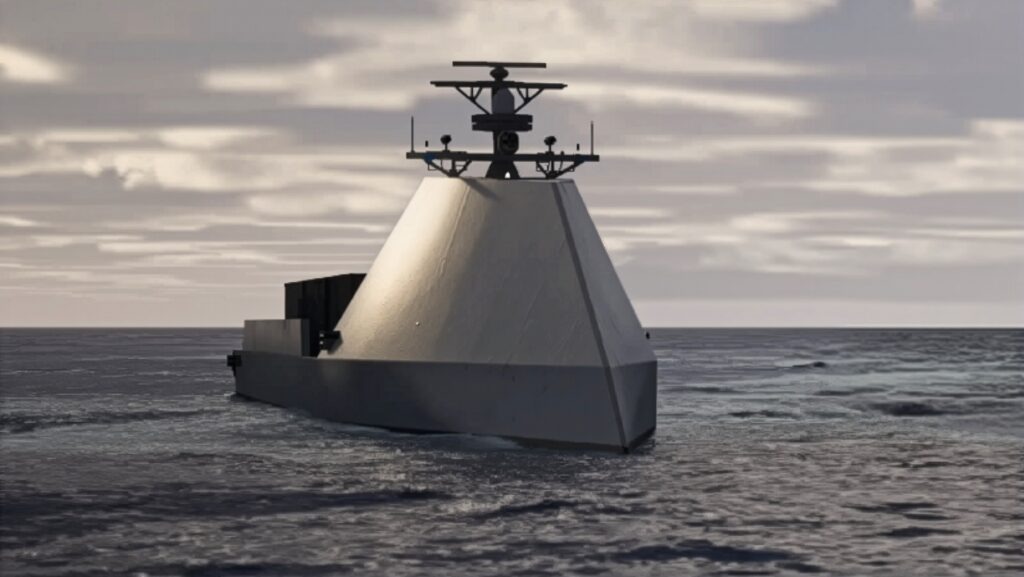
ROMULUS 190, the flagship of the ROMULUS family, is currently under construction. Built on a commercial-standard hull, it is engineered for rapid, repeatable production and immediate mission readiness. Designed for speeds exceeding 25 knots, the 190-foot vessel is capable of a minimum range of 2,500 nautical miles (nmi) carrying 4 x 40 foot ISO intermodal containers on the payload deck. ROMULUS 190 is being developed in partnership with Breaux Brothers, Beier Integrated Systems, and Incat Crowther.
ROMULUS is designed to meet the current and emerging requirements of the U.S. Navy, U.S. Marine Corps, joint forces, and allies. It delivers high-endurance, sustained open-ocean autonomy with a focus on lethality, cost efficiency, and scalability.
“The future fight demands speed, agility, and resilience, all embedded in the Odyssey-powered ROMULUS family,” said Chris Kastner, HII president and CEO. “By matching world-class shipbuilding with decades of unmanned systems expertise, we are delivering a mission-ready, swarm USV capability built for the next generation of operations.”
Odyssey: Proven, Open, and Evolving Odyssey ACS software suite has demonstrated performance on more than 35 USV platforms with over 6,000 operational hours in U.S. Navy, U.S. Marine Corps, U.S. Coast Guard, and international allied programs. Odyssey’s intuitive interface and enhanced, customizable features generate the required mission behaviors for greater lethality and survivability with simplified control of unmanned swarms across domains, making it a force multiplier for the modern fleet.
The software suite’s open-access, government-aligned architecture enables rapid integration of new sensors, payloads, and third-party autonomy technologies. It allows industry, government, and academia to test and refine capabilities, ensuring ROMULUS evolves in step with emerging naval concepts of operations.
ROMULUS integrates technologies from Shield AI, Applied Intuition, and C3 AI with HII’s Odyssey for enhanced autonomy, object classification, and lifecycle sustainment.
Multi-Mission, Multi-Domain Flexibility ROMULUS’s reconfigurable design supports teaming across surface, subsurface, and air domains for missions including counter-unmanned air systems (C-UAS), intelligence, surveillance and reconnaissance (ISR), strike operations, and the launch and recover of unmanned undersea vehicles (UUV) and unmanned aerial vehicles (UAV).
Enhanced-Domain Advantage with HII’s REMUS UUV Paired with HII’s proven REMUS UUVs, ROMULUS significantly extends undersea reach, closing anti-submarine warfare sensing gaps and keeping manned platforms at a safer standoff distance. REMUS’s decades-long track record in mine counter-measures (MCM) missions accelerates clearance operations and reduces fleet risk. Together, ROMULUS and REMUS deliver a scalable dual-domain solution across surface and subsurface missions.
Reinforcing HII’s Leadership With ROMULUS, HII reinforces its position as the global leader in durable, autonomous unmanned systems. Developed with support from HII’s Dark Sea Labs Advanced Technology Group, ROMULUS takes its place alongside the proven REMUS UUV line, of which more than 700 have been delivered to over 30 nations and more than 90% are still operational after more than two decades. Together, ROMULUS and REMUS, powered by HII’s Odyssey autonomy, form a dual-domain family of unmanned platforms that expands operational reach, maximizes mission flexibility, and ensures dependable performance across the full maritime spectrum.
Key ROMULUS Capabilities:
Modular, Open Architecture: Built on open standards, including Unmanned Maritime Autonomy Architecture (UMAA), Robot Operating System (ROS), and Data Distribution Service (DDS), Odyssey ensures compatibility with U.S. Navy autonomy requirements and control stations now and into the future. Odyssey’s modular architecture also allows for rapid reconfiguration and integration with modular payloads, new sensors and systems.
Multi-Agent Autonomy: Odyssey enables control of either individual assets or swarms, a key capability for enabling the future fight. Odyssey’s mission library delivers high-level autonomy with ease in executing rapid single-agent tasks or complex, multi-agent scenarios in coordination with crewed and unmanned platforms. Secure data management enables instant analytics or detailed post-mission review, while its modular design supports seamless integration of customer or third-party sensors, payloads, algorithms, and interfaces.
Intelligent Operations: Autonomous health monitoring, sensor fusion, and perception deliver intuitive mission planning, real-time situational awareness, and diagnostics. Navigation is compliant with the International Regulations for Preventing Collisions at Sea (COLREGS), ensuring operational reliability in all conditions.
Fleet Integration: Designed to align with future fleet Concepts of Operations (CONOPS), supporting unmanned and optionally manned missions and integrated operations with aircraft carrier strike groups and surface action groups.