X-Bow First to Deploy Lockheed Martin’s Secure AI for Rocket Production 
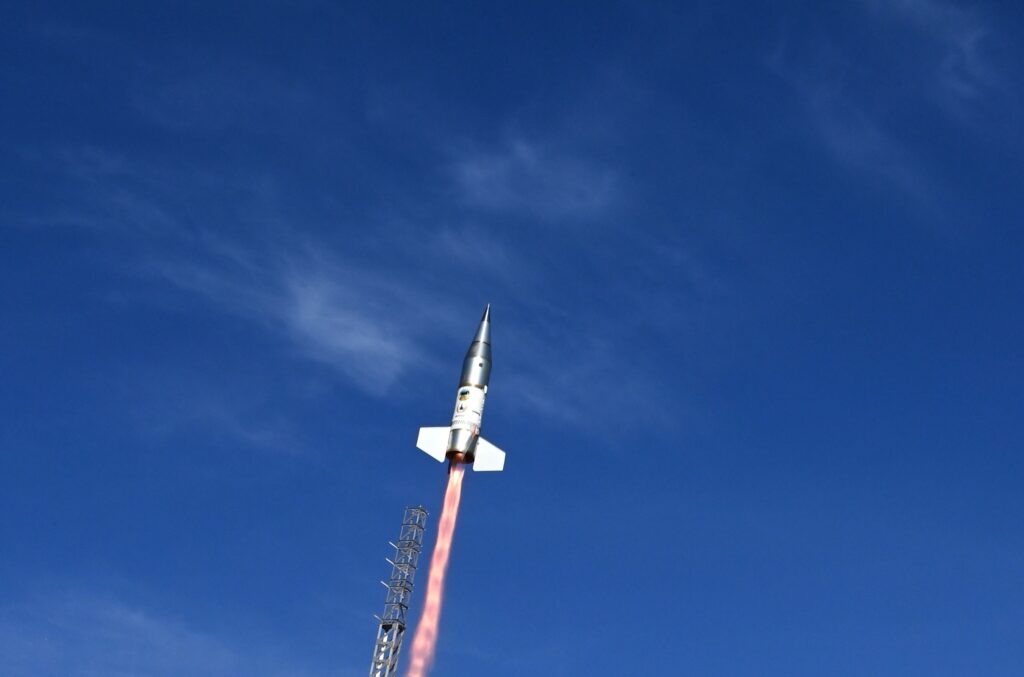
Launching SRMs at the speed of software. X-Bow is the first to deploy the Astris AI Factory (a Lockheed Martin Co. platform) to establish a Defense-Grade Digital Backbone. This accelerates manufacturing and delivers affordable capability.

Establishes Defense-Grade Digital Backbone to Accelerate Warfighter Capability 

Release From X-Bow Systems  

WASHINGTON, October 29, 2025 – X-Bow Systems Inc (X-Bow), the leading non-traditional producer of advanced manufactured solid rocket motors (SRMs) and defense technologies, announced today an agreement that establishes the company as the first customer to adopt defense-grade artificial intelligence (AI) capabilities within the Astris AI Factory, a secure, end-to-end AI platform from Astris AI, a Lockheed Martin company. 

This move is designed to accelerate X-Bow’s ability to meet urgent national security production demands by establishing a trusted digital backbone for its factory operations. 

Why It Matters: Faster, Affordable Rockets 

This is about applying defense-grade AI to X-Bow’s most sensitive, mission-critical functions—from secure data governance to factory control. This shift directly enables affordable and faster delivery of tactical rocket motors to the warfighter. 

·      Defense Focus: X-Bow is establishing an accredited digital environment with its first application being a secure AI agent. This initial governance step is critical to rapidly scaling affordable production for U.S. missile and hypersonics programs by proving the platform’s security for all proprietary Advanced Manufactured Solid Propellant (AMSP) processes. 

·      Security & IP: Using the Astris AI Factory, which is proven in classified environments, allows X-Bow to handle its core manufacturing IP with defense-grade security, ensuring data integrity from design to deployment. 

·      Manufacturing Control: The platform’s strategic operational focus is on advanced manufacturing control, leveraging Astris AI Factory’s generative AI and MLOps framework to free up engineering time and improve process control, enabling rapid, reliable iterations essential for defense production. 

·      Scale & Affordability: The agreement paves the way for X-Bow to rapidly extend this accredited platform across its manufacturing enterprise, enabling real-time production execution and higher throughput for tactical and large-scale rocket motors. 

The Tech Stack 

The platform integrates the latest AI enterprise software to operationalize sophisticated models. 

·      This framework allows X-Bow’s custom AI tools to securely retrieve and analyze proprietary technical data in real-time while drawing on multiple large language models for process optimization and digital twin fidelity. 

·      This architecture is designed to simplify and accelerate the accreditation process, a huge factor for defense suppliers operating on government programs. 

The Takeaway 

“This customer agreement dramatically improves our ability to secure the necessary accreditation to scale up manufacturing,” said Jason Hundley, Founder and CEO of X-Bow Systems. “This secure, accredited digital backbone is a game-changer for data governance and production integrity, allowing us to focus our engineering resources on delivering rapid, affordable solid rocket motors for our customers.” 

“This collaboration marks a defining moment in bringing trusted and reliable AI directly to mission-critical environments,” said James Droskoski, CRO, Astris AI. “By integrating the Astris AI Factory platform into X-Bow’s advanced manufacturing operations, we’re helping deliver a secure, data-driven foundation that accelerates production, strengthens supply chain resilience, and upholds the highest standards of national security. Together, we’re proving that AI can transform both speed and affordability for critical systems that protect our nation.” 


Lockheed Martin Invests $50M in Saildrone to Advance Unmanned Surface Vehicle Capabilities 

Lockheed Martin will rapidly equip Saildrone USVs with all-domain defense technology for lethal military applications. 

From Saildrone, Oct. 29, 2025 

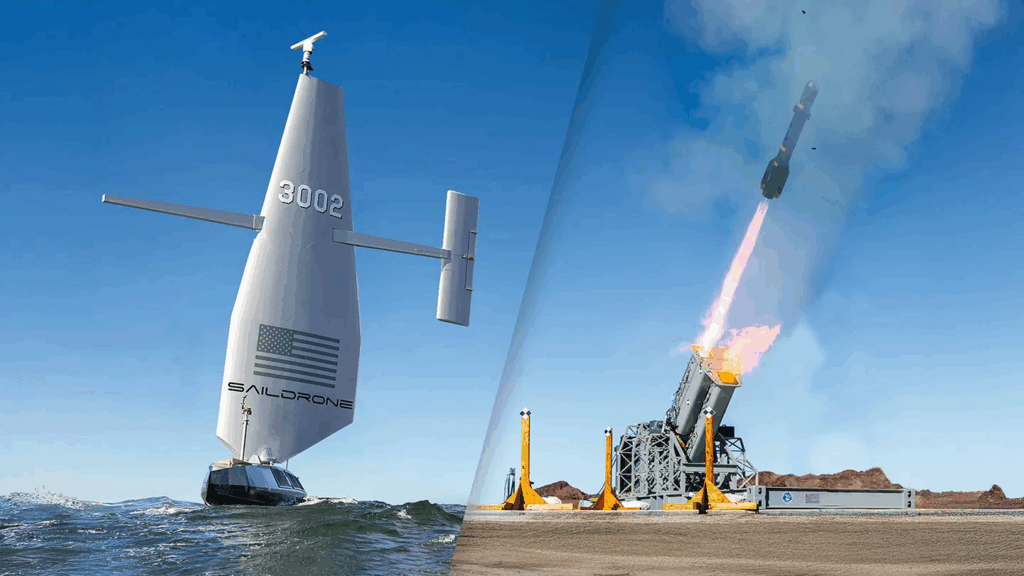
BETHESDA, Md. — Lockheed Martin (NYSE: LMT) today announced a $50 million investment in Saildrone, a global leader in maritime autonomous systems. This strategic collaboration will deliver commercially available unmanned surface vehicles (USV) equipped with lethal, combat-proven defense technology. The companies will collaborate with a goal of delivering integrations, including on-water, live fire demonstrations, in 2026. 

Why it matters 

This commercial relationship marries the world’s most sophisticated and trusted defense technology with the most capable and operationally tested USV technology. This combination will be key to realizing the US Navy’s USV vision for critical missions such as fleet defense, undersea surveillance, reconnaissance, and attack. Work will begin immediately, applying an open architecture approach along with secure command and control capability to integrate Lockheed Martin’s JAGM Quad Launcher (JQL) system onto the Saildrone Surveyor platform. 

Larger Saildrone vehicles are already in development to support significantly larger payloads and capabilities to include the Lockheed Martin Mk70 VLS launcher and thin line towed arrays. 

Expert perspectives 

Stephanie C. Hill, president, Rotary and Mission Systems, Lockheed Martin:  

“Lockheed Martin and Saildrone are leading the way to answer President Trump’s call for the defense industry to act differently and leverage the strength of all of industry for our national defense. Together, we are combining the most sophisticated commercial and defense technologies to deliver a lethal naval solution at speed and scale. The nation needs this capability to maintain dominance over our adversaries, and we will deliver it.”  

Richard Jenkins, founder and CEO, Saildrone: 

“For the last 10 years, we have focused on evolving the reliability, endurance, and autonomy of the Saildrone platform, which has been demonstrated in over 2 million nautical miles of active customer missions. With our technology proven, de-risked, and mission-ready, now is the right time to augment Saildrone USVs with sophisticated payloads to meet warfighter needs. This collaboration will give Saildrone the tools we need to transform the capabilities of our platforms, to include electronic warfare, anti-submarine warfare, sophisticated surveillance and reconnaissance, as well as deploying kinetic effects, all seamlessly integrated with Lockheed Martin’s trusted command, control, and fire control systems.” 

Additional Information 

Fast Fielding of Commercial Technology for Defense: Saildrone USVs have been accomplishing complex maritime missions in the remote ocean since 2013. First deployed by the U.S. Navy in 2021, they are currently operational today, working 24/7/365 alongside American Sailors in combat theaters around the world. This commercial relationship will harness Saildrone’s decade-plus of commercial expertise to quickly field new defense applications. Saildrone will maintain all shipbuilding responsibilities, and Lockheed Martin will serve as lead mission integrator. 

Investing Ahead of Need and Accelerating Capability: Lockheed Martin is investing in Saildrone to accelerate and de-risk deployment of urgently needed defense technologies. The investment will establish a collaborative relationship between Lockheed Martin and Saildrone systems integration teams to accelerate manufacture of new larger platforms and integrate Lockheed Martin payloads onto a variety of platforms. Lockheed Martin is also investing in its existing products to facilitate fully autonomous operations.  

Ready Now: The companies are focusing on integrating ready-now, proven capabilities with Saildrone USVs to get unmatched lethality into the hands of warfighters as soon as possible.  

Powering Economic Growth: Developing these transformational USVs will create jobs at Austal USA on the coast of the Gulf of America, where Saildrone’s larger systems are produced. However, this work is shipyard-agnostic; as we scale, it has the potential to power economic growth at all of America’s shipyards and across the wider maritime and defense industrial bases. 


Master Boat Builders Unveils State-of-the-Art Floating Dry Dock to Boost Throughput 

Master Boat Builders Unveils StateoftheArt Floating Dry Dock to Boost Throughput 

Conrad designed and built dry dock streamlines launches, increases throughput at Coden, and readies Master Boat for future government work 

CODEN, Ala. — October 29, 2025 — Master Boat Builders, Inc. (“Master Boat”) today announced it has taken delivery of a new, stateoftheart floating dry dock, giving the company direct control over launch schedules and accelerating vessel deliveries. 

Designed and built by Conrad Shipyard, the dry dock measures 155’ long x 66’ wide with 41’ tall wing walls, features a 2,000ton lifting capacity, and incorporates a barge bow to enable efficient towing. Master Boat will use the dock to launch recently constructed vessels. Previously, Master Boat rolled vessels onto a barge and towed them to third-party facilities in Alabama and Mississippi for launch – forcing Master Boat to be dependent on the availability and schedule of other yards. Now, Master Boat will have the ability to launch directly from its facility along the Theodore Industrial Canal, eliminating external constraints while improving reliability and cadence. 

“This is about improving our capacity, schedule certainty and cadence of delivery, especially as we begin to take on more work, especially government and defense programs,” said Garrett Rice, President of Master Boat Builders. “By modernizing how we launch and bringing that capability under our own roof, we’re now able to deliver critical vessels with greater predictability and certainty.” 

The new dry dock complements Master Boat’s recently announced strategic partnership with Austal USA. The two companies aim to strengthen the domestic maritime industrial base by increasing the ability of proven, regional shipyards to take on large, complex programs for the U.S. government. Under the MOU, the companies will collaborate on current programs under contract to Austal USA as well as on future efforts, enabling greater flexibility to meet evolving fleet requirements. By distributing work across complementary facilities, Austal USA and Master Boat aim to reduce bottlenecks, shorten production schedules, and create surge capacity for future demand. The companies also intend to co-invest in workforce development initiatives. 

“This is one more step in derisking schedules for our customers,” added Rice. “When we control launch windows on our term, we protect delivery momentum, reduce bottlenecks, and keep our focus where it belongs – building hardworking boats, on time.” 

Dry Dock at a Glance 

  • 155’ L × 66’ W × 41’ wing walls 

  • 2,000ton lifting capacity 

  • Barge bow for efficient towing 


Textron Aviation Defense Announces Wichita Production Plans for Beechcraft M-346N 

Advanced jet trainer program could bring major investment and jobs to Kansas 

From Textron Aviation Defense 

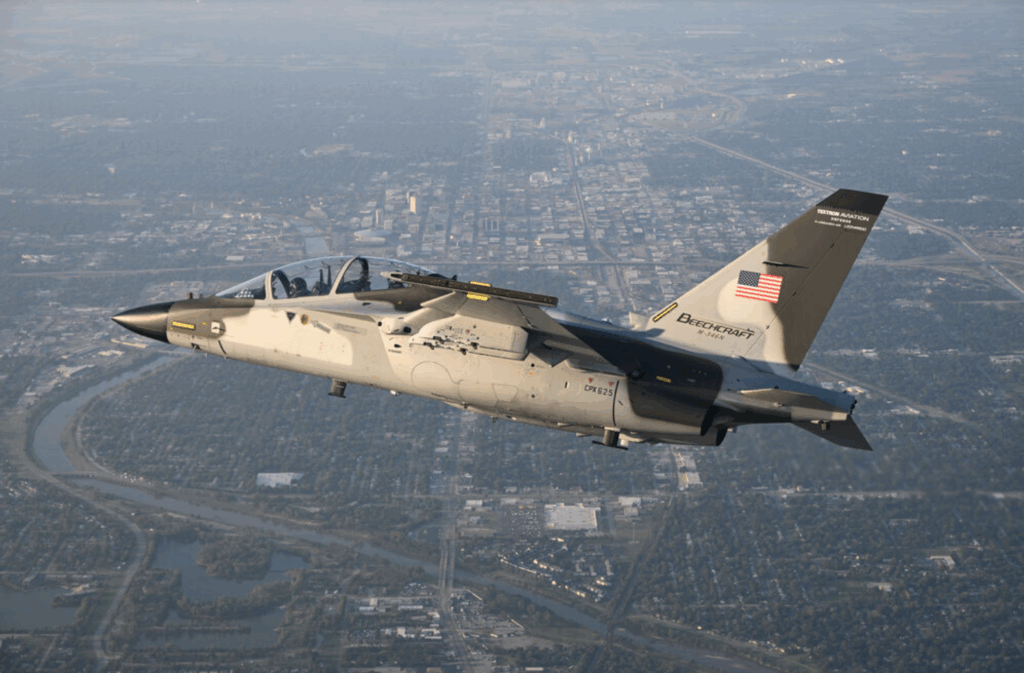
WICHITA, Kan. (Oct. 28, 2025) — Textron Aviation Defense LLC, a Textron Inc. (NYSE: TXT) company, today announced that if awarded the Undergraduate Jet Training System (UJTS) program contract by the U.S. Navy, it will assemble the Beechcraft M-346N at its east campus in Wichita, Kansas — the historic home of the Beechcraft brand for nearly a century. The announcement reinforces the company’s commitment to delivering the most advanced jet integrated training system for the U.S. Navy. 

Textron Aviation Defense expects to invest more than $38 million to modernize more than 50,000 square feet of existing manufacturing space on the company’s east Wichita campus if awarded the contract. The program is expected to create an estimated 100 direct manufacturing jobs in Wichita, along with numerous indirect jobs supporting aircraft production and assembly. 

 Wichita has long been the center of innovation for Beechcraft, and we’re proud to continue that tradition as we prepare to support the Navy’s next-generation training needs. This announcement underscores our 85-year legacy of supporting the U.S. government with training aircraft from the American heartland.Travis Tyler, president & CEO, Textron Aviation Defense 

The Beechcraft M-346N is the centerpiece of a low-risk, operationally proven integrated training system featuring Live-Virtual-Constructive capabilities optimized for advanced naval training. With more than 100 M-346 aircraft produced by Leonardo and a decade of performance training aviators for fourth- and fifth-generation aircraft, the M-346N offers a reliable, high-performance solution for the Navy’s next-generation training needs. 

The U.S. Navy has issued several Requests for Information ahead of an anticipated Request for Proposals for the UJTS program. Textron Aviation Defense anticipates the Navy will announce the contract award in January 2027 and believes that it is well-positioned to support the Navy’s objective of accelerating Initial Operational Capability (IOC). 

“Textron Aviation’s decision to assemble the Beechcraft M-346N in Wichita is a testament to the world-class aviation workforce present in Kansas,” said Sen. Jerry Moran, R-Kansas. “This aircraft is the right solution to meet the Navy’s future training requirements. I will continue my work on the Senate Defense Appropriations Subcommittee to make certain our Navy pilots have the necessary resources and equipment to support their mission. 

About the Beechcraft M-346N 

 The Beechcraft M-346N is a twin-engine, tandem-seat aircraft equipped with fully digital flight controls and avionics. It features a fly-by-wire flight control system with quadruple redundancy, a Head-Up Display and Large Area Display in each cockpit and hands-on throttle and stick (HOTAS) controls. Innovative safety features include the Automatic Ground Collision Avoidance System (Auto-GCAS). 

Powered by two Honeywell F124-GA-200 turbofan engines, the M-346N delivers a maximum cruise speed of more than 590 knots and a service ceiling of 45,000 feet. Its advanced aerodynamic design enables exceptional maneuverability and energy management, while the elevated rear cockpit provides instructors with excellent visibility throughout all phases of flight. 

Textron Aviation’s commitment to assembling the Beechcraft M-346N in Wichita is a testament to their rich heritage in the Air Capital of the World and their responsiveness to the needs of the United States Navy. As a steady defender of our aviation industry, I commend Textron’s leadership for investing in our skilled Kansas workforce and strengthening our military readiness.U.S. Congressman Ron Estes (Kansas) 


Navy Withdraws from Navy Museum Land Swap Agreement with DC

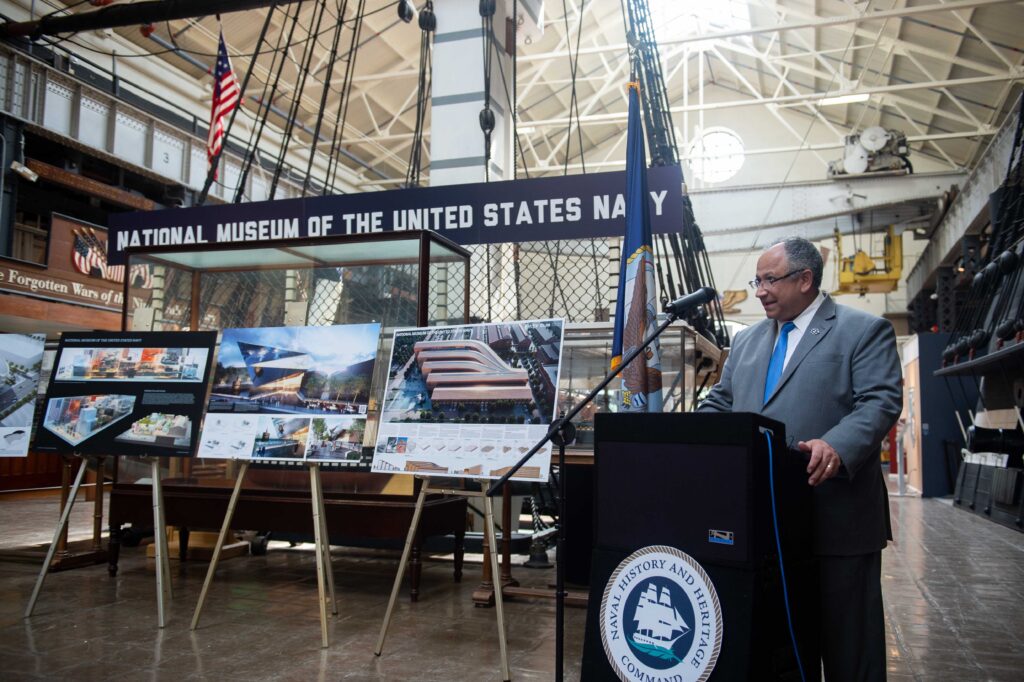
Then-Secretary of the Navy Carlos Del Toro unveiled conceptual renderings from five architecture firms at the National Museum of the U.S. Navy in April 2023. Photo credit: Naval History and Heritage Command

Secretary of the Navy John Phelan has withdrawn the service from a land swap with the District of Columbia that was to have created a home for a long-awaited new Museum of the United States Navy, the Navy’s Office of Legislative Affairs notified Congress.

“We want to notify you directly that, in consultation with the White House, the Secretary of the Navy has decided to strategically shift away from the leasing arrangement that contemplated private or mixed-use development of the O Parcel at the Washington Navy Yard in the interest of national security,” the OLA said in a statement provided to Seapower by the Naval History and Heritage Command.

“Given the sensitive work at the WNY, evolving national security threats, and a renewed focus on force protection, private development on the Washington Navy Yard property is not feasible from a national security perspective.

“This decision does not reflect a negative assessment of the land exchange, the developer [RedBrick], or the future National Museum of the Navy; instead, we are focused exclusively on the national security concerns of private development on the Washington Navy Yard. Please be assured we are committed to the future National Museum of the Navy.”

Former Navy Secretary Kenneth Braithwaite, now chair of the Navy Museum Development Foundation that is raising money for the new museum, first made the news public at a panel discussion at the Congress of the Naval Order of the United States in Philadelphia.

In a recent edition of the Tuesday Tidings newsletter of the National Maritime Historical Society, Braithwaite said the move means fundraising is on hold until a new site can be identified.

The location of the new museum was the subject of a press briefing last October, where then-Secretary of the Navy Carlos Del Toro and other officials, including Braithwaite, praised the location, which would have been near the Navy Yard as well as the Washington Nationals baseball stadium and the Audi Field soccer stadium.

Even had the site development continued there, it would have been a long time before anyone walked through the door. The foundation was charged with raising nearly half a billion dollars for the museum and the groundbreaking wouldn’t have been before 2030 at the earliest.


Kratos Forms Strategic Partnership with Korean Industry Leader to Advance Manned-Unmanned Teaming

Release From Kratos Defense & Security Solutions

SAN DIEGO, Oct. 27, 2025 (GLOBE NEWSWIRE) – Kratos Defense & Security Solutions, Inc. (Nasdaq: KTOS), a leading technology company in the defense, national security, and global markets, today announced the formation of a strategic partnership with Korea Aerospace Industries (KAI), a major Korean defense organization to advance Manned-Unmanned Teaming (MUM-T) technologies and capabilities. 

The collaboration builds on Kratos’ deep experience in affordable, high-performance tactical unmanned aerial systems—including the XQ-58A Valkyrie, Mako, and Tactical Firejet—and KAI’s aerospace technologies. Together, the organizations will work to integrate complementary systems and expertise to accelerate the development of interoperable, next-generation MUM-T solutions that enhance joint force readiness and operational flexibility. 

“This partnership represents the next step in evolving how crewed and uncrewed aircraft operate together in contested environments,” said Steve Fendley, President of Kratos’ Unmanned Systems Division. “By combining Kratos’ proven autonomous jet systems with KAI’s advanced technologies, we are expanding the boundaries of affordable mass and collaborative combat capability for U.S. and allied forces.” 

“Kratos has long believed that strategic international partnerships are key to ensuring readiness and deterrence through innovation,” said Eric DeMarco, President and CEO of Kratos. “Our collaboration with KAI, a world-class Korean organization, underscores our shared commitment to developing advanced, interoperable defense technologies that strengthen allied capability, resilience, and industrial cooperation.” 

The strategic partnership will focus on joint research, system integration, and evolution of scalable MUM-T applications, including autonomous loyal wingmen, distributed sensing, and collaborative strike missions, all focused on affordable mass. Kratos and KAI will also evaluate opportunities for technology co-development, production, and export in alignment with U.S. and allied defense requirements. 


Axon Vision Receives 1st Major Order for EdgeUAV System

From Axon Vision, Oct. 27, 2025 

Axon Vision, a leading provider of artificial intelligence (AI) solutions for defense applications, has secured a contract valued at approximately 2 million NIS from a leading loitering munitions manufacturer. Under the agreement, the company will supply its EdgeUAV system: an AI-powered solution for target acquisition, selective tracking, and precision guidance of unmanned aerial platforms such as drones, UAVs, and loitering munitions. The system supports full mission execution, from initial detection to accurate target engagement. 

The order follows a successful system integration process and will be delivered as software licenses for each platform. Deliveries are scheduled in phases and are due to be completed by January 2026. This is the first significant order of its kind for the EdgeUAV system in a license-based configuration, marking a key milestone for Axon Vision. It reflects the growing demand for AI-enhanced capabilities in the precision weapons domain and signals Axon Vision’s continued growth in the unmanned systems market. 

The EdgeUAV system features a real-time AI video processing engine that provides automatic target recognition (ATR), static & dynamic object tracking, multi-object tracking, and environment semantic segmentation. The system allows full multi-spectral support enabling day & night operation. Its modular and flexible architecture allows seamless integration with existing sensors and platforms, bringing next-generation performance to current systems. Moreover, the system’s ease of use is a key factor in enabling large-scale operational deployment of such munitions. 

Axon Vision’s AI technologies are becoming a core component of advanced weapon systems, enabling autonomous operation in complex environments and supporting a wide range of battlefield missions and border protection scenarios. Integrating the AI-based EdgeUAV into precision-guided munitions represents a significant advancement. This breakthrough will shorten the sensor-to-shooter cycles, reduce system costs through optimized sensor utilization and unlock new operational concepts such as swarms and coordinated or collaborative multi-platform missions. 

“Loitering munitions are playing an increasingly central role on the modern battlefield,” said Brig. Gen. (res.) Roy Riftin, CEO of Axon Vision. “Integrating AI into these systems is a game-changer – enabling faster, more precise and more autonomous operations across diverse scenarios. This order underscores the maturity of our technology and the trust our partners place in its operational value.” 


HII Successfully Completes Second Builder’s Sea Trials for Destroyer Ted Stevens (DDG 128) 

From HII, Oct. 24, 2025 

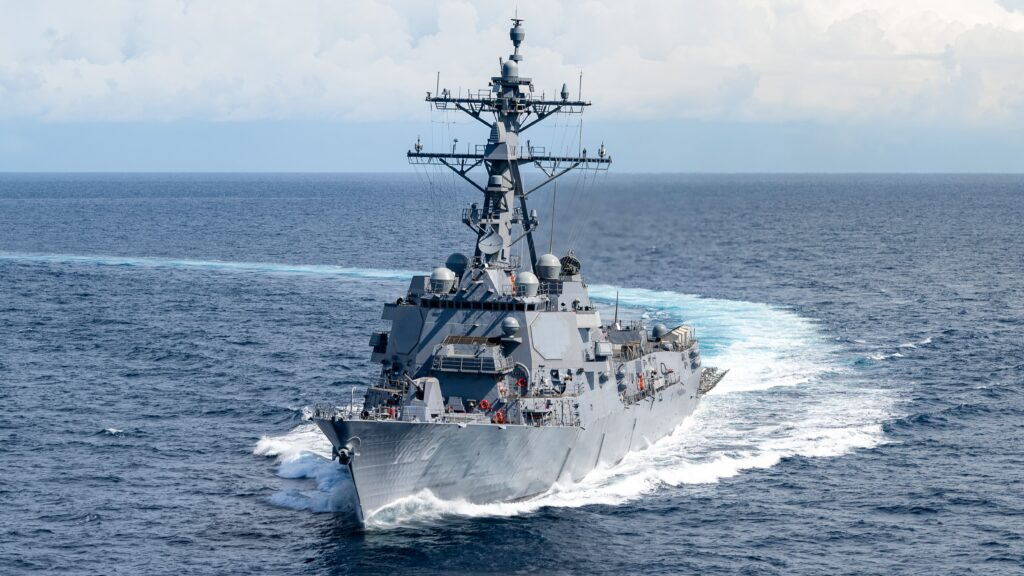
PASCAGOULA, Miss., Oct. 24, 2025 (GLOBE NEWSWIRE) — HII’s (NYSE: HII) Ingalls Shipbuilding division successfully completed the second builder’s sea trials for guided missile destroyer Ted Stevens (DDG 128), building on the success of the initial trials conducted at the end of September. The Arleigh Burke-class (DDG 51) destroyer spent multiple days in the Gulf of America testing the ship’s main propulsion, combat systems and other critical systems in preparation for the future acceptance trials. 

“The Ingalls and Navy team demonstrated tremendous teamwork during this trial and are fully committed to delivering DDG 128 to the fleet,” Ingalls Shipbuilding DDG Program Manager Ben Barnett said. “As we move forward, our focus remains on ensuring that every system is thoroughly tested and fully operational as we progress toward readiness for acceptance trials. I extend my gratitude to our test and trials team for their contributions to the ongoing success of the destroyer program.” 

During the second builder’s trials, the Ingalls and Navy team completed additional hull, mechanical, electrical and combat systems tests. This included testing the second-in-class Flight III AN/SPY-6 (V)1 radar system and the Aegis Baseline 10 combat system. These tests are designed to validate critical system performance and ensure the ship meets or exceeds Navy requirements. 

Flight III Arleigh Burke-class destroyers represent the next generation of surface combatants for the U.S. Navy and incorporate a number of design modifications that collectively provide significantly enhanced capability. To date, Ingalls has delivered 35 Arleigh Burke-class destroyers to the U.S. Navy, including the first Flight III, USS Jack H. Lucas (DDG 125) and currently has five more Flight III destroyers under construction: Ted Stevens (DDG 128), Jeremiah Denton (DDG 129), George M. Neal (DDG 131), Sam Nunn (DDG 133), and Thad Cochran (DDG 135), which authenticated the ship’s keel on Oct. 23. 

As the largest manufacturing employer in Mississippi, Ingalls Shipbuilding has been designing, building, and maintaining destroyers for the U.S. Navy for over 86 years. To learn more about the DDG 51 Arleigh Burke-class destroyer program at Ingalls work visit: https://hii.com/what-we-do/capabilities/guided-missile-destroyers/arleigh-burke-class/


U.S., Indian Navies Conduct Bilateral Training Near Diego Garcia 

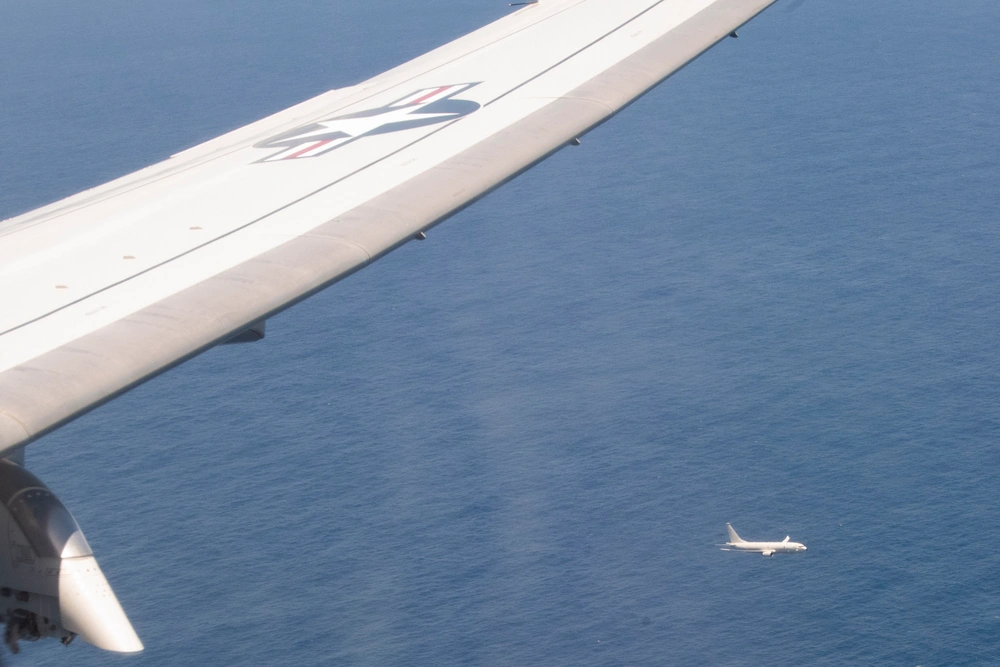
INDIAN OCEAN (Oct. 23, 2025) An Indian Navy multi-mission maritime patrol and reconnaissance aircraft P-8I Poseidon, attached to the “Condors” of Indian Navy Air Squadron 316, flies alongside a U.S. Navy P-8A Poseidon, attached to “The Skinny Dragons” of Patrol Squadron (VP) 4, as part of a bilateral combined detachment operating in the Indian Ocean, Oct. 23, 2025. (U.S. Navy photo by MC2 Isaac Rodriguez)  

From Commander, U.S. 7th Fleet, Oct. 27,2025    

DIEGO GARCIA, BRITISH INDIAN OCEAN TERRITORY — A multi-mission maritime patrol and reconnaissance aircraft (MPRA) P-8A Poseidon from Commander, Task Force (CTF) 72 joined an Indian Navy MPRA P-8I for a bilateral combined detachment and training in vicinity of Diego Garcia and the Indian Ocean, Oct. 22-28, 2025. 
 
The combined detachment saw both aircraft conduct bilateral trainings focused on antisubmarine warfare and maritime domain awareness to strengthen and refine the interoperability between the U.S. and Indian Navies. The training builds on prior interoperability exercises such as Tiger Triumph 2025, where the U.S. and Indian armed forces incorporated satellite and unmanned technologies to enhance joint communication and warfighting capabilities. The U.S.-India strategic partnership is founded on shared values including a commitment to democracy and upholding security, freedom, and prosperity. 
 
“Our P-8A crews were proud to fly alongside our Indian partners in this combined detachment,” said Capt. Rodney Erler, commodore of CTF 72. “Maritime domain awareness, which the global network of P-8 aircraft contribute to, is a critical aspect of identifying threats, traditional and non-traditional, that could threaten the stability and security in the region. By working with our allies and partners, we increase our shared maritime awareness to ensure a free and open Indo-Pacific.” 
 
After the arrival of the P-8I to Diego Garcia, the U.S. and Indian crews worked together on operational planning for the exercises to set the groundwork for increased enhanced information sharing, and cooperation at sea. This shore phase was concluded by a combined flight and bilateral anti-submarine and communication exercise. 
 
Patrol Squadron (VP) 4 is assigned to CTF 72, the command and control headquarters for Maritime Patrol and Reconnaissance Aircraft in U.S. 7th Fleet, promoting regional security and enhancement of theater security operations through multilateral engagements and providing reconnaissance and surveillance capabilities. 
 
U.S. 7th Fleet is the U.S. Navy’s largest forward-deployed numbered fleet and routinely interacts and operates with allies and partners in preserving a free and open Indo-Pacific region. 


Coast Guard Conducts Post-Storm Assessments, Cleanup Operations in Western Alaska 

From U.S. Coast Guard Arctic District, Oct. 24, 2025 

ANCHORAGE, Alaska – The Coast Guard is conducting post-storm assessments and cleanup operations in Western Alaska where communities have been impacted by severe flooding from Ex-Typhoon Halong. 

“The Coast Guard continues to support local, state and federal disaster recovery efforts by conducting pollution response operations in impacted communities,” said Capt. Christopher Culpepper, commander, U.S. Coast Guard Sector Western Alaska and U.S. Arctic. “We understand how essential the local ecology is for communities that depend on critical subsistence hunting and fishing activity. We are working to mitigate environmental impacts to preserve the communities’ food source and future viability.” 

Personnel from U.S. Coast Guard Sector Western Alaska and U.S. Arctic deployed to affected areas to identify pollution concerns and work with state, federal, and industry partners to conduct clean-up operations. Response teams have conducted pollution and damage assessments in Kipnuk, Bethel, Quinhagak, Hooper Bay, Nome, St. Michael, Tuntutuliak and Nightmute. Crews are also scheduled to conduct damage and pollution assessments in Kwigillingok, Napakiak, Napaskiak, Oscarville and Kongiginak. 

Coast Guard Cutter Aspen (WLB 208) deployed to the Yukon-Kuskokwim River Delta on Oct. 14 to determine potential hazards posed by storm damage and lingering debris and conduct repairs to impacted maritime navigation aids. 

The Coast Guard activated the Oil Spill Liability Trust Fund on Oct. 12 and contracted Resolve Marine Group to conduct cleanup operations in Nightmute. To date, Resolve crews have recovered a total of 724 gallons of petroleum product from various sources in Nightmute. 

On Oct. 23rd, the Coast Guard contracted Alaska Chadux Network to conduct cleanup operations in Kipnuk. They plan to begin operations on Oct. 25th, focusing on securing potential pollutions sources and mitigating any spilled products they find.