Coast Guard Cutter Hollyhock Returns to Honolulu After First Operation Blue Pacific Patrol
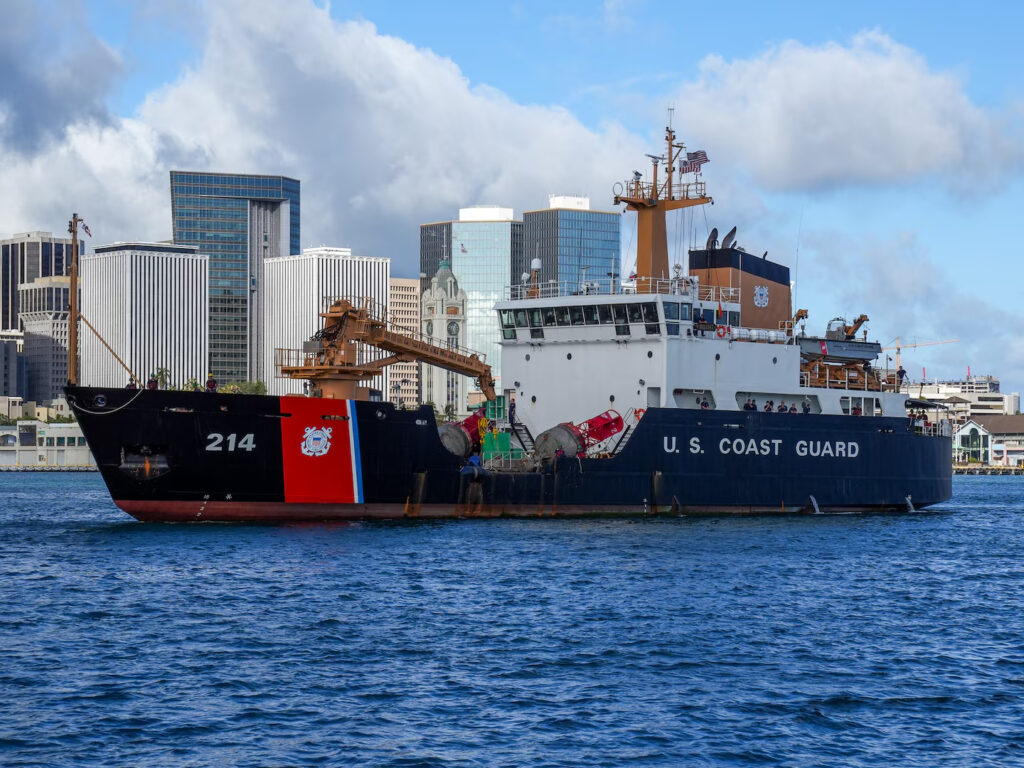
 USCGC Hollyhock (WLB 214) returns after completing their first Operation Blue Pacific patrol at Coast Guard Base Honolulu, Hawaii, June 7, 2026. The Hollyhock crew departed Honolulu in April and traveled more than 7,500 nautical miles over 42 days. (U.S. Coast Guard photo by Petty Officer 3rd Class Jennifer Nilson) 

From U.S. Coast Guard Oceania District External Affairs, June 8, 2026 

HONOLULU – The crew of USCGC Hollyhock (WLB 214) returned to Honolulu Sunday after completing their first Operation Blue Pacific patrol.  

The Hollyhock crew departed Honolulu in April and traveled more than 7,500 nautical miles over 42 days, making port calls in Pago Pago, American Samoa, Nuku’alofa, Tonga, Vava’u, Tonga, and Kiritimati, Kiribati.  

From May 15-18, the crew exercised a bilateral maritime law enforcement agreement by assisting Tongan Royal Navy officers with law enforcement operations in Tonga’s exclusive economic zone. During two commercial fishing vessel boardings, Hollyhock crew members assisted Tongan Royal Navy officers with conducting safety checks, reviewing documentation, inspecting gear and verifying catch.  

While visiting Nuku’alofa, the crew hosted public tours aboard the cutter for over 170 students and community members, participated in a beach clean-up at American Wharf, and conducted law enforcement tabletop exercises with the Tongan Royal Navy. During their port call in Vava’u, Tonga, the crew hosted an engagement with Penisimani Vainikolo, acting governor of Vava’u, and representatives from the Ministry of Internal Affairs, Ministry of Revenue & Customs, Tonga Tourism Authority, Tonga Police, and His Majesty’s Armed Forces.  

The crew serviced 16 navigational aids in Pago Pago, American Samoa, and harbors on the islands of Ta’u and Ofu, performing maintenance and repairs on six buoys, three lights, one day beacon, and three navigation ranges. During their port call in Pago Pago, the crew also volunteered at a beach clean-up at Lions Park in Tafuna, American Samoa, and toured the National Oceanic and Atmospheric Administration Baseline Observatory in Tula, American Samoa.  

In addition, the Hollyhock crew transported National Oceanic and Atmospheric Administration and U.S. Geological Survey personnel to Kanton Island in Kiribati and assisted with the repair of a tsunami warning station, the first such maintenance performed on the station in over 10 years.  

“Throughout this patrol, the Hollyhock crew demonstrated versatility and professionalism while carrying out a diverse set of missions,” said Cmdr. Jessica McCollum, commanding officer of the Hollyhock. “From maintaining crucial navigational aids in American Samoa to conducting bilateral operations with our Tongan partners, our crew strengthened maritime safety, security and U.S. presence in the region.”   

Operation Blue Pacific is an overarching multi-mission Coast Guard endeavor to promote security, safety, sovereignty and economic prosperity in Oceania. Coast Guard cutters, aircrew and personnel deploy throughout Oceania to maintain unrestricted, lawful access to the maritime domain for all nations, improve regional stability, and solidify the Coast Guard as a reliable partner for maritime safety, security and stewardship in the Pacific.   

The Hollyhock, a 225-foot seagoing buoy tender with a 50-person crew, was the fourteenth of 16 vessels built in the Juniper Class series. Originally homeported in Port Huron, Michigan, the cutter shifted homeport to Honolulu in October 2025. The Hollyhock is responsible for maintaining vital navigation aids throughout the Hawaiian Islands, Midway, American Samoa, and broader Oceania region. When deployed in support of Operation Blue Pacific, the Hollyhock’s presence and unique authorities reinforce security and stability in Oceania and along the U.S. maritime border of American Samoa.  


HII Partner Bayou Metals Launches Dedicated Manufacturing Line to Speed Romulus USV Production 

SLIDELL, La. — HII, America’s largest military shipbuilder and a global leader in autonomous maritime systems, today announced that Bayou Metal Supply & Manufacturing, a strategic partner in the serial production of HII’s Romulus unmanned surface vessels (USVs), has launched a dedicated manufacturing line to support accelerated construction of the platform. 

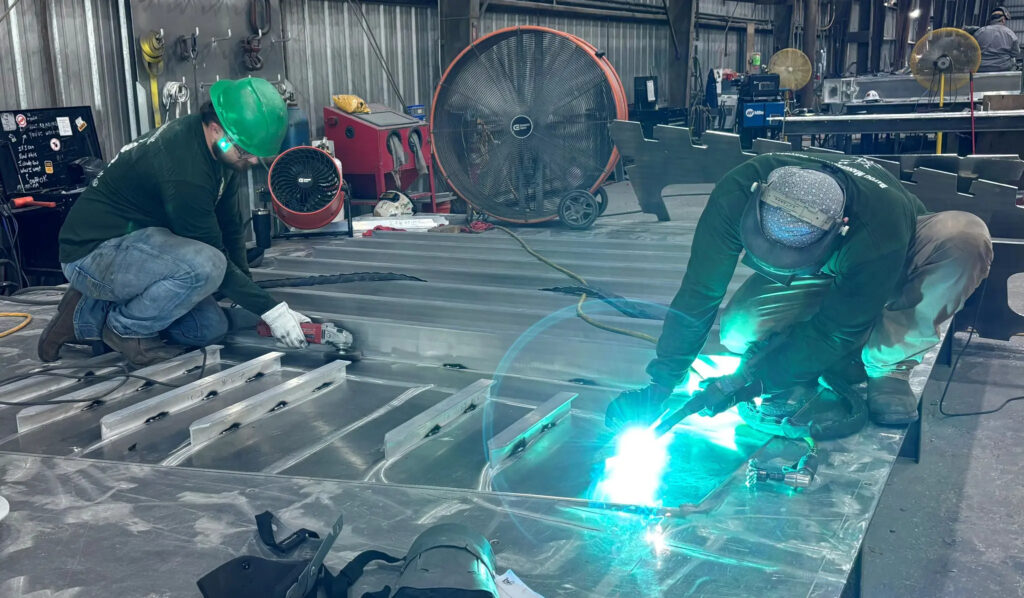
The new production line, located in Slidell, Louisiana, provides precision cutting, bending, welding, and assembly of major structural components into complete assembly units ready for shipment to Breaux Brothers Enterprises for final integration into the Romulus USV platform. 

Bayou Metals is playing a critical role on HII’s Romulus USV shipbuilding team as a strategic aluminum supply and fabrication partner. The company is providing marine-grade aluminum while establishing dedicated manufacturing capacity to meet the Romulus USV production schedule. 

“As we move from prototype to production, partnerships like Bayou Metals are essential to delivering capability at speed and scale,” said Andy Green, executive vice president of HII and president of HII’s Mission Technologies division. “Their ability to combine material supply with advanced fabrication strengthens our production model, reduces risk, and accelerates delivery the Romulus USV to the fleet.” 

William Stout, chief executive officer of Bayou Metal stated, “Bayou Metal is proud to continue its longstanding relationship with and support of industry leaders such as HII and Breaux Brothers. We remain committed to providing world-class service, quality materials, and trusted partnerships to the marine and shipbuilding sectors for years to come.” 

HII’s integrated coordination with Bayou Metals and other manufacturing partners ensures avoiding delays in securing materials and building parts. It also makes production more efficient by completing most of the setup work before final assembly at the shipyard. This model enhances throughput and supports faster, more repeatable serial production of Romulus vessels across multiple shipyards. 

In addition to improving manufacturing performance, the effort supports expansion of the U.S. shipbuilding industrial base by growing Gulf Coast manufacturing capacity and building a larger skilled workforce. 

HII recently announced plans for the production of four Romulus 151 vessels to be built by Breaux Brothers Enterprises in Louisiana, in addition to the vessel currently under construction. The announcement signals a rapid transition to initial production as HII accelerates delivery of autonomous surface capability to the U.S. Navy and allied partners. 

“Romulus represents a shift in how we deliver unmanned capability to the fleet,” Green said. “We are combining shipbuilding experience, scalable manufacturing, proven autonomy, and strong industry partnerships to move quickly from prototype to operational deployment.” 

Romulus USV: Built for Scale and Mission Flexibility 

Romulus is a modular family of AI-enabled USVs designed to support a wide range of missions, including intelligence, surveillance and reconnaissance (ISR), mine countermeasures, strike operations, counter-unmanned systems, and the launch and recovery of unmanned underwater and aerial vehicles. 

Engineered for serial, repeatable production, the platform combines endurance, global reach, and modular adaptability, enabling scalability across multiple vessel sizes while maintaining a common manufacturing and autonomy baseline. 


Secretary of War Announces Flag Officer Nominations 

From the Department of War, June 8, 2026 

Secretary of War Pete Hegseth announced today that the president has made the following nominations: 

Navy Vice Adm. Christopher S. Gray for reappointment to the grade of vice admiral, with assignment as deputy chief of Naval Operations for Sustainment, N4, Office of the Chief of Naval Operations/commander, Navy Sustainment, Pentagon, Washington, D.C. Gray is currently serving as commander, Navy Installations Command, Washington Navy Yard, Washington, D.C. 

Navy Rear Adm. Brad J. Collins for appointment to the grade of vice admiral, with assignment as commander, Navy Installations Command, Washington Navy Yard, Washington, D.C. Collins is currently serving as commander, Navy Region Hawaii, Joint Base Pearl Harbor-Hickam, Hawaii. 

Navy Rear Adm. Marc J. Miguez, for appointment to the grade of vice admiral, with assignment as commander, Third Fleet, San Diego, California. Miguez most recently served as Navy chief of Legislative Affairs, Pentagon, Washington, D.C. 

Navy Rear Adm. Paul C. Spedero, Jr., for appointment to the grade of vice admiral, with assignment as director, Joint Staff, Pentagon, Washington, D.C. Spedero is currently serving as vice director, Joint Staff, Pentagon, Washington, D.C. 

Navy Captain Patrick W. Finney for appointment to the grade of rear admiral (lower half). Finney is currently serving as Submarine Force Reserve Component director, Commander, Submarine Force Atlantic, Norfolk, Virginia. 

Navy Captain Robert C. Gerstemeier for appointment to the grade of rear admiral (lower half). Gerstemeier is currently serving as commanding officer, Navy Reserve, Commander, Navy Installations Command, Washington Navy Yard, Washington, D.C. 

Navy Captain Harold M. Kim for appointment to the grade of rear admiral (lower half). Kim is currently serving as commanding officer, Navy Reserve, Commander, U.S. Pacific Fleet Operations, Plans and Policy, Pearl Harbor, Hawaii. 

Navy Captain Andrew R. Needles for appointment to the grade of rear admiral (lower half). Needles is currently serving as Reserve chief of staff, Commander, Naval Forces Europe and Africa, Naples, Italy. 

Navy Captain Sara J. Taylor for appointment to the grade of rear admiral (lower half). Taylor is currently serving as commanding officer, Naval Reserve Headquarters, Commander, Naval Forces Europe and Africa, Naples, Italy. 


U.S. Army Crew Safely Rescued After Helicopter Lost at Sea

From U.S. Central Command, June 9, 2026 

TAMPA, Fla. — At 7:33 p.m. ET on June 8, two crew members from a U.S. Army AH-64 Apache were rescued by American forces after their helicopter went down near the coast of Oman while patrolling regional waters. 

The Soldiers were safely rescued within approximately two hours and are in stable condition. The cause of the incident is under investigation. 

Rescue efforts were led by U.S. Naval Forces Central Command and the 82nd Airborne Division, with support from U.S. Air Force and Navy units including U.S. 5th Fleet’s Task Force 59. 


General Dynamics NASSCO Christens the USNS Thurgood Marshall, the Seventh in the T-AO Program

From General Dynamics NASSCO, June 4, 2026 

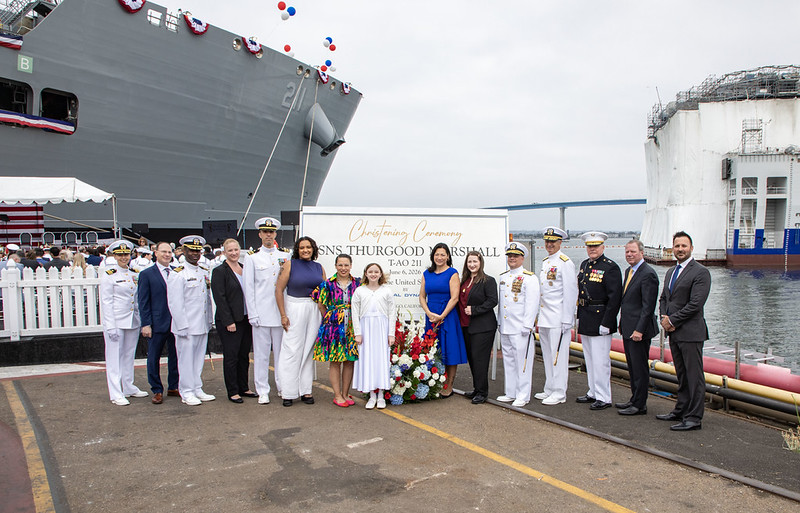
SAN DIEGO– General Dynamics NASSCO has christened and launched the USNS Thurgood Marshall (T-AO 211), the seventh ship in the fleet oiler program built for the U.S. Navy. The ship is named in honor of Thurgood Marshall, the first African American appointed to the U.S. Supreme Court, serving from 1967 to 1991. He was a prominent civil rights lawyer who argued and won the landmark Brown v. Board of Education case, which helped end racial segregation in public schools. 

Maj. Gen. David Bligh, Judge Advocate General of the Navy, representing the Secretary of the Navy, served as the principal speaker at the ceremony. 

“The General Dynamics NASSCO team has been a strong partner of our forces for decades, particularly in the design and construction of our Naval auxiliary ships,” said Bligh. “There is a vital link between our defense industrial base and the effectiveness of our fighting men and women around the world.” 

Remarks were also delivered by NASSCO President Dave Carver and representatives of the Navy. Following the remarks, ship co-sponsors Melonie Tibbs, Cecilia L. Marshall, and Alissa Kamens Marshall christened the vessel with the traditional champagne bottle break across the hull. 

“What we christen tonight is not just a ship — it’s the embodiment of American unity that will carry Thurgood Marshall’s legacy, and the legacy of America, all over the world,” said Carver. “His name on the hull of this ship reminds us that service takes many forms — and that truth, courage, and conviction must always guide our mission.” 

Fleet oilers serve as a supply lifeline for U.S. Navy vessels carrying out missions across the globe, including in the Western Pacific, Indian Ocean, and beyond. Crafted for underway replenishment, the oilers transfer fuel, lubricants, fresh water, and small amounts of dry cargo as part of the Navy’s combat logistics force. NASSCO designs all new vessels with double hulls to protect against oil spills and to enhance the durability of cargo and ballast tanks. The vessels measure 746 feet long, with a full load displacement of 49,850 tons. Each can carry 157,000 barrels of oil, along with significant dry cargo and aviation capability, and can reach a top speed of 20 knots. 

“To the men and women of General Dynamics NASSCO, your work directly contributes to this nation’s security,” said Vice Adm. Douglas Verissimo, representing the Chief of Naval Operations. “Your professionalism matters. You have not simply constructed a vessel — you have delivered operational capability and I truly thank you.” 

The first five ships in the class — USNS John Lewis (T-AO 205), USNS Harvey Milk (T-AO 206), USNS Earl Warren (T-AO 207), USNS Robert F. Kennedy (T-AO 208), and USNS Lucy Stone (T-AO 209) — have all been delivered to the Navy. The USNS Sojourner Truth (T-AO 210) recently completed successful sea trials and is set to be delivered on Tuesday, June 9, 2026. The USNS Thurgood Marshall (T-AO 211), USNS Ruth Bader Ginsburg (T-AO 212), USNS Harriet Tubman (T-AO 213) and USNS Dolores Huerta (T-AO 214) are currently under construction. 


U.S. Forces Disable Non-Compliant Oil Tanker in Gulf of Oman 

From U.S. Central Command, June 8, 2026 

TAMPA, Fla. — U.S. forces disabled an unladen oil tanker in the Gulf of Oman, June 8, after the vessel violated the ongoing blockade against Iran by attempting to sail to an Iranian port. 

U.S. Central Command (CENTCOM) disabled Palau-flagged M/T Marivex as it transited international waters in the Gulf of Oman toward Iran. An F/A-18 Super Hornet from USS Abraham Lincoln (CVN 72) fired a precision munition into the ship’s engineering and steering spaces after the crew failed to comply with directions from U.S. forces. Marivex is no longer sailing to Iran. 

CENTCOM forces have disabled seven non-compliant vessels, redirected 134 ships that complied, and allowed 42 vessels supporting humanitarian aid to pass since initiating the blockade on April 13.


Astrion Selected by U.S. Navy to Build, Integrate, and Sustain Maritime Autonomous Systems 

The hybrid fleet takes shape 

From Asttrion, June 2, 2026  

HUNTSVILLE, Ala., June 02, 2026 (GLOBE NEWSWIRE) — Astrion, a defense technology company building the integration and orchestration layer for modern warfare, has been selected as one of nine awardees on a $349.4 million indefinite-delivery/indefinite-quantity (IDIQ) contract awarded by Naval Information Warfare Center (NIWC) Pacific. The contract supports the development, integration, and sustainment of unmanned maritime systems through May 2034. 

The award reflects the growing importance of autonomous systems across the maritime environment and the increasing demand for mission-ready systems integration, testing, and sustainment capabilities. Through this contract, Astrion will provide technical solutions for the full lifecycle of unmanned maritime systems, from specification, design, and integration through testing, fielding, operations, and sustainment. 

“Robotic warfare is the future of armed conflict — on land, at sea, and in the air. Victory comes from the orchestration of multi-vendor autonomous systems into a force that fights as one,” said Tom Vice, chairman and CEO, Astrion. “The Navy is expanding the number, type, and tempo of autonomous systems faster than at any point in its history, and the harder problem is no longer building the platforms. It is orchestrating them. Astrion operates and maintains the Navy’s two Medium Displacement Unmanned Surface Vessels (MDUSVs) at sea today, and we bring the systems integration, test, and sustainment discipline that turns autonomous platforms into deployable combat capability. We are built for this work.” 

Astrion brings established experience in supporting the U.S. Navy’s unmanned maritime system initiatives, including the MDUSV program, which develops and deploys long-endurance unmanned surface vessels like Seahawk and Sea Hunter to demonstrate new technologies and support distributed maritime operations. 

Astrion’s work spans integration, test and evaluation, and sustainment of complex autonomous platforms in multi-vendor, government-owned environments. Astrion is known for delivering measurable improvements in maritime systems reliability, mission readiness, and lifecycle cost efficiency. Its experience and capabilities are critical to the efficient and affordable adoption of unmanned systems across the Navy. 


SIMA San Diego Reestablished to Drive Fleet Self-Sufficiency and Warfighter Readiness 

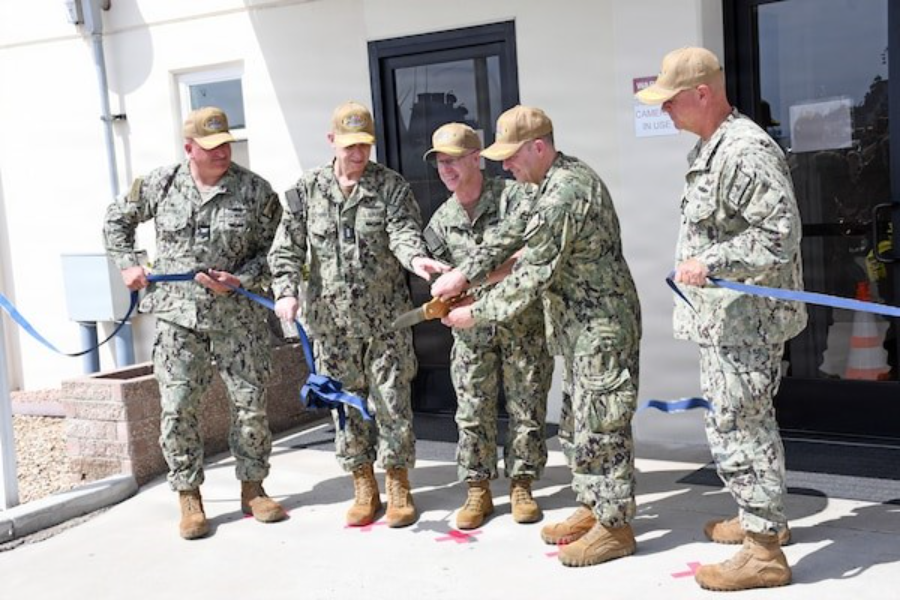
SAN DIEGO (June 4, 2026) From left to right, Capt. Brian Karosich, commanding officer of Southwest Regional Maintenance Center; Vice Adm. James Downey, commanding officer, Navy Sea Systems Command; Chief of Naval Operations Adm. Daryl Caudle; Capt. Bill Albert, commanding officer of Shore Intermediate Maintenance Activity (SIMA) San Diego; and Vice Adm. Brendan McLane, commander, Naval Surface Force, U.S. Pacific Fleet, cuts the ceremonial ribbon signifying the reestablishment of Shore Intermediate Maintenance Activity (SIMA), San Diego. The Navy reestablished SIMAs in San Diego and Norfolk in June as training commands for Sailors to improve their skills at repairing, maintaining, and modernizing surface warships. (U.S. Navy photo by Christopher Menzie) 

From the Navy Office of Information, June 5, 2026 

SAN DIEGO – In a decisive move to restore and expand organic ship repair capabilities, the Navy officially reestablished Shore Intermediate Maintenance Activity, San Diego (SIMA SD) on June 1. This strategic West Coast command will develop Sailors as advanced intermediate-level (I-level) maintenance technicians and in Fleet Technical Assist (FTA) roles, directly addressing the Navy’s critical need for self-sufficiency at sea. 

SIMA SD’s return was marked by a June 4 ceremony presided over by the Chief of Naval Operations (CNO), Adm. Daryl Caudle. 

“The end state of standing up SIMA is in our ability to forge adaptive and innovative Sailors,” said Adm. Caudle during the ceremony. “Sailors who are empowered to keep our ships ready at sea so they can fight at sea when our nation calls. In the next fight, we cannot assume there will be a safe harbor, a contractor on the pier or the luxury of time.” 

Originally established in 1978, SIMA SD provided shore-based I-level training for Sailors until its consolidation into SWRMC in 2004. This second standing-up of the command represents a return to a proven model, modernized for today’s high-tech Fleet. 

SIMA SD will focus intensely on Sailor development, improving Fleet readiness, and strengthening the Navy’s warfighting advantage. 

One of the most critical evolutions in this new SIMA model is the shift away from legacy, stove-piped maintenance training. Today’s complex operating environments demand technically versatile Sailors who can sense, assess, synthesize, and resolve casualties in real time, thousands of miles from the nearest shipyard. 

“This is a new era for SIMA,” said SIMA Commanding Officer, Capt. Bill Albert. “Today’s reestablishment marks a strategic inflection point. We are actively reversing the degradation of technical skills at sea by sending highly trained, master-level technicians back to the Fleet where they are needed most.” 

SIMA SD improves upon its historical foundation by deploying a multidisciplinary training rotation. Rather than limiting Sailors to a single specialized shop during their tour, they will rotate through various rate-specific communities of practice. This cross-training, combined with hands-on Fleet Technical Assist support, will develop the versatile, advanced troubleshooting skills required to handle complex casualties under way. 

Operationally, SIMA SD will coordinate closely with Fleet and under Type Commanders to optimize training pipelines, while strengthening alignment with Naval Reserve Forces to maximize surge repair capabilities. 

Sailors returning to the Fleet from SIMA SD will be fully equipped to diagnose and resolve issues at sea, minimizing the Navy’s reliance on outside contractors and costly in-port repairs. This enhanced organic capability directly supports the CNO’s strategic goal of maintaining an 80% surge-ready Fleet. 

While SIMA SD will operate as a separate command from SWRMC, the two organizations will maintain a tight, collaborative partnership to ensure the San Diego waterfront remains fully mission capable. 

The reestablishment of SIMA SD underscores the Navy’s commitment to building America’s Fleet of the Future. For over 250 years, American naval power has projected strength globally. That mission continues – and intensifies. We operate forward 24/7, 365 days a year. This operational tempo demands continuous capability delivery, and the Fleet of the Future is our answer.


U.S. Marine Corps Expands Autonomous Fires Capability with Oshkosh Defense ROGUE-Fires Block 2 Award  

From Oshkosh Defense LLC, June 1, 2026 

OSHKOSH, Wis. – Oshkosh Defense LLC, an Oshkosh Corporation [NYSE: OSK] business, announced today it has received two delivery orders from the U.S. Marine Corps for the Remotely Operated Ground Unit for Expeditionary Fires (ROGUE-Fires) Block 2 Production, totaling $92M.  

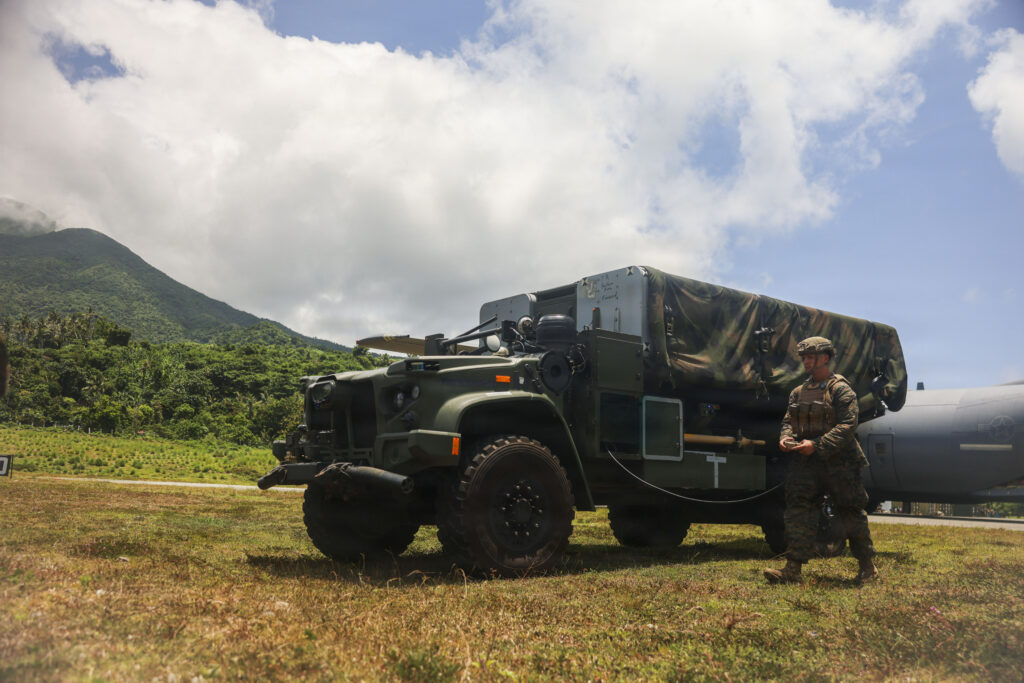
Built on the battle-tested Oshkosh Defense Joint Light Tactical Vehicle (JLTV), ROGUE-Fires combines next-generation autonomy with the protection, mobility, speed, and off-road capability Marines rely on in austere environments. The JLTV’s proven transportability, operational interoperability and available sustainment provide a strong foundation for expeditionary fires missions and distributed operations.  

Oshkosh Defense was initially awarded the ROGUE-Fires contract in 2022, and the platform has since become the first semi-autonomous ground system fielded by the U.S. military. The ROGUE-Fires offers the only in production and fielded semi-autonomous ground system for offensive and defensive fires.  

The Block 2 configuration introduces Forterra’s next-generation autonomy and expanded weapon system integration to support Expeditionary Advanced Base Operations (EABO) and distributed long-range precision fires missions.  

“As the Marine Corps continues to modernize its force structure and operational capabilities, Oshkosh remains focused on delivering advanced ground mobility solutions that support mission success,” said Pat Williams, Chief Programs Officer at Oshkosh Defense. “With new technology integration and expanded weapon system flexibility, ROGUE-Fires Block 2 demonstrates Oshkosh’s ability to integrate advanced technologies onto proven tactical vehicles.”  

ROGUE-Fires, built on a Modular Open System Approach, provides the architecture that now supports integration with the MLRS Family of Munitions (MFOM) and rapid swapping of future payload weapon systems based on mission requirements. This modular approach provides Marines with greater operational flexibility across evolving expeditionary fires missions and beyond.  

Forterra’s AutoDrive autonomous driving system is built to support operations in contested and GPS-denied environments.  

Vehicle deliveries under the contract are expected to continue through 2031.  


RENK America Moving to Become Second Builder of Ship Propulsion Bull Gears for U.S. Navy Ships

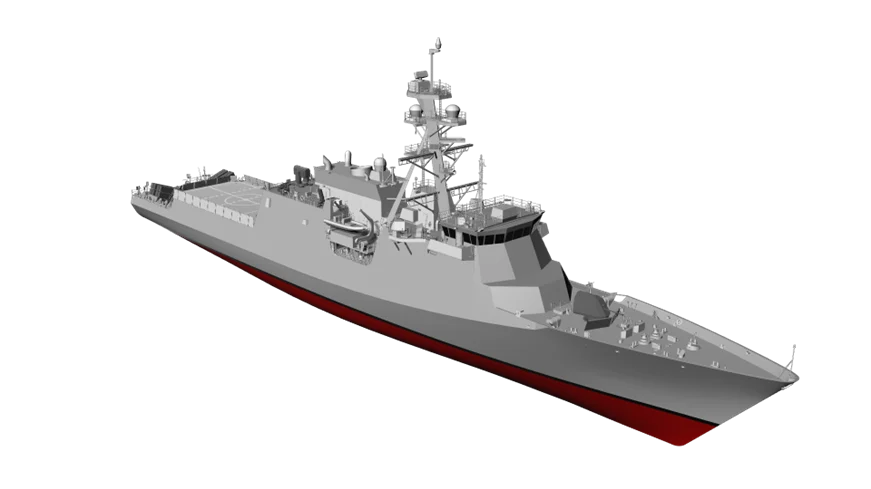
RENK is positioning itself to offer to provide the main gearboxes for the Navy’s proposed FF(X) frigate, a development of the Coast Guard’s Legend-class national security cutter. (U.S. Navy)

By Richard R. Burgess, Senior Editor 

ARLINGTON, Va. —  A 120-year-old American manufacturing company now owned by a German firm is positioning itself to return to building main gearboxes for new U.S. Navy ships as a Tier 1 supplier. 

RENK Group AG bought Cincinnati Gearing Systems of Cincinnati, Ohio last year, which made the main reduction gear sets for the two fast combat support ships (AOEs) and the Kaiser-class fleet replenishment oilers three decades ago. Now called RENK America Marine and Industry (RAMI), RAMI is part of the global RENK Group’s Marine and Industry division.

RENK Germany provided the main gear boxes for the Coast Guard’s Legend-class national security cutters and is providing the main gear boxes for the Heritage-class offshore patrol cutters. 

“Right now, for the big gear boxes — on aircraft carriers, cruisers, destroyers — there’s really only one supplier in America,” said Thom Burke, president of RENK America Marine and Industry (RAMI), in an interview with Seapower. “RENK’s big idea was to use Cincinnati Gear’s legacy experience in gearboxes to get back into bringing the Navy a second supplier. I was brought in to pivot us harder towards Navy business.” 

During his Navy career, Burke commanded two ships, including a nuclear-powered aircraft carrier. 

RAMI has approximately 120 employees who “grind the gears, make all the components, assemble the components, [and] test the assemblies.” Burke said.  

Since supplying gear boxes to the AOEs and T-AOs 25 or 30 years ago, “we fell out of the ability to make the big, giant bull gears that drive those main reduction gear sets,” he said. “RENK is making investments in the company to prepare us to do that so that we can compete on frigate, destroyer, battleship, cruiser, whatever that next ship is going to be for the Navy. 

Noting that the Navy is planning on building new frigates based on the Legend-class national security cutters, Burke said that “we’re [RENK] the incumbent for those vessels, so we’re preparing to grow ourselves up to be able to make frigates for the Navy if they so choose to do that.”

RAMI has been asked for a price quote for the proposed frigate Flight 1 design and is “trying to figure out ways to make those gearboxes here in America, here in Cincinnati, instead of Germany.”  

Burke said that Cincinnati and now RENK products are on every destroyer in the U.S. Navy right now.” 

The company also builds equipment for Textron’s LCAC 100-class of Ship-to-Shore Connectors and components for sustaining the Ohio-class submarines and for equipping the new Columbia-class submarines. 

“There’s plenty going on now, and there’s plenty potential for the future,” Burke said, noting that RAMI wanted “to be able to offer the Navy a robust capability.” 

Asked about RAMI’s workforce and the current industry-wide workforce challenges, Burke said, “We have been very aggressively trying to grow the workforce … [and] get a second shift. … “We’re filling out that second shift now.” 

He said RAMI has hired 15 workers over the last six months.  

“I’m trying to grow my own,” he said. “So far we’ve made a lot of progress, but it’s a continuing challenge for sure.” 

RAMI has a partnership with a local high school and community college and is leveraging the Navy Talent Pipeline Program and the Accelerated Training in Defense Manufacturing (ATDM) Program in Denville, Virginia, which is “specifically designed to help adult learners earn the skills necessary to make an immediate impact in the submarine industrial base (SIB),” the ATDM website said.