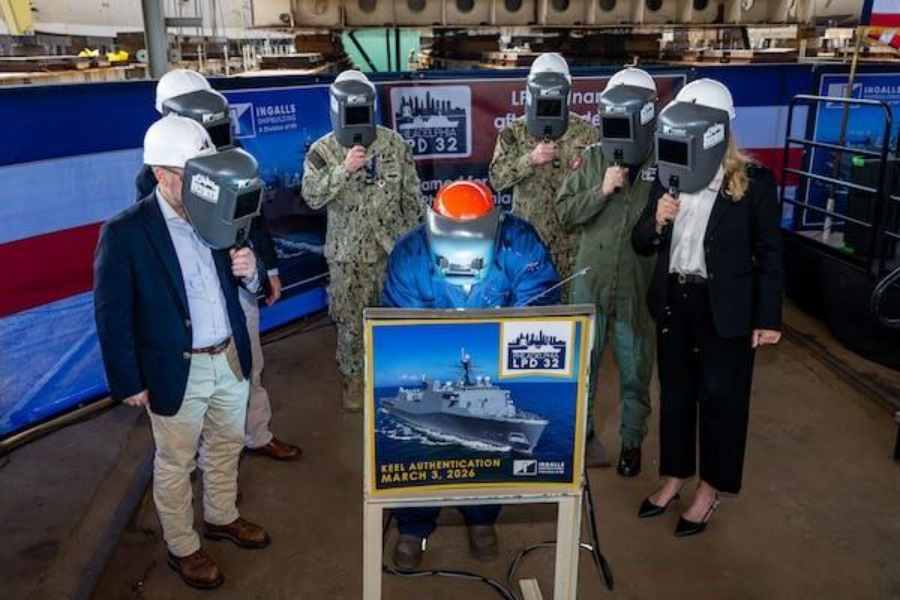
Mrs. Maureen Paparo, sponsor for LPD 32, Philadelphia, and other platform guests watch as Cory Dillon, Ingalls Structural Welder, welds the sponsor’s initials onto the keel plate at Ingalls Shipbuilding in Pascagoula, MS, March 3, 2026. (Photo/Luis Solis) In Photo From Left: Brian Blanchette, President of Ingalls Shipbuilding and Executive Vice President at HII Chris Kastner, President and CEO, HII, Captain Randy Slaff, Commanding Officer, Supervisor of Shipbuilding, Conversion and Repair, Gulf Coast, Cory Dillon, Ingalls Structural Welder, Captain Matt Tardy, Unites States Navy, Amphibious Warfare Program Manager, Program Executive Office, Ships, Admiral Samuel Paparo, Unites States Navy, Commander, United States Indo Pacific Command, and husband to our ship sponsor, and Mrs. Maureen Paparo, Sponsor and Keel Authenticator of LPD 32. (Photo by Luis Solis)
From Team Ships Public Affairs, March 4, 2026
PASCAGOULA, Miss. - The keel for the future USS Philadelphia (LPD 32), a San Antonio class-amphibious transport dock ship, was authenticated at HII’s Ingalls Shipbuilding division, March 3.
The ship is named in honor of the historic city of Philadelphia and its maritime legacy. The city is the birthplace of the U.S Navy and Marine Corps and was home to the Philadelphia Naval Shipyard from 1801-1995, which constructed numerous Navy vessels.
Keel laying authentication ceremonies are a centuries-old tradition marking a significant construction milestone where a ship transitions from design to reality. The keel was authenticated when the initials of the ship’s sponsor, Ms. Maureen Paparo, were welded onto a steel plate. Paparo is a Philadelphia native and the spouse of Adm. Samuel Paparo, the 27th Commander of U.S. Indo-Pacific Command. This plate will be permanently affixed to the ship’s hull, remaining with the vessel throughout its entire service life as a symbol of its beginning.
“The future USS Philadelphia honors one of America’s foundational cities and its continuous support of the Navy and the maritime domain,” said Capt. Matthew Tardy, program manager, Amphibious Warfare Program Office. “This keel laying marks the ceremonial beginning of construction and we look forward to delivering this ship to the fleet.”
San Antonio-class amphibious transport dock ships (LPD) are warships that embark, transport, and land elements of a landing force for a variety of expeditionary warfare missions, humanitarian assistance, and disaster relief. They provide the Navy and Marine Corps with modern, sea-based platforms that are networked, survivable, and built to operate with 21st-century transformational platforms such as air-cushioned landing craft (LCAC), modern helicopters, and vertical take-off landing craft (MV-22).
Today’s ceremony underscores the Navy’s commitment to building America’s Golden Fleet. For 250 years, American naval power has projected strength globally. That mission continues – and intensifies. We operate forward 24/7, 365 days a year. This operational tempo demands continuous capability delivery, and the Golden Fleet is our answer.
As a Department of War acquisition organization, PEO Ships is responsible for executing the development and procurement of all destroyers, amphibious ships and craft, and auxiliary ships, including special mission ships, sealift ships and support ships.
General Dynamics Mission Systems awarded contract to continue support to Trident II Strategic Weapon System
Delivering full life cycle support and next-generation fire control systems for strategic deterrence
From General Dynamics Mission Systems, March 4, 2026
CHANTILLY, Va. – General Dynamics Mission Systems announced today that it was awarded a costplus- incentive-fee and cost-plus-fixed-fee follow-on contract with an initial order value of $255 million as the prime integrator for the Trident II Fire Control System (FCS). Under the fiscal year 2026 FCS omnibus contract, General Dynamics will continue to provide full life cycle and operational support for all deployed Ohio-class ballistic missile submarine (SSBN) FCSs, as well as continue the development, production and installation for all new Columbia-class SSBN FCSs through 2032. The contract, awarded in January, includes options which, if exercised, would bring the cumulative value to $740 million.
General Dynamics Mission Systems supports the Navy’s shipbuilding priority with FCS development, production, sparing and installation activities for three Columbia-class hulls along with additional labs and trainers kits. Continuous development for the Trident II D5 Life Extension 2 (D5LE2) FCS will occur under this contract, as well.
“General Dynamics Mission Systems has been a trusted provider of highly reliable fire control systems to the U.S. submarine force for more than seven decades. We remain committed to delivering highly reliable state-of-the-art, innovative solutions to the U.S. Navy. Supporting the strategic deterrent mission is a responsibility we take seriously, and we are dedicated to continuing our track record of on-time, on-budget delivery,” said Laura Hooks, vice president and general manager of Maritime and Strategic Systems at General Dynamics Mission Systems.
Work will be performed in Pittsfield, Massachusetts (87%); Bangor, Washington (1%); Kings Bay, Georgia (1%); Loanhead, Midlothian, United Kingdom (4%); Cape Canaveral, Florida (3%); Groton, Connecticut (3%); and Quonset Point, Rhode Island (2%). If all options are exercised, work will continue until December 2032.
Hegseth: Iranian Warship Sunk by U.S. Submarine Torpedo
By Richard R. Burgess, Senior Editor
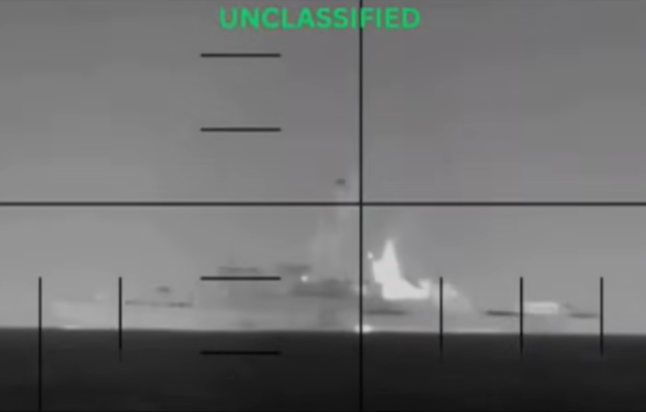
ARLINGTON, Va. — An Iranian warship has been sunk by a torpedo fired from a U.S. Navy submarine, the Secretary of War said. The action would be the first ship sunk by torpedo fired from a U.S. Navy ship since World War II.
Secretary of War Pete Hegseth said on March 4, 2026, that the Iranian ship was sunk in the Indian Ocean
According to the BBC, the sunken ship was the IRIS Dena, a guided-missile frigate that went down off the southern coast of Sri Lanka. The ship was one of six ships of the Moudge class.
According to Reuters, the Sri Lankan Navy rescued 32 people from the ship, of a crew estimated to number 180 members. At least 80 crew members died in the action.
The action represents the first sinking of an enemy warship by a U.S. submarine’s torpedo since World War II.
During the Falklands War, on May 2, 1982, the Royal Navy nuclear-powered attack submarine HMS Conqueror sank the Argentine Navy cruiser ARA Belgrano with a torpedo. The Belgrano was formerly the light cruiser USS Phoenix.
U.S. Navy submarines are armed with 21-inch Mark 48 21-inch diameter torpedoes.
Glamox wins contract to light US Navy’s latest Towing, Salvage, and Rescue Ship
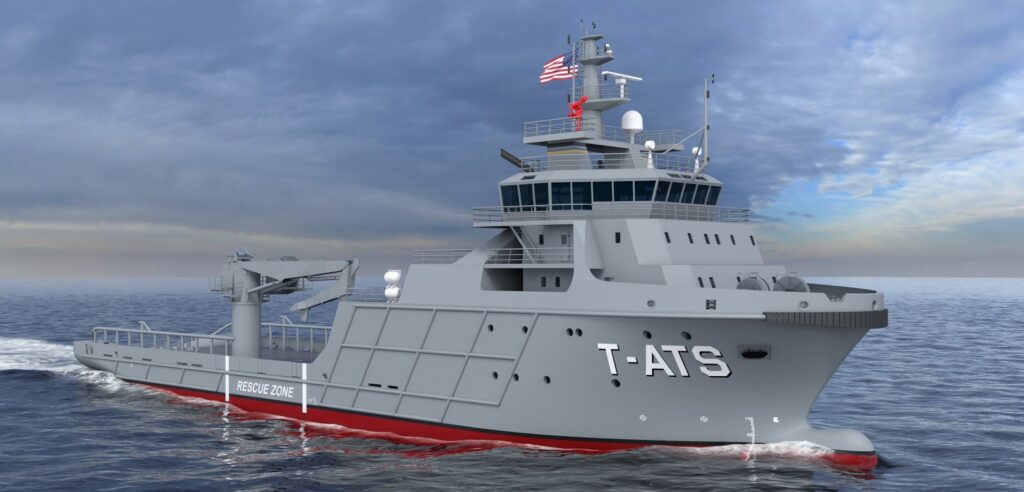
Artist’s impression of a Navajo-class T-ATS vessel. Photo Credit: Austal USA
Latest contract brings the total to eight Navajo-class vessels Glamox has lit
KATY, Texas, 4 February 2026:Glamox, one of the world’s leading lighting companies, has secured a contract from Austal USA to supply exterior and interior LED marine lighting for the future USNS James D Fairbanks (T-ATS 13), the latest Navajo-Class (T-ATS)Towing, Salvage, and Rescue ship being constructed for the US Navy (USN). This new contract brings the total to three T-ATS ships that Glamox is lighting for Austal USA. Previously, Glamox was awarded contracts to light five T-ATS vessels from Bollinger Houma Shipyards.
“We are proud to be supplying lighting for this workhorse of the seas, which will enter service in 2028. This latest order, along with orders from navies worldwide, highlights Glamox’s marine defence lighting capabilities, which range from lights for inshore rescue boats to large aircraft carriers,” said John O’Driscoll, General Manager of Glamox in North America.
T-ATS vessels will provide ocean-going towing, salvage and rescue capabilities to support fleet operations. They have a multi-mission common-hull platform capable of towing USN ships and will combine the capabilities of the retiring Rescue and Salvage Ship (T-ARS 50) and the Fleet Ocean Tug (T-ATF 166) vessels. The T-ATS series will be able to support current missions, including towing, salvage, rescue, oil spill response, humanitarian assistance, and wide-area search and surveillance.
The T-ATS vessels may also enable future rapid capability initiatives, such as supporting modular payloads with hotel services and appropriate interfaces. Their large, unobstructed 6,000 square feet (557 square metres) of deck space allows for the embarkation of a variety of stand-alone and interchangeable systems.
In addition to the T-ATS series, Glamox worked with Austal USA to supply lights for the auxiliary floating dry dock medium (AFDM) and navigation lights for the USN’s Landing Craft Utility (LCU) 1700-class vessels.
Four Days In, Hegseth, Caine Say U.S. Making Decisive Progress in Iran
March 4, 2026 | By Matthew Olay, DoW News
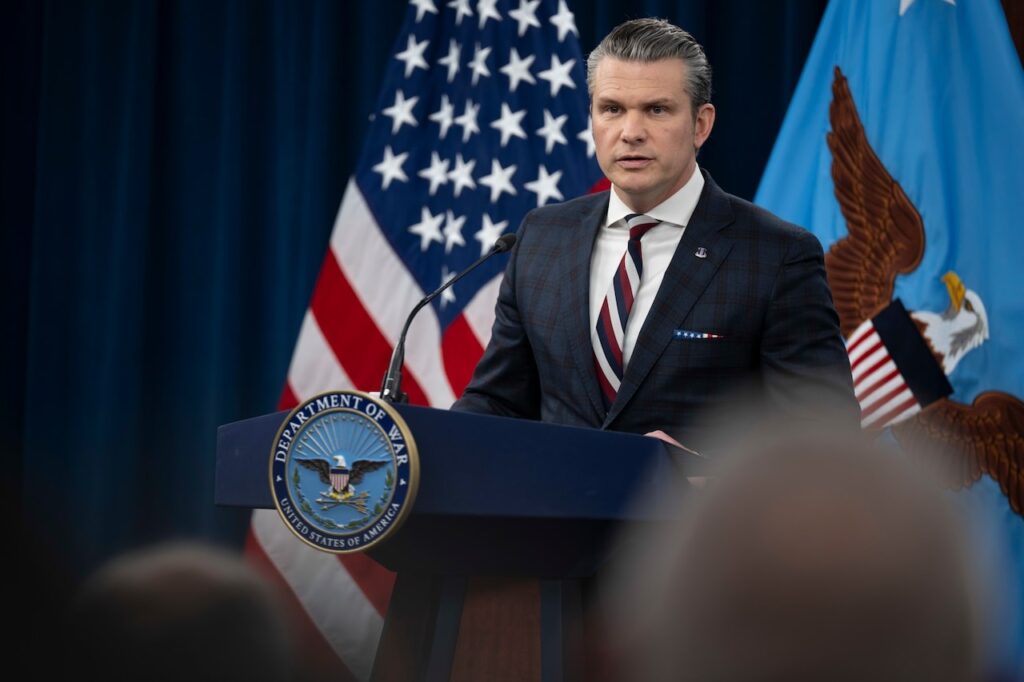
During the War Department’s second press conference since the U.S. and Israel’s launch of Operation Epic Fury against the Iranian regime Feb. 28, Secretary of War Pete Hegseth and Air Force Gen. Dan Caine, chairman of the Joint Chiefs of Staff, today said America is making decisive offensive progress in the conflict.
“I stand before you today with one unmistakable message about Operation Epic Fury: America is winning decisively, devastatingly and without mercy,” Hegseth told the media from the Pentagon’s press briefing room.
“We are only four days into this, and the results have been incredible — historic, really. … Only the United States could lead this [mission]. … But, when you add the Israeli Defense Forces — a devastatingly capable force — the combination is sheer destruction for our radical Islamist Iranian adversaries,” Hegseth said.
During his remarks, Caine reiterated that the U.S. and Israel’s joint, three-pronged mission in the region is to target and eliminate Iran’s ballistic missile systems, destroy the Iranian navy and ensure Iran cannot rebuild or reconstitute its combat capability or power — including ensuring the country never obtains nuclear weapons.
In terms of battle damage, Caine said there has been an 86% overall drop in Iran’s ballistic missile launches since the first day of fighting, and a 23% decrease in just the last 24 hours. Additionally, he added there has been 73% decrease in Iranian one-way attack drone shots fired from early on in the conflict.
In terms of air power, Hegseth said that the U.S. and Israeli forces are poised to have complete control of Iranian air space within the next few days.
“I hope all the folks watching understand what ‘uncontested airspace’ and ‘complete control’ means: It means we will fly all day [and] all night … finding, fixing and finishing the missiles and defense industrial base of the Iranian military; finding and fixing their leaders and their military leaders; flying over Tehran … [with] Iranian leaders looking up and seeing only U.S. and Israeli air power every minute of every day, until we decide it’s over — and Iran will be able to do nothing about it,” Hegseth said.
At sea, U.S. Central Command announced yesterday that more than 20 Iranian navy vessels have been destroyed, including the sinking of an Iranian combatant ship in the Indian Ocean by a U.S. Navy fast attack submarine.
It was the first time a U.S. submarine has used a Mark 48 torpedo to sink an enemy vessel since 1945, Caine noted.
“I want to remind everybody that this is an incredible demonstration of America’s global reach. To hunt, find and kill an out-of-area deployer is something that only the United States can do at this type of scale,” he said.
In discussing the Iranian regime’s predicament, Hegseth said he likens the situation to a football game, wherein Iran’s offense has already exhausted all of its scripted plays.
“But now that the game has started and the [U.S. and Israeli] defensive blitz is on, [Iran doesn’t] know what plays to call, let alone how to get in the huddle and call those plays,” Hegseth said.
He added, because so many of Iran’s senior leaders being killed on Operation Epic Fury’s first day, the military is unable to effectively communicate, let alone mount a coordinated and sustained offensive.
“This was never meant to be a fair fight, and it is not a fair fight. We are punching [the enemy] while they’re down, which is exactly how it should be,” Hegseth said, adding that Epic Fury has already unleashed twice the air power as the initial “shock and awe” phase of Operation Iraqi Freedom in 2003.
Looking ahead, Caine said that Centcom will continue to strike the regime’s infrastructure — including hunting and killing ballistic missile launchers and one-way attack capabilities — as well as continuing to attack Iran’s naval capabilities.
“We are just getting started,” Hegseth said.
Hegseth Says ‘Epic Fury’ Goals in Iran Are ‘Laser-Focused’
March 2, 2026 | By C. Todd Lopez, DoW News
Since early morning Feb. 28, American forces in the U.S. Central Command area of operations have been involved in an intense bombing campaign against Iran that has already resulted in the death of Iranian Supreme Leader Ayatollah Ali Khamenei.
As part of Operation Epic Fury, which started at 1:15 a.m. EST, American forces have already targeted the Islamic Revolutionary Guard Corps command and control facilities, Iranian air defense capabilities, missile and drone launch sites and military airfields.
Secretary of War Pete Hegseth said that while there is no timeline for the military operation, there are clearly defined goals for what the United States hopes to achieve.
“The mission of Operation Epic Fury is laser-focused,” Hegseth said today during a briefing at the Pentagon. “Destroy Iranian offensive missiles, destroy Iranian missile production, destroy their navy and other security infrastructure, and they will never have nuclear weapons.”
For decades, Iran has been in pursuit of a nuclear weapons capability, through both enrichment of weapons-grade nuclear material and development of missiles that can carry a nuclear warhead.
In June 2025, during Operation Midnight Hammer, the United States struck Iran’s Fordow Fuel Enrichment Plant using 30,000-pound GBU-57 “massive ordnance penetrator” bombs. That operation, Hegseth said, obliterated Iran’s nuclear program.
Nevertheless, Hegseth said, the Iranians have persisted in pursuing a nuclear capability and in building conventional capabilities to protect their nuclear ambitions.
“Iran was building powerful missiles and drones to create a conventional shield for their nuclear blackmail ambitions,” he said. “Our bases, our people, our allies, all in their crosshairs — Iran had a conventional gun to our head as they tried to lie their way to a nuclear bomb.”
The secretary said the clear goals for Epic Fury mean it will be unlike past American conflicts in Iraq and Afghanistan.
“Our ambitions are not utopian; they are realistic, scoped to our interests and the defense of our people and our allies,” he said. “This is not Iraq. This is not endless. … This is the opposite. This operation [has] a clear, devastating, decisive mission: destroy the missile threat, destroy the navy, no news.”
Hegseth said Epic Fury doesn’t include nation-building or democracy building goals.
Air Force Gen. Dan Caine, chairman of the Joint Chiefs of Staff, said planning for an operation such as Epic Fury has been underway for a significant amount of time.
“This marked the culmination of months, and in some cases, years, of deliberate planning and refinement against this particular target set,” Caine said. “From precision strikes against key military infrastructure to persistent intelligence and targeting integration to the close coordination of the components across vast distances, this operation again demonstrated America’s reach, readiness and professionalism, and that of our joint united force.”
Setting the Force
Over the last 30 days, at the direction of the secretary, Caine said, the joint force repositioned forces around the region in order to provide President Donald J. Trump with options, if he intended to act.
“These movements ensured that U.S. forces remained postured, protected and ready to respond decisively [to] any emerging threat,” he said.
That effort included thousands of service members, hundreds of advanced fighter aircraft, refueling tankers, a sustained flow of munitions, fuel and supplies, and the USS Abraham Lincoln and USS Gerald R. Ford carrier strike groups, along with their air wings. More capabilities continue to flow into the region, Caine said.
“This rapid buildup of forces demonstrated the joint force’s ability to adapt and project power at the time and place of our nation’s choosing,” Caine said.
The final word that Epic Fury was going to happen, he added, came Friday afternoon from the president.
“Operation Epic Fury approved. No aborts. Good luck,” Caine said, relaying the message from the president.
“In the region, every element of the joint force made their final preparations,” he said. “Air defense batteries readied themselves, checking their systems to respond to Iranian attacks. Pilots and crews rehearsed their strike packages for the final time. Air crews began loading their final weapons, and two carrier strike groups began to move towards their launching points across the globe.”
Epic Fury
U.S. Cyber Command and U.S. Space Command, he said, initiated action with non-kinetic effects to disable Iran’s communications ability. And then, at 1:15 a.m. EST, 9:45 a.m. Tehran time, Epic Fury kicked off.
“More than 100 aircraft launched from land and sea: fighters, tankers, airborne early warning, electronic attack, bombers from the states and unmanned platforms forming a single synchronized wave,” he said. “This was a daylight strike based on a trigger event conducted by the Israeli Defense Forces, enabled by the U.S. intelligence community.”
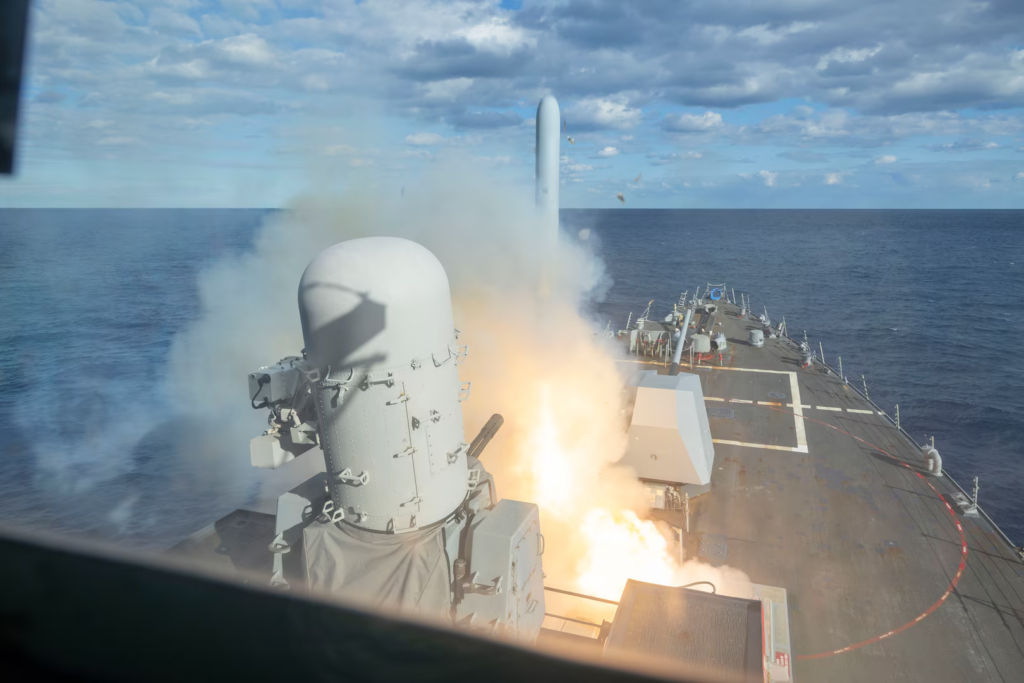
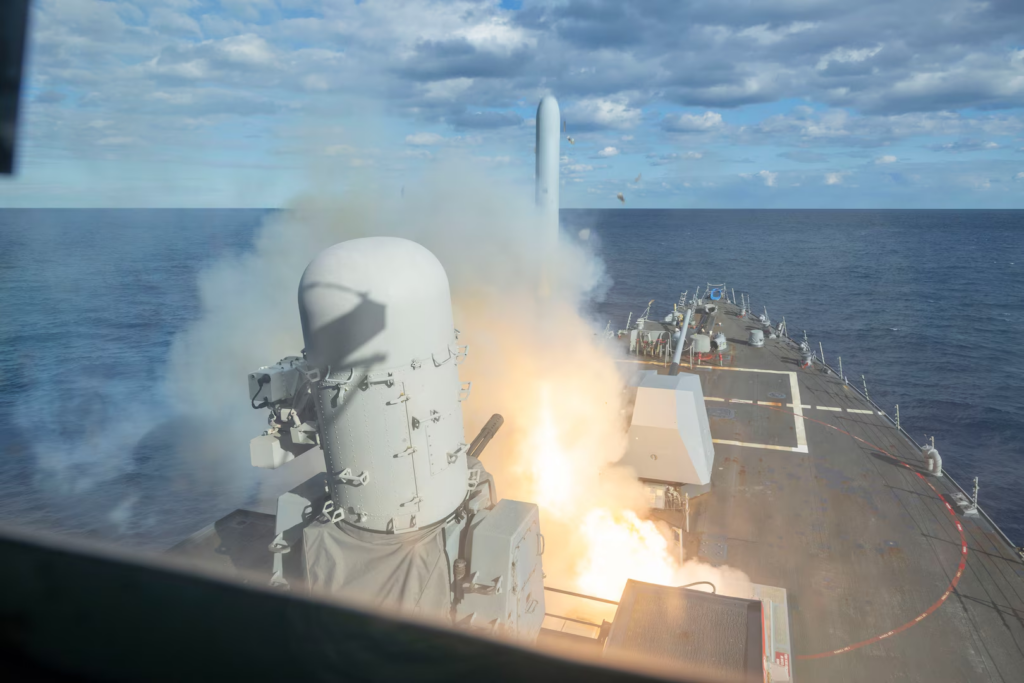
On the sea, the U.S. Navy launched Tomahawk missiles at Iran and attacked Iranian naval forces. While on the ground, he said, coordinated salvos of precision standoff weapons from across the region have neutralized hundreds of preplanned targets.
“This was a massive, overwhelming attack across all domains of warfare, striking more than 1,000 targets in the first 24 hours,” Caine said. “We are now roughly 57 hours into the operation. In the initial phase, Centcom’s focus was systematic, targeting of Iranian command and control, infrastructure, naval forces, ballistic missile sites and intelligence infrastructure — designed to daze and confuse them.”
As a result of strikes in Iran, Caine said the U.S. has established local air superiority, which enhances the ability to protect U.S. forces and allows them to continue operations there.
“Operation Epic Fury stands as a reminder of what the United States military uniquely delivers: the ability to project power on a global scale with speed, surprise, precision and overwhelming force, when and where our nation requires it,” Caine said. “What we’ve demonstrated over the past several days reflects years of investment in readiness, joint integration and professionalism of the joint force.”
During the briefing, Hegseth also directly addressed U.S. troops who are participating in Epic Fury, telling them that both he and the president have their backs.
“We will finish this on ‘America First’ conditions of President Trump’s choosing — nobody else’s — as it should be,” Hegseth said. “And know this above all, President Trump and I have your back, always. Through fire, through criticism, through fake news, through everything, we unleash you because you are the best, most powerful, most lethal fighting force the world has ever seen.”
U.S. Forces Launch Operation Epic Fury
From U.S. Central Command, Feb. 28, 2026
TAMPA, Fla. – U.S. Central Command (CENTCOM) commenced Operation Epic Fury, Feb. 28, at the direction of the President of the United States.
U.S. and partner forces began striking targets at 1:15 am ET to dismantle the Iranian regime’s security apparatus, prioritizing locations that posed an imminent threat. Targets included Islamic Revolutionary Guard Corps command and control facilities, Iranian air defense capabilities, missile and drone launch sites, and military airfields.
“The President ordered bold action, and our brave Soldiers, Sailors, Airmen, Marines, Guardians, and Coast Guardsmen are answering the call,” said Adm. Brad Cooper, commander of CENTCOM.
Following the initial wave of U.S. and partner strikes, CENTCOM forces successfully defended against hundreds of Iranian missile and drone attacks. There have been no reports of U.S. casualties or combat-related injuries. Damage to U.S. installations was minimal and has not impacted operations.
The first hours of the operation included precision munitions launched from air, land, and sea. Additionally, CENTCOM’s Task Force Scorpion Strike employed low-cost one-way attack drones for the first time in combat.
Operation Epic Fury involves the largest regional concentration of American military firepower in a generation.
Xeneta: Strikes Against Iran Shatter Prospects of Return of Red Sea Container Shipping
From Xeneta
OSLO – Norway, 28 February 2026 — The US and Israel carried out a joint military operation today, 28 February, targeting sites in Iran. Iran has responded with retaliatory military action.
Below is immediate insight from Xeneta Chief Analyst Peter Sand on implications for global ocean container shipping supply chains, with particular focus on the impact on Red Sea.
Peter Sand, Xeneta Chief Analyst:
“The repercussions of the joint military operation by the US and Israel against Iran and subsequent retaliatory action will see the further weaponization of trade and shatter hopes of a largescale return of container shipping to the Red Sea in 2026.
“Carriers had been returning selected east-west ocean container services to transits via Suez Canal in recent months after sailing around Cape of Good Hope since late 2023 due to attacks by Iran-backed Houthi militia in the Red Sea region.
“If Houthi militia resume attacks, as now seems likely, carriers will reverse the decision to return services to the Red Sea and prioritize the safety of crew, ship and cargo. Any plans for a phased return of container shipping to the Red Sea in 2026 will be shelved until the security situation becomes clearer.
“Carriers are on red alert and we have seen signs of them pre-empting this security deterioration in the Middle East, notably with CMA CGM last month reversing a decision to return its FAL1, FAL3 and MEX to the Red Sea citing ‘the complex and uncertain international context’.
“Earlier this week, Maersk announced its ME11 and MECL services would be rerouted via Cape of Good Hope due to security concerns in the Red Sea region.
Impact on ocean container shipping capacity and freight rates:
“Longer sailing distances around Cape of Good Hope absorb around 2.5 million TEU (20ft equivalent container units) of global container shipping capacity and increase the transport demands on the fleet. A largescale return of container shipping to the Red Sea region would free up this capacity, slash transit times and potentially see freight rates collapse at a global level.
“Average spot rates from China to US East Coast and US West Coast are down 32% and 35% respectively since the start of 2026. From China to North Europe and Mediterranean, average spot rates are down 23% and 33%.
“With a largescale return of container ships to Red Sea in 2026 now unlikely, freight rates on major global trades will continue to soften, but will not fall as hard as previously expected in the second half of the year as more services returned to Suez Canal transits.
“Compared to pre-Red Sea crisis (1 December 2023), average spot rates from China to North Europe and Mediterranean – the two trades most operationally impacted by the diversions around Cape of Good Hope – are still up 48% and 79% respectively.”
Impact on Middle East region:
“Ocean container services in Persian Gulf have continued unaffected by the recent build-up of military forces in the region, but the escalation in conflict through military strikes mean ships will now avoid the area, but for as short a time as possible.
“Average spot rates from China to UAE have ticked up 5% since 15 February to stand at USD 1572 per FEU (40ft equivalent container), no doubt pushed up by concerns over the security situation and shippers being worried about their goods getting in and out of ports in the Persian Gulf.
“There is no viable alternative to getting containers in or out of ports such as Jebel Ali by ocean if Persian Gulf is off limits. Carriers will instead omit these calls on east-west services and drop boxes at a least-worst alternative port for onward transportation by road.
“This will cause severe disruption and port congestion at a regional level, but will not have a major impact on a global scale when compared to the seismic influence of conflict in the Red Sea.”
Coast Guard interdicts 14 aliens near Point Loma
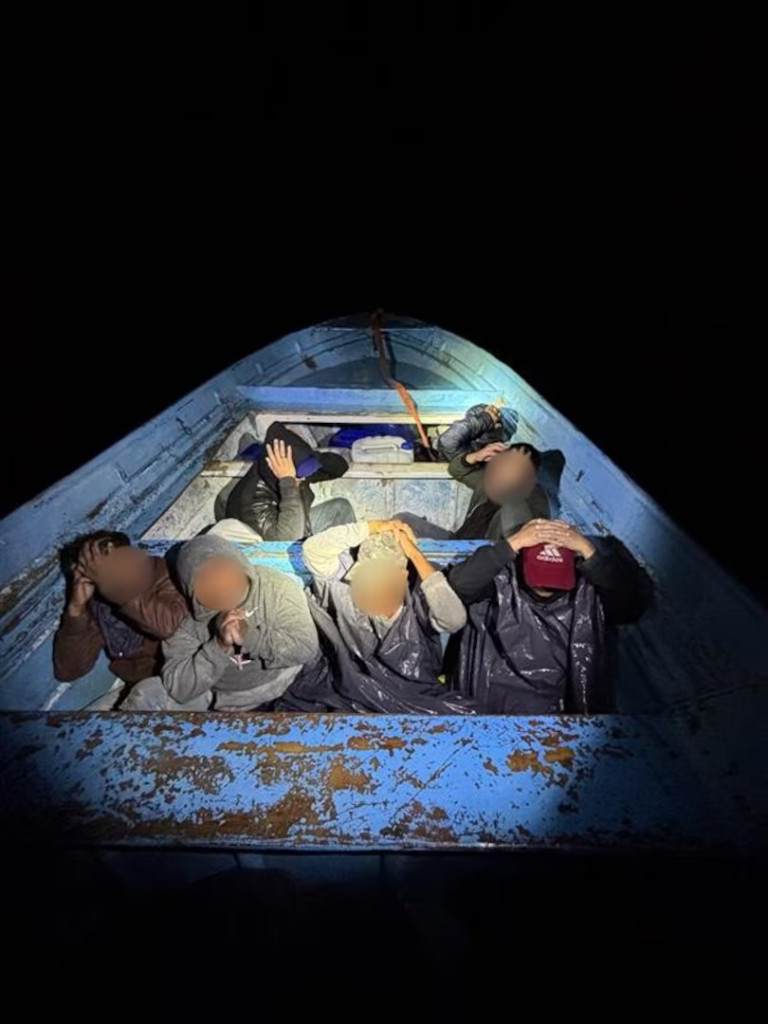
A Coast Guard Cutter Forrest Rednour (WPC 1129) boarding team interdicts a suspected alien vessel March 1, 2026, approximately 10 miles southwest of Point Loma, Calif. The crew discovered 14 individuals aboard, claiming El Salvadoran, Nicaraguan, Columbian, Guatemalan, and Mexican nationality. (U.S. Coast Guard courtesy photo)
From U.S. Coast Guard Southwest District, March 1, 2026
SAN DIEGO — The Coast Guard interdicted 14 suspected aliens approximately 10 miles southwest of Point Loma, San Diego, Sunday.
At approximately 12 a.m., U.S. Customs and Border Protection Air and Marine Operations detected a panga-style vessel transiting into U.S. waters and requested Coast Guard Cutter Forrest Rednour (WPC 1129) to intercept.
The Rednour’s boarding team interdicted the vessel and identified 14 suspected aliens aboard. The individuals claimed nationality from El Salvador, Nicaragua, Columbia, Guatemala, and Mexico.
All suspected aliens were transported to Imperial Beach Border Patrol at Ballast Point.
Austal USA Launches Final EPF, the Future USNS Lansing
From Austal USA
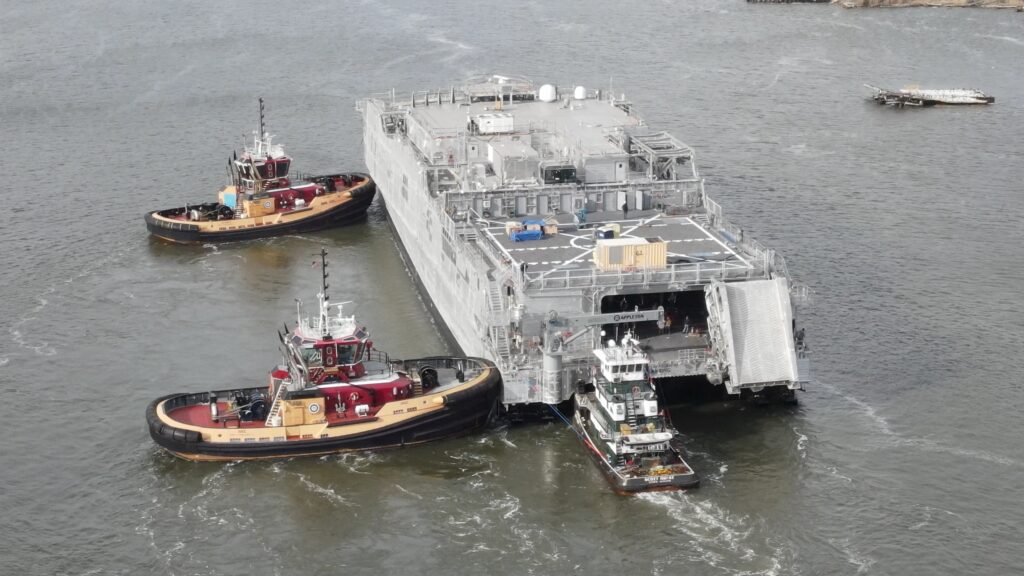
MOBILE, Ala. – Austal USA launched the company’s second ship in less than a week, the Navy’s final Expeditionary Fast Transport, future USNS Lansing (EPF 16) in Mobile, Ala., February 25, 2026. The U.S. Navy’s 16th Expeditionary Fast Transport (EPF), christened in early January, is now docked pier side for final outfitting and system activation in preparation for sea trials later this year.
During this launch process, self-propelled modular transporters (SPMT) lifted the ship almost three feet and moved it approximately 400 feet onto a deck barge moored adjacent to the final assembly bay. The barge moved the ship downriver where the ship was placed in a floating dry dock. The EPF was submerged in the dry dock enabling it to float for the first time, and it was returned back upriver to Austal USA’s new construction facility. This is the 26th ship launched at Austal USA using this proven process.
“The successful launch of this final Expeditionary Fast Transport is a true reflection of the power of teamwork and our commitment to applying lessons learned to every aspect of our work,” said Gene Miller, Austal USA Interim President. “Our test and activation teams, crane and rigging crews, and safety personnel worked seamlessly alongside our Navy partners and trusted vendors like Berard Transportation, Alabama Shipyard, and E.N. Bisso & Son tug services. These strong partnerships enable us to continuously refine our processes, identify areas for improvement, and efficiently achieve critical shipbuilding milestones to further support and strengthen the maritime industrial base.”
Production efforts on EPF 16 will shift to final outfitting and system activation to support future USNS Lansing, the Navy’s third EPF Flight II medical variant, getting underway for sea trials.