ThayerMahan Begins Array Manufacturing at New Connecticut Facility

ThayerMahan begins Linear Hydrophone Array manufacturing at new 5,000 square foot state-of-the-art production facility. (ThayerMahan photo) 

From ThayerMahan Inc. 

GROTON, Conn., June 16, 2026 /PRNewswire/ — ThayerMahan, Inc., a leader in acoustic intelligence and undersea surveillance solutions, today announced the official commencement of Linear Hydrophone Array manufacturing at a new, 5,000 square foot state-of-the-art production facility in the company’s Groton, Connecticut campus. The new facility and production lines significantly expand the company’s ability to build and deliver its critical array technologies and acoustic intelligence solutions at scale. 

The new production line and facility reflect accelerating global demand for ThayerMahan’s passive acoustic intelligence systems. By expanding production, ThayerMahan has demonstrated its commitment to scale domestic manufacturing, meet existing contract obligations, and maintain the performance, quality, and reliability standards demanded by government and commercial customers worldwide. 

“Linear hydrophone array manufacturing is one of the most technically demanding and exacting production disciplines in undersea sensing,” said Andy Meecham, Chief Technology Officer at ThayerMahan. “This is an extraordinary accomplishment for our team. Bringing array manufacturing in‑house is only possible because of the decades of engineering rigor, process development, and hands-on expertise of our teams. It also places ThayerMahan among a very small group of companies globally that can do this work reliably, repeatably, and at production volumes that matter.” 

By bringing array manufacturing in house, ThayerMahan has reduced its reliance on outside suppliers for specialized components and gained more control over design iterations and intellectual property. The shift is intended to create a more resilient and responsive manufacturing operation as mission requirements evolve. 

The expansion comes amid rising focus on maritime domain awareness and undersea security. As global demand grows for persistent sensing capabilities, domestic production capacity increasingly represents a key element of the U.S. industrial base for maritime defense. 

“Connecticut is where ThayerMahan builds,” said Mike Connor, Chairman and CEO of ThayerMahan. “It’s where we’ve been building for a decade. We believe deeply in manufacturing critical undersea capability here, with a world‑class workforce that understands the mission, the technology, and the responsibility that comes with both. This new facility is a direct investment in southeastern Connecticut and in the people who make our success possible every day.” 

To support array production, ThayerMahan has hired and assembled a dedicated manufacturing team of skilled technicians, engineers, and production specialists. The company will continue to attract additional top technical talent to the southeastern Connecticut region as production increases. 

This expansion builds on ThayerMahan’s recent momentum as demand grows worldwide for persistent and scalable passive acoustic monitoring to support defense, security, and critical infrastructure protection. By beginning array manufacturing in Groton, the company has positioned itself to deliver critical undersea awareness more quickly and at larger scale – while anchoring that capability firmly in Connecticut. 


State Department Approves Possible Sale of MH-60R Helos to New Zealand 

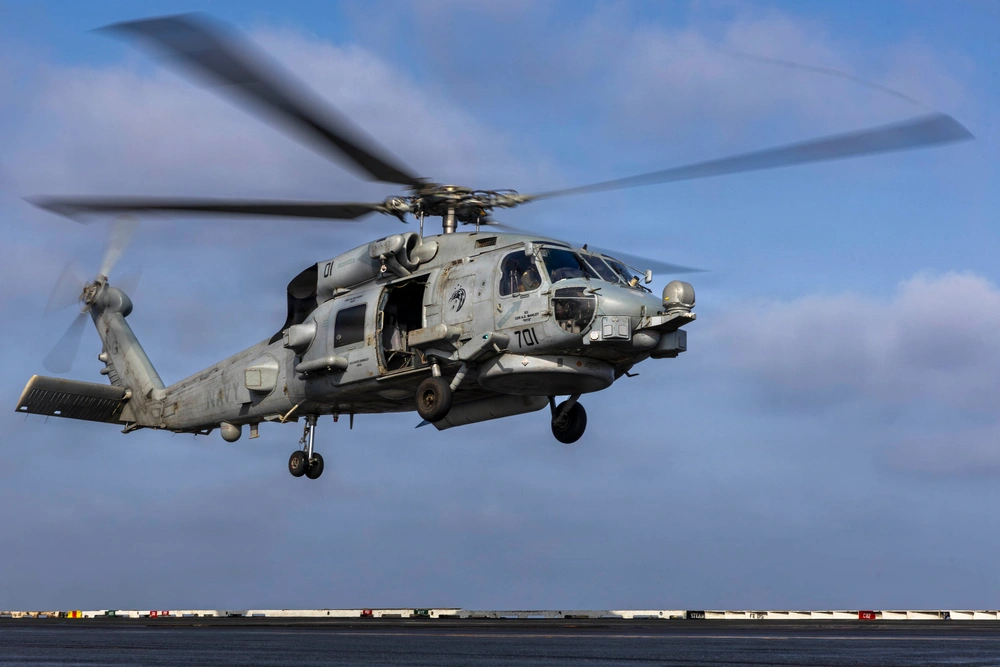
An MH-60R Seahawk, attached to Helicopter Maritime Strike Squadron (HSM) 71, takes off the flight deck of Nimitz-class aircraft carrier USS Abraham Lincoln (CVN 72), June 5, 2026. Abraham Lincoln is deployed to the U.S. 5th Fleet area of operations to support maritime security and stability in the Middle East. (U.S. Navy photo)

By Richard R. Burgess, Senior Editor 

ARLINGTON, Va.  —The U.S. Department of State has approved the possible Foreign Military Sale of ‘Lockheed Martin MH-60R Seahawk helicopters to the government of New Zealand, the department said in a June 5 release. 

The Government of New Zealand has requested five MH-60Rs and associated equipment and weapons for an estimated cost of $1.5 billion. The sale would include engines, avionics, sonar systems, radars, sonobuoys, electronic surveillance systems, spares, ground support equipment, flight simulators, technical manuals, and support services, among other support. Weapons would include Hellfire and Advanced Precision Kill Weapon Systems and M240D machine guns.   

The sale would bring to ten the number of air arms operating or soon to operate the MH-60R, the others being the U.S. Navy, Royal Australian Navy, Royal Danish Air Force, Hellenic Navy, Indian Navy, Norwegian Coast Guard, Republic of Korea Navy, Royal Saudi Navy, and Spanish Navy.  


Coast Guard to build 30 additional housing units, child development center at Base Kodiak 

A computer-generated image shows Coast Guard housing units delivered through the Nemetz Park housing project at Base Kodiak, Alaska. In May 2026, the Coast Guard ordered construction of 30 additional housing units and a child development center to support families assigned to base units. (U.S. Coast Guard image) 

From U.S. Coast Guard Arctic District, June 12, 2026 

WASHINGTON – The Coast Guard awarded two task orders in May 2026 to the Tutor Perini Corporation to construct 30 additional housing units, a child development center and other infrastructure improvements at Base Kodiak. 

Both task orders were issued under the National Multiple Award Construction Contract III. The first task order, valued at $81.8 million, constructs 15 family housing duplexes, featuring 20 three-bedroom and 10 four-bedroom units. The second task order, valued at $61.6 million, supports construction of a 22,000-square-foot child development center and an 11,000-square-foot outdoor play area. Construction of both task order projects is expected to finish in 2028. 

These projects mark the final phase of the Nemetz Park housing initiative, which has already delivered 50 new housing units for Coast Guard families at Base Kodiak. 

The task orders also include site development, demolition, utility infrastructure, road and sidewalk pavement, landscaping, child play areas, a new water tank and soil and water remediation. The new child development center will provide childcare services for more than 200 children. 

Base Kodiak is the Coast Guard’s largest operational facility and a critical provider of U.S. presence and capability in the Arctic region, supporting both surface and aviation operations. 

The Coast Guard is leveraging the historic investments provided through the Fiscal Year 2025 Budget Reconciliation and prior year appropriations to deliver shore facilities and infrastructure that support the full scope of Coast Guard missions. Using the historic $25 billion investment provided by the FY25 budget reconciliation, the Coast Guard has already ordered over $13 billion in new fleet assets and capabilities, demonstrating the Service’s commitment to modernizing acquisition, enhancing infrastructure, and delivering next-generation technology. 

“These new housing units and child development center represent a significant investment in the well-being of Coast Guard families stationed at Base Kodiak,” said Capt. John Barresi, deputy assistant commandant, Program Executive Office Shore. “By expanding access to quality housing, modern facilities, and essential services, we are ensuring our personnel – and their families – have the support they need to thrive, allowing our workforce to remain focused on fulfilling the Coast Guard’s vital mission in this region.” 

The completed cutter support facilities and family housing units were planned and executed by the Coast Guard’s Program Executive Office-Shore, Facilities Design and Construction Center and Shore Infrastructure Logistics Center. 


Saronic and Castelion to Demonstrate First-of-Its-Kind Maritime Hypersonic Launch Capability 

Today, Saronic and Castelino announced plans to join forces to launch a hypersonic vehicle from an unmanned surface vessel. By integrating Castelion’s Blackbeard with Saronic’s Medium Unmanned Surface Vessel (MUSV) Marauder, the two companies offer a powerful, credible option to deter would-be adversaries. 

A First-of-Its-Kind Integration 

The collaboration between Castelion and Saronic marks the first integration of autonomous surface vessels with hypersonics, and stands to accelerate distributed hypersonic capabilities by pairing Saronic’s autonomous surface vessels (ASVs) with Castelion’s low-cost hypersonics. The companies, both founded in late-2022, are targeting a demonstration in 2027. 

“Launching a Castelion hypersonic from a Marauder MUSV significantly changes the approach for any adversary calculating where and how the U.S. can strike,” said Dino Mavrookas, Co-Founder and CEO of Saronic. “Deterrence is ultimately a function of capability, capacity, and credibility. Saronic and Castelion are working to increase all three by combining autonomous maritime and hypersonic strike capabilities that are more scalable, more affordable, and faster to field.” 

Hypersonic systems launched from unmanned platforms give commanders more ways to generate credible strike capacity without relying only on scarce, expensive crewed launch assets. By distributing launch across a larger number of lower-cost platforms, the U.S. can increase magazine depth, create more operational flexibility, and present adversaries with more launch locations, trajectories, and timing challenges. This approach makes hypersonic forces harder to predict, harder to suppress, and easier to scale. 

Building the Infrastructure to Get There 

The path to at-sea launch in 2027 requires both companies to move beyond the limitations of land-based ranges and exquisite crewed maritime assets to accelerate the flight test cadence. 

Saronic’s ASVs have already made headway to solve the problem. In late 2025, Saronic supported a Castelion Blackbeard flight test by operating the 24-foot ASV Corsair as an autonomous at-sea telemetry collection and communications node. The two teams are now advancing joint risk-reduction efforts to support continued flight test operations and build toward a 2027 maritime launch demonstration. 

“Blackbeard and Marauder will give our warfighters more shots, from more places, with fewer constraints.” said Bryon Hargis, Co-Founder and CEO of Castelion. 

Built to Deliver at Scale 

Both companies have a proven record of rapid hardware and software iteration to achieve real-world results. Castelion went from clean-sheet design to more than 25 flight tests in under two and a half years. Saronic brought Marauder from design to on-water trials in under a year and is actively building three more hulls at its shipyard in Franklin, Louisiana. Both companies have invested in production infrastructure to sustain and accelerate progress made by rapid technological advancements. 

Castelion is expanding production capacity to several thousand Blackbeard missiles annually. Its Project Ranger campus, a 1,000-acre hypersonic manufacturing facility in New Mexico backed by more than $250 million in private capital, exists for one reason: to produce hypersonic systems at the speed and scale effective deterrence demands. 

Saronic is executing a $300 million shipyard expansion in Louisiana that will add 300,000 sq. ft. of production capacity and is expected to be complete by the end of 2026. The expanded shipyard will provide the capability to deliver 20 Marauders annually. This is one facet of Saronic’s overall strategy to scale production capacity; its Austin, Texas facility adds 400,000 sq. ft. of production capacity built to produce thousands of small ASVs per year, and Port Alpha — Saronic’s planned next-generation shipyard — will serve as the foundation for a new era of American shipbuilding and a catalyst for revitalizing the U.S. maritime industrial base. 

Together, these investments chart a clear path for the U.S. and its allies to field this combined capability at the scale and speed of relevance. 


U.S. 2nd Fleet and International Partners Commence Fleet Exercise 250 

From U.S. 2nd Fleet, June 15, 2026 

NORFOLK, Va. (June 15, 2026) – Ships from 17 allied and partner nations arrived to Naval Station Norfolk in preparation for Fleet Exercise (FLEETEX) 250, June 14-15. 

Beginning on June 16, the multi-national maritime exercise will commence for the first time in Hampton Roads and in the Atlantic Ocean. A special reception aboard Wasp-class amphibious assault ship USS Iwo Jima (LHD 7) will serve as a welcome event for FLEETEX 250. The large-scale exercise is designed to enhance interoperability and test the integrated forces in a dynamic, multi-domain training environment. 

FLEETEX 250 will bring together 31 warships, multi-national aircraft, and their crews to conduct a series of structured training events at-sea. The exercise will focus on a full spectrum of naval warfare, including anti-air (AAW), anti-submarine (ASW), and amphibious operations, culminating in a scenario-driven free-play event against a dynamic adversary. The primary goal is to build cohesiveness, validate tactical procedures, and strengthen the collective capabilities of the participating forces in a simulated combat environment. 

“Fleet Exercise is a tremendous opportunity to bring together a powerful, multi-national force,” said Vice Adm. Doug Perry, commander, U.S. 2nd Fleet. “Training and operating as an integrated team sharpens our competitive edge and demonstrates our shared commitment to maritime security and stability in the Atlantic.” 

The exercise is divided into two main phases: 

Harbor Phase (June 16-21): Participating forces will assemble at Naval Station Norfolk for final planning, pre-sail briefings, and integration. 

At-Sea Execution (June 22-29): Ships will get underway to conduct a series of training serials, a fleet formation photo exercise (PHOTOEX), and a final free-play battle problem. 

FLEETEX 250 runs concurrently with several public events in Norfolk, including the 50th Annual Norfolk Harbor Fest, Virginia SAIL 250, and Norfolk Fleet Week. These events will feature public tours of visiting warships and international tall ships, alongside a grand Parade of Sail, offering the public a unique opportunity to engage with Sailors and mariners from around the world. 

Participating nations in FLEETEX 250 include Belgium, Brazil, Canada, Cameroon, Côte d’Ivoire, Cyprus, Denmark, France, Germany, Mexico, Morocco, Netherlands, Norway, Peru, Senegal, Spain, Turkey, United Kingdom, and the United States. 

Following the exercise, many participating units – joined by the historic tall ships – will sail to New York City to take part in the seventh International Naval Review 250 from July 3-8. 

“While FLEETEX 250 provides critical at-sea training that enhances our combined capabilities, it also sets the stage for a historic celebration at the International Naval Review in New York City,” said Perry. “The interoperability we forge here in Hampton Roads ensures that when this magnificent multi-national fleet arrives to commemorate our nation’s 250th anniversary, it will stand as a powerful symbol of enduring global partnerships and our shared commitment to the seas.” 

U.S. 2nd Fleet, reestablished in 2018 in response to the changing global security environment, develops and employs maritime ready forces to fight across multiple domains in the Atlantic and Arctic in order to ensure access, deter aggression and defend U.S., allied, and partner interests.


USS Mitscher Returns to Norfolk from Deployment to 5th and 6th Fleets 

From Navy Office of Information, June 16, 2026 

NORFOLK, Virginia – Arleigh Burke-class guided-missile destroyer USS Mitscher (DDG 57) returned to Naval Station NorfolkJune16, concluding an 11-monthdeployment to the U.S. 5th and 6th Fleet areas of operations. 

The warship, assigned to Destroyer Squadron Two, departed Naval Station Norfolk for a regularly scheduled deployment to the U.S. European Command area of responsibility, July 25, 2025. Mitscher conducted their pre-deployment certification as part of the Gerald R. Ford Carrier Strike Group but deployed independently to U.S. 5th and 6th Fleets areas of operations. 

“Team Mitscher continues to take great pride in service to our nation,” stated Cmdr. Stephen Prugh, commanding officer, USS Mitscher. “This team has worked tirelessly over the last11monthsoperatingthroughout the U.S. 5th and 6th Fleet areas of operations as an independent deployer and integrating with the Gerald R. Ford, Abraham Lincoln, and UK Prince of Wales Strike Groups.  I’m impressed with the crew’s resilience, perseverance, and grit. I could not be prouder of their accomplishments at sea. Seize the Day!” 

Equipped with the Aegis combat system, Mitscher provides multi-mission offensive and defensive capabilities to conduct anti-air, anti-submarine, anti-surface warfare, and ballistic missile defense. 

Commissioned on Dec. 10,1994, USS Mitscher is the second U.S. Navy warship named to honor Admiral Marc A. Mitscher (1887-1947), famed naval aviator and World War II aircraft carrier task group commander.


Vice Adm. Williams Relieves Vice Adm. Wolfe Jr. at PAE SSP Change of Command Ceremony 

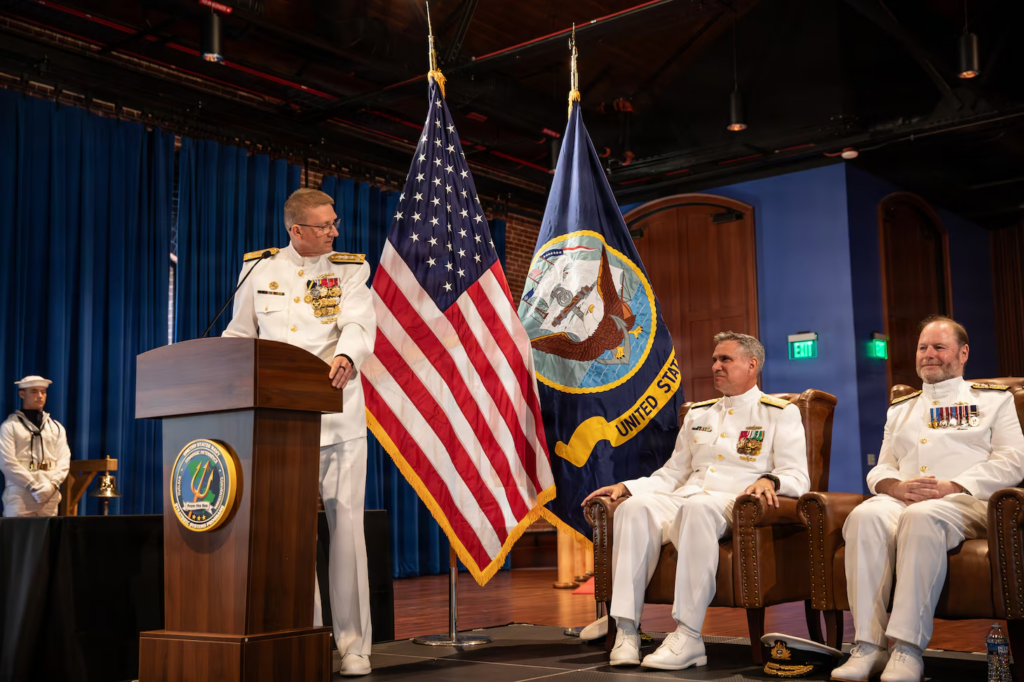
Vice Adm. Johnny Wolfe Jr., the outgoing director of Portfolio Acquisition Executive (PAE) Strategic Systems Programs (SSP), speaks to Vice Adm. Douglas L. Williams, the incoming director of PAE SSP, during the PAE SSP Change of Command ceremony in Washington D.C., on June 12, 2026. Williams, who previously performed the duties of director of test at the Missile Defense Agency, assumes command of PAE SSP as the 15th director in program history. (U.S. Navy photo by Adrian Pacheco)

by Portfolio Acquisition Executive Strategic Systems Programs Public Affairs 

June12, 2026 

WASHINGTON NAVY YARD – On June 12, 2026, Portfolio Acquisition Executive (PAE) Strategic Systems Programs (SSP) held a joint retirement and Change of Command ceremony at Admiral Leutze Park, recognizing the transfer of leadership from Vice Adm. Johnny Wolfe Jr., to Vice Adm. Douglas L. Williams. The honorable William Mahan, performing the duties of the Assistant Secretary of the Navy for Research, Development, and Acquisition, presided over the event and former Commander of U.S. Strategic Command Adm. Charles “Chas” Richard (ret.) delivered remarks as the keynote speaker. 

“Wow, what a legacy you leave, Johnny,” Richard said. “Your achievements culminated in SSP being recognized as the organizational standard for acquisition commands and your example and leadership have ensured that the next generation is ready to carry the torch. Vice Adm. Williams, congratulations on this next chapter for you and your family. We can be confident that you will carry on this tradition of excellence in the stewardship of your new command.” 

Williams previously served as the director for test at the Missile Defense Agency (MDA), where he was responsible for all aspects of planning, designing, and execution of the missile defense system flight, ground, and cyber testing, as well as wargames and exercises. He brings more than 30 years of active-duty experience to the role and has been acquainted with PAE SSP’s no-fail mission since the very start of his naval career, serving various roles and leadership positions across PAE SSP, culminating in the role of technical director as his last assignment before becoming a flag officer. In 2022, Williams was selected to the rank of Rear Admiral (lower half) and was assigned to MDA. 

Now, he returns as a newly appointed vice admiral taking on the mantle as the 15th director of PAE SSP and overseeing the Navy’s premier strategic weapon system (SWS) and regional strike capabilities, including the Conventional Prompt Strike and Nuclear-Armed Sea-Launched Cruise Missile programs. 

“I want to extend my deepest gratitude to Vice Adm. Wolfe,” Williams said. “Your visionary leadership and steadfast dedication have set a standard of excellence that will endure long after your departure. The importance of SSP to our country’s national defense has never been more vital. We remain the proud stewards of the sea-based leg of the nuclear triad, a true corner stone of our national sovereignty. SSP has invested nearly 30 years in preparing me for this moment. I am ready to join you in getting the job done. Our country is depending on us, and we will deliver.” 

Wolfe, the outgoing PAE SSP director, took charge of the command in 2018. Under his leadership, PAE SSP achieved major milestones, etching the command’s significance in U.S. Navy history and consistently providing the nation – and its warfighters – with unparalleled warfighting capabilities. Wolfe led PAE SSP’s execution of the development, acquisition, sustainment, safety and security, fleet support and modernization of the Trident II (D5) SWS and established the programs to develop the Navy’s Regional Strike Systems in support of the full spectrum of deterrence. 

“It is hard to believe this day has finally arrived,” Wolfe said. For my entire adult life, I have had the distinct honor and privilege of wearing this uniform, of serving our great nation, and of being a part of something vastly larger than myself—the United States Navy. Serving as the Director of SSP has been the honor of a lifetime. The scope and scale of our mission have always been vital, but the growth we have seen over the last nine years has been nothing short of extraordinary. We have expanded our reach, established new programs, and taken on unprecedented new challenges to meet the demands of a changing world. I am exceedingly proud of what this team has accomplished. As we look to the future, the mission of SSP is evolving at a rapid pace. The defense of our nation requires us to be more agile, more innovative, and more forward-thinking than ever before.” 

Wolfe retires from the U.S. Navy after a distinguished military career spanning more than 38 years of active-duty service. His leadership ensured relentless dedication to the Navy’s strategic deterrence mission and to national security priorities. As he brings down the curtain on a decorated naval career, he leaves PAE SSP and its workforce with a solid foundation forged through trust and commitment to the nation’s defense. 

“If there is a central theme I have tried to live by throughout my career – and the one message I want to leave with you today – it is simple yet absolute: the mission is paramount, but it is the people who are most important,” Wolfe said. “It is a philosophy of servant leadership. Our primary role as leaders is to take care of our people, to empower them, to foster their growth, and to ensure they have everything they need to succeed. Because I have learned, time and time again, that when our people thrive, the mission will never fail.” 

PAE SSP is responsible for sustaining the strategic weapon system on the Ohio-class ballistic missile submarines and supporting the integration of the D5LE weapon system on the new Columbia-class SSBNs. Looking to the future, PAE SSP is actively modernizing the sea-based leg of the nuclear triad through the development of the D5LE2 SWS and pioneering regional strike capabilities of the future through development of the nuclear-armed sea launched cruise missile and the non-nuclear hypersonic conventional prompt strike system. 


USS Augusta Returns to San Diego 

From Lt. Brinn Hefron, June 12, 2026 

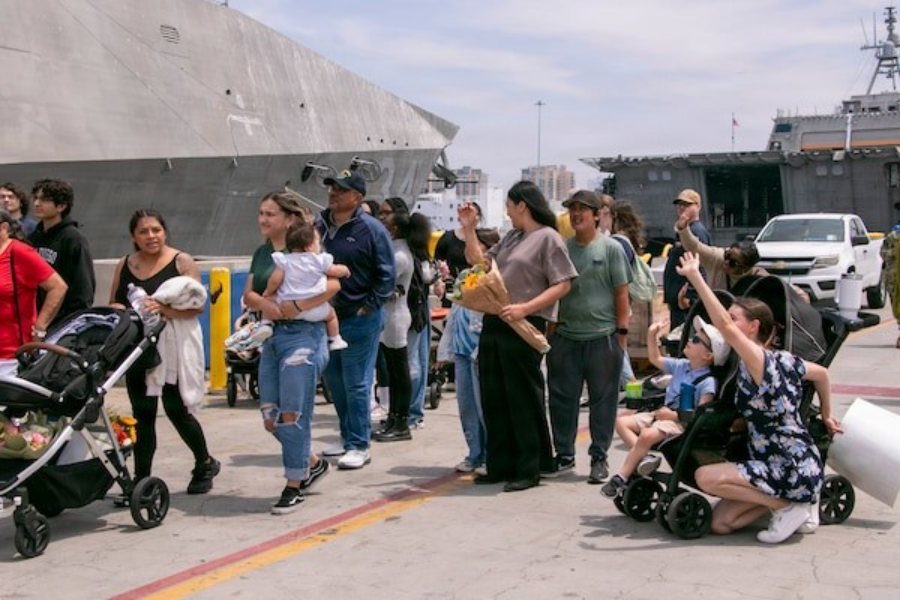
SAN DIEGO –Independence-variant littoral combat ship USS Augusta (LCS 34) arrived at its San Diego homeport June 11, following six months of operations in the U.S. 3rd Fleet in support of U.S. Northern Command (NORTHCOM)-led Operation Ardent Vanguard to protect the southern border. 

“Congratulations to Augusta for completing this underway in support of national tasking with flying colors,” said U.S. Navy Cmdr. Zachary Smith, commanding officer of Augusta. “The crew achieved more than 500 hours of flight operations with an MH-60S LCS detachment and 12 small boat operations with the 11-meter rigid-hull inflatable boat.” 

Augusta and embarked U.S. Coast Guard Law Enforcement Detachments, under NORTHCOM’s maritime homeland defense authorities, was responsible for six interdictions of suspected smuggling vessels, preventing the flow of illegal drugs and other illegal activity. 

While underway, Augusta successfully integrated three separate teams of U.S. Navy aviation, Aerosonde UAS and U.S. Coast Guard Law Enforcement Detachments to enable multi-domain operations. Augusta conducted the most helicopter flight hours ever for an embarked aviation detachment on an operational Independence-variant LCS. 

“The team integrated with embarked U.S. Coast Guard Law Enforcement and Helicopter Sea Combat detachments, showcasing the capabilities of an LCS operating in the littorals,” said Smith. “I am proud to be the CO of this team of teams. Augusta carried out the ship’s motto: ‘protecting the frontier!’” 

Augusta is a fast, optimally manned, mission-tailored surface combatant that operates in near-shore and open-ocean environments, winning against 21st-century coastal threats. LCS, like Augusta, integrate with joint, combined, manned and unmanned teams to support forward presence, maritime security, sea control, and deterrence missions around the globe. 


U.S. Coast Guard advances Arctic security with Kodiak and Seward homeports 

From U.S. Coast Guard Headquarters, June 11, 2026 

WASHINGTON — The U.S. Coast Guard announced it would homeport its first two Arctic Security Cutters in Kodiak, Alaska with a third Alaska Arctic Security Cutter homeported in Seward when the infrastructure is ready. This follows April’s announcement that the Service would homeport its first two Arctic Security Cutters in Alaska. With the first delivery expected in 2028, the Coast Guard is accelerating preparations to ensure each location is ready to support sustained Arctic operations including advancing critical infrastructure and housing required to support the trained and ready crews who will bring these cutters to life.   

“America’s future in the Arctic demands strength, capability and resolve,” said Secretary of Homeland Security Markwayne Mullin. “I want to thank President Trump for his bold leadership and vision in directing this critical investment and Alaska’s congressional delegation for championing the funding that made these icebreakers possible. These cutters will deliver the enduring operational capability our Nation needs to defend our sovereignty, deter adversaries, and safeguard vital resources for the American people. 

Selecting these homeports marks a major step in expanding U.S. Arctic capabilities and strengthening the Nation’s icebreaker fleet. Supported by $3.5 billion in Fiscal Year 2025 Reconciliation funding and international collaboration, including a landmark agreement with Finland, the Arctic Security Cutter program represents the most significant U.S. investment in icebreaker technology in decades – revitalizing American shipbuilding and reinforcing the industrial base essential to national defense. 

“Homeporting Arctic Security Cutters in Kodiak and Seward will strategically position these state-of-the-art icebreakers to reinforce America’s maritime dominance in the Arctic,” said Adm. Kevin E. Lunday, commandant of the Coast Guard. “This positioning is critical to national security, enabling the Coast Guard to defend our northern border and meet evolving threats with speed and strength.” 

Arctic Security Cutters will anchor a modernized icebreaker fleet built for the most demanding conditions, ensuring the United States is equipped to defend its interests and meet emerging challenging in the Arctic for decades to come.   


Rethinking Sailors and CVN RCOH: Navy Leverages Industry Contracts to Reclaim Up to 1 Million Sailor Man-Hours 

From CNIC & NAVSEA Public Affairs, June 15, 2026 

NORFOLK, Va. (June 15, 2026) – The Navy Quality of Service Cross-Functional Team (QoS CFT) and PAE Maritime’s In-Service Aircraft Carrier Program Office (PMS 312) are changing how the Navy does business for the execution of aircraft carrier Refueling and Complex Overhaul (RCOH), beginning with USS Harry S. Truman (CVN 75). 

A RCOH is a comprehensive maintenance and modernization overhaul that is performed at the midpoint of an aircraft carrier’s 50-year lifespan. Traditionally, Sailors assigned to a ship undergoing an RCOH could be assigned to perform supplementary, non-rate-specific duties such as painting, insulating, transportation services, and maintenance. 

The Navy is rethinking its approach by leveraging commercial contracts to fulfill these requirements during Harry S. Truman’s upcoming RCOH, a strategic shift that will potentially return up to one million man-hours to the crew. By reducing the crew’s supplementary workload during demanding shipyard periods, Sailors will have more time to focus on advanced training and operational readiness. 

“This shift is about putting our Sailors’ time and talents where they matter most,” said Vice Adm. Scott Gray, who leads the Navy QoS CFT. “By contracting out routine tasks like transportation and preservation, we free our crew from traditional shipyard duties, empowering them to focus on their in-rate training and core warfighting capabilities.” 

To date, five Navy contracts have returned approximately 690,000 labor hours to the crew, with plans to award five additional contracts over the next five years. 

As a key component of the Navy’s broader Quality of Service (QoS) initiatives, this strategy allows for optimized, smaller crew sizes to remain assigned to ships undergoing maintenance. 

By alleviating hands-on, non-rate-specific maintenance tasks, Sailors can concentrate on developing critical warfighting skills and completing their professional development. This approach maintains a higher state of overall readiness while significantly improving the crew’s quality of life in the shipyard environment. 

Ultimately, this transition is expected to streamline maintenance processes, fostering a more sustainable and effective workforce balance between active-duty personnel and the shipyard’s industrial base. 

The Portfolio Acquisition Executive (PAE) for Maritime is the single accountable organization for delivering surface ships for the U.S. Navy. This new centralized organizational construct empowers leaders with broader scope and greater authority to accelerate delivery of combat capability and ensure acquisition speed and discipline are driven by what the warfighter needs—when they need it.” 

In addition to leading the Navy QOS CFT, Vice Adm. Scott Gray serves as Commander, Navy Installations Command, which is responsible for worldwide U.S. Navy Shore installation management, designing and developing integrated solutions for sustainment and development of Navy shore infrastructure as well as quality of life programs. CNIC oversees 10 Navy regions, 71 installations, and more than 48,600 employees who are focused on warfighting and manning, training, and equipping the Shore to fight and win. Navy installations are warfighting platforms essential to every fleet operation.