USS John P. Murtha to Support NASA’s Artemis II Mission
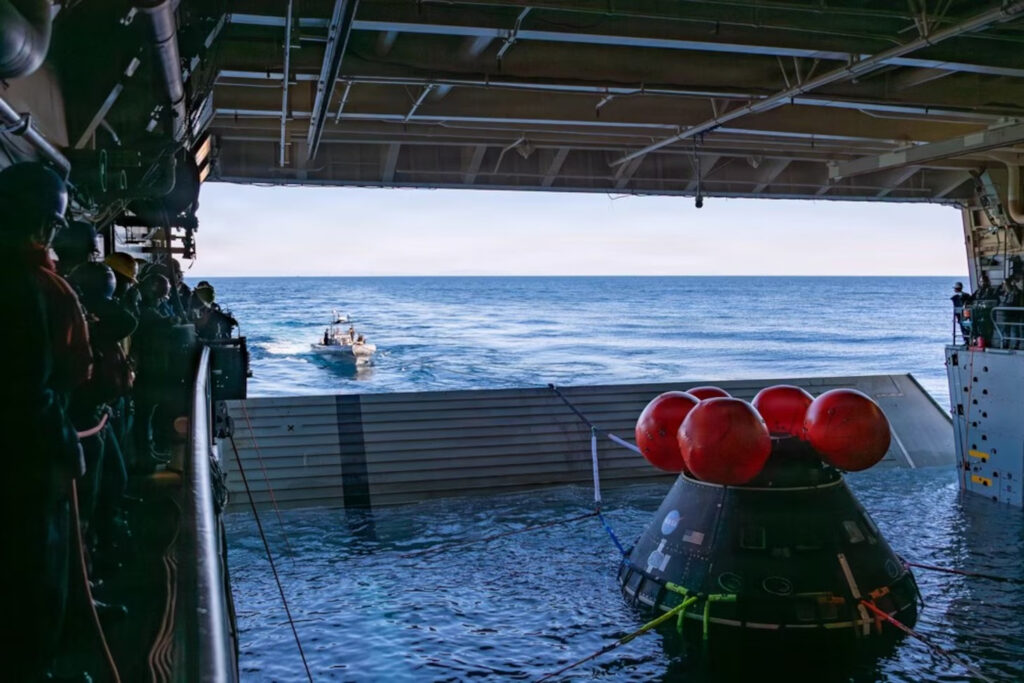
Sailors assigned to amphibious transport dock ship USS John P. Murtha (LPD 26) and NASA engineers prepare to release a crew module test article from the ship’s well deck, Jan. 26, 2026. John P. Murtha is underway in the U.S. 3rd Fleet area of operations performing a just-in-time training in support of U.S. Space Command’s human space flight recovery mission to retrieve NASA’s Artemis II crew and spacecraft following their splashdown in the Pacific Ocean. (U.S. Navy photo by MC1 Jomark A. Almazan)
From Petty Officer 1st Class Jomark Almazan, April 6, 2026
SAN DIEGO — Amphibious transport dock ship USS John P. Murtha (LPD 26) is slated to serve as the recovery ship for the Orion spacecraft and its crew upon their return from the historic Artemis II mission.
The ship is named in honor of the late and long-serving Pennsylvania Congressman John P. Murtha.
“It is a fitting tribute to Congressman Murtha, who dedicated his life to serving our nation, that the ship bearing his name will be integral to this historic moment in space exploration,” said U.S. Navy Capt. Erik Kenny, commanding officer of John P. Murtha. “He was a champion for our military and a visionary. We are honored to carry on his legacy by supporting NASA and the Artemis II mission.”
The Artemis II mission is the first crewed flight of NASA’s Space Launch System (SLS) rocket and Orion spacecraft, sending four astronauts on an approximately 10-day journey that will take them beyond the Moon. This mission will mark humanity’s first crewed voyage to the vicinity of the moon in over 50 years.
Upon completion of their mission, the Orion capsule will splash down in the Pacific Ocean, where John P. Murtha and its crew will be prepared to recover the astronauts and the spacecraft.
The U.S. Navy’s amphibious transport dock has unique advantages, including a well deck, helicopter pad, onboard medical facilities, and communication capabilities needed to support the mission. The platform gives NASA the ability to recover the Orion space capsule and collect critical data to help ensure it’s ready to recover the astronauts and capsule during future Artemis missions.
MH-60S Sea Hawk helicopters from Helicopter Sea Combat Squadron (HSC) 23 will provide imagery support for NASA by tracking the Orion space capsule as it travels through Earth’s atmosphere. After splashdown, HSC-23 helicopters will recover the astronauts once they exit the capsule and bring them to the ship for assessment and then transport them to shore.
Explosive Ordnance Disposal Group (EODGRU) 1 will provide Navy divers to recover and transport the Orion space capsule from the ocean to the ship’s well deck. Navy divers are experts in mobile diving, salvage, towing, and open water, small boat operations. In addition to the Navy divers, EODGRU-1 will support the recovery mission with a dive medical team to assess and assist the astronauts following their exit from the capsule.
Artemis II is NASA’s first crewed mission in a series of missions around and to the lunar surface where crew can build and test systems needed to prepare for the challenge of future missions to Mars. The mission launched from NASA’s Kennedy Space Center in Florida, April 1, with four astronauts onboard.
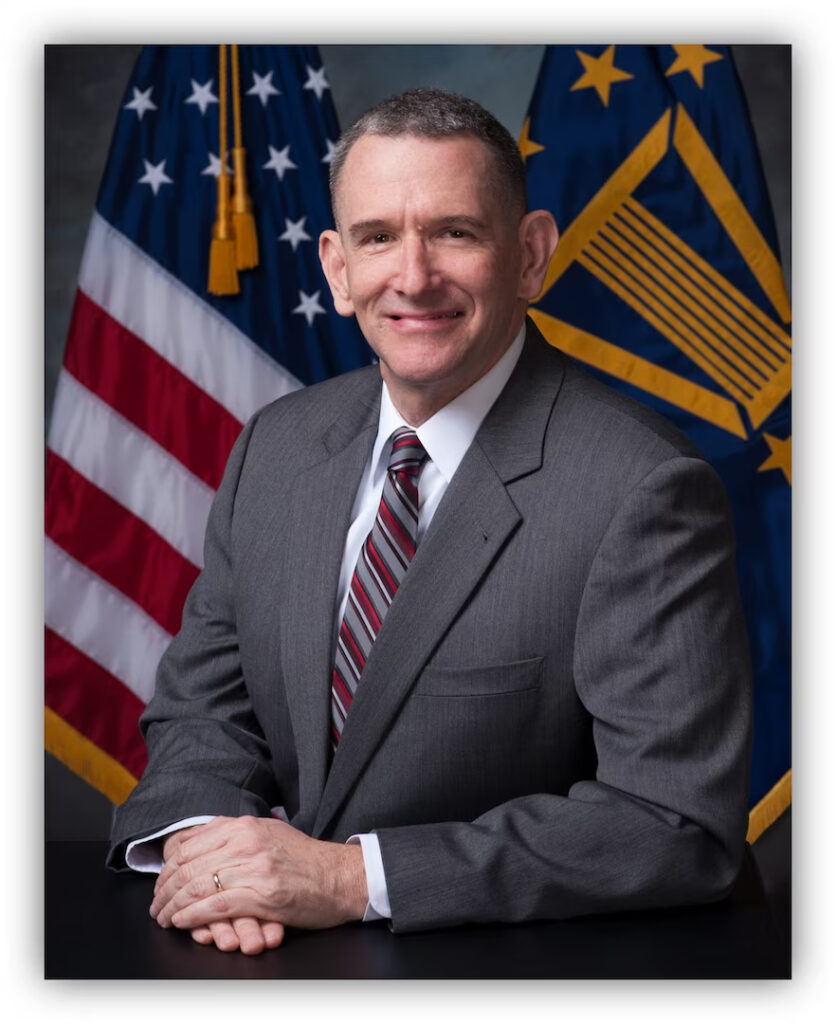
Mr. Peter Reddy named NAVSEA Warfare Centers Executive Director
By NAVSEA Warfare Centers Public Affairs, April 8, 2026
WASHINGTON – Mr. Peter Reddy has been appointed as the Executive Director of the Naval Sea Systems Command (NAVSEA) Naval Surface and Undersea Warfare Centers.
Reddy most recently served as the Deputy Assistant Secretary of the Navy for Research, Development, Test and Engineering (DASN (RDT&E)), under the Assistant Secretary of the Navy for Research, Development and Acquisition (ASN (RDA)). In that role, he was responsible for executive oversight of all matters related to RDT&E budget activities, science and engineering, advanced research and development, prototyping and experimentation, and test and evaluation. He was also responsible for management and stewardship of the Naval Research and Development Establishment (NR&DE), which includes naval laboratories and warfare centers, Office of Naval Research, Naval Postgraduate School, five University Affiliated Research Centers, and the Navy’s Federally Funded Research and Development Center.
Jason Potter, who is performing the duties of ASN (RDA), congratulated Reddy for assuming his critical new role at the NAVSEA Warfare Centers and called him a champion for the Department of the Navy engineering workforce, with an encyclopedic knowledge of the NR&DE and the intricacies of the Navy Working Capital Fund.
Reddy became a member of the Senior Executive Service (SES) in November 2019 with his appointment as Executive Director of Naval Information Warfare Center (NIWC) Atlantic, part of the Naval Information Warfare Systems Command (NAVWAR), where he served until January 2025.
A seasoned aerospace and systems engineer, Reddy brings extensive technical and engineering leadership expertise, forged through a distinguished career as both a senior civilian executive and a commissioned officer in the U.S. Marine Corps, where he served for 30 years before retiring from active duty in May 2014. He has a proven track record of managing a broad portfolio, including information systems technology; command, control, communications, computers, intelligence, surveillance and reconnaissance (C4ISR); and cyber systems.
In a message to the NAVSEA Warfare Centers’ workforce, Acting NAVSEA Executive Director Thomas A. Perotti noted, “Mr. Reddy’s leadership and vision will be instrumental as we continue to accelerate the delivery of decisive combat power for our Navy and our nation.”
The NAVSEA Warfare Centers are the Navy’s principal research, development, test and evaluation assessment activity for surface ship and submarine systems and subsystems and supply the technical operations, people, technology, engineering services and products needed to equip and support the fleet and meet the warfighters’ needs. The Warfare Centers comprise 10 divisions: Naval Surface Warfare Center (NSWC) Carderock, NSWC Corona, NSWC Crane, NSWC Dahlgren, NSWC Indian Head, Naval Undersea Warfare Center (NUWC) Keyport, NUWC Newport, NSWC Panama City, NSWC Philadelphia, and NSWC Port Hueneme.
Navy UAS Surpass 1 Million Hours in ISR Operations
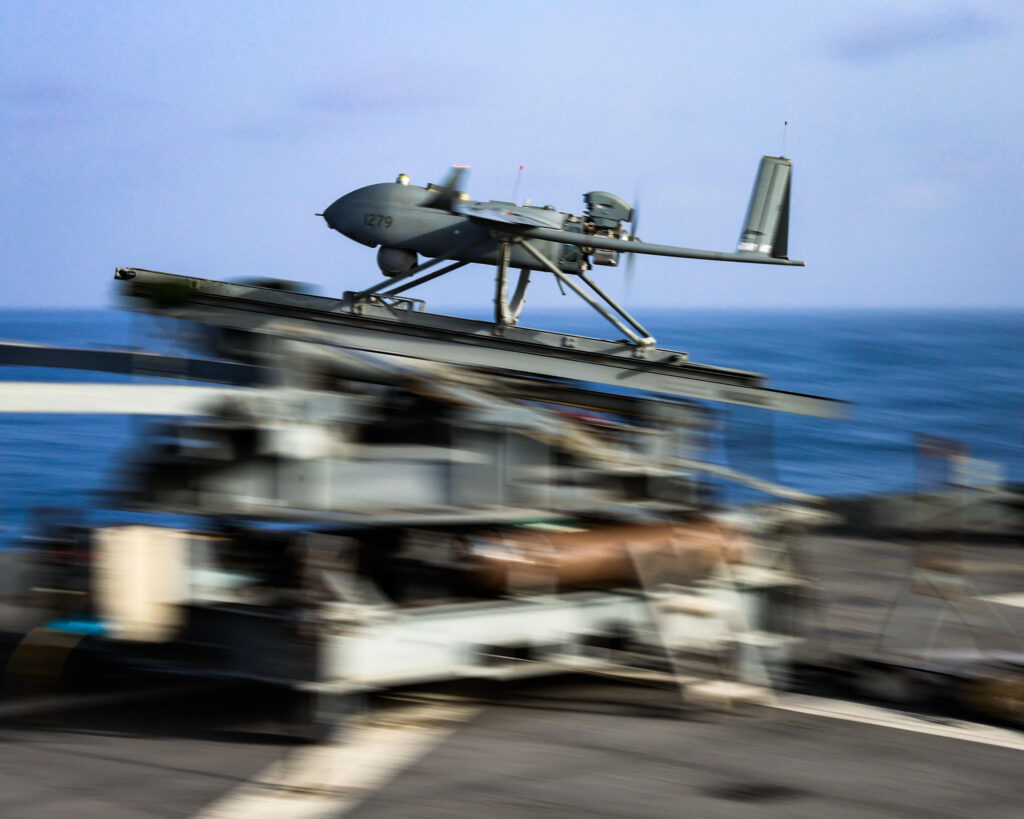
A Textron MQ-19 Aerosonde Unmanned Aircraft System launches from the expeditionary sea base ship USS Hershel “Woody” Williams (ESB-4).
From the Navy and Marine Corps Small Tactical Unmanned Aircraft Systems Program Office, April 9, 2026
PATUXENT RIVER, Md. – The Navy and Marine Corps Small Tactical Unmanned Aircraft Systems (UAS) Program Office announced its Intelligence, Surveillance and Reconnaissance (ISR) Services UAS have surpassed 1 million flight hours supporting operations on land and at sea.
Sailors achieved the milestone during routine mission support in the U.S. 6th Fleet.
Since the program’s inception in 2005, the program office has completed more than 50 UAS installations aboard Navy and Military Sealift Command (MSC) ships and operated from more than 50 land-based locations worldwide. The ISR Services team ensures ships across the 4th, 5th, 6th and 7th fleets, as well as land-based operations worldwide, are equipped to provide day-and-night ISR support to joint force and coalition partners.
“Every hour flown represents more than mission success—it reflects the resilience of our people, the trust of our partners and the impact we’ve had on history,” said Gregg Skinner, program manager. “Together, we’ve supported operations in every corner of the globe, advanced unmanned systems into the fight and stood ready in times of uncertainty.”
More than a dozen ships are currently equipped with ISR Services UAS, enabling naval vessels to launch and recover aircraft in support of missions. Sea- and land-based systems include the Boeing Insitu MQ-27 ScanEagle and the Textron MQ-19 Aerosonde, both providing day-and-night surveillance and around-the-clock mission support to the warfighter.
UAS installations are optimized to help transfer full-motion video and other sensor data to personnel in critical locations. The information gathered by these systems plays a vital role in tactical operational decision-making and long-term intelligence gathering, strengthening the Navy and Marine Corps’ ability to maintain maritime domain awareness and operational readiness.
U.S. Coast Guard Cutter Midgett Rescues Family Missing for 7 Days in Micronesia
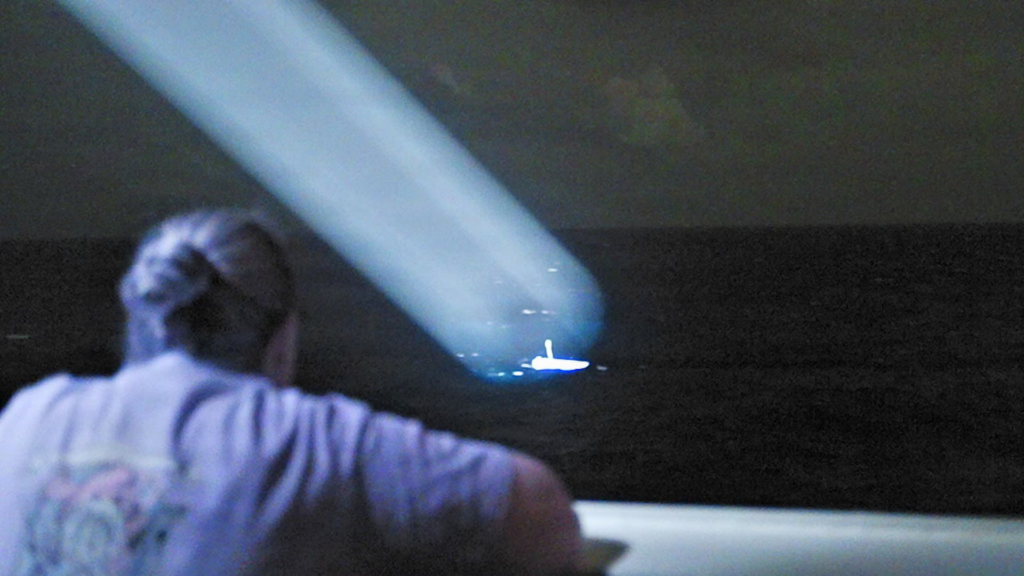
U.S. Coast Guard Lt. Cmdr. Stephanie Jocis, operations officer aboard Legend-class cutter USCGC Midgett (WMSL 757), observes a 23-foot single-outboard skiff vessel, carrying three members of a missing family in the waters of Chuuk State, Federated States of Micronesia, in Midgett’s search light during the early hours of April 6, 2026. The crew of Midgett rescued the family after the vessel went missing on March 30 in the waters of Chuuk State. U.S. Coast Guard missions in the Indo-Pacific focus on issues directly supporting and advancing our regional partners’ efforts to protect fish stocks and ensure the safety of life at sea, ensuring a secure and prosperous Indo-Pacific. (U.S. Coast Guard photo by Seaman Lauren Taber)
From U.S. Coast Guard Forces Micronesia, April 7, 2026
SANTA RITA, Guam — A family of three was returned to Chuuk State, part of the Federated States of Micronesia, following search and rescue operations conducted by the Legend-class cutter USCGC Midgett (WMSL 757) crew on April 6, 2026.
The Midgett crew located the missing family after receiving a report on Easter Sunday from authorities in the Federated States of Micronesia and the U.S. Embassy that the vessel was overdue.
“Our U.S. Coast Guard colleagues’ swift and courageous actions in this successful search and rescue mission not only reflect the highest standards of professionalism and humanity but also reinforce the deep and enduring partnership between the United States and the Federated States of Micronesia,” said Jennifer Johnson, U.S. Ambassador to the Federated States of Micronesia. “This mission exemplifies the spirit of cooperation and mutual support at the heart of the Compact of Free Association, underscoring how our close relations translate into real, life-saving outcomes for our people.”
At night, the crew of Midgett visually located the 23-foot single-outboard skiff carrying the missing family, two men and one woman, in the waters off the coast of Chuuk State. The family departed Fananu Island on March 30 for the short passage to Murillo Island, but never arrived due to a failure of their single outboard engine. At the height of search planning, the predicted search area exceeded 14,000 square nautical miles in rough seas with waves reaching 10 feet.
All three survivors were rescued and uninjured. They were then safely delivered to Weno in Chuuk State for further transport to Fananu Island.
“National Security Cutter crews spend most of their time executing maritime law enforcement missions, often with our international partners,” said Capt. Brian Whisler, commanding officer of Midgett. “SAR cases like this one are not routine for our platform. Our bridge watchstanders spotted the small skiff in rough seas just after midnight, and that kind of situational awareness does not happen by accident. It is what this crew trains for, and I could not be prouder of how they performed.”
During the SAR operation, watchstanders from the U.S. Coast Guard Joint Rescue Sub-Center Guam at U.S. Coast Guard Forces Micronesia/Sector Guam developed the search patterns and coordinated with U.S. Coast Guard District Oceania and Air Station Barbers Point personnel to launch an HC-130 Hercules airplane and crew from Hawai’i to support the search and directed the launch of the USCGC Frederick Hatch (WPC 1143) crew from Guam. The Midgett crew, already conducting a Western Pacific patrol, diverted following a bilateral maritime law enforcement boarding with two embarked officers from the FSM in their exclusive economic zone, approximately 200 nautical miles south of Fananu Island.
“This rescue reflects the strategic value of maintaining a capable surface presence across the region’s vast maritime expanse,” said Lt. Cmdr. Derek Wallin, the U.S. Coast Guard search and rescue mission coordinator. “Without the Midgett’s proximity, coordinating a search across more than 14,000 square nautical miles of open ocean would have required significantly more time and resources. Time the three missing people may not have had.”
Throughout its current Indo-Pacific region patrol, Midgett’s crew is scheduled to engage with regional partners and participate in joint operations to enhance maritime safety and security. While deployed to the region, Midgett is assigned to Destroyer Squadron 15, the Navy’s largest DESRON and the U.S. 7th Fleet’s principal surface force. DESRON 15 regularly assumes tactical control of surface units operating in the area.
U.S. 7th Fleet, the Navy’s largest forward-deployed numbered fleet, routinely interacts and operates with allies and partners in preserving a free and open Indo-Pacific.
NRL’s Advanced Payloads Soar into Orbit Aboard STPSat-7 Mission
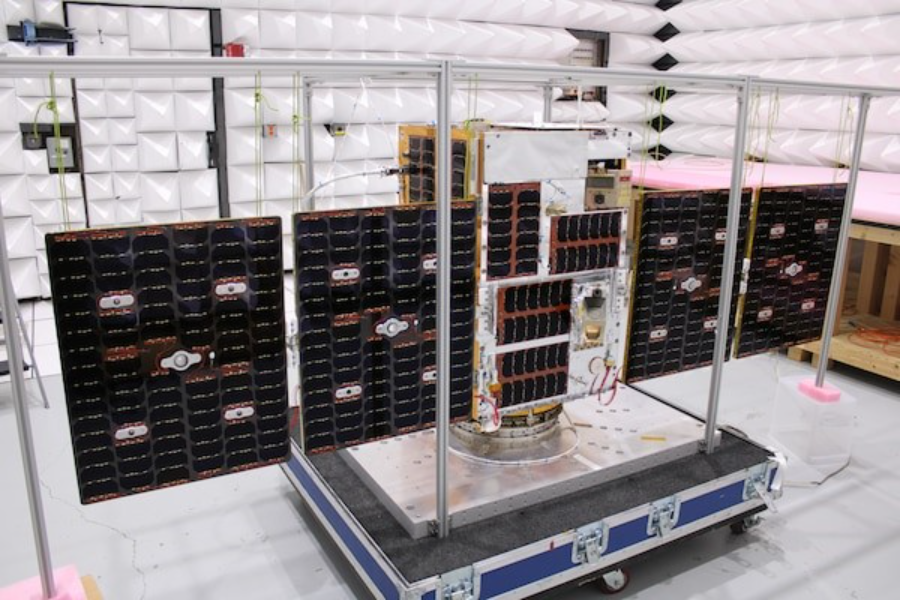
Department of War (DoW) Space Test Program’s (STP) STPSat-7 payload, at NASA Marshall Space Flight Center, Huntsville, Ala., June 25, 2025. (Photo by DoW Space Test Program)
From Emily Winget U.S. Naval Research Laboratory Corporate Communications, April 7, 2026
WASHINGTON,D.C. – U.S. Naval Research Laboratory (NRL) successfully launched three advanced experimental payloads aboard the Department of War (DoW) Space Test Program’s (STP) Satellite-7 mission at approximately 4:33 a.m. PDT on April 7 from Vandenberg U.S. Space Force (USSF) Base, Calif.
NRL’s payloads included the Lasersheet Anomaly Resolution and Debris Observation (LARADO) instrument; the Global Navigation Satellite System (GNSS) Orbiting Situational Awareness Sensor (GOSAS); and the Gadolinium Aluminum Gallium Garnet (GAGG) Radiation Instrument (GARI-1C).
The STPSat-7 spacecraft is aboard the STP-S29A mission, which uses a Northrop Grumman Minotaur IV launch vehicle, marking a significant step forward in advancing U.S. space-based capabilities for the U.S. Navy and national security. By improving understanding of the space environment and testing next-generation satellite technologies, NRL is ensuring the United States maintains its technological advantage and protects critical assets in orbit.
LARADO
One of the key NRL payloads, LARADO will directly address the growing threat of orbital debris.
“LARADO is the next step in ensuring situational awareness in space,” said Andrew Nicholas, NRL Sensor Development and Applications Section Head and LARADO principal investigator. “The instrument will detect and characterize small orbital debris that cannot be observed from the ground. This is vital to understanding the space environment and will provide essential data to update orbital debris models. These updates are important to the orbital debris research community, engineers designing spacecraft to survive and minimize growth to the debris environment, satellite operators, and policy makers.”
The LARADO concept began in 2012. In FY22, NASA’s Heliophysics Division Space Weather Program’s Orbital Debris and Space Situational Awareness portfolio within its Science Mission Directorate began funding the development of the LARADO instrument for STPSat-7.
GOSAS
GOSAS will improve the reliability of navigation and communication systems for warfighters.
“The GOSAS is a CubeSat-compatible, programmable dual GPS receiver designed to characterize the orbital GNSS environment and produce high quality ionospheric space weather products,” said Scott Budzien, Ph.D., NRL research physicist and GOSAS principal investigator. “Understanding and predicting space weather is critical for ensuring the accuracy of GPS and the integrity of military communications.”
GOSAS is a follow-on to the NRL experiment GROUP-C (GPS Radio Occultation and Ultraviolet Photometry-Collocated) experiment on the International Space Station from 2017-2023 that serendipitously detected GPS ground interference. GOSAS originated in 2020 with the mission of increasing GPS accuracy for the warfighter.
GARI-1C
GARI-1C is set to pave the way for future defense applications from space, including detecting weapons of mass destruction. The NRL team takes technology developed for ground-based applications and tests its performance in space. Since most commercial-off-the-shelf components are not radiation-hardened, understanding how they respond to the harsh radiation environment of space is critical for future operational use.
“GARI-1C is designed to space-qualify new gamma-ray detector technology for space-based defense applications,” stated Lee Mitchell, Ph.D., NRL Research Physicist and GARI-1C principal investigator. “This detector technology offers improved energy resolution, lower power consumption and reduced size compared to similar systems, which is key to developing more advanced and efficient sensors for detecting threats from orbit.”
The DoD/DoW Space Test Program (STP) was founded in 1966 to provide flight opportunities for all DoD/DoW research and development activities in an economic and efficient manner. Under the U.S. Space Systems Command, STP supports mission design, payload-to-bus integration, space vehicle-to-launch vehicle integration, and on-orbit operations for S&T payloads that exhibit potential military utility. By advancing scientific knowledge and capability, STP is foundational to ensuring continuous STP advantage in the space domain.
“The success of this mission, achieved through a powerful collaboration with the DoW’s Space Test Program, highlights how cutting-edge research and development are fundamental to preserving America’s strategic edge in space,” said USSF Lt. Col. Brian Shimek, system program manager and director for STP.
NRL’s Space Science Division conducts a broad-spectrum of Research, Development, Test & Evaluation in solar-terrestrial physics, astrophysics, upper and middle atmospheric science, and astronomy. The Division’s Military Deputy, Lt. Elijah Ray, is embedded with DoW STP at Kirtland Air Force Base, N.M., as NRL’s on-site liaison for space experiment coordination and advocacy.
About the U.S. Naval Research Laboratory NRL is a scientific and engineering command dedicated to research that drives innovative advances for the U.S. Navy and Marine Corps from the seafloor to space and in the information domain. NRL, located in Washington, D.C. with major field sites in Stennis Space Center, Mississippi; Key West, Florida; Monterey, California.
NRL offers several mechanisms for collaborating with the broader scientific community, within and outside of the Federal government. These include Cooperative Research and Development Agreements (CRADAs), LP-CRADAs, Educational Partnership Agreements, agreements under the authority of 10 USC 4892, licensing agreements, FAR contracts, and other applicable agreements.
U.S. Navy and Royal Danish Navy Conducted Medical Evacuation Near Greenland, Highlighting Arctic Interoperability
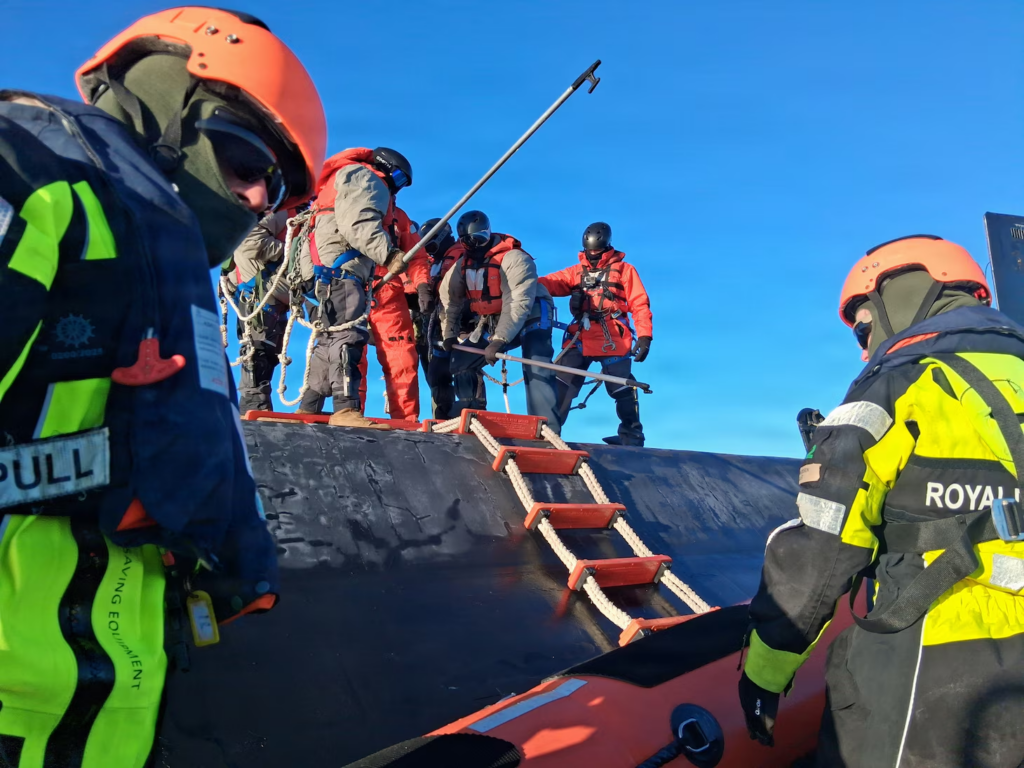
NUUK, Greenland (Feb. 21, 2026) – Members of the Royal Danish Navy assigned to the offshore patrol vessel HDMS VAEDDEREN (F 359) embark the Virginia-class fast-attack submarine USS Delaware (SSN 791) ) in preparation for a personnel transfer. Delaware is operating in the U.S. Naval Forces Northern Command (NAVNORTH) area of operations. NAVNORTH is the maritime component of U.S. Northern Command (USNORTHCOM) and is responsible for homeland defense, maritime security, and theater security cooperation in the Arctic and North American maritime approaches. (Courtesy photo)
PETERSON SFB, Colo.– A recent medical evacuation of a U.S. Navy Sailor off the coast of Greenland demonstrated the importance of international partnerships and readiness in the Arctic.
In late February, while preparing for Ice Camp 2026, a Sailor aboard the Virginia-class fast-attack submarine USS Delaware (SSN 791) required urgent medical attention. Severe weather conditions prevented evacuation to other locations, prompting the submarine to divert toward Greenland. U.S. naval forces coordinated with the Danish Joint Arctic Command, which dispatched the Royal Danish Navy offshore patrol vessel HDMS Vaedderen (F 359) to assist.
Crews from both nations worked together to transfer the Sailor at sea.
The MEDEVAC occurred as U.S. forces were preparing for Ice Camp 2026, an Arctic operation focused on testing and refining capabilities in the region. These efforts underscore the shared commitment of the U.S. and its allies to Arctic security and regional stability.
U.S. Coast Guard, NOAA partner to restore tsunami warning capability on remote FSM atoll during 29-day Operation Rematau patrol period
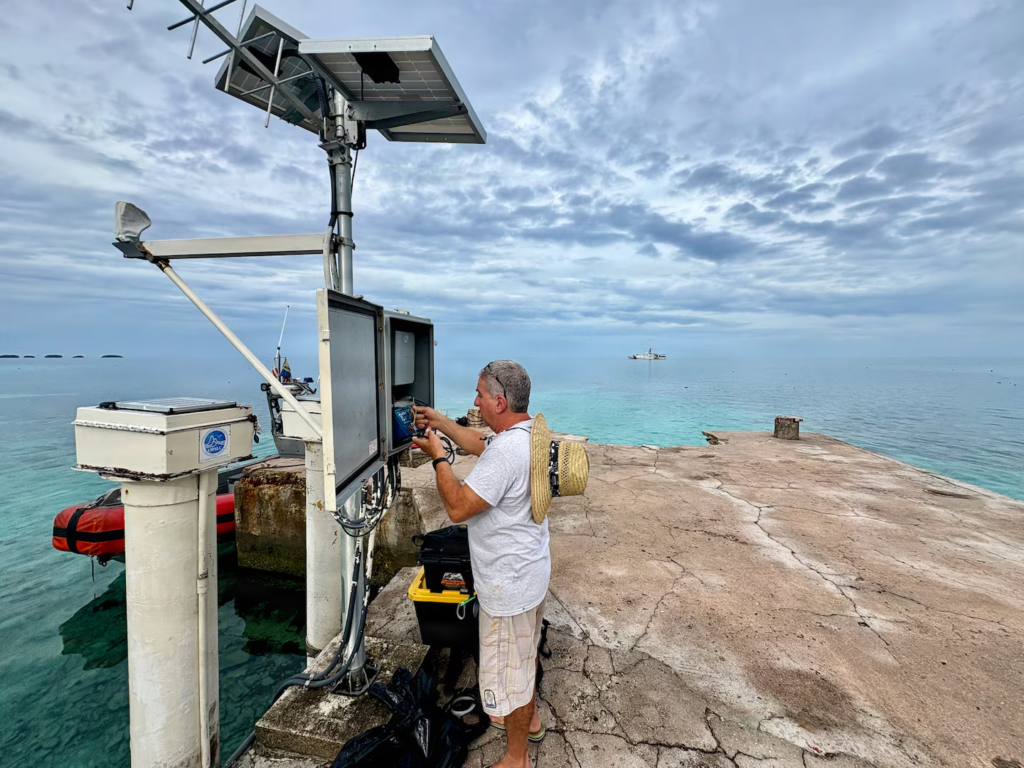
The crew of USCGC Oliver Henry (WPC 1140) supports a University of Hawai’i Sea Level Center technician to upgrade a regional NOAA weather monitoring station on Kapingamarangi Atoll, Federated States of Micronesia, on March 20, 2026, in conjunction with supporting a supply delivery. Oliver Henry is the first Fast Response Cutter to make the transit. USCGC Oliver Henry (WPC 1140) returned to Guam on March 29, 2026, closing out a 29-day patrol period that restored a critical tsunami early warning station to a remote Pacific atoll, delivered humanitarian supplies to two island communities, and enforced fisheries laws across more than 4,000 nautical miles. (U.S. Coast Guard photo)
U.S. Coast Guard Forces Micronesia, April 6, 2026
SANTA RITA, Guam — The crew of the USCGC Oliver Henry (WPC 1140) returned to Guam on March 29, closing out a 29-day patrol period that restored a critical tsunami early warning station on a remote Pacific atoll, delivered humanitarian supplies to two island communities, and enforced fisheries laws across more than 4,000 nautical miles.
The patrol under Operation Rematau covered U.S. waters in the Commonwealth of the Northern Mariana Islands, Guam, and the Federated States of Micronesia.
“The Coast Guard’s credibility in this part of the Pacific is built one port call, one boarding, one supply delivery at a time. This patrol, from the fisheries enforcement work in FSM’s EEZ to getting that NOAA technician to Kapingamarangi, is exactly how we honor the commitments the United States made to the people in this region. I’m proud of how this team delivered on that responsibility,” said Lt. Ray Cerrato, commanding officer of USCGC Oliver Henry.
The mission’s most consequential stop came at Kapingamarangi Atoll, one of FSM’s most isolated communities. The Oliver Henry crew transported a University of Hawai’i Sea Level Center technician to the atoll to upgrade a regional weather monitoring station, the first such upgrade in 12 years. Supported by the U.S. Embassy in the FSM and the National Oceanic and Atmospheric Administration, the mission restored the station’s capacity to support tsunami early-warning monitoring across the Western Pacific.
The station’s importance came into sharp focus days after Oliver Henry returned to Guam. On April 2, a magnitude 7.4 earthquake struck in the Molucca Sea, prompting the Pacific Tsunami Warning Center to issue a threat forecast for coastal communities across the Western Pacific, including Guam, the CNMI, Palau, and Yap. The Kapingamarangi gauge was online and transmitting when the event occurred, ready to contribute observed sea level data to the warning center’s analysis.
The earthquake’s distance meant tsunami generation was minimal and not detectable at the Kapingamarangi station, but the network it supports held. The PTWC team confirmed the station is one of a small number of sensors covering that stretch of the Western Pacific and that its restoration directly maintains the readiness network the warning center depends on.
The crew conducted three fisheries enforcement boardings of foreign-flagged vessels, two Western and Central Pacific Fisheries Commission inspections on the high seas, and one enhanced bilateral boarding of a vessel under the FSM’s jurisdiction in their EEZ, directly advancing accountability under local and international laws in a region where illegal fishing is estimated to cost Pacific nations billions annually.
At Kuttu and Kapingamarangi, the crew delivered 3,000 pounds of humanitarian supplies to residents with limited access to outside goods. The crew also provided Chuuk State Government officials with high-quality imagery documenting the condition of a cargo vessel that grounded on the reef outside of Kuttu Island in the Mortlock Islands in 1998 and has been deteriorating since, supporting local government response efforts.
The patrol expanded the Coast Guard’s operational reach for future missions. The crew charted previously unrecorded reefs within Greenwich Pass at Kapingamarangi, establishing a navigable route into the atoll’s lagoon for future operations. The Oliver Henry crew also transported Marine Safety Unit Saipan personnel to Tinian and Rota for inspections of port facilities, streamlining logistics, and ensuring the safe flow of goods throughout the CNMI.
During the 395 operational hours underway, the crew improved readiness by qualifying members in roles ranging from underway officer of the deck to engineering officer of the watch while also honoring nautical traditions with one member earning their permanent cutterman designation and six shellback designations during the patrol’s equatorial crossing. They also completed nearly two dozen engineering, navigation, and seamanship training drills, and confirmed the cutter’s weapons systems remain fully mission-capable during a live-fire exercise.
Operation Rematau is the U.S. Coast Guard’s sustained operational presence across the Freely Associated States of the Pacific, the Federated States of Micronesia, the Republic of the Marshall Islands, and the Republic of Palau. The operation reflects U.S. commitments under the Compacts of Free Association and advances a secure, open, and prosperous Pacific.
Coast Guard Cutter Waesche Seizes Over $65K in Unreported Pollock Roe in Dutch Harbor
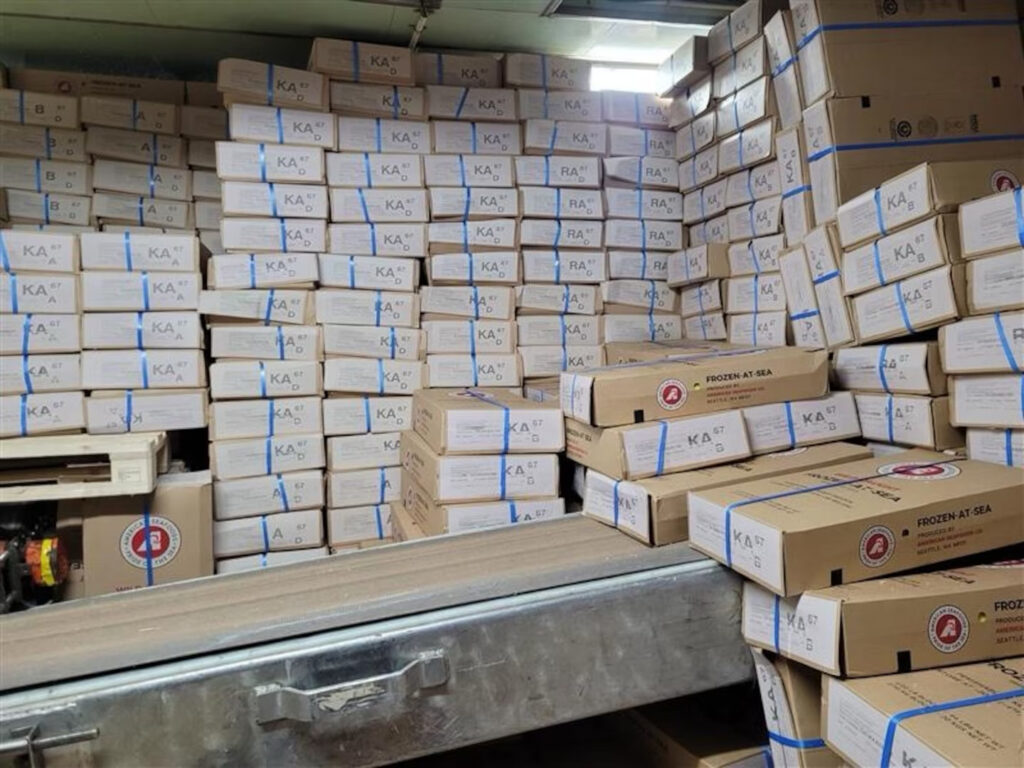
The crew of the U.S. Coast Guard Cutter Waesche (WMSL 751) seized approximately 5.4 metric tons of unreported pollock roe from the catcher-processor vessel Northern Eagle approximately 17 miles north of Dutch Harbor March 28, 2026. At the request of NOAA Fisheries OLE, Waesche ‘s boarding team remained with the Northern Eagle as it transited to Dutch Harbor. They observed the offload and documented 11,524 boxes of pollock roe, which was 241 boxes more than the 11,283 declared in the vessel’s production report. (U.S. Coast Guard courtesy photo)
From U.S. Coast Guard Arctic District, April 6, 2026
JUNEAU, Alaska – The crew of the U.S. Coast Guard Cutter Waesche (WMSL 751) seized approximately 5.4 metric tons of unreported pollock roe, valued at over $65,000, after uncovering significant violations of federal fishing regulations aboard the catcher-processor vessel Northern Eagle.
The boarding occurred approximately 15 nautical miles north of Dutch Harbor on March 26. It was initiated based on reasonable suspicion of a significant Living Marine Resources (LMR) violation, following a pre-boarding audit by the National Oceanic and Atmospheric Administration (NOAA) Fisheries Office of Law Enforcement (OLE), which revealed major discrepancies between the vessel’s production reports and electronic logbook.
During the boarding, the Waesche’s team obtained the vessel’s logs. After further analysis, NOAA Fisheries OLE confirmed that the vessel recorded less catch in its logbook than the vessel’s reported production weight. The production weight exceeded its reported catch weight by 1,223 metric tons.
“The integrity of fisheries data is paramount for the sustainability of our nation’s living marine resources,” said Capt. Tyson Scofield, commanding officer of the Waesche. “This seizure highlights the Coast Guard’s commitment to enforcing federal law with our partner agencies to ensure a level playing field for all fishermen who follow the rules. I am extremely proud of the Waeschecrew’s dedication and perseverance to complete this multi-day operation.”
The investigation also uncovered evidence from a previous voyage indicating the underreporting and offload of approximately 12.4 metric tons of pollock roe, valued at an estimated $150,000.
“As a cooperative enforcement partner, we collaborate closely with the Coast Guard to identify and address suspected and known violations at sea,” said Benjamin Cheeseman, assistant director of NOAA Fisheries Office of Law Enforcement, Alaska Division. “The Coast Guard’s support was key to uncovering these violations on the water where they occurred, and our partnership remains essential to protecting our nation from those who break the law.”
At the request of NOAA Fisheries OLE, Waesche ‘s boarding team remained with the Northern Eagle as it transited to Dutch Harbor. They observed the offload and documented 11,524 boxes of pollock roe, which was 241 boxes more than the 11,283 declared in the vessel’s production report.
Following the discovery, Rear Adm. Bob Little, the Coast Guard Arctic District commander, authorized the seizure of the unreported product. The seized pollock roe has been secured in a cold storage facility in Dutch Harbor.
The Coast Guard will work with NOAA Fisheries OLE for further investigation and potential prosecution.
USS Ashland Completes Ship Wartime Repair and Maintenance in the Philippines
Hull Maintenance Technician 2nd Class Christian Deang, assigned to Southwest Regional Maintenance Center, welds a fan unit bracket aboard Whidbey Island-class dock landing ship USS Ashland (LSD 48) as part of ship wartime repair and maintenance exercise (SWARMEX) in Cebu, Philippines, March 25, 2026. (U.S. Navy photo by MCSN Maliq J. Martin)
From USS Ashland Public Affairs, April 6, 2026
Whidbey Island-class amphibious dock landing ship USS Ashland (LSD 48) completed a ship wartime repair and maintenance exercise (SWARMEX), April 5, as part of its scheduled port visit to Cebu.
These exercises are routinely conducted to maintain readiness and proficiency. This iteration follows Arleigh Burke-class guided-missile destroyer USS Pinckney (DDG 91) in Singapore in February 2026, demonstrating Ashland’s ability to conduct maintenance and repair while forward deployed and away from homeport.
“This exercise allowed us to work shoulder-to-shoulder with our Philippine allies to conduct complex repairs while keeping USS Ashland ready to respond to any contingency in the region,” said Cmdr. Adam Peeples, Ashland’s commanding officer. “We cannot thank the Philippines enough for their gracious hospitality, and our visit signifies the unwavering resolve our two nations share in preserving a free and open Indo-Pacific.”
SWARMEX consisted of three distinct, concurrent elements: expeditionary repair availability, battle damage assessment and repair table-top exercise, and continuous maintenance availability.
“Our Sailors really came together as a team to meet the challenges of this exercise,” said Peeples. “The skills we learned increase our capability to keep USS Ashland in top material condition and help our forces maintain peace through strength.”
Ashland and embarked Marines from I Marine Expeditionary Force make up Task Force Ashland (TF Ashland), which is conducting routine operations in U.S. 7th Fleet. TF Ashland is a flexible, purpose-built task force that can operate independently or integrate with other naval assets, showcasing a key component of Distributed Maritime Operations (DMO). This model provides combatant commanders with more options to maintain presence and build partner capacity.
U.S. 7th Fleet, the Navy’s largest forward-deployed numbered fleet, routinely interacts and operates with allies and partners in supporting peace, stability, and prosperity and preserving a free and open Indo-Pacific region.
Trump Proposes $1.5 Trillion Defense Budget
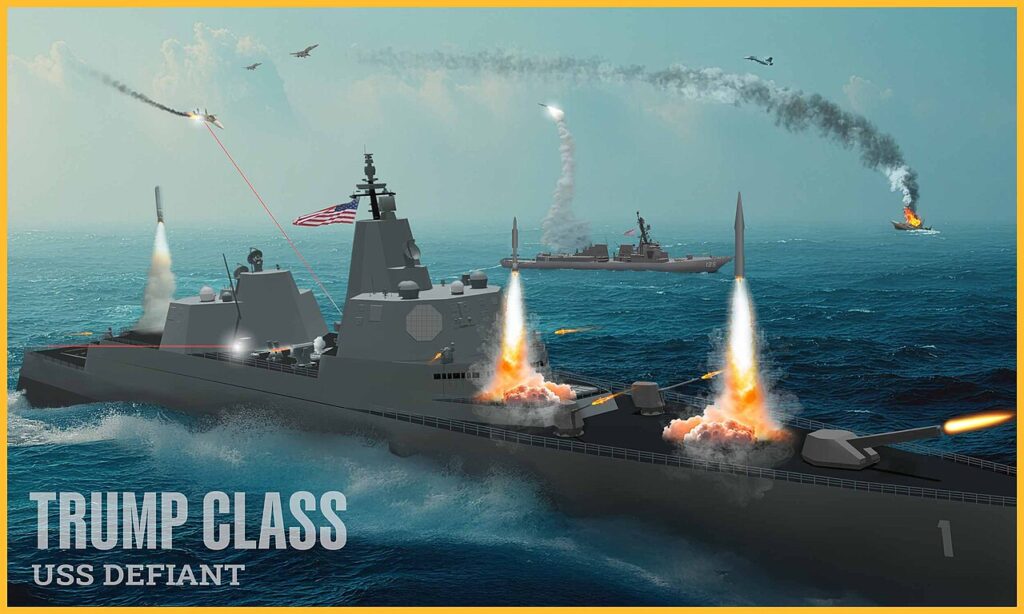
An artist’s conception of the proposed Trump-class USS Defiant battleship. Image credit: White House
President Trump has proposed a $1.5 trillion defense budget for fiscal 2027 that would begin funding of the Trump-class battleship, provide $65.8 billion for shipbuilding, provide a pay raise for the troops and continue funding for the “Golden Dome” missile defense system.
“The Budget builds upon the historic $1 trillion overall defense topline enacted for 2026 and requests $1.5 trillion in total budgetary resources for 2027,” says a budget outline released April 4. “This is a $441 billion or 44-percent increase from the 2026 enacted level in combination with the $151.5 billion in mandatory funding provided through the Working Families Tax Cut Act (WFTC), Public Law 119-21.”
The budget request serves as a road map for Congress to follow, but Congress will ultimately have to approve or disapprove the various spending levels in the president’s budget, many of which will prove controversial, as it also calls for cutting renewable energy, housing and health programs.
Defense Spending
The military shipbuilding budget would include the 18 battle force ships and 16 non-battle force ships and “establishes President Trump’s Golden Fleet, including initial funding for the Trump-class battleship and next generation frigates,” according to the outline.
It would also “maintain or increase” procurement of Columbia- and Virginia-class submarines and would expand procurement of strategic sealift vessels, hospital ships, tankers, submarine tenders and more.
“The repair capacity of public shipyards would be increased, while improved production across the fleet would help address delays and ensure the timely delivery of vessels,” the outline says.
The budget will also call for “unprecedented investments” in unmanned and counter-unmanned systems and “historic investments to aggressively scale its AI [artificial intelligence] ecosystem and ensure broad adoption throughout the armed forces.”
It will also call for realigning funding from “aging, legacy platforms” toward spending on “next-generation, cutting-edge capabilities that are necessary to win 21st Century wars,” reversing “a longstanding negative trend of under-resourced investment that forces DoW [the Department of War] to retain obsolete military capabilities, the sustainment of which further crowds out procurement of new systems.”
To help pay for these new investments, the budget proposes further elimination of spending related to diversity, equity and inclusion, or DEI, efforts, as well as “effectively disestablishing the department’s ‘climate’ portfolio and eliminating climate-specific funding” for electric vehicles and infrastructure, climate change research, climate-related wargames and simulations, and others.
The heads of the House and Senate Armed Services Committee praised the budget on Friday.
“America is facing the most dangerous global environment since World War II. Growing threats from adversaries such as China, Russia, Iran, North Korea, Islamic radicals, and narco-terrorists require decisive action and renewed urgency to reinvest in our defenses. This bold commitment provides the resources needed to rebuild American military capability and confront those challenges head-on,” Sen. Roger Wicker, (R-Mississippi), and Rep. Mike Rogers, (R-Alabama), said in a joint statement.
Some Democrats were less impressed. Rep. Brendan Doyle, ranking member of the House Budget Committee, said, “the President is now demanding a massive increase in defense spending, including a $350 billion slush fund for his reckless war with Iran, while cutting billions from health care, education, housing, and more. This budget represents ‘America Last’.”
Congressional hearings on the budget request are expected to begin soon.