Leidos to Accelerate Hypersonic Weapons Production for U.S. Army, Navy 

RESTON, Va. (May 12, 2026) – Leidos (NYSE: LDOS) has been awarded a $2.7 billion U.S. Army contract to advance hypersonic weapons from prototyping to production. This contract unifies the Thermal Protection Shield (TPS) and Common Hypersonic Glide Body (CHGB) programs, with the goal of streamlining development and accelerating delivery of this critical capability in alignment with Army acquisition reform initiatives. 

By integrating these programs, Leidos will work to help the warfighter achieve greater efficiency, reduce production timelines and support a reliable supply of components to meet operational demands. Leidos brings proven expertise in guidance systems, sensor technologies, and precision munitions integration to this effort, helping to advance the nation’s hypersonic capabilities and strengthen its integrated air and missile defense. 

“This contract is a major step forward in delivering hypersonic capabilities to the warfighter at speed,” said Leidos Defense President Cindy Gruensfelder. “Our team is committed to supporting the Army and Navy in producing this critical operational capability.” 

The combined contract is intended to transition the programs into a production-ready phase to support the Department of War’s initiatives. Leidos has been the prime contractor on the TPS program since 2021 and CHGB program since 2019. 

This contract aligns with Leidos’ NorthStar 2030 strategy, emphasizing commitment to innovation and technological leadership in defense and national security. By focusing on advanced hypersonic and precision strike technologies, Leidos is not only working to meet current defense needs but also positioning the company for future military capabilities, a key pillar of its long-term corporate vision. 


SRF-JRMC Continues to Deliver Warships to Fleet On Time 

From U.S. Naval Ship Repair Facility Japan RMC, May 13, 2026 

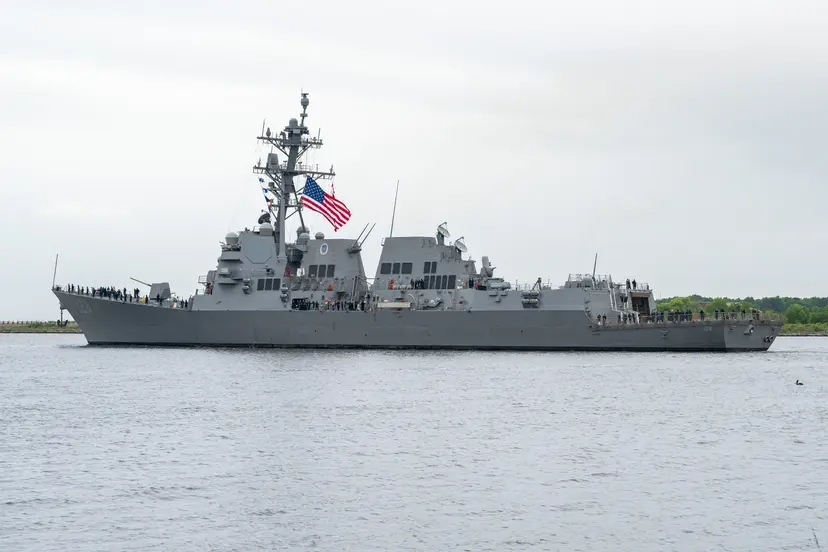
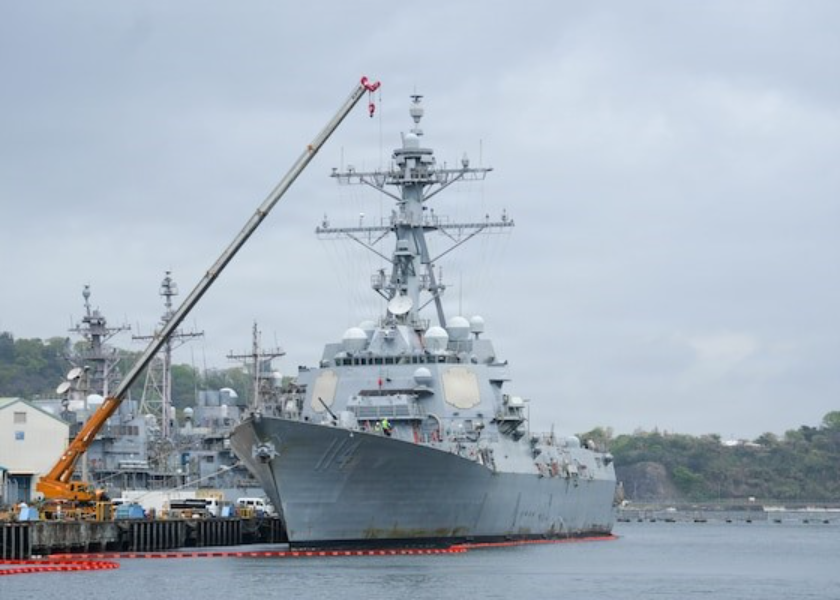
YOKOSUKA, Japan — U.S. Naval Ship Repair Facility and Japan Regional Maintenance Center (SRF-JRMC) completed a key maintenance period for the Arleigh Burke-class guided-missile destroyer USS Ralph Johnson (DDG 114), returning the ship to the fleet on time April 6. 

The successful Chief of Naval Operations (CNO) maintenance availability reinforces SRF-JRMC’s critical role in generating combat-ready ships to support U.S. 7th Fleet operations. 

This year, SRF-JRMC has delivered all seven of its completed ships to the fleet on time or ahead of schedule. From January through April, SRF-JRMC returned two mine countermeasures ships, three destroyers, and an amphibious transport dock to the U.S. 7th Fleet. 

The timely and successful work by the U.S. Navy’s primary ship repair team in Japan underscores its commitment to ensuring U.S. 7th Fleet remains a lethal, mission-ready force in the Indo-Pacific. 

Diligently preserving, maintaining, and employing combat ready ships in the Indo-Pacific is a core focus of U.S. Pacific Fleet, reflecting teamwork among Sailors and civilian maintenance personnel. The CNO availabilities brought together the ship’s crew, SRF-JRMC’s Japanese master labor contractors, local Japanese contractors and U.S.-based companies. 

“Our success this year is a testament to the dedication and professionalism of the ships’ crews, the ship superintendents and their teams, and the entire SRF-JRMC organization,” said Capt. Wendel Penetrante, SRF-JRMC commanding officer. “Managing availabilities, with the recent increase in operational tempo, demonstrates their exceptional capability. We continue to meet the spirit of the command’s motto, ‘Nan Demo Dekimasu!’”, which means ‘we can do anything!’ in Japanese.” 

The U.S. Navy maximizes its ability to maintain a reliable presence in the region by conducting complex repairs at forward locations. This demonstrates a long-term commitment to a free and open Indo-Pacific. 

For over 75 years, SRF-JRMC has been the linchpin of U.S. naval operations in the Indo-Pacific region by providing intermediate and depot-level repair for the ships of U.S. 7th Fleet. 


GA-ASI and USAF Demonstrate APKWS on MQ-9A Reaper 

Flight Test of Advanced Precision Kill Weapon System Using MQ-9A 

From General Atomics Aeronautical Systems, Inc. 

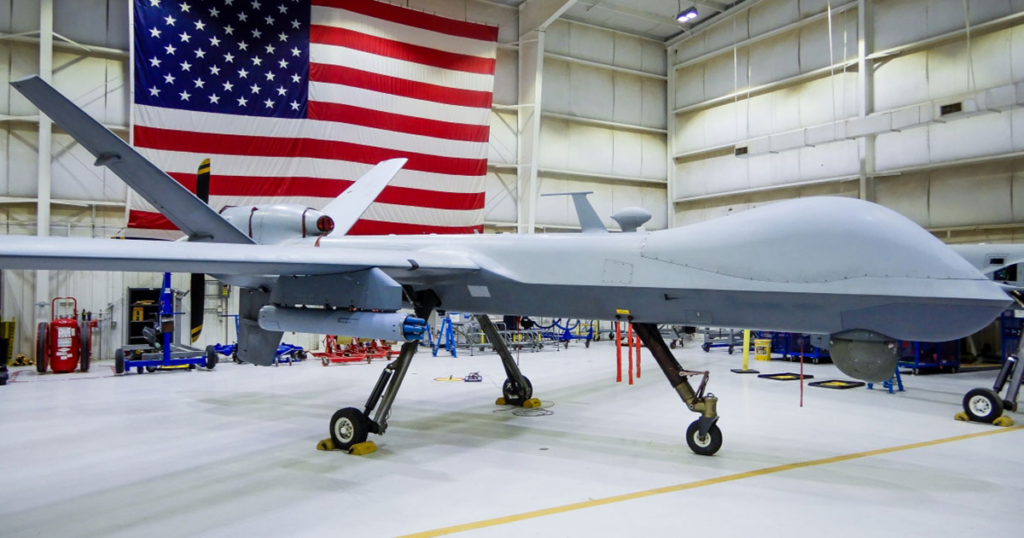
SAN DIEGO – 11 May 2026 – General Atomics Aeronautical Systems, Inc. (GA-ASI), in collaboration with the U.S. Air Force (USAF), has conducted flight tests of an Advanced Precision Kill Weapon System (APKWS) using a USAF MQ-9A Reaper® Remotely Piloted Aircraft. MQ-9A is produced by GA-ASI.  

The testing took place recently at the Nevada Test and Training Range (NTTR).  

The demonstration featured multiple types and variations of shot profiles, including aerial targets. All shots were executed flawlessly by the MQ-9A crews using laser-guided rockets and a specialized launcher. 

This effort supported real-time technological adaptation requirements, moving rapidly from planning to integration and flight test. It also brought together multiple Department of War stakeholders and their industry partners.  

“We recognize the value that a system like APKWS brings to the MQ-9 aircraft as a tool to counter one-way attack drones,” said GA-ASI President David R. Alexander. “APKWS can increase the number of weapons the MQ-9A is able to carry, as well being able to carry new lower cost weapons. More than anything, this integration effort underscores how government and industry can collaborate to rapidly test and make new capabilities available to warfighters.”  


Navy Advances Acquisition Reform Strategy: Appoints Three New Portfolio Acquisition Executives 

From the Department of the Navy Office of Information, May 11, 2026 

WASHINGTON – The Department of the Navy today announced the establishment of three additional Portfolio Acquisition Executive (PAE) organizations: PAE Aviation, PAE Mission Systems and PAE Munitions. With these directives, the Navy continues foundational acquisition reforms focused on accelerating delivery of capability to the fleet. 

“The needs of the warfighter demand that our acquisition system move faster in order to outpace the threat,” said Jason Potter, Performing the Duties of Assistant Secretary of the Navy for Research, Development and Acquisition (ASN RDA). “The establishment of these PAEs today will accelerate acquisition efforts in three key portfolios.” 

The Department of the Navy has designated three senior acquisition leaders as the interim PAEs: 

  • PAE Aviation: Vice Adm. John Dougherty 

  • PAE Mission Systems: Mr. Jim Day 

  • PAE Munitions: Mr. Paul Mann 

 “We are empowering these officials to move out and deliver for the fleet,” Potter said. “With these authorities, we are removing barriers that slowed down capability delivery. We are also doing away with fragmented accountability. Each PAE is accountable for mission outcomes across their entire portfolio.” 

The PAE represents a significant evolution of the previous Program Executive Officer (PEO) construct, with PAEs possessing broader scope and authority. PAEs are responsible for an entire portfolio of like programs and will have direct authority not only for program offices, but also over associated technical, contracting and sustainment functions. Approximately 70 percent of these functions and associated personnel will move from systems commands (SYSCOMs) into the PAEs. 

“This is not just a name change, but a critical step toward streamlining and simplifying the Navy’s acquisition process,” said Adm. Jim Kilby, Vice Chief of Naval Operations. “The three new PAEs are designed to align authority and accountability, reduce process overhead, equip program managers to execute more effectively, and deliver operational capability to the Navy and Marine Corps with speed and scale.” 

“We are fully committed to getting Marines what they need with the speed and flexibility demanded by the modern security environment,” said Gen. Bradford J. Gering, the Assistant Commandant of the Marine Corps. “We have empowered our PAEs with broad authorities and cradle-to-grave oversight of portfolios. This combination will eliminate obstacles and accelerate the delivery of capabilities to our Marines at the speed of relevance.” 

The establishment of PAE Aviation, PAE Mission Systems and PAE Munitions brings the total of Department of the Navy PAEs to nine, joining PAEs for Robotic and Autonomous Systems, Maritime, Industrial Operations, Marine Corps, Strategic Systems Programs, and Undersea.


U.S. Coast Guard Announces $212M in Base Charleston improvements 

From U.S. Coast Guard Headquarters, May 11, 2026 

WASHINGTON – The U.S. Coast Guard today awarded two contracts that will deliver critical new operational and support facilities at Base Charleston in North Charleston, South Carolina. These projects support the Coast Guard’s transformation initiatives and will deliver critical new operational and support facilities to the expanding base. 

One contract, awarded to The Whiting-Turner Contracting Company of Greenbelt, Maryland and executed by the U.S. Coast Guard Facilities Design and Construction Center in Norfolk, Virginia, is for the full recapitalization of Base Charleston’s Pier Mike. This $116.7 million, fixed-price, design-build project includes demolition of the existing pier and replacing it with a state-of-the-art structure designed to homeport four Offshore Patrol Cutters (OPCs) and one visiting cutter. Each berth will also be capable of mooring National Security Cutters, providing significant strategic flexibility for the fleet. Contract completion is expected in 2030. 

The second contract has been awarded to Brasfield & Gorrie, LLC of Birmingham, Alabama for the design and construction of a new 30,000-square-foot combined medical and dental facility, a new entry control point/visitor’s center and various supporting utilities at Base Charleston. This $95.5 million project is a major step forward in increasing personnel readiness through improved access to medical and dental care, ensuring crews receive necessary support to sustain mission readiness. Contract completion is expected by July 2029. 

Both contracts were awarded under the Department of Homeland Security’s National Multiple Award Construction Contract III and were made possible by the Coast Guard’s historic $25 billion investment included in the Working Families’ Tax Cut Act. 

“I am excited for the incredible potential these projects have to improve the welfare of our Servicemembers and their families, to homeport our future fleet of Offshore Patrol Cutters and to operationalize the generous investments being made in our Service by the American people,” said Vice Admiral Jo-Ann Burdian, commander of Coast Guard Atlantic Area. “Our people are our greatest asset, and everything we do on their behalf, to ensure they are ready, trained and well-supported will enable us to act with clarity, cohesion, and purpose to deliver the outcomes our Nation expects.” 

The Pier Mike project follows Whiting-Turner’s successful demolition and ongoing reconstruction of the nearby Pier November. This adjacent project is progressing on time and on budget. 


Flight III Destroyer Ted Stevens (DDG 128) Sails Away from HII’s Ingalls Shipbuilding

From HII 
 

PASCAGOULA, Miss., May 08, 2026 (GLOBE NEWSWIRE) — The Flight III Arleigh Burke-class guided missile destroyer Ted Stevens (DDG 128) departed HII’s (NYSE: HII) Ingalls Shipbuilding division today enroute to its homeport in Norfolk, Virginia ahead of its future commissioning in Whittier, Alaska. 

“The sail-away of Ted Stevens reflects the strong momentum of our Flight III destroyer deliveries and the team’s work to deliver the most capable and combat ready ships to the fleet,” said Chris Brown, Ingalls Shipbuilding DDG 51 program manager. “Seeing DDG 128 depart Ingalls is a proud moment for us all, and we are honored to support the Navy with a ship that will strengthen U.S. maritime security for decades to come.” 

DDG 128 is the second Flight III Arleigh Burke-class destroyer built and delivered by Ingalls. The ship represents the next generation of surface combatants, featuring the Flight III AN/SPY-6(V)1 radar system and the Aegis Baseline 10 combat system designed to counter evolving threats well into the 21st century. 

Ingalls Shipbuilding currently has five additional Flight III destroyers under construction, with seven more in early pre-planning and material procurement phases. To increase throughput and meet growing demand from the Navy, Ingalls is executing a distributed shipbuilding initiative, partnering with shipyards and fabricators beyond the company’s traditional labor market to improve schedule performance across all programs. 

In 2026, HII plans to outsource more than 2.5 million hours of shipbuilding work, while expanding its structural assembly network of assembly partner companies, enabling more work to be completed outside the shipyard before final assembly. 

To date, Ingalls has delivered 36 Arleigh Burke-class destroyers, including the first Flight III, USS Jack H. Lucas (DDG 125), and Ted Stevens (DDG 128). Flight III destroyers currently under construction include Jeremiah Denton (DDG 129), George M. Neal (DDG 131), Sam Nunn (DDG 133), Thad Cochran (DDG 135), and John F. Lehman (DDG 137). Ships in pre-planning include Telesforo Trinidad (DDG 139), Ernest E. Evans (DDG 141), Charles French (DDG 142), Richard J. Danzig (DDG 143), Intrepid (DDG 145), Robert Kerrey (DDG 146), and Ray Mabus (DDG 147). 


U.S. Marine Corps Strengthens Arctic Readiness with Campaign – Alaska

From Communications Directorate, Headquarters Marine Corps, May 9, 2026 

WASHINGTON, D.C. -  The United States Marine Corps has launched “Campaign – Alaska,” a strategic initiative to enhance its operational capabilities in the Arctic. This campaign combines two key efforts: the Marine Rotational Force – Alaska (MRF – Alaska) and the establishment of a Supporting Arms Liaison Team – Alaska (SALT – Alaska). These initiatives will address the Arctic’s growing strategic importance in an era of global competition and ensure the Marine Corps is prepared for the extreme conditions of the High North. 

The 2026 National Defense Strategy prioritizes key terrain in the Western Hemisphere from the Arctic to South America as vital for homeland defense and strategic competition.  

The Commandant of the Marine Corps, Gen. Eric Smith, stated that “the Arctic is a region of growing strategic importance. The Marine Corps must be prepared to operate and win in its extreme conditions. MRF – Alaska and SALT – Alaska are critical to ensuring our Marines are forward postured, trained and equipped to project power globally, reaffirming our commitment as the Nation’s expeditionary force in readiness.” 

MRF – Alaska, under the direction of Marine Forces Northern Command (MARFORNORTH), will conduct persistent, multi-domain expeditionary training and experimentation in Alaska. By participating in Joint exercises like Arctic Edge and Red Flag, MRF – Alaska will provide a training venue to prepare the Fleet Marine Force for operating in arctic conditions. This will not only bolster homeland defense but also improve interoperability with Joint and allied forces, deter adversaries, and promote regional stability.  

“In this era of strategic competition, Alaska is critical to homeland defense and a vital theater for global power projection in the Arctic,” said Lt. Gen. Bobbi Shea, Commanding General, Marine Forces Northern Command. “The Marine Corps Campaign – Alaska is a deliberate and necessary step to ensure we provide the Joint Force with a combat-credible force to support the National Defense Strategy.”  

Complementing the rotational force, Marine Corps Forces Reserve (MARFORRES) is establishing SALT – Alaska, a permanent detachment of the 6th Air Naval Gunfire Liaison Company (ANGLICO) at Joint Base Elmendorf-Richardson (JBER). This builds on MARFORRES’ long-standing presence in Alaska, dating back to 1985. The SALT – Alaska detachment will be instrumental in expanding training and operational activities and will facilitate coordination with Joint Forces, allies and local communities. By fiscal year 2027, SALT – Alaska will provide a persistent Marine Corps presence in Alaska, ensuring continuity in Arctic operations and positioning the force for rapid expansion when needed.  

Campaign – Alaska is a deliberate, forward-thinking strategy to meet the challenges and opportunities of the Arctic. By combining persistent rotational training with a permanent liaison capability, the Marine Corps is creating a robust Arctic presence. This will enable the Corps to project power, defend the homeland, and deter adversaries in one of the world’s most demanding environments. 

Lt. Gen. Shea stated, “Alaska will only grow in strategic importance. The Marine Corps is committed to ensuring we are prepared to operate in the High North.” 


U.S. Disables 2 More Vessels Violating Blockade in Gulf of Oman

From U.S. Central Command, May 8, 2026 

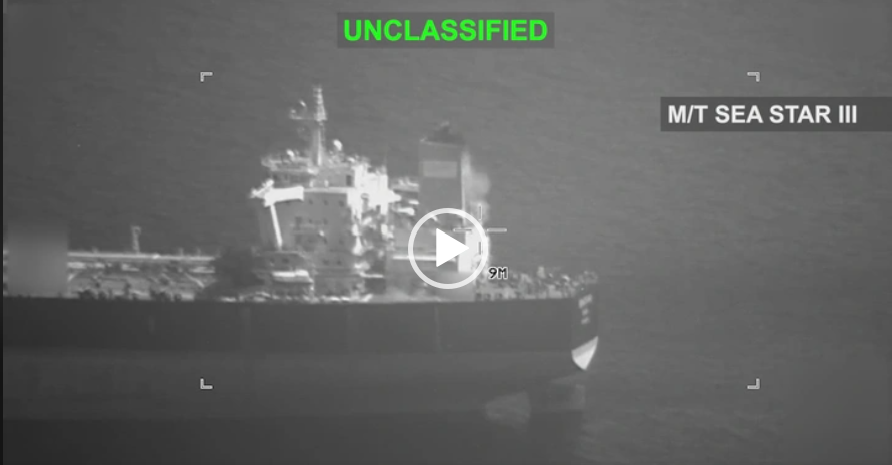
TAMPA, Fla. — U.S. forces disabled M/T Sea Star III and M/T Sevda, May 8, prior to both vessels entering an Iranian port on the Gulf of Oman in violation of the ongoing U.S. blockade. 

U.S. Central Command (CENTCOM) enforced blockade measures against two Iranian-flagged unladen oil tankers attempting to pull into an Iranian port on the Gulf of Oman. A U.S. Navy F/A-18 Super Hornet from USS George H.W. Bush (CVN 77) disabled both tankers after firing precision munitions into their smokestacks, preventing the non-compliant ships from entering Iran. 

U.S. forces also disabled Iranian-flagged M/T Hasna, May 6, as it attempted to sail to an Iranian port in the Gulf of Oman. An F/A-18 Super Hornet from USS Abraham Lincoln (CVN 72) disabled the unladen oil tanker’s rudder by firing several rounds from a 20mm cannon gun. 

All three vessels are no longer transiting to Iran. 

“U.S. forces in the Middle East remain committed to full enforcement of the blockade of vessels entering or leaving Iran,” said Adm. Brad Cooper, CENTCOM commander. “Our highly trained men and women in uniform are doing incredible work.” 

Multiple commercial vessels have been disabled and more than 50 have been redirected by CENTCOM forces to ensure compliance. 


USS Daniel Inouye Returns to Fleet Early After Successful Maintenance

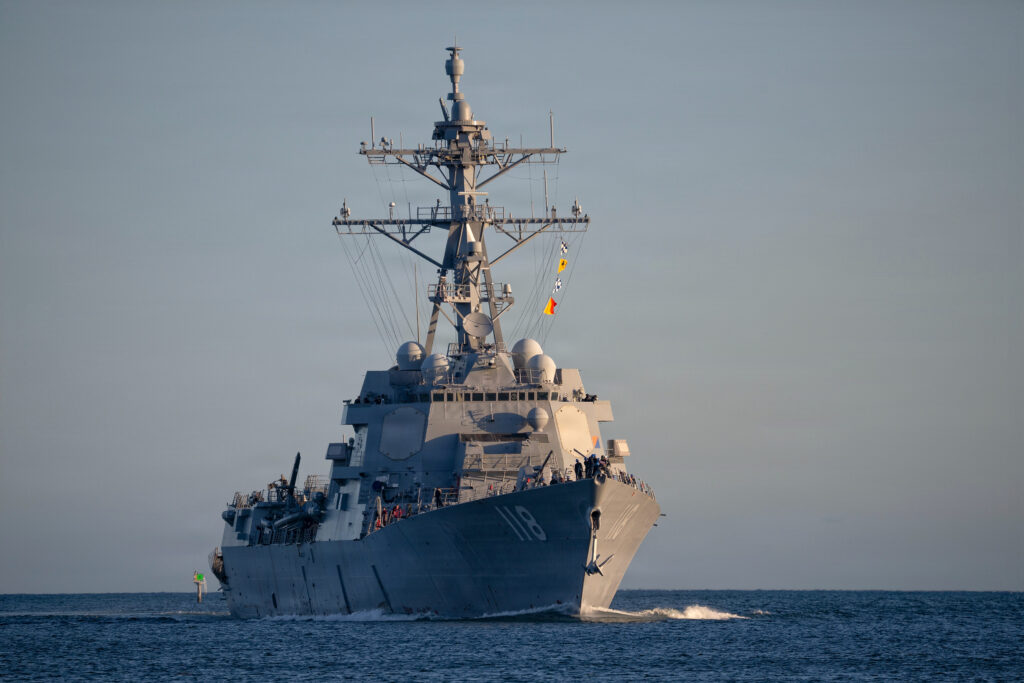
The Arleigh Burke-class guided-missile destroyer USS Daniel Inouye (DDG 118) returns to Pearl Harbor on April 23, 2026. Hawaii Regional Maintenance Center completed a complex maintenance period of the Inouye eight days ahead of schedule, providing a significant boost to fleet readiness. PHNSY & IMF’s mission is to keep the Navy’s fleet “Fit to Fight” by repairing, maintaining, and modernizing the Navy’s fast-attack submarines and surface ships. Strategically located in the heart of the Pacific, it is the most comprehensive fleet repair and maintenance facility between the U.S. West Coast and the Far East. (U.S. Navy photo by Mike Wilson)

From Michael Wilson, Hawaii Regional Maintenance Center, May 8, 2026 

Arleigh Burke-class guided-missile destroyer USS Daniel Inouye (DDG 118) rejoined the Pacific Fleet in April after completing a complex maintenance period eight days ahead of schedule. 

The Arleigh Burke-class guided-missile destroyer USS Daniel Inouye (DDG 118) returns to Pearl Harbor on April 23, 2026. Hawaii Regional Maintenance Center completed a complex maintenance period of the Inouye eight days ahead of schedule, providing a significant boost to fleet readiness. PHNSY & IMF’s mission is to keep the Navy’s fleet “Fit to Fight” by repairing, maintaining, and modernizing the Navy’s fast-attack submarines and surface ships. Strategically located in the heart of the Pacific, it is the most comprehensive fleet repair and maintenance facility between the U.S. West Coast and the Far East. (U.S. Navy photo by Mike Wilson) 

Leaders from the U.S. Pacific Fleet and Hawaii Regional Maintenance Center (HRMC) recognized the joint government-industry team for the achievement in a ceremony at Joint Base Pearl Harbor-Hickam, March 19, 2026. The project’s success was hailed as an example of exceptional teamwork and professionalism. 

“This maintenance period for USS Daniel Inouye set the highest standards across the Pearl Harbor waterfront,” said Capt. Brian Ryglowski, HRMC deputy commander. 

He praised the ship’s crew for their “culture, mindset, and positive attitude,” which allowed them to seamlessly integrate with nearly 20 different maintenance activities. 

“The ship definitely went ‘for broke’,” Ryglowski added, referencing the ship’s motto. “This was an unprecedented performance that gave back significant operational time.” 

Effective and efficient maintenance keeps the U.S. Navy lethal and ready to defend the nation and maximizes the lifespan of its vessels. Navy regional maintenance centers conduct repairs and alterations that cannot be done by the ship’s crew. 

Daniel Inouye’s Commanding Officer. U.S. Navy Cmdr. Ryan Kelly, attributed the success to his team’s culture. 

“Our Project Team culture was founded on three main principles: team cohesion, a solution-driven mindset and deliberate communication,” Kelly said. “No matter the barrier or challenge we faced, there was a level of commitment to each other that ensured our success. I am convinced that our people made the difference.” 

Daniel Inouye is named for the late U.S. Senator from Hawaii, a Medal of Honor recipient who served in the 442nd Regimental Combat Team in Europe during World War II. The ship honors this legacy by adopting the unit’s historic motto, “Go for Broke.” 

This maintenance was managed by HRMC and executed by the lead maintenance contractor, Pacific Shipyards International. 

HRMC, in conjunction with Pearl Harbor Naval Shipyard and Intermediate Maintenance Facility, keeps the Navy’s fleet “Fit to Fight” by repairing, maintaining, and modernizing surface ships and fast-attack submarines. Strategically located in the heart of the Pacific, it is the most comprehensive fleet repair and maintenance facility between the U.S. West Coast and the Far East. 


Gecko Robotics’ Komodo Robot Aids Ship Flight Deck Maintenance

By Richard R. Burgess, Senior Editor 

ARLINGTON, Va. — Robots and other unmanned systems are advocated to relieve humans for the “dull, dirty, and dangerous” jobs and missions the Navy is called upon to complete. One example is the increasing use of robotics for assessment and maintenance of ship surfaces such as the flight decks, weather decks, and well desks as applicable of amphibious warfare ships and guided-missile destroyers. Artificial intelligence is being added to speed up the processes. 

Flight decks are coated with non-skid, a rough coating that reduces the slickness of the decks, enhancing the safety of operations sea for personnel, aircraft, and ground support equipment. The coating needs to be replaced periodically as it is worn down by operations. Assessing that need is being accomplished by Gecko’s Komodo robots.   

The U.S. Navy and the General Services Administration have awarded Gecko Robotics of Pittsburgh, Pennsylvania, a contract with a ceiling of $71 million “to deploy artificial intelligence and robotics to assess and maintain the health of military assets,” the company said in a release. “Gecko will start work with 18 ships [per year] in the U.S. Pacific Fleet with the initial award worth up to $54million over a five-year period. 

“The Chief of Naval Operations has set a target of 80% fleet readiness, which Gecko will have a crucial role in helping to meet,” Gecko said. “Gecko’s advanced AI and robotic technology identify repairs up to 50 times faster and more accurately than manual methods, reducing maintenance delays and boosting battle readiness. This work will be carried out across destroyers, amphibious warships, and littoral combat ships.” 

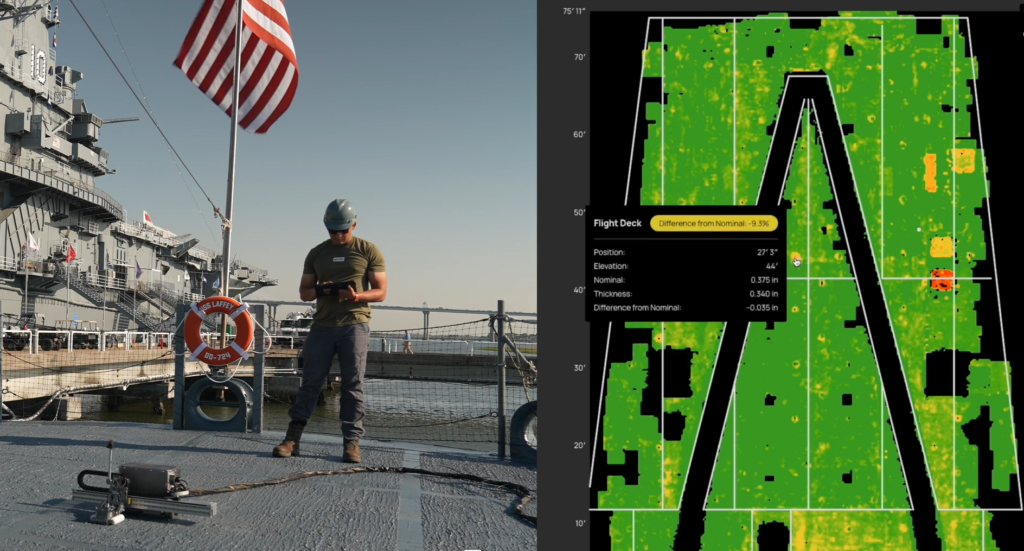
Gecko’s Komodo robot is designed to assess the extent of corrosion of non-skid, said Troy Demmer, co-founder and president of Gecko, in an interview with Seapower. The crawling robot uses “electromagnetic acoustic conduction to create an ultrasonic waveform that can penetrate that non-skid down to the base metal and be able to assess any sort of corrosion.” 

The Komodo is able to operate during different sea states on the ship’s flight deck, enabling an assessment of the deck at sea six to 12 months before the ship enters a maintenance availability, reducing the time spent on the task of refurbishing the deck. The robot rolls along like a paint roller, its sensor scanning the deck in its passes, taking measurements, and recording those data points on a map display of a laptop computer. The measurements allow the Navy to determine the areas of the deck that need attention for non-skid maintenance. 

Gecko also uses its Toka wall-climbing robots to scaling U.S. Navy ship hulls in order to assess corrosion. 

Demmer expects the U.S. Naval Surface Force Atlantic to request Gecko’s services in the future in a separate contract. 

“Where value hasn’t improved, that’s where opportunity lives. Cracking the cost equation is just as important as cracking the physics equation,” said Justin Fanelli, Chief Technology Officer for the Department of the Navy, quoted by Geck in its release. ”We’re now seeing solutions that make innovation adoption easier and in doing so save time, money and risk. When these American companies, pure play defense and dual use companies like Gecko Robotics, choose to do hard things and move the needle on our outcome metrics, not by percentage points but by orders of magnitude, it results in faster, better portfolio management.” 

Gecko employs about 275 personnel, half of them based in Pittsburgh.