Amphibious Coalition Forecasts Benefits of Multi-Ship Amphib Ship Buy
By Richard R. Burgess, Senior Editor
ARLINGTON, Va. — The industry association for suppliers for the builder of U.S. Navy’s amphibious warfare fleet sees immediate benefits this year and the next one for its member companies, the association’s survey said.
In its annual survey of 219 member companies, the Amphibious Warfare Industrial Base Coalition (AWIBC) said that a majority of its member companies affirmed that the Navy’s announcement last year of a multi-ship buy will benefit their companies.
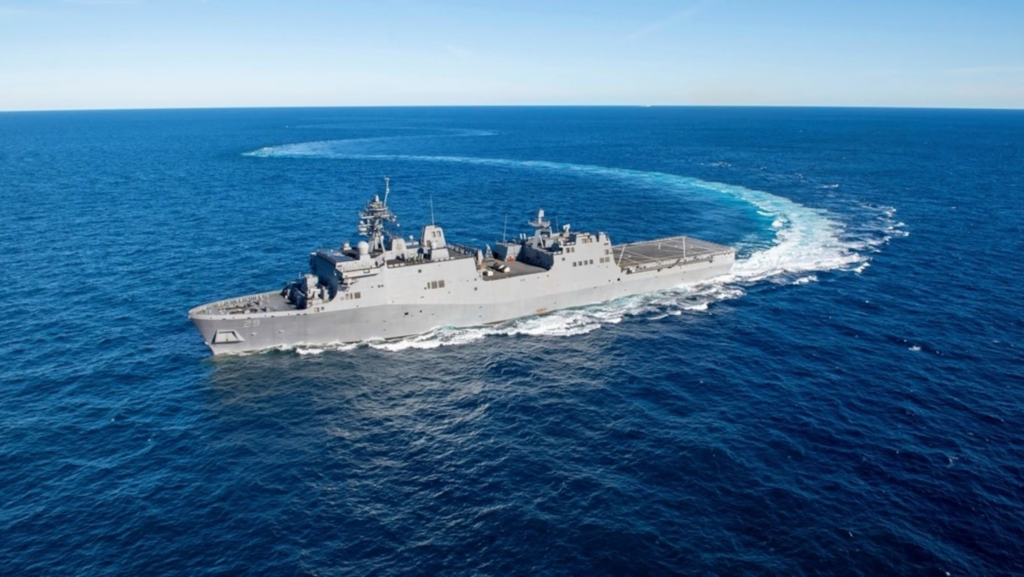
The survey focused on the August 2024 announcement by then-Secretary of the Navy Carlos Del Toro that the Navy would procure four amphibious warfare ships — one America-class amphibious assault ship (LHA) and three Flight II San Antonio-class amphibious transport dock ships (LPDs) in a bundle procurement according to the below schedule:
LPD 33 in FY25
LPD 34 in FY27
LHA 10 in FY27
LPD 35 in FY29
The four ships in the procurement would be built at the HII Ingalls Shipbuilding shipyard in Pascagoula, Mississippi.
“Our survey asked specifically about the impacts this bundle will have on the supplier base,” said Jack Feenick, a spokesman for the AWIBC. “We also included questions about the overall health of the industrial base, touching on key areas like workforce, training, inflation, and supply chain disruptions. Below are some of the key findings from our survey and attached is an infographic that provides some more insight on the data.”
Amphibious Warship Industrial Base Coalition (AWIBC) Survey
(Conducted survey from October – November 2024 from a sample of 219 total suppliers.)
65% of amphibious warship suppliers say that the bundle buy will lead to immediate benefits starting in 2025 or 2026.
82% of suppliers that support both amphibious ships and submarines agree that bundle buys benefit their capability to deliver on orders as well as their overall capacity.
52% say the bundle purchase will strengthen the shipbuilding industrial base to meet the demand of today and tomorrow
46% say the bundle purchase enables the hiring, retention, and training of a workforce
42% say the bundle purchase helps invest in equipment to ensure quality and on-time delivery
Consistent with findings from our survey last year, the top three challenges facing suppliers are:
Inflation
Workforce training and retention
Supply chain disruptions
Currently, only 10% of amphibious warship suppliers are operating at full capacity.
74% of suppliers who say they are sole-source/single-source supplier to the Navy are amphib suppliers.
Suppliers say that multi-ship procurements and earlier AP [advance procurement] funding are most likely factors to drive down material costs, help meet delivery schedules and improve their workforce and facilities.
Lawmakers Introduce SHIPS Act to Revitalize Shipbuilding, Commercial Maritime Industries
U.S. Merchant Marine Academy graduates throw their covers in celebration during the Merchant Marine Academy Commencement Ceremony in Kings Point, New York, June 22, 2024. Credit: U.S. Marine Corps | Staff Sgt. Kelsey Dornfeld
A bipartisan group of U.S. Senators and Representatives on Dec. 19 introduced introduced the Shipbuilding and Harbor Infrastructure for Prosperity and Security (SHIPS) for America Act, comprehensive legislation to revitalize the United States shipbuilding and commercial maritime industries.
The SHIPS for America Act was introduced by Sens. Mark Kelly (D-Arizona) and Todd Young (R-Indiana) and Reps. John Garamendi (D-California) and Trent Kelly (R-Mississippi). After decades of neglect, the United States has a weakened shipbuilding capacity, a declining commercial shipping fleet dwarfed by China and a diminished ability to supply the U.S. military during wartime, the lawmakers said.
They said the bipartisan proposal would restore American leadership across the oceans by establishing national oversight and consistent funding for U.S. maritime policy, incentivizing domestic shipbuilding, enabling U.S.-flagged vessels to better compete in international commerce, rebuilding the U.S. shipyard industrial base and expanding the mariner and shipyard workforce.
“We’ve always been a maritime nation, but the truth is we’ve lost ground to China, who now dominates international shipping and can build merchant and military ships much more quickly than we can,” said Kelly, a U.S. Navy veteran and the first U.S Merchant Marine Academy graduate to serve in Congress.
“The SHIPS for America Act is the answer to this challenge. By supporting shipbuilding, shipping, and workforce development, it will strengthen supply chains, reduce our reliance on foreign vessels, put Americans to work in good-paying jobs, and support the Navy and Coast Guard’s shipbuilding needs. I’m excited to introduce this comprehensive, fully paid for legislation today alongside my Republican and Democratic colleagues and our partners representing all parts of the industry, and together we’re going to work to get this effort across the finish line.”
“America has been a maritime nation since our founding, and seapower was a significant contributor to our rise to being the most powerful nation on earth. Unfortunately, the bottom line now is America needs more ships. Shipbuilding is a national security priority and a stopgap against foreign threats and coercion. Our bill will revitalize the U.S. maritime industry, grow our shipbuilding capacity, rebuild America’s shipyard industrial base, and support nationwide workforce development in this industry. This legislation is critical to our warfighting capabilities and keeping pace with China,” Young said.
The move drew support from a wide variety of maritime-related groups and is backed by the Navy League of the United States.
“The Navy League applauds the introduction of the SHIPS for America Act, a landmark legislative achievement that will comprehensively meet the needs of the U.S. merchant marine and bolster our shipbuilding industrial base,” said Mike Stevens, CEO of the Navy League.
“In today’s global threat environment, arguably the most perilous since the end of the Cold War, the United States must not only maintain the finest Navy, Marine Corps, and Coast Guard on the seas, but also ensure a robust U.S.-flag merchant marine and a resilient shipbuilding industrial base. These elements are crucial for safeguarding our national and economic security in the event of large-scale military conflict. The SHIPS for America Actaddresses these vital considerations and reaffirms that America is, and always will be, a maritime nation.”
The SHIPS for America Act would:
Coordinate U.S. maritime policy by establishing the position of Maritime Security Advisor within the White House, who would lead an interagency Maritime Security Board tasked with making whole-of-government strategic decisions for how to implement a National Maritime Strategy. The bill also establishes a Maritime Security Trust Fund that would reinvest duties and fees paid by the maritime industry into maritime security programs and infrastructure supporting maritime commerce.
Establish a national goal of expanding the U.S.-flag international fleet by 250 ships in 10 years by creating the Strategic Commercial Fleet Program, which would facilitate the development of a fleet of commercially operated, U.S.-flagged, American crewed, and domestically built merchant vessels that can operate competitively in international commerce.
Enhance the competitiveness of U.S.-flagged vessels in international commerce by establishing a Rulemaking Committee on Commercial Maritime Regulations and Standards to cut through the U.S. Coast Guard’s bureaucracy and red tape that limits the international competitiveness of U.S.-flagged vessels, requiring that government-funded cargo move aboard U.S.-flag vessels, and requiring a portion of commercial goods imported from China to move aboard U.S.-flag vessels starting in 2029.
Expand the U.S. shipyard industrial base, for both military and commercial oceangoing vessels, by establishing a 25 percent investment tax credit for shipyard investments, transforming the Title XI Federal Ship Financing Program into a revolving fund, and establishing a Shipbuilding Financial Incentives program to support innovative approaches to domestic ship building and ship repair.
Accelerate U.S. leadership in next-generation ship design, manufacturing processes, and ship energy systems by establishing the U.S. Center for Maritime Innovation, which would create regional hubs across the country.
Make historic investments in maritime workforce by establishing a Maritime and Shipbuilding Recruiting Campaign, allowing mariners to retain their credentials through a newly established Merchant Marine Career Retention Program, investing in long-overdue infrastructure needs for the U.S. Merchant Marine Academy, and supporting State Maritime Academies and Centers for Excellence for Domestic Maritime Workforce Training and Education. The bill also would streamline and modernize the U.S. Coast Guard’s Merchant Mariner Credentialing system.
Ready to Dive: ROV Pioneer Shares Seafaring Stories in New Book
A remotely operated vehicle prepares to go on a dive. Credit: Curt Newport
Curt Newport spent his career as a member of an elite club — as an underwater salvage expert, he has participated in more than 150 undersea operations, ranging from the recovery of astronaut Gus Grissom’s Liberty Bell 7 suborbital spacecraft to salvaging Air India Flight 182, the space shuttle Challenger and even sending images back from the RMS Titanic.
After 47 years as a trailblazer for using robotics for underwater salvage, Newport retired in 2022 and is the author of a new memoir, “Ready to Dive,” about his career, published by Purdue University Press. (He has also been a race car driver and musician, but there is only so much room in the magazine.) Underwater explorers such as Jacques Cousteau and TV shows such as “Sea Hunt” helped stoke Newport’s early interest in the undersea world. He got a job building ship fenders for $3.50 an hour, then graduated to building and maintaining saturation diving systems before deciding to attend commercial diving school in California.
When he graduated, the company Ocean Systems had purchased a remotely operated vehicle (ROV) named Scorpio One, and Newport was hired to work on that team. He worked on oilfields with ROVs, did submarine cable work for communications companies such as AT&T, “and eventually graduated up into doing deep-ocean search and recovery, mostly for the Navy,” he told Seapower. With that, he was off to the races for a career stretching nearly five decades.
Undersea Technology
Technology has long been used in deep-ocean work, from towed sonar arrays to ROVs, each with their own strengths and weaknesses.
Towed arrays or camera sleds are useful and can provide real-time data but have a sizable turning radius. “The downside of those towed systems is if you’re working in deep water you’re going to have some very long turnaround times. When you get to the end of a search line, you’re going to make a turn, and in deep water, that can take anywhere from nine to 12 hours,” he said.
ROVs are nimbler to deploy and have gotten larger and more capable over the years, being able to dive anywhere from 300 meters down to 7,000 meters (almost 23,000 feet). They have been joined by autonomous underwater vehicles that require no tether.
There are also manned submersibles, which hit the news again last summer when the Titan submersible imploded during a dive to the ruins of the Titanic. Newport has done two dives in the Russian Mir 1 manned submersible, to 4,800 meters (including a dive to a sunken ship) but now it and the Mir 2 have been decommissioned and are displayed in museums.
“Really for the deep work, the advantage of an autonomous vehicle is you don’t have those long turn times. And actually, the quality of the side-scan data is better because you’re not being towed by a ship. It’s a very stable imaging platform,” he said. “The problem is, you can’t see any of the side scan data until you’ve recovered the vehicle and downloaded the data. That’s a disadvantage. And they tend to be kind of complicated.”
In the early days, the crews spent as much time wrestling with the vehicles as they did diving, Newport said.
“When I first started out with the Scorpio One vehicle, we spent most of our time broken down as opposed to diving because they were just complicated vehicles there, it was a new technology and we had a lot of problems with them. And you still have problems with it, but they’ve gotten to be a lot more reliable,” especially with their communication systems and sensors.
“And the imaging systems were nothing like what we have now,” he said. “I mean, the first vehicle I worked with, we didn’t even have a colored camera. We had a black and white. We had one black and white SIT camera, SIT means silicon, silicon intensified target. It’s a low-light camera,” Newport said. “And you know, nowadays vehicles will have four or five, six cameras. You got cameras all over the place. And we didn’t have that. And the manipulators we had back then were fairly crude. But, you know, for the type of salvage work we were doing, you don’t need a really sophisticated manipulator. In fact, it’s better to not have one.”
Newport suits up for a dive in 1977. Credit: Curt Newport
Now there are also sophisticated acoustic tracking systems that can operate as deep as 11,000 meters. In a nutshell, the differences between now and when Newport started in the diving business are “reliability and the ability to tell where the heck the vehicle is relative to the ship,” he said.
The Subsea Bounty
There are a great many things at the bottom of the world’s oceans waiting to be recovered or discovered. It’s “just limitless,” he said. “When you think about human history, how long humans have been using the ocean to go from one place or another, thousands of years, and the things that are lost in deep water are generally well preserved.”
At one wooden shipwreck in 16,000 feet of water, he found silk fabric still intact and gold wrapped in newspaper that was still readable. In the deep ocean environment, “it’s only 36 degrees down there forever, pretty much. There’s no light. There’s no oxygen. So, everything is really well preserved. … Airplanes, ships, whatever, it’s all down there, but it costs money to do that stuff.”
Newport said the most interesting salvage of his career “has got to be Grissom’s Liberty Bell 7 spacecraft.”
That cramped vehicle was launched on July 21, 1961, in the early days of the space race with the Soviet Union. It conducted a short, sub-orbital flight and made Virgil “Gus” Grissom the second American to fly in space, but it started to sink after splashdown and nearly drowned him. It stayed below the waves for nearly four decades until Newport’s team found it in an expedition funded by the Discovery Channel. “It’s one of those things that no one really expected us to ever be able to find it,” he said. “You know, the thing is only nine feet tall, six feet in diameter, is lost in deep water, about 6,000 feet. And everybody who knew anything about this said, ‘well, it’s lost and gone forever.’”
The salvage team was just starting their work “and it was the first target we dove on. It just came out of the gloom down there, there it was. So that, that was the most amazing ever,” he said.
Now that he’s retired, one thing Newport doesn’t do is spend time on boats.
“Ever since I started in this business, I have very rarely ever got on a boat for recreation. It just seems too much like work,” he said. “If you’re a bus driver, and then [on] your vacation time, you don’t go on a cross-country trip. You stay home. The same thing with boats, with ships, you know. People can go out in little liners and whatever all they want, I’ll just stay here and have my cocktail or something.”
Curt Newport, author of “Ready to Dive.” Credit: Curt Newport
Book Excerpt from ‘Ready to Dive’
On Finding the Wreck of the Challenger
I was in California visiting my brother when Challenger was lost. Like other Americans, I watched with a heavy heart as another American spacecraft was lost at sea. Unlike Liberty Bell 7, this one did not remain intact, and its location would be marked by tangled debris drifting in the Gulf Stream currents. Tons of wreckage peppered the seafloor, much like the Air India jetliner, and once again, it would be up to people like me to help find the one piece of wreckage that provides conclusive proof of the cause of the disaster. The salvage of Challenger was the largest search and recovery operation in history and required the use of a mixture of underwater technologies: side-scan sonars to map the debris field, manned submersibles to identify wreckage, and divers and remote vehicles to recover the evidence.
The task confronting the Navy was overwhelming: Search an area encompassing about 470 square nautical miles and identify all targets as being Challenger or non-Challenger, inspect and categorize the targets, then recover all wreckage that might bear evidence of the disaster. Unfortunately, the location where Challenger went down was heavily traveled by ship and air traffic and drug smugglers, and it had been the repository of a large percentage of NASA’s launch failures. There was a lot of space junk littering the seafloor.
The Navy set up their priorities as follows. First, they simply had to find the smoking gun. While it was strongly suspected that a segment of Challenger’s right-hand booster had failed, NASA had to be sure. In the tons of debris stuck on the bottom, we had to find that one piece. Second, for humanitarian purposes, the Navy had to recover the astronauts’ remains. Based on my Air India experience, I knew there would not be much left to recover. Challenger’s crew compartment had struck the ocean at over 200 miles per hour and broken up into several pieces. Third, we had to find and recover the tracking and data relay satellite located in the shuttle’s cargo bay. If it was not found, the government would have to spend millions of dollars to change satellite communication codes so the Soviets could not find the TDRS and subsequently monitor our military communications.
And finally, we found what everyone wanted to see: a 6,000-pound chunk of steel. On one edge was an opening unlike what we had seen before. It was rounded and melted, not broken and sharp. This was how Challenger had perished.
Flag Officer Announcements
Nov. 14, 2024
Secretary of Defense Lloyd J. Austin III announced today that the president has made the following nominations:
Navy Capt. Erin E. O. Acosta for appointment to the grade of rear admiral (lower half). Acosta is currently serving as chief of staff, Naval Meteorology and Oceanography Command, Stennis Space Center, Mississippi.
Navy Capt. Walter H. Allman III for appointment to the grade of rear admiral (lower half). Allman is currently serving as commandant, U.S. Naval Academy, Annapolis, Maryland.
Navy Capt. Andrew M. Biehn for appointment to the grade of rear admiral (lower half). Biehn is currently serving as director of Development and Integration, Program Executive Officer for Integrated Warfare Systems, Washington Navy Yard, Washington, D.C.
Navy Capt. Wesley P. Bringham for appointment to the grade of rear admiral (lower half). Bringham is currently serving as strategic integration group director for the vice chief of naval operations, Office of the Chief of Naval Operations, Pentagon, Washington, D.C.
Navy Capt. Kertreck V. Brooks for appointment to the grade of rear admiral (lower half). Brooks is currently serving as transformation integration branch head, N16, Office of the Chief of Naval Operations, Washington, D.C.
Navy Capt. Richard G. Burgess for appointment to the grade of rear admiral (lower half). Burgess is currently serving as commanding officer, USS Gerald R. Ford (CVN 78), Norfolk, Virginia.
Navy Capt. Daryle D. Cardone for appointment to the grade of rear admiral (lower half). Cardone is currently serving as aircraft carrier branch head, N98, Office of the Chief of Naval Operations, Pentagon, Washington, D.C.
Navy Capt. Cameron R. Chen for appointment to the grade of rear admiral (lower half). Chen is currently serving as branch head, N957, Office of the Chief of Naval Operations, Pentagon, Washington, D.C.
Navy Capt. Jereal E. Dorsey for appointment to the grade of rear admiral (lower half). Dorsey is currently serving as special assistant for public affairs to the Chairman of the Joint Chiefs of Staff, Joint Staff, Pentagon, Washington, D.C.
Navy Capt. Matthew J. Duffy for appointment to the grade of rear admiral (lower half). Duffy is currently serving as director, Operations Division, Fiscal Management and Budget, Office of the Secretary of the Navy, Pentagon, Washington, D.C.
Navy Capt. Reginald S. Ewing III for appointment to the grade of rear admiral (lower half). Ewing is currently serving as fleet surgeon, U.S. Fleet Forces Command, Norfolk, Virginia.
Navy Capt. Damian D. Flatt for appointment to the grade of rear admiral (lower half). Flatt is currently serving as assistant judge advocate general (operations and management), Office of the Judge Advocate General of the Navy, Washington Navy Yard, Washington, D.C.
Navy Capt. John P. Friedmann for appointment to the grade of rear admiral (lower half). Friedman is currently serving as executive assistant to the Director, Naval Reactors, Washington Navy Yard, Washington, D.C.
Navy Capt. William K. Gantt Jr. for appointment to the grade of rear admiral (lower half). Gantt is currently serving as director, Senate Liaison Office, Office of Legislative Affairs, Pentagon, Washington, D.C.
Navy Capt. Michael R. Jarrett Jr. for appointment to the grade of rear admiral (lower half). Jarrett is currently serving as chief of staff, Navy Installations Command, Washington Navy Yard, Washington, D.C.
Navy Capt. Daniel L. Lannamann for appointment to the grade of rear admiral (lower half). Lannamann is currently serving as officer in charge/program manager, Program Executive Office for Aircraft Carriers, Washington Navy Yard, Washington, D.C.
Navy Capt. David Loo for appointment to the grade of rear admiral (lower half). Loo is currently serving as division chief, Program and Budget Analysis Division, Joint Staff, Pentagon, Washington, D.C.
Navy Capt. Brian A. Metcalf Jr. for appointment to the grade of rear admiral (lower half). Metcalf is currently serving as acting vice commander, Naval Sea Systems Command, Washington Navy Yard, Washington, D.C.
Navy Capt. Gary G. Montalvo Jr. for appointment to the grade of rear admiral (lower half). Montalvo is currently serving as executive assistant to commander, U.S. Indo-Pacific Command, Camp H.M. Smith, Hawaii.
Navy Capt. Raymond P. Owens III for appointment to the grade of rear admiral (lower half). Owens is currently serving as branch head for Security Cooperation and International Affairs, N51, Office of the Chief of Naval Operations, Pentagon, Washington, D.C.
Navy Capt. Davidtavis M. Pollard for appointment to the grade of rear admiral (lower half). Pollard is currently serving as executive assistant to Commander Naval Air Forces/Naval Air Force, U.S. Pacific Fleet, San Diego, California.
Navy Capt. Matthew T. Pottenburgh for appointment to the grade of rear admiral (lower half). Pottenburgh is currently serving as executive assistant to the Chief of Naval Operations, Office of the Chief of Naval Operations, Pentagon, Washington, D.C.
Navy Capt. William R. Reed for appointment to the grade of rear admiral (lower half). Reed is currently serving as executive assistant to commander, U.S. Fleet Forces Command, Norfolk, Virginia.
Navy Capt. Karrey D. Sanders for appointment to the grade of rear admiral (lower half). Sanders is currently serving as executive assistant to the deputy chief of naval operations, Integration of Capabilities and Resources, N8, Office of the Chief of Naval Operations, Pentagon, Washington, D.C.
Navy Capt. Charles R. Sargeant for appointment to the grade of rear admiral (lower half). Sargeant is currently serving as executive assistant to the vice chief of naval operations, Office of the Chief of Naval Operations, Pentagon, Washington, D.C.
Navy Capt. Benjamin A. Snell for appointment to the grade of rear admiral (lower half). Snell is currently serving as chief of staff, Naval Information Warfighting Development Center, Norfolk, Virginia.
Navy Capt. John W. Stafford for appointment to the grade of rear admiral (lower half). Stafford is currently serving as chief of staff, Submarine Force, U.S. Atlantic Fleet, Norfolk, Virginia.
Navy Capt. Omarr E. Tobias for appointment to the grade of rear admiral (lower half). Tobias is currently serving as commanding officer, Naval Facilities, Washington, D.C.
Navy Capt. Thomas J. Zerr for appointment to the grade of rear admiral (lower half). Zerr is currently serving as chief of staff, Naval Surface Force, U.S. Pacific Fleet, San Diego, California.
Paws for Effect: Support Pup Sage is Popular on USS Gerald R. Ford
Sage, a three-year-old female Labrador Retriever, deployed aboard the world’s largest aircraft carrier, USS Gerald R. Ford (CVN 78) through Mutts with a Mission, watches the Thanksgiving Turkey Trot 5K on the flight deck, Nov. 23, 2023. U.S. Navy | Chief Mass Communication Specialist Mike DiMestico
Captain Rick “Powder” Burgess took command of the aircraft carrier USS Gerald R. Ford (CVN 78) just eight days before it was to sail on its first full-length combat deployment. In putting the new ship through its paces he would be employing 23 different new technologies, but his first decision as commanding officer involved a 24th innovation — the Navy’s first-in-class vessel, its largest, longest and most advanced, would have a specially trained dog aboard to boost morale and help the crew go the distance.
The three-year-old female Yellow Labrador named Sage was on board as the Gerald R. Ford left Norfolk in May 2023 for duty that was expected to involve being near the Russia-Ukraine conflict.
“I made the decision to deploy with Sage. That was not directed by admirals or anyone else,” Burgess said. “I wanted to bring her on in an effort to help Sailors with the resiliency piece, which has always been a challenge. And you know it’s probably always been a challenge, but we were coming off a couple years with Covid, and we were having longer deployments.”
While military dogs have seen duty on land and aboard ship doing security duties, Sage was specially trained to bring peace of mind and comfort, both sorely needed by Sailors battling loneliness and stress, close confines and combat tempo. Sage was provided by arrangement with a Virginia Beach non-profit called Mutts With A Mission, founded to provide disability and support dogs for veterans and first responder organizations.
“And I saw her as a free opportunity, honestly, to help out with Sailors. And so, Sage is unique in many ways, she’s the first of the program,” Burgess said.
“Ideally, the way the program is conceived, between the ages of two and three these handpicked dogs will go through training. They will get immersion, they’ll find out or figure out how to climb up and down ladders. They will do all that part of it, the logistical side of it. Then they come to the crew, at the age of three, and they’ll stay until they’re 10 years old.”
Sage’s job is to help Sailors handle immense emotional stress and the Ford’s first journey would prove to be an unanticipated stressor when war broke out in Israel on Oct. 7. A five-month tour turned into an eight-month endurance session of homecomings delayed, including three about-faces from homeward bound back to a Middle East aflame from Syria to Gaza and on down to the Red Sea. That’s also where the second demonstration dog, a male named Demo, served aboard USS Dwight D. Eisenhower (CG 69), which replaced Ford on deployment.
“We had an extraordinarily low number of admissions for suicidal ideations compared to those folks that previously deployed, so clearly Sage obviously contributed to that success,” Burgess said.
Sage, a three-year-old female yellow Labrador Retriever, is deployed aboard the aircraft carrier USS Gerald R. Ford (CVN 78), May 3, as part of the Expanded Operational Stress Control Canine pilot program. U.S. Navy | Mass Communication Specialist 2nd Class Jackson Adkins
Fans on Ford and Beyond
While the new ship, new captain, new crew and new dog were all getting their sea legs, the sweet and gentle creature quickly developed a fan base.
“We learned early on too there was a new thing on ‘Green Sheet,’ which has the daily schedule for the crew to look at … someone came up with the idea to put a paw print by where the events [were] and where Sage would participate. And we immediately saw attendance double, triple, quadruple,” Burgess said.
“Come for the dog, stay for the talk,” was the goal of shipboard presentations where Sage held court for groups of sailors, as COMNAVAIRLANT [Commander, Naval Air Force Atlantic] PAO Dawn Stankus told Navy Times. The playful pup was center stage as the Navy’s mental health teams aboard ship described the options available for seeking help.
Coral Gables, Florida, psychiatrist Arthur Bregman has internationally recognized expertise treating ADHD, depression, anxiety, PTSD, substance abuse disorder, and many other issues for a wide range of ages.
“It’s the 20- to 40-year-olds, the Millennials, who are our new Greatest Generation,” Bregman said of the current generation of military service members with that perfect description of the age range on a naval vessel from the youngest Sailors to the senior officers.
“There’s a powerful health benefit,” Bregman said of Sage’s healing skills during the week in January that the Ford and Carrier Air Wing 8 returned home. “It decreases depression, reduces anxiety, lowers stress … it’s just so good to have a dog involved, to be attuned to our behavior and emotions.”
Bregman’s insights come from his fame, from Europe to America in print and broadcast news stories, on his pinpointing of the global peacetime crisis known now as Cave Syndrome. From Covid then to the aircraft carrier now, people have felt the effect of being trapped emotionally and physically in close confines for so long and then have trouble adjusting to the outside world.
Whether before groups or one-on-one, Sage was a valued emotional resource, Burgess said.
“She made an appreciable difference on people. There were many examples of Sailors going to her handler and saying, ‘Hey, could I just spend five minutes with Sage?’ Again, we don’t know if that saved somebody from going down and seeking admission for mental health reasons or otherwise, but she was a calming presence. and every time Sailors got to spend time with her, it was meaningful.”
Sage’s popularity soon grew to include not only the Sailors and Marines of the attached air wing but also every ship in the Ford Strike Group. This led to Sage being outfitted with proper PPE [‘pup protective equipment’] and heading via helo to the guided missile cruiser USS Normandy [CG 60], goggles and booties and all of that, she did great. They fenced off part of their flight deck for her and the crew to come to her,” Burgess said with a proud smile.
Burgess asked the cruiser’s captain why he wanted Sage to hold court on the flight deck rather than inside the ship. “It was a logistics problem. The entire crew wanted to get in there … the entire crew wanted to see her.”
With both ship and crew back home and preparing for the next deployment, Sage remains on board many days of the week continuing her permanent assignment to the ship. And as her captain is certain, she is very much a member of the crew.
This story appears in the October 2024 issue of Seapower magazine.
EAST CHINA SEA (Sept. 24, 2020) An EP-3E Airborne Reconnaissance Integrated Electronic System (ARIES) II, assigned to the “World Watchers” of Fleet Air Reconnaissance Squadron 1 (VQ-1), transits over the East China Sea. (U.S. Navy photo by MC3 Andrew Langholf)
By Richard R. Burgess, Senior Editor
Oct. 8, 2024
ARINGTON, Va. — A planned homecoming ceremony for two U.S. Navy EP-3E electronic reconnaissance aircraft and their crews today has been postponed because of the Navy’s current operational commitments.
According to the Facebook account of Fleet Air Reconnaissance Squadron One (VQ-1), the ceremony was to welcome home the crews from the final operational deployments of VQ-1 and the EP-3E. The two crews were scheduled to return to the squadron’s home base of Naval Air Station Whidbey Island, Washington.
A Navy directive issued July 18, 2023, scheduled VQ-1’s de-activation for March 31, 2025, but that the squadron was to cease operations by Sept. 30, 2024. Apparently, operational commitments initially delayed the cessation to Oct. 8, 2024, and now have required continued operations to an undetermined date. The operational commitments likely are related to the hostilities in the Middle East.
According to an Oct. 8 statement to Seapower from the Navy’s maritime patrol reconnaissance program office, the last EP-3Es may not be retired until March 2025.
“Due to OPSEC [operations security] we cannot offer the number of aircraft, but there are sufficient aircraft to support the mission through the March 2025 date above,” the statement said.
The EP-3Es that have been retired and those that will be retired in the future will be delivered to the 309th Aerospace Maintenance and Regeneration Group (309th AMARG) at Davis-Monthan Air Force Base, Arizona, for storage.
The Lockheed-built EP-3Es are being replaced by the Northrop Grumman MQ-4C Triton high-altitude, long-endurance unmanned aerial vehicles. The Tritons have been operating from Guam and from NAS Sigonella, Sicily, and on Oct. 1, a third Triton site was established in the U.S. Fifth Fleet area of operations. The Navy directive also said that the foreign signals intelligence capability executed by EP-3Es would be assumed by a VUP [special projects patrol squadron].
In addition to the EP-3Es, the Navy operates a handful of P-3C, NP-3C, and NP-3D Orion aircraft flown by Air Test and Evaluation Squadron 30 (VX-30) at NAS Point Mugu, California, and by Scientific Development Squadron One (VXS-1) at NAS Patuxent River, Maryland.
Rebuilding a Skilled Workforce, Full Speed Ahead
Mechanical Group (Code 930) Production Inside Machine Shop Machinist Shawn Martin uses computer numerical control machining to complete daily machining operations, part of the training available under the Accelerated Training in Defense Manufacturing program. NORFOLK NAVAL SHIPYARD | Daniel DeAngelis
If you’ve transitioned out of the sea services, you may struggle to chart a course for your future. The Accelerated Training in Defense Manufacturing (ATDM) program allows veterans to retrain or uptrain for jobs with military suppliers. This accelerated training opportunity helps strengthen national defense capabilities while providing veterans with stable, lucrative career opportunities.
The best part? It’s free.
Submarines and unmanned underwater vehicles are a vital and rapidly expanding component of U.S. defense and marine security. The Department of Defense anticipates that nearly 10,000 additional skilled workers will be needed each year to design, build and test these vessels to support the submarine industrial base.
Unfortunately, the number of trained workers in manufacturing fields has shrunk to record lows. In addition to limiting growth, not having the resources to maintain and repair existing assets impacts the readiness of the current fleet and threatens national security. To address this deficiency, the Department of Defense has partnered with private institutions to develop the ATDM program.
ATDM is a rigorous, rapid and innovative prototype training platform operating on the campus of the Institute for Advanced Learning and Research (IALR) in Danville, Virginia. It is a cooperative effort supported by the Navy, the Office of the Secretary of Defense, state and local officials and defense industry partners.
The program has five strategic goals: Fill the gaps in submarine industrial base and defense industrial base trades; decrease the time-to-talent to place workers “on the line;” modernize the workforce; diversify the workforce; deliver trained workers to the industrial base in scale and velocity.
The four-month program provides each student with 600+ hours of instruction in one of five specialized trades: additive manufacturing, computer numerical control machining, non-destructive testing, quality control inspection (metrology) and welding.
This intensive, accelerated training allows students to gain proficiency quickly, obtain industry-recognized credentials and “hit the ground running” as soon as they begin work in the private sector. The program connects educators, government agencies and industry leaders to ensure the curriculum aligns with industry standards and requirements.
Classes progress on a rolling schedule, with new cohorts beginning approximately every two months. Students train on three shifts (7 a.m.-3 p.m., 3 p.m.-11 p.m., and 11 p.m.-7 p.m.), mirroring standard private-sector manufacturing schedules.
Each shift cohort has 12 students, one instructor and one experienced technician. The teachers and technicians work closely with students to help them master concepts and practice execution. Dr. Debra Holley, the program’s director, estimates 90% of the training is hands-on, adapting to each student’s ability and allowing them to learn more quickly and effectively.
Diverse and Dynamic Workforce
Any adult U.S. citizen or permanent resident with a high school diploma or GED can apply to ATDM. Candidates accepted into the program are scheduled for the next available cohort. If the soonest cohort is full, they may be waitlisted, or they may be able to choose a start date farther in the future to accommodate personal or professional needs.
Students’ backgrounds, experiences and education levels vary widely. Approximately 25% of current and past students are veterans. ATDM also works with the Department of Defense’s Skillbridge program to help current servicemembers pursue retraining as they transition out of service. It also partners with the U.S. Chamber of Commerce Foundation’s Hiring Our Heroes jobs connection program and the NextOp nonprofit organization to help veterans retrain for civilian careers.
ATDM also works with the Veterans Administration’s Computer/Electronic Accommodations Program to provide accommodation solutions for veterans with visual, hearing, cognitive, communication and dexterity disabilities. While each student has unique needs, and each specialization has different requirements, facilities like a welding booth designed for wheelchair users reflect the program’s commitment to helping overcome barriers that can limit veterans’ employment options.
About 209 students (five cohorts) have completed the ATDM program since it opened its doors in June 2021. Upon completion, graduates from this program can obtain critical defense industry jobs. ATDM also provides job placement assistance, partnering with nearly 100 companies and conducting employment fairs.
According to Holley, 92% of the cohort that finished in June 2024 had job offers upon completion. Many of the program’s corporate partners provide ringing endorsements of the quality and applicability of the ATDM graduates’ skills and training.
The ATDM program also anticipates its own continued success and growth in the next few years. In October 2023, it began constructing a new, state-of-the-art training facility that will allow it to graduate 800-1,000 skilled workers annually by 2025.
Currently, the ATDM program is entirely free. No service obligation or commitment is required. However, after completing their training, students are expected to pursue employment in the defense manufacturing industry.
The program provides each student with a complimentary, private apartment located about five minutes away and connected to the campus by shuttle. Spouses and children may accompany students. Although the program doesn’t cover the cost of food or other living expenses, it can help connect students with local charitable organizations and government resources.
In addition to furthering national defense objectives, ATDM is having a markedly positive impact on the local economy. The expansive new training center is a significant capital investment by the Navy in the Danville area. It is expected to increase economic stability and prosperity in the region and throughout the Commonwealth of Virginia.
Program director Holley recognizes the unique nature of the ATDM program’s public-private collaboration, noting it benefits everyone involved.
“It’s a way to make an impact and serve your country and community,” she said, “and also train for a really good job.”
Navy Announces Commissioning Date for the Future USS Nantucket
Marinette, Wisconsin – The future USS Nantucket transits the Menominee River in northern Wisconsin, departing for at-sea demonstrations during Acceptance Trials, December 6, 2023. The USS Nantucket is a testament to the enduring partnership between Nantucket, Massachusetts, and the Navy honoring the rich heritage of the people of Nantucket and the maritime legacy that the island represents. Photo By Lockheed Martin
By Karli Yeager, Commander, Naval Surface Force, U.S. Pacific Fleet Public Affairs
Sept. 11, 2024
The U.S. Navy will commission the future USS Nantucket (LCS 27), a Freedom-variant littoral combat ship, November 16, 2024, at Charlestown Navy Yard in Boston, Massachusetts.
The naming of LCS 27 honors the rich heritage of the people of Nantucket and the maritime legacy that the island represents.
As the sponsor of LCS 27, Polly Spencer, the wife of the 76th Secretary of the Navy, will lead the time-honored Navy tradition of giving the order during the ceremony to “man our ship and bring her to life!” At that moment, the crew hoists the commissioning pennant, and Nantucket becomes a proud ship of the fleet.
Nantucket will be the 14th Freedom-variant littoral combat ship and the fourth ship to bear the name.
Following its commissioning, Nantucket will depart Boston for its homeport assignment of Naval Station Mayport in Jacksonville, Florida.
Nantucket is a fast, optimally manned, mission-tailored surface combatant that operates in near-shore and open-ocean environments, winning against 21st-century coastal threats. LCSs like Nantucket will integrate with joint, combined, manned, and unmanned teams to support forward presence, maritime security, sea control, and deterrence missions around the globe.
The mission of CNSP is to man, train, and equip the Surface Force to provide fleet commanders with credible naval power to control the sea and project power ashore.
Navy to Pursue a Block Buy of 4 Amphibious Warfare Ships
August 15, 2024
By Richard R. Burgess, Senior Editor
WASHINGTON – The secretary of the Navy has notified Congressional leaders that the Navy will pursue a block buy of four amphibious warfare ships — one America-class amphibious assault ship (LHA) and three San Antonio-class amphibious transport dock ships (LPDs) — through fiscal year (FY) 2029.
The move potentially would save U.S. taxpayers “nearly $1 billion through additional efficiencies,” said U.S. Senator Roger Wicker, R-Mississippi, the highest-ranking Republican on the Senate Armed Services Committee, who released the following statement in response:
“Today is a great day for American shipbuilding and our Navy’s ability to deter China in the years ahead,” Wicker said. “As I have long noted – including in my recent “Peace Through Strength” report – the multi-ship buy of warships is a cost-effective way to provide stability for the industrial base on key shipbuilding programs. I look forward to seeing these contracts through to their execution, and I believe that additional benefits could be obtained if we increase funding for material procurement in bulk.”
Specifically, the block-buy would encompass the following ships:
LPD 33 in FY25
LPD 34 in FY27
LHA 10 in FY27
LPD 35 in FY29
Paul Roden, chairman of the Amphibious Warfare Industrial Base Council, issued the following statement regarding the block-buy decision:
“Today is a historic day for the amphibious warship industrial base. Our suppliers have been advocating for a multi-ship buy for years. So, we are thrilled to see lawmakers, the Navy and Marine-Corps listen to our concerns and reach this deal, which will provide the predictable funding that our suppliers urgently need. Not only will this block buy save the taxpayers nearly $1 billion, but it will provide over 650 companies across 39 states with the stability we need to invest in our skilled workforce, get ahead of inflation and ensure on time deliveries. The companies of the amphibious warship industrial base are extremely proud of their contributions to our national security and will deliver the highest quality parts and services for these future amphibious warships.”
The three LPDs would be built in the Block II configuration, which features the Raytheon-built SPY-6(V)2 Enterprise Air-Search Radar.
The four ships in the procurement would be built at the HII Ingalls Shipbuilding shipyard in Pascagoula, Mississippi.
Q&A: Vice Admiral Andrew J. Tiongson, Commander, Pacific Area and Commander, Defense Force West, U.S. Coast Guard
U.S. Coast Guard Vice Adm. Andrew Tiongson, commander of Pacific Area, shakes hands with Gen. Angus J. Campbell, Chief of the Defence Force, Australian Defence Force, in Canberra, Australia, Feb. 6, 2023. Tiongson discussed partnerships with ADF to combine efforts to ensure the region is resilient and prosperous. U.S. Coast Guard | Senior Chief Petty Officer Charly Tautfest
Vice Admiral Andrew J. Tiongson assumed command of Coast Guard Pacific Area in Alameda, California on July 8, 2022. He serves as the operational commander responsible for all Coast Guard missions westward from the Rocky Mountains across the Indo-Pacific, Arctic, and Antarctic regions, to the coast of eastern Africa. He concurrently serves as commander, Defense Force West and provides Coast Guard operational support to the Department of Defense and Combatant Commanders.
A 1989 graduate of the U.S. Coast Guard Academy, Tiongson has served on board five Coast Guard cutters and a U.S. Navy cruiser, serving as commanding officer of three of the cutters.
Tiongson discussed the roles and missions of the Pacific Area with Senior Editor Richard R. Burgess. Excerpts follow.
How would you describe the roles of the Coast Guard in the expanse of the Pacific area?
TIONGSON: The Coast Guard, in many ways, fills a little bit of a vacuum within the entire Indo-Pacific region the smaller nations in Oceania, and the Western Pacific for nations like the Philippines, Japan, South Korea, et cetera, and Taiwan, for that matter. That niche that we fill is maritime governance, basically the array of Coast Guard statutory missions: search and rescue, marine environmental response, maritime security law enforcement, fisheries, facilitating commerce, and the global marine transportation system. All of those things are missions that we do day in and day out and, frankly, what I see mostly is nations within the Indo-Pacific that see how we can do that for our country, and they want to copy that [and] learn from it. They want to work with us and emulate how we provide maritime governance to the United States. That’s what we get from engaging with a lot of our partners throughout the Indo-Pacific region.
How does the Coast Guard Pacific Area support U.S. Indo-Pacific Command (INDOPACOM)?
TIONGSON: [Through] that niche that we fill. For example, a lot of what’s happening out in the Western Pacific are the coast guards. We see tons of articles about the Philippines coast guard and the PRC [Peoples Republic of China] coast guard interacting with each other. We, as a coast guard, fit right in there and we have very similar missions. So, it makes it easier for us to talk back and forth and we do that with our larger national security cutters. In fact, one of them is departing Hawaii today [May 21] heading into the Western Pacific, and it will have our first trilateral exercise with the [Republic of] Korea coast guard, Japan coast guard, United States Coast Guard working together to have a regional approach to maritime governance issues in that region.
In other places ── Oceania or Blue Pacific Region ── our smaller cutters are even more prevalent and better. These small nations’ coast guards or navies are akin to these smaller vessels. It’s not like we’re overwhelming them with a large vessel that comes at your port. In fact, large vessels cannot even fit in some of these ports, but our smaller cutters can. We’re able to do subject matter expert exchanges on things like maritime law enforcement, search and rescue, those types of things. In a competition phase, maritime governance is extremely important. To help nations and to work with nations to exhibit maritime governance and proper maritime behaviors is key. I think that INDOPACOM is extremely grateful and wired into all of the things that we do.
Our national security cutters that go into the Western Pacific, the vast majority of the time will be under the tactical control of 7th Fleet and they work with us directly to ensure that we’re getting after our nation’s strategic goals. And with all the activities we do in the Oceania of Blue Pacific region, we work hand-to-hand with INDOPACOM.
What are the expectations of the trilateral agreement signed with the coast guards of Japan and the Republic of Korea?
TIONGSON: The expectations are very simple: In a nutshell, we will work together to improve the security, the safety and the prosperity of our shared regions. We have sent [USCGC] Waesche to execute that first implementation with the Korea coast guard, Japan coast guard, and U.S. Coast Guard, but it’s not our first trilateral that we’ve done. We’ve had great success working with Japan coast guard and Philippines coast guard, all working together, again, for the safety, security, and prosperity of the region as well as our nation, the United States.
As one example, there was an oil spill off of one of the Philippine Islands that rely upon the ocean for subsistence and their economy. The people that helped out the Philippine coast guard and the response to that [included] a five-person U.S. Coast Guard team and a Korea coast guard team, and Japan coast guard sent a couple of folks as well, so it’s amazing what you can do with small groups of people in this region. The U.S. Coast Guard commander O-5 running a unified command cell was able to address the issue and help employ all of the resources in the right way to get after that threat to the livelihood of this Philippine island. That woman O-5 ended up being the key adviser to the commandant of the Philippine coast guard and the president of the Philippines.
Not only is it about big ships and aircraft, but it’s also about small groups of people that go and provide such expertise, whether it’s an exchange of ideas or assistance.
Coast Guard Vice Adm. Andrew Tiongson, commander of Pacific Area, participates in an area familiarization boat ride in San Diego Harbor with Coast Guard Maritime Security Response Team-West members in San Diego, Feb. 16, 2023. Tiongson conducted an all hands and a unit visit to discuss the importance of MSRT-W missions and operations. U.S. Coast Guard | Lt. Cmdr. Paul Jansen
What is the operational impact of the new Sentinel-class fast response cutters (FRCs) based in Guam?
TIONGSON: The FRCs, first off, are game changers for the Coast Guard in general. Back in the day, we had patrol boats that were limited in terms of the sea states they could handle, the food that they could carry, the number of crew members and certainly their duration at sea. The FRCs have changed that. We are looking at FRCs giving new light on how we can employ those. So, for us, they’re very much a game changer, particularly in the vastness of the Pacific Ocean. We have three that are stationed in Guam right now. We have sent them as far as Australia and the Philippines and, along the way, they provide IUU [illegal, unreported, and unregulated] fisheries enforcement. They will also pull into different partner nations and provide subject matter expert exchanges on things like search and rescue, maritime law enforcement, fisheries, humanitarian assistance and disaster response. In addition to that, what really makes them a big game changer for us is the 14 now bilateral agreements we have with nations in the Blue Pacific. Those are shiprider agreements that enable us to take one of their authorities that are underway with us and help that nation by enforcing their laws and regulations against anybody who is trying to take their sovereign resources in their exclusive economic zones [EEZs].
Our partnerships are becoming so strong that, now, in two countries, we have what is called an expanded and enhanced shiprider agreement in which we do not even need a physical human being on board the platform; all we need to do is call into the nation. An example could be a PRC fishing vessel that is in your EEZ fishing. Would you like us to enforce your laws and regulations, the rules and regulations? A lot of times it comes back, yes, and we exercise that agreement.
And, really, what they are doing is sending a signal that the United States presence is here. We want to become a trusted partner with you and in order to be that trusted partner, we have to be there.
In addition to the three FRCs we have in Guam, the Coast Guard was just appropriated two more, and those two more will go hopefully to Guam. We want to build up Guam with three new FRCs. And then we want to put one in Honolulu, Hawaii.
What has the USCGC Harriet Lane accomplished since it was based in Hawaii?
TIONGSON: Harriet Lane is a complete game changer for us. Harriet Lane recently completed her inaugural patrol, visiting nations like Samoa, Vanuatu and Papua New Guinea. They have done exactly what I mentioned the FRCs are doing but on a larger scale.
The Pacific Area is scheduled to receive the first of the offshore patrol cutters. What missions will they be performing?
TIONGSON: We are extremely excited to have new offshore patrol cutters starting out in our AOR [area of responsibility]. This is an incredible program for the Coast Guard and the largest shipbuilding program that we have had since World War II. I had the great opportunity to watch the first one, Argus, being launched late last year. They will provide us with more offshore capacity. Think of all of those types of missions that I mentioned these platforms are going to be doing those types of missions for us globally. They are replacing our medium-endurance cutters, but I believe what we will see is that they will come with a great deal of capability and we will find new ways to employ them that we could not do with our 210-foot and even our 270-foot cutters.
How have the new HC-130Js aircraft at Barbers Point, Hawaii, added capability to your aviation operations?
TIONGSON: The cockpit avionics upgrades coupled with the efficiencies of the engines and a propeller-type design allow us to fly these HC-130J aircraft higher, get on scene faster and stay on scene longer. When you think in terms of maritime domain awareness and search and rescue, these things are definitely a game changer for our service compared with the HC130H model and the other fixed-wing assets we have had. Yes, we’re excited to have those in Barbers Point as well as Kodiak, Alaska, and to be transitioning to them in Sacramento, California.
What concerns do you have about sustaining your icebreakers until the polar security cutter comes online?
TIONGSON: In a nutshell, there is more and more of a need for U.S. Coast Guard presence in the high latitudes than ever before. I see that in terms of great-power competition up in the Arctic region. I see that in Antarctica, with Chinese PRC research icebreaker vessels that are down there a great deal, and with Chinese expansion on that continent. The U.S. presence is needed. How that presence gets into those areas is via icebreaking. We need them [polar security cutters] fast and we needed them yesterday.
It is a challenge to sustain the two that we have right now. We have one heavy icebreaker, 1970s-vintage Polar Star, which provides icebreaking so that we can resupply our McMurdo station there, run by our National Science Foundation, and several other agencies there at are on that station for the scientific missions. After doing that, she goes right into the drydock and we try to fix everything. This is a vessel that works in the harshest of maritime environments. Am I worried about sustainment of it? Absolutely yes. The Coast Guard cutter Healy, that operates primarily for us in the Arctic, also is aging. She has done a trans-Arctic voyage and is set up to do yet another one. She runs the same type of schedule as the Polar Star: operations for several months and then a major maintenance period to keep her running.
Recently we were appropriated a commercially available icebreaker. It will help us a great deal in our missions that are Arctic-related. A light icebreaker, it could not handle the thickness of ice in the Antarctic, but definitely will help us out with what the Healy s mission is.
Is the commercial icebreaker going to be crewed by Coast Guardsmen or by a contract crew?
TIONGSON: That’s a great question and we are working through differing courses of action for that. The first thing is we’ve got to figure out what the crew is going to be and look like. The second thing that has to happen is we have to paint the icebreaker in U.S. Coast Guard markings on the vessel so that people are not confused when they see our American flag flying proudly from it. The third is, over time, we have to militarize the vessel, about it meeting military specifications: the flight deck for landing helicopters, things like that, and certain military specifications for safety and security reasons. It is really a phased approach that happens over time. Although it was just recently appropriated to us, we still have to procure the vessel. We have set up its home port in Juneau, Alaska, in terms of the pier space and then certainly maintenance activities.
For your missions closer to home, are your forces sufficient or is the number of tasks overwhelming them?
TIONGSON: We are not set up that we can handle all of these things all at once. Right now, the biggest example would be Operation Vigilant Century [OVS], [with Atlantic Area cutters] working on irregular migration coming from Haiti and Cuba for which a lot of Coast Guard resources are out on the seas, ensuring their safety and our security as we move forward. As we surge into places like that off of Haiti in the Florida Straits area, that means that those assets can’t go somewhere else, so that hinders us in looking at different places. Typically, the Atlantic area would provide some of those cutters over to the Eastern Pacific to conduct the counter-drug mission. But, right now, they are not, because they are doing this OVS mission set. And so, we have to come up with unique and innovative ways to try to fill those vacancies. So, yes, we got pressurized to do those things here in defense of the homeland.
I will also offer that the Coast Guard, like the other armed services, has personnel issues in terms of our workforce and recruiting. Although recently we have been having great success and we are doing pretty well, we are still down about 2,500 people and, in our organization, 2,500 is a lot. We have been working very hard to figure out what can we not do in terms of priority of the missions and platforms that will loosen up the pressures on our people so that our people and platforms can focus on the highest risks to our nation. That means that we have laid up some 87-foot coastal patrol boats and did an advanced decommissioning of one of our 50-plus-year-old 210-foot cutters. We have released some of the pressure on the personnel system because now we don t have to fill those billets and positions.
Tiongson speaks at a press conference before the crew of the Coast Guard Cutter Waesche offloads 18,219 pounds of cocaine, worth more than $239 million, on Dec. 6, 2023. U.S. Coast Guard
Is there anything you would like to add?
TIONGSON: What I would emphasize is I was very specific in the words “a trusted partner.” That’s what we are trying to be throughout the Indo-Pacific region and everywhere from Central America and South America, Arctic nations, Antarctic, and then certainly, Western Pacific, Central Pacific and the Blue Pacific.
One of our key things is that we always want to see the threats and challenges through the eyes of our partners, always meeting them where they are and with what they need. That’s an important phrase there because sometimes, with the U.S. in all of our might, we overwhelm some of these smaller nations. So, always meeting them where they are at with what they need is a very important thing to how engage with different countries. We are getting good support from our administration and Congress with what we talked about the Indo-Pacific and the Coast Guard. An example already was the Harriet Lane. We talked about the two additional FRCs that were appropriated to us in the FY24 budget. Previous to that, we’ve increased the number of liaison [personnel] and attaches we have in the region. We’ve stood up two other Centers of Expertise: The Marine Environmental Response Regional Activity Center and the IUU Fisheries Center of Expertise. These are all people. But again, it’s not about scale and aircraft. People engage a lot, provide subject matter expert exchanges, provide training and then they make a big difference throughout the region in terms of us being a trusted partner. On our unfunded priorities list, we have a second kind of Harriet Lane or Indo-Pacific support cutter. And then in our FY25 budget we have two additional FRCs for the Indo-Pacific area. So, a lot of things are happening and it’s very exciting to be part of this.