Sea-Air-Space: Textron Offers the Tsunami USV Family for Multi-Purpose Navy Use
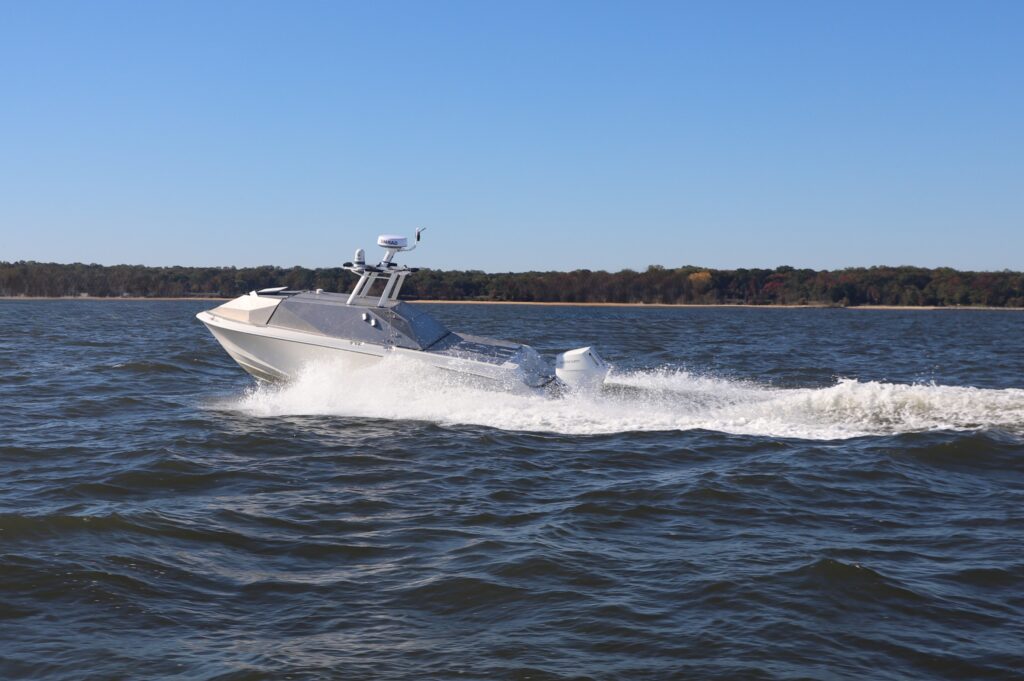
Tsunami, a small USV, is a joint effort by Textron Systems and Brunswick Corp. Photo credit: Textron Systems
Textron Systems (Booth 1827, D1), originator of the Common Unmanned Surface Vehicle (CUSV) in U.S. Navy service, has developed a less expensive USV that could be used for a variety of missions and could even be considered attritable.
Textron is teamed with Brunswick Corp., a small craft manufacturer, to offer Tsunami, family of deployable, small, scalable, gasoline-powered outboard-engine craft, with hull lengths ranging from 14 to 42 feet long. Certain of the models have a payload capacity of 1,000 pounds, ranges between 600 and 1,000 nautical miles, and operable in Sea State 4.
“We are the originator of the common uncrewed surface vehicle, the CUSV, for the Navy which was successfully adapted to become the Navy’s first unmanned surface vehicle program of record and which is being fielded to the littoral combat ship fleet now [for mine countermeasures],” said David A. Phillips, senior vice president, Air, Land & Sea Systems, Textron Systems, in a briefing to reporters. “Surface warfare that doesn’t necessarily require the power and the weight necessary in a mine countermeasure system.”
Phillips noted several mission sets that an inexpensive unmanned craft could take on, including port security, port surveillance, escort and training.
“We have been in constant collaboration with Navy and commercial customers as to what a system like this might bring them in terms of operational flexibility [and] emerging mission sets,” he said. We continue discussion with the Navy — all elements of the Navy to include fleet as well as our particular programs in which we work. And we’ve been hearing an increased expression of interest in a small, rapidly deployable, unmanned surface vehicle that can support a variety of missions beyond mine countermeasures.”
Brunswick, builder of recreational watercraft of such product lines as Boston Whaler, Bayliner and Mercury Marine, has craft adaptable to Textron’s vision and has established supply lines.
“Brunswick’s portfolio of reliable high-performance vessels — their watercraft, propulsion systems, control systems — and manufacturing capacity and their global footprint along with our mature autonomy technology and systems integration capability was really the perfect combination to allow us to develop an accessible, rapidly deployable, and what I call a modular open systems architecture oriented family of vehicles or systems,” Phillips said.
“Brunswick’s technologies are already in mass commercial production and globally available. That allows us to reduce costs, risk, and production time when integrating and ultimately delivering these vessels. Their global footprint and mature resilience supply chain provides our customers with an unmatched support and aftermarket service.”
Brunswick “has invested in and developed a built‑in drive-by-wire system for us to ramp our higher levels of operationally relevant autonomy that we’ve developed and delivered to the U.S. Navy and that we’ve proven through mine countermeasure unmanned surface vehicles and that we fielded operationally with the Navy and demonstrated through exercises like RIMPAC and FLEX,” he said.
Phillips said the Tsunami could be fielded rapidly.
“We recognize the need for a ready-now solution that harnesses the capability and capacity of the U.S. industrial base,” he said. “That’s important at being able to scale and being able to rapidly deploy systems when our customer wants them. … Speed. Speed to market. Speed to contract. Speed to delivery. Leveraging this mature production capability enables rapid production without the costs and risks of developing boutique manufacturing capability and scaling mass production. These watercraft are already in production.”
The Tsunami craft is adaptable to swarming tactics, according to Textron.
“We’ve also done some testing in that realm,” Phillips said. “Although I’m not going to go into certain mission scenarios, the swarm is important and controlling multiple systems is important. We’ve done that for many years with our aircraft systems. We understand swarming of systems. We also understand the complexity associated with that. We have designed this system and we have demonstrated this system to operate multiple watercraft. I won’t get into how many.”
The low cost of the Tsunami is key to the craft being attritable, Phillips said.
Asked by Seapower if the USVs used by Ukraine against the Russian navy were part of the inspiration for the Tsunami, Phillips replied that “it certainly informed us of that emergent need. … I am not presupposing what one of our customers might use our system for.”
Aircraft Carrier Suppliers Warn of Production Going Cold
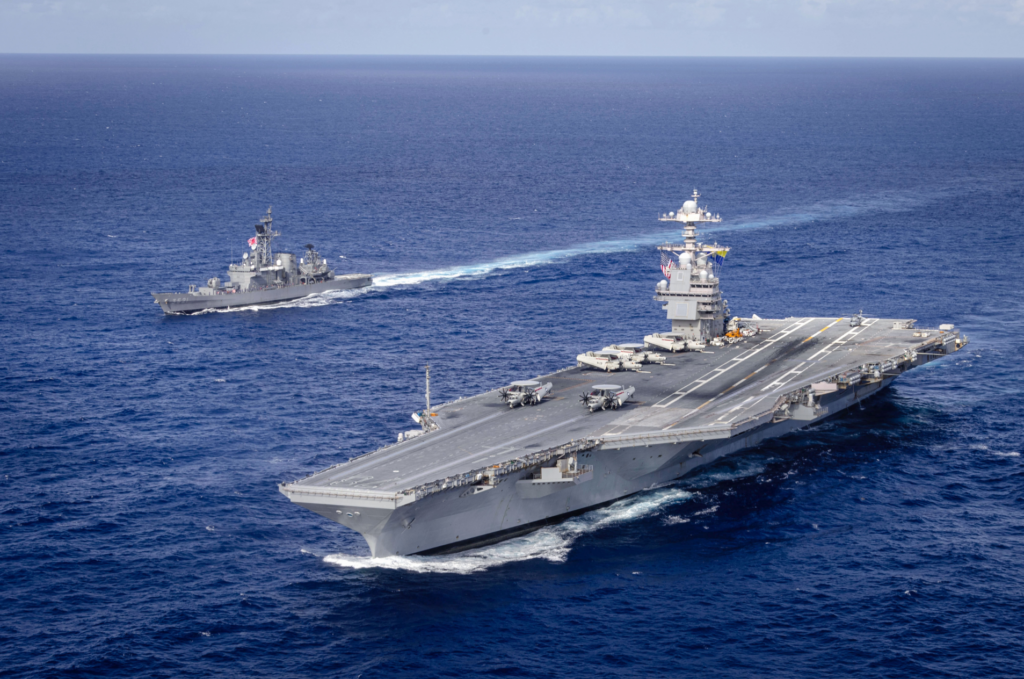
The world’s largest aircraft carrier, USS Gerald R. Ford (CVN 78), sails in formation with Japan Maritime Self Defense Force (JMSDF) Hatakaze-class guided missile destroyer JS Shimakaze (TV-3521) while conducting routine operations in the Atlantic Ocean, Sept. 23, 2024. (U.S. Navy photo by MC2 Jacob Mattingly)
By Richard R. Burgess, Senior Editor
ARLINGTON, Va. — The coalition of industrial base suppliers for aircraft carrier production is warning that some suppliers’ production lines are going “cold” or soon will do so in there is further delay in starting procurement for the next Gerald R. Ford-class aircraft carrier, (CVN 82).
The Aircraft Carrier Industrial Base Coalition (ACIBC) is looking for a $600 million commitment from the Congress in advance procurement toward the construction of CVN 82. Last week ACIBC leaders and members met with members of Congress to discuss carrier funding.
“We’re asking for $600 million of advance procurement funding so that we can start long-lead material and get that ball rolling [for CVN 82],” said Lisa Papini, chair of the ACIBC. “We’re looking for a commitment to start CVN 82 no later than Fiscal Year 2029.”
Papini said the situation is worse for suppliers this year than last.
“Last year when we were here, we were warning that companies in our coalition without a new ship award would start to go cold, specifically, people that are doing continuous production lines would start to have those production lines go cold in the near future,” she said. “This year we have companies that are saying they have gone cold, or they will be cold — and by cold, I mean that that production line has ceased continuous operation.”
According to an ACIBC fact sheet with the results of a survey of 219 suppliers, 73% of member critical or single-source material supply lines are cold or will go cold in 2026 without the advance funding. Those percentages would increase in 2027 and 2028 to 83% and 96%, respectively, without the advance funding. A majority of the suppliers also provide products and materials for submarine construction as well.
To deal with the business delays, suppliers are reassigning workforce to other business or exploring other business outside of shipbuilding, the fact sheet said.
Papini said that the worsening situation does not match with the nation’s demand for aircraft carriers around the world, noting that in recent years carrier deployments have been extended numerous times and that longer deployments result in more need for supplier support and maintenance.
“The companies who support and who provide products to the new construction [carriers], so CVN 82, are the companies who provide the service and parts to sustain carriers and overhaul carriers as well, so as production lines start to go cold, the ability to support carriers in service and support overhauls decreases,” Papini said. “We’re at this inflexion point.”
She stressed that the industrial base “has such a significant role in supporting the ships when they are in service, helping them achieve their actual service life, keeping them running. It’s the companies across the country who have supplied the equipment, the parts, the services when something needs repair.”
The ACIBC would like to see Congress authorizing a two-carrier procurement, CVN 82 along with CVN 83. CVN 80 and CVN 81 were procured in such a manner.
“We know that that’s the best way to procure ships, to specifically procure aircraft carriers — so a two-carrier buy with three years of advanced procurement funding for long-lead material and four-year centers,” Papini said.
The Navy has stated that the optimum procurement profile for CVNs is two-ship procurement with at least three years of advance procurement and construction at four-year intervals.
A MUSt DO: REPMUS is Primary Means for NATO to Develop Maritime Uncrewed Capability
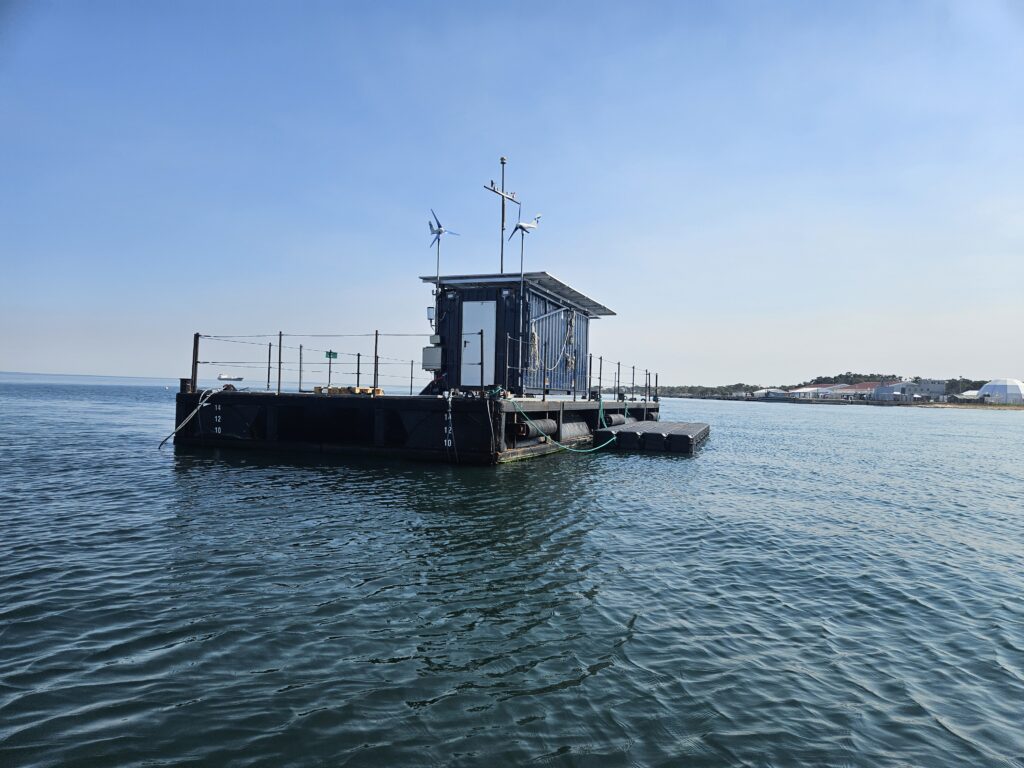
At Robotic Experimentation and Prototyping using Maritime Uncrewed Systems 2024, the Portuguese Navy tested a prototype of an offshore artificial island, designed to provide a base for forward deploying and sustaining autonomous capabilities. Photo credit: Lee Willett
NATO navies are steadily increasing their use of maritime uncrewed systems, or MUS, aided by an extensive exercise process that covers the development of vehicles, payloads, capabilities and supporting architecture through various phases.
These phases include research and development, test and evaluation, operational experimentation and integration into frontline assets and task groups.
One exercise that has evolved to cover at least the first three phases in this process is the Portuguese navy-led Robotic Experimentation and Prototyping using Maritime Uncrewed Systems, which takes place annually off the Tróia peninsula in southern Portugal. Established in 2010, it is hosted by the navy’s Tróia-based Navy Operational Experimentation Center, or CEOM.
REPMUS originally focused on the research and development and test and evaluation phases. However, in recent years, especially due to the accelerating requirement to integrate MUS capabilities into frontline operations, the operational experimentation phase has become an equally crucial part of the REPMUS process.
The exercise’s operational importance is underlined by the fact that NATO’s Allied Maritime Command has developed and attached Dynamic Messenger — the alliance’s first and primary MUS operational experimentation exercise — to REPMUS.
The two exercises were run in tandem in 2022 and 2023, co-hosted by CEOM and MARCOM; Dynamic Messenger will return to Tróia for REPMUS 2025.
The significance of REPMUS is underlined by the fact that several other major international MUS development activities now seek to support, draw on or understand the REPMUS process:
• Representatives from the Australia-U.K.-U.S. strategic partnership are focused on advanced maritime technology capability.
• NATO’s Defence Innovation Accelerator for the North Atlantic construct assesses, tests and develops startup technology to demonstrate potential defense capability and deliver it more quickly to frontline operators.
• The European Defence Agency is developing concepts and capabilities tested in and around REPMUS.
• NATO’s Norfolk, Virginia-based Allied Command Transformation branch and La Spezia, Italy-based Centre for Maritime Research and Experimentation’s in-house laboratory have been testing concepts, technologies and capabilities at REPMUS for several years.
The increasing importance of REPMUS was demonstrated in the 2024 exercise as more than 100 MUS vehicles were involved, more than 700 experimentation serials were conducted, and 30 countries participated, NATO allies and partners alike.
One partner of note was the Ukrainian Navy. Ukraine’s experience of operating and countering uncrewed systems in both offensive and defensive operations in its ongoing war with Russia underscores the role uncrewed systems play today in conflict.
Thus, REPMUS has become a more important tool for NATO and its navies, providing capability development from research and development and test and evaluation to operational experimentation and accelerating the generation of MUS capabilities for operations.
“The NATO defense planning process is the primary means for identifying NATO’s minimum capabilities requirements, the apportionment of those capabilities among allies and progress assessment,” Captain António Mourinha, the Portuguese Navy’s CEOM director and REPMUS chief of staff, told Seapower in an interview in December.
“Through this process, NATO allies are working together to develop and procure innovative maritime solutions and applications to increase operational effectiveness, limit risk to human life and reduce operational costs. In this context, and in the evolving landscape of maritime operations, MUS are seen as revolutionary and a dynamic force multiplier in the composition of our future fleets.
“These systems may increase, at fast pace, the mass, reach and flexibility of our maritime capabilities, improving operational effectiveness, efficiency and safety and thereby maximizing the potential of these fleets in a new manned-unmanned teaming construct,” Mourinha said.
The role REPMUS plays here is in capability development, evolving and improving the MUS systems to meet operational requirements, including for interoperability between the MUS vehicles themselves, building creweduncrewed teaming and supporting multidomain operations.
“REPMUS provides a cooperative environment where academia, industry, national armed forces and NATO can work together to foster advances in MUS capabilities, with a focus on interoperability … [it] allows for an exchange of innovative ideas and knowledge, thereby accelerating the development of new capabilities and the testing of such systems in a realistic operational setting,” Mourinha said.
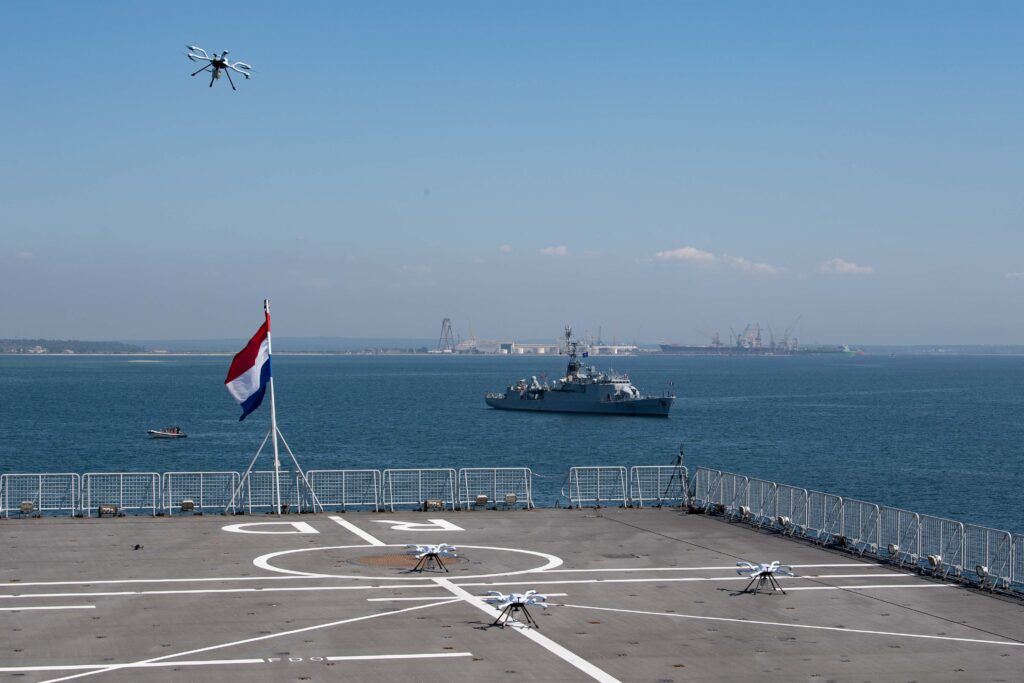
Uncrewed air vehicles work with crewed surface vessels at Robotic Experimentation and Prototyping using Maritime Uncrewed Systems 2022. REPMUS is an exercise in which NATO navies build capacity to deliver crewed-uncrewed teaming in multidomain operations. Photo credit: NATO | Fran S. Dzioba
Rolling Process
REPMUS is a rolling process, with capability developments and lessons learned taken forward into the following year’s exercise.
REPMUS 2024 addressed national and NATO MUS capability development through focusing on technology, doctrine, training, interoperability and crewed-uncrewed teaming.
The REPMUS process also focuses on MUS use in all major warfare domains, including anti-air, anti-surface and anti-submarine operations, plus more specific taskings like mine countermeasures, force protection, harbor security, maritime security and critical undersea infrastructure protection.
At REPMUS 24, MUS use was tested in various conceptual and technological contexts, and Mourinha highlighted several examples.
The exercise tested and developed the requirements for NATO Standardization Agreement 4817, a mainstay STANAG for underwater communications in particular, building multidomain command and control for underwater operations involving, for example, uncrewed underwater vehicles.
“STANAG 4817 is a key feature for allied interoperability in using MUS,” Mourinha said. Alongside being used for sharing the common operational picture, 4817 was used at REPMUS 24 to conduct MUS command and control for the first time, he said.
Several of the serials focused on underwater tasks. Reflecting what was an emerging operational requirement for NATO, but now is an enduring one, critical underwater infrastructure protection serials were conducted using maritime uncrewed systems.
Here, “blue force” surface ships, uncrewed surface and underwater vessels and acoustic sensors were used to detect and prevent “red force” disruption activities.
For mine warfare, the exercise tested the use and coordination of MUS alongside the development of a visualization and command and control tool that enables holographic presentation of the mine threat area.
With Russian submarine activity continuing to increase across the Euro-Atlantic theater, MUS — especially uncrewed surface vehicles and uncrewed underwater vehicles — are central to NATO’s development of its anti-submarine warfare barrier concept, for which multistatic acoustic detection was tested in REPMUS 24.
“The barrier is a defensive ASW concept, using MUS extensively to detect, track and, if necessary, neutralize adversary submarines attempting to penetrate strategic areas, like naval bases, choke points or shipping lanes,” Mourinha said.
The impact of Russia’s invasion of Ukraine on NATO operational requirements is reflected in the REPMUS work on countering uncrewed systems. At REPMUS 24, counterdrone work encompassed testing capabilities and tactics in all maritime domains.
“This is an important area of development, since many actors can cause disruptive effects, even with the simplest of uncrewed systems,” Mourinha said.
REPMUS also tests NATO navies’ ability to integrate other concepts and technologies to enhance MUS capabilities, such as through exploiting artificial intelligence. In this context, a concept called “silicon sailor” was tested, involving experimenting with how AI can assist with accessing naval operational manuals and protocols, providing fast access to critical information, supporting decision-making processes and enhancing personnel training. Scenarios included maritime navigation and rescue tasks.
A notable REPMUS 24 development was the establishment of an artificial island — located in the Sado Estuary Natural Reserve, offshore from the main exercise base and CEOM headquarters at Tróia — designed as a prototype for a future, larger island construct designed to support MUS operations and wider surveillance and ocean monitoring.
“The structure was created … to test the requirements for MUS operation, ocean sensing, energy production and management, and efficient data processing and storage, with the testing of an underwater computer and server,” Mourinha said. Drawing on data gathered and lessons learned from the prototype, the navy intends to develop the larger artificial island to deploy it close to the deep waters of the Setubal Canyon on the peninsula’s seaward side.
Experimentation around these themes will continue at REPMUS 2025, with additional focus areas of persistent surveillance and data exploitation — reflecting Dynamic Messenger.
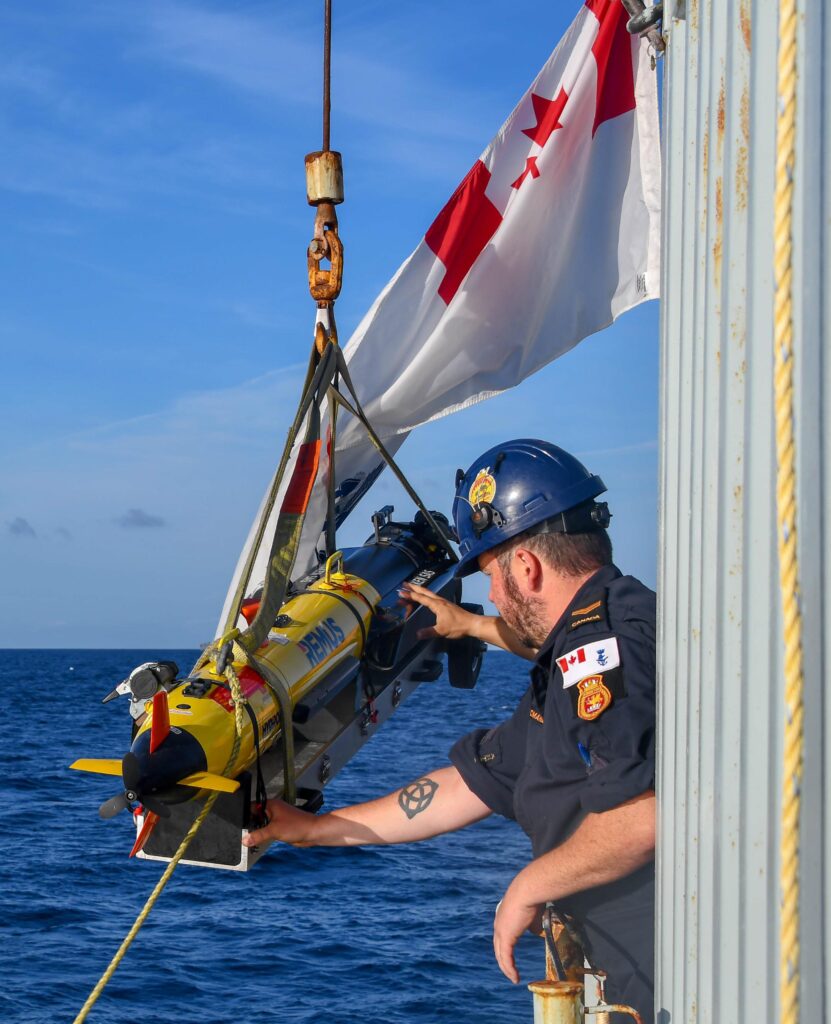
At REPMUS 2022, a REMUS UUV is deployed from a Royal Canadian Navy Kingston-class maritime coastal defense vessel. REPMUS is a core exercise process for developing NATO maritime uncrewed systems capabilities. Photo credit: Estonian navy | NATO
Testing Zone
The testing conducted at REPMUS is enabled and supported by the fact that CEOM and the wider Tróia exercise area sit in the middle of a Portuguese government “technological free zone,” which the navy and Portugal’s naval industry can exploit.
The zone covers more than 1,000 square miles and permits testing and operational experimentation of new technology in a secure, at-sea space free from other users, enabling technology readiness levels to be developed to the point where the technologies can be presented to regulatory authorities for certification.
“The idea is to increase the use and efficiency of CEOM in a more cooperative way, by bringing more countries, international industry and research centers to experiment at CEOM in a concept closer to the one used in REPMUS, Mourinha said. The zone provides capacity for multiple stakeholders to be present at the same time to conduct testing, with this combined presence enabling synergies to be achieved and information to be exchanged, he said.
In 2025, CEOM will increase engagement with both Portuguese industry and NATO allies to increase their experimentation presence around the peninsula.
Allied presence at REPMUS 25 may also increase, possibly including one of the U.S. Navy’s latest MUS capability and operational development organizations, the U.S. 6th Fleet’s Task Force 66.
Dr. Lee Willett is an independent writer and analyst specializing in naval and maritime matters. With a 25-year professional background,he has spent time at sea on submarines,aircraft carriers and other craft.This article was first published in the February-March issue of Seapower.
DON Authorizes Attendance at Sea-Air-Space 2025 for Military, Civilian Personnel
FOR IMMEDIATE RELEASE March 25, 2025
ARLINGTON, Va. — Travel for the Navy League’s Sea-Air-Space Symposium has been authorized for all Department of Navy military speakers, moderators, and panelists, and attendance at the event has been approved for all National Capital Region (local) Navy federal civilian employees and uniformed military personnel.
A memo released by acting Under Secretary of the Navy Terrence Emmert, dated 20 March 2025, says, “I approve the Department of the Navy’s attendance at the Navy League’s Sea-Air-Space Symposium, 6-9 April 2025, at National Harbor, Maryland.”
Sea-Air-Space, the nation’s largest maritime national security symposium, is critical, as it “provides a platform for the professional development of Department of the Navy personnel on the latest developments in naval warfare, as well as an opportunity for Navy engagement with representatives from a broad cross-section of government, industry, academia, and the international community.” (GENADMIN released 24 MARCH 2025).
The Navy League of the United States, the host for Sea-Air-Space, is offering federal active-duty and civilian employees admission and transportation to the event, as well as one complimentary meal event. The Navy League also offers them discounted parking and meals for purchase at a discounted rate. Local bus services to and from the Gaylord National Harbor is also available for all federal civilian employees and uniformed military. Please see website, www.seaairspace.org for further details. Attendees not opting for these services are responsible for their own commuting costs to the event.
Newly confirmed 79th Secretary of the Navy, the Honorable John C. Phelan, will address Sea-Air-Space attendees on his priorities for the Department, including ways to revitalize U.S. shipbuilding, strengthen warfighting culture, and recruit America’s best and brightest. Top speakers also include acting Commandant of the United States Coast Guard Admiral Kevin Lunday, Acting Chief of Naval Operations Admiral Jim Kilby, and Commandant of the Marine Corps General Eric Smith.
Nimitz Carrier Strike Group Departs Bremerton for Regularly Scheduled Indo-Pacific Deployment
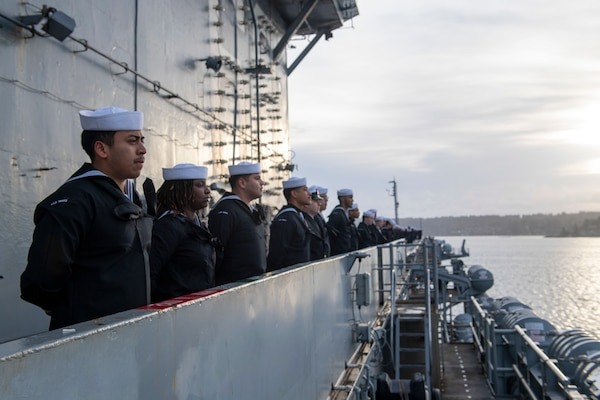
Sailors man the rails on the flight deck of the aircraft carrier USS Nimitz (CVN 68) in the Puget Sound after getting underway for a regularly scheduled Indo-Pacific deployment, March 21, 2025. (U.S. Navy photo by MCSN Japeth Carter)
From Commander, U.S. 3rd Fleet Public Affairs, March 24, 2025
The Nimitz Carrier Strike Group (NIMCSG) departed Naval Base Kitsap in Bremerton, Washington, for a regularly scheduled deployment to the Western Pacific, March 21. For five decades, the Nimitz Carrier Strike Group has upheld the U.S. Navy’s commitment to a forward presence while ensuring maritime security, deterring aggression, and protecting the American way of life. Nimitz, in its 50th year of service, continues and celebrates its legacy of strengthening alliances and partnerships, demonstrating the power of teamwork and cooperation in maintaining peace and security.
The Nimitz Carrier Strike Group (NIMCSG) departed Naval Base Kitsap in Bremerton, Washington, for a regularly scheduled deployment to the Western Pacific, March 21. For five decades, the Nimitz Carrier Strike Group has upheld the U.S. Navy’s commitment to a forward presence while ensuring maritime security, deterring aggression, and protecting the American way of life. Nimitz, in its 50th year of service, continues and celebrates its legacy of strengthening alliances and partnerships, demonstrating the power of teamwork and cooperation in maintaining peace and security.
The strike group’s deployment will focus on protecting security, freedom, and prosperity for the United States, our allies and partners, and demonstrating the U.S. Navy’s unwavering commitment to a free and open Indo-Pacific.
NIMCSG consists of the Nimitz-class aircraft carrier USS Nimitz (CVN 68), Carrier Air Wing (CVW) 17, and Destroyer Squadron (DESRON) 9.
The embarked air wing consists of nine squadrons flying F/A-18C/E/F Super Hornets, EA-18G Growler, E-2D Hawkeyes, C-2A Greyhounds, and MH-60R/S Sea Hawks; Squadrons are the “Fighting Redcocks” of Strike Fighter Squadron (VFA) 22, “Mighty Shrikes” of VFA-94, “Kestrels” of VFA-137, “Blue Diamonds” of Strike Fighter Squadron (VFA) 146, “Cougars” of VAQ-139, “Indians” of Helicopter Sea Combat Squadron (HSC) 6, “Bluetails” of Carrier Airborne Early Warning Squadron (VAW) 121, “BattleCats” of Helicopter Maritime Strike Squadron (HSM) 73, and the “Rawhides” of Fleet Logistics Support Squadron (VRC) 40.
DESRON 9 consists of the Arleigh Burke-class guided-missile destroyers USS Curtis Wilbur (DDG 54), USS Gridley (DDG 101), USS Wayne E. Meyer (DDG 108) and USS Lenah Sutcliffe Higbee (DDG 123).
An integral part of U.S. Pacific Fleet, U.S. 3rd Fleet operates naval forces in the Indo-Pacific and provides the realistic and relevant training to ensure the readiness necessary to execute the U.S. Navy’s timeless role across the full spectrum of military operations. U.S. 3rd Fleet works together with our allies and partners to advance a shared vision of a free, open, and secure Indo-Pacific in which all nations are secure in their sovereignty and free from coercion.
Coast Guard Teams Deploy to American Samoa to Patrol Border, Conduct Boardings
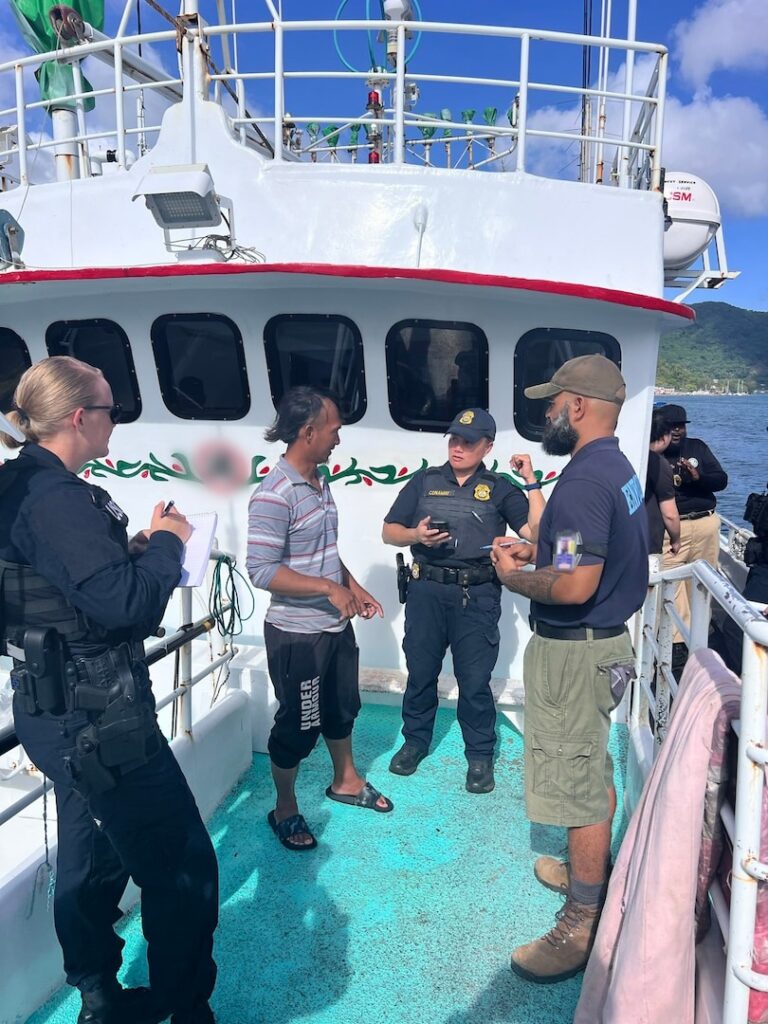
A U.S. Coast Guardsman assigned to a Coast Guard Sector Honolulu boarding team, National Oceanic and Atmospheric Administration Office of Law Enforcement officer and American Samoa Department of Marine and Wildlife Resources officer speak to the master of a foreign-flagged fishing vessel during a boarding offshore Pago Pago, American Samoa, Feb. 26, 2025. (U.S. Coast Guard photo, courtesy Sector Honolulu)
From Coast Guard District 14 External Affairs, March 4, 2025
HONOLULU – Coast Guard Maritime Safety and Security Team Honolulu personnel and a boarding team from Coast Guard Sector Honolulu deployed to American Samoa from Feb. 10-27 to protect the U.S. maritime border, enforce U.S. laws and regulations, enhance maritime domain awareness and coordinate with agency partners.
During the deployment, team members boarded six U.S.-flagged commercial fishing vessels, six foreign-flagged commercial fishing vessels, and five recreational boating safety boardings, resulting in the termination of one recreational voyage due to deficient safety equipment.
Crews patrolled the U.S. territorial maritime border and the U.S. Exclusive Economic Zone surrounding American Samoa, which extends up to 200 miles offshore.
Additionally, MSST Honolulu and Sector Honolulu personnel conducted over 26 hours of training with the American Samoa Department of Homeland Security and American Samoa Marine Patrol, a law enforcement unit within the American Samoa Department of Marine and Wildlife Resources. Training primarily focused on boarding procedures and weapons proficiency.
“Working closely with partners in American Samoa heightens our awareness of any illicit activities in the area and hones our combined ability to safeguard the maritime border,” said Lt. Cmdr. Nic Iannarone, enforcement division chief, Sector Honolulu. “Teamwork is a key component of taking a stand against threats to our ports and waterways.”
In accordance with the President’s Executive Orders and direction from Adm. Kevin Lunday, the acting commandant of the Coast Guard, the Coast Guard is increasing cutter patrols and operations in American Samoa. The Coast Guard is surging assets to increase presence in key areas to protect America’s maritime borders, territorial integrity, and sovereignty.
Maritime Safety and Security Team Honolulu is a specialized unit of the Coast Guard dedicated to enhancing maritime security and safety in the Pacific region. With a highly trained personnel team equipped to conduct law enforcement operations, port security assessments, and emergency response activities, MSST Honolulu collaborates closely with local, state, and federal agencies to safeguard vital maritime infrastructure and natural resources.
Sector Honolulu serves a broad expanse of the Pacific that includes 200 nautical miles surrounding the State of Hawaii, the islands and atolls of the Hawaiian Island Chain and American Samoa. The sector’s primary missions include ensuring maritime security, conducting search and rescue operations, enforcing environmental protection laws, and facilitating law enforcement activities.
Navy CNO Franchetti Fired
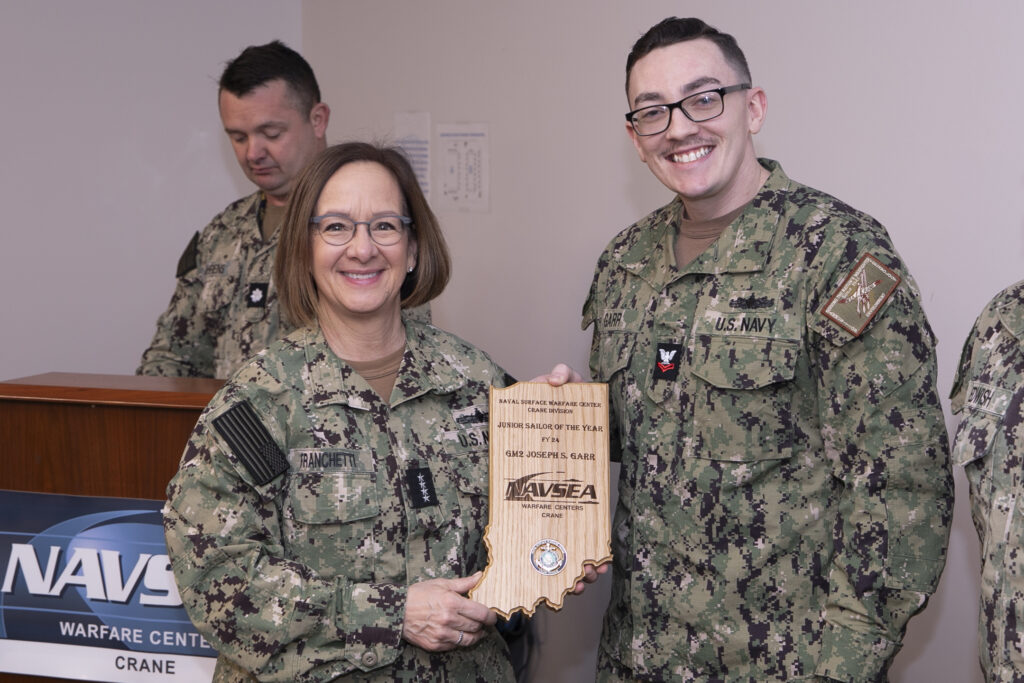
Chief of Naval Operations Admiral Lisa Franchetti presents an award to a Sailor at Naval Support Activity (NSA) Crane, in Crane, Indiana, Feb. 10, 2025. Photo Credit: U.S. Navy | Senior Chief Petty Officer Elliott Fabrizio
Secretary of Defense Pete Hegseth announced he was firing Chief of Naval Operations Admiral Lisa Franchetti on Friday, the same day as he relieved Air Force General Charles Q. Brown as chairman of the Joint Chiefs of Staff, according to the New York Times.
According to the Times and other reports, Hegseth said Franchetti and Air Force General James Slife, the service’s vice chief of staff, also fired, had “distinguished careers,” and “we thank them for their service and dedication to our country.”
Franchetti was the 33rd chief of naval operations, the first woman to be CNO and the first woman to serve on the Joint Chiefs of Staff. She entered the Navy after earning a degree in journalism at Northwestern University and joining the Naval ROTC program there.
She later commanded the destroyer USS Ross, commanded U.S. Naval forces in Korea, served as commander of the U.S. 6th Fleet in the Mediterranean and director of strategy, plans and policy for the U.S. Joint Chiefs of Staff.
Navy Retires Last EP-3E Electronic Reconnaissance Aircraft
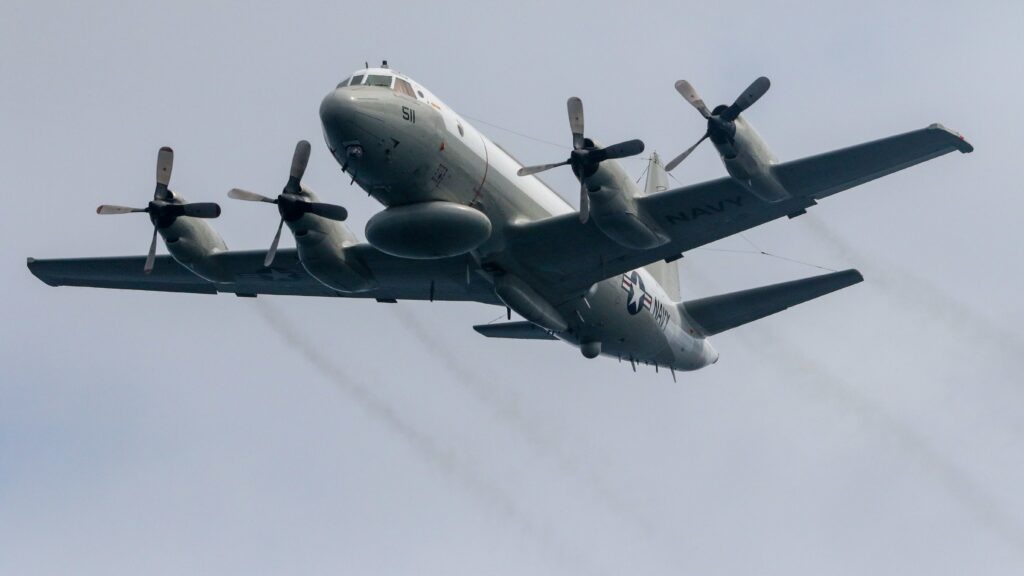
EAST CHINA SEA (Sept. 24, 2020) An EP-3E Airborne Reconnaissance Integrated Electronic System (ARIES) II, assigned to the “World Watchers” of Fleet Air Reconnaissance Squadron 1 (VQ-1), transits over the East China Sea. (U.S. Navy photo by MC3 Andrew Langholf)
By Richard R. Burgess, Senior Editor
ARLINGTON, Va. — The Navy has retired its last EP-3E Aries II electronic reconnaissance aircraft after the type’s 45 years of service to the fleet.
In an informal Feb. 12, 2025, ceremony, at Naval Air Station Whidbey Island, Washington, Fleet Air Reconnaissance Squadron One (VQ-1), the sole remaining operator of the EP-3E, farewelled the last EP-3E. The aircraft was flown away on Feb. 13 for the last time.
The aircraft, BuNo 159893, was the last of 26 EP-3Es that served the fleet beginning in 1970. Ten P-3A Orion patrol aircraft were converted to EP-3Es for operation by VQ-1 and VQ-1, joining two earlier EP-3B versions in service. This batch of EP-3Es were replaced beginning the 1990s by a new generation of EP-3Es converted from P-3C Orions, with ultimately 17 aircraft converted to sustain an operational fleet of 12 aircraft.
The EP-3E fleet provided multi-intelligence support to the fleets and to theater combatant commanders with near-real-time signals intelligence and full-motion video, the Naval Air Systems Command said. The aircraft was equipped with sensitive electronic receivers and high-gain dish antennas. The large crew was able to fuse the intelligence it collected with offboard intelligence and provide threat warning and situational awareness in support of suppression of enemy air defenses, anti-air warfare, anti-submarine warfare, and anti-surface warfare.
The EP-3E has been succeeded by the MQ-4C Triton high-altitude, long-endurance unmanned aerial vehicle operated by Unmanned Patrol Squadron 19.
VQ-1 has one P-3C remaining, which it used as a utility training and transport aircraft. The aircraft, BuNO 161588, will be retired in an informal ceremony to be held at NAS Whidbey Island on Feb. 20, 2025.
VQ-1 will hold its deactivation ceremony at Whidbey Island on March 28, 2025. The official date for the deactivation is March 31.
Marine Corps Updates F-35 Procurement, Transition Plan
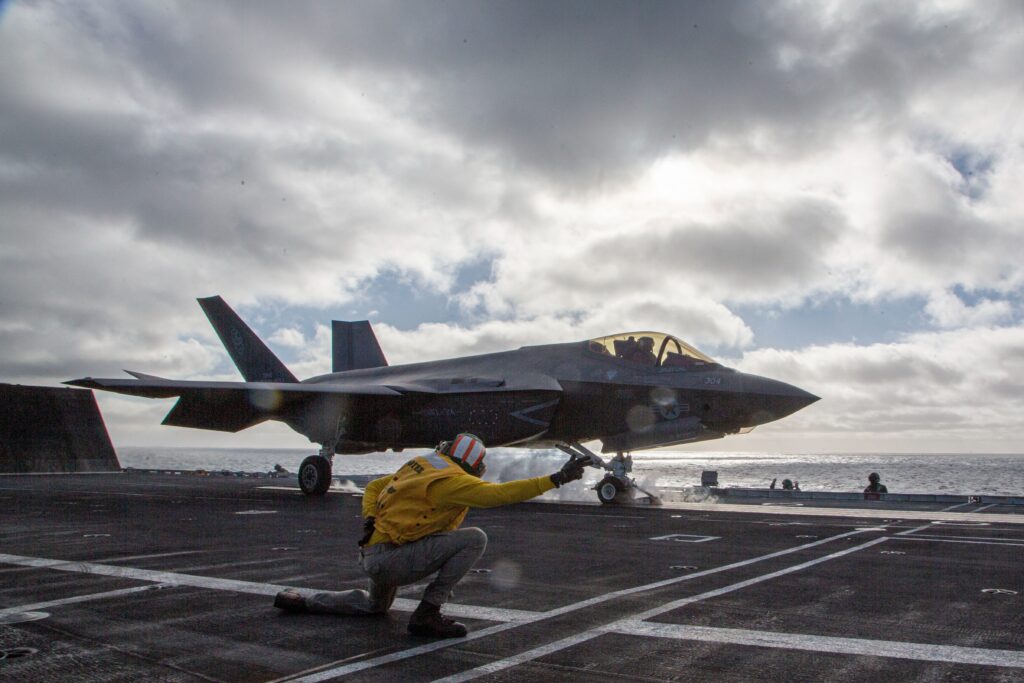
Marine Fighter Attack Squadron (VMFA) 314 launch and recover F-35C as they work to renew their carrier qualifications onboard the USS Abraham Lincoln (CVN 72) (U.S. Marine Corps photo by 1stLt. Charles Allen)
By Richard R. Burgess, Senior Editor
ARLINGTON, Va. — The U.S. Marine Corps has adjusted its procurement and transition plan for its F-35 Lightning II strike fighter fleet. While the overall program of record remains at 420 F-35s, the balance between the numbers of short takeoff and vertical landing F-35B and the carrier launch capable F-35C has changed, with the number of F-35Cs increasing and the number of F-35Bs decreasing.
According to the 2025 Marine Corps Aviation Plan released Feb. 3, the Corps plans to procure a total 280 F-35Bs and 140 F-35Cs, as compared with the earlier program of record of 353 F-35Bs and 67 F-35Cs. These numbers will allow the Corps to support 12 F-35B fighter-attack (VMFA) squadrons and eight F-35C VMFA squadrons.
Before, the Corps had planned to support only four F-35C squadrons, VMFAs 314, 311, 251, and 115. With the change in the procurement profile, four other F/A-18 Hornet squadrons also will make the transition to the F-35C: VMFAs 232 and 323 and reserve VMFAs 112 and 134.
Currently, all but two operational F-35 squadrons are allowed to be equipped with 10 aircraft, with the other two, both based at Marine Corps Air Station Iwakuni, Japan, being allowed 12 aircraft each. Under the new plan, all operational F-35 squadrons will be equipped with 12 aircraft each beginning in 2030.
The Marine Corps F-35C squadrons will continue to support the TACAIR Integration Plan, in which they deploy as units of Navy carrier airwings.
Lockheed Martin Offers Mk70 Launcher to Increase Lethality of LCS
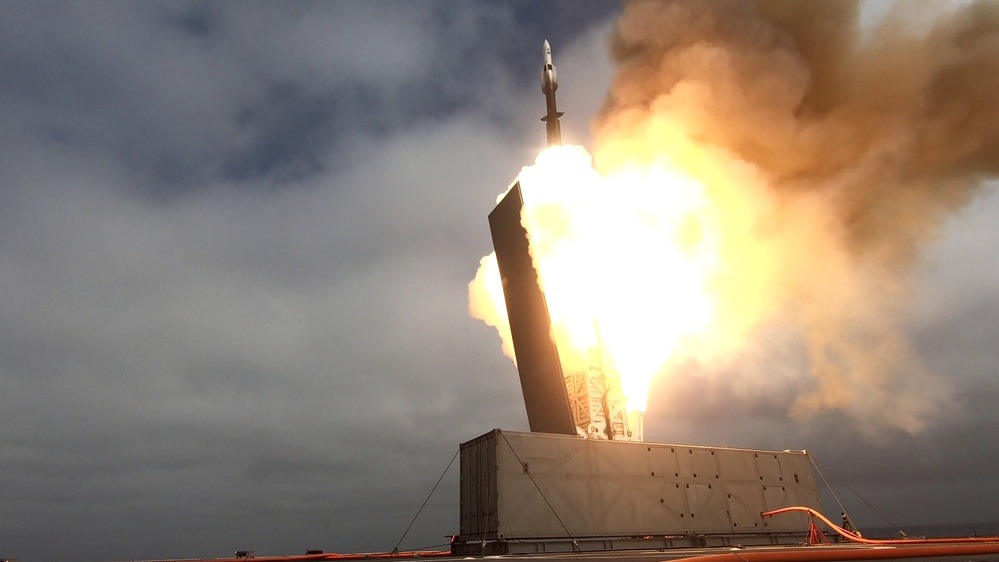
An SM-6 missile is launched from a containerized launcher on board USS Savannah (LCS 28) on Oct. 24, 2023. (U.S. Navy photo)
By Richard R. Burgess, Senior Editor
ARLINGTON, Va. — Lockheed Martin has adapted its Mk41 vertical missile launcher into a scalable containerized system than can be deployed on U.S. Navy ships, including the littoral combat ships (LCS) and non-traditional platforms of opportunity to increase their lethality with mid-range precision strike and air defense capabilities. company officials said.
The system, called the Mk70 Payload Delivery System, is a 40-foot-long ISO container in which four VLS cells can be fitted. The Mk70 system, designed for and deployed with the U.S. Army in a land-based configuration, can launch any type of missile certified for the Mk41, including the Tomahawk cruise missile, the various Standard surface-to-air missiles, the antisubmarine rocket, and the Evolved SeaSparrow missile. The Mk70 container is transportable on a C-17 cargo aircraft.
Ed Dobeck, director for launching systems at Lockheed Martin, told Seapower that the Mk70 was developed two years ago in concert with the Defense Department’s Strategic Capabilities Office to provide the Army with the ability to deploy and fire the Raytheon-built SM-6 Standard missile.
The same container can be secured on the flight deck or helicopter landing pad of a Navy ship using helicopter tie-down chains, occupying 400 square feet of a flight deck. Power from the ship’s electrical system can supply 400 volts to the Mk70. No modifications are required to the ship itself. The container can be installed within hours with a pier-side crane. A command shelter with virtual Aegis and Tomahawk control systems controls the launch of the missiles.
The flight deck of the Freedom-class LCS can accommodate three Mk70 containers, while the Independence-class LCS can accommodate four containers, Dobeck said. With one or more containers installed, the ships are unable to launch or land helicopters. The missile tubes can be reloaded horizontally, an advantage over the ship-installed Mk41’s need for vertical re-load by cranes.
Lockheed Martin has demonstrated containerized launch of SM-6 missiles from two Navy ships. An SM-6 missile was fired from the USS Savannah (LCS 28) in October 2023 and before that another was fired from the Overlord medium unmanned surface vessel Ranger during an exercise.
Dobeck said that the Navy has shown great interest in the Mk70 system, which already has been delivered to the Army. Two full batteries — totaling eight missile cells — have been delivered to the Army and two have been delivered to other customers. The Army has deployed the Mk70 to the Philippines