State Department Approves Possible Sale of MH-60R Helos to New Zealand
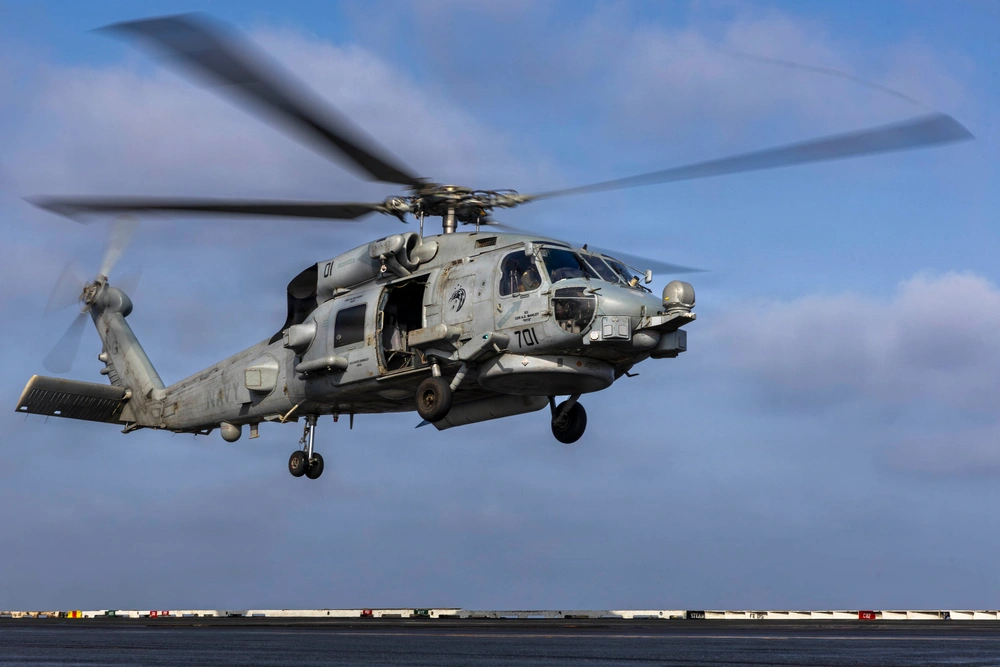
An MH-60R Seahawk, attached to Helicopter Maritime Strike Squadron (HSM) 71, takes off the flight deck of Nimitz-class aircraft carrier USS Abraham Lincoln (CVN 72), June 5, 2026. Abraham Lincoln is deployed to the U.S. 5th Fleet area of operations to support maritime security and stability in the Middle East. (U.S. Navy photo)
By Richard R. Burgess, Senior Editor
ARLINGTON, Va. —The U.S. Department of State has approved the possible Foreign Military Sale of ‘Lockheed Martin MH-60R Seahawk helicopters to the government of New Zealand, the department said in a June 5 release.
The Government of New Zealand has requested five MH-60Rs and associated equipment and weapons for an estimated cost of $1.5 billion. The sale would include engines, avionics, sonar systems, radars, sonobuoys, electronic surveillance systems, spares, ground support equipment, flight simulators, technical manuals, and support services, among other support. Weapons would include Hellfire and Advanced Precision Kill Weapon Systems and M240D machine guns.
The sale would bring to ten the number of air arms operating or soon to operate the MH-60R, the others being the U.S. Navy, Royal Australian Navy, Royal Danish Air Force, Hellenic Navy, Indian Navy, Norwegian Coast Guard, Republic of Korea Navy, Royal Saudi Navy, and Spanish Navy.
NAPA Ship Design Software Company Looking to Expand in North America
Mikko Forss, NAPA’s executive vice president for Design Solutions (NAPA photo)
By Richard R. Burgess, Senior Editor
ARLINGTON, Va. — A major ship design software company is focusing on expanding its customer base in North America, especially in view of the U.S. government’s increased shipbuilding initiatives and substantial industry investments.
The company, NAPA, based in Finland, designs software applications for ship design, safety, and operations.
“We basically provide 3D CAD [computer-aided design] and engineering software for the shipyards’ engineering offices,” said Mikko Forss, NAPA’s executive vice president for Design Solutions, in an interview with Seapower. “With the help of our software, our customers are able to make critical safety- and naval architecture-related divisions during their design process.
“Our customer base represents 90% of the annual shipbuilding output,” Forss said. “If we measure it in terms of compensated gross tonnage, we have a very strong position in the key shipbuilding markets in Korea, Japan, China, Europe, and, we have quite a few customers in North America.
“North America is a very important territory to us,” he said. “Your government has announced the Maritime Action Plan that comes with substantial industry stimulus and investments. We believe we can help the U.S.A. to deliver good quality vessels on time, on budget. So, we’re very much focusing on the North America market at the moment, and we are working with all the key stakeholders… “For the moment, our main focus is on the Navy and Coast Guard. We see ourselves as a really good partner for the U.S. shipbuilding industry to ramp up productivity and efficiency during these unprecedented times.”
Forss said the NAPA ship design software is “off the shelf,” so without any customization you can start to apply it for your design work Most of our customers have actually tailored and customized our software for their needs. That has proven to be a really, really powerful way of solving the specific challenges they have at hand.”
He cited South Korea’s HD Hyundai Heavy Industries, the world’s largest shipyard, as using heavily customized NAPA software to match with their design process.
“With that approach, they can gain more productivity, they can draw more design iterations in less amount of time, and that leads to quality products — ships, in this case — while maintaining the delivery schedule and budget,” he said.
Forss noted that all the major companies designing and building ice-going vessels are using NAPA software for multiple different design disciplines, including hull structure and stability management.
He also said that NAPA is emphasizing skilled workforce development. NAPA has partnered with universities in the United States that offer curricula in naval architecture “to build together a program, a curriculum where our software is included and there we have a mutual and shared vision to produce talent and skills that the industry needs because our industry is having, actually, a very exceptional moment, high order books, political-level attention toward our business that is almost unprecedented. But one major challenge we are facing is that skill shortage, that same thing I’m hearing when I’m traveling in Korea, in Japan, in the U.S. and in Canada. One way to solve this challenge is that we are partnering with academia to offer skills for the future graduates that are readily usable in the industry.”
Founded in 1989, NAPA has offices in ten countries and has 230 experts on board.
Forss, a graduate from Helsinki University and a naval architect for almost 20 years, explained his enthusiasm for his profession.
“Ships are the largest man-made objects that move,” he said. “It’s just a remarkable effort of engineering to design and build those and that is still fascinating me every single day. … Naval architects are one big family, globally, and the relationships and connections are really tight in our business.”
RENK America Moving to Become Second Builder of Ship Propulsion Bull Gears for U.S. Navy Ships
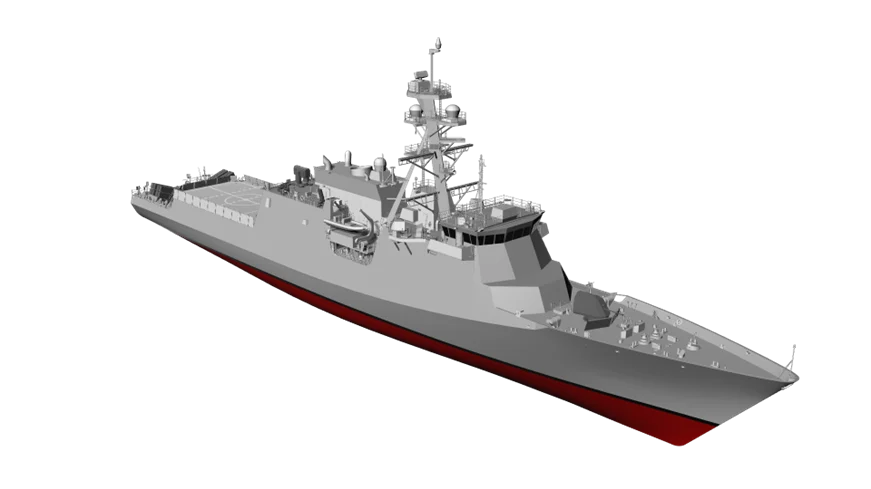
RENK is positioning itself to offer to provide the main gearboxes for the Navy’s proposed FF(X) frigate, a development of the Coast Guard’s Legend-class national security cutter. (U.S. Navy)
By Richard R. Burgess, Senior Editor
ARLINGTON, Va. — A 120-year-old American manufacturing company now owned by a German firm is positioning itself to return to building main gearboxes for new U.S. Navy ships as a Tier 1 supplier.
RENK Group AG bought Cincinnati Gearing Systems of Cincinnati, Ohio last year, which made the main reduction gear sets for the two fast combat support ships (AOEs) and the Kaiser-class fleet replenishment oilers three decades ago. Now called RENK America Marine and Industry (RAMI), RAMI is part of the global RENK Group’s Marine and Industry division.
RENK Germany provided the main gear boxes for the Coast Guard’s Legend-class national security cutters and is providing the main gear boxes for the Heritage-class offshore patrol cutters.
“Right now, for the big gear boxes — on aircraft carriers, cruisers, destroyers — there’s really only one supplier in America,” said Thom Burke, president of RENK America Marine and Industry (RAMI), in an interview with Seapower. “RENK’s big idea was to use Cincinnati Gear’s legacy experience in gearboxes to get back into bringing the Navy a second supplier. I was brought in to pivot us harder towards Navy business.”
During his Navy career, Burke commanded two ships, including a nuclear-powered aircraft carrier.
RAMI has approximately 120 employees who “grind the gears, make all the components, assemble the components, [and] test the assemblies.” Burke said.
Since supplying gear boxes to the AOEs and T-AOs 25 or 30 years ago, “we fell out of the ability to make the big, giant bull gears that drive those main reduction gear sets,” he said. “RENK is making investments in the company to prepare us to do that so that we can compete on frigate, destroyer, battleship, cruiser, whatever that next ship is going to be for the Navy.
Noting that the Navy is planning on building new frigates based on the Legend-class national security cutters, Burke said that “we’re [RENK] the incumbent for those vessels, so we’re preparing to growourselves up to be able to make frigates for the Navy if they so choose to do that.”
RAMI has been asked for a price quote for the proposed frigate Flight 1 design and is “trying to figure out ways to make those gearboxes here in America, here in Cincinnati, instead of Germany.”
Burke said that Cincinnati and now RENK products are on every destroyer in the U.S. Navy right now.”
The company also builds equipment for Textron’s LCAC 100-class of Ship-to-Shore Connectors and components for sustaining the Ohio-class submarines and for equipping the new Columbia-class submarines.
“There’s plenty going on now, and there’s plenty potential for the future,” Burke said, noting that RAMI wanted “to be able to offer the Navy a robust capability.”
Asked about RAMI’s workforce and the current industry-wide workforce challenges, Burke said, “We have been very aggressively trying to grow the workforce … [and] get a second shift. … “We’re filling out that second shift now.”
He said RAMI has hired 15 workers over the last six months.
“I’m trying to grow my own,” he said. “So far we’ve made a lot of progress, but it’s a continuing challenge for sure.”
RAMI has a partnership with a local high school and community college and is leveraging the Navy Talent Pipeline Program and the Accelerated Training in Defense Manufacturing (ATDM) Program in Denville, Virginia, which is “specifically designed to help adult learners earn the skills necessary to make an immediate impact in the submarine industrial base (SIB),” the ATDM website said.
Overwatch Imaging’s ASO Software Integrates AI with Sensors
ARLINGTON, Va. – Integration of artificial intelligence (AI) with imaging sensors relieves operator workload on some drones and Navy aircraft and enables those operators to focus on decision making rather than sifting through overwhelming amounts of data, a sensor technology expert said.
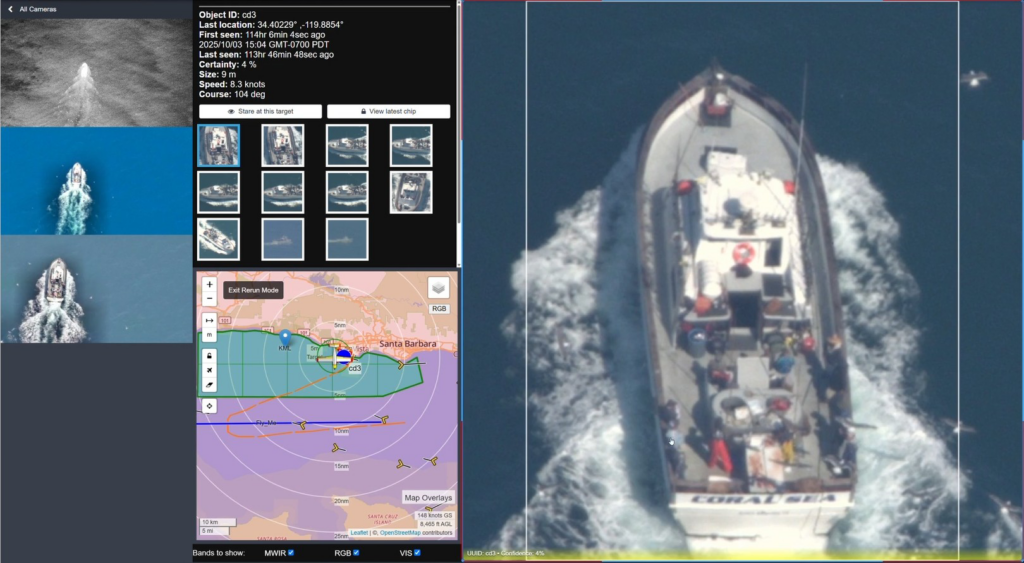
“We focus on automating the experience of using sensors — especially in the maritime environment but also overland — to make it easier and faster as well as better for crews to gain intelligence from the sensors that they use,” said Greg Davis, founder and CEO of Overwatch Imaging, an imagery intelligence technology company, in an interview with Seapower. “That process uses artificial intelligence and autonomy to reduce the workload for the crews that are using sensors and also provide those crews with a super-human vision — to see more than they can naturally see by using the power of computing and AI.”
“The Navy has this problem [in that] they collect a lot more data than they can look at,” Davis said. “Sometimes they don’t even collect data because they know they can’t look at it.”
Davis likened the task as “needing to find a needle in a haystack.”
Over watch’s software, called Automated Sensor Operator (ASO), uses a connection to a sensor that same as the crew would.
“The crew interacts with a sensor through ethernet corrections or serial connections,” Davis said. “We use that same method of connecting to the sensor. We sit between the crew member and the sensor. From that position we can take command of the sensor and accomplish the job that the sensor operator wants to accomplish and do that in an automated way that allows the crew member to focus on something else. We provide alerts when there’s something to see.”
No modifications to an aircraft’s mission computer are required, Davis said.
“We add a small edge processor, a small, ruggedized computer that basically lives between the sensor and the operator workstation,” he said. “That small computer does the AI, the sensor autonomy, right there at the edge between the sensor and the crew in a way that does not change the existing airworthiness of the kit.”
Overwatch puts the ASO software on sensors of its own designs and the ASO is “compatible with third-party sensors like sensors that are on Navy [MH-60] Seahawks or on the [P-8] Poseidon,” he said.
Overwatch Imaging, based in Hood River, Oregon, has deep roots in the autonomous systems and drone industry, Davis said. It has had an existing SBIR contract for 2 years that started with a Navy requirement for AI-enabled video processing. Overwatch is expanding its work to include a contract with another unnamed agency.
Davis noted that special operations forces, the Coast Guard, Customs and Border Protection all have “the same characteristic of needing to search big areas to find small things. Once you find the small things, our crews are very good at responding.
The company also is working on applying its technology to radar
“We started building ASO for image-based sensors, but next up this summer for us is an ASO for other types of sensors,” Davis said. “Probably a synthetic-aperture radar will be the first extension for us beyond image-based sensors. But eventually we’ll probably make this for all of the sensors in use on naval aircraft and other kinds of sophisticated aircraft. The crew can focus on making decisions, rather than looking at a lot of raw data. Let’s use computers to look at the raw data. … freed up that crew time to do decision making rather than staring at a [computer] screen.
Sigma Defense in Running for Navy Next-Generation CANES Programs
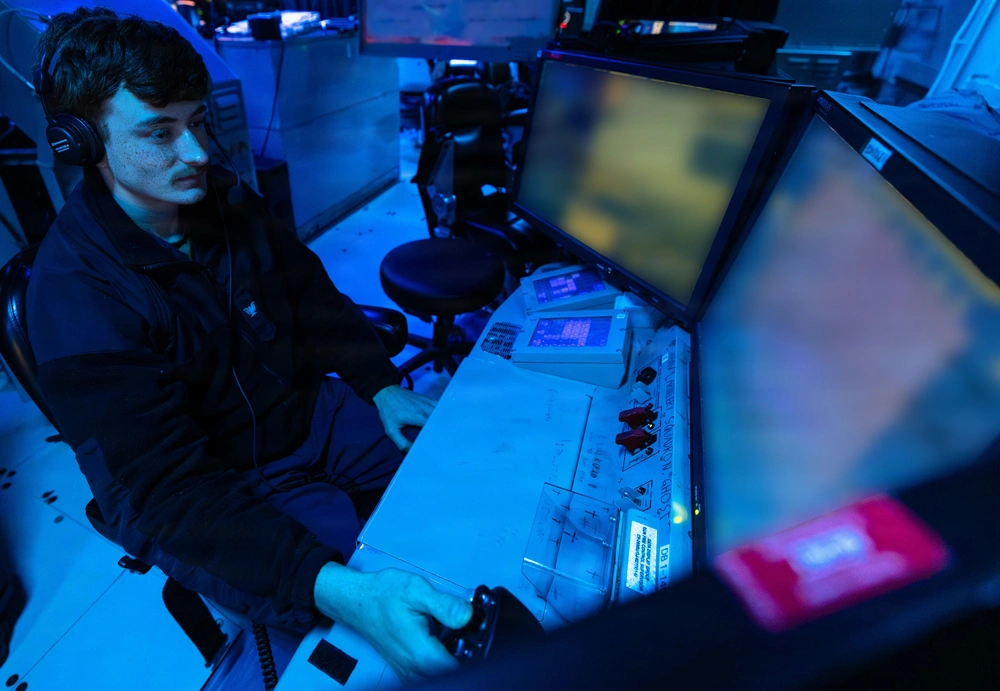
A U.S. Sailor stands watch in the combat information center of Arleigh Burke-class guided-missile destroyer USS Milius (DDG 69), April 9, 2026. Milius is deployed to the U.S. 5th Fleet area of operation to support maritime security and stability in the Middle East. (U.S. Navy photo) (Image blurred for operation security purposes)
By Richard R. Burgess, Senior Editor
ARLINGTON, Va. Sigma Defense, a company with a prime contract for the Navy’s Consolidated Afloat Networks and Enterprise Services (CANES) program, is in the running for a down-select for the Next-Generation (NextGen) CANES program.
CANES provides a core set of highly survivable, secure shipboard network services that is a programmatic and technical infrastructure consolidation of previously separately delivered and managed networks into a single computing environment. It can handle unclassified, secret, and sensitive compartmentalized information domains across the fleet with applications for email, chat, voice, and weapon system command and control.
Sigma was awarded an OTA [Other Transactional Authority] for NextGen, said Ed Anderson, executive vice president for Innovative Mission Solutions, Sigma Defense, in an interview with Seapower. “It’s a clean sheet of paper but with existing hardware as a first go, and then we are going to get into hardware revisions to add capability and simplify the design. … We are in a down-selected prototype phase [with] at least one other competitor.”
Anderson noted comments made in recent remarks by Chief of Naval Operations Admiral Daryl Caudle when he decried the lack of standardization of the various CANES versions in the fleet, and the need for a new CANES design to overcome some of the difficulties of the system.
In February, SOLUTE, a Sigma Defense company, was awarded a seven-year, indefinite-delivery / indefinite-quantity contract by the Naval Information Warfare Center Pacific, San Diego, California to provide technical and programmatic services for the CANES program. The three-year base contract is valued at $42 million and includes two, two-year option periods that can bring the overall value to $102 million, Sigma said in a release.
“Through CANES, Sigma Defense will support the design, integration, and testing of systems that are part of the CANES architecture, provide software engineering support, including development and updates for all CANES platforms, ensure systems modernization and provide fleet readiness support,” the release said.
Asked about the main challenge in the CANES installation on board ships, Anderson noted the “difficulty with installing is the duration required. We’re cutting holes in ships to get racks in, any change in hardware requires re-cutting those holes, a large amount of time re-routing cabling. So, one particular thing we are looking to do is, with the software change, what capability could we add? What hard spots could we alleviate? That is the key aim for our work on NextGen.”
Julie Ferraro, Sigma’s vice president for Maritime Networks, told Seapower that CANES is installed on new ships and retrofitted on ships already delivered.
“The intention for NextGen is that we will handle a “green field” and a “brown field,” clean install or with existing configurations at different levels of integration,” she said.
Anderson said he expected the Navy to make a further down-select in June or July 2026.
Sigma Defense is based at Perry, Georgia, with other offices in San Diego, California; Huntsville, Alabama; Turnersville New Jersey: Orlando, Florida; and Arlington, Virginia.
ANELLO Photonics Miniaturizes Navigation Systems for Unmanned Systems
ARLINGTON, Va. — A Silicon Valley-based technology company is finding success in developing and producing small, silicon chip-based navigation systems ideal for unmanned systems operating in GPS-denied environments across land, air and sea.
ANELLO Photonics, headquartered in Santa Clara, California, develops advanced navigation systems based on silicon photonics technology. The company integrates optical sensing and inertial navigation capabilities onto compact silicon chips to deliver high-performance positioning and guidance solutions.
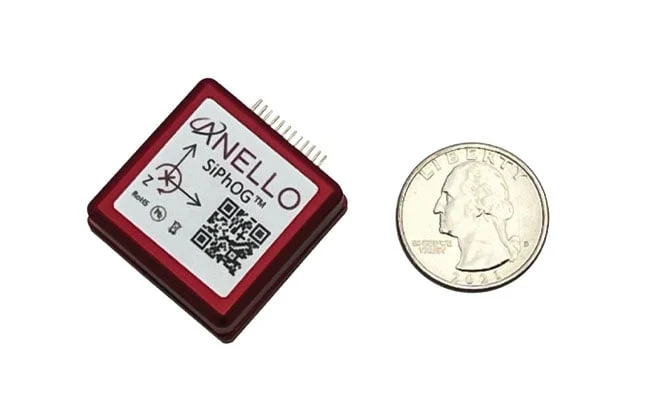
Its core product, the SiPhOG (Silicon Photonic Optical Gyroscope), is a photonic integrated circuit that provides the functionality of a traditional fiber-optic inertial navigation system used in aircraft, ships, and submarines, while significantly reducing size, weight, power consumption, and system complexity.
“Fiber-optic gyros are high-end, navigation-grade sensors usually used for ICBMs, fighter jets, [and] submarines. They’re the gold standard, [and] often can navigate for weeks or months at a time,” said Dr. Kirstin Schauble, Vice President for Systems Engineering at ANELLO, in an interview with Seapower. “They’re fantastic sensors; the problem with them is that they are big, bulky, power hungry, and extremely expensive.”
As such, fiber-optic gyros are impractical for small unmanned systems, particularly attritable systems.
“We’ve taken the core physics behind traditional fiber-optic gyroscopes – systems that conventionally rely on numerous discrete optical components – and integrated them onto a compact silicon photonics chip,” said Schauble. “By integrating active and passive photonic elements onto a two by five millimeter chip , we’ve dramatically reduced the size and complexity of high-performance inertial navigation technology. The SiPhOG is also mass producible and highly robust, while still delivering the precision expected from traditional fiber-optic gyroscopes due to the significant innovations we’ve achieved in silicon photonics.”
Because the SiPhOG is relatively inexpensive, small, lightweight, and consumes little electric power, it is ideal for equipping swarms of autonomous systems such as unmanned aerial vehicles (UAVs), unmanned surface vessels (USVs) and unmanned underwater vehicles (UUVs).
Schauble said the SiPhOG is ideal for Group 2/3 fixed wing drones, USVs, and 10-foot-to-200-foot vessels.
“We’re able to bring high precision capability to lower-cost, lower size-weight-power form factors for smaller vessels that previously couldn’t afford FOG-level performance,” she said.
The company’s Maritime Inertial Navigation System (INS) delivers precise and reliable navigation in GPS-denied or contested environments, enabling continuous positioning, heading, and motion tracking for autonomous maritime platforms.
ANELLO’s X3 IMU (Inertial Measurement Unit) integrates seamlessly into existing systems and can operate either independently or as part of a larger navigation architecture, according to Schauble. Designed with an open interface and modular architecture, the X3 supports flexible plug-and-play integration across a wide range of aerial autonomous applications.
According to a company press release, ANELLO was selected in January by the Department of War (DoW) for a $20 million award under the Accelerate the Procurement and Fielding of Innovative Technologies (APFIT) program to fast-track the procurement, production, and scaling of ANELLO’s GPS-denied navigation technology.
ANELLO’s SiPhOG-based Maritime INS is integrated on several autonomous systems, including HavocAI’s USVs and BlackSea Technologies’ Chaser USV.
Schauble said ANELLO’s workforce is expanding from its current 35-to-40 personnel.
“We can’t build these things fast enough,” she said commenting on the flood of orders.
Pilots Eject from T-45C Goshawk in May 26 Mishap
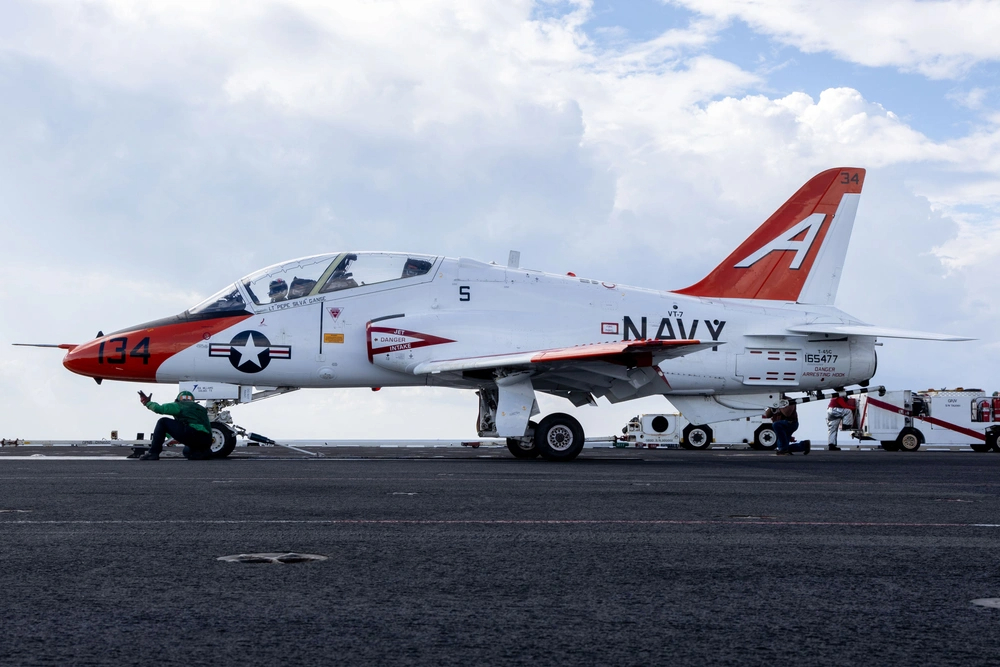
ATLANTIC OCEAN (Sept. 20, 2025) A T-45C Goshawk, attached to Training Airwing (TW) 1, prepares for launch on the flight deck of the Nimitz-class aircraft carrier USS Harry S. Truman (CVN 75). (U.S. Navy photo by Mass Communication Specialist Seaman Michael Gomez)
By Richard R. Burgess, Senior Editor
ARLINGTON, Va. — A U.S. Navy T-45C Goshawk jet training aircraft crashed May 26, 2026, in Mississippi. The two aviators in the crew ejected successfully.
The T-45C crashed near Shuqualak, Mississippi, according to a post by television station WTOK.
The T-45C was assigned to Training Air Wing One, based at Naval Air Station Meridian, Mississippi.
According to an aviation expert, the aircraft was the 35th T-45 to be lost in mishaps since the aircraft began service in 1991.
The Navy is in the process of selecting a new training aircraft to replace the T-45.
Gecko Robotics’ Komodo Robot Aids Ship Flight Deck Maintenance
By Richard R. Burgess, Senior Editor
ARLINGTON, Va. — Robots and other unmanned systems are advocated to relieve humans for the “dull, dirty, and dangerous” jobs and missions the Navy is called upon to complete. One example is the increasing use of robotics for assessment and maintenance of ship surfaces such as the flight decks, weather decks, and well desks as applicable of amphibious warfare ships and guided-missile destroyers. Artificial intelligence is being added to speed up the processes.
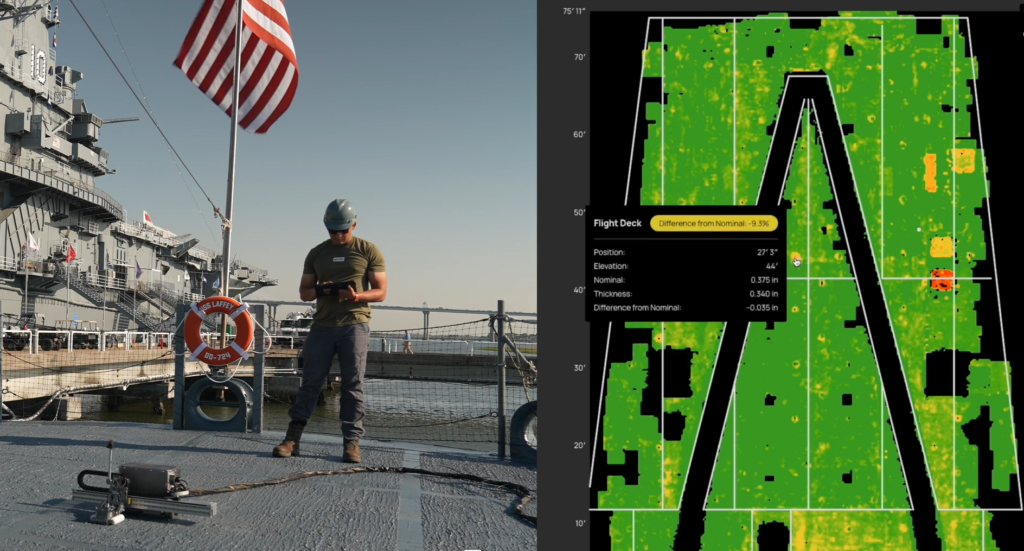
Flight decks are coated with non-skid, a rough coating that reduces the slickness of the decks, enhancing the safety of operations sea for personnel, aircraft, and ground support equipment. The coating needs to be replaced periodically as it is worn down by operations. Assessing that need is being accomplished by Gecko’s Komodo robots.
The U.S. Navy and the General Services Administration have awarded Gecko Robotics of Pittsburgh, Pennsylvania, a contract with a ceiling of $71 million “to deploy artificial intelligence and robotics to assess and maintain the health of military assets,” the company said in a release. “Gecko will start work with 18 ships [per year] in the U.S. Pacific Fleet with the initial award worth up to $54million over a five-year period.
“The Chief of Naval Operations has set a target of 80% fleet readiness, which Gecko will have a crucial role in helping to meet,” Gecko said. “Gecko’s advanced AI and robotic technology identify repairs up to 50 times faster and more accurately than manual methods, reducing maintenance delays and boosting battle readiness. This work will be carried out across destroyers, amphibious warships, and littoral combat ships.”
Gecko’s Komodo robot is designed to assess the extent of corrosion of non-skid, said Troy Demmer, co-founder and president of Gecko, in an interview with Seapower. The crawling robot uses “electromagnetic acoustic conduction to create an ultrasonic waveform that can penetrate that non-skid down to the base metal and be able to assess any sort of corrosion.”
The Komodo is able to operate during different sea states on the ship’s flight deck, enabling an assessment of the deck at sea six to 12 months before the ship enters a maintenance availability, reducing the time spent on the task of refurbishing the deck. The robot rolls along like a paint roller, its sensor scanning the deck in its passes, taking measurements, and recording those data points on a map display of a laptop computer. The measurements allow the Navy to determine the areas of the deck that need attention for non-skid maintenance.
Gecko also uses its Toka wall-climbing robots to scaling U.S. Navy ship hulls in order to assess corrosion.
Demmer expects the U.S. Naval Surface Force Atlantic to request Gecko’s services in the future in a separate contract.
“Where value hasn’t improved, that’s where opportunity lives. Cracking the cost equation is just as important as cracking the physics equation,” said Justin Fanelli, Chief Technology Officer for the Department of the Navy, quoted by Geck in its release. ”We’re now seeing solutions that make innovation adoption easier and in doing so save time, money and risk. When these American companies, pure play defense and dual use companies like Gecko Robotics, choose to do hard things and move the needle on our outcome metrics, not by percentage points but by orders of magnitude, it results in faster, better portfolio management.”
Gecko employs about 275 personnel, half of them based in Pittsburgh.
Terradepth Mines Seabed Intelligence for Maritime Customers
By Richard R. Burgess, Senior Editor
ARLINGTON, Va. — The seabeds of the world’s oceans are becoming less mysterious, thanks to companies like Terradepth, a company that provides its clients with geospatial surveys of the seabed to meet their economic, defense, or scientific needs.
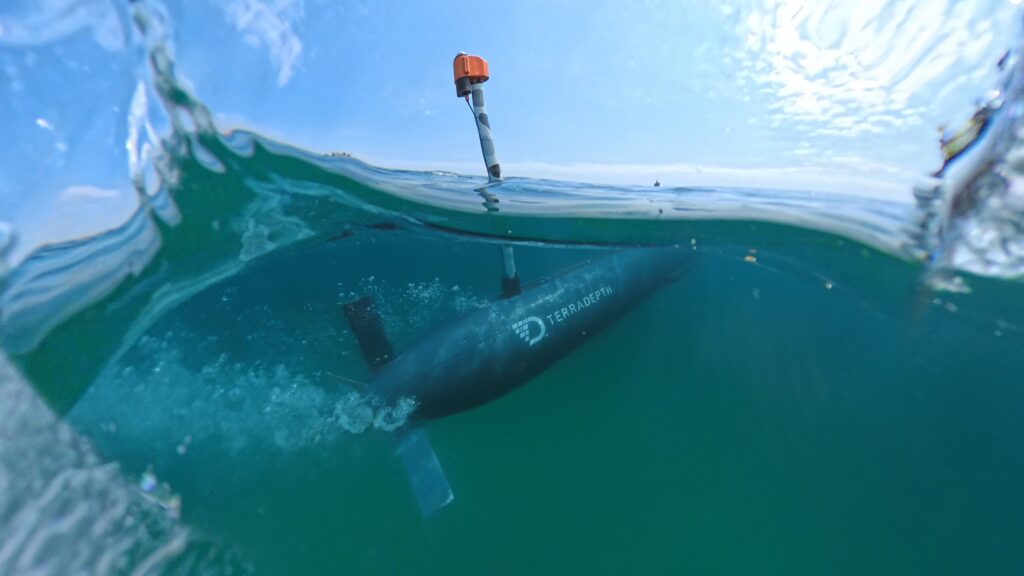
Terradepth Inc., founded in 2018 and based in Austin, Texas, with a facility in Panama Beach, Florida, provides customized robotic surveys of the seabed using autonomous unmanned underwater vehicles (AUVs) and provides data to its customers through its Absolute Ocean intelligence layer software platform for their awareness of their ocean systems and infrastructure.
“Absolute Ocean is a high-resolution map that pulls data from multiple information sources,” said Joe Wolfel, Terradepth founder and chief executive officer, in an interview with Seapower, noting that the data is collected and aggregated into one spot. “That ecosystem drives better and faster decision making [for customers] at scale.”
Wolfel explained that Terradepth takes some ocean data — from NOAA, for example — into the Absolute Ocean data platform that is publicly available to its customers.
“A lot of times customers want to keep their data private and secure, so they have access to al of the publicly available data and obviously their own data holdings in the geospatial platform, Absolute Ocean,” he said.
Wolfel told Seapower that his company builds and deploys its own AUVs and also uses AUVs built by other companies “to the extent that it makes sense.” The company deploys teams equipped with AUVs to areas to be surveyed. The teams can fly to ports worldwide and deploy on vessels of opportunity to execute their surveys. He said the “major cost driver of ocean data acquisition is the requirement for that surface vessel.”
Terradepth’s missions are varied: looking for mines, a leak in an oil pipeline, a break in a data transmission cable. Its data is used in sectors including defense and national security; maritime insurance, government; regulation; scientific research, offshore energy; and telecommunications, according to the company website.
Terradepth cooperates with other ocean technology companies such as Saildrone, Anduril, Kongsberg, and Oceaneering. Many of its customers and missions are not disclosable. Its customers have included NOAA. The U.S. Navy uses the company software for undersea applications.
Wolfel is a Naval Academy graduate, a former Navy SEAL officer who later worked for the McCrystal Group where he was exposed to a lot of emerging technologies, including Gate Technologies, that made “about half the world’s data storage,” he said. He recalled the 2005 collision of the attack submarine USS San Francisco with an uncharted seamount and how the incident highlighted the dearth of knowledge about the world’s seabeds.
“There was just a huge gap in our understanding of that environment,” he said. “That stuck with me … and gave me the opportunity to do something special.”
“We’re trying to drastically reduce human cognitive load with respect to high-resolution seabed data,” Wolfel said. “The amount of human involvement that occurs throughout that ocean operating system between data acquisition, data processing; before we built Absolute Ocean, we were keeping data on hard disk drives and Fedexing it around the world, or hand carrying them. We have to be able to reduce human in the loop, human on the loop with respect to that entire ecosystem,” referring to the ocean’s 310 billion square kilometers of seabed.
5 Ways Shipbuilding Can Be Shipshape Despite Geopolitical Instability
By Vicky Uhland, Seapower Correspondent
Shipbuilding is highly affected by geopolitical volatility and there are five key adjustments that will define the new winners in this rapidly shifting environment, according to a new report from McKinsey & Company.
The report, “Seizing the advantage in shipbuilding amid geopolitical shifts,” was released during Sea-Air-Space 2026.
“It’s a desire to look beyond the everyday headlines of defense budgets and capacity restraints and look more globally at the shipbuilding sector,” McKinsey senior partner and report co-author Ryan Brukardt said during a discussion at Sea-Air-Space.
Brukardt and McKinsey Senior Partner Brooke Weddle said there are four main geopolitical factors affecting shipbuilding in the western hemisphere:
Trade agreements and tariffs
State-directed industrial policies and incentives
Import, export and capital controls
Artificial intelligence and technology.
While all of these can make it difficult for U.S. and European shipbuilders to compete with other countries, the report notes that they can outperform their industry peers with five best practices:
Rethinking portfolio strategy with future-proof platforms. This involves an unsentimental, analytical assessment of core products, big bets, products with limited market opportunities unless they’re linked to a specific program, and reevaluated products, the report says.
Examples of core products include command and control systems or radar and sensor systems. Big bets might be communications systems or digital twins. Opportunistic go-to-market products could be training or self-defense systems. And products that might need to be reevaluated include navigation or propulsion-control systems.
Accelerating production to meet spiking demand. This includes developing more efficient processes and personnel management by using technological innovations like AI-enabled dynamic scheduling and digitized workflows.
The McKinsey researchers found that using AI to handle scheduling inputs can increase throughput rates by at least 10 to 15 times, Weddle said.
De-risking supply chains. Starting with the COVID-19 pandemic and extending to the current tariffs, sanctions and regional conflicts, shipbuilders have been dealing with vulnerabilities in their supply chains.
The report recommends two best practices to help address these vulnerabilities: continuous exposure assessment, including advanced illumination models that help companies identify common sub-supplier choke points and other risks; and mitigation planning such as finding alternative suppliers and considering insourcing capabilities.
Improving cost structures. The report identified three cost categories that are most affected by geopolitical disruption: materials, external labor and internal labor.
Materials procurement strategies can include creating supplier risk profiles for each country, supplier and commodity. Managing external labor includes developing multi-region vendor pools and shifting toward more modular work packages with standardized scopes of work. Handling internal labor costs requires time, the report found, but can include developing digital work instructions and smoothing out workloads.
Building organizational capabilities. Many shipyards have trouble attracting and retaining young workers because of limited growth opportunities, low pay and difficult working conditions, the report found. And retirement looms — the report cited data that a third of U.S. aerospace and defense manufacturing employees are over age 55.
“When you compare our shipyards to Korea, it’s not always a great place to be a young or older worker,” Weddle said. “We need to fundamentally rethink what we think about workforce in the shipbuilding environment.”
The report recommends using holistic talent strategies like recruiting people with similar skills from non-shipbuilding sectors; partnering with schools for job-shadowing initiatives; cutting the time it takes to achieve job proficiency though standardized onboarding boot camps and hands-on learning; rethinking performance measures to identify what roles high-performance employees are best suited for; and determining the underlying causes of attrition by encouraging employee feedback.
“Capital is the constraint in certain places but really, at the end of the day, it’s management practices, appropriate use of technology, and ability to attract and retain talent that are most significant” for gaining competitive advantage in an increasingly geopolitical shipbuilding environment, Brukardt said.