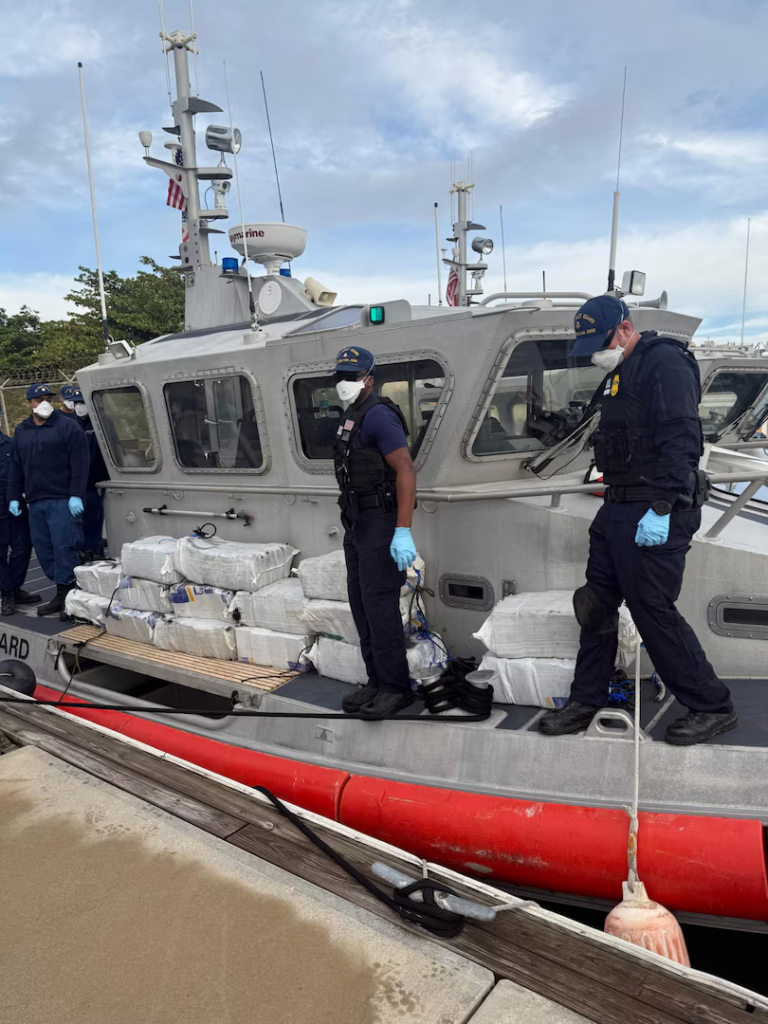
A Coast Guard Station San Juan boat crew and Homeland Security Task Force – San Juan Region partner agencies completed the custody transfer of three apprehended smugglers and the offload of sixteen bales of cocaine which weighed 506kgs/1,115.54 pounds which were valued at more than $7 million. The apprehension and seizure followed the interdiction of a drug smuggling vessel in Atlantic Ocean waters north of Puerto Rico, Jan. 14, 2026. (U.S. Coast Guard photo)
From U.S. Coast Guard Southeast District, Jan. 22, 2026
SAN JUAN, Puerto Rico — A Coast Guard Station San Juan boat crew working with Homeland Security Task Force – San Juan Region partner agencies interdicted a drug smuggling vessel and apprehended three men in Atlantic Ocean waters north of Puerto Rico, Jan. 14, 2026.
During the interdiction, law enforcement agents seized 16 bales of cocaine weighing a combined total of 506kgs/1,115.54 pounds, which are estimated to have a wholesale value of more than $7 million.
During patrol efforts, a Coast Guard Air Station Miami HC-144 Ocean Sentry aircrew detected a suspicious 25-foot blue and white panga type go-fast vessel in international waters north of Vega Baja, Puerto Rico. Coast Guard watchstanders in Sector San Juan diverted the cutter Joseph Tezanos and a Station San Juan 45-Response Boat Medium boat crew to interdict the suspect vessel. A Customs and Border Protection Air and Marine multi-role enforcement aircraft also responded and maintained aerial surveillance of the suspect vessel. Once on-scene, the Station San Juan boat crew, with the support of the CBP aircrew and the cutter Joseph Tezanos, successfully interdicted and took positive control of the suspect vessel. Following the interdiction, the Coast Guard boat crew embarked the three smugglers and recovered sixteen bales of contraband which tested positive for cocaine from the vessel. The contraband and suspects were later transferred to HSTF law enforcement partners in San Juan, Puerto Rico.
“This successful narcotics interdiction highlights the efficient interoperability and strength within the Coast Guard, Customs and Border Protection Caribbean Air and Marine Branch and our Homeland Security Task Force partner agencies to interdict drug smuggling vessels and secure the nation’s Eastern Caribbean maritime borders from this threat.” said Cmdr. Matthew Romano, Coast Guard Sector San Juan chief of response. “I commend the professionalism and coordination between all partners who contributed to this the interdiction. We are proud to stand the watch alongside our Department of Homeland Security, Department of Justice and our local law enforcement partners as we continue to relentlessly combat illicit trafficking throughout the waters of Puerto Rico and the U.S. Virgin Islands.”
Coast Guard Cutter Returns to Florida After Escorting Recently Seized Motor Tanker
CAPE CANAVERAL, Fla. — The U.S. Coast Guard Cutter Vigilant (WMEC 617) returned to Cape Canaveral on Friday after a 33-day patrol in the Caribbean Sea supporting operations Pacific Viperand Southern Spear.
During the patrol, Vigilant escorted a motor tanker, which was seizedby a U.S. Coast Guard tactical boarding team with support from the Department of War, for operating as a vessel without nationality in the Caribbean Sea. Vigilant’s crew coordinated with naval and law enforcement partners to transfer personnel and provisions to the tanker. A law enforcement team from Vigilant boarded the vessel to provide security during the 600-nautical-mile transit to the United States.
Cmdr. Steve Welch, commanding officer of Vigilant, said, “I am proud of the crew’s adaptability and professionalism during this mission of national importance. Their performance ensured the safe execution of the operation in partnership with the Department of War.”
Unique statutory authorities enable the Coast Guard to enforce international and domestic law in the maritime domain, deploying assets to conduct missions in U.S. waters and on the high seas. The Coast Guard’s involvement in this seizure was conducted under Title 14, U.S. Code and in accordance with customary international law. The Coast Guard exercises these authorities to protect maritime safety, security, and U.S. interests.
Fairbanks Morse Awards Contract to Welin Lambie for Launch-and-Recovery Davits for Coast Guard
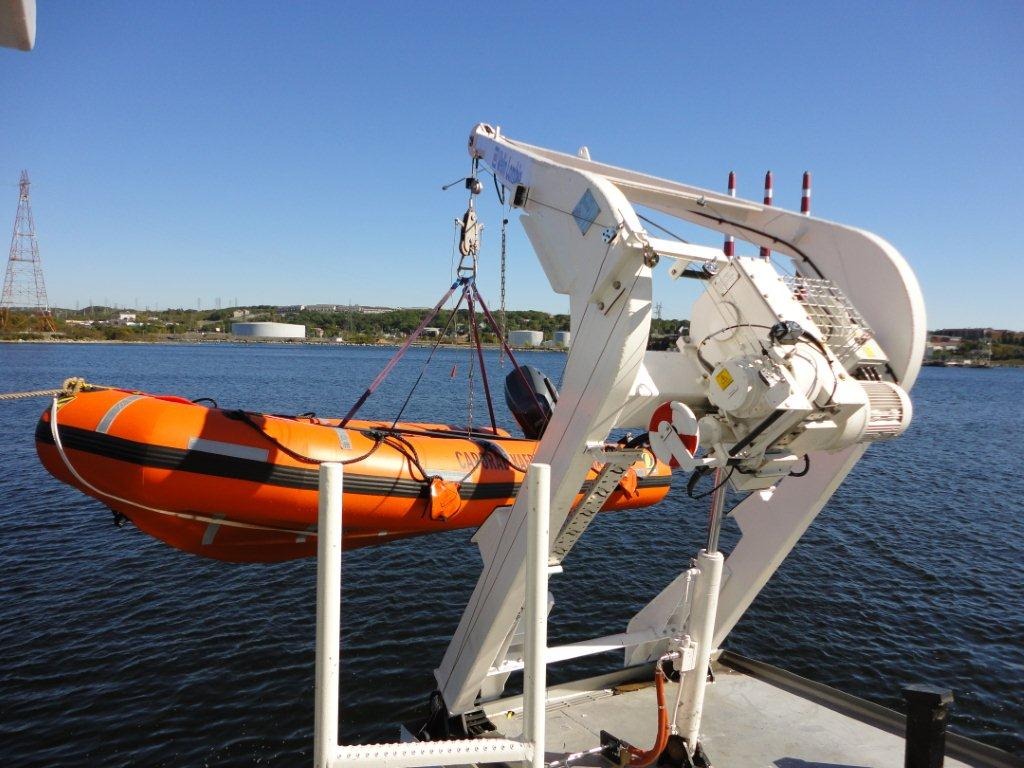
Fairbanks Morse Defense (FMD), today announced that Welin Lambie has been awarded an Indefinite Delivery Contract (IDC) to provide aftermarket support for Welin Lambie davits installed across the U.S. Coast Guard (USCG) fleet. This contract ensures access to OEM-quality parts and support services to ensure fleet readiness and the long-term reliability of critical launch-and-recovery systems.
The framework contract was signed in July 2025 and includes a base year with four one-year options, extending potential support through 2030. Each option year is pre-priced to provide predictable costs and streamlined procurement, allowing the Coast Guard to rapidly secure OEM parts, technical services, overhauls and new davit systems as operational needs arise.
“This award highlights our continued commitment to supporting the U.S. Coast Guard with reliable, mission-critical systems that protect crews and enhance operational availability,” said Ben Dunscombe, Managing Director at Welin Lambie. “Our davits are critical to ensuring that Coast Guard vessels can safely launch and recover boats in demanding conditions. This contract strengthens our service footprint and will ensure that the Coast Guard receives the highest level of technical support and aftermarket care.”
Davit systems are life-critical components on USCG vessels that enable the safe launch and recovery of rescue craft for interdiction, search-and-rescue and maritime security missions. As a long-standing supplier to U.S. naval forces, and with more than 70 davits delivered to USCG, Welin Lambie has established a strong reputation for engineering robust, precision-built davit solutions that ensure safe and dependable launch and recovery operations.
The contract will also leverage the capabilities of Fairbanks Morse Defense’s Federal Equipment Company (FEC), which have developed specialized expertise in overhauling U.S. Coast Guard davit systems. This integrated approach ensures rapid turnaround, improved lifecycle management and direct access to factory-certified technicians.
Coast Guard Launches RAPTOR, Hosts Demonstration of Innovative Technology
A graphic representing the U.S. Coast Guard’s new Office of Rapid Response and Prototyping (CG-RAPTOR), launched to accelerate the development and deployment of innovative technology for enhanced maritime operations. CG-RAPTOR supports Force Design 2028, driving rapid solutions to empower Coast Guard personnel and strengthen mission success. (U.S. Coast Guard courtesy graphic)
WASHINGTON — The U.S. Coast Guard is proud to announce a bold new era in mission success, unveiling a rapid-response approach that identifies, prototypes and delivers breakthrough technologies to meet urgent operational needs and drives accelerated transition to programs. The Office of Rapid Response and Prototyping (CG-RAPTOR) is accelerating the “idea-to-operations” cycle, rolling out proven solutions within 30, 60, and 90 days through dynamic collaboration with operators, industry leaders and subject matter experts.
In just 150 days, CG-RAPTOR has debuted advanced unmanned systems, innovative personnel management tools, secure communications platforms and real-time readiness tracking – empowering servicemembers with game-changing capabilities.
With a commitment to delivering impactful technology every 30 days, CG-RAPTOR is launching the Coast Guard into a future defined by agility, integration and operational excellence.
This Friday in San Diego, CG-RAPTOR will host an exclusive demonstration for Coast Guard personnel and select invitees, showcasing the latest advancements in sensor data and video feed integration across a unified operational picture.
This event will highlight direct-to-operator tactical situational awareness, supporting emerging priorities such as Southern Border personal watercraft interdiction.
Attendees will experience firsthand how CG-RAPTOR’s innovative solutions deliver real-time operational insights and enhance mission effectiveness in the field.
“With Force Design 2028, we are completely changing the game on how the Coast Guard delivers our mission through operational agility, integration and automation,” said Captain Chad Brick, the inaugural chief of CG-RAPTOR. “CG-RAPTOR feeds on this transformative approach, rapidly driving cutting-edge technology directly into the hands of our operators for a more effective workforce and to protect our nation’s maritime interests.”
The Coast Guard’s technological modernization comes on the heels of a historic year for the service. In fiscal year 2025, the Coast Guard seized a record-breaking 510,000 pounds of cocaine, thanks in large part to strategic surge operations like Operation Pacific Viper. The Coast Guard also surpassed its recruiting goals, welcoming over 5,200 new active-duty members, the highest annual total since 1991. These successes underscore the importance of investing in an agile, capable, and responsive force to meet evolving global challenges.
Force Design 2028 is the way the Coast Guard will defeat adversaries, deliver peace through strength, and protect the Homeland both today and for decades to come. The Service will embrace innovation and cutting-edge technology to control the nation’s borders, facilitate commerce to economic prosperity and strategic mobility, and ensure readiness to respond to any crisis or contingency. Force Design 2028 is Coast Guard’s bold roadmap for enduring success.
As part of Force Design 2028, the Coast Guard continues to foster a culture of innovation from within. Many of the service’s advancements are born from the creative ideas of its own workforce. Coast Guard members are encouraged to submit their ideas and solutions through the CG Ideas@Work platform, a crowdsourcing tool that empowers every member to help shape the future of the service.
For more information on CG-RAPTOR, please visit the official page here. Additional details on Force Design 2028 can be found here.
Lunday Sworn In as 28th Commandant of the U.S. Coast Guard
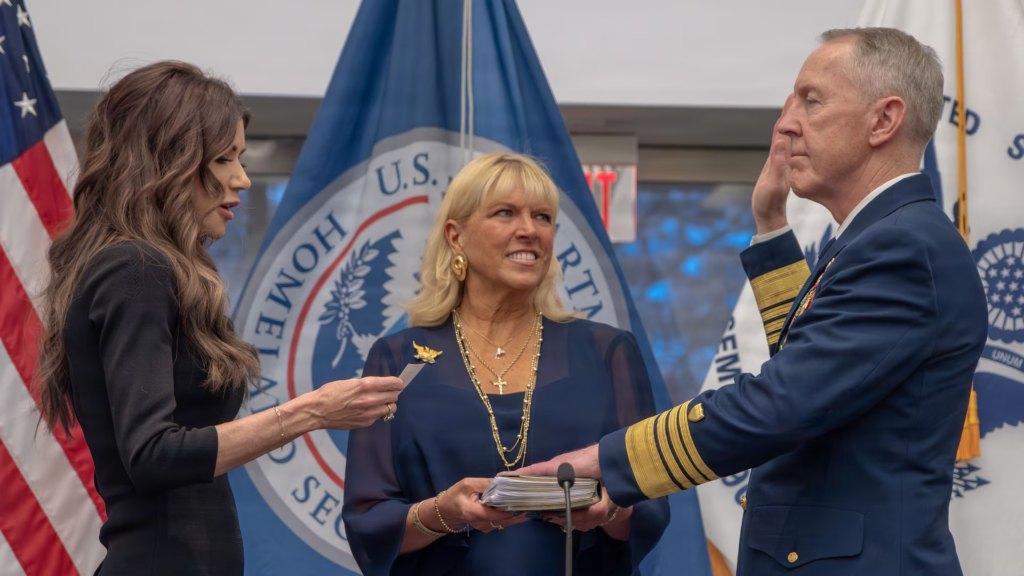
U.S. Coast Guard Adm. Kevin E. Lunday is sworn in as the 28th Coast Guard Commandant by U.S. Department of Homeland Security Secretary Kristi Noem at Coast Guard Headquarters in Washington, D.C. on Jan. 15, 2026. Lunday served as Acting Commandant since Jan. 20, 2025. Before serving as Commandant, Lunday served as the 34th Vice Commandant of the Coast Guard. (U.S. Coast Guard photo by Petty Officer 2nd Class Gabriel Wisdom)
From U.S. Coast Guard Headquarters, Jan. 15, 2026
WASHINGTON – The United States Coast Guard held a formal swearing-in and assumption of command ceremony Jan. 15 for Adm. Kevin Lunday as the 28th Commandant of the U.S. Coast Guard during an event at Coast Guard Headquarters.
Secretary Kristi Noem joined senior Coast Guard leadership, members of the Joint Force and distinguished guests in recognizing the transition of command and Adm. Lunday’s commitment to leading the Service.
“President Trump’s plan was simple when he became President of the United States. He wanted to revitalize the Coast Guard, equip it with the best technology, ships, and aircraft available, and then recruit the men and women that were necessary to run it all. It’s a tall order, and it takes a special kind of leader to lead this team and make that a reality,” said Secretary Noem. ”With almost 40 years in the Coast Guard, and with command experience that has ranged from the Indo-Pacific to the Persian Gulf to cyberspace, Kevin Lunday was the man for the job. Congratulations, Admiral Lunday!”
Upon taking the oath of office, Adm. Lunday formally assumed the responsibilities of Commandant and reaffirmed the Coast Guard’s enduring role as a vital instrument of national power responsible for controlling, securing, and defending the U.S. border and maritime approaches; facilitating the safe and secure flow of commerce that is vital to economic prosperity, strategic mobility, and America’s maritime dominance; and responding to crises and contingencies that may come without warning.
“I am honored to assume command of the United States Coast Guard,” said Adm. Kevin Lunday. “Every day, Coast Guard men and women carry out missions that protect our homeland, secure our maritime borders, save lives and protect national security. I am humbled to serve alongside them while ensuring they have what they need to succeed – today and in the future.”
As Commandant, Adm. Lunday will lead the Service’s continued transformation through Force Design 2028, while strengthening operational readiness and supporting the Coast Guard workforce and their families.
The Coast Guard remains Always Ready, delivering mission excellence across the maritime domain in service to the American people.
Coast Guard Awards $200M Contract to Rebuild Station South Padre Island, Texas
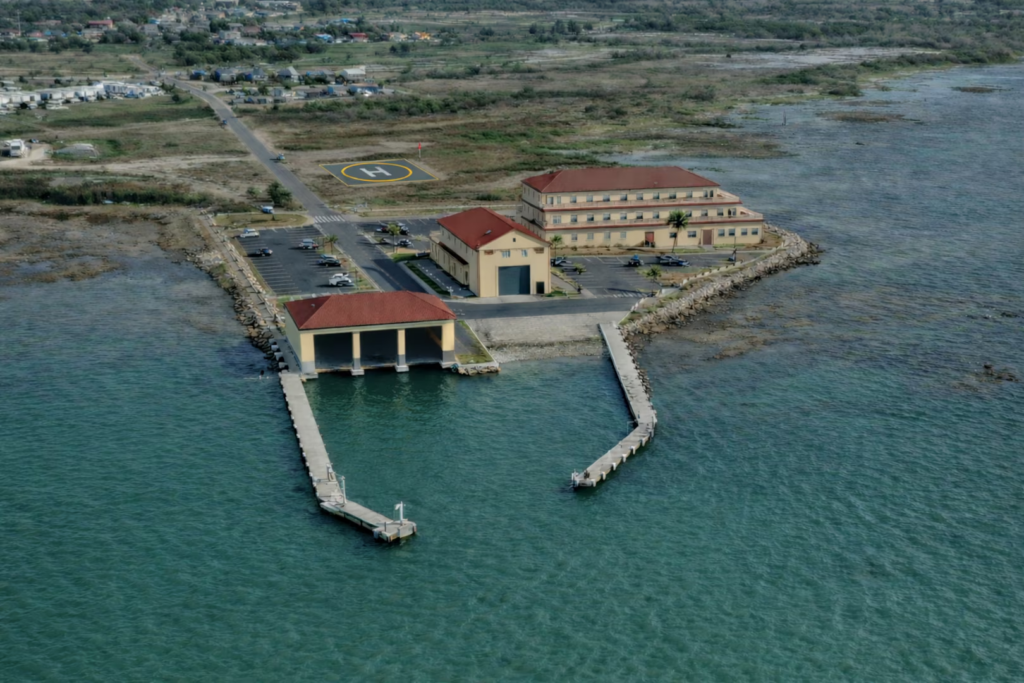
An architectural rendering depicts the future U.S. Coast Guard Station South Padre Island, Texas. The $200 million recapitalization project includes new operational, support, and waterfront facilities, and is scheduled for completion in 2028. (U.S. Coast Guard courtesy illustration)
From U.S. Coast Guard Heartland District, Jan. 14, 2026
WASHINGTON — The U.S. Coast Guard has awarded a $200 million design-build contract to The Haskell Company for the comprehensive recapitalization and expansion of Coast Guard Station South Padre Island in South Padre Island, Texas. This award marks the largest single task order in the history of the Coast Guard’s military construction program.
The contract, funded through the One Big Beautiful Bill Act, will deliver the design and construction of more than 120,000 square feet of essential facilities and supporting infrastructure, directly enhancing mission readiness and execution for Coast Guard and Customs and Border Protection personnel on the southwest U.S. border in Texas. Preliminary design and environmental work will begin immediately, with project completion anticipated in summer 2028.
Located six miles north of the United States-Mexico border, Station South Padre Island is at the forefront of securing the U.S. southern border. The recapitalization project will support the Coast Guard’s operations to secure the U.S. border and maritime approaches, facilitate commerce vital to economic prosperity and strategic mobility, and respond to contingencies along the Gulf Coast and surrounding waterways.
The scope of work includes:
Environmental assessment, site survey investigations, and design services for various facilities
Construction of new station facilities
Construction of Unaccompanied Personnel Housing (UPH), additional berthing, and mission support facilities
Rebuilding of waterfront infrastructure
Construction of a Joint Operations Center and Customs and Border Protection support space
Forward operations space for Deployable Specialized Forces
Delivery of a new harbor operations center and other mission support facilities
Comprehensive site development, utilities, and outfitting
The project represents the largest award value for a shore infrastructure construction project in Coast Guard history and will be delivered on the shortest timeline to date. The planning phase was compressed from the standard 18 months to 45 days, while the contracting process was reduced from 15 months to four months.
On April 20, 2025, a fire severely damaged the boat house at Station South Padre Island, forcing crews to relocate operations. The next day, station personnel responded to reports of illegal fishing and interdicted a vessel in the U.S. Exclusive Economic Zone, where they discovered 130 pounds of red snapper and 75 pounds of shark on board.
“The courageous team of Station South Padre Island showed resilience and determination,” said Admiral Kevin Lunday, acting Commandant of the Coast Guard. “The day after fire severely damaged facilities at Station South Padre Island, this crew was back on patrol, successfully interdicting illicit activity in one of our most complex operating environments. This project will provide Station South Padre Island with modern facilities and empower them to continue operations to control, secure, and defend our southern border.”
Cutter Alert Returns Home After Interdicting $18.4M in Narcotics During 45-day Patrol
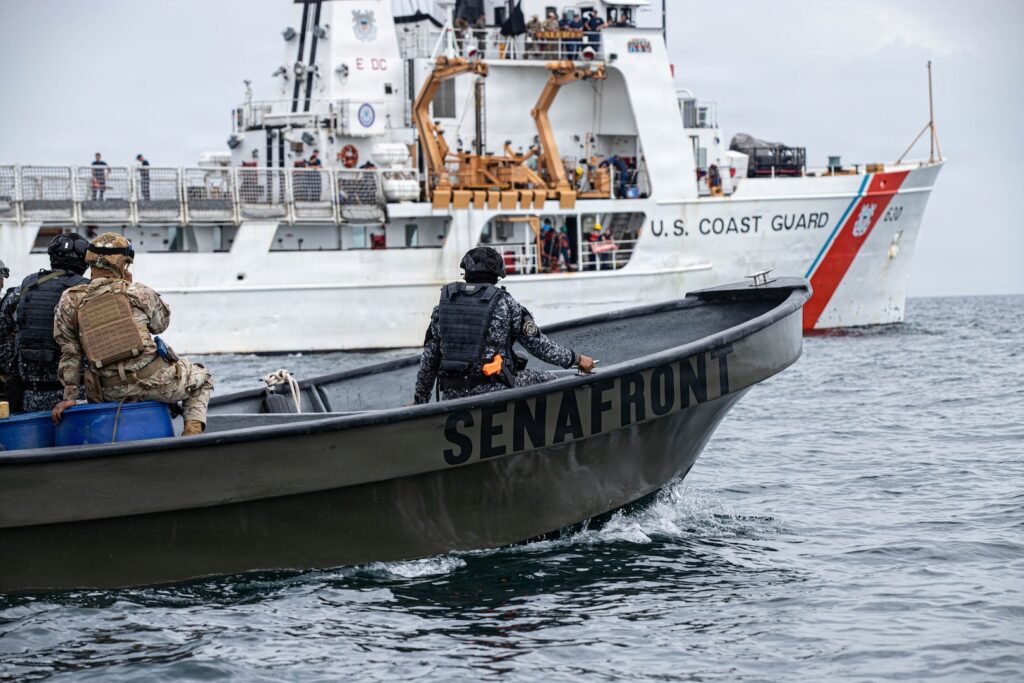
Members of the Servicio Nacional de Fronteras and U.S. Coast Guard Cutter Alert conduct a training exercise near Panama City, Panamá, Dec. 19, 2025. The Coast Guard’s long-standing cooperation with Panamanian security institutions is a small part of broader ongoing cooperative security efforts between the U.S. and partners in Central America. (U.S. Army photo by Spc. Trey Woodard)
Coast Guard Cutter Alert returns home after interdicting more than $18.4M in narcotics during 45-day patrol
Cape Canaveral, Fla. — The crew of the Coast Guard Cutter Alert (WMEC 630) returned to their home port in Cape Canaveral, Thursday, following a 45-day counter-drug patrol in the Windward Passage, Caribbean Sea and Eastern Pacific Ocean.
While underway in the Coast Guard Southeast District area of responsibility, Alert’s crew interdicted a go-fast style vessel trafficking illegal narcotics in the Windward Passage. The crew seized 2,250 pounds of cocaine valued at $18.4 million, seven pounds of marijuana valued at $7,000 and an illegal firearm. The four suspected smugglers on board, narcotics and firearm were transferred to the Bahamas government for prosecution.
“I am immensely proud of my crew’s unwavering dedication,” said Cmdr. Mario Gil, commanding officer of Alert. “Time spent away from family and missed holidays represents a significant sacrifice, which makes their commitment to combating narco-terrorism and protecting our nation’s borders from illicit drugs all the more commendable, as demonstrated by the extraordinary success of this patrol.”
In the region, Alert’s crew also patrolled in support of Operation Vigilant Sentry while underway in the Coast Guard Southeast District area of responsibility. Crew member presence in the vicinity of Haiti served to deter unsafe and illegal migration.
While transiting the Panama Canal, the crew had the distinct honor of hosting Ambassador Kevin Marino Cabrera, U.S. Ambassador to Panama, aboard the cutter for a tour of the ship, discussions about current operations and a Miami-inspired lunch prepared by Alert’s culinary specialists.
The crew also supported U.S. – Panama relations by hosting eight members from Panama’s National Aeronaval Service (SENAN) and Joint Maritime Force – Panama for joint training and a professional exchange of counter-narcotics best practices. Crew members conducted multiple joint pursuit-style, simulated interdictions with vessels and forces from SENAN. This training provided continued support of the Salas-Becker Complementary Agreement of 2002, which created a framework for U.S.–Panama bilateral cooperation to counter illicit drug trafficking by sea and air.
During a port-of-call visit to Golfito, Costa Rica, Alert’s crew welcomed representatives from the Costa Rican Coast Guard aboard for a tour of the ship and an embarked MH-65 Dolphin helicopter from the Coast Guard Helicopter Interdiction Tactical Squadron, based in Jacksonville. The visit fostered joint nation inoperability and strengthened international counter-drug efforts in the region.
While at sea in the Coast Guard Southwest District area of responsibility, the crew conducted boardings to verify and enforce international law at sea in the Eastern Pacific Ocean.
In addition, Alert crew members earned the title of shellback after crossing the equator, a title few sailors earn during a career.
Coast Guard Releases Force Design 2028 Initial Update, Highlights Return on Investment
WASHINGTON — The United States Coast Guard today released the Force Design 2028 Initial Update, detailing the reforms implemented since January 2025 and the significant, measurable impacts these changes have delivered for the American people. The update underscores how Force Design 2028 has strengthened the Service’s operational effectiveness, improved workforce readiness, accelerated capability delivery, and generated unprecedented value for the Nation.
As a result of these reforms, the Coast Guard is better positioned today than at any point earlier this year to control, secure, and defend the U.S. southern border and maritime approaches; facilitate the uninterrupted flow of commerce; and rapidly respond to national and global contingencies.
“The United States Coast Guard serves as a vital instrument of national power, advancing security both at home and abroad, safeguarding the American economy, and providing rapid response to emergent contingencies. When I became the Secretary of Homeland Security, we took steps to change the Coast Guard in support of President Trump’s America First Agenda,” said Kristi Noem, Secretary of Homeland Security. “Through the implementation of Force Design 2028, the extraordinary return on investment—the value the Coast Guard provides to our Nation—is poised to grow even further. The men and women of the Coast Guard exemplify the very best of our Nation. We are immensely proud of their achievements through Force Design 2028. Together we will continue to put America First.”
“As we deliver the first update on Force Design 2028, the Coast Guard is already a stronger, more agile, capable, and responsive fighting force,” said Adm. Kevin Lunday, Acting Commandant of the U.S. Coast Guard. “The Service is better positioned than it was in January 2025 to effectively control, secure, and defend the U.S. borders and maritime approaches, facilitate the uninterrupted flow of commerce, and rapidly respond to contingencies. Force Design 2028 is already improving operational outcomes while establishing the foundation for even greater achievements in the future.”
Unmatched Return on America’s Investment Through disciplined and aggressive stewardship of its $12.1 billion annual budget, the Coast Guard delivers an unmatched return on investment for the Nation. Conservative analysis shows the Service generates more than $74 billion in social and economic value through cost avoidance—representing a 6-to-1 return on taxpayer investment.
Historic Counter-Drug and Law Enforcement Results Since January 2025, the Coast Guard has seized more than 466,000 pounds of cocaine—equivalent to over 176 million lethal doses, enough to kill more than 52 percent of the U.S. population. In Fiscal Year 2025 alone, the Service interdicted more than 510,000 pounds of cocaine, the highest total in Coast Guard history and an increase of more than 200 percent over FY24.
Beyond interdictions, Coast Guard counter-drug and law enforcement missions generate substantial social value. Conservative estimates indicate these operations saved the Nation over $10 billion in avoided costs, including more than $2.27 billion in healthcare costs associated with cocaine interdiction alone.
Facilitating Commerce and Responding to Contingencies The Coast Guard’s continued governance and protection of the Marine Transportation System enabled the safe movement of 1.8 billion tons of cargo in FY25—an increase of more than 13 percent from FY24—returning more than $28 billion in value to the American people.
The Service also reaffirmed its enduring commitment to saving lives at sea. In FY25, Coast Guard crews saved nearly 5,000 lives and preserved/assisted more than $974 million in property while responding to mariners in distress across the Nation’s waterways.
Building a Larger, Healthier, and More Ready Workforce Force Design 2028 continues to advance efforts to build a healthier, more resilient, and mission-ready workforce, including progress toward expanding the force by 15,000 military members to meet evolving operational demands and support new assets.
In FY25, the Coast Guard exceeded 110 percent of its active-duty enlisted recruiting goal, enlisting more than 5,200 members—the highest total since 1991. The Service also achieved 104 percent of its Reserve Enlisted recruiting goal and 100 percent of its active-duty Officer mission.
Enhanced Agility in Response to National Priorities Increased agility resulting from Force Design 2028 initiatives enabled the Coast Guard to rapidly address emerging threats and national priorities:
Operation Border Trident, launched in March 2025, targeted transnational terrorist and criminal organizations and illegal alien activity in the California Coastal Region, increasing interdictions by 44 percent compared to FY24.
Operation River Wall, initiated in October 2025, secured approximately 260 miles of the Rio Grande River, resulting in the interdiction of 47 illegal aliens and the deterrence of 237 more.
Operation Pacific Viper, launched in August 2025, doubled the Coast Guard’s most capable assets in the Eastern Pacific. In just over four months, crews seized more than 170,000 pounds of illegal narcotics—averaging approximately 1,600 pounds of cocaine interdicted per day.
Structural Reform and Rapid Capability Delivery These outcomes were made possible by sweeping reforms enacted under Force Design 2028. The Coast Guard established new leadership roles—including Chief of Staff, Deputy Commandant for Systems, Deputy Commandant for Personnel, and Program Executive Offices—while eliminating 14 Admiral positions (32 percent) to streamline decision-making and maximize efficiency.
The Service also created the Rapid Response Prototype Team (RAPTOR) to deliver technology solutions at speed. RAPTOR transitioned a capability from concept to operational use in just three weeks, supporting Operation Border Trident with a contractor-owned, contractor-operated long-range unmanned aerial system employing artificial intelligence.
Additionally, the Coast Guard empowered commanders by revising administrative policies related to non-judicial punishment and delegating surface and airborne use-of-force authorities, increasing operational effectiveness at the tactical level.
Accelerated Investment and the Road Ahead Capability delivery is being further accelerated through Force Design 2028 and resources provided by the One Big Beautiful Bill Act (OB3). More than $3 billion in OB3 funds have already been obligated, with 75 percent of total funding expected to be obligated by the end of FY26. In the coming months, the Coast Guard will implement major structural changes and investments, including:
Establishing a Deployable Specialized Forces Command to enhance integration with the Department of War and optimize force employment. Expanding training capacity to support a growing force of more than 15,000 additional military members.
Enhancing Maritime Domain Dominance through Coastal Sentinel, improving sensor integration and operational responsiveness. Rapidly identifying, testing, and acquiring commercially available boats, cutters, and aircraft to empower Coast Guard personnel across all mission areas.
Executing a comprehensive Force Posture and Operational Concepts Campaign to transform how the Service organizes, trains, equips, and employs forces—streamlining strategic decision-making, decentralizing execution, and leveraging next-generation technologies to ensure enduring U.S. maritime dominance.
The Force Design 2028 Initial Update affirms the Coast Guard’s commitment to reform, readiness, and results—delivering security, prosperity, and unmatched value for the American people today and into the future.
USCGC Hickory Arrives in Guam, Restoring Full Buoy Tender Capacity in Oceania
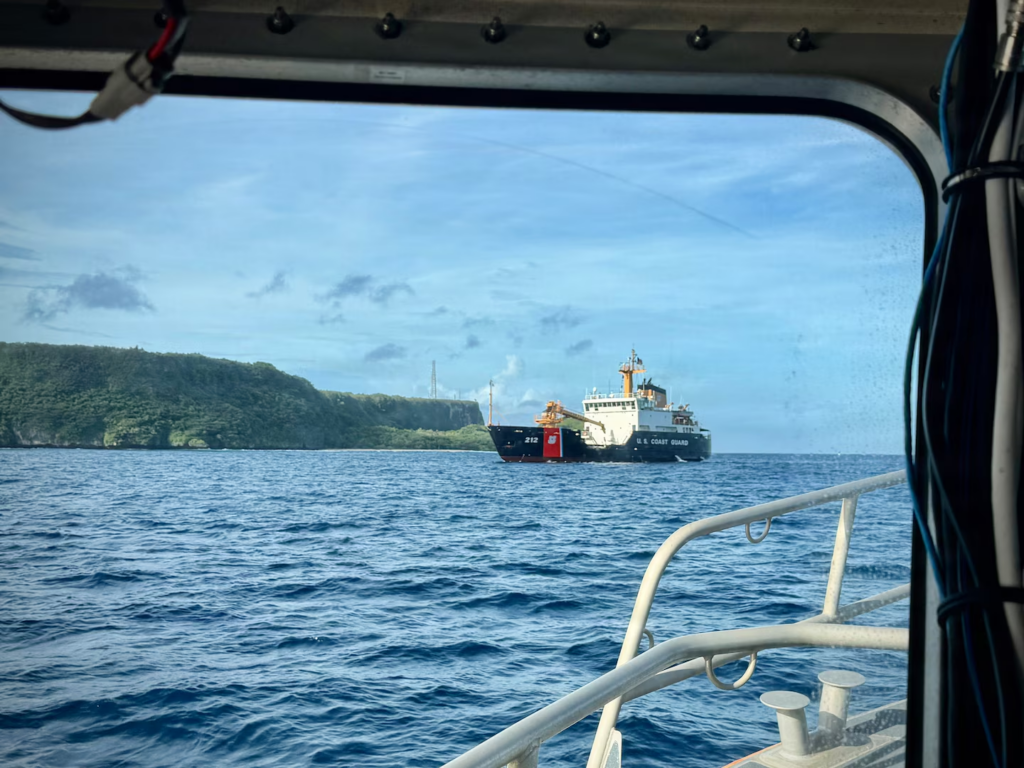
The USCGC Hickory (WLB 212), a 225-foot Juniper-class seagoing buoy tender, arrives in Apra Harbor as it comes to their new homeport in Guam on Jan. 14, 2026, following a more than 13,000-mile transit over 71 days from the U.S. Coast Guard Yard in Baltimore through the Panama Canal. After an extended Major Maintenance Availability at the Yard, part of the In-Service Vessel Sustainment Program that modernizes the entire Juniper-class fleet with hull repairs, system upgrades, and replacement of obsolete equipment, the Hickory is now fully revitalized. (U.S. Coast Guard photo by Chief Warrant Officer Muir)
U.S. Coast Guard Forces Micronesia, Jan. 14, 2026
SANTA RITA, Guam — The USCGC Hickory (WLB 212), a 225-foot Juniper-class seagoing buoy tender, arrived at its new homeport in Guam on Wednesday, following a more than 13,000-mile transit over 71 days from the U.S. Coast Guard Yard in Baltimore through the Panama Canal.
After an extended Major Maintenance Availability at the Yard, part of the In-Service Vessel Sustainment Program that modernizes the entire Juniper-class fleet with hull repairs, system upgrades, and replacement of obsolete equipment, the Hickory is now fully revitalized.
These enhancements ensure the cutter’s reliability for its full 30-year service life, boosting operational efficiency and mission readiness. The Hickory’s arrival marks a key milestone for the U.S. Coast Guard Oceania District, restoring the full complement of three seagoing buoy tenders dedicated to the vast Pacific region. Homeported in Guam, the Hickory specializes in maintaining aids to navigation, critical for safe passage through strategic sea lanes that support military forward posture and vital commercial shipping.
The cutter’s area of responsibility encompasses 143 ATON, of which 90 are federally maintained. Reliable ATON is essential for marking navigational hazards and preventing maritime accidents that could disrupt maritime traffic, endanger vessels, or cause economic impacts in this geopolitically significant theater. En route to homeport, Hickory visited Majuro from Jan. 7 to 8 to conduct joint reconnaissance of existing port buoys with the Marshall Islands Ports Authority. The assessment supported future maintenance and upgrade planning aimed at improving maritime safety, port access, and resilience.
During Hickory’s absence, U.S. Coast Guard personnel maintained operations through resourceful measures, including deploying jump teams. In the fall of 2023, cutter personnel, having safely delivered Hickory’s predecessor, USCGC Sequoia, to the Yards, conducted a full assessment of the local ATON constellation and made repairs through a combination of dive teams and shoreside support to all the aids affected by the Category 5 Typhoon Mawar, which made landfall in May.
The sister ship USCGC Juniper came out in November 2023 to work on aids. More recently, in October 2025, a jump team from the Aids to Navigation Team Honolulu rapidly repaired seven critical aids across Guam, Rota, Saipan, and Tinian, demonstrating exceptional ingenuity amid operational challenges as the cutter crew worked to bring the ship back to Guam.
With Hickory’s specialized crane and capabilities, the cutter is poised to address up to seven outstanding federal aids in the Guam and Saipan areas, including several buoys, dayboards, and ranges, further enhancing maritime safety.
As a multi-mission platform, the Hickory crew will also support search and rescue, maritime law enforcement, marine environmental protection, and homeland security operations across Oceania’s expansive waters.
“This crew has shown remarkable resilience through extended separations and demanding preparations. We are excited to reunite with our families in Guam and eager to get underway on ATON missions that keep these vital sea lanes safe. As a multi-mission cutter, Hickory stands ready to support the full spectrum of Coast Guard operations in this critical region,” said Lt. Cmdr. Jonathan Lash, commanding officer of Hickory.
Hickory was previously known as “The Kenai Keeper” and “Bull of the North” while in Alaska. Its current moniker is “Bull of the Pacific.” The USCGC Juniper (WLB 201) and USCGC Hollyhock (WLB 214), both homeported in Honolulu, round out the roster of seagoing buoy tenders in the Oceania District.
The U.S. Coast Guard operates 16 Juniper-class 225-foot seagoing buoy tenders (WLB 201–216), commissioned between 1996 and 2004. These multi-mission cutters feature a length of 225 feet, a beam of 46 feet, twin diesel propulsion for a 6,000 nautical-mile range at 12 knots, and a crew of approximately 48. As of 2025, all 16 have completed or are undergoing their Midlife Maintenance Availability program to extend their service life and enhance operational reliability.
Stopping Small Vessels Safely at Sea
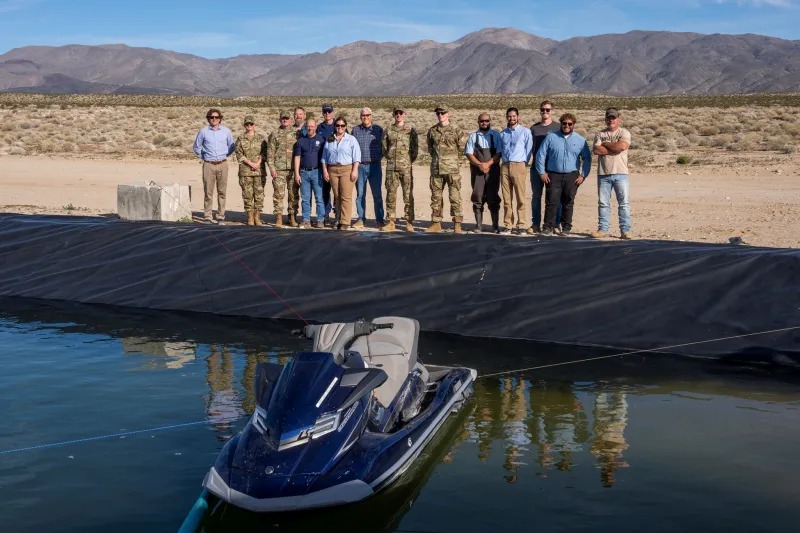
The multi-agency team poses at the CVSC test site. (Photo by NAWC Visual Communication Branch.)
Release From the Department of Homeland Security
The Science and Technology Directorate (S&T) is developing a new contactless vessel stopping technology for the U.S. Coast Guard (USCG) to bolster interdiction efforts along our maritime borders.
S&T, USCG, and the Naval Air Warfare Center Weapons Division (NAWCWD) have been conducting proof-of-concept demonstrations of a new Contactless Vessel Stopping Capability (CVSC) prototype. The CVSC uses high energy microwaves to temporarily stop the motor inside of small watercraft, like jet skis. The most recent demonstration, held in December, showed how effective it can be and how much progress has been made.
This effort began when USCG approached S&T seeking a technology that would allow them to safely and consistently stop small non-compliant vessels. The solution S&T is developing with NAWCWD utilizes highly energized radio frequency pulses to overwhelm the electronic circuits within the targeted vessel, causing the engine to shut down and bring the jet ski to a stop. NAWCWD was selected to build the prototype because they have specialized expertise with high-powered microwave technologies that have demonstrated disruption, degradation, and denial effects on electronic target types, including outboard vessels and combustion engines.
“We’re looking forward to improving upon the progress we’ve made and accelerating future developments to give USCG a solution to their small vessel gap as fast as possible,” said S&T Maritime and Immigration Security Solutions Program Manager Anthony Caracciolo.
One potential use case for CVSC technology would be assisting USCG with intercepting a jet ski suspected of traveling from Mexico and trying to come ashore in San Diego. Currently, USCG uses a much larger, 33-foot boat to chase it down. Jet skis are small, fast, and very maneuverable, and there are not many options when it comes to stopping that kind of vessel. CVSC is akin to law enforcement deploying a spike strip on a road to stop a non-compliant vehicle. Once a watercraft is stopped, USCG can determine whether the vessel is involved in something nefarious, like moving drugs, or human trafficking.
Naval Air Weapons Station (NAWS) China Lake is known for its military research and development facilities and provided an excellent venue to test and evaluate CVSC. The small, teardrop-shaped pond that was used for the test is called PMT, dating back to its previous history as the Pacific Missile Test Center, which merged with NAWS many years ago.
The multi-agency team poses at the CVSC test site. Photo credit: NAWC Visual Communication Branch.
To demonstrate the prototype’s capabilities, a jet ski is tethered in place in the PMT. The engine is started, and a test rig consisting of a server attached to a cone-shaped antenna is powered up and aimed at the idling jet ski. At the first demonstration, held last September, the engine was shut down using the CVSC multiple times, restarted, and shut down again, showing that there was no permanent damage to the craft.
“There are microwave transmitters that can stop a large vessel,” Caracciolo said, “with engines mounted on the back.” The microwave transmitter can be placed on the front of the pursuing boat for a direct line-of-sight engagement. “But jet skis are different. The small engine is inside of the craft, and the operator is blocking it with their body. CVSC is designed to be effective in those challenging conditions.”
A follow up demonstration was then conducted in December. During the September demo it took some time for the motor in the targeted jet ski to stop. During the December demo, the jet ski was shut down almost instantaneously. The improved response was due to correcting a fault in the transmission cable connecting the pulse generator to the antenna and slightly increasing the pulse repetition rate.
S&T will take the information gathered from this test and apply it to the next prototype, which will refine the power levels, ranges and safety parameters. Follow-on demonstrations are scheduled for early next year.
Until spike strips are invented for the high seas, S&T will be there to develop the next best thing.
For more information about CVSC, listen to Anthony Caracciolo’s episode of S&T’s Technologically Speaking podcast, Good Chance You’re Going to Save Lives.