CGC Forward interdicts suspected drug smugglers in Eastern Pacific Ocean
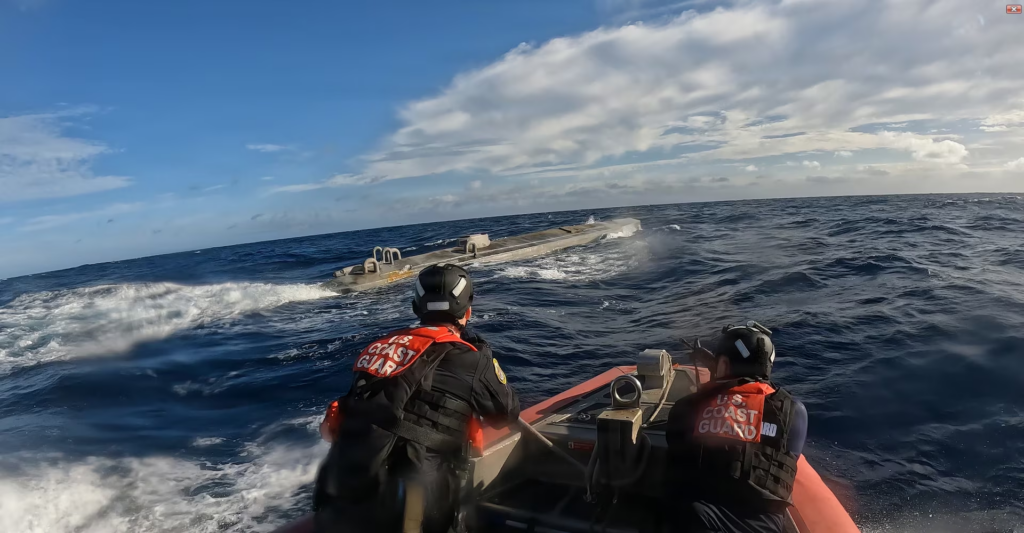
The U.S. Coast Guard Cutter Forward’s Over-the-Horizon cutter boat approaches a Self-Propelled Semi-Submersible in the Eastern Pacific Ocean, February 24, 2026. (U.S. Coast Guard courtesy photo)
From U.S. Coast Guard Southwest District, March 11, 2026
PORTSMOUTH, Va. – Coast Guard Cutter Forward (WMEC 911) delivered a decisive blow to maritime criminal networks by intercepting a self-propelled semi-submersible (SPSS) vessel during a routine patrol on February 24 in the Eastern Pacific Ocean.
A maritime patrol aircraft detected the vessel and reported the location to Forward watchstanders. Forward’s crew rapidly deployed its over-the-horizon cutter pursuit boat and an embarked MH-65 aircraft from the Helicopter Interdiction Tactical Squadron (HITRON) to intercept the suspicious vessel.
Despite repeated verbal commands issued by the boarding team, the SPSS failed to comply or stop their vessel. The boarding team successfully gained access to the vessel, secured positive control, and apprehended four suspected narco-terrorists. All personnel were safely evacuated to the cutter as the SPSS experienced flooding and subsequently sank.
SPSS vessels are commonly used by maritime criminal networks to transport large quantities of drugs in the Eastern Pacific. The Coast Guard routinely interdicts these vessels as part of ongoing counterdrug operations in the region.
“SPSS vessels are purpose-built to move large quantities of illicit, dangerous cargo,” said Cmdr. Andrew Grantham, commanding officer of the Forward. “This interdiction of an SPSS of over 70 feet, prevented a potential 17,600 lbs of cocaine—more than 6 million lethal doses—from reaching U.S. shores. Stopping this vessel demonstrates the exceptional skill and dedication of the Forward crew, the HITRON, Joint Interagency Task Force South, and Coast Guard District Southwest at imposing significant costs on transnational crime organizations.”
The Coast Guard is committed to deterring criminal activity and enhancing maritime security through disrupting illicit smuggling activity at sea before it can reach U.S. shores.
Coast Guard Cutter Forward is a 270-foot Famous-class medium-endurance cutter that conducts counterdrug, migrant interdictions and search and rescue missions throughout the Western Hemisphere. Link to provide more information on the Forward: History
U.S. Coast Guard Cutter Polar Star completes Operation Deep Freeze 2026 mission, departs Antarctica
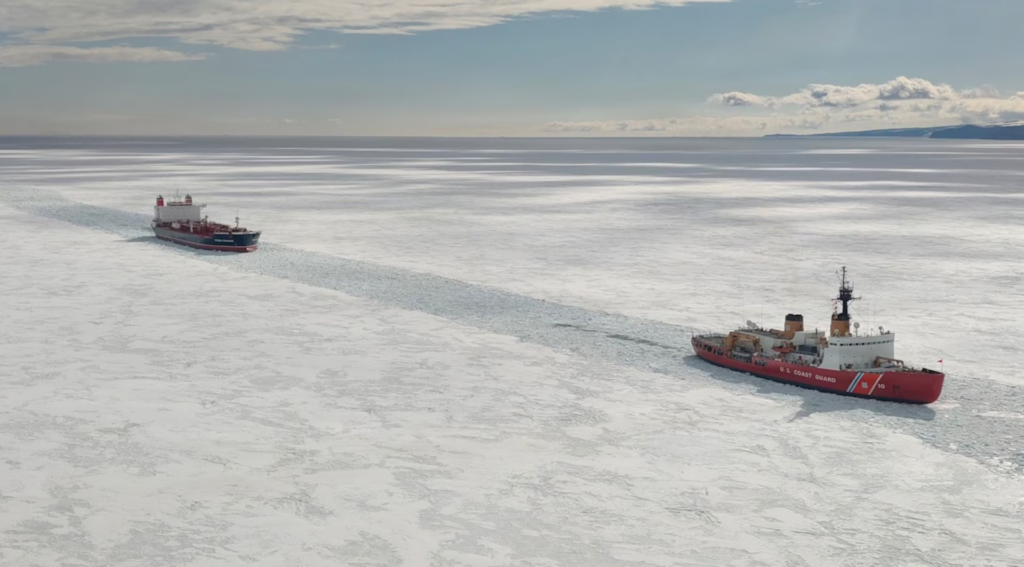
USCGC Polar Star escorts the motor vessel Stena Polaris, the largest fuel tanker ever to reach McMurdo Station, through the ice-covered Ross Sea during Operation Deep Freeze 2026, Jan. 21, 2026. Pacific Air Forces operates on a 24-hour basis to provide the U.S. National Science Foundation complete joint operational and logistic support for Operation Deep Freeze. (U.S. Coast Guard photo by Ensign Madelyn Greene)
From U.S. Coast Guard Northwest District, March 11, 2026
SOUTHERN OCEAN — The U.S. Coast Guard Cutter Polar Star (WAGB 10) departed McMurdo Sound, Antarctica, on March 1, after operating for 55 days below the Antarctic Circle and traveling 14,000 miles in support of Operation Deep Freeze 2026.
The cutter marked its 50th year of commissioned service on Jan. 17 while breaking free a cruise ship trapped in pack ice during a six-hour evolution. The Australian-owned cruise ship Scenic Eclipse II contacted the Polar Star for assistance after encountering denser ice than expected, roughly eight nautical miles from McMurdo Station. The Polar Star’s crew conducted two close passes to break the vessel free, then escorted it approximately four nautical miles to open water.
A few days later, the Polar Star and its crew finished establishing a seven-mile channel through fast ice, creating a navigable route for vessels to reach McMurdo Station. Shortly after its establishment, the Polar Star escorted the 600-foot fuel tanker Stena Polaris into and out of Winter Quarter’s Bay through the brash ice-filled channel to deliver more than 6 million gallons of fuel to McMurdo Station.
“I am so proud of how this crew, once again brought their best energy and worked together through every single challenge this year’s mission presented,” said Capt. Jeff Rasnake, commanding officer of the Polar Star. “Despite the heavy toll Operation Deep Freeze exacts on each individual, mentally and physically, our spirits remain high as we point our compass north and start our journey home.”
In late January, the cutter spent five days moored at McMurdo Station, where crew members helped onload 300,000 gallons of fuel.
After departing, the Polar Star removed the 4,200-ton floating ice pier from Winter Quarters Bay into McMurdo Sound during a joint operation with the National Science Foundation. This cleared the bay for the arriving vessel Plantijngracht to conduct cargo operations via a U.S. Army Modular Causeway System. Shifting ice floes necessitated the Plantijngracht requiring an escort from the Polar Star to reach the protected waters in Winter Quarters Bay.
After cargo operations were complete and the Plantijngracht departed, the Polar Star conducted its fifth and final escort of the season to bring the tug Rachel through lingering late-season pack ice to deliver the new NSF Discovery Pier to McMurdo Station.
“The delivery of the new NSF Discovery Pier is a landmark achievement that will significantly enhance the logistical support for the U.S. Antarctic Program for years to come,” said Cmdr. Samuel Blase, the Polar Star’s executive officer. “This multi-year effort culminated this year with the remarkable trek of the pier from Oregon to the McMurdo Sound, and teamwork between the Coast Guard, National Science Foundation, U.S. Navy Seabees, U.S. Army Corps of Engineers, the New Zealand Antarctic Program, and Tug Rachel for its installation.”
The Polar Star departed Seattle in November for its 29th deployment to Antarctica in support of Operation Deep Freeze.
Operation Deep Freeze provides logistical support for the U.S. Antarctic Program, which is managed by the National Science Foundation. The mission includes strategic and tactical airlift, airdrop, aeromedical evacuation, search and rescue, sealift, seaport access, bulk fuel supply, cargo handling, and other transportation requirements. These efforts enable continuous critical scientific research in one of the most remote regions on Earth.
The Polar Star and its crew also demonstrated its continued support to the Convention on the Conservation of Antarctic Marine Living Resources (CCAMLR) efforts by safeguarding resources and U.S. national interests through monitoring activity on the high seas in the Antarctic region.
The Polar Star is the United States’ only surface asset capable of providing year-round access to both Polar Regions. It is a 399-foot heavy polar icebreaker commissioned in 1976, weighing 13,500 tons and is 84 feet wide with a 34-foot draft. The six diesel and three gas turbine engines produce up to 75,000 horsepower.
U.S. Coast Guard Authenticates Keels for First Three Waterways Commerce Cutters
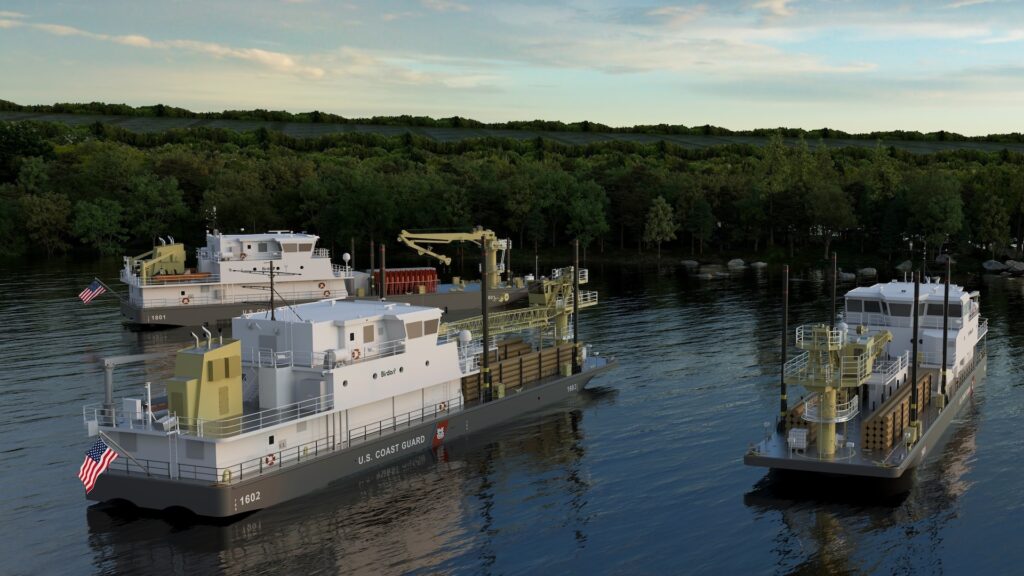
A rendering of the future U.S. Coast Guard Waterways Commerce Cutters Allen Thiele, Fred Permenter, and Samuel Wilson. The new “Chief Petty Officer Class” cutters will honor the legacy of senior enlisted leaders and strengthen the Coast Guard’s inland fleet capabilities. (U.S. Coast Guard courtesy rendering Birdon Group)
WASHINGTON – The U.S. Coast Guard authenticated the keels for future Coast Guard cutters Allen Thiele, Fred Permenter and Samuel Wilson on Friday in Bayou La Batre, Alabama.
In a special proceeding, the keels for three cutters were authenticated simultaneously, a departure from the traditional single-vessel ceremony. Keel authentication is a time-honored maritime tradition in which the ship’s sponsor welds their initials onto a ceremonial plate that is permanently affixed to the cutter, signifying the foundation of the vessel.
“Today marks a monumental step forward in the modernization of our inland fleet,” said Master Chief Petty Officer of the Coast Guard Phillip Waldron. “The new fleet has been designated the ‘Chief Petty Officer’s Class’ and the crews onboard who carry out critical missions on behalf of the Nation will honor the legacy of the senior enlisted leaders whose names they bear.”
The “Chief Petty Officer Class” designation for these cutters highlights the close involvement of the chief petty officer community, many of whom were in attendance.
All three cutter sponsors attended the ceremony. They are Delia Corbley, sponsor for future cutter Allen Thiele and daughter of the cutter’s namesake; Kristin Permenter Melvin, sponsor for future cutter Fred Permenter and granddaughter of the cutter’s namesake; and Barbara Wilson, sponsor for future cutter Samuel Wilson and widow of the cutter’s namesake.
Master Chief Petty Officer Allen Thiele, a boatswain’s mate, served in the Coast Guard from 1958 to 1990 and was selected as the fifth master chief petty officer of the Coast Guard.
Chief Petty Officer Fred Permenter, a boatswain’s mate, was awarded the Gold Lifesaving Medal in 1952 following the rescue of four of five crew members when St. George’s Reef Light Station’s motor launch capsized as it was lowered in heavy seas.
Chief Petty Officer Samuel Wilson, a boatswain’s mate, was awarded the Coast Guard Medal of Extraordinary Heroism in 1979 during the rescue of 81 crew members from the Japanese Fishing Vessel Ryuyo Maru No.2 that ran aground on St. Paul Island, Alaska.
The cutters are the first three of 30 future WCCs that will replace the Coast Guard’s legacy inland tender fleet, which will strengthen the Coast Guard’s capabilities to facilitate commerce vital to economic prosperity, strategic mobility, and maritime dominance. The WCC fleet will will play a critical role in controlling, securing, and defending America’s ports and waterways. and maintaining the United States’ 12,000-mile marine transportation system. This critical waterway network supports more than $5.4 trillion in annual economic activity and millions of American jobs.
Acquisition of the WCC fleet is supported by funding from the One Big Beautiful Bill Act – the largest single funding commitment in Coast Guard history – which included $162 million to accelerate production rates and deliver three cutters ahead of schedule. The first Waterways Commerce Cutter is expected to be completed in 2027.
Coast Guard Cutter Munro crew returns home after 119-day, multi-mission patrol; more than 20,000 pounds of cocaine seized
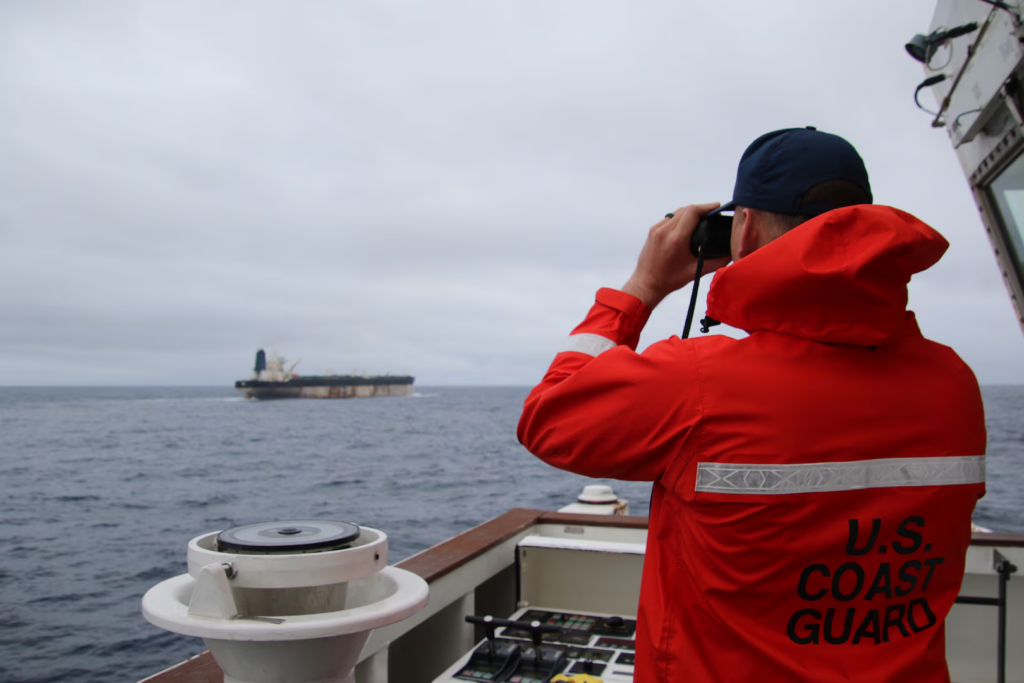
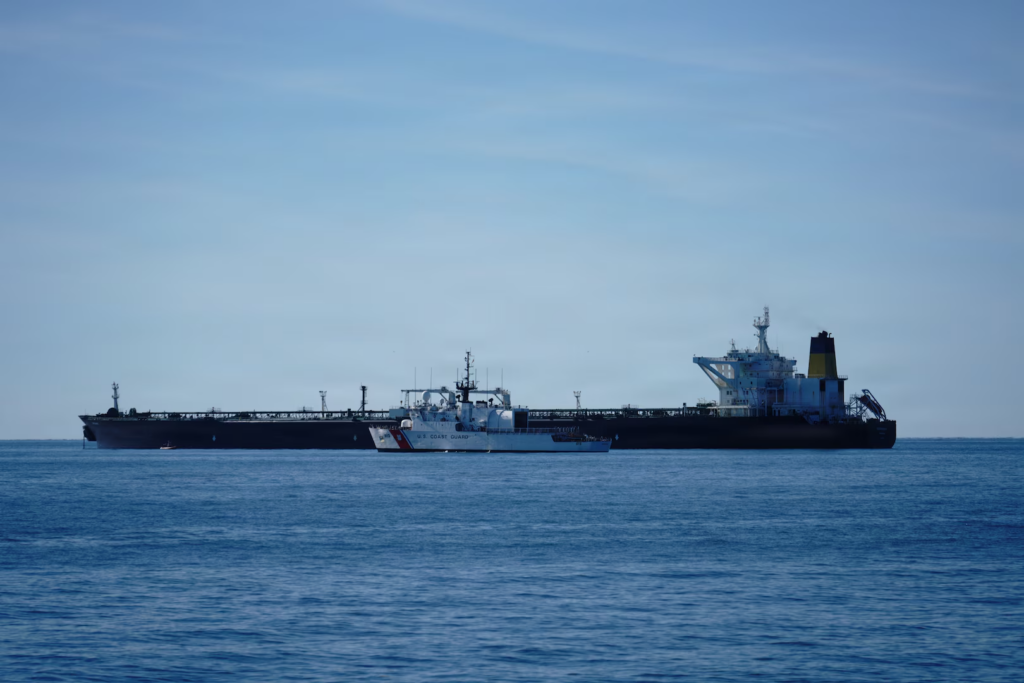
A Coast Guard Cutter Munro (WMSL 755) crew member observes the oil tanker Bella 1 in the North Atlantic Ocean, Jan. 6, 2026. Munro’s crew monitored the vessel until it was seized by Coast Guard deployable specialized forces, with support from the Department of War, after Bella 1 violated U.S. sanctions and resisted initial boarding attempts off coastal Venezuela in late December. (U.S. Coast Guard photo)
From U.S. Coast Guard Pacific Area, March 6, 2026
ALAMEDA, Calif. – The crew of U.S. Coast Guard Cutter Munro (WMSL 755) returned to their home port in Alameda, on Sunday, following a historic 119-day multi-mission deployment spanning more than 26,000 miles from the Eastern Pacific Ocean to the Northern Atlantic.
Munro departed Alameda on November 3, 2025, to conduct training workups and participate in the Department of War’s exercise Resolute Hunter offshore of San Diego, before sailing into the Eastern Pacific to execute a counternarcotics patrol in support of the U.S. Coast Guard’s Operation Pacific Viper. Munro was diverted to the Atlantic Ocean in support of the Department of War’s Operation Southern Spear.
While supporting U.S. Southern Command’s Joint Interagency Task Force South and Coast Guard Southwest District, Munro detected and identified a heavily laden go-fast vessel transiting along a known smuggling route in the Eastern Pacific. With the help of its two cutter pursuit boats, Scan Eagle short-range unmanned aerial system, and an embarked MH-65 aircraft from the Helicopter Interdiction Tactical Squadron (HITRON), Munro successfully found, tracked and interdicted the vessel using warning shots and disabling fire from the HITRON aircraft. Munro subsequently detained six suspected narco-terrorists and seized 22,052 pounds of cocaine valued at over $250 million – the single largest maritime drug seizure in 18 years, and the largest ever in HITRON’s history. This interdiction continued the Coast Guard’s historic counter-drug operations through Operation Pacific Viper, including the seizure of over 200,000 pounds of cocaine along maritime smuggling routes from South and Central America since early August.
After transiting through the Panama Canal, Munro took station in the Caribbean Sea, ready to conduct new tasking in support of Operation Southern Spear. Munro located and identified the dark fleet Motor Tanker Bella 1, a U.S. sanctioned vessel determined to be without nationality and subject to U.S. jurisdiction. Munro’s crew continuously pursued the non-compliant vessel across the North Atlantic Ocean for 18-days and over 4,900-miles. The pursuit culminated with the boarding of Bella 1, where Munro worked in tandem with Department of War assets to seize control of the 333-meter crude oil carrier for further transfer to the U.S. Department of Justice and U.S. Department of Homeland Security for disposition.
“The service, our nation and our families can be extremely proud of Munro,” said Capt. Jim O’Mara, Munro’s commanding officer. “This crew rose to every new challenge thrown at them with professionalism and persistence, and they achieved historic results. This was a one-of-a-kind deployment for us, but it is also just one part of a much broader campaign and U.S. national strategy.”
“We could not have done this without support from partners, allies, and our families,” said O’Mara. “Our families had to adapt to each new twist, just like all military families do across the Armed Forces. It is tough on them. But when they hold strong at home that keeps us motivated and focused on our mission. Now, we reunite with our loved ones, proud of what we accomplished and already preparing for the next mission.”
Commissioned in 2017, Munro is one of four U.S. Coast Guard Legend-class National Security Cutters homeported in Alameda, California. The cutter is named in honor of Signalman First Class Douglas A. Munro – the only Coast Guardsman awarded the Medal of Honor – for his heroic actions on September 27th, 1942, when he gallantly sacrificed himself in the defense, rescue, and evacuation of 500 stranded U.S. Marines from Point Cruz, Guadalcanal, in the Solomon Islands.
Coast Guard interdicts 14 aliens near Point Loma
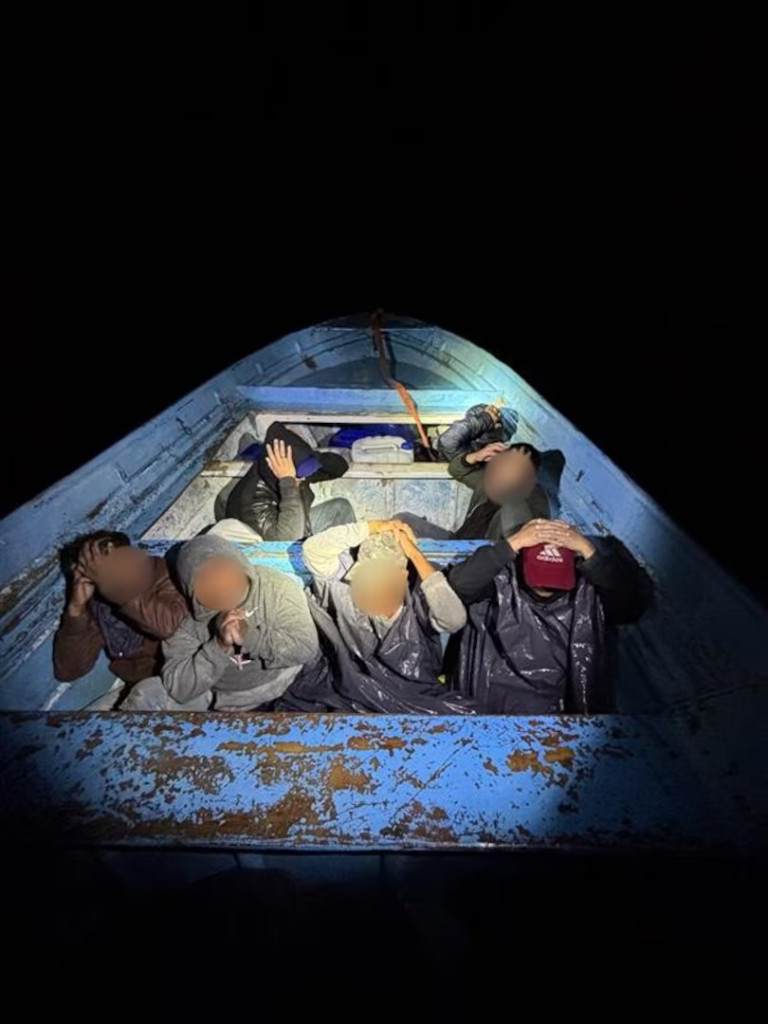
A Coast Guard Cutter Forrest Rednour (WPC 1129) boarding team interdicts a suspected alien vessel March 1, 2026, approximately 10 miles southwest of Point Loma, Calif. The crew discovered 14 individuals aboard, claiming El Salvadoran, Nicaraguan, Columbian, Guatemalan, and Mexican nationality. (U.S. Coast Guard courtesy photo)
From U.S. Coast Guard Southwest District, March 1, 2026
SAN DIEGO — The Coast Guard interdicted 14 suspected aliens approximately 10 miles southwest of Point Loma, San Diego, Sunday.
At approximately 12 a.m., U.S. Customs and Border Protection Air and Marine Operations detected a panga-style vessel transiting into U.S. waters and requested Coast Guard Cutter Forrest Rednour (WPC 1129) to intercept.
The Rednour’s boarding team interdicted the vessel and identified 14 suspected aliens aboard. The individuals claimed nationality from El Salvador, Nicaragua, Columbia, Guatemala, and Mexico.
All suspected aliens were transported to Imperial Beach Border Patrol at Ballast Point.
U.S. Coast Guard Accepts Delivery of 62nd Fast Response Cutter Named for 9/11 Hero
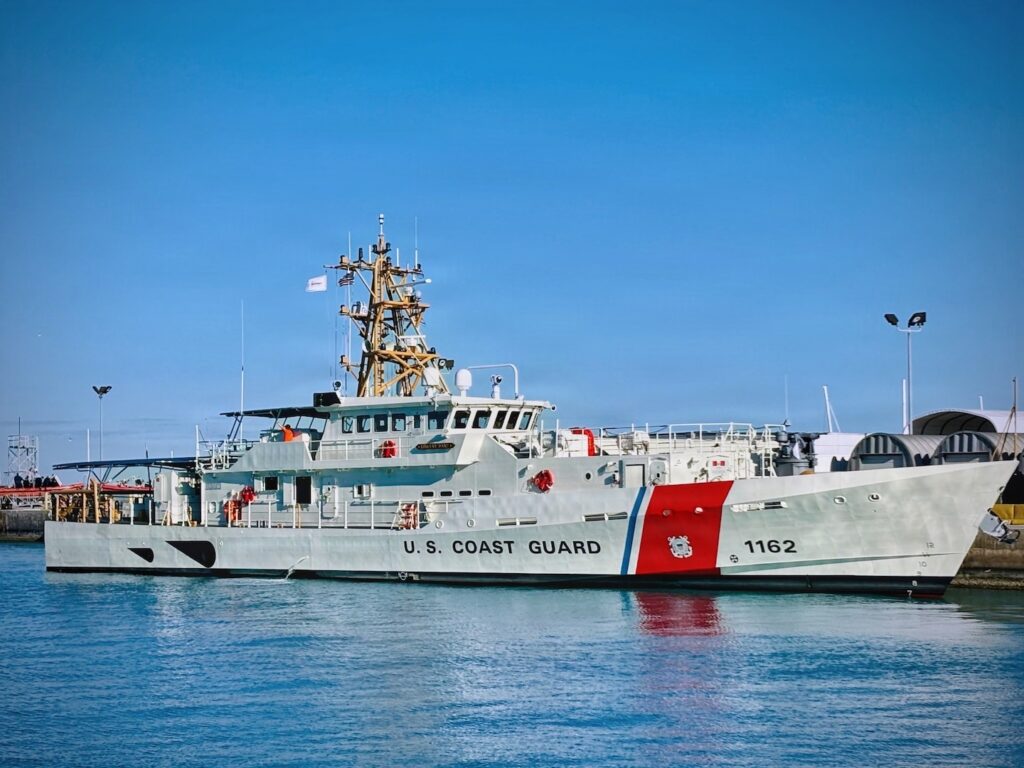
The USCGC Vincent Danz (WPC 1162), seen here moored in Key West, Florida, the day prior to its official acceptance as the U.S. Coast Guard’s newest cutter on Feb. 26, 2026. The cutter is named for Vincent Danz, a New York City police officer and U.S. Coast Guard reservist who made the ultimate sacrifice on Sept. 11, 2001, while responding to the attacks on the World Trade Center. (U.S. Coast Guard photo)
KEY WEST — The U.S. Coast Guard accepted delivery of the 62nd Fast Response Cutter, USCGC Vincent Danz (WPC 1162), on Thursday in Key West.
The Vincent Danz is the fourth FRC to be homeported to Guam.
“Accepting delivery of the Vincent Danz, Guam’s newest Fast Response Cutter, demonstrates the Coast Guard’s enduring commitment to the security of our Nation, the Pacific, and our partners throughout Oceania,” said Capt. Jessica Worst, commander, Coast Guard Forces Micronesia/Sector Guam. “Vincent Danz exemplified selfless service as a New York police officer and Coast Guard reservist. This cutter will honor his legacy by protecting lives, combating illicit activity, and ensuring maritime security of our coasts, across Micronesia and beyond.”
The Sentinel-class FRCs replace the 1980s Island-class 110-foot patrol boats and possess 21st-century command, control, communications, computers, cyber, intelligence, surveillance, and reconnaissance equipment, with improved habitability and seakeeping.
The U.S. Coast Guard ordered a total of 77 FRCs to date to perform a range of missions, including countering illicit maritime activities, search and rescue, bilateral and multilateral international operations, and the national defense of ports, waterways, and coastal areas.
Each FRC is named after an enlisted U.S. Coast Guard hero who performed extraordinary service in the line of duty. Vincent Danz was a New York City police officer and U.S. Coast Guard reservist who made the ultimate sacrifice on Sept. 11, 2001, while responding to the attacks on the World Trade Center. Danz was a veteran of the United States Marine Corps and joined the New York City Police Department in 1987, while continuing to serve in the Coast Guard Reserve as a Port Security Specialist 2nd Class.
Danz was serving in the New York City Police Department, Emergency Services Unit, ESU Truck 3, when he responded to the World Trade Center as part of a massive emergency response and was killed when the World Trade Center collapsed. He was posthumously awarded the New York City Police Department’s Medal of Honor for his heroic deeds. His actions that day embodied the Coast Guard’s core values of honor, respect, and devotion to duty.
“It’s an honor, and we’re all incredibly proud to carry on the legacy of heroes like Vincent Danz,” said Petty Officer David Somera, the engineering petty officer and a proud son of Guam. “This third time I’ve been part of such a commissioning crew, and there’s a deeper appreciation for what it takes to bring a cutter to life. You start with this perfectly new ship, and it’s our job as the first crew to turn it from a steel vessel into a living, breathing part of the Coast Guard. It’s more than the mechanics; we’re building a team and a home that will serve and protect the people of Guam and the Pacific.”
The FRCs homeported in the U.S. territory of Guam extend the U.S. Coast Guard and Oceania District’s operational reach across the Pacific, conducting maritime security operations, combating illegal fishing, supporting search and rescue missions, and strengthening partnerships with Pacific Island nations and Allies. These cutter crews are essential to maintaining a safe, secure, and prosperous Pacific in one of the world’s most expansive maritime regions.
Vincent Danz will join the Myrtle Hazard (WPC 1139), Oliver Henry (WPC 1140), and Frederick Hatch (WPC 1143), commissioned in 2021 in Guam. Since their 2021 commissioning, Guam’s FRC crews distinguished themselves across the region.
USCGC Myrtle Hazard became the first to operationalize the bilateral maritime law enforcement agreement with Papua New Guinea, conducting joint patrols and boardings in 2023. USCGC Oliver Henry saved mariners in the Federated States of Micronesia, delivered humanitarian assistance during the Yap drought, and towed the 500-ton yacht Black Pearl to Palau, rescuing 11 people in 2024. USCGC Frederick Hatch became the first FRC to visit numerous Pacific ports, including Tacloban, Philippines, for the 80th anniversary of the Battle of Leyte Gulf, and operationalized the enhanced bilateral agreement with Palau in 2024. In the Marianas, the crews of all three cutters saved multiple lives, delivered critical supplies, and suppressed asymmetric migration.
Sixty-one FRCs are in service: 13 in Florida; seven in Puerto Rico; six each in Bahrain and Massachusetts; five in Alaska; four in California; three each in Hawaii, Guam, Texas, New Jersey, and Mississippi; and two each in North Carolina and Oregon.
Coast Guard Interdicts Suspected Drug Smuggling Vessel, Seizes $1.3M in Narcotics
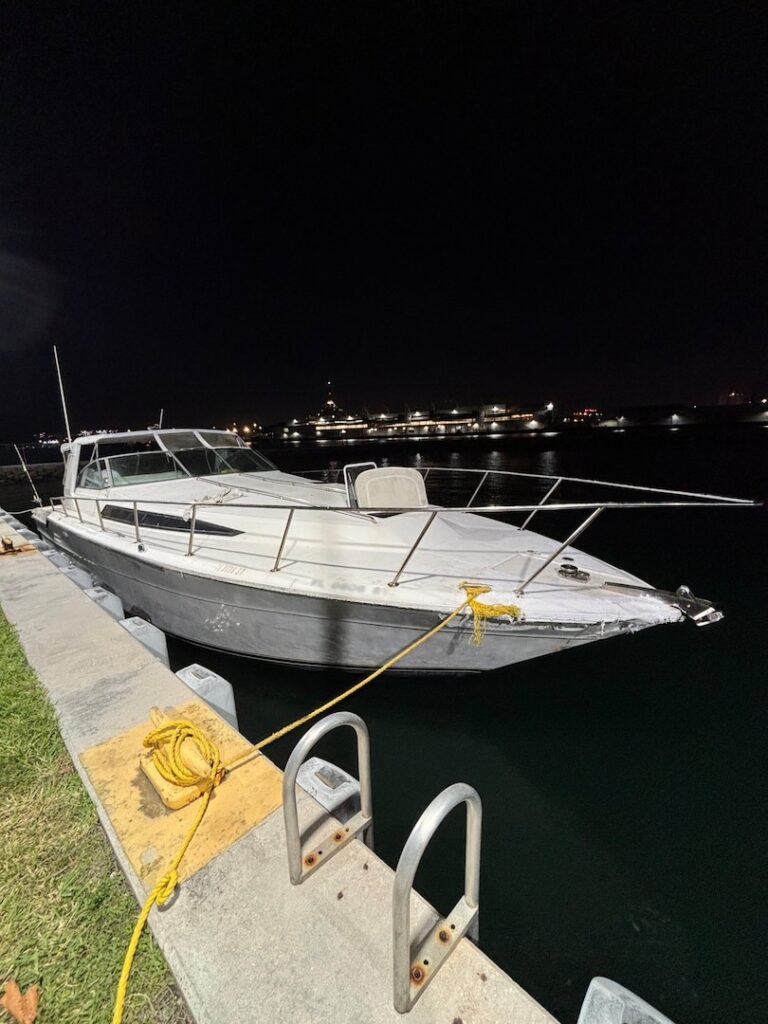
A suspected drug smuggling vessel tied to the pier following an interdiction by the crew of the Coast Guard Cutter Richard Etheridge 8 miles off Miami, Florida, Feb. 21, 2026. The Etheridge’s crew seized approximately 17 pounds of marijuana and 174 pounds of cocaine found aboard the vessel. (U.S. Coast Guard photo)
From Coast Guard Southeast District, Feb. 27, 2026
MIAMI – Coast Guard Cutter Richard Etheridge’s crew interdicted a suspected smuggling vessel, Saturday, at approximately 2:15 p.m., about 8 miles offshore of Miami.
During the boarding, the joint law enforcement crew found approximately 17 pounds of marijuana and 174 pounds of cocaine, later confirmed through laboratory testing, worth an estimated $1.3 million.
The two suspected smugglers were taken into custody for further investigation by Homeland Security Investigations.
“Our crew is committed to keeping drugs off the streets and protecting America’s borders,” said Lt. Zane Carter, commanding officer, Coast Guard Cutter Richard Etheridge. “I could not be prouder of my crew’s professionalism and their seamless integration with our partner agencies.”
Agencies involved in the interdiction:
Coast Guard Southeast District
Coast Guard Sector Miami
Coast Guard Cutter Richard Etheridge
Coast Guard Investigative Service
Homeland Security Investigations
Customs and Border Protection Office of Field Operations K9 unit
Customs and Border Protection Air and Marine Operations
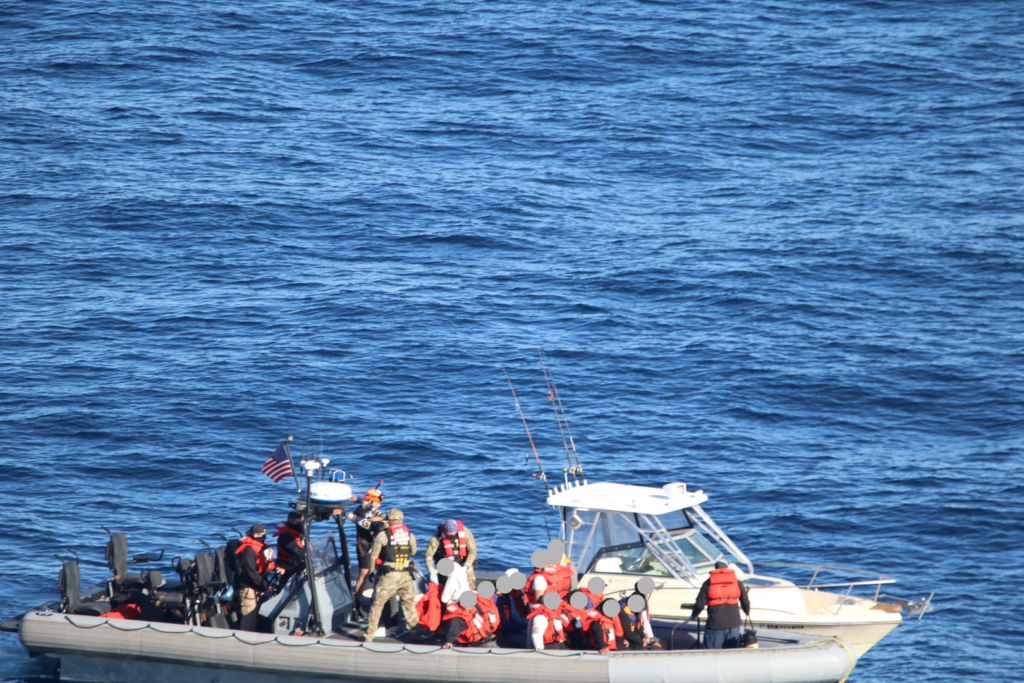
The U.S. Coast Guard and Department of Homeland Security partner agencies interdict a suspected maritime smuggling vessel during coordinated operations south of San Clemente Island, California, Feb. 21, 2026. In total, crews interdicted five vessels and apprehended 62 aliens in under 90 minutes. (U.S. Coast Guard courtesy photo)
From U.S. Coast Guard Southwest District Public Affairs, Feb. 24, 2026
SAN DIEGO — The U.S. Coast Guard and Department of Homeland Security partner agencies, supported by the U.S. Navy, interdicted five suspected maritime smuggling vessels and apprehended 62 aliens during coordinated operations south of San Clemente Island, Saturday.
At approximately 12:30 p.m., watchstanders at the Sector San Diego Joint Harbor Operations Center received reports from a partner agency aircraft of three vessels suspected of smuggling illegal aliens, transiting northbound from Mexican waters. The vessels were described as 20-to-25-foot cuddy cabin-style boats carrying fishing gear and fuel barrels onboard.
The Coast Guard Cutter Haddock (WPB-87347) already on patrol in the area, launched a small boat crew to investigate the first vessel and conduct a boarding. Located approximately 26 miles south of San Clemente Island, the vessel was observed flying a U.S. flag and was compliant during the boarding. Haddock crews reported 10 aliens aboard the vessel, all claiming Mexican nationality.
A Department of Homeland Security partner agency aircraft located a second vessel of interest and directed a law enforcement crew to the vessel’s location, ultimately leading to a pursuit. Failing to comply with law enforcement commands to stop, warning shots were employed to compel the vessel’s compliance. The vessel complied, and 10 additional aliens were identified onboard, all claiming Mexican nationality. All 10 individuals were subsequently embarked aboard the Haddock.
A Department of Homeland Security partner agency vessel then stopped a third vessel suspected of smuggling illegal aliens. Nine additional aliens, all claiming Mexican nationality, were identified and safely embarked aboard the Haddock.
Additional reports of suspected smuggling vessels in the area prompted further response. A U.S. Navy helicopter and small boat crew from the littoral combat ship USS Augusta (LCS-34) with an embarked Coast Guard Maritime Law Enforcement Team (MLET) assisted in locating and interdicting a fourth cuddy cabin vessel. The Coast Guard MLET identified 16 aliens aboard the vessel, 14 claiming Mexican nationality and two claiming Colombian nationality. All 16 individuals were detained and transferred to the Sentinel-class Forrest Rednour (WPC-1129).
A fifth vessel was later intercepted by a Department of Homeland Security partner agency vessel, which employed warning shots to gain compliance after the vessel failed to obey law enforcement commands to stop. Seventeen aliens were aboard the vessel,16 claiming Mexican nationality and one claiming Guatemalan nationality. All were taken into custody.
In total, crews interdicted five vessels and apprehended 62 aliens in under 90 minutes. The Haddock and Rednour crews transported all aliens to Coast Guard Sector San Diego, where they were transferred to another Department of Homeland Security agency for further processing. One unaccompanied minor was identified among the group.
Department of Homeland Security partner agency personnel seized four of the five vessels. The fifth vessel, which was taking on water and determined to be unseaworthy, was left at sea.
The Coast Guard routinely conducts patrols alongside interagency and Department of War partners to detect suspected maritime smuggling operations and interdict illegal activity, while ensuring the safety of life at sea. This case is an example of the stellar partnerships and complex coordination required amongst all agencies involved.
Coast Guard, Homeland Security Task Force Partners Seize and Offload $13.3M in Cocaine
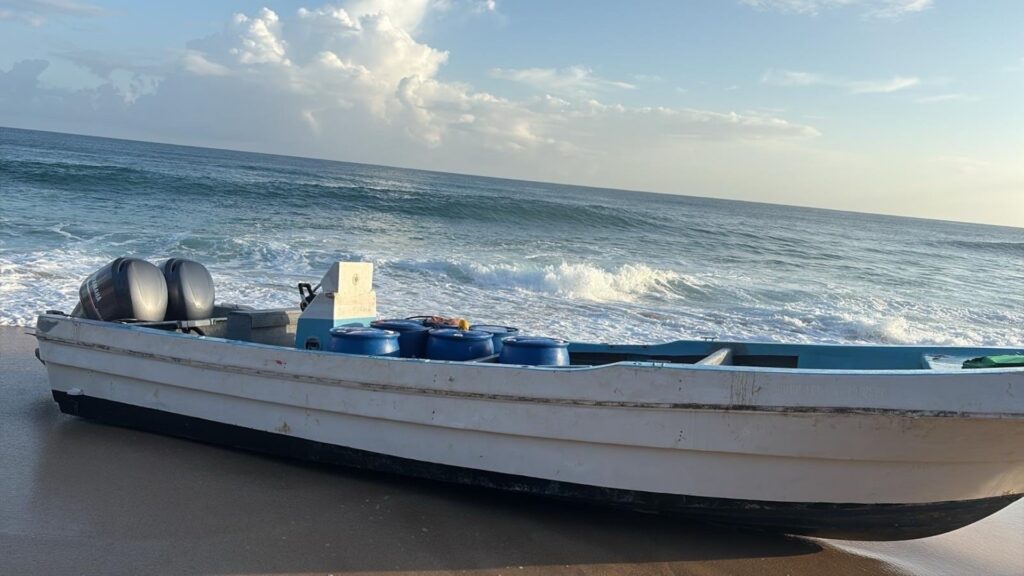
A suspected drug smuggling vessel is beached off Camuy, Puerto Rico, Feb. 13, 2026. Coast Guard law enforcement crews disrupted a drug trafficking go-fast vessel and seized 2,083 pounds of cocaine. (U.S. Coast Guard photo)
SAN JUAN, Puerto Rico — The U.S. Coast Guard and partners with Homeland Security Task Force – San Juan Region, disrupted a drug trafficking go-fast vessel and seized 29 bales of cocaine in the Atlantic Ocean north of Puerto Rico, Friday.
The seized contraband weighed a combined 2,083 pounds worth an estimated $13.3 million. No apprehensions were reported. Homeland Security Investigations is leading the investigation into the case.
During a routine patrol Friday night, the air crew of a Coast Guard HC-144 Ocean Sentry aircraft sighted a panga-style go-fast vessel carrying multiple bales and fuel containers, approximately 100 nautical miles north of Camuy, Puerto Rico. Sector San Juan Command Center diverted Coast Guard Cutter Joseph Napier to interdict the suspect vessel and coordinated with Homeland Security Task Force – San Juan region partners, including Customs and Border Protection Caribbean Air and Marine Branch, Ramey Sector Border Patrol and Homeland Security Investigations.
As the cutter Joseph Napier approached, the suspected smugglers began evasive maneuvers before jettisoning their cargo overboard and fleeing. The crew of the Joseph Napier recovered 29 bales from the water, which later tested positive for cocaine. U.S. Border Patrol agents subsequently located the abandoned go-fast vessel ashore near Arecibo, Puerto Rico. The seized drugs were transferred to Homeland Security Investigations agents in San Juan.
“Fantastic work by the Joseph Napier, Air Station Borinquen and Air Station Miami crews for their efforts sighting and pursing the suspect vessel and subsequently locating the 29 jettisoned bales of cocaine,” said Lt. John Groen, commanding officer of Joseph Napier. “If you are thinking about smuggling drugs to Puerto Rico, think again; the Coast Guard and our Homeland Security Task Force partners will use all available resources to find you and stop you.”
“This successful interdiction and seizure are a testament to the outstanding teamwork and coordination among the Homeland Security Task Force San Juan partners,” said Yariel Ramos, Acting Special Agent in Charge, Homeland Security Investigations San Juan. “Our joint efforts with the U.S. Coast Guard, Customs and Border Protection, and U.S. Border Patrol demonstrate our unwavering commitment to protecting our borders and disrupting the flow of illicit drugs into Puerto Rico and the United States. We will continue to leverage our combined resources and expertise to safeguard our communities and hold criminal organizations accountable wherever they are.”
“Puerto Rico and the U.S. Virgin Islands comprise the United States’ Caribbean border and serve as critical entry points into our country,” said Roberto Vaquero, CBP Director of Field Operations for Puerto Rico and the U.S. Virgin Islands. “Our location places us on the front line of defense against maritime and aerial threats. CBP’s presence here is vital to protecting the United States’ Caribbean border. Through teamwork, technology, and dedication, we keep our communities safe and support a secure and prosperous future for all. This operation highlights the importance of our partnerships and our commitment to stopping drug smuggling and securing our borders.”
The Coast Guard is part of a whole-of-government approach to protect our maritime approaches in the Eastern Caribbean and secure our nation’s borders by interdicting drug smuggling activities at sea and dismantling foreign terrorist organizations and transnational criminal organizations, including narco-trafficking and human smuggling operations.
This counterdrug interdiction is part of the Homeland Security Task Force HSTF initiative established by Executive Order 14519. Protecting American People Against Invasion. The HSTF is a whole of government partnership dedicated to eliminating criminal cartels, foreign gangs, transnational criminal organizations, and human smuggling and trafficking rings operating in the United States and abroad. Through historic interagency collaboration the HSTF directs the full might of the United States law enforcement towards identifying, investigating, and prosecuting the full spectrum of crimes committed by these organizations, which have long fueled violence and instability within our borders. In performing this work, the HSTF places special emphasis on investigating and prosecuting those engaged in child trafficking or other crimes involving children. The HSTF further utilizes all available tools to prosecute and remove the most violent criminal aliens from the United States. HSTF San Juan Region comprises agents and officers from Coast Guard Sector San Juan, the Coast Guard Investigative Service; the Drug Enforcement Administration Caribbean Division; the Federal Bureau of Investigation San Juan Field Office; United States Immigration and Customs Enforcement – Homeland Security Investigations; U.S. Customs and Border Protection’s Office of Field Operations, Air and Marine Operations Caribbean Branch, and U.S. Border Patrol Ramey Sector; the United States Marshals Service Districts of Puerto Rico and the U.S. Virgin Islands; the U.S. Postal Inspection Service Miami Division – San Juan Field Office; the Bureau of Alcohol, Tobacco, Firearms and Explosives – Miami Field Division; the High Intensity Drug Trafficking Area – Puerto Rico / Virgin Islands; the Transportation Security Administration – Federal Air Marshal; the Federal Aviation Administration, the Department of State Bureau of Diplomatic Security – RAC San Juan, the United States Secret Service and the United States Attorney’s Office for the District of Puerto Rico.
Coast Guard Cutter Mohawk Returns from 60-day Patrol After Escorting Oil Tankers
From U.S. Coast Guard Atlantic Area, Feb. 17, 2026
KEY WEST, Fla. — The crew of Coast Guard Cutter Mohawk returned to their homeport in Key West, Saturday, after a 60-day patrol in the Caribbean Sea and Gulf of America, where crew members boarded and escorted two sanctioned oil tankers.
Operating in support of Operation Southern Spear, Mohawk’s crew partnered with Department of War and Department of Homeland Security assets as well as additional Coast Guard units to board and escort the two sanctioned vessels, preventing the illicit trade of crude oil in violation of international sanctions.
“Our dedicated crews are the frontline of maritime security,” said Cmdr. Taylor Kellogg, commanding officer of Mohawk. “Their vigilance and expertise were instrumental in the successful interdiction and escort of these tankers, preventing illicit oil from destabilizing the Western Hemisphere. This is a clear demonstration of the Coast Guard’s commitment to enforcing international law and our vital role in the Joint Force. I’m proud of their selfless service and devotion to duty.”
On Dec. 20, a Coast Guard tactical law enforcement team with DoW support intercepted and boarded the Panamanian-flagged motor tanker Centuries. Subsequently, Mohawk escorted Centuries during its transit from the Caribbean Sea to the Gulf of America, where the tanker moored for further disposition in coordination with the Centuries’ flag state.
On Jan. 15, a Coast Guard tactical team with DoW support intercepted and seized the Venezuelan-linked, Aframax motor tanker Veronica, prompting Mohawk’s crew to quickly transit back to the Caribbean Sea and provide escort duties. Following a boarding by a joint warfare team, Mohawk escorted Veronica to a secure anchorage in the Caribbean Sea.
The back-to-back escorts totaled 17 days and covered a combined distance of 2,700 nautical miles.
Unique statutory authorities enable the Coast Guard to enforce international and domestic law in the maritime domain, deploying assets to conduct missions in U.S. waters and on the high seas. The Coast Guard’s involvement in these maritime activities was conducted under Title 14, U.S. Code and in accordance with customary international law. The Coast Guard exercises these authorities to protect maritime safety, security and U.S. interests.
About the U.S. Coast Guard and Operation Southern Spear
The U.S. Coast Guard’s missions are enabled by a unique blend of military, law enforcement and humanitarian capabilities. The Coast Guard is the principal federal agency responsible for maritime safety, security and environmental stewardship in U.S. ports, waterways and on the high seas.
Operation Southern Spear is a multi-agency effort led by the DoW to counter illicit maritime trade and enforce international sanctions. By leveraging joint capabilities, the operation aims to disrupt transnational criminal organizations and maintain stability in the maritime domain.
Mohawk is a 270-foot, Famous-class medium endurance cutter homeported in Key West. An asset of U.S. Coast Guard Atlantic Area, the cutter’s primary missions include counter-narcotics, alien interdiction, homeland security, and search and rescue in support of U.S. interests in the Western Hemisphere.
Based in Portsmouth, Virginia, U.S. Coast Guard Atlantic Area is responsible for all Coast Guard missions east of the Rocky Mountains to the Arabian Gulf, spanning five districts and 40 states. It oversees a wide range of operations, including counter-drug and alien interdiction, enforcement of federal fishery laws, and search and rescue operations in support of Coast Guard missions throughout the Western Hemisphere. In addition to surge operations, Atlantic Area is a force provider of surface and air assets to the Caribbean and Eastern Pacific to combat transnational organized crime and illicit maritime activity.