SAFE Boats International Delivers Response Boat–Small Demonstrator to U.S. Coast Guard
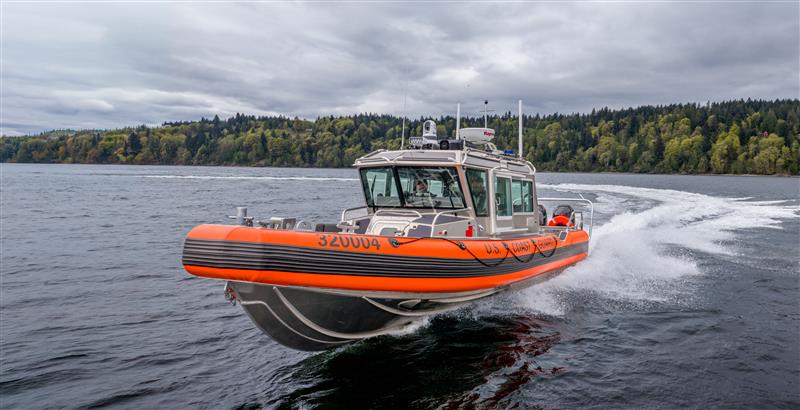
SAFE Boats International delivered its Response Boat-Small demonstration to the U.S. Coast guard. Photo credit: SAFE Boats International

SAFE Boats International, a U.S. manufacturer of high-performance aluminum vessels, announced the successful delivery of its Response Boat–Small (RB-S) demonstrator unit to the U.S. Coast Guard in Charleston, South Carolina. The delivery marks a key milestone in the Coast Guard’s evaluation of next-generation capabilities for one of its most critical and widely deployed operational platforms.

Purpose-built to meet the evolving demands of Coast Guard missions, including search and rescue, law enforcement, and maritime security, the SAFE Boats RB-S Demonstrator reflects a rapid, agile development approach rooted in real-world operator experience and advanced marine engineering.

Measuring 32 feet by 4.5 inches long with an 8-foot, 6-inch beam, the vessel delivers a cruising speed of 28 knots and a top speed of 49 knots, powered by twin 300hp V10 Mercury Verado outboard engines. Designed for performance, durability, and crew survivability, the platform integrates a range of advanced features that distinguish SAFE Boats as a leader in next-generation patrol craft.

“The delivery of this RB-S demonstrator underscores SAFE Boats’ ability to move quickly, listen closely, and deliver a highly capable platform built around the realities of Coast Guard operations,” said Rob Goley, Chief Revenue & Customer Officer at SAFE Boats International. “Our employee-owners, many of whom are veterans and former operators, bring firsthand experience to every stage of design and construction. That perspective ensures we are not just building boats but delivering mission-ready tools that prioritize crew safety, comfort, and operational effectiveness.”

The SAFE Boats RB-S demonstrator features a full foam collar system constructed from closed-cell polyethylene foam encapsulated in a durable polyurethane membrane, eliminating the need for inflation, reducing maintenance, and enhancing long-term reliability. Beyond durability, the collar plays a critical role in vessel stability, performance, and crew safety in dynamic maritime environments.

Additional performance innovations include enhanced performance fins for increased lift and superior cornering, as well as a stepped transom hull design that allows engines to be mounted higher reducing drag and increasing speed and fuel efficiency. A proprietary “speed shoe” integrated into the keel further enhances hydrodynamic efficiency.

SAFE Boats’ aluminum hull is engineered with air- and watertight integrity and undergoes pressure testing to prevent water intrusion. A self-bailing deck and concave lifting strakes contribute to improved handling and seaworthiness in challenging conditions.

Crew safety and comfort are central to the vessel’s design. The onboard AC system allows simultaneous operation of heating and air conditioning, enabling independent control of temperature, airflow, and defogging, critical for maintaining visibility and reducing fatigue in all weather conditions. Shock-mitigating SHOXS seating further enhances crew endurance during high-speed operations.

The vessel also features modular MOLLE panel systems for mission-configurable storage, overhead-mounted visibility windows for enhanced situational awareness, and the Intelligent Marine Assistance System by Hefring Marine, an advanced technology platform that improves operational safety, efficiency and survivability through real-time data and guidance.

“This platform is the result of thoughtful design and disciplined execution by more than 300 employee-owners committed to building boats that perform when it matters most,” Goley added. “From hull design to onboard systems, every detail reflects our focus on protecting the crew and enhancing mission capability.” The RB-S Demonstrator program brings together multiple industry partners to support the Coast Guard’s evaluation of future vessel designs. SAFE Boats’ delivery highlights its continued leadership in advanced patrol craft programs and its longstanding partnership with the Coast Guard.
Wreckage of U.S. Coast Guard Cutter Tampa Discovered Off Cornwall, United Kingdom

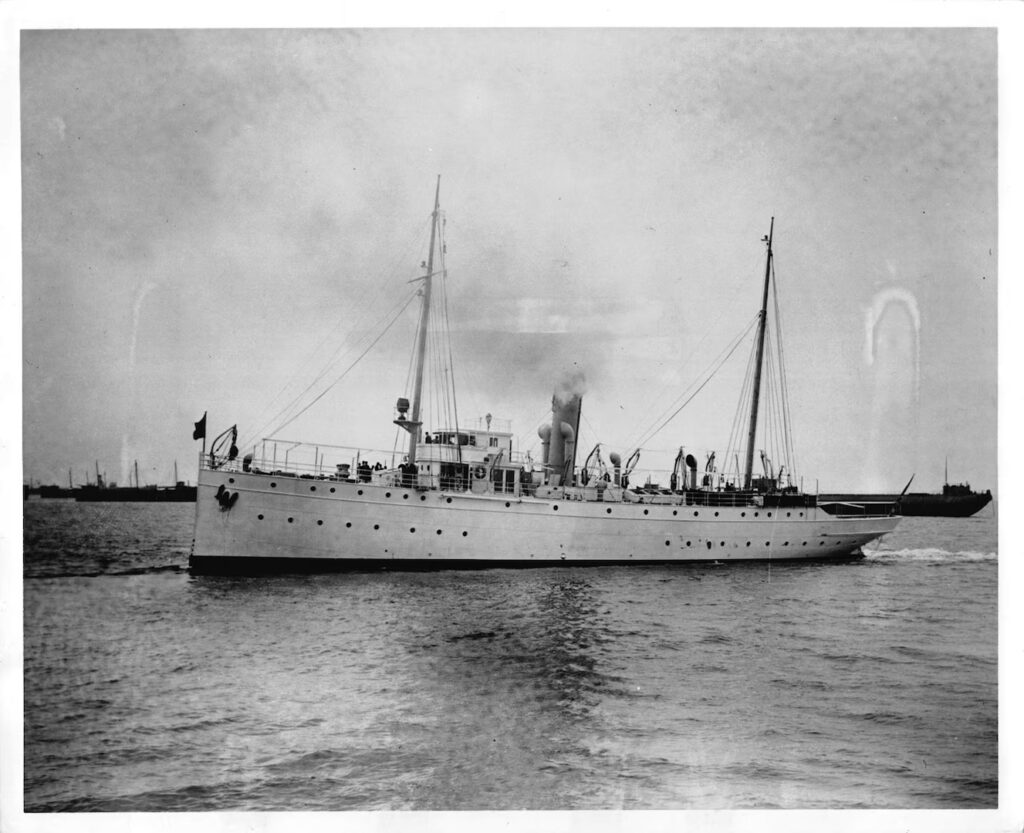
A historical photo of Coast Guard Cutter Tampa, which was lost in 1918 during World War I after being torpedoed by a German submarine. Tampa’s wreckage was recently located off the coast of Cornwall, United Kingdom, marking the largest single naval American combat loss of life in World War I. (U.S. Coast Guard photo)

From U.S. Coast Guard Headquarters, April 29, 2026 

WASHINGTON – The wreckage of the Coast Guard Cutter Tampa has been located and confirmed by the British technical-diving team Gasperados. The site lies approximately 50 miles off Newquay, Cornwall, United Kingdom, at a depth exceeding 300 feet deep in the Atlantic Ocean. 

Tampa was lost in 1918 during World War I after being torpedoed by a German submarine in the Bristol Channel. The vessel sank in less than three minutes, resulting in the death of all 131 people aboard—111 Coast Guardsmen, four U.S. Navy personnel, and 16 British Navy personnel and civilians. This remains the largest single American naval combat loss of life in World War I. 

“Since 1790, the Coast Guard has defended our nation during every armed conflict in American history, a legacy reflected in the courage and sacrifice of the crew of Coast Guard Cutter Tampa,” said Adm. Kevin Lunday, commandant of the Coast Guard. “When the Tampa was lost with all hands in 1918, it left an enduring grief in our service. Locating the wreck connects us to their sacrifice and reminds us that devotion to duty endures. We will always remember them.  We are proud to carry their spirit forward in defense of the United States.” 

In 2023, the Coast Guard Historians Office was contacted by the Gasperados Dive Team regarding the Tampa. Over the past three years, the all-volunteer team conducted an extensive search for the wreckage. 

“We provided the dive team with historical records and technical data to assist in confirming the wreck site,” said Dr. William Thiesen, Coast Guard Atlantic Area Historian. “This included the archival images of the deck fittings, ship’s wheel, bell , weaponry, and archival images of the Tampa.” 

The Coast Guard is now developing plans for underwater research and exploration in coordination with its offices of specialized capabilities, historians, cutter forces, robotics and autonomous systems, and dive locker. 

Additional information about the Tampa’s legacy can be found here


Coast Guard Offloads Over $53M in Illicit Drugs From the Eastern Pacific & Caribbean

From U.S. Coast Guard District, April 27, 2026

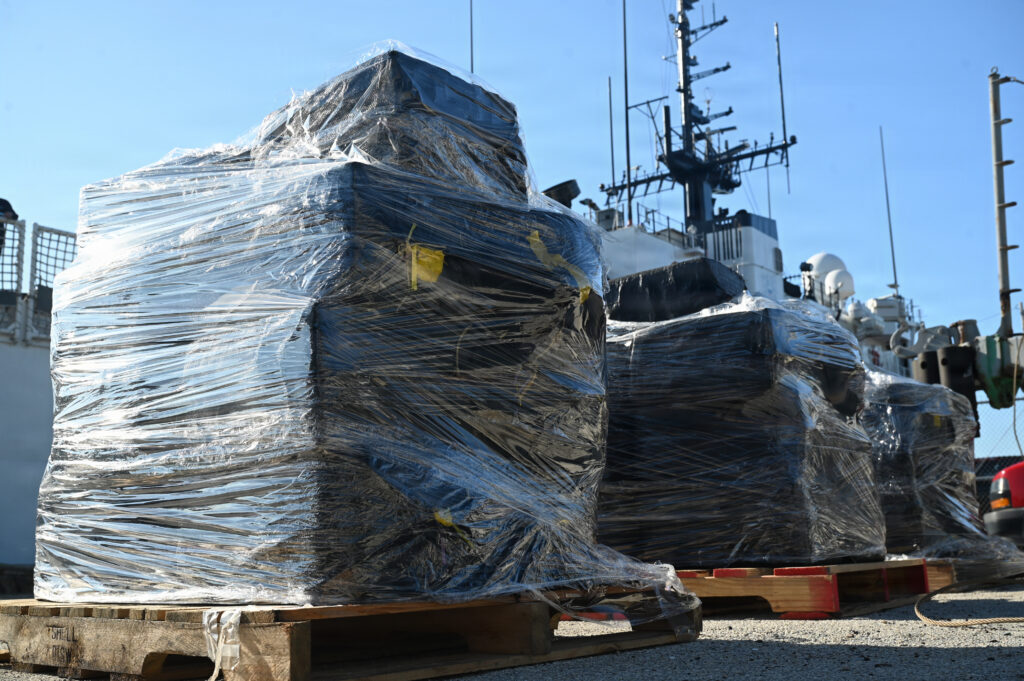
Bales of illegal narcotics are placed on pallets by crew members aboard USCGC Escanaba (907) during a drug offload of 7,050 pounds of cocaine at Port Everglades, Florida, April 27, 2026. The seized contraband was the result of one interdiction in the Caribbean Sea and one interdiction in the Eastern Pacific Ocean worth an estimated $53 million dollars. Photo credit: U.S. Coast Guard | Petty Officer 2rd Class Eric Rodriguez

MIAMI – U.S. Coast Guard Cutter Escanaba’s crew offloaded approximately 7,050 pounds of cocaine worth more than $53 million, Monday, April 27, at Port Everglades.

The seized contraband was the result of one interdiction in the Caribbean Sea and one interdiction in the Eastern Pacific Ocean.

“The crew’s achievements on this patrol reflect the very best of our service—courage, vigilance, and an unshakeable commitment to protecting the American people,” said Cmdr. Nicholas Seniuk, Escanaba’s commanding officer. “Every pound of narcotics kept off our streets represents lives changed, violence prevented, and communities made safer. We couldn’t be prouder of their extraordinary work.”

The following assets and crews were involved in the interdiction operations:

Coast Guard Cutter Escanaba’s offload continues record-setting Coast Guard operations to interdict, seize, and disrupt transshipment of cocaine and other bulk illicit drugs by sea. These drugs fuel and enable cartels and transnational criminal organizations to produce and traffic illegal fentanyl threatening the U.S. This includes the Coast Guard’s seizure of over 511,000 pounds of cocaine in 2025 – over three times the Service’s annual average – as well as accelerated counter-narcotics operations in the Eastern Pacific through Operation Pacific Viper. Since launching this operation in early August, the Coast Guard has seized over 215,000 pounds of cocaine and apprehended 160 suspected narco-traffickers. The Coast Guard’s persistent operations and rapid response have denied criminal organizations billions in illicit revenue and prevented the flow of dangerous drugs into American communities.

Eighty percent of interdictions of U.S.-bound drugs occur at sea. This underscores the importance of maritime interdiction in combatting the flow of illegal narcotics and protecting American communities from this deadly threat. Detecting and interdicting illicit drug traffickers on the high seas involves significant interagency and international coordination. Joint Interagency Task Force South, in Key West, conducts the detection and monitoring of aerial and maritime transit of illegal drugs. Once an interdiction becomes imminent, the law enforcement phase of the operation begins, and control of the operation shifts to the U.S. Coast Guard for the interdiction and apprehension phases. Interdictions in the Caribbean Sea are performed by members of the U.S. Coast Guard under the authority and control of the Coast Guard Southeast District, headquartered in Miami. Interdictions in the Eastern Pacific Ocean are performed by members of the U.S. Coast Guard under the authority and control of the Coast Guard Southwest District, headquartered in Alameda, California.

Coast Guard Cutter Escanaba is a 270-foot medium endurance cutter homeported in Portsmouth, Virginia, under U.S. Coast Guard Atlantic Area Command.


Coast Guard’s sole heavy icebreaker returns home following Antarctic deployment 

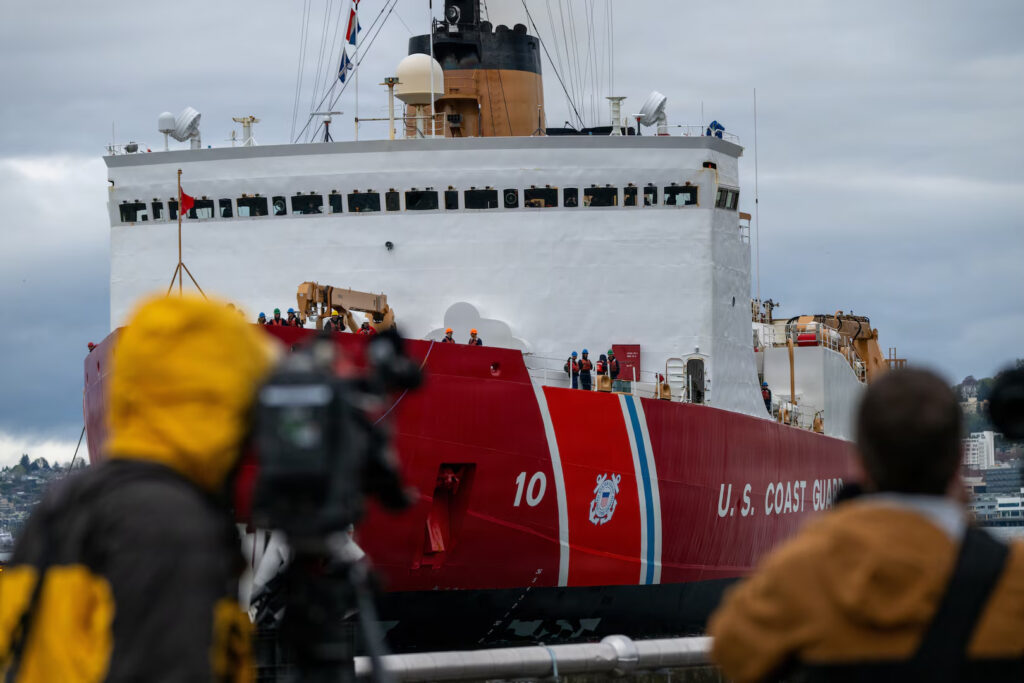
U.S. Coast Guard Cutter Polar Star (WAGB 10) returns to Coast Guard Base Seattle following a 146-day Antarctic deployment in support of Operation Deep Freeze, April 13, 2026. The Polar Star is the United States’ only surface asset capable of providing year-round access to both Polar Regions. It is a 399-foot heavy polar icebreaker commissioned in 1976, weighing 13,500 tons and is 84 feet wide with a 34-foot draft. (U.S. Coast Guard photo by Petty Officer 2nd Class Briana Carter) 

From U.S. Coast Guard Northwest District, April 20, 2026 

SEATTLE — The crew aboard the U.S. Coast Guard Cutter Polar Star (WAGB 10) returned home to Seattle on April 13, following a 146-day Antarctic deployment in support of Operation Deep Freeze (ODF) 2026. 

Polar Star departed Seattle Nov. 20, traveling more than 20,000 nautical miles through ocean and ice to complete ODF 2026. ODF is the logistical support provided by the Department of War to the U.S. National Science Foundation (NSF)-managed U.S. Antarctic Program (USAP). 

While spending 62 days in Antarctic waters, Polar Star conducted multiple mission sets before departing the Antarctic region on March 8. The cutter established a seven-mile-long channel through fast ice up to eight feet thick and escorted a fuel tanker and container vessel through the ice in McMurdo Sound in order to resupply McMurdo Station. Polar Star also escorted a tug with the 330-foot-long NSF Discovery Pier for install at McMurdo Station to provide a semi-permanent means to moor ships for the USAP. 

Polar Star supported the Commission for the Conservation of Antarctic Marine Living Resources (CCAMLR) by completing sighting reports of fishing vessels in the Ross Sea. Through monitoring and documenting fishing activity, the crew helped ensure compliance with established regulations, protecting marine resources and U.S. interests in one of the world’s most remote and scientifically significant regions. 

“Coming back to Seattle following deployment for the first time in a few years means a lot, especially considering how we spend over 300 days away from homeport each year,” said Rasnake. “So, we’ll enjoy the warm embrace of friends and family for a minute before quickly getting back after the hard work of maintaining this cutter and getting it ready for next year’s mission.” 

While transiting home, Polar Star’s crew made port calls in Hobart, Australia and Wellington, New Zealand. While in Hobart, Polar Star hosted international visitors from CCAMLR, Australian Armed Forces and Australian Government, including the commanding officer of Navy Headquarters Tasmania. 

In Wellington, the U.S. Embassy hosted a reception aboard Polar Star, where David Gehrenbeck, U.S. Chargé d’Affaires to New Zealand, hosted 40 distinguished guests, including, the Honorable Judith Collins, the 43rd Minister of Defence. Other guests and Embassy representatives from over ten different countries joined Polar Star’s crew members to acknowledge the U.S. and New Zealand’s joint support of the Antarctic Treaty and celebrate Polar Star’s first visit to Wellington since December 2021. 

Commissioned on Jan. 17, 1976, Polar Star is the nation’s only active heavy icebreaker and has served as a cornerstone of U.S. presence in the polar regions. For five decades, the cutter has executed missions ranging from Antarctic resupply and search and rescue to environmental protection and national defense. 

“Polar Star reminded us of her age on more than one occasion this deployment, but as always, this crew demonstrated the cutter’s unique capability by working together through each challenge and finding a way to get the job done,” said Capt. Jeff Rasnake, Polar Star’s commanding officer. 

Polar Star will be completing its annual dry dock maintenance over the summer, ensuring it is ready to meet all mission requirements for ODF27. The critical work completed during these periods ensures that U.S. maintains year-round access to the high latitudes. 


Coast Guard Poised to Meet Great Expectations

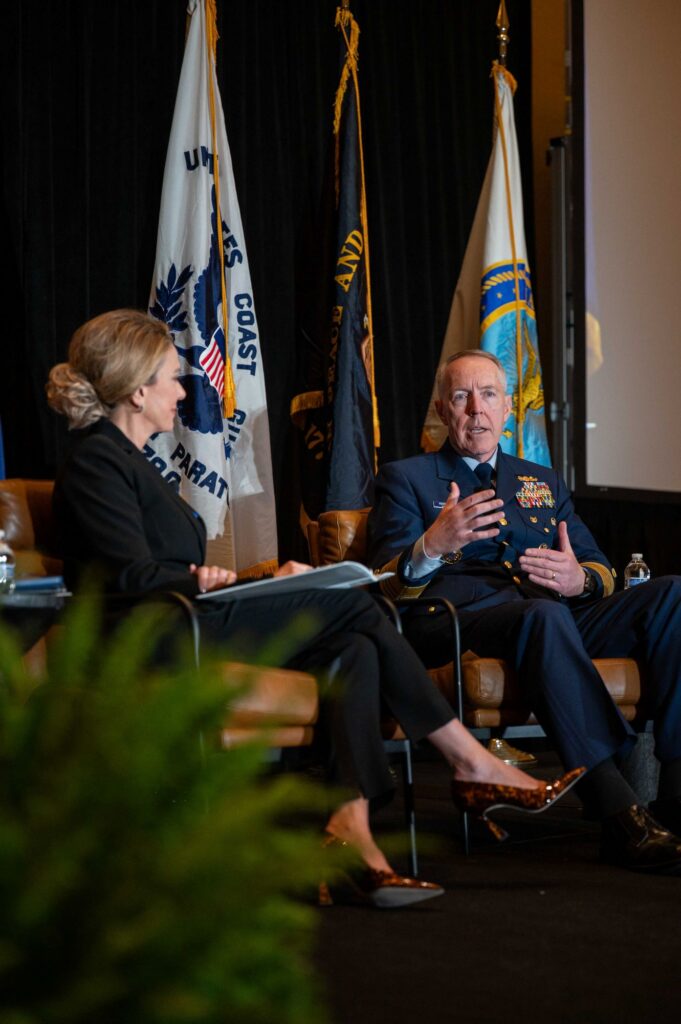
U.S. Coast Guard Commandant Admiral Kevin E. Lunday addresses the service’s successes and challenges at Sea-Air-Space. Photo credit: Laura Hatcher

The U.S. Coast Guard is quickly allocating an unprecedented $24.6 billion funding infusion provided to the Department of Homeland Security agency in last year’s budget reconciliation bill. At the same time, the armed services branch is shuttered, caught in the political crossfire over the actions of another DHS entity, Immigration and Customs Enforcement.

In describing this bizarre situation to a Sea-Air-Space 2026 audience on April 22, the 28th Coast Guard Commandant, Admiral Kevin E. Lunday, looked to Charles Dickens, who opens “A Tale of Two Cities” with the famous lines, “it was the best of times, it was the worst of times. …”

“We want to get those worst of times out of here,” he said in a conversation with ABC News correspondent Kyra Phillips on the closing day of the conference. Lunday urged Congress to fund the Coast Guard to “ensure our readiness but pay our people.”

Citing an emergency authority, the White House directed DHS to cut checks to personnel across the agency, including affected members of the Coast Guard, a temporary solution that most agree is not a substitute for annual appropriations.

Promise Amid the Peril

Despite the funding stoppage, Lunday said it’s still an “amazing time for our service.”

That’s in part thanks to the nearly $25 billion from the reconciliation bill, which is funding long-deferred shipbuilding and modernization efforts at the agency, which Lunday has led since Jan. 15, 2026.

Lunday said the Coast Guard relies on an aging fleet — including 50-year-old cutters — to conduct much of its work. For instance, this year these stalwart vessels freed frozen shipping lanes in the New England, New York and Great Lakes regions so ships could deliver essential cargo like home heating oil and other goods.

“Keeping commerce moving is a constant, constant effort,” he said. “In fact, it’s one of the most important, but maybe one of the things that is not aways seen.”

These operations have continued amid a decades-long downward spiral in readiness, Lunday said. He said the Coast Guard requires about $20 billion in annual funding but has in recent years received just under $13 billion per year.

To reverse that trajectory, Lunday’s team knew they needed to get the new cash out the door quickly. To do this, the service created an acquisition “super highway” to accelerate the shipbuilding acquisitions process.

The Coast Guard has already obligated $9 billion of the new money, with three new heavy icebreakers and 11 new Arctic security cutters set to roll off the U.S. shipyards starting in 2028.

“No one is moving that fast,” Lunday said.

Topline Annual Appropriations

However, it’s critical that Congress also support the president’s fiscal 2027 budget request of $15.6 billion to build on the one-time cash injection from the reconciliation bill, he said. The plus-up in yearly funding is necessary for homeports, hangars, facilities and other infrastructure to support the roughly 100 new assets funded through the bill, he said.

That includes funding to train, hire and support the families of roughly 1,300 additional personnel needed to crew the new vessels.

“And the ’27 budget request goes a long way to do that,” he said. “But we’re going to need to continue to see that topline growth, not only in the operating funds but continued investments in capital assets to be able to meet the demands of the American people.”

The Coast Guard is currently comprised of about 41,000 active-duty military and 8,700 civilian employees, 6,200 reservists and 26,000 auxiliary volunteers.

Compared to its size, Lunday said the Coast Guard delivers “unprecedented value” to the nation, saving lives, protecting the maritime borders, keeping trade routes safe and free, and providing disaster assistance worldwide. Some of these operations in 2025 involved:

  • Saving 5,220 people and assisting more than 19,000 through search-and-rescue missions.
  • Diverting a four-person crew far inland to help respond to the July 4 Central Texas floods, which ultimately killed 135 people.
  • Deploying USCG cutters Storis, Healy and Waesche to protect U.S. sovereignty in the Arctic by chasing off five Chinese research vessels that traversed U.S. waters.
  • Ensuring the safe maritime passage of $1.8 billion tons of cargo, a 13% annual increase.
  • Seizing a record-breaking 511,000 pounds of cocaine trafficked to the United States by cartels.

As the 236-year-old service begins its promising next chapter, Lunday said he hopes the funding lapse can end so he can refer to a different Dickens’ tome: “Great Expectations.”


Changing Polar Region Presents New Challenges and Opportunities for Navy, Coast Guard, Industry

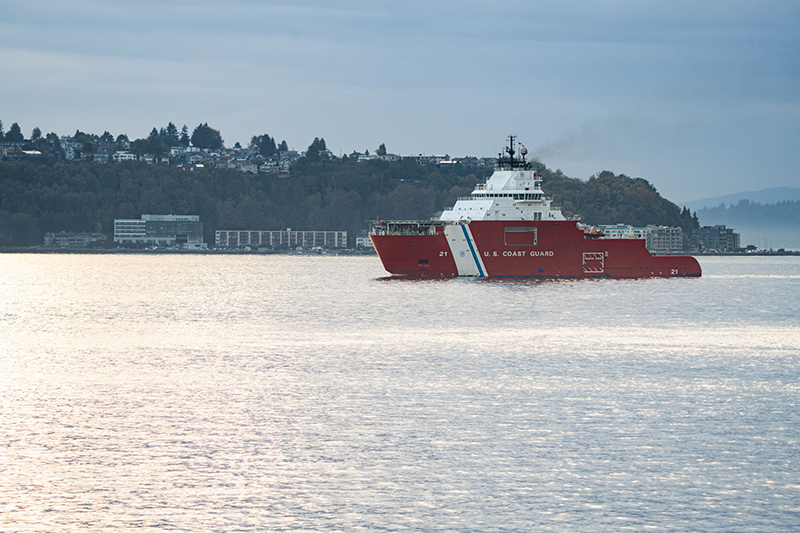
Coast Guard Cutter Storis (WAGB-21) transits past West Seattle on its way to its temporary homeport at Coast Guard Base Seattle, Oct. 3, 2025, after its August 2025 commissioning in Alaska. The cutter is the Coast Guard’s first polar icebreaker acquired in over 25 years, but more icebreakers are on the way. Credit: U.S. Coast Guard | Petty Officer 3rd Class Daylan M. Garlic-Jackson 

By Erika Fitzpatrick, Seapower Correspondent 

The U.S. military and allied nations are ramping up their strategic offensive and defensive capabilities in the Arctic to confront an expanding presence from adversaries such as China, Russia, Iran and North Korea, said Vice Admiral Doug Perry, U.S. Navy Commander of Joint Force Command Norfolk, at Sea-Air-Space on Monday, April 20.  

“We have to acknowledge that is not a situation we want to allow to continue, to the detriment of free nations and certainly [of] the United States,” Perry said during a polar issues panel moderated by Dr. Abbie Tingstad, professor of Arctic Research at the Center for Arctic Study and Policy at the U.S. Coast Guard Academy. 

The Arctic polar region is primarily ocean, surrounded on its edges by the eight member states of the Arctic Council: Canada; the Kingdom of Denmark, which includes Greenland and the Faroe Islands; Finland; Iceland; Norway; the Russian Federation; Sweden; and the United States, where Alaska includes a 1.5-million-square-mile exclusive economic zone in its surrounding waters.  

Council decisions are achieved in agreement with six “permanent participants” that represent Aleut, Arctic Athabaskan, Gwich’in, Inuit, Saami, and Russian Indigenous people, who have inhabited the Arctic for millennia and are about 10% of the 4 million Arctic residents. 

The Arctic in the last four decades has warmed three times faster than the worldwide average, according to a 2024 Arctic Council report, by its Arctic Monitoring and Assessment Programme. The has led to new concerns, collaborations, and potential conflicts among Arctic nations, all touched on by the Sea-Air-Space panelists.  

For instance, Russia is revitalizing assets throughout the high north, including air bases; granting oil and gas rights to China; and refilling liquid natural gas tankers that are now built for the Arctic’s northern sea route. Although some of the Russian Federation’s long-range aviation is focused elsewhere, Perry said its northern fleet is “large unimpacted by the Ukrainian fight.”  

A More Arctic NATO 

Those are emerging threats, Perry said, but on the plus side: “Also what has changed in the last couple years is that Finland and Sweden joined NATO.”  

With the exception of Russia, Perry works directly with these and other Arctic nations in his other role as the director of the U.S. 2nd Fleet Combined Joint Operations from the Sea Centre of Excellence (CJOS COE), established in May 2006. Representing 13 nations, CJOS is the only such center based in the United States and one of 27 NATO-accredited COEs worldwide to collaborate on maritime-based joint operations. 

Perry said Arctic allies and partners in his geography under NATO are shoring up defenses against new Russian capabilities; increasing domain awareness and readiness through synchronized, scheduled exercises; and providing deterrence through an enhanced presence in the region.  

Cooperation is key because it’s an “ugly endeavor” to operate ships, icebreakers and submarines in the harsh Arctic climate “all the time,” Perry said, adding that it’s not feasible to operate foot patrols across Greenland and Canada. “It’s not achievable and it would be really expensive.”  

But allies must be a regular show of force in the region. “That’s where the missiles are going to fly — they’re going to fly over the polar region,” Perry said, “whether they’re coming from North Korea or China or Russia, and so we need to understand how to defend against that.” 

Icebreakers on the Way 

And “the icebreakers are coming,” said an excited Vice Admiral Nathan Moore, deputy commandant of Operations at the U.S. Coast Guard. “For us in the Coast Guard, that is something that we have not been able to say — well, ever.” Two of three planned heavy icebreakers, being built at “world record speed,” should be operational in fiscal 2028. 

This bigger fleet — including 11 Arctic Security Cutters — expands USCG patrol capabilities amid a 37% rise in U.S. Arctic maritime traffic, including of foreign military vessels traversing the area. “There’s a lot of icebreaker capacity coming,” Moore said. He added that allies have broadened their focus beyond search and rescue and pollution response to safety and sovereignty. 

USCG still has to designate Arctic-trained personnel to command the new vessels and figure out how to supply, maintain and sustain the fleet in the remote region. For instance, Dutch Harbor, on Alaska’s Amaknak Island in Unalaska, is seven or eight days away by sea from the deep waters of the high north. 

That’s why it’s essential to maintain relationships with allies, who operate deep water ports and bases the United States needs to use, Perry said.  

Although there are challenges, the United States and partner nations still have immense knowledge that positions them well to compete in the region, said retired Navy Vice Admiral Bill Merz, a former submarine commander who is now senior vice president of Aerospace and Defense Technologies at Oceaneering.  

“It’s a fascinating place to operate,” Merz said of the Arctic, teaming with life and spectacular visuals above and below the ice. But the operational environment is ever-changing and dangerous, he said, describing a cacophonous riot of crashing and shifting floes of varying thicknesses in areas that are almost impossible to map.  

Leverage the Magic 

Allied Arctic nations can partner with industry to gain even more intelligence of the region. The U.S. oil and gas industry, he said, has unparalleled experience operating on the ocean floor for long stretches, including with uncrewed vehicles that can function without human intervention for months. “So, there’s a lot of magic there,” he said.  

He conceded that China’s Navy is disciplined and will be a regional player eventually. “But I tell you, they got a lot to learn,” Merz said. “There’s a difference between showing up at the Arctic and living and sustaining yourself in an environment where … communications are horrible, navigation’s tough” and there’s very little, if any, infrastructure. 

“That understanding is a tremendous advantage that we have and that we need to take advantage of,” he said. “And as we bring industries and the navies together, that’s a powerful partnership.” 


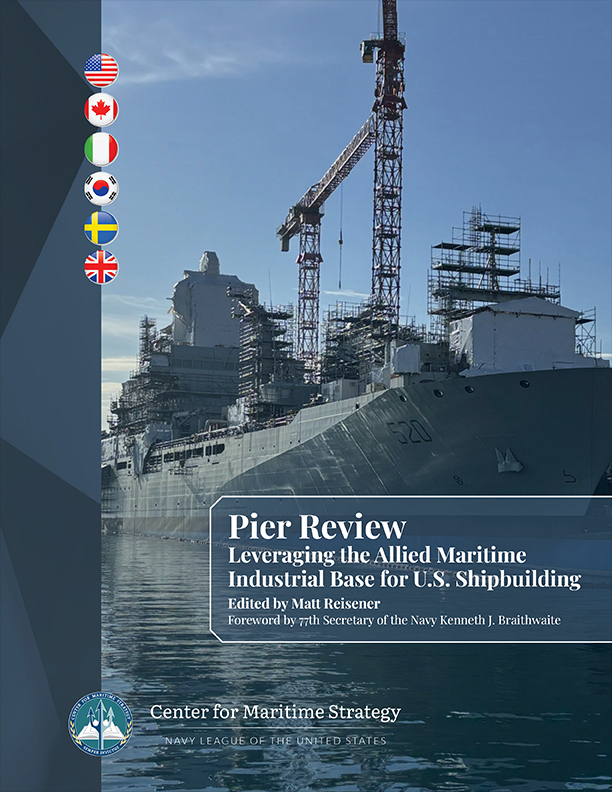
Maritime Industrial Base in Crisis, New CMS Report Finds

By Matt Reisener 

America’s maritime industrial base (MIB) is in crisis. Decades of deindustrialization, inconsistent policy support, labor attrition and increasingly globalized supply chains have left the United States struggling to produce ships on time and on budget, all while strategic competition at sea intensifies. America’s MIB is unable to support the needs of its Navy, compete with rising naval and shipbuilding powers such as China, or reliably contribute to the protection of America’s most vital national interests in the decades to come.  

However, many of the United States’ maritime allies are experiencing similar challenges to their domestic shipbuilding industries and have adopted creative approaches to solving them. The United States must utilize the experience, knowledge and resources of its allies to develop the best strategy possible for building a stronger, more resilient MIB.  

Accordingly, the Center for Maritime Strategy conducted a study of America’s allied maritime industrial base to examine how five American allies (South Korea, Italy, Canada, Sweden and the United Kingdom) build commercial and naval ships, how they support their shipbuilding industries and what lessons America can learn from its allies about how to revitalize its MIB.  

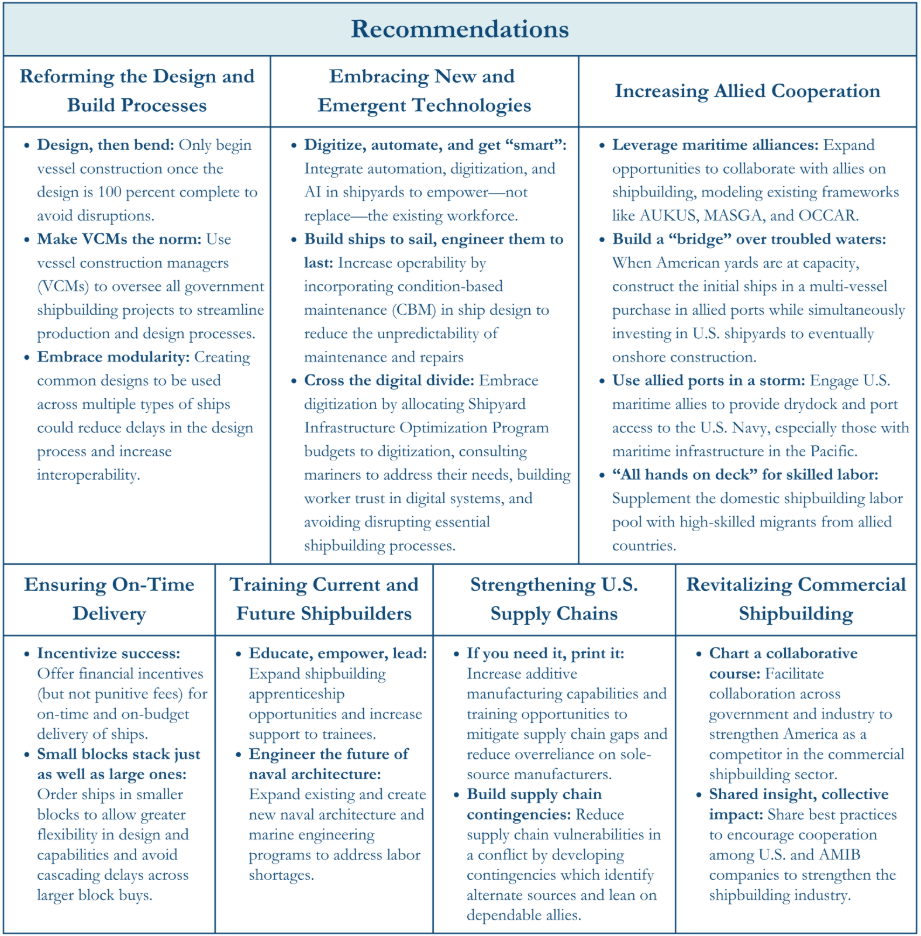
Each country faces similar shipbuilding challenges to America but has taken a different approach to addressing them. Although South Korea and Italy have successfully maintained strong commercial and naval shipbuilding sectors, Canada and the United Kingdom have largely allowed their commercial sectors to atrophy while primarily focusing on warship construction, while Sweden has seen both sectors significantly diminish and maintains only marginal naval shipbuilding capabilities. Many of America’s allies have successfully maintained strong MIBs by streamlining the process for designing and building ships. Among the countries studied, the most successful nations at sustaining strong commercial and naval shipbuilding industries have found ways to minimize late-stage design changes, build a greater variety of ships based on a common design and establish a shipbuilding culture which emphasizes delivering ships on time and under budget.  

Similarly, the study illustrates how government investments in their MIBs can set their shipbuilding industries up for success, including by training the next generation of skilled tradespeople and supporting greater supply chain resilience. America’s most successful shipbuilding allies have also heavily invested in integrating new technology into their shipyards, fully embracing automation, digitization and artificial intelligence to support their work — often with strong government support for these efforts. 

America can build a stronger, more capable MIB by partnering with and learning from its allies. Accordingly, this study provides recommendations for how America can apply these insights to support its MIB while embracing greater multilateral maritime cooperation.   

CMS and speakers from the allied nations in the report will host a panel discussion on the new report on Tuesday, April 21 from 3:30-4:30 p.m. in the Cherry Blossom Ballroom.  

Read the full report here.


Q&A: Fincantieri Marine Group CEO George Moutafis

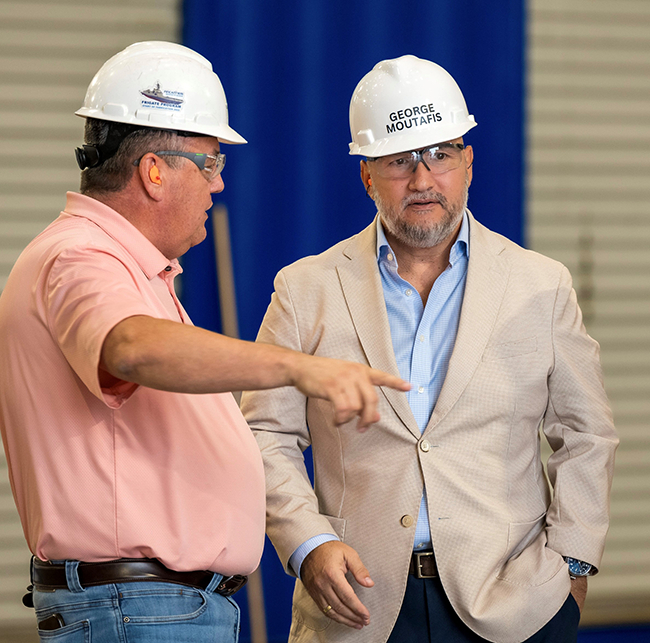
Fincantieri Marine Group CEO George Moutafis, right, tours company facilities. (CREDIT: Fincantieri Marine Group)

In February 2026, Fincantieri Marine Group (Booth 1223) issued the following release: 

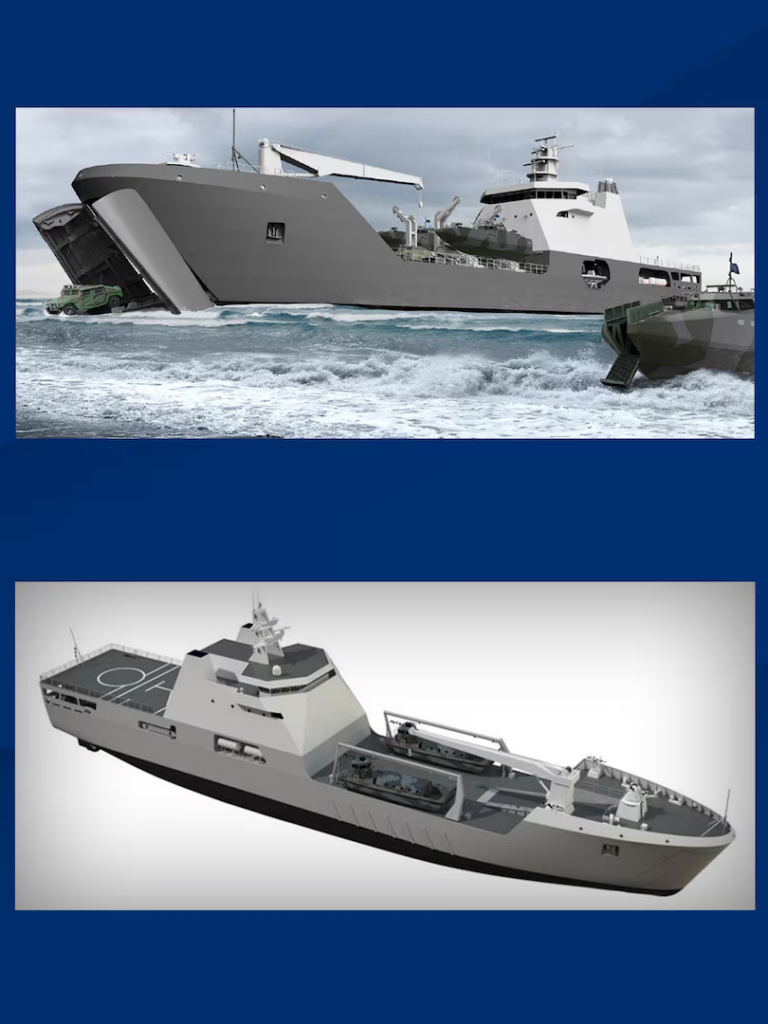
“As you may have seen in NAVSEA’s press release, the U.S. Navy tapped Fincantieri to build four of the first wave of Medium Landing Ships (LSMs) for the Marine Corps. Our $1B investment over the last 18 years to create concurrent production lines across our Wisconsin system of shipyards has positioned us to be a prime player in the American shipbuilding renaissance. This announcement represents a good start of follow-on workload, part of the framework agreed with the Navy to ensure stability following the announcement in November. Details are still being worked out between us and the Navy, and we will communicate any developments, as soon as they solidify. Our intent is to quickly build as many vessels as the Navy will trust us with, in the LSM class and other classes that our armed forces require, to contribute to our nation’s needs.” 

Fincantieri Marine Group CEO George Moutafis later discussed the LSM program’s vessel construction management (VCM) concept with Senior Editor Richard R. Burgess. 

The Vessel Construction Management concept proved successful with Philly Shipyards and its National Security Multi-Mission Vessel (NSMV) program. What advantages and disadvantages do you see with the VCM concept? 

MOUTAFIS: Advantages: I trust our Navy wants to see whether this mechanism can deliver quality vessels fast, by streamlining oversight and creating unity of effort. Such benefits can be achieved if the concept is applied in its intended form: 

A key aspect is to empower the VCM to make decisions on construction, favoring schedule, without compromising quality and without seeking constant guidance or approval from the Navy. When combined with a complete and final design and a commercial-type relationship between the VCM and shipbuilders, this can be truly powerful and harness efficiency in decision-making and speed. 

So, overall, this concept is aimed at simplifying things. From that vantage point, this approach aligns perfectly with our goal of fast serial production of naval vessels, and we are ready to continue our partnership with the Navy and help them test this concept.   

Disadvantages: More than disadvantages, it will be key for all parties involved (the Navy, the VCM, the shipbuilder(s) to embrace the concept, draw the relevant lines and collectively ensure we do not fall into mishaps of the past that might jeopardize what this concept is trying to achieve. 

 The U.S. Navy has issued a request for proposal for a vessel construction manager to oversee the acquisition of the new Medium Landing Ship. This strategy is designed to maximize commercial practices to accelerate delivery, improve cost discipline, and expand the U.S. shipbuilding industrial base, with a contract award anticipated for mid-2026. (CREDIT: Naval Sea Systems Command

With the VCM chosen as the LSM program management concept, what changes will Marinette have to institute to accommodate the concept? 

MOUTAFIS: We are ready. In Wisconsin we have a system of yards where we have executed successfully programs for our Navy, for our Coast Guard, but also for commercial customers, under a variety of contractual setups.  

We will wait to see the details of how the Navy will position itself towards the program and how the VCM will seek to exercise oversight and work with us. We are ready to adjust to whatever those requirements are. 

At first glance, an oversight and collaboration similar to the one witnessed during the NSMV program and a “build-to-print” design, for now, appear to alleviate some demands in terms of administration and engineering, allowing us to swiftly get into what we do best: swift serial construction … but it all remains to be seen.  

What adjustments, if any, will be needed for your workforce as you shift from LCS production to the LSM? 

MOUTAFIS: Using a “build-to-print” approach allows construction to happen quicker. Plus, it minimizes change and prevents extensive and time-consuming design iterations.   

We will need to review all the technical details, but we do not foresee major adjustments to workforce. Our system-of-yards configuration ensures agility in the workforce, rendering them able to jump from Navy standards to commercial or ABS standards.  

And with the right level of sustained demand signal, we will be able to improve efficiency and speed, which will be a win for all parties. Our system of yards can accommodate multiple parallel lines, almost concurrently. 

How is Marinette fairing with the nationwide shortage of skilled shipyard workers? 

MOUTAFIS: No doubt, shipbuilders and the related trades remain in high demand. We have expanded our recruiting efforts over the previous few years, and we are blessed to say that our efforts worked. Last year alone we hired nearly 800 employees and improved our retention by 50%.   

Our Wisconsin operations saw positive feedback on several new initiatives over the previous 18 months, aimed at stabilizing the workforce. Efforts like cash bonuses to incentivize employee retention and tax-free subsidized childcare had a positive effect on our employees and our operations. 

In years past Marinette had difficulty in retention of shipyard workers because of housing shortages in the region. Has that situation been alleviated to any degree? 

MOUTAFIS: Yes, there has been a concerted effort by the local communities and developers to expand the number of local housing options that closely align to our growing workforce and their families. We believe this is less of an issue given the development and community support over the last couple of years in Northeast Wisconsin.       

Is Marinette continuing with cooperative relationships with community colleges for workforce development? What is your assessment of the cooperation?  

MOUTAFIS: Yes, we are continuing and seeking to expand our network of such collaborations. We have a continuously growing relationship with Northeast Wisconsin Technical College to not only reinforce the need to up-skill current employees, but also to introduce new technologies and digital tools to attract the shipbuilders of the next generation.  

Imagine a not-so-distant future replete with examples of shipyard welders leveraging cobots (collaborative robots) to weld in places where it’s difficult for humans to easily work. That is the future of shipbuilding and why we’re equipping our employees with digital tools like exoskeletons for demanding and repetitive tasks and augmented and virtual reality that allows workers on the deckplates to communicate challenges directly to the engineering team using a wearable digital device.    


U.S. Coast Guard Cutter Midgett Rescues Family Missing for 7 Days in Micronesia 

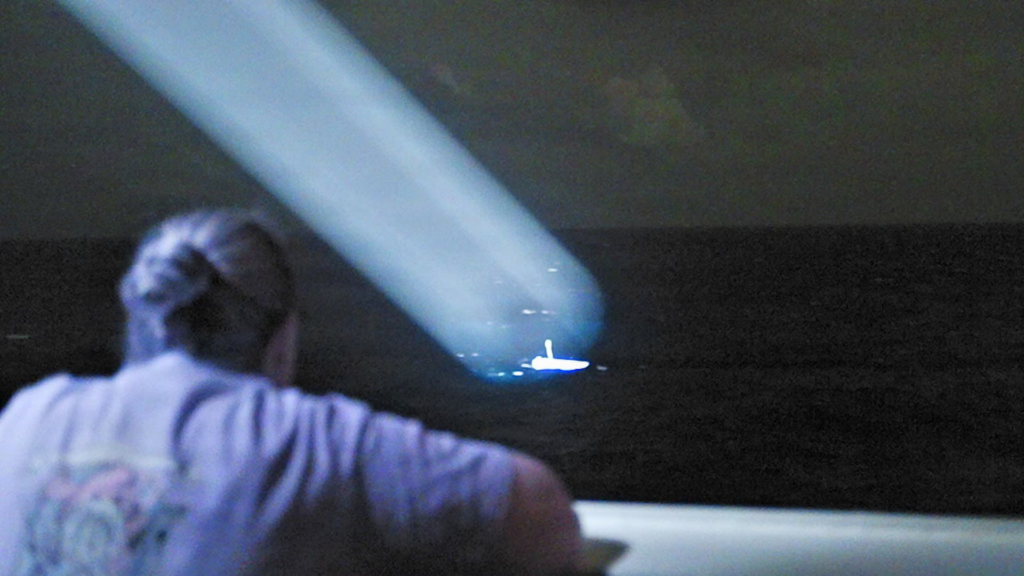
U.S. Coast Guard Lt. Cmdr. Stephanie Jocis, operations officer aboard Legend-class cutter USCGC Midgett (WMSL 757), observes a 23-foot single-outboard skiff vessel, carrying three members of a missing family in the waters of Chuuk State, Federated States of Micronesia, in Midgett’s search light during the early hours of April 6, 2026. The crew of Midgett rescued the family after the vessel went missing on March 30 in the waters of Chuuk State. U.S. Coast Guard missions in the Indo-Pacific focus on issues directly supporting and advancing our regional partners’ efforts to protect fish stocks and ensure the safety of life at sea, ensuring a secure and prosperous Indo-Pacific. (U.S. Coast Guard photo by Seaman Lauren Taber) 

From U.S. Coast Guard Forces Micronesia, April 7, 2026 

SANTA RITA, Guam — A family of three was returned to Chuuk State, part of the Federated States of Micronesia, following search and rescue operations conducted by the Legend-class cutter USCGC Midgett (WMSL 757) crew on April 6, 2026. 

The Midgett crew located the missing family after receiving a report on Easter Sunday from authorities in the Federated States of Micronesia and the U.S. Embassy that the vessel was overdue. 

“Our U.S. Coast Guard colleagues’ swift and courageous actions in this successful search and rescue mission not only reflect the highest standards of professionalism and humanity but also reinforce the deep and enduring partnership between the United States and the Federated States of Micronesia,” said Jennifer Johnson, U.S. Ambassador to the Federated States of Micronesia. “This mission exemplifies the spirit of cooperation and mutual support at the heart of the Compact of Free Association, underscoring how our close relations translate into real, life-saving outcomes for our people.” 

At night, the crew of Midgett visually located the 23-foot single-outboard skiff carrying the missing family, two men and one woman, in the waters off the coast of Chuuk State. The family departed Fananu Island on March 30 for the short passage to Murillo Island, but never arrived due to a failure of their single outboard engine. At the height of search planning, the predicted search area exceeded 14,000 square nautical miles in rough seas with waves reaching 10 feet. 

All three survivors were rescued and uninjured. They were then safely delivered to Weno in Chuuk State for further transport to Fananu Island. 

“National Security Cutter crews spend most of their time executing maritime law enforcement missions, often with our international partners,” said Capt. Brian Whisler, commanding officer of Midgett. “SAR cases like this one are not routine for our platform. Our bridge watchstanders spotted the small skiff in rough seas just after midnight, and that kind of situational awareness does not happen by accident. It is what this crew trains for, and I could not be prouder of how they performed.” 

During the SAR operation, watchstanders from the U.S. Coast Guard Joint Rescue Sub-Center Guam at U.S. Coast Guard Forces Micronesia/Sector Guam developed the search patterns and coordinated with U.S. Coast Guard District Oceania and Air Station Barbers Point personnel to launch an HC-130 Hercules airplane and crew from Hawai’i to support the search and directed the launch of the USCGC Frederick Hatch (WPC 1143) crew from Guam. The Midgett crew, already conducting a Western Pacific patrol, diverted following a bilateral maritime law enforcement boarding with two embarked officers from the FSM in their exclusive economic zone, approximately 200 nautical miles south of Fananu Island. 

“This rescue reflects the strategic value of maintaining a capable surface presence across the region’s vast maritime expanse,” said Lt. Cmdr. Derek Wallin, the U.S. Coast Guard search and rescue mission coordinator. “Without the Midgett’s proximity, coordinating a search across more than 14,000 square nautical miles of open ocean would have required significantly more time and resources. Time the three missing people may not have had.” 

Throughout its current Indo-Pacific region patrol, Midgett’s crew is scheduled to engage with regional partners and participate in joint operations to enhance maritime safety and security. While deployed to the region, Midgett is assigned to Destroyer Squadron 15, the Navy’s largest DESRON and the U.S. 7th Fleet’s principal surface force. DESRON 15 regularly assumes tactical control of surface units operating in the area. 

U.S. 7th Fleet, the Navy’s largest forward-deployed numbered fleet, routinely interacts and operates with allies and partners in preserving a free and open Indo-Pacific. 


U.S. Coast Guard, NOAA partner to restore tsunami warning capability on remote FSM atoll during 29-day Operation Rematau patrol period 

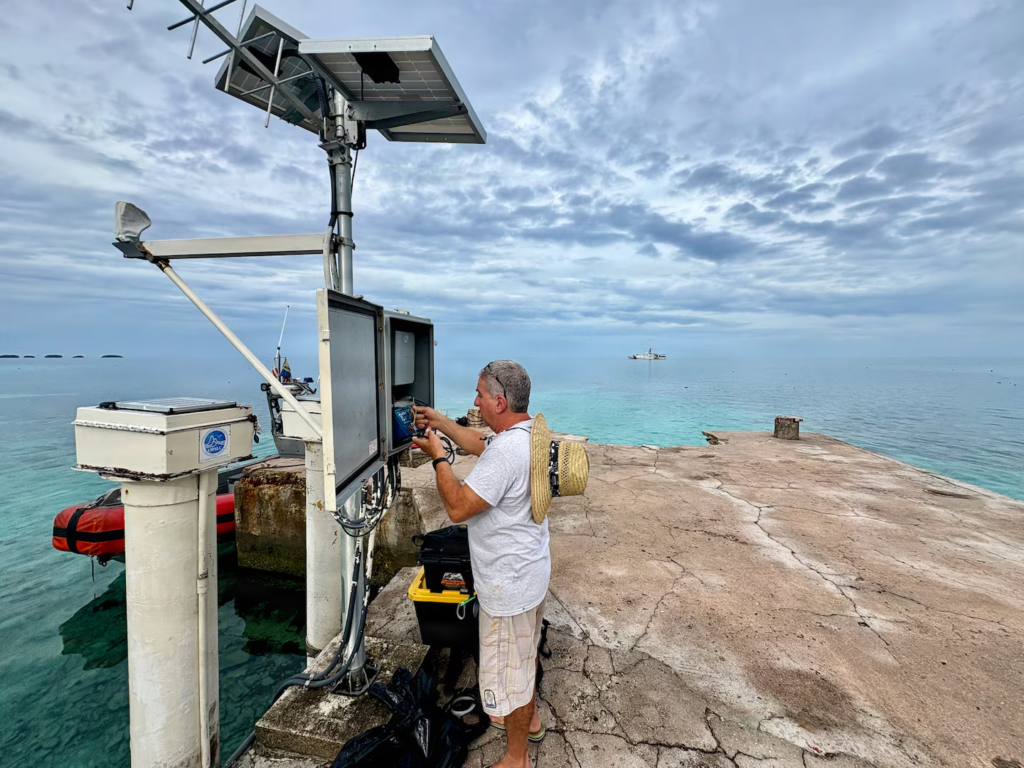
The crew of USCGC Oliver Henry (WPC 1140) supports a University of Hawai’i Sea Level Center technician to upgrade a regional NOAA weather monitoring station on Kapingamarangi Atoll, Federated States of Micronesia, on March 20, 2026, in conjunction with supporting a supply delivery. Oliver Henry is the first Fast Response Cutter to make the transit. USCGC Oliver Henry (WPC 1140) returned to Guam on March 29, 2026, closing out a 29-day patrol period that restored a critical tsunami early warning station to a remote Pacific atoll, delivered humanitarian supplies to two island communities, and enforced fisheries laws across more than 4,000 nautical miles. (U.S. Coast Guard photo) 

U.S. Coast Guard Forces Micronesia, April 6, 2026 

SANTA RITA, Guam — The crew of the USCGC Oliver Henry (WPC 1140) returned to Guam on March 29, closing out a 29-day patrol period that restored a critical tsunami early warning station on a remote Pacific atoll, delivered humanitarian supplies to two island communities, and enforced fisheries laws across more than 4,000 nautical miles. 

The patrol under Operation Rematau covered U.S. waters in the Commonwealth of the Northern Mariana Islands, Guam, and the Federated States of Micronesia. 

“The Coast Guard’s credibility in this part of the Pacific is built one port call, one boarding, one supply delivery at a time. This patrol, from the fisheries enforcement work in FSM’s EEZ to getting that NOAA technician to Kapingamarangi, is exactly how we honor the commitments the United States made to the people in this region. I’m proud of how this team delivered on that responsibility,” said Lt. Ray Cerrato, commanding officer of USCGC Oliver Henry. 

The mission’s most consequential stop came at Kapingamarangi Atoll, one of FSM’s most isolated communities. The Oliver Henry crew transported a University of Hawai’i Sea Level Center technician to the atoll to upgrade a regional weather monitoring station, the first such upgrade in 12 years. Supported by the U.S. Embassy in the FSM and the National Oceanic and Atmospheric Administration, the mission restored the station’s capacity to support tsunami early-warning monitoring across the Western Pacific. 

The station’s importance came into sharp focus days after Oliver Henry returned to Guam. On April 2, a magnitude 7.4 earthquake struck in the Molucca Sea, prompting the Pacific Tsunami Warning Center to issue a threat forecast for coastal communities across the Western Pacific, including Guam, the CNMI, Palau, and Yap. The Kapingamarangi gauge was online and transmitting when the event occurred, ready to contribute observed sea level data to the warning center’s analysis. 

The earthquake’s distance meant tsunami generation was minimal and not detectable at the Kapingamarangi station, but the network it supports held. The PTWC team confirmed the station is one of a small number of sensors covering that stretch of the Western Pacific and that its restoration directly maintains the readiness network the warning center depends on. 

The crew conducted three fisheries enforcement boardings of foreign-flagged vessels, two Western and Central Pacific Fisheries Commission inspections on the high seas, and one enhanced bilateral boarding of a vessel under the FSM’s jurisdiction in their EEZ, directly advancing accountability under local and international laws in a region where illegal fishing is estimated to cost Pacific nations billions annually. 

At Kuttu and Kapingamarangi, the crew delivered 3,000 pounds of humanitarian supplies to residents with limited access to outside goods. The crew also provided Chuuk State Government officials with high-quality imagery documenting the condition of a cargo vessel that grounded on the reef outside of Kuttu Island in the Mortlock Islands in 1998 and has been deteriorating since, supporting local government response efforts. 

The patrol expanded the Coast Guard’s operational reach for future missions. The crew charted previously unrecorded reefs within Greenwich Pass at Kapingamarangi, establishing a navigable route into the atoll’s lagoon for future operations. The Oliver Henry crew also transported Marine Safety Unit Saipan personnel to Tinian and Rota for inspections of port facilities, streamlining logistics, and ensuring the safe flow of goods throughout the CNMI. 

During the 395 operational hours underway, the crew improved readiness by qualifying members in roles ranging from underway officer of the deck to engineering officer of the watch while also honoring nautical traditions with one member earning their permanent cutterman designation and six shellback designations during the patrol’s equatorial crossing. They also completed nearly two dozen engineering, navigation, and seamanship training drills, and confirmed the cutter’s weapons systems remain fully mission-capable during a live-fire exercise. 

Operation Rematau is the U.S. Coast Guard’s sustained operational presence across the Freely Associated States of the Pacific, the Federated States of Micronesia, the Republic of the Marshall Islands, and the Republic of Palau. The operation reflects U.S. commitments under the Compacts of Free Association and advances a secure, open, and prosperous Pacific.