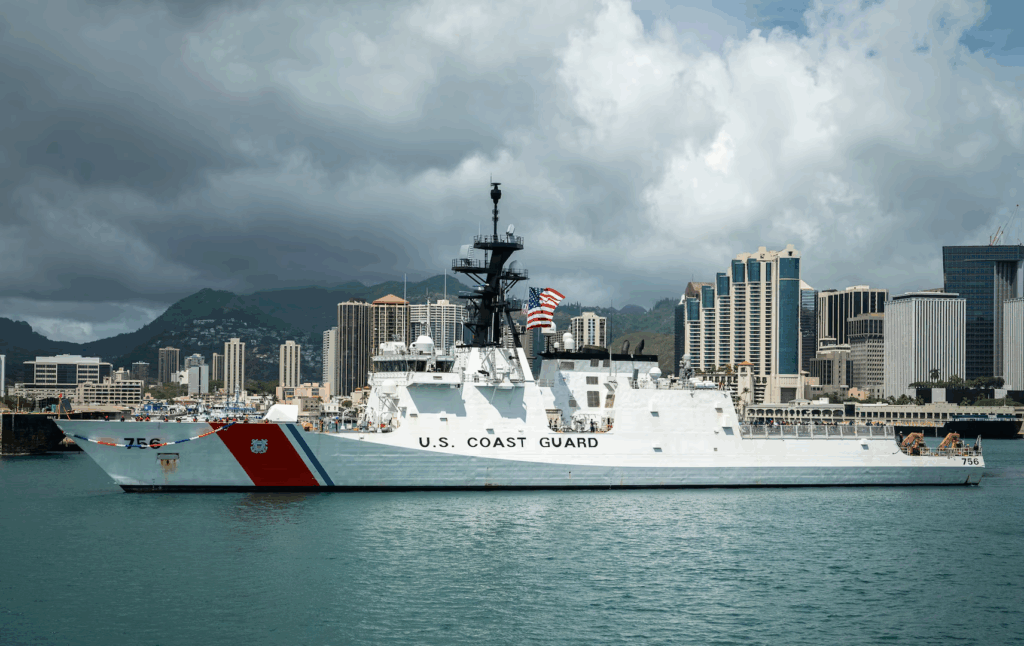
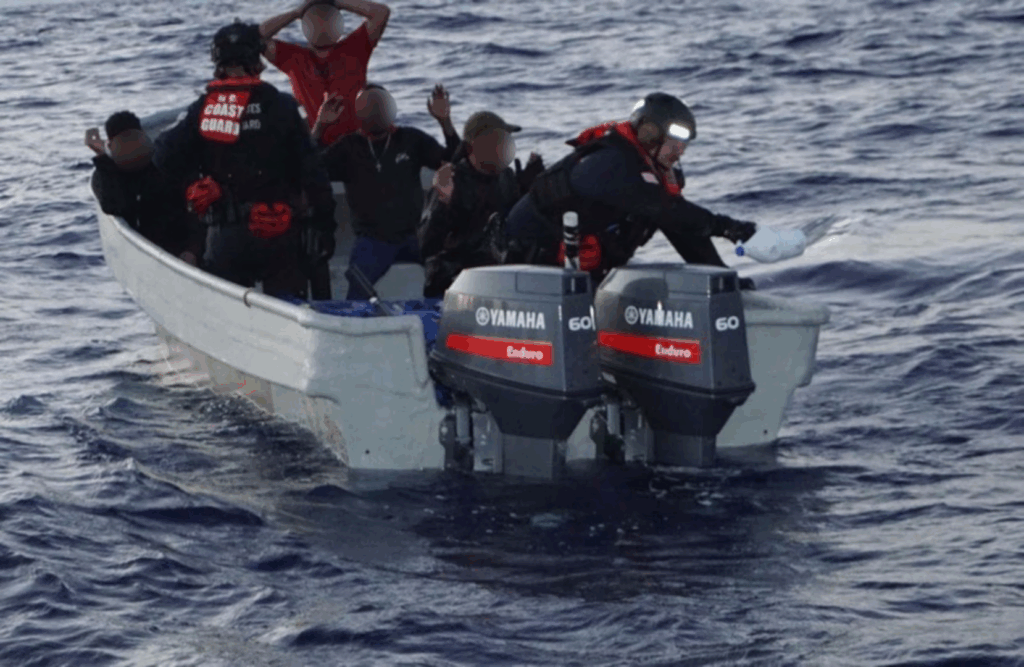
U.S. Coast Guard Cutter Stratton Commences Months-Long Indo-Pacific Patrol 
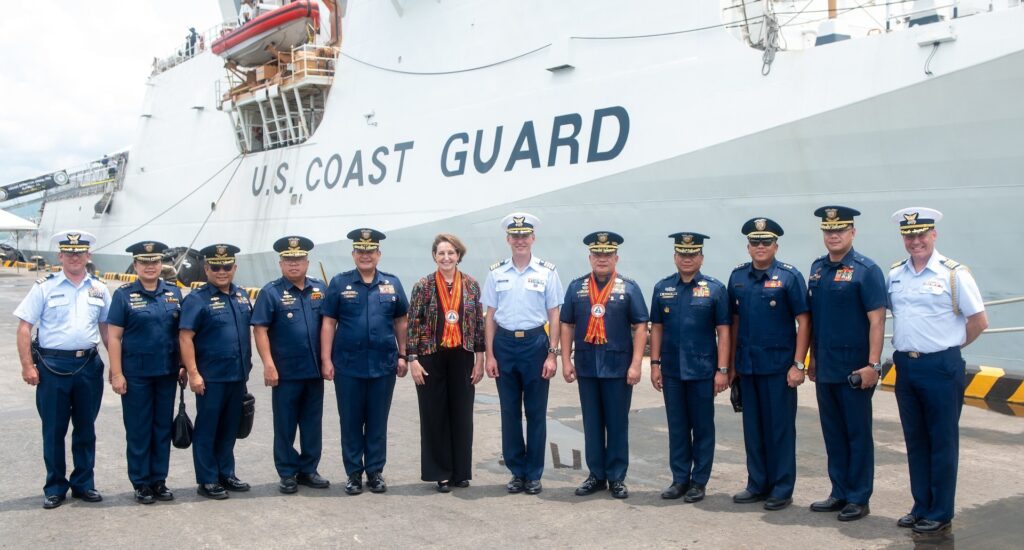
The Legend-class USCGC Stratton (WMSL 752) (background) sails alongside a Philippine Coast Guard vessel as Stratton arrives in Puerto Princesa, Philippines, May 16, 2025. (U.S. Coast Guard photo by Petty Officer 3rd Class William Kirk) 

From U.S. Coast Guard Pacific Area, May 24, 2025 

PUERTO PRINCESA, Philippines — The U.S. Coast Guard Cutter Stratton (WMSL 752) and its crew departed Puerto Princesa, Philippines, Monday, after in-port engagements and visits with the Philippine Coast Guard (PCG), the U.S. Ambassador to the Republic of the Philippines MaryKay Carlson, U.S. embassy staff, and PCG District Palawan senior leadership. 
 
Stratton’s visit to Puerto Princesa marked the first international port call of their months-long deployment to the Indo-Pacific region. 
 
Following their departure, Stratton’s crew conducted a bilateral Maritime Cooperative Activity (MCA) with the Armed Forces of the Philippines and the PCG within the Philippines’ exclusive economic zone. The MCA included exercises in maritime domain awareness, division tactics, maneuvering, and visit, board, search and seizure procedures. 
 
These engagements demonstrate the U.S. commitment to maritime governance that supports security, freedom and prosperity in the region. 
 
The U.S. Coast Guard serves as a unique instrument of national power, bridging defense, diplomacy and law enforcement to further national objectives and mutual interests with allies and partners like the Philippine Coast Guard. 
 
During the visit, Stratton’s commanding officer, Capt. Brian Krautler, welcomed Amb. Carlson, PCG Commandant Adm. Ronnie Gil Gavan, and senior PCG leaders aboard Stratton, highlighting U.S. Coast Guard interoperability with allies. 
 
“Our alliance with the Philippine Coast Guard has cultivated a close, collaborative maritime partnership—this is Stratton’s second deployment to the Philippines during my two years aboard as commanding officer,” Krautler said. “Our enduring partnership enables combined effects and cooperation across a broad spectrum of engagements and operations. Stratton’s deployment to the Indo-Pacific will further strengthen our relationships with allied coast guards and services throughout the region.” 
 
The U.S. Coast Guard works closely with regional allies to deliver a broad range of capabilities in support of a prosperous and secure Indo-Pacific. Multilateral operations like the at-sea MCA and in-port engagements enhance cooperation, improve interoperability and strengthen readiness. 
 
While moored, Krautler and Stratton’s leaders also met with the WESTCOM Commander PCG District Palawan for a pre-sail planning meeting to discuss bilateral search and rescue exercises (SAREX) to enhance cooperation. At-sea operations and exercises with the Philippine Coast Guard will strengthen the ability to execute coordinated maritime operations and enhance overall mission readiness.| 
 
The U.S. Coast Guard’s commitment to a prosperous and secure Indo-Pacific requires working closely with regional allies, allowing the service to improve its logistics flexibility to better deliver a broad range of capabilities. 
 
During the patrol, Stratton is scheduled to engage with regional partners and participate in joint operations aimed at enhancing maritime safety and security. Throughout its Indo-Pacific deployment, Stratton is assigned to Destroyer Squadron (DESRON) 15, the Navy’s largest DESRON and the U.S. 7th Fleet’s principal surface force. DESRON 15 regularly assumes tactical control of surface units operating in the area. 
 
Stratton’s port call to the Philippines marks the cutter’s third visit following stops in 2019 and 2023. Consistent U.S. Coast Guard national security cutter deployments to the region demonstrate the U.S. commitment to strong maritime governance that supports security, freedom and prosperity in the Western Pacific. 
 
Commissioned in 2012, Stratton is one of ten Legend-class national security cutters and one of four homeported in Alameda, California. National security cutters are 418 feet long, 54 feet wide and have a 4,600 long-ton displacement with a top speed of 28 knots, a range of 12,000 nautical miles and can hold a crew of up to 170. National security cutters routinely conduct operations throughout the Pacific, where their combination of range, speed and ability to operate in extreme weather provides mission flexibility. 
 
The namesake of U.S. Coast Guard Cutter Stratton is Capt. Dorothy Stratton, who led the service’s all-female reserve force during World War II. Dorothy Stratton was the first female commissioned officer in the Coast Guard and commanded more than 10,000 personnel. The ship’s motto is “We can’t afford not to.” 


U.S. and Philippine Coast Guards Conduct Maritime Cooperative Activity 

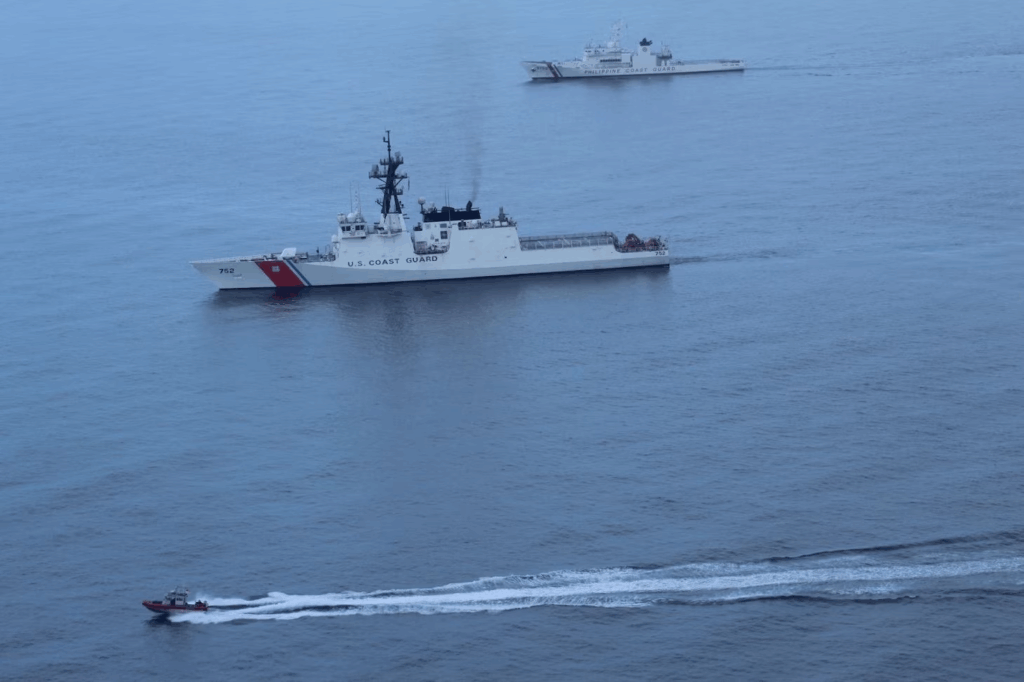
The Legend-class USCGC Stratton (WMSL 752), middle, sails with Philippine Coast Guard Teresa Magbanua-class patrol vessel BRP Melchora Aquino (MRRV-9702), top, in the Sulu Sea, May 20, 2025. Stratton is deployed and assigned to Destroyer Squadron (DESRON) 15, the Navy’s largest DESRON and the U.S. 7th Fleet’s principal surface force. (Courtesy photo)

By Commander, Task Force 71/Destroyer Squadron 15, May 21, 2025 

SULU SEA  –  The Armed Forces of the Philippines, the Philippine Coast Guard, and the United States Coast Guard (USCG), demonstrating a collective commitment to strengthen regional and international cooperation in support of a free and open Indo-Pacific, conducted a bilateral Maritime Cooperative Activity (MCA) within the Philippines’ Exclusive Economic Zone, May 20. 
 
This iteration builds upon previous MCAs and our continuing operations together, which strengthen the interoperability of our defense/armed forces doctrines, tactics, techniques, and procedures. 
 
MCAs are conducted in a manner that is consistent with international law and with due regard to the safety and navigational rights and freedoms of all nations. 
 
Participating units included the Legend-class cutter USCGC Stratton (WMSL-752) and a P-8A Poseidon maritime patrol and reconnaissance aircraft from the U.S. Navy, as well as the Philippine Navy’s Gregorio del Pilar-class patrol ship BRP Ramon Alcaraz (PS16); Acero-class patrol gunboats BRP Gener Tinangag (PG903) and BRP Domingo Deluana (PG905); an AW109 naval helicopter; the Philippine Air Force’s Super Tucano and Sokol helicopters; and the Philippine Coast Guard’s Teresa Magbanua-class patrol vessel BRP Melchora Aquino (MRRV 9702). 
 
“Maritime Cooperative Activities help us continue to build strong military-to-military ties with our Philippine navy allies,” said Vice Adm. Fred Kacher, commander, U.S. 7th Fleet. “With each iteration, these operations further advance our collective efforts to preserve regional stability in this critical part of the world.” 
 
This iteration of the MCA included exercises in maritime domain awareness, division tactics, maneuvering, and Visit, Board, Search and Seizure. 
 
“The U.S. Coast Guard has a significant presence in the Indo-Pacific region,” said Capt. Brian Krautler, Stratton’s commanding officer. “On our Western Pacific deployments, we frequently engage with partner nations through professional exchanges and capacity building, as shown with this operation. This is an opportunity to reinforce vital links with our counterparts who mutually value the preservation of a free, secure and open maritime environment.” 
 
The U.S., along with our allies and partners, upholds the right to freedom of navigation and overflight and other internationally lawful uses of the sea related to those freedoms. 
 
USCGC Stratton is underway in the U.S. 7th Fleet area of operations in support of a secure and prosperous Indo-Pacific region. 
 
U.S. 7th Fleet is the U.S. Navy’s largest forward-deployed numbered fleet, and routinely interacts and operates with allies and partners in preserving a free and open Indo-Pacific region. 


Noem Delivers USCG Academy Commencement Address, Announces New Coast Guard Leadership

From Headquarters, U.S. Coast Guard, May 21, 2025 

NEW LONDON, Conn. — Secretary of Homeland Security Kristi Noem announced Force Design 2028 (FD2028) Wednesday during the Coast Guard Academy commencement ceremony. 

This initiative provides a blueprint to transform the Coast Guard into a stronger, more ready and capable fighting force. 

Speaking at the ceremony, Noem expressed respect for the Service and committed to advocating for funding support. Noem’s FD2028 executive report outlines a vision for the Coast Guard’s future. 

“Now, more than ever, the American people need a strong and capable Coast Guard,” said Noem. “The Coast Guard must not simply evolve. It must revolutionize how it functions and operates to ensure decisive advantage over adversaries. This requires a fundamental change. Force Design 2028 is the bold blueprint needed to drive urgent action and win.” 

Noem also announced President Donald J. Trump’s nomination of Adm. Kevin E. Lunday to serve as the 28th commandant of the Coast Guard. Lunday will continue serving as acting commandant until confirmed by the U.S. Senate. 

The 28th commandant will lead the Coast Guard through a historic period of change. Under their leadership, we will establish the first Coast Guard service secretary and facilitate the implementation of FD2028. FD2028 will re-shape how the Coast Guard functions and operates to ensure decisive advantage over adversaries. 

“Now is the time for fundamental change,” said Lunday. ”Secretary Noem has said that we must reinvigorate the Coast Guard or risk strategic failure. I am honored to lead our Coast Guard men and women in this historic effort to renew the service for the future.” 

FD2028 outlines several key initiatives and campaign areas: 

  • Establish a service secretary: This initiative establishes a legislatively authorized, secretary of the Coast Guard nominated by the president and confirmed by the Senate. This secretary would report directly to the secretary of homeland security and provide civilian leadership, oversight, accountability and advocacy, with authorities comparable to secretaries of other military services. 

  • People: Recognizing that the workforce is at the core of the Service, FD2028 seeks to grow the Coast Guard’s military workforce by at least 15,000 members by the end of fiscal year 2028 to restore readiness and support a growing fleet and new capabilities. Initiatives include transforming the workforce by aligning with the president’s executive order on “Restoring America’s Fighting Force” and instituting a physical fitness test, modernizing enlisted accessions and investing in recruiting incentives, investing in officer leader growth through various programs, revitalizing the Coast Guard Reserve with a focus on mobilization readiness and streamlining policies and processes for the civilian workforce. 

  • Organizational Design: FD2028 will reform the Coast Guard’s organizational structure to become more effective, enabling a leaner, more agile and strategically focused Headquarters by streamlining processes and eliminating redundancies. Key initiatives include designing the future force to win by embracing strategic planning and establishing a futures development and integration function, creating program executive offices for a systems-focused approach to acquisitions and sustainment, establishing a Deployable Specialized Forces command for improved integration and interoperability, strengthening Coast Guard Cyber Command to address cyber and space threats, transferring operational and service-delivery functions out of Headquarters. 

  • Technology: FD2028 will position the Coast Guard to become a leader in the adoption and use of advanced technology, human-machine teaming and data. Initiatives include creating Coastal Sentinel, a next-generation integrated sensor network leveraging artificial intelligence for unprecedented threat identification, supporting a revitalized U.S. maritime industry by replacing antiquated systems for vessel registration and mariner credentials, supporting workforce growth with a modern human resources information technology system incorporating artificial intelligence, delivering an improved logistics system for conditions-based maintenance, and establishing a rapid response prototype team to quickly identify, adopt and deliver advanced technology capabilities. 

  • Contracting and acquisitions (C&A): This campaign aims to streamline C&A processes to better respond to emerging threats, strengthen industry coordination and prioritize speed and flexibility. The service will reform acquisition practices to deliver needed capabilities—including icebreakers and unmanned systems—while managing risk. Planned changes include establishing a disciplined requirements process, assigning senior acquisition authority to the secretary of the Coast Guard, creating a senior procurement executive role, outsourcing procurement activities for effectiveness and designating single points of accountability to empower program managers.  

FD2028 represents an opportunity at a critical moment in history to transform the Coast Guard. Within 30 days, the commandant will deliver an execution plan, followed by the commencement of a force posture and operational concepts campaign within 150 days, and the first of semiannual updates within 180 days. 

“Force Design 2028 is the Coast Guard’s way forward,” said Lunday. ”Under the leadership of Secretary Noem, we are moving out today to aggressively implement this transformational change.” 

Read the FD 2028 executive report here

The Coast Guard is America’s premier maritime law enforcement agency. It is part of the Department of Homeland Security and, at all times, a military service and part of the joint force defending the nation. For over 234 years, the American people have depended on its missions and the unique value the Coast Guard provides to assure our economic prosperity and national security. With its ships, aircraft, boats and nearly 55,000 military members and civilian employees, every day the Coast Guard: controls the U.S. border and maritime approaches; protects America’s ports and waterways; conducts military operations to defend the Nation; saves lives; enforces federal law; leads in national emergencies; and maintains the flow of maritime commerce to ensure America’s economic prosperity. 

More information about the U.S. Coast Guard can be found at www.uscg.mil. Follow @USCG on X and Instagram, like us on Facebook, subscribe on YouTube and follow LinkedIn — connect with us. 


U.S. Coast Guard Barque Eagle to Visit Los Angeles During Fleet Week 

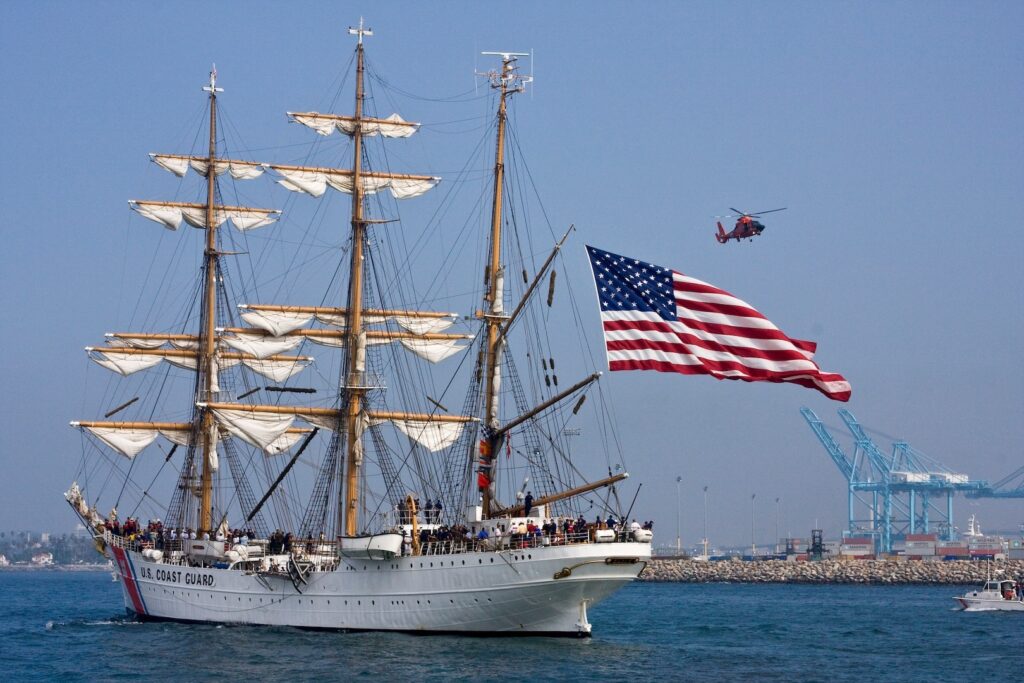
CGC Eagle parades into Los Angeles Harbor under the watchful eye of a CG Dolphin helicopter and 41-foot Utility Boat. (Photo by Michael Brodey, USCG Aux.)

From U.S. Coast Guard Pacific Area, May 19, 2025 

LOS ANGELES — U.S. Coast Guard Barque Eagle (WIX 327) will participate in Los Angeles Fleet Week festivities during Memorial Day weekend, May 23 – 26. 

Eagle will be moored at Berth 50/51 in San Pedro’s Outer Harbor, where it will offer free public tours during the following dates and times: 

  • Friday, May 23 (10 a.m. to 3 p.m.) 

  • Saturday, May 24 (10 a.m. to 3 p.m.) 

  • Sunday, May 25 (10 a.m. to 3 p.m.) 

Visitors will need to join a digital queue and be assigned a time to get in line before their visit. They will then take a shuttle bus to the ship. For more information, go to the Los Angeles Fleet Week’s web page at: https://lafleetweek.com/events_schedule/ships/ 

At 295 feet in length, Eagle is the largest tall ship flying the stars and stripes and the only active square-rigger in United States government service. Constructed in 1936 by the Blohm and Voss Shipyard in Hamburg, Germany, and originally commissioned as the Horst Wessel by the German Navy, Eagle was a war reparation for the United States following World War II. Eagle is a three-masted barque with more than 22,300 square feet of sail and six miles of rigging.  Eagle has served as a classroom at sea to future Coast Guard officers since 1946, offering an at-sea leadership and professional development experience as part of the Coast Guard Academy. 

Los Angeles marks the third port call of Eagle’s 14-week journey along the West Coast. Many Coast Guard Academy practices are steeped in what the Academy mission refers to as “the sea and its lore,” traditions that date back to the golden age of sail, when vessels like Eagle made up the Navy and Revenue Cutter Service, the precursor of the modern United States Coast Guard. Eagle also serves as a goodwill ambassador for the United States and Coast Guard, making calls at foreign ports to foster relations with partner nations. 

For a continuous stream of information about Eagle, including port cities, tour schedules, current events, as well as cadet and active duty crewmember photographs, follow the United States Coast Guard Barque EAGLE Facebook page or on Instagram @barqueeagle.  All U.S. Coast Guard imagery is in the public domain and can be shared widely. 


Coast Guard Cutter Forward Returns Home After Seizing More Than $23M in Cocaine

From U.S. Coast guard Atlantic Area, May 19, 2025 

PORTSMOUTH, VA — The crew of Coast Guard Cutter Forward (WMEC 911) returned to their home port in Portsmouth, Monday, following a 79-day patrol in the Eastern Pacific Ocean.  

Forward’s crew deployed in support of Joint Interagency Task Force – South (JIATF-S) to conduct counter-drug operations while underway in the Eleventh Coast Guard District’s area of responsibility. Through detection, monitoring and interdiction efforts, crew members directly reduced the flow of illicit narcotics into the United States. Forward’s crew worked alongside additional units to include Coast Guard Cutters Kimball (WMSL 756), Thetis (WMEC 910), and the Coast Guard Tactical Law Enforcement Team – South (TACLET-S) to stop suspected drug smuggling while patrolling off the Pacific coast of Central and South America.  

While at sea, the cutter interdicted a vessel engaged in drug-trafficking. After it was detected by a maritime patrol aircraft, a Coast Guard boarding team that included members from TACLET-S launched to pursue the vessel, which led to the apprehension of four suspected drug traffickers. A second small boat crew was launched to locate and recover 37 bales of cocaine that were jettisoned by the suspected traffickers, resulting in the seizure of 2,039 pounds of cocaine worth more than $23 million.  

“Transnational criminal organizations are smart and sophisticated, and our crews meet that challenge head-on,” said Cmdr. Andrew Grantham, commanding officer of Forward. “Throughout this demanding patrol, our team performed with professionalism and determination. However, as a 35-year-old cutter, Forward faces increasing limitations that can impact mission effectiveness – including lost opportunities to interdict known threats. As the Commandant has stated, we continue to feel the strain of sustaining aging assets. Continued investment in new capabilities will ensure we remain ready to counter evolving threats in the maritime domain.”  
 
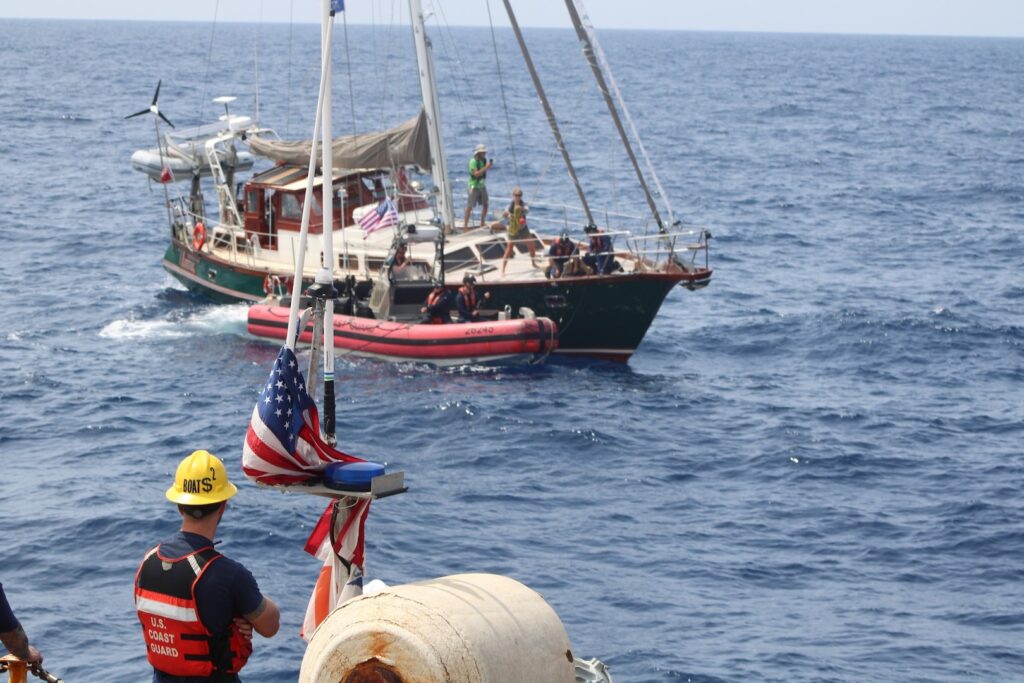
On May 17, the crew of Forward rescued two people and their disabled 60-foot sailboat nearly 90 miles offshore of Charleston, South Carolina. Forward’s crew towed the sailboat to coastal waters, where a Station Charleston boat crew and a commercial salvage vessel took over and safely transported the two sailors and their boat to shore. No injuries were reported. 

During the deployment, Forward’s crew engaged with Ecuadorian navy officials and valued partners in the Galápagos Islands during a port of call on San Cristóbal Island, Ecuador. Forward hosted the delegation aboard the cutter, providing a tour to highlight Coast Guard capabilities in support of U.S., Ecuadorian, and international joint objectives.  

Support from TACLET-S, which is based in Miami, improves mission capability. As part of the Coast Guard’s deployable specialized forces, LEDETs deliver boarding officer teams for high-risk maritime interdiction operations. These units are highly skilled and experienced in counter-drug missions and enforcing U.S. law at sea.   

JIATF-S, in conjunction with partner nations, works to target, detect and monitor illicit drug trafficking within the joint operating area. The organization facilitates the interdiction and apprehension of illicit traffickers to dismantle transnational criminal organizations while reducing the flow of drugs to the public. Once interdiction becomes imminent, the law enforcement phase of the operation begins, and control of the operation shifts to the U.S. Coast Guard throughout the interdiction and apprehension. Interdictions in the Eastern Pacific Ocean are performed by members of the U.S. Coast Guard under the authority and control of the Coast Guard’s Eleventh District, headquartered in Alameda, California.    

Forward is a 270-foot, Famous-class medium endurance cutter. The cutter’s primary missions are counter-drug and migrant interdiction operations, as well as search and rescue in support of U.S. Coast Guard operations throughout the Western Hemisphere. The cutter falls under the command of U.S. Coast Guard Atlantic Area, which is based in Portsmouth, Virginia.    

For information on how to join the U.S. Coast Guard, visit Go Coast Guard.com to learn about active duty and reserve, officer and enlisted opportunities. Information on how to apply to the U.S. Coast Guard Academy can be found here.   

For more, follow us on Facebook, Instagram and X.     


USCGC Calhoun Offloads More than $141M in Illegal Narcotics at Port Everglades 

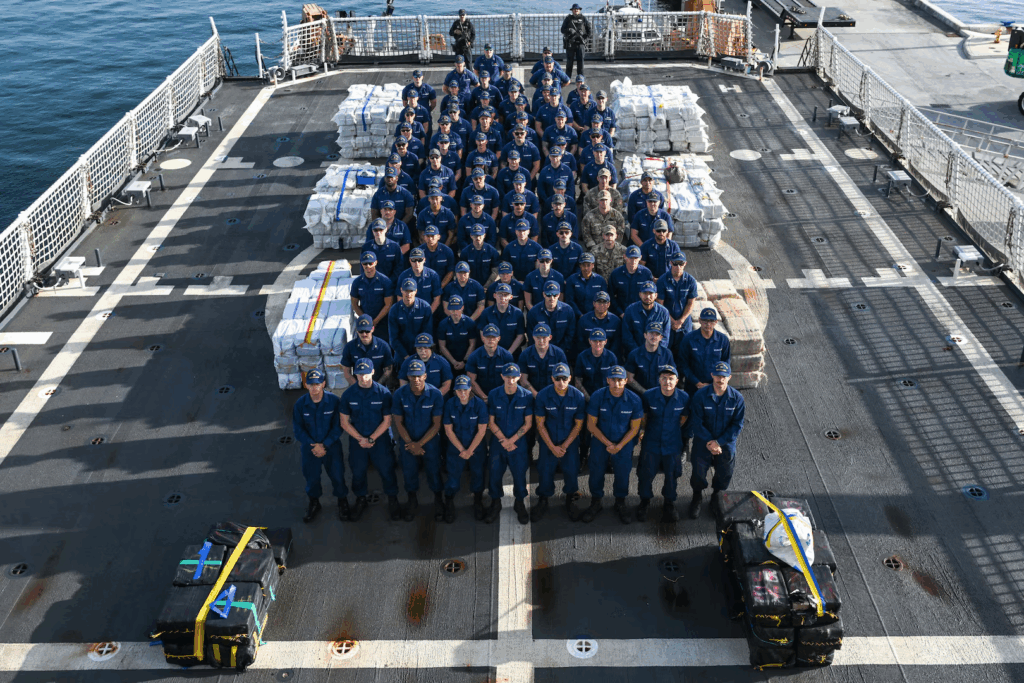
Crew members aboard U.S. Coast Guard Cutter Calhoun (WMSL 759) pose before preparing to offload pallets of illegal narcotics in Port Everglades, May 16, 2025. Calhoun’s crew offloaded more than 19,055 pounds of cocaine and marijuana valued at approximately $140.9 million in Port Everglades, May 16, 2025. (Coast Guard photo by Petty Officer 3rd Class Jessica Walker)

From U.S. Coast Guard 7th District, May 16, 2025 

MIAMI – U.S. Coast Guard Cutter Calhoun’s crew offloaded approximately 19,055 pounds of cocaine and marijuana, worth an estimated $140.9 million, Friday, at Port Everglades.   

The seized contraband was the result of five interdictions in the Atlantic Ocean and Caribbean Sea by interagency partners. The resulting criminal investigations are linked to substantial amounts of transnational criminal organizations and including the foreign terrorist organization, Tren de Aragua.  

On April 12, the Calhoun’s crew, under tactical control of Coast Guard Atlantic Area, detected a suspicious fishing vessel in international waters exhibiting behavior consistent with narcotic trafficking approximately 1,200 miles west of Las Palmas, Canary Islands. The crew interdicted the suspicious vessel, seizing approximately 10,000 pounds of cocaine.  

On May 1, a military patrol aircraft located a suspicious vessel approximately 100 miles off Colombia. A Coast Guard law enforcement detachment deployed on USS Minneapolis Saint Paul interdicted the vessel, seizing approximately 1,500 pounds of cocaine.   

On May 5, a military patrol aircraft located a suspicious vessel approximately 80 miles off Dominican Republic. Calhoun’s crew interdicted the vessel, seizing approximately 825 pounds of cocaine.   

On May 6, Calhoun’s crew interdicted a suspicious vessel approximately 85 miles off Haiti. A law enforcement crew stopped the vessel, seizing approximately 3,135 pounds of cocaine and 14 pounds of marijuana.   

On May 7, a military patrol aircraft located two suspicious vessels approximately 155 miles off Dominican Republic. Calhoun’s crew interdicted both vessels, seizing approximately 3,580 pounds of cocaine.  

“I’m incredibly proud of Calhoun’s role in continuing to disrupt the flow of illicit narcotics,” said Capt. Matthew Hammond, Calhoun’s commanding officer. “The Coast Guard and our partners work tirelessly to deny drug trafficking organizations access to smuggling routes bound for the United States and dismantle transnational criminal activity abroad, which threaten Americans here at home.”  

The following crews also assisted with interdiction operations:  

  • Seventh Coast Guard District watchstanders  

  • U.S. Coast Guard Tactical Law Enforcement Team-South  

Detecting and interdicting illicit drug traffickers on the high seas involves significant interagency and international coordination. Joint Interagency Task Force-South, in Key West, conducts the detection and monitoring of aerial and maritime transit of illegal drugs. Once an interdiction becomes imminent, the law enforcement phase of the operation begins, and control of the operation shifts to the U.S. Coast Guard for the interdiction and apprehension phases. Interdictions in the Caribbean Sea are performed by members of the U.S. Coast Guard under the authority and control of the Seventh Coast Guard District, headquartered in Miami.    

These interdictions relate to Organized Crime Drug Enforcement Task Forces’ Strike Force initiatives and designated investigations. OCDETF identifies, disrupts, and dismantles the highest-level criminal organizations that threaten the United States using a prosecutor-led, intelligence-driven, multi-agency approach. Additional information about the OCDETF program can be found at https://www.justice.gov/OCDETF.    

Calhoun, commissioned in 2024, is the newest 418-foot Legend-class national security cutters homeported in North Charleston, South Carolina. The cutter’s primary missions are counter-drug operations and defense readiness.   

Read more about Calhoun’s April 13 interdiction.  

Read more about USS Minneapolis Saint Paul interdiction.   

For breaking news, follow us on X (formerly Twitter). For additional information, find us on Facebook and follow us on Instagram.    

Make a difference on land, at sea or in the air with the Coast Guard. Visit GoCoastGuard.com to learn more about active duty and reserve, officer and enlisted opportunities. Information on how to apply to the U.S. Coast Guard Academy can be foundhere.    


Coast Guard to Reduce Flag Officer Positions by 25%

By Richard R. Burgess, Senior Editor 

ARLINGTON, Va. — The U.S. Coast Guard has been ordered to reduce the number of admirals by at least 25% before next year, the service announced. 

In a May 25 directive from Acting Commandant Adm. Kevin Lunday, the service announced that the reductions were part of its Force Design 2028 initiative.  

“As part of Force Design 2028, the Secretary of the Department of Homeland Security has determined that there is redundant executive oversight in our force structure which hinders efficient decision making and Service effectiveness,” The opening statement of the announcement said. 

“As a result, and consistent with similar efforts within the Department of Defense, the Secretary has ordered a reduction of no less than 25% of flag officer positions by 1 January 2026,” the announcement said. “The positions to be eliminated and the plan to reorganize the flag corps will be announced in separate correspondence.” 
 

The Coast Guard currently has approximately 45 flag officers. 

The service also has negated the results of its fiscal 2025 promotion board for the rank of rear admiral (lower Half) while folding opportunity in next year’s selection board. 
 

“The Secretary also disapproved the Promotion Year (PY) 2025 rear admiral (lower half) (RDML) selection board report after determining that the guidance to that board did not align with this Administration’s policies,” the announcement said. “The Secretary’s action also supports planning to reorganize the leadership structure. Officers who were considered by the PY25 RDML selection board and who are otherwise eligible, including those previously selected, will be considered by the PY26 RDML selection board that will convene under new guidance.” 


New Systems Pending, but Coast Guard ‘Stretched Thin,’ Lunday Says

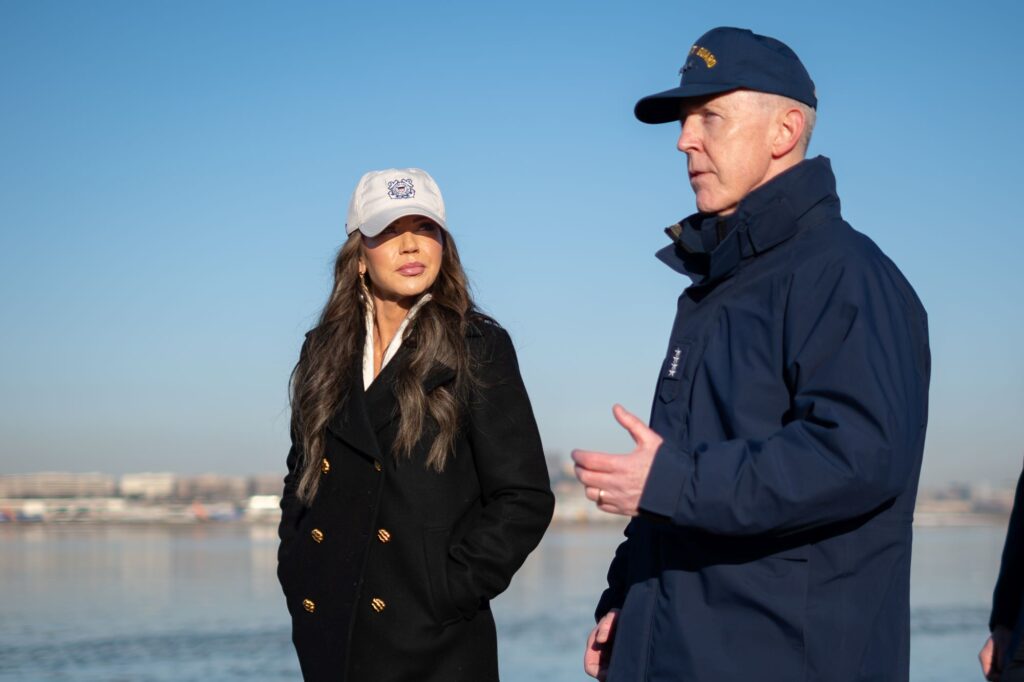
Secretary of Homeland Security Kristi Noem and Admiral Kevin Lunday, acting Commandant of the Coast Guard, shown here discussing response efforts in Washington D.C., January 30, after a helicopter and passenger jet collided. Photo credit: U.S Coast Guard | Petty Officer 1st Class Brandon Giles

Much-needed new ships are on the way for the U.S. Coast Guard, acting Commandant Admiral Kevin Lunday told members of a House Armed Services Committee panel on May 14 as Congress prepares to receive defense budget requests from the new administration.

Lunday noted the service quickly moved resources to the Southern U.S. border in the wake of the presidential election.

“In January of this year, under the leadership of Secretary [Kristi] Noem, I directed our operational commanders to immediately increase Coast Guard presence along the U.S. border and maritime approaches, starting with the southern border where the president has declared a national emergency,” Lunday told members of the committee’s Subcommittee on Homeland Security. “We surged forces, tripling the number of forward-deployed air and surface assets in that area.”

The service also moved to continue operations to control the northern border, including on the Great Lakes, to maritime approaches around Alaska, Hawaii and U.S. territories in the Pacific.

“Tasked with defending the nation’s maritime borders, countering threats like illegal migration and drug trafficking, safeguarding our ports and waterways, responding to maritime disasters, and saving lives, the service is now stretched thin, with significant workforce shortages and aging, underfunded assets and infrastructure nearing collapse,” he said. “The Coast Guard’s current organizational structure and reactive posture are no longer adequate to meet current and emerging challenges.”

Acquisitions

Last month, Lunday debuted a plan called Force Design 2028, aimed at addressing those issues. It will focus on four major areas: People, organization, acquisition and contracting and technology, including an effort to “Develop a high velocity acquisition and contracting system to rapidly deliver the assets the service needs to fulfill its commitment to the American people.”

Some much-needed assets are already in the works, Lunday told members of the panel, with new production milestones achieved.

The service’s top ship acquisition priority is the polar security cutter and Lunday said the first PSC received approval on April 30 for full production by Bollinger Shipyards. Functional design maturity has topped 95 percent, so “they already are construction 10 of the pre-fabrication assembly units, which are the bottom center sections of that new icebreaker,” he said.

Likewise, the service is moving ahead to replace its aging construction tenders and river tenders, which maintain aids to navigation, and some of which have been in service since the 1940s. The DHS has approved the construction of the first eight of the new water commerce cutter being built by Birdon America, with their homeports to be decided later.

New systems are needed in the air as well, Lunday said.

The recent termination of the C-27J missionization program and stalled growth in our HC-130J program place our readiness to conduct various missions in jeopardy, including long range surveillance, disaster response, and border security operations,” he said. “For our rotary wing fleet, it is imperative that we continue and accelerate transition of air stations from the short-range MH-65E to the medium-range MH-60 to ensure sustainability and increase our capability to serve our national priorities.”


USCGC Kimball Returns Home After 84-Day Counter-Drug Patrol in the Eastern Pacific 

U.S. Coast Guard Cutter Kimball (WMSL 756) crew members, Tactical Law Enforcement Team South, U.S. Coast Guard Maritime Safety and Security Team Los Angeles/Long Beach, Navy, Helicopter Interdiction Tactical Squadron Jacksonville all stand at attention during an all hands event during a drug offload in San Diego April 24, 2025. (U.S. Coast Guard photo by Petty Officer 3rd Class Austin Wiley)

From U.S. Coast Guard Pacific Area, May 9, 2025 

HONOLULU — The crew of Coast Guard Cutter Kimball (WMSL 756) returned to their Honolulu home port Monday after an 84-day deployment to the Eastern Pacific Ocean. 
 
While patrolling international waters off the Pacific coasts of Mexico, Central, and South America, Kimball’s crew interdicted five suspected drug smuggling vessels, seizing $191 million worth of cocaine and apprehending 18 suspected drug smugglers. 
 
The drugs were offloaded in San Diego on April 24 by the Kimball crew and multiagency partners. 
 
The Kimball deployed to the region under the tasking of Joint Interagency Task Force – South (JIATF-S) in support of Operation Martillo. 
 
During the deployment, Kimball’s crew conducted counter-drug missions in the Coast Guard’s Eleventh District area of responsibility countering transnational criminal organizations and preventing illegal narcotics from reaching the United States. They worked alongside other Coast Guard units, law enforcement personnel from Tactical Law Enforcement Team South (TACLET SOUTH), contractors operating small Unmanned Aerial Systems (sUAS), Helicopter Interdiction Tactical Squadron (HITRON) crews, Department of Defense assets, and Customs and Border Protection. 
 
Together, these partners supported the Kimball in controlling, securing, and defending the U.S. border and maritime approaches. 
 
“The pride I feel for this crew is immeasurable,” said Capt. Robert Kinsey, commanding officer of Kimball.  “Their professionalism, resilience, and dedication to serving our nation at sea is truly inspiring.  They are mothers, fathers, sons, and daughters who have answered the call to defend the nation as part of the joint fighting force as the pointy end of the spear that protects our shores and saves American lives.  We remain steadfast in our commitment to continually hardening and sustaining enhanced maritime security operations. We will continue to work tirelessly with our partners to disrupt these criminal enterprises and protect our nation.” 
 
These interdictions are part of the U.S. government’s ongoing effort to dismantle transnational criminal organizations and deny them resources to fund violent and illicit operations. 
 
The Kimball’s crew partnered with the Mexican Navy at-sea to promote regional maritime governance and assist in combating the international drug trade. For 54 days, two Mexican naval officers observed U.S. Coast Guard counter-drug operations firsthand, fostering enhanced collaboration between the two nations. 
 
While moored in Amador, Panama, the Kimball’s crew also hosted personnel from Panama’s Servicio Nacional Aeronaval (SENAN) for a subject matter expertise exchange. The event featured discussions and demonstrations of the Kimball’s capabilities, including sUAS drones, cutter small boats, and the embarked HITRON MH-65 Dolphin helicopter. Personnel from U.S. Coast Guard Tactical Law Enforcement Team South showcased their law enforcement kits and highlighted counter-drug boarding methods, furthering international cooperation in addressing maritime security challenges. While in Panama, the Kimball partnered with the USS Chosin (CG-65) to host Secretary of Defense Pete Hegseth, emphasizing DoD and DHS joint presence in the region. 
 
Several units and partners supported the Kimball’s counter-drug operations and interdictions. The U.S. Coast Guard HITRON from Jacksonville, Florida, provided aerial support in the forms of reconnaissance and aerial use of force. The U.S. Coast Guard TACLET SOUTH and U.S. Coast Guard Maritime Safety and Security Team Los Angeles / Long Beach (MSST LA/LB) assisted with surface pursuit and law enforcement boardings. The U.S. Coast Guard Eleventh District provided operational oversight and logistical support, ensuring the execution of mission objectives throughout the deployment. 
 
Along with partner nations, JIATF-S targets, detects, and monitors illicit drug trafficking within the joint operating area. The organization facilitates the interdiction and apprehension of illicit drug traffickers to dismantle transnational criminal organizations while reducing the flow of illegal drugs to the public. Once interdiction is imminent, the operation transitions into its law enforcement phase, with the U.S. Coast Guard assuming control throughout the interdiction and apprehension of the traffickers. 
 
The Kimball is one of two 418-foot, Legend-class national security cutters homeported in Honolulu. The cutter’s primary missions are counter-drug operations and defense readiness. 


Coast Guard Offloads $5.4M in Seized Cocaine Following Interdiction off Puerto Rico 

The crew of the Coast Guard Cutter Joseph Napier offloaded approximately 725 pounds of seized cocaine worth an estimated $5.4 million to Coast Guard Investigative Service and Drug Enforcement Agency Special Agents custody in San Juan, Puerto Rico, May 7, 2025. The interdiction occurred April 28, 2025, in waters north of Aguadilla, Puerto Rico, and is the result of multi-agency efforts in support of the Caribbean Corridor Strike Force. (U.S. Coast Guard photo)

From U.S. Coast Guard 7th District, May 7, 2025 

SAN JUAN, Puerto Rico — The crew of the Coast Guard Cutter Joseph Napier offloaded approximately 725 pounds of seized cocaine worth an estimated $5.4 million to Coast Guard Investigative Service and Drug Enforcement Agency Special Agents custody in San Juan, Wednesday. 
 
The interdiction is the result of multi-agency efforts in support of the Caribbean Corridor Strike Force. The Coast Guard Cutter Joseph Napier crew transferred custody of five suspected smugglers apprehended in this case, Dominican Republic nationals, to the Dominican Republic Navy off Punta Cana, Dominican Republic, Saturday.  

During the night of April 28, 2025, the crew of a Customs and Border Protection Air and Marine Operations multi-role enforcement aircraft detected a suspicious 35-foot go-fast vessel in international waters north of Aguadilla, Puerto Rico. Coast Guard watchstanders in Sector San Juan diverted the cutter Joseph Napier to interdict the suspect vessel. Once on-scene, the cutter Joseph Napier crew launched the cutter’s Over the Horizon boat to carryout out the interdiction. During the pursuit, the suspected smugglers attempted to flee the scene while jettisoning suspected contraband cargo overboard. Shortly thereafter, the cutter boat crew stopped and gained compliance from the suspect vessel. Following the interdiction, cutter Joseph Napier’s crew recovered eight bales, seven of which had been jettisoned overboard, and they apprehended the five persons onboard. The seized contraband tested positive for cocaine.  
 
“This was an excellent case that would not have been possible without the support provided by Customs and Border Protection Caribbean Air and Marine Branch,” said Lt. John M. Groen, Coast Guard Cutter Joseph Napier commanding officer. “Their flight remained on scene for several hours and communicated flawlessly with the pursuit team. I am so incredibly proud of the entire Joseph Napier crew’s outstanding performance. The interdiction highlights Sector San Juan and the Seventh Coast Guard District’s unwavering commitment to combat drug trafficking organizations and secure America’s maritime borders.” 
 
The specific mission of the Caribbean Corridor Strike Force (CCSF) is to identify, disrupt, and dismantle Transnational Criminal Organizations. The CCSF is comprised of agents and officers from the Drug Enforcement Administration, Federal Bureau of Investigation, United States Immigration and Customs Enforcement-Homeland Security Investigations, United States Coast Guard Investigative Service, and United States Marshals Service, and the United States Attorney’s Office for the District of Puerto Rico. 
 
U.S. Coast Guard Cutter Joseph Napier is 154-foot Sentinel-class fast response cutter homeported in San Juan, Puerto Rico.