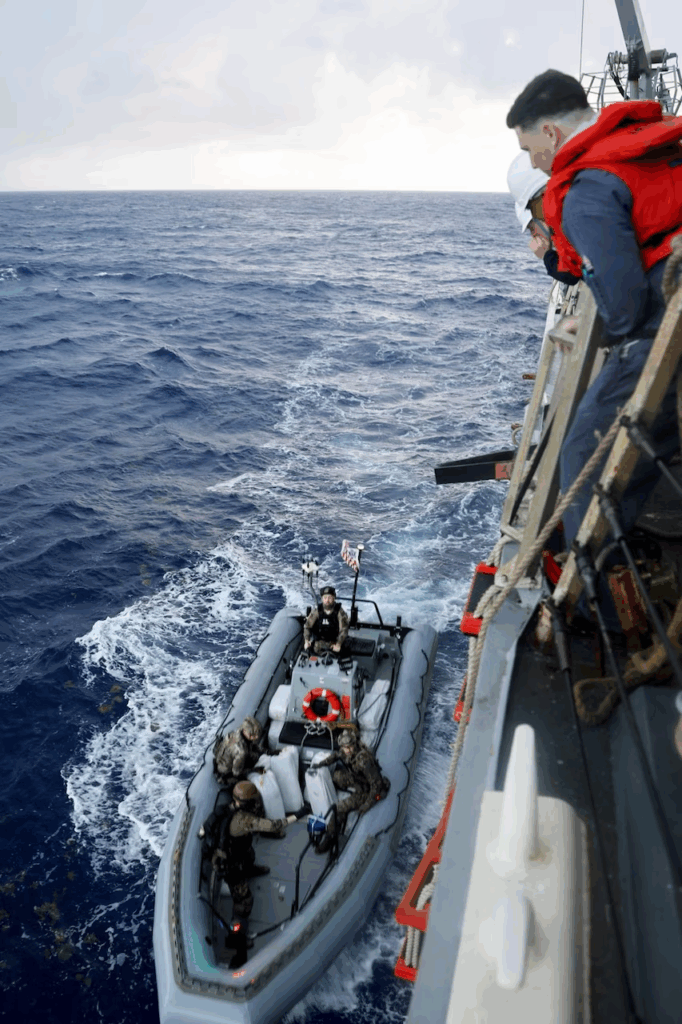
Coast Guard Cutter Valiant Exits Active Duty After 57 Years of Service  
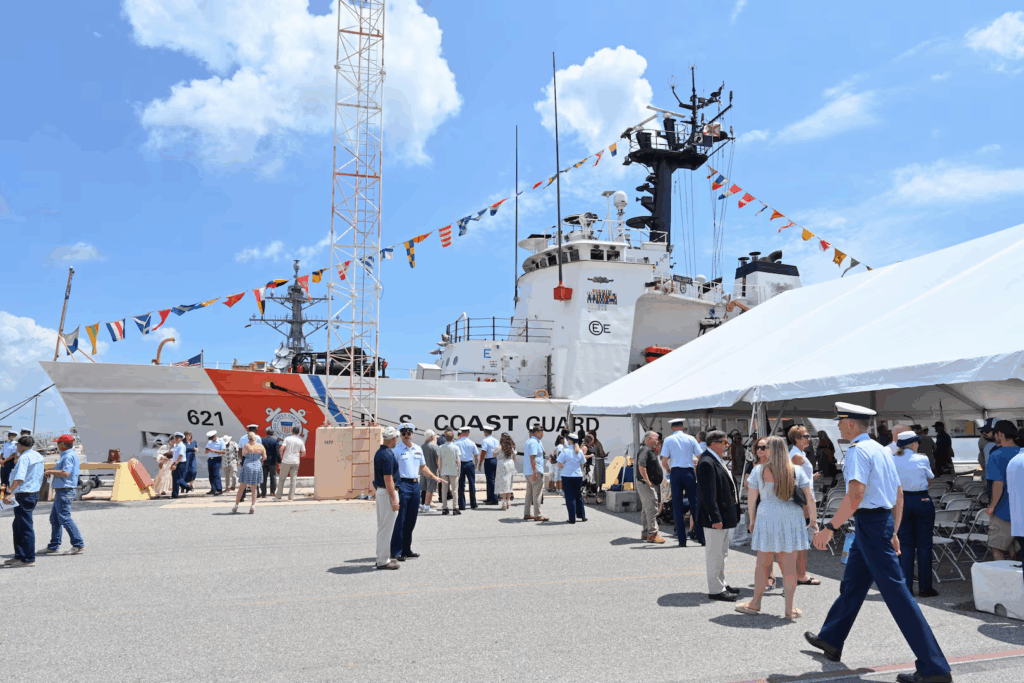
Coast Guard Cutter Valiant (WMEC 621) is moored to the pier at Naval Station Mayport in Jacksonville, Florida, June 17, 2024. The cutter was honored after more than 57 years of service during a heritage recognition ceremony held in front of Coast Guard and cutter leadership, the assembled crew and former crew members, family and friends. (U.S. Coast Guard photo by Petty Officer 2nd Class Brandon Hillard)

From U.S. Coast Guard Atlantic Area, June 17, 2025 

NAVAL STATION MAYPORT, Fla. — The Coast Guard held a heritage recognition ceremony, Tuesday, in Jacksonville to honor the U.S. Coast Guard Cutter Valiant (WMEC 621) and recognize its more than 57 years of exemplary service. 

The ceremony was presided over by Rear Adm. Adam Chamie, assistant commandant for operations integration and response policy, Coast Guard Headquarters in Washington, D.C., and served to celebrate Valiant’s contributions to the Coast Guard and nation in the presence of cutter leadership, current and former crew members, families and friends. 
 
In addition to Chamie, a former commanding officer of Valiant, 2014-2016, the official party included: Cmdr. Matthew Press, commanding officer of Valiant, retired Capt. Timothy Cronin, former commanding officer of Valiant, 2016-2018, Senior Chief Petty Officer Clark Lauer, command senior enlisted leader of Valiant, Lt. Cmdr. Merrill Gutowski, executive officer of Valiant and master of ceremonies, and Chaplain Duke Leon Ann’El, Fraternal Order of Police, former Valiant crew member, 2006-2007. 

The event also marked the ship’s exit from active-duty service for an indeterminate time, placing it in commission, special status. The 210-foot Valiant operated as a Coast Guard Atlantic Area Command asset, based in Portsmouth, Virginia, and was most recently homeported in Mayport. 

Valiant, a multi-mission cutter, was built in Lorain, Ohio by the American Shipbuilding Company and was commissioned, Nov. 3, 1967. The cutter is the 7th of 16 vessels built in the Reliance-class of medium endurance cutters that have operated in the Coast Guard’s fleet. These cutters were designed for search and rescue, law enforcement missions such as counter-drug and alien interdiction, as well as national defense and international engagement. 

Valiant was named after the inspirational trait, which means to act with courage and determination. It is the first Coast Guard cutter to bear its name. 
 
The cutter has been helmed by several notable commanding officers to include, Adm. James Loy, former commandant of the Coast Guard, 1998-2002, and Capt. John G. Witherspoon, the first African American officer to command a medium endurance cutter and for whom the annual John G. Witherspoon Inspirational Leadership Award, which recognizes the Coast Guard officer, active duty and reserve, who best exemplifies the Coast Guard’s Core Values of Honor, Respect and Devotion to Duty, is named. 

Valiant spent its first 24 years in the Coast Guard Eighth District area of responsibility while being homeported in Galveston, Texas. While there, it earned its nickname, “Guardian of the Gulf,” after crews assisted in several high-profile search and rescue cases. 
 
In 1971, Valiant provided assistance after two Venezuelan freighters collided. 

In 1972, the crew of Valiant supported the International Ice Patrol and identified icebergs off the coast of Newfoundland, Canada, locating hazards to navigation in the North Atlantic Ocean. 
 
Later in the decade, the cutter responded to a collision between a tanker and a freighter in 1979. 
 
Valiant played a crucial role in the mass Cuban exodus of 1980 known as the Mariel Boatlift, while working alongside numerous Coast Guard cutters, small boats, aircraft, and U.S. Navy vessels. 
 
In June of 1990, Valiant and other Coast Guard cutters responded to the 853-foot Norwegian tanker Mega Borg after a deadly explosion in the engine room led to the release of oil approximately 60 miles off the coast of Texas. Valiant’s crew persevered through complex logistical problems, mounting an effective firefighting, salvage and pollution cleanup campaign. 
 
Between 1991 and 1994, the cutter was decommissioned for the purpose of undergoing a major maintenance availability at the Coast Guad Yard in Baltimore, Maryland, extending its service operational life through modifications and modernizations. 
 
After Valiant was recommissioned in January of 1994, it was transferred to the Seventh Coast Guard District area of responsibility and relocated to its second home port of Miami Beach for the next 18 years. 
 
During Operations Able Manner and Able Vigil in 1994, the crew of Valiant interdicted over 500 Haitian and Cuban migrants. And the cutter repatriated over 1,900 Haitian migrants from Guantánamo Bay, Cuba to Port-au-Prince, Haiti over the course of 11 passages during this time. 

Valiant served as patrol commander during the 1996 Summer Olympics sailing events in Savannah, Georgia, where the cutter directed over 29 Coast Guard assets to help ensure security for 800 athletes representing 98 different countries. 
 
In 1997, the cutter’s crew helped train over 500 Caribbean Coast Guard members during Operation Tradewinds. Valiant taught personnel from 12 countries in fields such as damage control, engineering and seamanship fundamentals. 
 
In January 1999, a Valiant and Coast Guard law enforcement detachment (LEDET) 406 boarding team interdicted over 10,000 pounds of cocaine from the merchant ship Cannes. 
 
On Nov. 7, 1999, the crew of Valiant discovered a person in the water and another on the sinking hull of a partially submerged vessel. The two were enroute to Antigua and spent over 30 hours before they were rescued. 

A few days later, Valiant’s crew rendezvoused with the HMS Northumberland and an embarked U.S. Coast Guard LEDET aboard the British naval vessel to intercept over 2.5 tons of cocaine aboard the the motor vessel Adriatik. After three days of lifting 110-pound bags of sugar, the crew of Valiant uncovered the illicit narcotics. 

Later in the same month, Valiant served as on-scene commander while attempting to locate two missing sailing vessels near Saba Island, Netherlands Antilles in the wake of Hurricane Lenny. Their efforts located several capsized vessels adrift in the region, but unfortunately only one survivor was found. 

In 2003, the first official Department of Homeland Security secretary’s speech was given by Secretary Thomas Ridge aboard Valiant at the Port of Miami. 

In 2004, Valiant conducted alien migration interdiction operations during the Haiti rebellion, repatriating 531 Haitians intercepted on boats as they fled growing violence and turmoil fueled by rebel forces. 
 
While deployed in 2006 to the Caribbean Basin and Florida Straits, Valiant’s crew interdicted 270 aliens attempting to enter the U.S. illegally and assisted the government of the Bahamas, seizing a Dominic Republic-flagged vessel illegally fishing in Bahamian territorial seas. The 65 crew members aboard the fishing vessel Barlovento were later transferred to Bahamain officials. During the same patrol, the crew made a port of call in Miami to host a presidential visit by President George W. Bush. 

The cutter interdicted nearly five tons of cocaine from four separate smuggling vessels during a 2009 patrol. The narcotics, worth over $125 million, were seized as a result of coordinated efforts between Valiant’s crew, other Coast Guard assets and U.S. Customs and Border Patrol aircraft. 
 
The crew of Valiant responded to the Haiti Earthquake of 2010, both supporting relief efforts while countering mass migration at sea. Valiant crew members assisted the Haitian Coast Guard to repair their damaged assets and coordinated with the Haitian government and the United Nations to open Cap-Haitien as a resupply and repatriation port during the earthquake’s aftermath. 

On Aug. 8, 2012, Valiant transferred to its current home port of Mayport. 
 
In 2017, Valiant conducted a counter-drug patrol in support of Joint Interagency Task Force – South. While deployed to the coast of Central and South America, the crew seized $47 million worth of cocaine and rescued several seas turtles entangled in garbage. 
 
In October 2019, during an Eastern Pacific patrol, the cutter interdicted a self-propelled semi-submersible, a fishing vessel and a go-fast vessel. These actions resulted in Valiant seizing 16,000 pounds of cocaine worth over $218 million. 

In September 2023, Valiant’s crew encountered a man in a giant hamster wheel, known as a hydro-pod, well off the Georgia coast. The man was warned about the approaching hurricanes and urged to abandon his unsafe vessel. Despite threats of self-harm and violence, the case was eventually handed over to another Coast Guard vessel, and after three days, he was arrested. 

Most recently, Valiant completed a 33-day patrol in the Caribbean Sea earlier this year where the crew conducted counter-drug operations and seized 10,000 pounds of cocaine. The crew was transferred additional contraband from interdictions made by foreign naval partners with embarked Coast Guard law enforcement detachments on board. On June 6, the crew offloaded a combined total of 17,450 pounds of cocaine and 2,585 pounds of marijuana worth $132 million at Port Everglades. 

The Valiant now transitions into an inactive shipyard status as part of the Coast Guard’s efforts to modernize its cutter fleet to combat the evolving security threats in the maritime domain. Force Design 2028 is an accelerated effort to transform the Coast Guard into a more agile, capable, and responsive fighting force. By optimizing resources, enhancing workforce readiness and integrating advanced technology to ensure mission readiness, Force Design 2028 provides a bold blueprint to renew the service to be better prepared to meet the mission readiness demanded by the American public. 

Once back at the Coast Guard Yard, Valiant’s current crew will transition to different units both ashore and afloat, a step taken to help ensure the Coast Guard’s ability to prioritize lifesaving missions, national security, and protection of the Maritime Transportation System with no degradation to these critical services. 

“I am grateful and thankful for our team. The crew makes the cutter, and I am honored to be part of this extraordinary team,” said Cmdr. Matthew Press, commanding officer of Valiant. “I am honored to be part of Valiant’s prestigious legacy.” 
 
Valiant is a 210-foot, Reliance-class medium endurance cutter with a crew of 64 and 12 officers. Since commissioning in 1967, Valiant has conducted search and rescue missions, counter-drug and alien interdiction operations, supported national defense, marine environmental protection and homeland security missions and participated in the International Ice Patrol.    

To view b-roll of the ceremony, click here. 

For information on how to join the U.S. Coast Guard, visit GoCoastGuard.com to learn about active duty, reserve, officer and enlisted opportunities. 

Information on how to apply to the U.S. Coast Guard Academy can be found here.   


Airspace around Coast Guard Cutters Now Restricted for Drones

By Richard R. Burgess, Senior Editor 

ARLINGTON, Va. — The Federal Aviation Administration has declared the airspace in the vicinity of U.S. Coast Guard cutters to be restricted airspace to unmanned aerial systems (UAS). 

In a June 16 directive from Coast Guard Headquarters, the commandant of the Coast Guard announced the new policy that “explicit approval is required to fly UAS in the immediate vicinity of a Cutter.”  

All UAS are prohibited from flying “within a stand-off distance of 3,000 feet laterally and 1,000 feet above all Cutters operating, transiting, or at port within U.S. territorial waters,” the directive said. 

The directive applies to all Coast Guard cutters greater or equal to 65 feet in length, which is the length that distinguishes a cutter from a boat. 


USCGC Harriet Lane Conducts Law Enforcement Operations with Cook Islands Partners 

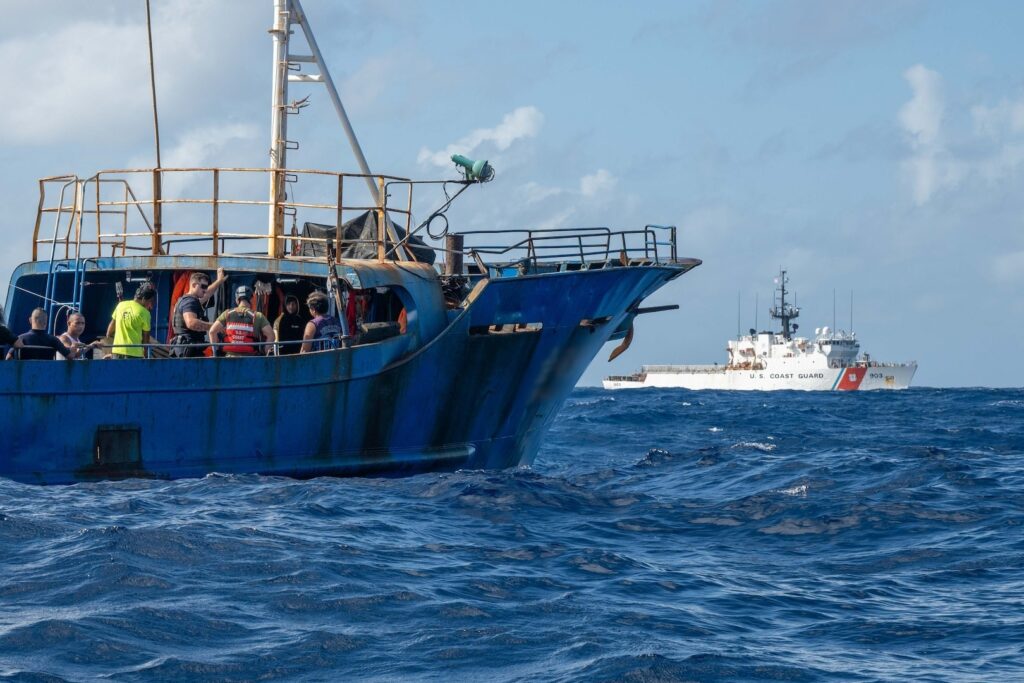
Crew members from U.S. Coast Guard Cutter Harriet Lane (WMEC 903) and Fishery Officers from the Cook Island Ministry of Marine Resources converse with crew members of a fishing vessel during an fishery inspection of the vessel June 7, 2025, in the Pacific Ocean. (U.S. Coast Guard photo by Petty Officer 3rd Class Austin Wiley) 

From Coast Guard 14th District External Affairs, June 16, 2025  

RAROTONGA, Cook Islands – The U.S. Coast Guard concluded bilateral maritime law enforcement operations alongside Cook Islands law enforcement partners offshore Rarotonga Friday.  

The crew of Coast Guard Cutter Harriet Lane (WMEC 903) worked alongside the Cook Islands’ Ministry of Marine Resources to conduct fisheries law enforcement patrols. These mutually beneficial patrols focused on detecting and deterring illegal fishing activities while ensuring the sustainable management of marine resources within the Cook Islands’ exclusive economic zone (EEZ), which borders the EEZ of American Samoa.  

“Working with the Cook Islands’ Ministry of Marine Resources has been an incredible opportunity,” said Cmdr. Nicole Tesoniero, commanding officer of the Harriet Lane. “Seeing firsthand our combined dedication to protecting marine resources and upholding laws and regulations reinforces the importance of these partnerships. We’re proud to support their efforts in ensuring a sustainable future for their waters and the wider Pacific.”  

During this nine-day operation, the Harriet Lane crew and two Ministry of Marine Resources officers conducted six boardings of fishing vessels operating within the Cook Islands’ EEZ, resulting in one suspected violation. These boardings focused on verifying compliance with Cook Island fisheries regulations, including proper licensing, gear restrictions and reporting requirements. The increased presence of law enforcement activity serves as a deterrent to potential illegal fishing activities. Additionally, the Harriet Lane crew’s presence deters increasing trends of drug smuggling in the Pacific.   

“As a small island and developing state like the Cook Islands, our biggest advantage and our strength is through cooperation with our partners in the Pacific when conducting fisheries boardings,” said Sai Sarau, a Cook Islands Ministry of Marine Resources Fisheries officer. “Together, we will weave a stronger Pacific community ready to face future challenges.”  

These bilateral operations are conducted under the existing maritime law enforcement agreement between the U.S. and Cook Islands. These agreements allow U.S. Coast Guard personnel to work with partner nations to enforce their sovereign laws and protect shared maritime interests, contributing to a joint objective in countering malign and illegal behaviors in the Oceania region.   

“This operation is an example of the enduring partnership between the United States and the Cook Islands,” said Cmdr. Nicholas Gilmore, U.S. Coast Guard Attaché to U.S. Embassy Wellington, New Zealand. “We are committed to working alongside our Cook Islands partners to promote maritime security, protect valuable marine ecosystems, and ensure a prosperous and sustainable future for the region.”  

About the U.S. Coast Guard in the Pacific:  

Based in Honolulu, the U.S. Coast Guard Fourteenth District continues to foster enduring partnerships with regional allies through Operation Blue Pacific, an overarching multi-mission endeavor promoting security, safety, sovereignty, and economic prosperity in Oceania. The U.S. Coast Guard remains committed to maritime security, safety and stewardship, solidifying its longstanding reputation in the Pacific as a trusted partner.  

About U.S. Coast Guard Cutter Harriet Lane: 

Commissioned in 1984, Harriet Lane is a 270-foot medium-endurance cutter homeported in Pearl Harbor, Hawaii, to support Coast Guard missions in the Pacific region. The service’s medium endurance cutter fleet supports a variety of Coast Guard missions including search and rescue, law enforcement, maritime defense, and protection of the marine environment.  


USS Cole Assists Royal Canadian Navy, U.S. Coast Guard, Transfer Intercepted Contraband 

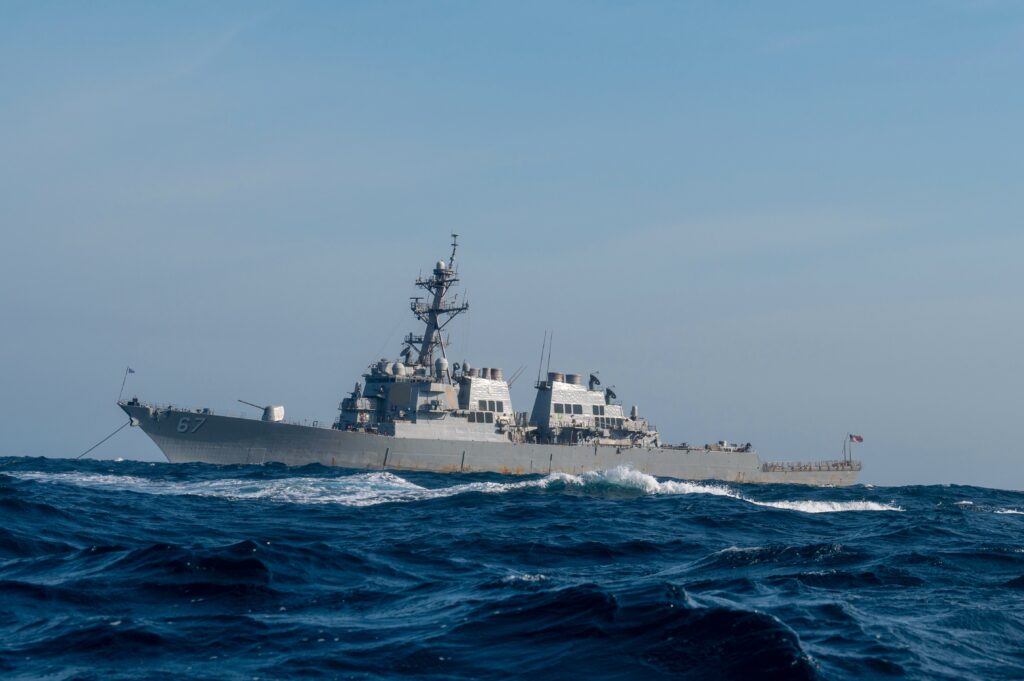
Arleigh Burke-class guided missile destroyer USS Cole (DDG-67) moors off the coast of Charleston, South Carolina, April 15, 2025, during Exercise Southern Lightning. (U.S. Air Force photo by Staff Sgt. Emily Farnsworth) [Stock Photo] 
 

13 June 2025 

From U.S. Northern Command, U.S. Naval Forces Southern Command Public Affairs 

CARIBBEAN SEA – The Arleigh Burke-class guided missile destroyer USS Cole (DDG 67), supporting maritime southern border operations, conducted a hold-and-transfer of 245 kilograms of contraband recovered by the Royal Canadian Navy Harry DeWolf-class offshore patrol vessel HMCS William Hall (AOPV 433) in the Caribbean Sea June 9. The Reliance-class U.S. Coast Guard (USCG) Cutter Vigorous (WMEC 627) accepted the contraband from the Cole’s embarked USCG Law Enforcement Detachment (LEDET) June 11 during a rendezvous at sea in the Caribbean. 

The Cole, with the embarked LEDET, provides a combination of U.S. Navy endurance, range, and capability with USCG law enforcement authorities, increasing protection to the U.S. southern border’s maritime approach. 
 
The contraband’s transit was detected by Joint Interagency Task Force (JIATF) South, which collaborates with partner nations and leverages all-domain capabilities to detect and monitor illicit drug trafficking in the region. 
 
The contraband and surrounding circumstances are considered under investigation and are subject to review and disposition through the U.S. Department of Justice. 
 
The U.S. Coast Guard LEDET has unique legal authority to conduct U.S. law enforcement operations in support of border security missions under U.S. Northern Command. Utilizing the Coast Guard’s jurisdiction, the Cole will employ LEDET personnel to perform vessel boardings, searches, and seizures in U.S. and international waters, targeting drug trafficking, illegal immigration, and transnational crime with a nexus to the U.S. southern border. With LEDET’s tactical expertise guiding interdiction efforts, the Cole will harness its advanced surveillance systems and mobility to locate and intercept suspect vessels, effectively extending Coast Guard authority through naval power to enhance maritime security operations. This collaboration ensures a robust, legally empowered response to maritime threats, strengthening U.S. border protection efforts. 
 
U.S. Naval Forces Southern Command/U.S. 4th Fleet serves as a trusted maritime partner for Caribbean, Central and South American maritime forces and promotes unity, security, and stability in the region. 
 
For more USNAVSOUTH/4th Fleet news and photos, visit facebook.com/NAVSOUS4THFLT, https://www.fourthfleet.navy.mil/, X – @ NAVSOUS4THFLT, and https://www.linkedin.com/company/u-s-naval-forces-southern-command-u-s-4th-fleet 


Coast Guard Offloads More than $138M in Drug Interdictions in Caribbean Sea 

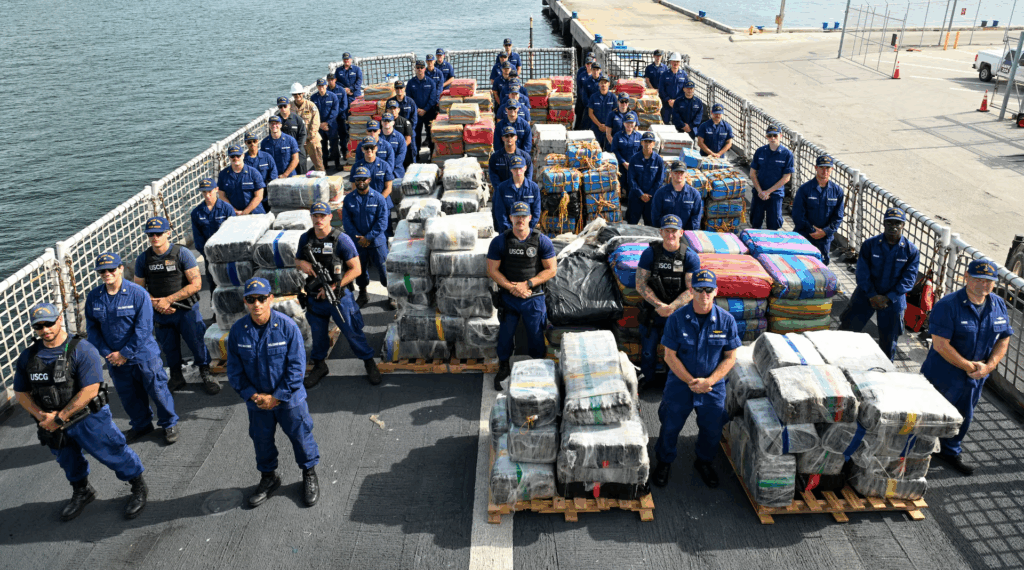
USCGC Valiant (WMEC 621) crew members pause for a group photo with pallets of drugs before offloading at Port Everglades in Fort Lauderdale, Florida, June 6, 2025. The Valiant crew offloaded more than $132 million in illicit drugs interdicted in the Caribbean Sea. (U.S. Coast Guard photo by Petty Officer 1st Class Diana Sherbs)

From U.S. Coast Guard 7th District, June 6, 2025 

MIAMI –U.S. Coast Guard Cutter Valiant’s crew offloaded 17,450 pounds of cocaine and 2,585 pounds of marijuana worth $132 million, Friday, at Port Everglades.  

U.S. Coast Guard Cutter Vigorous crew offloaded approximately 840 pounds of cocaine worth an estimated $6.2 million, Thursday, at Coast Guard Base Miami Beach.  

The seized contraband was the result of six interdictions in the Caribbean Sea by Coast Guard and interagency partners.   

“I am incredibly proud of our Valiant team and how they exemplify American values. They sacrifice time away from their families and when necessary, put themselves in harm’s way to secure our borders and protect the American people,” said Cmdr. Matthew Press, commanding officer of Valiant. “Collaborating with the United States Navy, Royal Canadian, and Royal Netherlands Navies, our multinational team disrupted transnational criminal organizations making the world a safer place.”  

On May 19, a maritime patrol aircraft located a suspicious vessel approximately 85 miles north of Aruba. Valiant’s crew interdicted the vessel and seized approximately 2,645 pounds of cocaine.   

On May 22, a maritime patrol aircraft located a suspicious vessel approximately 170 miles north of Aruba. Valiant’s crew interdicted the vessel and seized approximately 7,750 pounds of cocaine.   

On May 25, a maritime patrol aircraft located a suspicious vessel approximately 290 miles south of the Dominican Republic. USS Gravely’s crew and embarked U.S. Coast Guard Law Enforcement Detachment 401 interdicted the vessel and seized approximately 840 pounds of cocaine. The narcotics were transferred to the Vigorous.  

On May 29, a maritime patrol aircraft located a suspicious vessel approximately 140 miles south of the Dominican Republic. His Majesty’s Canadian Ship William Hall’s crew and embarked Coast Guard LEDET 103 interdicted the vessel and seized approximately 750 pounds of cocaine. The narcotics were transferred to the Valiant.  

On May 29, a maritime patrol aircraft located a suspicious vessel approximately 15 miles north of Venezuela. The Royal Netherlands Navy ship HNLMS Friesland crew and embarked Coast Guard LEDET 404 interdicted the vessel and seized approximately 4,050 pounds of cocaine and 2,585 pounds of marijuana. The narcotics were transferred to the Valiant.  

On May 31, a maritime patrol aircraft located a suspicious vessel approximately 185 miles north of Colombia. HMCS William Hall’s crew and embarked Coast Guard LEDET 103 interdicted the vessel and seized approximately 2,250 pounds of cocaine. The narcotics were transferred to the Valiant.  

The following crews assisted with interdiction operations:  

  • U.S. Coast Guard Tactical Law Enforcement Team South  

  • U.S. Coast Guard Tactical Law Enforcement Team Pacific  

  • Seventh Coast Guard District watchstanders  

Detecting and interdicting illicit drug traffickers on the high seas involves significant interagency and international coordination. Joint Interagency Task Force-South, in Key West, conducts the detection and monitoring of aerial and maritime transit of illegal drugs. Once an interdiction becomes imminent, the law enforcement phase of the operation begins, and control of the operation shifts to the U.S. Coast Guard for the interdiction and apprehension phases. Interdictions in the Caribbean Sea are performed by members of the U.S. Coast Guard under the authority and control of the Seventh Coast Guard District, headquartered in Miami.     

These interdictions relate to Organized Crime Drug Enforcement Task Forces’ Strike Force initiatives and designated investigations. OCDETF identifies, disrupts, and dismantles the highest-level criminal organizations that threaten the United States using a prosecutor-led, intelligence-driven, multi-agency approach. Additional information about the OCDETF program can be found at https://www.justice.gov/OCDETF.     

USCGC Valiant is a 210-foot medium-endurance cutter homeported in Jacksonville under U.S. Coast Guard Atlantic Area Command.   

USCGC Vigorous is a 210-foot medium-endurance cutter homeported in Virginia Beach, Virginia under U.S. Coast Guard Atlantic Area Command.  

For breaking news, follow us on X (formerly Twitter). For additional information, find us on Facebook and follow us on Instagram.     


Latest Polar Icebreaker USCGC Storis Departs on First Voyage 

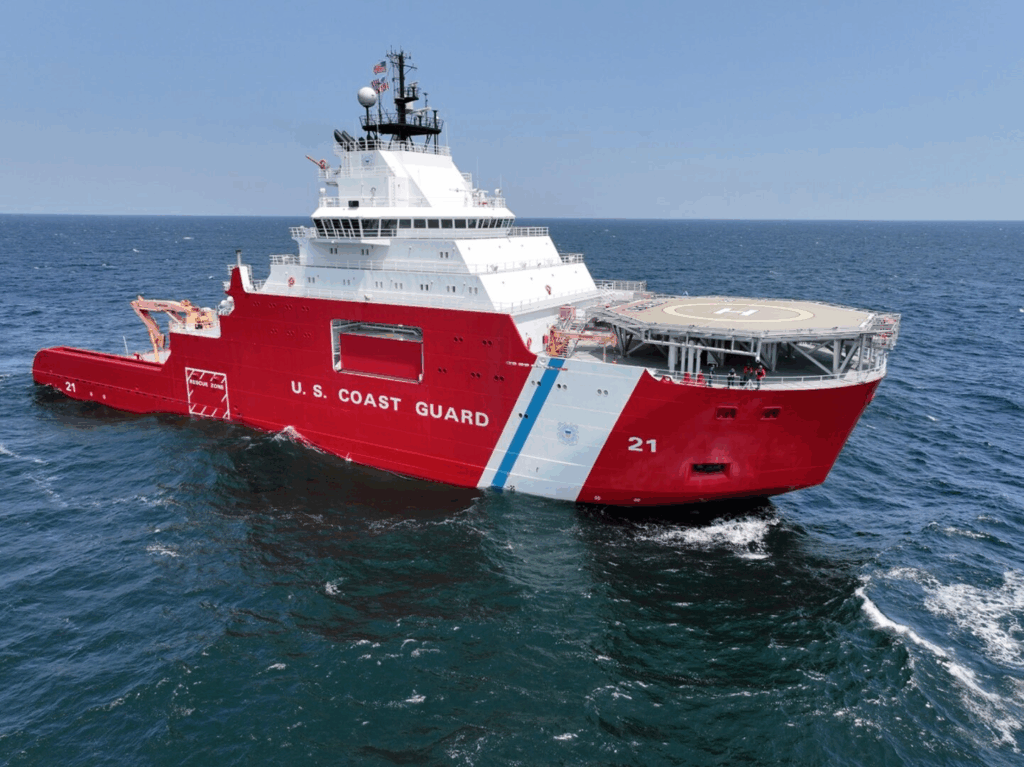
PASCAGOULA, Miss. – The U.S. Coast Guard Cutter Storis is shown here underway, June 3, 2025. The Storis is the Coast Guard’s first new polar icebreaker acquisition in 25 years and will expand U.S. operational presence in the Artic Ocean. Photos courtesy of Edison Chouest Offshore.

From U.S. Coast Guard Headquarters, June 4, 2025 

PASCAGOULA, Mississippi – The U.S. Coast Guard Cutter Storis (WAGB 21), the Coast Guard’s first polar icebreaker acquired in more than 25 years, departed on its initial voyage to safeguard U.S. sovereign interests in the Arctic and conduct Coast Guard missions.  

Storis’ departure marks an early milestone in the service’s transformation through Force Design 2028 (FD2028), which includes reforming Coast Guard acquisitions to rapidly deploy capabilities to execute the Coast Guard’s missions. 

The motor vessel Aiviq, acquired Dec. 20, 2024, from an Edison Chouest Offshore subsidiary, was renamed Storis following modifications to enhance communications and self-defense capabilities. The vessel will expand U.S. operational presence in the Arctic and support Coast Guard missions while the service awaits the delivery of the Polar Security Cutter (PSC) class. The Coast Guard will continue evaluating the cutter’s condition and requirements to achieve full operational capability. 

Storis is commanded by Captain Keith M. Ropella who currently serves as chief of cutter forces at Coast Guard Headquarters in Washington D.C., and previously commanded Coast Guard Cutter Polar Star (WAGB 10), from July 2022 to July 2024. 

The vessel is manned with a hybrid crew consisting of military cuttermen and civilian mariners. This is the second vessel in Coast Guard history to bear the name Storis. The original Storis, known as the “Galloping Ghost of the Alaskan Coast,” had a storied history conducting 64 years of icebreaking operations in Alaska and the Arctic before being decommissioned in 2007. 

Storis will be commissioned this August in Juneau, Alaska, which will eventually be the vessel’s permanent homeport. Until the necessary shore infrastructure improvements are completed in Juneau, Storis will be temporarily berthed in Seattle, Washington, with the Service’s two other polar icebreakers. 

The acquisition was made possible through the Don Young Coast Guard Authorization Act of 2022 and fiscal year 2024 appropriations. It does not affect the ongoing procurement of PSCs and is not part of the PSC program of record. 

The Coast Guard operates the United States’ fleet of icebreakers to assure access to the polar regions to protect U.S. sovereignty. To fulfill this mission and meet operational needs in the polar regions, the Coast Guard requires a fleet of eight to nine polar icebreakers. In support of the President’s intent to acquire at least 40 new icebreakers, the Coast Guard is working to replace, modernize and grow its aging fleet of icebreakers, which currently includes three polar icebreakers, 21 domestic icebreakers and 16 ice-capable buoy tenders. As the United States’ third polar icebreaker, Storis will provide near-term operational presence and support national security as a bridging strategy until the full complement of PSCs is delivered. 

Announced by Secretary of Homeland Security Kristi Noem on May 21, FD 2028 is a blueprint to transform the Coast Guard into a stronger, more ready and capable fighting force. This initiative will include campaigns focused on people, organization, contracting and acquisition, and technology. You can read more about FD 2028 here: Force Design 2028


Coast Guard Cutter Diligence Returns Home After 61-day Counter-Drug and Fisheries Patrol 

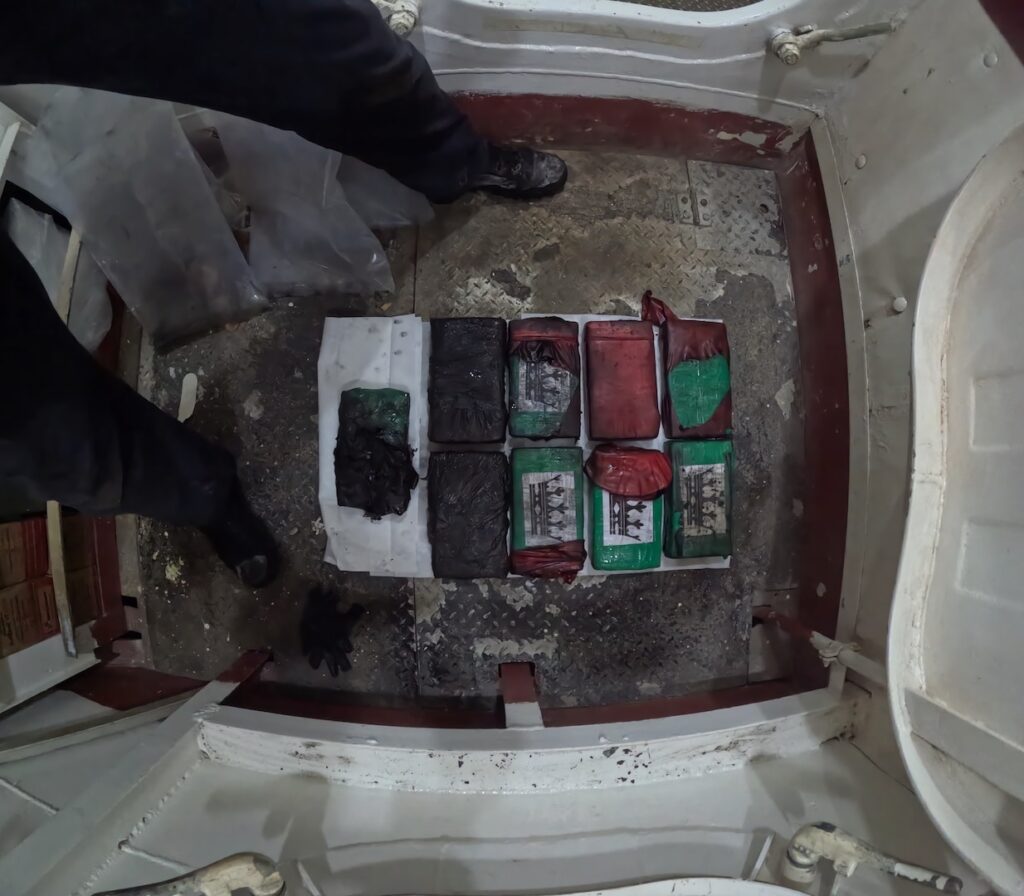
Coast Guard Cutter Diligence (WMEC 616) crew members seize approximately 40 pounds of cocaine from a disabled sailing vessel in the Caribbean Sea, April 24, 2025. Diligence’s crew conducted a 61-day counter-drug and fisheries patrol in the Caribbean Sea and Gulf of America. (U.S. Coast Guard photo) 

From U.S. Coast Guard Atlantic Area, June 2, 2025 

PENSACOLA, Fla. — The crew of Coast Guard Cutter Diligence (WMEC 616) returned to their home port in Pensacola, May 21, following a 61-day patrol in the Caribbean Sea and Gulf of America, where crew members conducted counter-drug operations and fisheries boardings to enforce U.S. federal law at sea and protect America’s maritime boundary. 

Diligence deployed in support of Joint Interagency Task Force – South (JIATF-S) while underway in the Seventh Coast Guard District’s area of responsibility. Crew members worked closely with international and interagency partners to disrupt drug trafficking ventures in the Caribbean Sea. 
 
While at sea, the crew interdicted two separate drug-smuggling vessels suspected of drug trafficking and provided logistical support to partners for several additional interdictions. 

On April 12, Diligence interdicted a vessel suspected of drug smuggling. After a pursuit and use of disabling fire, crew members gained control of the go-fast style vessel. After retrieving 28 bales of jettisoned marijuana, the crew of Diligence seized approximately 1,660 pounds of marijuana in total and apprehended the three suspected smugglers on board. 
 
On April 23, a military patrol aircraft located a disabled sailing vessel approximately 170 miles off Colombia. Coast Guard Cutter Diligence’s crew boarded the vessel and seized approximately 40 pounds of cocaine. 

During patrol, Diligence worked with the Royal Netherlands navy offshore patrol vessel HNLMS Groningen (P 843), U.S. Navy assets, Tactical Law Enforcement Team – Pacific (PACTACLET), and Coast Guard Cutters Campbell (WMEC 909), Venturous (WMEC 625) and John Patterson (WPC 1153). The collective interoperability of these units highlights the importance of multi-national and interagency cooperation in support of maritime counter-drug operations. 

While underway in the Eighth Coast Guard District’s area of responsibility, the crew conducted fisheries enforcement missions while underway in the Gulf of America. While patrolling near the maritime boundary line near Mexico, Diligence’s law enforcement teams conducted five boardings of U.S. commercial fishing vessels. These inspections ensured compliance with federal safety standards and fishery management regulations, supporting the Coast Guard’s mission to promote safe and sustainable fishing practices. 

While moored in Galveston, Texas, Diligence was opened to the public and the crew provided over 100 tours, sharing information about the ship and the Coast Guard’s missions. 

“Our success during this recent patrol is tied to a much broader effort that includes regional and interagency partners, said Cmdr. Nolan Cain, commanding officer of Diligence. “The crew continues to work incredibly hard to secure the maritime border and bring narcotics traffickers to justice. A special thanks to the City of Galveston for hosting us during two port calls.” 

Based in San Diego, California, PACTACLET personnel provide counter-narcotic law enforcement capabilities and support the interdiction, apprehension and processing of suspected drug smugglers. PACTACLET members are skilled in law enforcement boarding procedures at sea and are critical for mission execution.  

Detecting and interdicting illicit drug traffickers on the high seas involves significant interagency and international coordination. JIATF-S, in Key West, conducts the detection and monitoring of aerial and maritime transit of illegal drugs. Once an interdiction becomes imminent, the law enforcement phase of the operation begins, and control of the operation shifts to the U.S. Coast Guard for the interdiction and apprehension phases. Interdictions in the Caribbean Sea are performed by members of the U.S. Coast Guard under the authority and control of the Seventh Coast Guard District, headquartered in Miami.   

Diligence is a 210-foot, Reliance-class medium endurance cutter. Its primary missions include counter-drug and migrant interdiction operations, enforcement of federal fishery laws, and search and rescue in support of U.S. Coast Guard operations throughout the Western Hemisphere. 

For information on how to join the U.S. Coast Guard, visit GoCoastGuard.com to learn about active duty, reserve, officer, and enlisted opportunities. Information on how to apply to the U.S. Coast Guard Academy can be found here.  


Coast Guard Cutter William Hart Returns Home

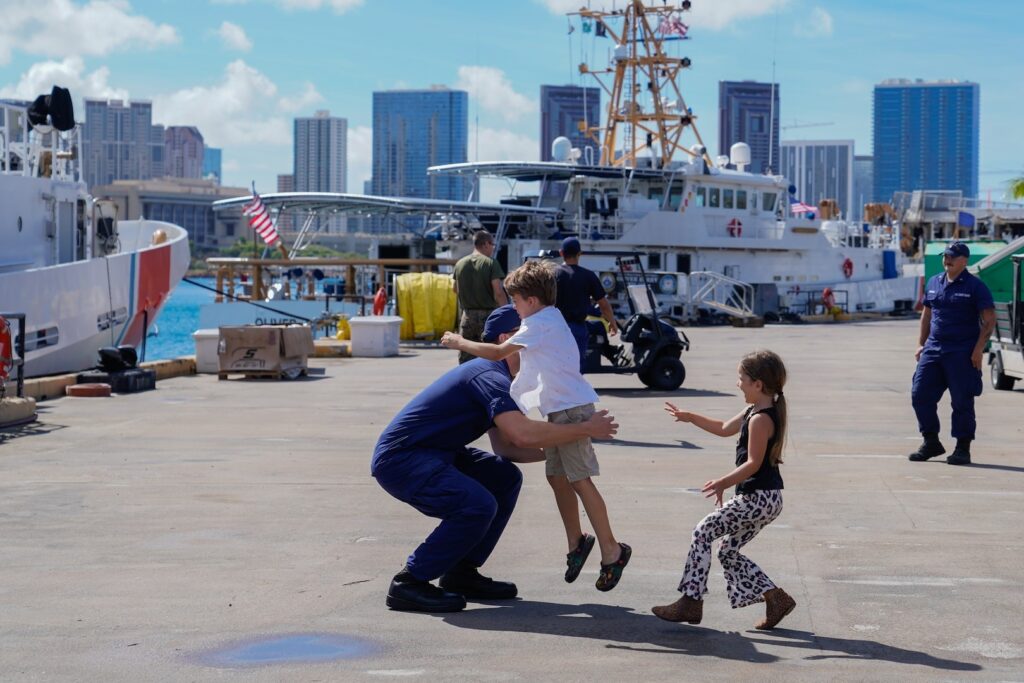
A crew member of Coast Guard Cutter William Hart (WPC 1134) embraces his family on the pier at Coast Guard Base Honolulu, May 31, 2025. The crew of the William Hart traveled more than 7,000 nautical miles during their 46-day patrol of Oceania. (U.S. Coast Guard photo by Petty Officer 3rd Class Avery Tibbets) 

Coast Guard 14th District External Affairs, May 31, 2025  

HONOLULU – The crew of Coast Guard Cutter William Hart (WPC 1134) returned to Honolulu Saturday following a 46-day patrol in support of Coast Guard District Fourteen’s Operation Blue Pacific in Oceania.   

The William Hart crew departed Coast Guard Base Honolulu in April and traveled more than 7,000 nautical miles spanning from the Hawaiian Islands to the Kingdom of Tonga. Patrolling in support of Operation Blue Pacific, the cutter’s crew worked alongside Pacific Island Countries to enhance maritime domain awareness, combat illegal fishing activities and reinforce a shared commitment to maritime governance and regional stability.  

Reinforcing U.S. border security and territorial integrity, the William Hart crew also patrolled U.S. and neighboring Exclusive Economic Zones, including those in American Samoa. These operations advanced the United States’ commitment to securing our borders and maritime approaches to detect, deter, and interdict illegal activities and threats to the homeland.  

Leveraging existing bilateral maritime law enforcement agreements, the William Hart crew conducted seven vessel boardings and seven observation reports alongside Pacific Island law enforcement partners within the respective exclusive economic zones. The cutter’s crew also conducted two fishery boardings on the high seas in concert with the Western and Central Pacific Fisheries Commission, addressing illegal, unreported, and unregulated fishing within the region.  

During William Hart’s patrol, the crew made port calls in American Samoa, Fiji, Tonga, and Samoa. The crew hosted tours for members of the Fijian Navy, U.S. Embassy Nuku’alofa, and the Tongan Royal Navy. The crew also engaged with the next generation of maritime professionals, providing tours for students from the National University of Samoa Maritime School and the Ministry of Police Maritime Division. A sporting event hosted by the Tongan Royal Navy, alongside personnel from an Australian naval vessel, further solidified regional camaraderie. In Samoa, a dinner hosted by the Australian Embassy served to strengthen diplomatic and maritime partnerships.  

“This patrol emphasizes the Coast Guard’s vital role in promoting maritime security and regional stability throughout Oceania, while safeguarding U.S. interests” said Lt. Cmdr. Stephen A. Hills, commanding officer of the William Hart. “Our crew worked alongside our Pacific partners to strengthen maritime governance, counter illegal fishing and narcotics trafficking and build lasting relationships that enhance safety and sovereignty across the region.”  

The William Hart is the third 154-foot Sentinel-class fast response cutter homeported in Honolulu. The cutter’s primary missions are maritime law enforcement, search and rescue and national defense.   


USS Gravely and U.S. Coast Guard Conduct Drug Interdiction in Caribbean Sea 

CARIBBEAN SEA (May 25, 2025) Coast Guardsmen assigned to U.S. Coast Guard Law Enforcement Detachment (LEDET) 401, and Sailors assigned to the Arleigh Burke-class guided-missile destroyer USS Gravely (DDG 107), prepare to transfer bails of cocaine seized during a maritime interdiction operation (MIO) while underway in the Caribbean Sea. U.S. Navy assets are deployed under U.S. Northern Command’s maritime homeland defense authorities with a U.S. Coast Guard Law Enforcement Detachment embarked to enable maritime interdiction missions to prevent the flow of illegal drugs and other illegal activity. U.S. Northern Command is working together with the Department of Homeland Security to provide additional military forces and capabilities at the southern border. (U.S. Navy photo by Mass Communication Specialist 1st Class Ryan Williams)

by U.S. 2nd Fleet Public Affairs, May 29, 2025 

CARIBBEAN SEA — The Arleigh Burke-class guided missile destroyer USS Gravely (DDG 107) seized an estimated 860 pounds of illegal drugs from a vessel in the Caribbean Sea, May 25. 

The interdiction by Gravely was conducted by the ship’s Visit, Board, Search and Seizure (VBSS) team alongside a U.S. Coast Guard Law Enforcement Detachment (LEDET) assigned to the ship.  

“I am incredibly impressed by the professionalism and prompt action executed by the Sailors and Coast Guardsmen aboard Gravely! Seamless integration of U.S. Navy and U.S. Coast Guard maritime assets is integral to border protection — this is an excellent example of that teamwork,” said Vice Adm. Doug Perry, Commander, U.S. 2nd Fleet. “Border security is national security. Gravely’s deployment highlights our dedication — and the Nation’s dedication — to maritime homeland defense priorities.” 

Gravely’s VBSS team boarded a vessel of interest. The team discovered and seized 19 bales of cocaine, with an approximate weight of 860 pounds and an estimated value of $13,650,000. 

U.S. Navy forces are deployed under U.S. Northern Command’s maritime homeland defense authorities with a LEDET embarked to enable maritime interdiction missions to prevent the flow of illegal drugs and other illegal activity. 

Since entering the Gulf of America March 15, Gravely has received support from P-8 aircraft assigned to Naval Air Station Jacksonville, Fla., allowing for enhanced and increased identification of illicit activity for the embarked Coast Guard LEDET in the Gulf of America and the U.S. 2nd Fleet and U.S. 4th Fleet areas of operation. 

Utilizing the Coast Guard’s jurisdiction, Gravely employs LEDET personnel to perform vessel boardings, searches, and seizures in U.S. and international waters, targeting drug trafficking, illegal immigration, and transnational crime with a nexus at the U.S. southern border. With the LEDET’s tactical expertise guiding interdiction efforts, Gravely harnesses its advanced surveillance systems and mobility to locate and intercept suspect vessels, effectively extending Coast Guard authority through naval power to enhance maritime security operations. This collaboration ensures a robust, legally empowered response to maritime threats, strengthening U.S. border protection efforts. 

U.S. 2nd Fleet, reestablished in 2018 in response to the changing global security environment, develops and employs maritime forces ready to fight across multiple domains in the Atlantic and Arctic in order to ensure access, deter aggression and defend U.S., allied, and partner interests. 


Leidos Acquires Kudu Dynamics, Advancing AI Capabilities For Cyber Warfighters 

RESTON, Va. (May 28, 2025) – Leidos (NYSE:LDOS) announced today that it has acquired Kudu Dynamics, accelerating Leidos’ rapid scaling of artificial intelligence (AI)-enabled cyber capabilities for defense, intelligence and homeland security customers. 

Leidos’ extensive current AI-enabled cyber offerings arm users with the rapid capability and scale needed to automate vulnerability detection, enhance novel defenses, neutralize attacker advantages and evade adversary defenses. Acquiring Kudu Dynamics will accelerate Leidos’ strategy for AI-enabled offensive cyber, electromagnetic spectrum operations and vulnerability research.   

Founded in 2013, Kudu Dynamics has rapidly grown its work across the Department of Defense, leading the industry in automated targeting, scalable hardware reverse engineering and the generation of other non-kinetic effects. 

“Kudu’s ability to generate new cyber capabilities with AI perfectly complements our strategy to rapidly grow differentiated offensive cyber technology capabilities,” said  Leidos Chief Executive Officer Tom Bell. “This acquisition underlines Leidos’s commitment to continue to build smarter full-spectrum cyber capabilities, so that the U.S. and its allies dominate the cyber warfighting domain.” 

“We’re excited to deliver the next level of capabilities to our customers as we bring together the highly innovative cyber professionals and disruptive technologies of Kudu with the scale, resources and experience of Leidos,” said Kudu Dynamics’ Founder and CEO Mike Frantzen. “In Leidos, we’ve found a partner who shares our ethic of purposeful innovation in support of our nation’s most critical missions.” 

The Kudu Dynamics purchase marks Leidos’ first acquisition in two-and-a-half years. Increasing investment in the company’s already formidable cyber capabilities is among the five strategic growth pillars of its new NorthStar 2030 strategy, developed through a year of deep strategic thinking in 2024.   

The approximately $300 million all-cash acquisition closed May 23. 

Advisors 

Baird served as exclusive financial advisor to Kudu Dynamics on this transaction.