Lockheed Martin Delivers First Integrated Combat System Enabled Baseline
From Lockheed Martin
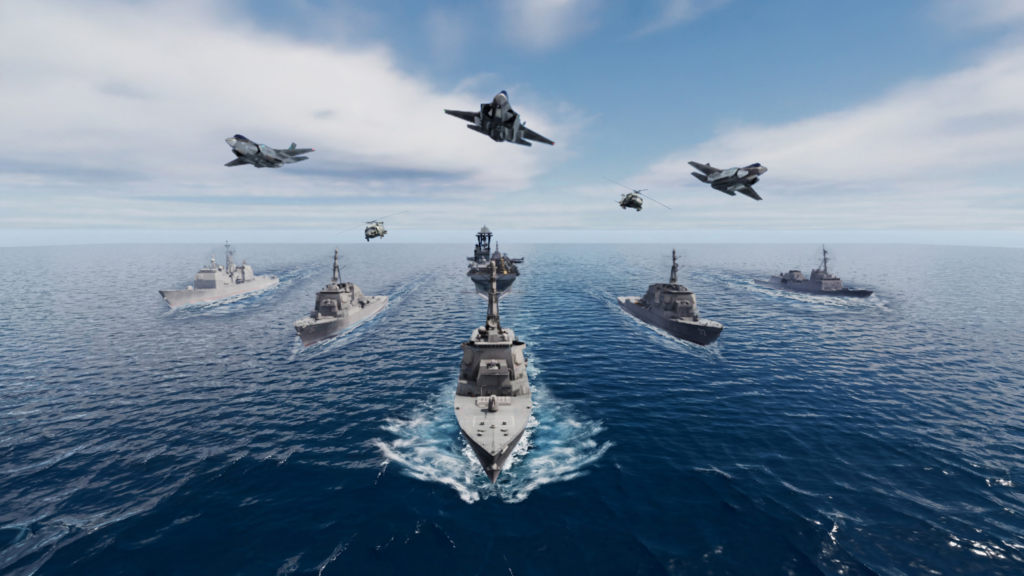
MOORESTOWN, N.J., May 28, 2026 – Lockheed Martin (NYSE:LMT) has successfully delivered the first Integrated Combat System (ICS)-enabled baseline to the U.S. Navy. ICS-enabled baselines combine heritage combat system capability with modern infrastructure, driving rapid proliferation of capability through a singular development effort at scale. Working with the Navy and industry partners, this marks the start of a six‑month operating cadence for updates and certifications that will be fielded across the fleet, a significant step toward the Navy’s vision of fleetwide commonality.
The six-month cadence keeps the ICS adaptable and continuously refreshed with cutting edge capabilities, ensuring the surface fleet stays at the forefront of naval warfare.
“The first ICS‑enabled baseline delivery highlights Lockheed Martin’s commitment to and partnership with the U.S. Navy to accelerate the transition to a common, fully integrated combat architecture in a continuously evolving warfighting environment,” said Chandra Marshall, vice president of Multi‑Domain Combat Systems at Lockheed Martin. “Each baseline upgrade delivered and integrated into the ICS further reinforces and expands the already proven Aegis integrated air and missile defense capability.”
Highlights and Impact
The Aegis BL9.C3.0 Package: This is the first baseline compiled from the Forge development environment. It introduces the re-architected display component, Tactical PaaS (Platform as a Service), which establishes the foundation for containerized software, and a suite of new operational capabilities.
Accelerated Capability Fielding: Each follow-on delivery will incrementally integrate new capabilities, sensors, effectors, and software. Driving towards a single ICS-enabled baseline cuts cost and ensures that every surface combatant can field the latest combat capabilities on a predictable schedule.
Delivering baseline BL9.C3.0 highlights Lockheed Martin’s partnership with the U.S. Navy, our commitment to deliver force-level capability, and accelerate the transition to a common, fully integrated combat architecture.
Two Decades of Cooperation in the Indo-Pacific: Pacific Partnership 2026 Mission Begins
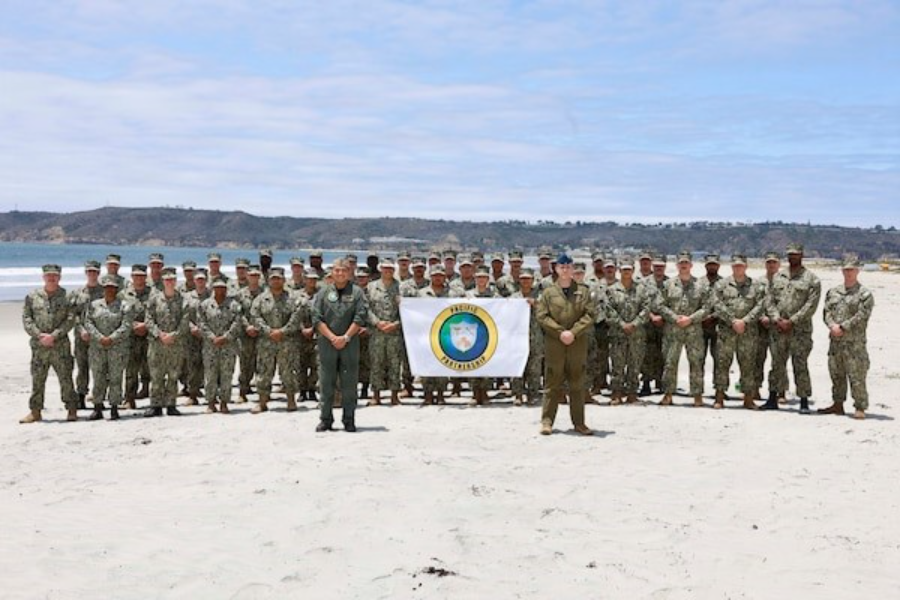
NAVAL AIR STATION NORTH ISLAND, Calif. (May 26, 2026) – U.S. Navy Capt. Robert Reyes (left), mission commander of Pacific Partnership 2026 (PP26), Royal Canadian Armed Forces Col. Alain Lafrenière (right), deputy mission commander of PP26, and Sailors pose for a photo commemorating the start of the mission on Naval Air Station North Island, May 26, 2026. (U.S. Navy Photo by Mass Communication Specialist 1st Class Justin E. Yarborough)
From Courtesy Story, May 28, 2026
SAN DIEGO — Pacific Partnership, the U.S. Navy’s largest annual maritime humanitarian and civic assistance effort conducted in the Indo-Pacific, officially began with the departure of U.S. personnel from San Diego to the mission coordinating hub in the Philippines, May 27, 2026.
The Pacific Partnership 2026 (PP26) team, led by U.S. Navy Capt. Robert C. Reyes, mission commander, and Canadian Armed Forces Col. Alain Lafrenière, deputy mission commander, will conduct mission stops in Indonesia, Malaysia, the Philippines, Timor-Leste, and Vietnam.
“This year marks the 20th anniversary of Pacific Partnership, and the 22nd time embarking on this critical mission alongside our allies and partners,” said Reyes. “With our unified commitment to a free and open Indo-Pacific, we strengthen regional security by building host nation capacity to prepare for and overcome crises, deepen cooperation, and deliver an enduring impact across the region.”
U.S. personnel will work alongside personnel from participating nations including Australia, Canada, Germany, Japan, New Zealand, Republic of Korea, Singapore, and the United Kingdom to bolster host nation capacity to administer critical humanitarian services and support efforts to prepare and respond to disaster emergencies in the region.
“Our team has worked hard to plan this mission and we are excited to visit new countries, experience new cultures, and integrate with our allies and partners to see first-hand, the positive impact we can have together, said Master Chief Air Traffic Controller Eric Zimmerman, senior enlisted leader for PP26.
During the deployment, the PP26 mission team will work alongside host nation partners to conduct medical exchanges, engineering projects, community outreach, and disaster preparedness engagements. The first stop is scheduled to take place in Vietnam in mid-June.
PP26 will focus on enhancing multilateral cooperation, strengthening national capacities for disaster and emergency response, and deepening strategic partnerships throughout the region.
The U.S. Pacific Fleet, along with its allies and partners, remains steadfast in advancing the shared vision of a free, open, and secure Indo-Pacific.
Pacific Partnership works collaboratively with host and partner nations to enhance regional interoperability and disaster response capabilities, increase security in the region, and foster new and enduring friendships in the Indo-Pacific.
For updates and multimedia from Pacific Partnership 2026, follow #PacificPartnership, #PP26, and #PacificPartnership26 on social media or visit: Pacific Partnership
U.S. 4th Fleet Commander Strengthens Maritime Partnership During Argentina Visit
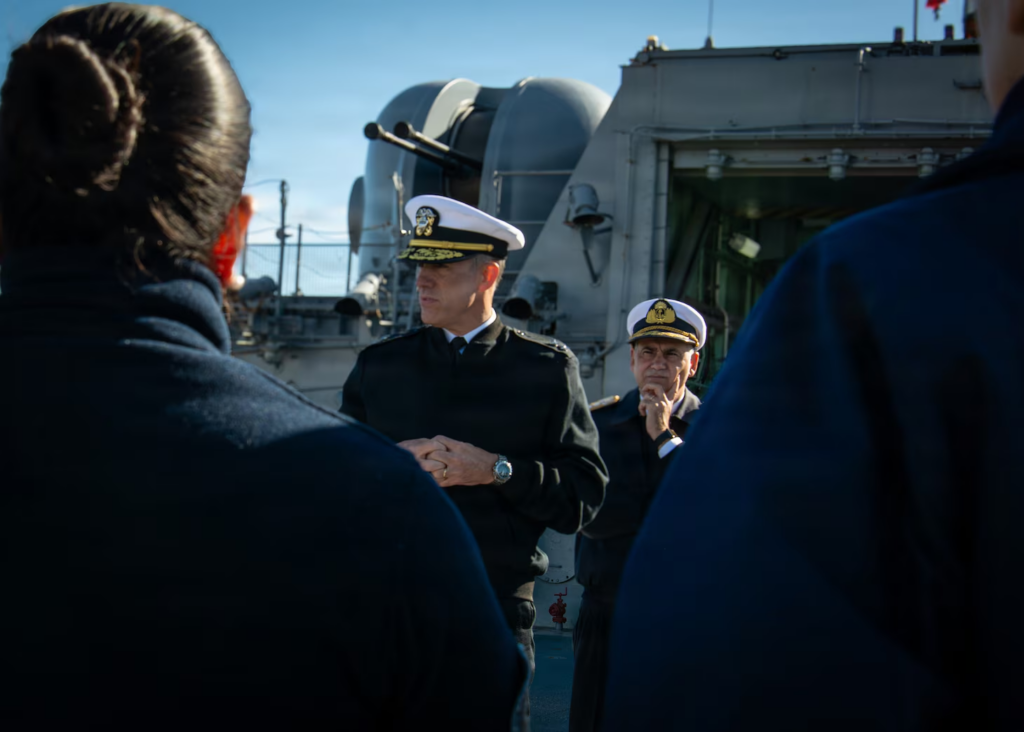
Rear Adm. Carlos Sardiello, commander of U.S. Naval Forces Southern Command/U.S. 4th Fleet, addresses Argentine Sailors aboard MEKO 360H2-class destroyer ARA La Argentina (D 11) during a ship tour at Puerto Belgrano Naval Base, Argentina, May 18, 2026. (U.S. Navy photo by Chief Mass Communication Specialist Margie Vinson)
By Chief Petty Officer Margie Vinson, May 27, 2026
PUERTO BELGRANO NAVAL BASE, Argentina – The U.S. delegation, led by Rear Adm. Carlos Sardiello, commander of U.S. Naval Forces Southern Command/U.S. 4th Fleet, was hosted by Rear Adm. José Alberto Martí Garro of the Argentine Navy. The U.S. contingent also included Col. Jeffrey Hammond, Operations Officer for U.S. Marine Corps Forces, South, along with representatives from Joint Interagency Task Force South and Special Operations Command South.
The talks focused on enhancing interoperability, deepening maritime domain awareness, and advancing cybersecurity cooperation to address shared security interests. Key areas of discussion included leveraging upcoming multinational exercises such as UNITAS and Southern Seas to ensure seamless integration and teamwork between the two naval forces.
“Argentina has had a longstanding relationship of cooperation with the U.S.,” said Sardiello. “The foundation of that is interoperability, trust and security. This helps ensure international norms and maritime domain are enforced so that we may respond to any crisis.”
As part of the visit, the U.S. delegation participated in celebrations for the 212th Argentine Navy Day and observed a Joint Combined Exchange Training (JCET) demonstration. The exercise featured the U.S. Army’s 7th Special Forces Group and Argentine Marine Special Operations Forces (Comandos Anfibios), observed alongside U.S. Ambassador Marc Stanley at the Baterias training area. The agenda also included a visit to the destroyer ARA Sarandi (D13) and the presentation of the Legion of Merit to former Naval Attaché Rear Adm. Calafel at the Argentine Navy Headquarters in Buenos Aires.
The event concluded with the signing of minutes by Rear Adm. Sardiello and Rear Adm. Martí Garro, formally documenting the key agreements reached and solidifying a collaborative path forward. Both leaders reiterated their shared commitment to a robust and lasting defense partnership between the United States and Argentina.
A U.S. Naval Forces Southern Command/U.S. 4th Fleet serves as a trusted maritime partner for Caribbean, Central, and South American maritime forces, working to promote unity, security, and stability throughout the region.
Austal USA Names Gene Miller as President
Board concludes search by confirming interim leader as permanent selection
From Austal USA, May 27, 2026
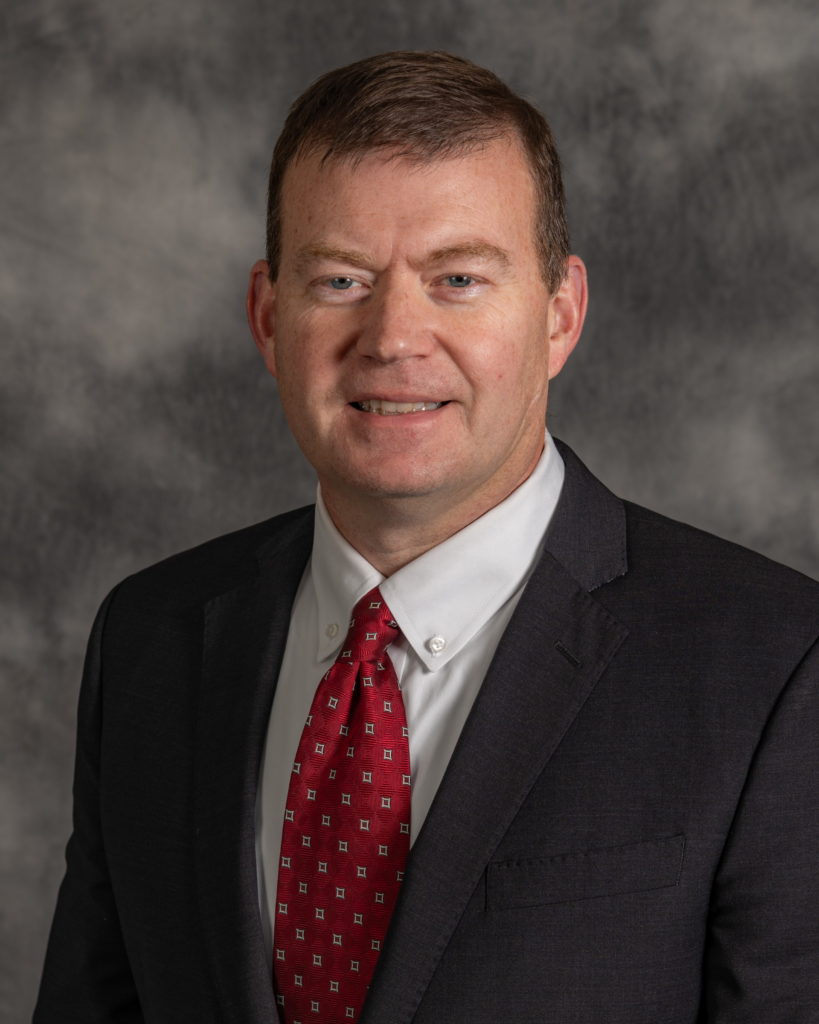
MOBILE, Ala. – Austal USA today announced that Gene Miller has been chosen as the company’s president, effective immediately. Miller has served as interim president since February 16, 2026, following the planned retirement of former president Michelle Kruger. His selection follows a comprehensive three-month search conducted by the company’s Board of Managers.
Miller’s career spans more than three decades in naval architecture and shipbuilding. Prior to joining Austal USA as chief operating officer in 2024, he held senior leadership roles across the industry. At Ingalls Shipbuilding, he served as director for amphibious ship programs. Before that, Miller spent more than 20 years at General Dynamics Bath Iron Works, serving in a variety of engineering, operational and program management leadership roles before rising to vice president of programs and planning. Miller is a graduate of Webb Institute and MIT.
“Gene’s selection reflects our confidence in the leadership team we have built and the direction Austal is moving toward,” said Austal USA Chairman of the Board of Managers Chris Chadwick. “Since stepping into the interim role in February, he has demonstrated the qualities we have been looking for: operational discipline, a commitment to the workforce and the ability to deliver results. He has the relationships and strategic clarity to carry Austal USA’s momentum forward at a critical moment for our industry and for national defense. We are in a strong position for what comes next, and Gene is the right leader to take us there.”
As president, Miller will lead a team of more than 3,500 shipbuilding professionals across Austal USA’s operations in Mobile, Washington D.C., San Diego and various Virginia locations. He will oversee all aspects of the company’s ship and submarine module manufacturing and development of autonomous sea-ready technologies. He inherits a program portfolio that has grown significantly in recent years and a next-generation shipyard well-positioned for the work ahead.
“I am honored by the Board’s confidence and energized by what this team has built together,” said Miller. “Austal USA’s greatest strength is its workforce, and everything we do as a leadership team is in service to the men and women who show up every day to build ships that defend this nation. I am committed to growing this company, investing in our people and delivering on the promise of what Austal USA is capable of.”
UTIC Expands Undersea Workforce Development Through Sonar Training Partnership
MIDDLETOWN, R.I. – More than 100 Undersea Technology Innovation Consortium (UTIC) member company employees recently completed a successful sonar training course through a partnership with the University of Rhode Island (URI) and RTX. The partnership, aimed at strengthening the defense technology workforce, allowed UTIC members to take the Principles of Sonar, Underwater Sound, and Undersea Systems Course on a non-credit basis during the Spring 2026 semester. URI graduate students also completed the course for credit. The course was offered virtually and in person.
This is the third time the course has been offered and since its inception, over 500 UTIC member employees have gained critical undersea tech skills. The initiative comes as demand is growing for specialized technical talent across the undersea and maritime defense sectors.
“As undersea technology continues to rapidly evolve, expanding access to specialized education and technical training is essential to building a skilled, future-ready workforce,” said UTIC Chief Executive Officer Molly Donohue Magee. “Partnerships like this one with URI and RTX help ensure our member organizations have the knowledge, capabilities, and talent needed to support innovation, strengthen competitiveness, and advance the nation’s undersea mission.”
Led by Dr. John Short — a nationally recognized expert in sonar and undersea systems — the program provided valuable insights and knowledge transfer to both emerging professionals and longtime engineers. Dr. Short emphasized the importance of initiatives like this in sharing and advancing expertise across generations.
“This course represents more than professional development—it is an investment in the future of the undersea technology industry,” said Dr. John Short. “By combining fundamental principles with practical application, the program helps professionals strengthen technical expertise, apply new knowledge to real-world challenges, and build on both existing and emerging innovations.”
Principles of Sonar, Underwater Sound, and Undersea Systems is a graduate-level course focused on the fundamentals of sonar technology, underwater acoustics, and undersea systems engineering. The curriculum covers active and passive sonar design, acoustic modeling, ocean environment fundamentals, and practical applications such as performance estimation, system tradeoffs, and in-water testing. The course is expected to be offered again in Spring 2027.
Hyperion Systems to Build First 3D Printed Uncrewed Surface Vessel in the Southern Hemisphere
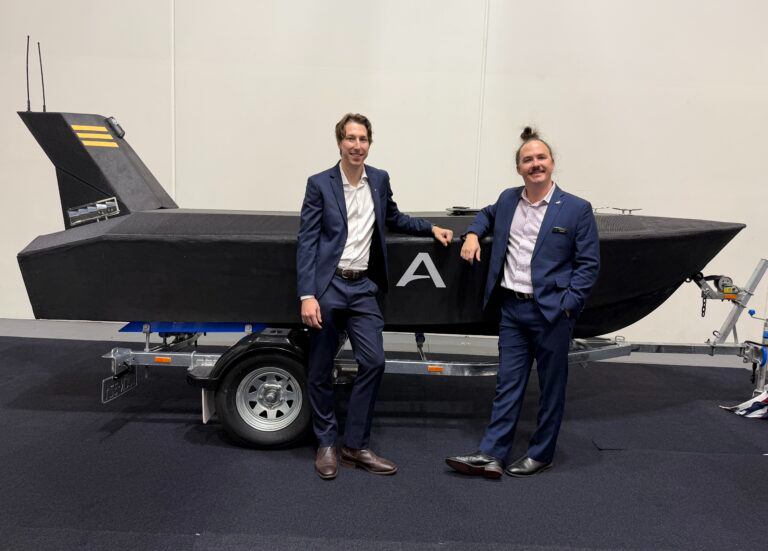
Image caption: Hyperion CEO Joshua Wigley and Greenroom COO Harry Hubbert with ASTRA 3D printed vessel
From Hyperion Systems, May 25, 2026
Hyperion Systems has unveiled the southern hemisphere’s first 3D printed Uncrewed Surface Vessel (USV), marking a major milestone for advanced manufacturing and autonomous maritime capability in Western Australia (WA).
Designed by WA marine architect Versatile Marine and powered by Greenroom Robotics’ AI and autonomy software, the ASTRA 460 will be manufactured in Henderson Western Australia by Hyperion Systems, demonstrating how next-generation vessels can be built faster, more affordably and with sovereign Australian capability.
The project was officially unveiled today at the Indian Ocean Defence and Security conference (IODS) by WA Defence Minister Paul Papalia alongside the first public viewing of Hyperion’s deployable “factory in a box” TitanCell.
The 4.6m ASTRA hulls will be 3D printed using Large Format Additive Manufacturing (LFAM) and recycled polymer waste by a consortium led by Hyperion Systems with integration support from key Australian stakeholders.
The autonomous navigation and control system will be delivered by Greenroom Robotics’ GAMA platform, providing a proven solution that is flexible and readily scalable to varying USV configurations.
Hyperion CEO Joshua Wigley said the vessel hull will be manufactured in approximately 40 hours using LFAM 3D printing, compared to at least 4-6 weeks using traditional boat-building methods.
“This dramatic reduction in production time highlights the transformative potential of additive manufacturing for rapid maritime capability and sovereign industrial resilience,” Mr Wigley said.
Greenroom Robotics co-founder and COO, Harry Hubbert said that Greenroom’s autonomy stack is ideally suited to Hyperion’s rapidly reconfigurable 3D printed USV platforms.
“In contested environments, the ability to quickly adapt a vessel to meet evolving mission requirements delivers a significant asymmetric advantage,” Mr Hubbert said. “Hyperion’s 3D printed USVs can deliver almost real-time customisation to suit the specific operating context.”
“In a matter of days, a vessel can be printed, autonomy enabled and on the water. This opens up endless possibilities for rapid, scalable and distributed maritime defence.”
The ASTRA 460 will be among the world’s first LFAM 3D-printed USVs and a larger 8m initial prototype is planned to be supplied to a European navy for use at a major naval exercise later in 2026.
Subject to successfully completing a series of rigorous sea trials which will start later this month, the fully autonomous vessel will feature:
· Top speed approximately 40 knots
· Cruising speed between 20-30 knots
· Range of up to 180-200 kilometres
· Multi-mission capability, including covert movement of small teams
· Operation across a range of sea states
· Modular payload flexibility for surveillance, security and defence roles.
Mr Wigley said combining Hyperion’s AI development toolkit with variable scale LFAM printing capacity will mean the ASTRA will be the first of a series of USVs which will be produced in many sizes and capability configurations that can be printed either in Henderson of deployed and printed using Hyperion’s “Titan Cell”.
“We are immediately provisioning to build 10 units a month and can scale to over 100 as needed,” he said.
Uncrewed Surface Vessels have rapidly become a critical component of modern defence capability
ASTRA Project Manager Jacob Kleinman said recent conflicts have demonstrated the effectiveness of USVs as cost-efficient, low-risk platforms that enhance maritime surveillance, reconnaissance and operational reach while reducing risk to personnel.
“USVs provide strong force-multiplication advantages. They are significantly cheaper to build and operate than traditional crewed vessels, enable persistent maritime presence, and act as force multipliers for manned fleets,” he said.
“We see the ASTRA playing a key role supporting missions including intelligence, surveillance and reconnaissance, border protection and security operations. Its modular payload capability also allows rapid reconfiguration for mission-specific roles.”
The ASTRA project brings together leading defence industry players to position Western Australia at the forefront of advanced maritime manufacturing, while strengthening Australia’s sovereign capability in autonomous maritime systems.
TitanCell also on display
Mr Wigley said the IODS conference also provided a unique opportunity to publicly show for the first time the deployable anywhere TitanCell which can be used to manufacture USVs and a range of other products.
Designed as a deployable “factory-in-a-box”, the TitanCell combines advanced robotics, 3D printing and in-house recycled polymer technology to manufacture products such as marine infrastructure, modular housing components, culverts, pontoons and autonomous vessel hulls.
By using difficult-to-recycle plastics, including material recovered from decommissioned resources industry infrastructure, the TitanCell supports sovereign manufacturing capability, reduces waste and carbon emissions and allows advanced manufacturing to be deployed directly to remote, regional or disaster-affected areas where traditional supply chains are limited.
The commercialisation of the TitanCell was accelerated via a $385,000 matched funding grant provided under the Australian Government’s Industry Growth Program.
Department of the Navy Names New Service Acquisition Executive
From the Navy Office of Information, May 26, 2026
ARLINGTON, Va. — Acting Secretary of the Navy Hung Cao announced today that William F. Mahan, a member of the Senior Executive Service, is now performing the duties of Assistant Secretary of the Navy for Research, Development and Acquisition. In this capacity, Mahan will serve as the senior acquisition executive for both the Navy and Marine Corps.
Mahan, a former submarine officer and a 2003 graduate of the United States Naval Academy, also brings a wealth of industry experience to the role. He was the founder and Chief Executive Officer of a defense engineering firm that supported the Department of War with expertise in systems engineering and integration, rapid prototyping, flight testing, and acquisition management.
“Restoring our maritime dominance requires bold leadership in warfighting acquisition,” Cao said. “Will Mahan is a proven leader who will help the Navy deliver the Golden Fleet to ensure our Sailors and Marines have what they need to fight and win when the nation calls.”
Jason L. Potter, who had been performing the duties of the assistant secretary since July 2025, returns to his original role as the Principal Civilian Deputy ASN RDA.
“Jason provided vital leadership over the past year, including the establishment of Portfolio Acquisition Executives and getting an ambitious, yet achievable shipbuilding plan over the finish line,” Cao added. “I am incredibly grateful for his steady hand and unflinching commitment to the mission, and we are extremely fortunate to retain his expertise in our acquisition leadership team.”
Mahan assumes stewardship of the Department of the Navy’s warfighting acquisition efforts as the department undergoes foundational acquisition reforms, shifting from a compliance-based bureaucracy to a more agile, warfighter-focused organization. At the same time, the Department of the Navy is making investments with industry to invigorate the maritime industrial base and build historic numbers of ships for the Navy and Marine Corps. The recently unveiled U.S. Navy Shipbuilding Plan calls for generational investments in both manned and unmanned ships, including surface combatants, submarines, aircraft carriers, amphibious ships, and auxiliary and combat logistics ships.
U.S. Blockade of Iran Reaches Milestone of Redirecting 100 Ships
From U.S. Central Command, May 23, 2026
TAMPA, Fla. — U.S. Central Command (CENTCOM) forces reached the milestone of redirecting 100 commercial vessels, May 23, while enforcing a maritime blockade against Iran.
American forces began implementing the blockade April 13 against commercial ships entering and exiting Iranian ports, in accordance with a presidential proclamation. Over the past six weeks, more than 15,000 Soldiers, Sailors, Marines and Airmen have redirected 100 vessels, disabled four, and allowed 26 humanitarian aid ships to pass.
“Our service members are doing extraordinary work,” said Adm. Brad Cooper, CENTCOM commander. “They have been highly effective by executing the mission with precision and professionalism, allowing zero trade into and out of Iranian ports which has squeezed Iran economically.”
More than U.S. 200 aircraft and warships are supporting the mission, including the Abraham Lincoln Carrier Strike Group, George H.W. Bush Carrier Strike Group, Tripoli Amphibious Ready Group/31st Marine Expeditionary Unit, and multiple guided-missile destroyers.
The blockade is being enforced against vessels of all nations entering or departing Iranian ports and coastal areas, including all Iranian ports on the Arabian Gulf and Gulf of Oman.
Coast Guard Cutter Waesche Returns to Alameda After Successful 113-Day Patrol
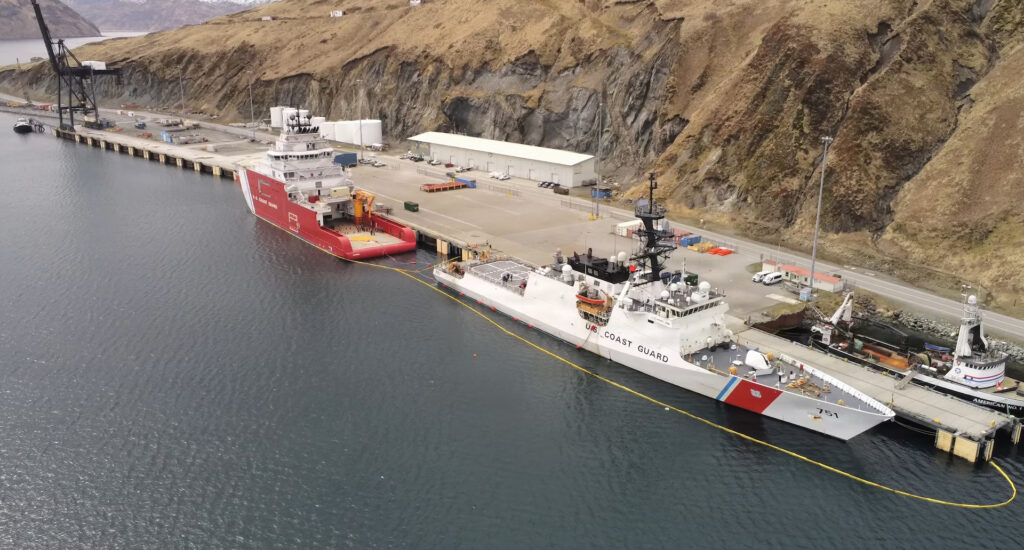
USCGC Storis (WAGB 21) and USCGC Waesche (WMSL 751) conduct a proof‑of‑concept fueling‑at‑sea evolution while moored in Dutch Harbor, Alaska, May 1, 2026. The evolution marked a successful operation as first of its kind with a new Polar Asset. (U.S. Coast Guard photo via shipboard drone by Lt. j.g. Genzo Matua Gonzales) May 22, 2026
From U.S. Coast Guard Arctic District, May 22, 2026
ALAMEDA, Calif. – The crew of U.S. Coast Guard Cutter Waesche (WMSL 751) returned to their homeport in Alameda Friday after concluding a 113-day patrol in the Bering Sea. The cutter traveled 18,685 nautical miles conducting a broad range of operations including maritime law enforcement, search and rescue and the integration of new capabilities, all while projecting U.S. presence in the high north environment.
The Waesche crew rescued five mariners from the fishing vessel Ocean Bay after it ran aground and began taking on water near Umnak Island, Alaska. The cutter provided on scene support while an Air Station Kodiak MH-60T Jayhawk helicopter crew hoisted the fishermen to safety. Additionally, the Waesche provided communications and oversight during the aerial rescue of two hikers stranded in the Dutch Harbor mountains.
The primary mission of the patrol was protecting the U.S. commercial fishing fleet, securing, controlling, and defending U.S. borders and maritime approaches. Waesche’s crew conducted 15 boardings, discovering 11 violations.
The deployment also highlighted the Coast Guard’s commitment to joint operations and technological advancements in the Arctic. The crew conducted deck landing qualifications for more than 64 flight hours with pilots from Air Station Kodiak and the Alaska Air National Guard’s 210th Rescue Squadron. This patrol also saw the initial integration of the V-BAT unmanned aircraft system (UAS), a remote surveillance drone capable of vertical takeoff and landing, which provides persistent airborne surveillance to support a wide range of Coast Guard missions from a smaller footprint.
In a demonstration of the service’s capability to sustain forces in the high north, Waesche conducted the first-ever fueling at sea exercise with the Coast Guard Cutter Storis (WAGB 21) in Dutch Harbor, Alaska. The exercise proved Storis’s unique ability to extend asset time on station and deliver fuel direct to another cutter, maximizing the nation’s operational footprint. The two cutters also engaged in a passing exercise, maneuvering in close formation to hone visual communication and ship handling skills.
“The Bering Sea is one of the most challenging areas that the Coast Guard operates in, especially during the winter,” says Capt. Tyson Scofield, commanding officer of Waesche. “I am extremely proud of the grit and devotion to duty that the crew displayed by rising to the challenges of sub-freezing temperatures, equipment casualties and a government shutdown to successfully execute a myriad of missions and provide sovereign presence in this challenging environment.”
Waesche is a 418-foot National Security Cutter with a top speed of 28 knots, a range of 12,000 nautical miles, and a permanent crew of 120. She is equipped with a 4,000 square-foot flight deck and hangars capable of housing two multi-mission helicopters.
U.S. Coast Guard Commissions 62nd Fast Response Cutter Honoring 9/11 Hero
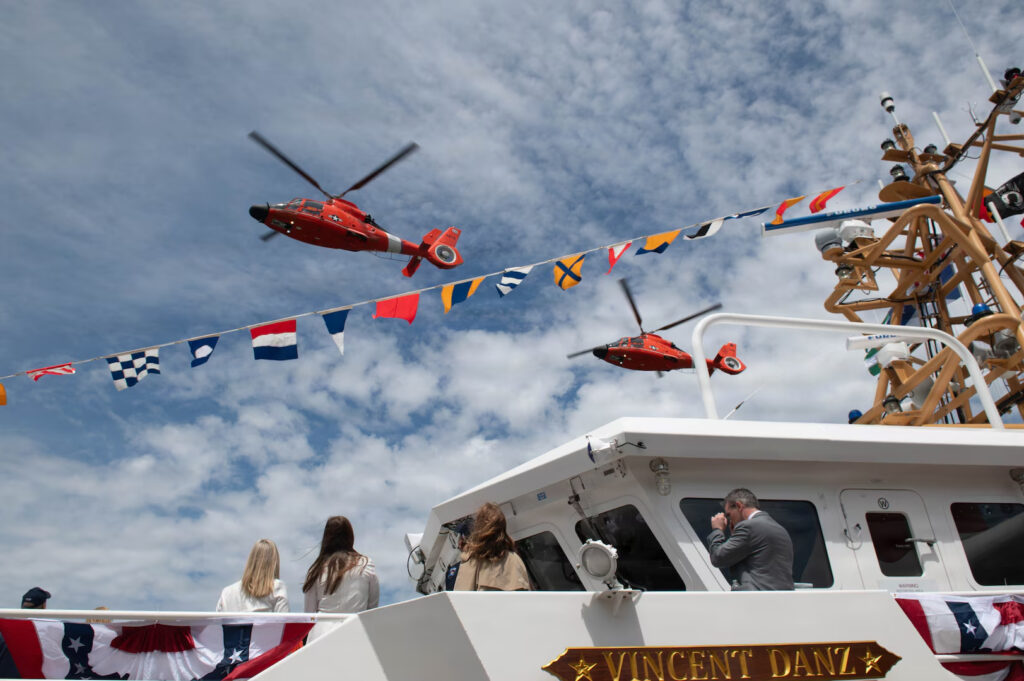
Two U.S. Coast Guard MH-65 Dolphin helicopters fly over the Coast Guard Cutter Vincent Danz (WPC 1162) following the cutter’s commissioning ceremony in New York City, May 22, 2026. The Vincent Danz is the 62nd Fast Response Cutter and honors Petty Officer 2nd Class Vincent Danz, a New York City police officer and Coast Guard reservist who died responding to the September 11, 2001, attacks. (U.S. Coast Guard photo by Marco A. Gutierrez Rosales)
From U.S. Coast Guard Forces Micronesia, May 22, 2026
NEW YORK — The U.S. Coast Guard commissioned its newest Fast Response Cutter, USCGC Vincent Danz (WPC 1162), for official entry into its service fleet during a ceremony held in New York City on Friday.
The Vice Commandant of the Coast Guard, Vice Adm. Thomas Allan, presided over the ceremony. Members of the Danz family were also in attendance, including the cutter’s sponsor, Ms. Angela Donohue, widow of the late Vincent Danz.
“Vincent Danz’s legacy will live on not only through his family and his brothers and sisters in the NYPD, but through the Coast Guard crew who will breathe life into this cutter today,” said Adm. Tom Allan. “The Coast Guard Cutter Vincent Danz will perform the Coast Guard’s vital work across Oceania—projecting U.S. presence, countering illicit maritime activity, and strengthening our international partnerships.”
The Vincent Danz is the 62nd Sentinel-class Fast Response Cutter in the service and the fourth of five FRCs to be homeported in Guam with U.S. Coast Guard Forces Micronesia/Sector Guam. The crew of the Vincent Danz will primarily serve U.S. and mutual interests in Oceania with an emphasis on the Micronesia and Melanesian sub-regions, conducting maritime security operations, combating illegal activity, supporting search and rescue missions, and strengthening partnerships with Pacific Island nations and Allies. The cutter is a multi-mission platform.
The cutter’s namesake, Vincent Danz, was serving in the New York City Police Department, Emergency Services Unit, ESU Truck 3, when he responded to the World Trade Center as part of a massive emergency response and was killed when the World Trade Center collapsed. He was posthumously awarded the New York City Police Department’s Medal of Honor for his heroic deeds. He was a veteran of the United States Marine Corps and joined the New York City Police Department in 1987, while continuing to serve in the U.S. Coast Guard Reserve as a Port Security Specialist 2nd Class.
As a U.S. Coast Guard reservist, Danz understood the meaning of service to country and community. His courage in the face of unimaginable danger and his dedication to saving others made him a hero not only to New York City but to the nation. This cutter honors his memory and the legacy of all first responders who gave their lives on Sept. 11, 2001.
The Vincent Danz will join the Myrtle Hazard (WPC 1139), Oliver Henry (WPC 1140), and Frederick Hatch (WPC 1143), all of which were commissioned in Guam. Since their 2021 commissioning, Guam’s FRC crews have distinguished themselves across the region, most recently responding to the impacts of Super Typhoon Sinlaku on communities in the Marianas. USCGC Myrtle Hazard’s crew became the first to operationalize the bilateral maritime law enforcement agreement with Papua New Guinea, conducting joint patrols and boardings in 2023. USCGC Oliver Henry’s crew saved around a dozen mariners in the Federated States of Micronesia, delivered humanitarian assistance during the Yap drought, and towed the 500-ton yacht Black Pearl to the Republic of Palau, rescuing 11 people in 2024. USCGC Frederick Hatch became the first FRC to visit several Pacific ports, including Tacloban, Philippines, for the 80th anniversary of the Battle of Leyte Gulf, and the crew operationalized the enhanced bilateral agreement with Palau in 2024.
The U.S. Coast Guard ordered a series of new FRCs to replace the 1980s-era Island-class 110-foot patrol boats. Using the $25 billion provided by the historic Fiscal Year 2025 budget reconciliation, which includes $1 billion for additional FRCs, the Coast Guard has already ordered over $13 billion in new fleet assets and capabilities. This rapid investment demonstrates the Coast Guard’s commitment to modernizing acquisition, delivering next-generation technology, and revitalizing American shipbuilding.
The FRCs feature advanced command, control, communications, computers, intelligence, surveillance, and reconnaissance equipment, as well as over-the-horizon cutter boat deployment capability, enhancing the Service’s ability to control, secure, and defend U.S. borders and maritime approaches. These new assets and capabilities continue the U.S. Coast Guard’s modernization, through which the Service is transforming into a more agile, capable, and responsive fighting force.
The commissioning ceremony is a traditional milestone in a cutter’s life, marking its entry into active service and signifying its readiness to conduct operations.