USCENTCOM Forces Continue to Target Houthi Terrorists 

From U.S. Central Command, Apr. 27, 2025 
 

TAMPA, Fla. –Since March 15, U.S. Central Command (USCENTCOM) forces have conducted an intense and sustained campaign targeting the Houthi terrorist organization in Yemen to restore freedom of navigation and American deterrence.  These operations have been executed using detailed and comprehensive intelligence ensuring lethal effects against the Houthis while minimizing risk to civilians. 

  • To preserve operational security, we have intentionally limited disclosing details of our ongoing or future operations. We are very deliberate in our operational approach, but will not reveal specifics about what we’ve done or what we will do. 

  • We will continue to increase the pressure and further disintegrate Houthi capabilities as long as they continue to impede freedom of navigation. 

  • Since the start of Operation Rough Rider, USCENTCOM has struck over 800 targets.  These strikes have killed hundreds of Houthi fighters and numerous Houthi leaders, including senior Houthi missile and UAV officials. 

  • The strikes have destroyed multiple command-and-control facilities, air defense systems, advanced weapons manufacturing facilities, and advanced weapons storage locations.  These storage facilities housed advanced conventional weapons, including anti-ship ballistic and cruise missiles, unmanned aerial systems, and uncrewed surface vessels, which were employed in Houthi terrorist attacks on international shipping lanes. 

  • While the Houthis have continued to attack our vessels, our operations have degraded the pace and effectiveness of their attacks.  Ballistic missile launches have dropped by 69%. Additionally, attacks from one way attack drones have decreased by 55%. 

  • U.S. strikes destroyed the ability of Ras Isa Port to accept fuel which will begin to impact Houthi ability to not only conduct operations, but also to generate millions of dollars in revenue for their terror activities. 

  • The operation has been conducted by a robust assembly of forces to include two Carrier Strike Groups, the Harry S. Truman Carrier Strike Group and the Carl Vinson Carrier Strike Group.  We are extremely proud of our well-trained and professional forces as they have effectively delivered precise and lethal strikes against Houthi military capabilities. 

  • Iran undoubtedly continues to provide support to the Houthis. The Houthis can only continue to attack our forces with the backing of the Iranian regime. 

  • We will continue to ratchet up the pressure until the objective is met, which remains the restoration of freedom of navigation and American deterrence in the region. 


USNS Sojourner Truth Christened as MSC’s Newest Fleet Replenishment Oiler 

From Sarah Cannon, April 28, 2025 

SAN DIEGO — Military Sealift Command’s (MSC) newest fleet replenishment oiler USNS Sojourner Truth (T-AO 210), was christened during a ceremony at the General Dynamics NASSCO shipyard in San Diego, Calif., last night. 

The event was attended by Dr. Brett A. Seidle, performing the duties of the Under Secretary of the Navy; Vice Adm. John F. G. Wade, commander, U.S. THIRD Fleet; Capt. Micah Murphy, commander, Military Sealift Command Pacific; executives and employees of NASSCO San Diego; and the decedents of Sojourner Truth. 
 
The ship honors Sojourner Truth, and escaped slave who became an American abolitionist and activist for African-American civil rights, women’s rights, and alcohol temperance. 
 
“We reserve the naming of our ships for special places, historic events and great people who represent the best among us, and who’s distinguished contributions are worthy of our remembrances for generations to come,” said Seidel. “In that vein, Sojourner Truth was a natural choice to be memorialized with a ship bearing her name.” 
 
The official christening moment happened when the ship’s sponsor, Barbara Allen, the sixth-generation granddaughter of Sojourner Truth, broke a bottle of champagne over the ship’s bow with the words, “For the United States of America, I christen you the USNS Sojourner Truth. May God bless this ship and all who sail on her.” Following the christening moment, the ship blew her horns and slid down the rails, amid a fanfare of music from the Navy Band Southwest and a shower of red, white and blue streamers. 
 
The 746-foot Truth is the sixth ship of the John Lewis fleet replenishment oiler class. Truth has the ability to carry 162,000 barrels of diesel ship fuel, aviation fuel and dry stores cargo. The John Lewis class is built with double hulls to protect against oil spills and strengthened cargo and ballast tanks and will be equipped with a basic self-defense capability. The Lewis-class of oilers will replace the current Kaiser Class fleet replenishment oilers as they age out of the MSC fleet. 
 
“The greatness of this ship is only matched by the greatness of her crew who represent the thousands of Civil Service Mariners at sea today and the staff of Military Sealift Command who support them ashore, “said Murphy. “Our nation and our Navy are fortunate to have these Americans who step forward through the maritime academies, the union halls, the maritime industry, and many other walks of life, from all corners of the nation to serve in the United States Merchant Marine. In peacetime or war, U.S. Merchant Mariners have answered the call to service every time. They demonstrate a deep and rich history of professionalism, seamanship, and bravery across the globe.” 
 
In addition to Truth, three more Lewis-class oilers are on order for the Navy. In July 2016, US Secretary of the Navy Ray Mabus said that he would name the Lewis-class oilers after prominent civil rights activists and leaders including Harvey Milk, Lucy Stone, Thurgood Marshall, Ruth Bader Ginsburg and Harriet Tubman. 
 
“The Navy’s ability to project power across the globe depends on sustained operations at sea and that simply wouldn’t be possible without ships like USNS Sojourner Truth,” said Murphy. “Without MSC’s Combat Logistics Force, carrier strike groups and amphibious forces would be tethered to shore-based support, severely limiting their reach and operational tempo. In short, these ships enable U.S. naval forces to remain forward-deployed, flexible, and ready to respond anywhere in the world on short notice.” 
 
MSC directs and supports operations for approximately 140 civilian-crewed ships that replenish U.S. Navy ships at sea, conduct specialized missions, preposition combat cargo at sea around the world, perform a variety of support services, and move military equipment and supplies to deployed U.S. forces. MSC exists to support the joint warfighter across the full spectrum of military operations, with a workforce that includes approximately 6,000 Civil Service Mariners and 1,100 contract mariners, supported by 1,500 shore staff and 1,400 active duty and reserve military personnel. 


Coast Guard Offloads More than $214 million Worth of Illegal Cocaine in San Diego 

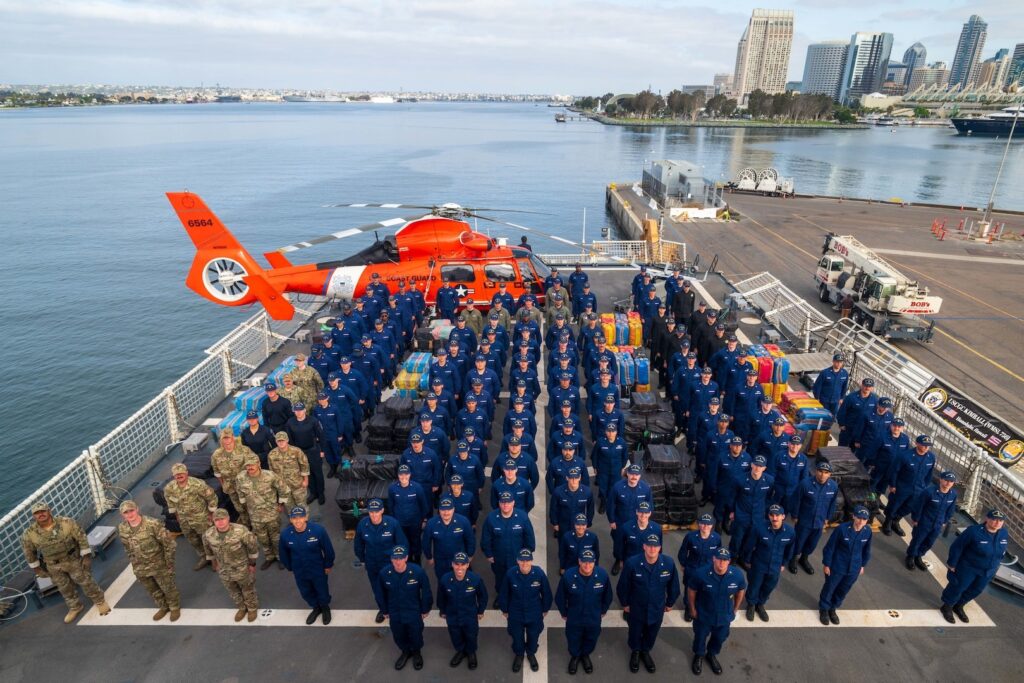
U.S. Coast Guard Cutter Kimball (WMSL 756) crew members, Tactical Law Enforcement Team South, U.S. Coast Guard Maritime Safety and Security Team Los Angeles/Long Beach, Navy, Helicopter Interdiction Tactical Squadron Jacksonville all stand at attention during an all hands event during a drug offload in San Diego April 24, 2025.  (U.S. Coast Guard photo by Petty Officer 3rd Class Austin Wiley) 

From U.S. Coast Guard Pacific Area, April 24, 2025 

SAN DIEGO — The crew of the U.S. Coast Guard Cutter Kimball (WMSL 756) offloaded approximately 18,898 pounds of cocaine, with an estimated value of more than $214.3 million, on Thursday in San Diego.    

The offload is a result of six separate suspected drug smuggling vessel interdictions or events off the coasts of Mexico and Central and South America by the Coast Guard Cutter Kimball and Coast Guard Cutter Forward during the months of February through April.  

Multiple U.S. agencies, including the Departments of Defense, Justice, and Homeland Security, collaborate in the effort to combat transnational organized crime. The Coast Guard, Navy, Customs and Border Protection, FBI, Drug Enforcement Administration, and Immigration and Customs Enforcement, along with allied and international partner agencies, all play a role in counter-narcotic operations.    

The fight against drug cartels in the Eastern Pacific Ocean requires unity of effort in all phases, from detection, monitoring and interdictions to criminal prosecutions by international partners and U.S. Attorneys’ Offices in districts across the nation. The law enforcement phase of counter-smuggling operations in the Eastern Pacific Ocean is conducted under the authority of the Eleventh Coast Guard District, headquartered in Alameda, California. The interdictions, including the actual boardings, are led and conducted by members of the U.S. Coast Guard. The Coast Guard continues to increase operations to interdict, seize, and disrupt transshipment of cocaine and other bulk illicit drugs by sea. These drugs fuel and enable cartels and Transnational Criminal Organizations to produce and traffic illegal fentanyl threatening the U.S.     

The Coast Guard Cutter Kimball is one of two legend-class national security cutters homeported in Honolulu, Hawaii.  

The Coast Guard Cutter Kimball’s crew can operate in the most demanding open ocean environments, and the vast approaches of the Southern Pacific, where significant narcotics trafficking occurs.


US Navy to Christen Future USNS Sojourner Truth

From the Navy Offoce of Information, 25 April 2025 

SAN DIEGO—The U.S Navy will christen the future USNS Sojourner Truth (T-AO 210) during a ceremony on April 26 at 8 p.m. (PDT) at General Dynamics NASSCO. 

Dr. Brett Seidle, performing the duties of the Under Secretary of the Navy, will deliver the principal address followed by remarks from Vice Adm. John Wade, commander, U.S. Third Fleet; Capt. Micah Murphy, commander, Military Sealift Command (MSC), Pacific; and Dave Carver, president, General Dynamics NASSCO. 

T-AO 210 is named in honor of Sojourner Truth, a nineteenth century civil rights activist from New York. In a time-honored Navy tradition, ship sponsor Barbara Allen, a sixth-generation descendant of the ship’s namesake, will christen the ship by breaking a bottle of sparkling wine across the bow. 

The christening of the future USNS Sojourner Truth symbolizes the Navy’s 250-year commitment to innovation and maritime dominance. From seabed to space, the Navy delivers power for peace – always ready to fight and win. This milestone marks the Navy’s enduring legacy and commitment to shaping the future of maritime power. 

John Lewis-class fleet replenishment oilers (T-AOs) are operated by MSC and feature substantial volume for oil as well as significant dry cargo capacity. They also possess aviation capability. T-AOs provide additional capacity to the Navy’s Combat Logistics Force and are a cornerstone of the Navy’s fuel delivery system. These ships are essential to sustaining contested logistics, enabling lethality even in sea-denied environments. 

General Dynamics NASSCO is currently in production of three additional T-AOs, with two more under contract for future production. Additionally, a Block Buy contract was issued in September 2024 for the detail design and construction of T-AO 214-221. 

Program Executive Office, Ships, one of the Department of Defense’s largest acquisition organizations, is responsible for executing the development and procurement of all destroyers, amphibious ships and craft, and auxiliary ships, including special mission ships, sealift ships and support ships. 


USS Cape St. George Arrives in San Diego after Modernization 

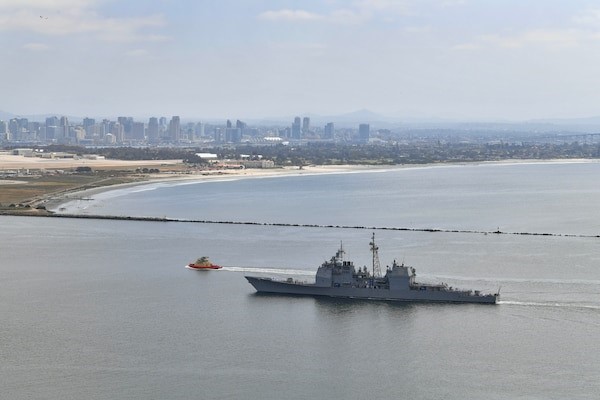
Ticonderoga-class guided missile cruiser USS Cape St. George (CG 71) arrives at the mouth of San Diego Bay, April 22, 2025. Cape St. George, previously based at Everett, Wash., completed her homeport change to Naval Base San Diego. (U.S. Navy photo by MC1 Kelby Sanders)

From Lt. Grace Kording, April 24, 2025 

SAN DIEGO – The Ticonderoga-class guided-missile cruiser USS Cape St. George (CG 71) arrived Apr. 22 in its new homeport of Naval Base San Diego, California from Naval Base Everett, Washington, after conducting phased modernization at Vigor Shipyard in Seattle. This move was a permanent change of station for the crew and family members. 

“I am so incredibly proud of this dedicated crew and for all of the hard work and sacrifice that brought Cape St. George back to life. Repairing and restoring systems after an extended modernization was a herculean effort, and this talented crew is the reason the ship was able to return to sea and reintegrate into our Navy’s fighting force,” said Capt. Jennifer Pontius, commanding officer of Cape St. George. 
 
The cruiser began modifications in June 2021 and is scheduled to conclude in 2025. During this time, Cape St. George underwent extensive upgrades to its hull, mechanical systems, engineering, and combat systems in preparation for rejoining maritime operations. 
 
“It’s been a long, rigorous journey bringing Cape St. George’s power plant back to life, but I am proud of the work we have done. I was filled with so many emotions when we got underway after spending numerous hours restoring the engine room equipment, but I understand this is only the beginning of our mission,” said Gas Turbine Systems Technician (Mechanical) 2nd Class Annsia Stewart. “We are ready to make San Diego our home!” 
 
The upgrades ensure Cape St. George remains one of the most technologically advanced and lethal ships in the U.S. Navy. 
 
“I arrived at Cape St. George while it was dry-docked, and it has been an amazing experience seeing the reconstruction to get the ship fully operational. It is an incredible opportunity to set a foundation for future Sailors,” said Lt. j.g. William Neel, Strike Officer. 
 
Cape St. George was commissioned June 12, 1993. The ship’s name commemorates the battle fought in the South Pacific off the island of New Ireland in the Bismarck Archipelago on Nov. 25, 1943. Modern U.S. Navy guided-missile cruisers are multi-mission Air Warfare, Undersea Warfare, Naval Surface Fire Support, and Surface Warfare (SUW) surface combatants capable of supporting carrier strike groups, amphibious forces, or independent missions. The mission of Commander, Naval Surface Force, Pacific Fleet is to man, train, and equip the Surface Force to provide fleet commanders with credible naval power to control the sea and project power ashore. 


USS New York, USS Oak Hill to Participate in Fleet Week New York 2025 

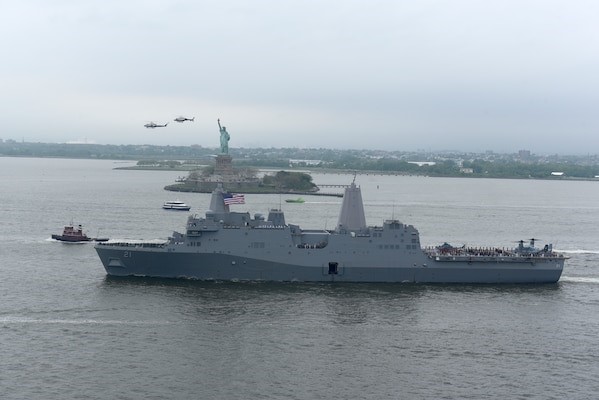
NEW YORK — USS New York (LPD 21) leaves New York Harbor at the conclusion of Fleet Week New York 2019. Fleet Week New York, now in its 31st year, is the city’s time-honored celebration of the sea services. It is an unparalleled opportunity for the citizens of New York and the surrounding tri-state area to meet Sailors, Marines and Coast Guardsmen, as well as witness firsthand the latest capabilities of today’s maritime services. (U.S. Navy photo by Chief Mass Communication Specialist Roger S. Duncan)

April 24, 2025 

NORFOLK, Va. – Fleet Week New York returns to New York City on May 21 – 27, 2025, with two U.S. Navy ships, two Coast Guard cutters, and five U.S. Navy Academy Yard Patrol boats (YPs). Additionally, our Canadian neighbor will join the week-long celebration.

Ships from the U.S. and Royal Canadian Navy will participate in the Parade of Ships on Wednesday, May 21.  
 
USS New York (LPD 21) and USCGC Calhoun (WMSL 759) will be available for public ship tours Friday and Saturday, May 23-24, from 9 a.m. to 4 p.m. Public ship tours in Staten Island will be available on May 22- 
26, from 9 a.m. to 4 p.m. 
 
The event has been held nearly every year since 1984. This year’s theme is “Honoring the Past, Defending the Future: 250 Years of Sea Service Excellence,” which celebrates the rich history of the sea services, honoring service members from the past, present, and future who play a crucial role in supporting the fleet while carrying out our maritime strategy and strategic objectives. 
 
“This year marks the 250th birthday of the Navy and Marine Corps, and as we continue to evolve as a fighting force, we are reminded that our greatest strength comes not only from our sea service members, but from the people we serve,” said Rear Adm. Carl Lahti, Commander, Navy Region Mid-Atlantic. “Fleet Week New York reminds us that behind every uniform is a story—of family, of sacrifice, and of service to something greater than self. As we celebrate 250 years of the Navy and Marine Corps, we are proud to return to a city whose strength and spirit mirror the very heart of our nation.” 
 
Ship and pier locations include: 
– Manhattan, Pier 88 South: (Ship public tours on Friday & Saturday, May 23-24, from 9 a.m. to 4 p.m.) 
• San Antonio-class amphibious transport dock, USS New York (LPD 21) from Norfolk, Virginia 
– Manhattan, Pier 90 North: (Ship public tours on Friday & Saturday, May 23-24, from 9 a.m. to 4 p.m.) 
• Legend-class cutter USCGC Calhoun (WMSL-759) from Charleston, South Carolina 
• Harry DeWolf-class offshore patrol vessel HMCS Frédérick Rolette (AOPV 434) from Halifax, 
Canada 
 
– Manhattan, Intrepid Museum, Pier 86: (Ship public tours on Thursday & Friday, May 22-23, from  
10 a.m. to 4 p.m.) 
• Five U.S. Naval Academy YPs from Annapolis, Maryland 
 
– Homeport Pier, Staten Island: (Ship public tours will be May 22 – 26 from 9 a.m. to 4 p.m.) 
• Whidbey Island-class dock landing ship USS Oak Hill (LSD 51) from Norfolk, Virginia 
• Bay-class cutter USCGC Sturgeon Bay (WTGB 109) from Bayonne, New Jersey 
2/2/2 
 
Please note: Canadian Navy Harry DeWolf-class offshore patrol vessel HMCS Frédérick Rolette (AOPV 434) will not be available for tours.  
 
The week-long event will include a variety of public military demonstrations. It is an unparalleled  
opportunity for the citizens of New York and the surrounding tri-state area to meet members of the sea  
services, as well as witness firsthand the latest capabilities of America’s maritime services. 


Marines Surpass 1,000 MQ-9A Flight Hours as Capabilities Expand 

From General Atomics Aeronautical Systems Inc. 

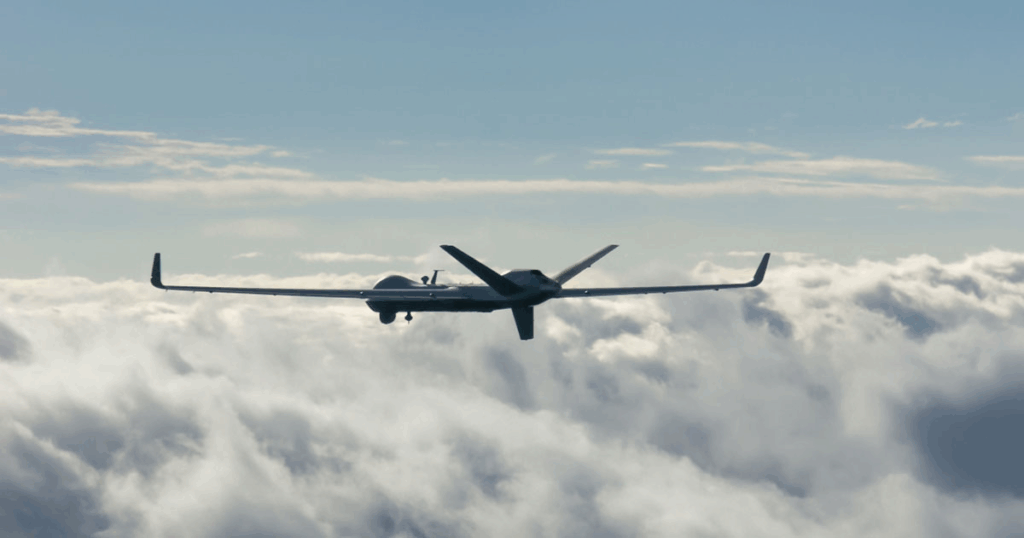
SAN DIEGO – 23 April 2025 – General Atomics Aeronautical Systems, Inc. is proud to announce that the U.S. Marine Corps has passed more than 1,000 flight hours with MQ-9A unmanned aircraft in support of service-level training exercises and weapons and tactics instructor courses. This accomplishment involved a combined aircrew of dedicated Marines and GA-ASI personnel, highlighting the seamless integration and operational effectiveness of the MQ-9A platform within the Marine Air-Ground Task Force (MAGTF) and the MAGTF Unmanned Expeditionary (MUX) Program. 

These demanding exercises showcased the advanced capabilities of the MQ-9A by integrating cutting-edge technologies such as the SkyTower networking support pod, Automatic Identification System, latest-generation Lynx® multi-mode radar and various other tactical networks and capabilities. The joint teams successfully conducted satellite launch and recovery activities operating out of a strategic expeditionary landing field near Marine Corps Air Ground Combat Center Twentynine Palms, Calif., further demonstrating the platform’s precision targeting and reconnaissance abilities in realistic training scenarios. 

Previously, an uncrewed aircraft required a crew positioned at the airfield where it was operating to fly it for takeoff via direct line-of-site radio link. Then a mission crew could take over the aircraft from anywhere via satellite. Today, satellite launch and recovery means the main Marine mission crew, which can be sited anywhere, flies the aircraft from takeoff via the satellite link. This capability, validated in the Marine Corps operations, enables huge flexibility and expands the locations from which units can operate. 

A key element of these exercises also included not only live-fire training but also comprehensive mission planning, networked communications, and multi-domain coordination. These events provided invaluable experience in integrating the MQ-9A into complex, distributed combat scenarios across the full range of Marine Air-Ground Task Force operations. From supporting maneuver elements with real-time intelligence, surveillance and reconnaissance to validating command and control networks, the MQ-9A consistently demonstrated its adaptability and operational value. This milestone underscores the platform’s critical role in enhancing situational awareness, mission execution, and overall effectiveness across the battlespace. 

“Reaching 1,000 flight hours for these rigorous training exercises alongside our Marine Corps and Air Force partners is a testament to the reliability and adaptability of the MQ-9A platform,” said GA-ASI President David R. Alexander. “This achievement highlights the power of collaboration and the critical role the MQ-9A can play in supporting the MAGTF’s mission readiness.” 

The successful integration of the MQ-9A platform across recent operations represents a major milestone in aligning capability with the MAGTF construct. These events showcased the MQ-9A’s ability to support distributed operations, extend sensor coverage, and provide persistent intelligence, surveillance and reconnaissance in support of dynamic mission sets. The coordinated efforts of Marines and GA-ASI personnel underscored the platform’s high degree of interoperability and its growing role in enabling expeditionary operations in contested environments. 

To date, GA-ASI has delivered 17 MQ-9A UAS to USMC. The USMC awaits delivery of three additional aircraft by the end of this year. 


T-54As Visit NAS Whidbey Island  

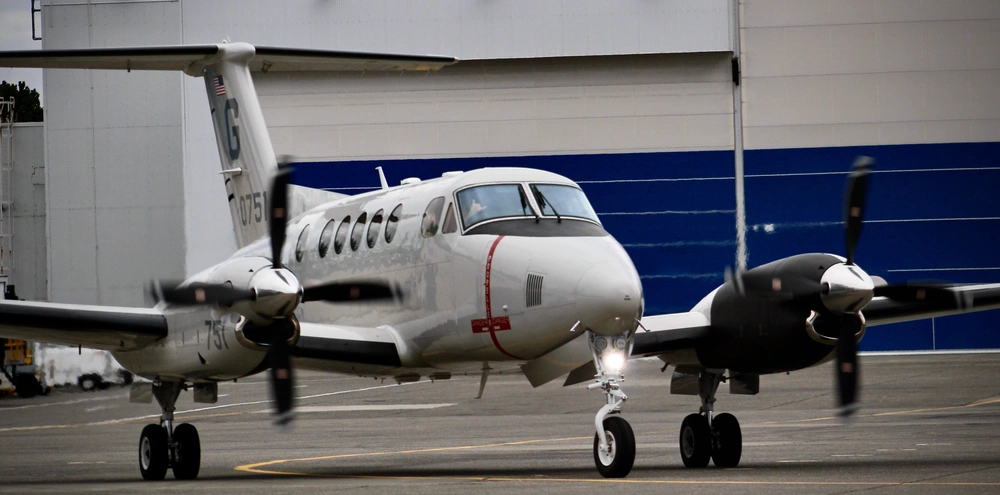
OAK HARBOR, Wash. (March 27, 2025) A T-54A Marlin, assigned to Training Wing Four, taxis while the pilot monitoring gives a shaka at Naval Air Station Whidbey Island, Wa. March 27 2025. A pair of T-54As arrived at NAS Whidbey Island Mar. 27 after completing their first cross-country flight to Washington State, showcasing the range capacity as the Navy’s newest multi-engine trainer. (U.S. Navy photo by Lt. Sara Wedemeyer) 

By Lt. Sara Wedemeyer, Chief of Naval Air Training, March 27, 2025   

WHIDBEY ISLAND, Wash – A pair of T-54As arrived at Naval Air Station (NAS) Whidbey Island Mar. 27 after completing their first cross-country flight to Washington State, showcasing the range capacity as the Navy’s newest multi-engine trainer. 
 
This cross country was used as training flights within the Flight Instructor Training Unit (FITU) Syllabus. The Instructors Under Training (IUTs), taught by FITU Instructor Pilots (IPs), will be the next generation of squadron IPs and the first to teach student naval aviators how to fly the T-54A. 
 
Lieutenant Hunter Jones, one of the visiting naval aviators, believes the T-54A will make a difference in the lives of student naval aviators at Training Wing Four, Naval Air Station Corpus Christi. 
 
“We are thrilled to begin training the next generation of pilots in the T-54A, a platform that will significantly enhance our ability to prepare naval aviators for the challenges ahead,” said Jones. “Flying the T-54A from Naval Air Station Corpus Christi to Naval Air Station Whidbey Island truly demonstrates its capabilities. Students are set to start training on the new plane in the next few weeks and this milestone would not have been possible without the exceptional leadership of Cdr. Michael “Textron” Brammer and the entire Multi Engine Training System (METS) FIT Team at Training Wing Four. Their dedication and expertise have been instrumental in ensuring the seamless transition to this aircraft.” 
 
The T-54A fleet is located at Naval Air Station (NAS) Corpus Christi as a member of Training Wing Four. The Navy’s newest generation of student naval aviators will use the T-54A to earn their wings of gold and go on to fly aircraft such as the P-8A Poseidon, E-2D Hawkeye, CMV-22 Osprey, E6-B Mercury, and the C-130 Hercules. 


Museum to Showcase Navy Military Medical Innovations 

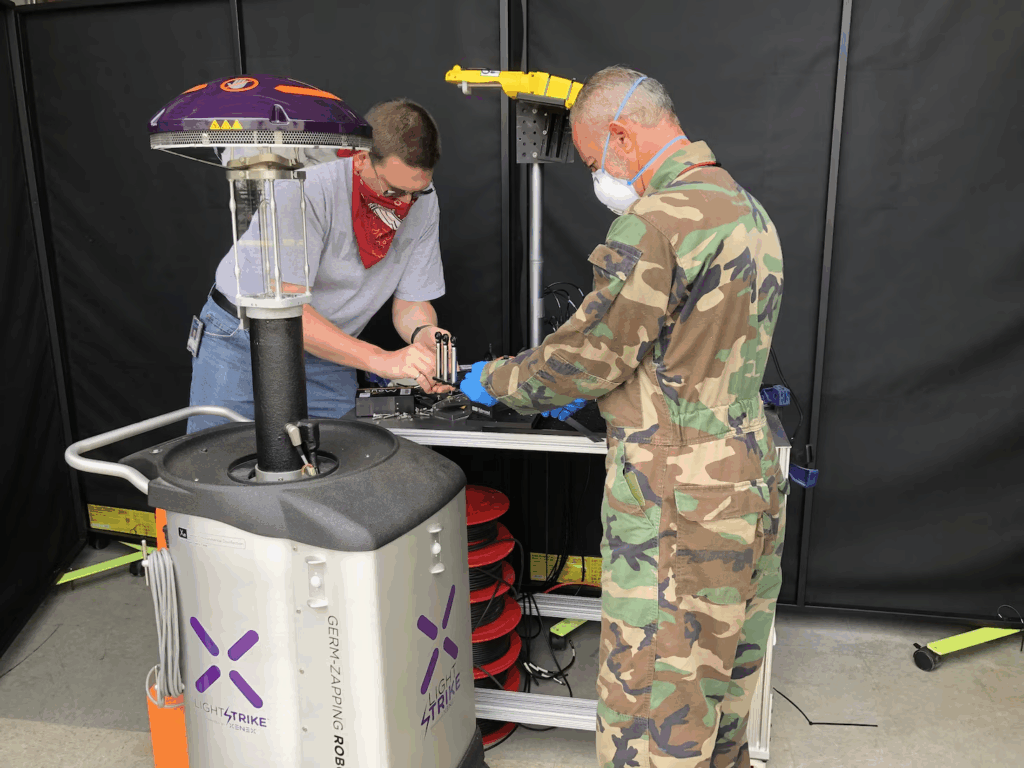
Principal Investigator of the U.S. Naval Research Laboratory (NRL) Navy Coronavirus Rapid Response Team (NCR2T) Team, Brett M. Huhman, Ph.D., P.E. from the Advanced Pulsed Systems Section and former NRL Engineering Technician Mike Jabari prepare a Xenon source for evaluation testing. Designed for whole-room disinfection, the team determined how effective the source would be from a light perspective, and Naval Surface Warfare Center Dahlgren Division followed up with a site visit to perform biological efficacy testing in the Ultraviolet Characterization Lab at NRL-DC Headquarters, May 2020. (U.S. Navy photo) 

By Nicholas E. M. Pasquini, U.S. Naval Research Laboratory Corporate Communications, April 22, 2025 

WASHINGTON, D.C.  –  The U.S. Naval Research Laboratory (NRL) recently transferred a number of historical artifacts related to the COVID-19 pandemic to the National Museum of Health and Medicine and is scheduled to exhibit military medical innovations to the public, Apr. 26. 
  
The Military Medical Innovation Family Event program takes place in the museum galleries where presenters from a variety of military activities conduct demonstrations and activities highlighting innovative products and research that benefit readiness, health, care, and rehabilitation of the warfighter. 
  
In April 2020, during the early stages of the COVID pandemic, the Naval COVID Rapid Response Team (NCR2T) was established by Naval Sea Systems Command (NAVSEA) after the USS Theodore Roosevelt (CVN 71) became the first ship in the U.S. Fleet to fight through a COVID-19 outbreak. The chief of naval operations then charged NAVSEA with evaluating technologies and developing processes and procedures to provide tools for Fleet commanders, type commanders, and ship commanders to ensure and promote mission readiness amidst the pandemic. 
  
NRL was tasked by NAVSEA with evaluating the efficacy of ultraviolet light sources procured by the NCR2T. The Plasma Physics Division leveraged experience across multiple disciplines to design a standardized measurement test stand, verify calibration of measurement equipment, and perform analysis of the devices.  
  
NRL researchers evaluated commercial ultraviolet (UV) sources for viral disinfection to combat COVID-19 on land and at sea and established a dedicated UV characterization lab in five days to ensure safe introduction and effective operation of UV sources across the Fleet. 
  
This work was done in close collaboration with the Naval Surface Warfare Center Dahlgren Division, which performed biological surrogate testing to evaluate the effectiveness of the UV sources for disinfection of COVID-19 on surfaces relevant to Navy applications. The devices range from small, hand-held UV sources to large devices meant to disinfect an entire room.  
  
The laboratory used an automated 3-axis motorized translation stage to measure the light emitted from ultraviolet light sources to measure both the intensity and quality of the light generated by the devices. Data was collected from this apparatus to create 2D “maps” of the light emitted from the sources to enable comparison of different technologies. 
  
In addition, NRL’s work helped identify situations where use of UV provides sufficient viral disinfection at a particular energy level and the development of standard operating procedures to ensure safe UV operation for the Fleet
 
“NRL’s commitment to performing leading-edge fundamental and applied research has enabled the Lab to be instrumental in numerous innovations that have significantly enhanced the capabilities of the U.S. Navy and nation as a whole,” said NRL Plasma Physics Division Superintendent Joe Peñano, Ph.D. “This legacy of innovation underscores NRL’s commitment to swiftly supporting Fleet operations as well as addressing emerging challenges.” 
 
The devices transferred were critical in the development of the Navy’s response to the COVID -19 pandemic. “These devices represent hundreds of hours of research by engineers and physicists in the Plasma Physics Division at NRL to provide evaluation criteria to the Fleet for immediate use,” said Principal Investigator of the NRL NCR2T Team, Brett M. Huhman, Ph.D., P.E. from the Plasma Physics Division. “We were able to respond rapidly to NAVSEA’s call for support, with a laboratory set up and ready to evaluate the devices within a week.” 
  
Military medical innovations are changing the way health care is delivered in the Military Health System. During this family-friendly event, visit with DOD experts as they showcase the latest in virtual reality, medical simulation, and much more. This is a great opportunity to speak with multi-disciplinary NRL subject matter experts to also learn more about other research programs and associated technologies on display: 
  
Buzz Off: Protection From the Small, But Deadly 
This station demonstrates recently developed NRL technology that defends from some of the most dangerous animals on the planet—bugs. In this demo, we will go over the historical impact of insects on military and civilians, current strategies to protect against these tiny assailants, and future polymer-based fiber and gel technologies to repel these bugs out of everyday life. 
  
From Sample to Sequence in the Field: A Closer Look at Bacteria and their DNA 
Bacteria live in nearly every environment on earth and are important to this planet’s ecosystems. Most serve a useful purpose, but some can cause disease in humans. Using strep throat as a case study, we will demonstrate some of the tools and latest technologies we use to identify and study bacteria, including uncovering the genetic sequence of these tiny organisms with a portable DNA sequencer. 
 
About the U.S. Naval Research Laboratory 
NRL is a scientific and engineering command dedicated to research that drives innovative advances for the U.S. Navy and Marine Corps from the seafloor to space and in the information domain. NRL is located in Washington, D.C. with major field sites in Stennis Space Center, Mississippi; Key West, Florida; Monterey, California, and employs approximately 3,000 civilian scientists, engineers and support personnel 


HII Hosts HD Hyundai Heavy Industries Leaders at Ingalls Shipbuilding 

From HII 
 

PASCAGOULA, Miss., April 22, 2025 (GLOBE NEWSWIRE) — HII (NYSE: HII) hosted HD Hyundai Heavy Industries leaders at the company’s Ingalls Shipbuilding division Tuesday, advancing joint goals of the memorandum of understanding signed by the two companies earlier this month. The visit focused on identifying near-term opportunities and exploring the implementation of new processes that could support the acceleration of ship production. 

“This visit is a continuation of the important dialogue taking place between HII and our international partners,” Ingalls Shipbuilding President Brian Blanchette said. “Today’s visit allowed us to showcase the great work our Ingalls shipbuilders do every day in support of national security and an opportunity to exchange ideas on best practices, while examining what we can begin working on right away.” 

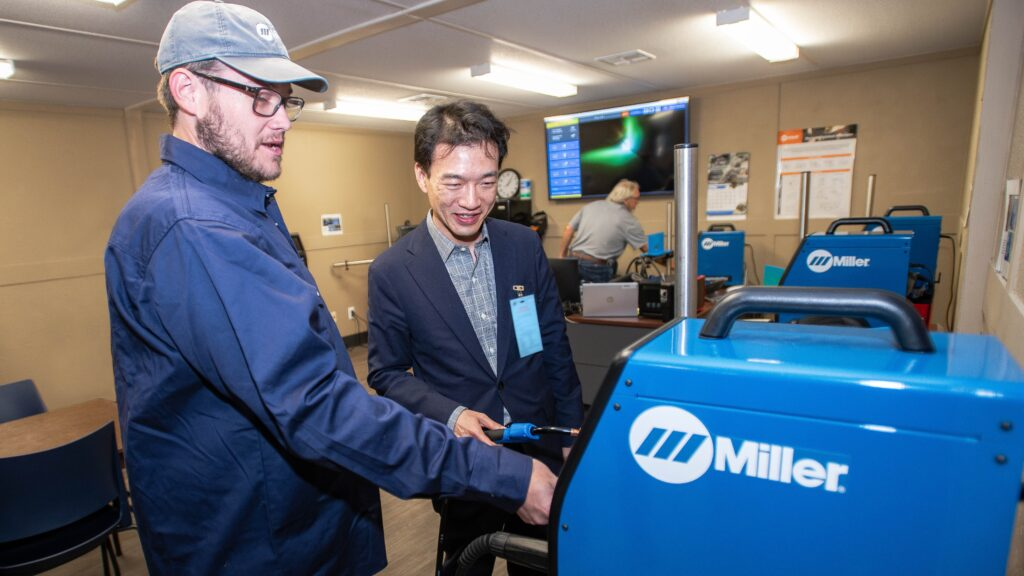
The visit included meetings with Ingalls leadership, a tour of the shipyard and a stop at the company’s new virtual welding lab, where the group experienced how this immersive, hands-on training environment is not only enhancing the skills of current and future shipbuilders, but also setting a new national benchmark for how technology can be leveraged to grow a highly proficient workforce in this essential trade. 

Photos accompanying this release are available at: https://hii.com/news/hii-hosts-hd-hyundai-heavy-industries-leaders-at-ingalls-shipbuilding/

“We appreciate the opportunity to visit our partners at HII and see how they are using technology to enhance efficiency and quality at Ingalls,” Chief Executive of the Naval & Special Ship at HHI Won-ho Joo said. “We look forward to building on the strong foundation set by our recent MOU announcement.” 

HII and HHI are two of the world’s leading shipbuilders across multiple classes of ships. By working with shipbuilding allies, this strategic partnership aims to leverage the combined expertise and resources of both companies to advance technological innovation, maximize production efficiency, and strengthen the global defense industry.