Sea-Air-Space: First P-8A Overhauled by L3Harris to Be Delivered in 2025
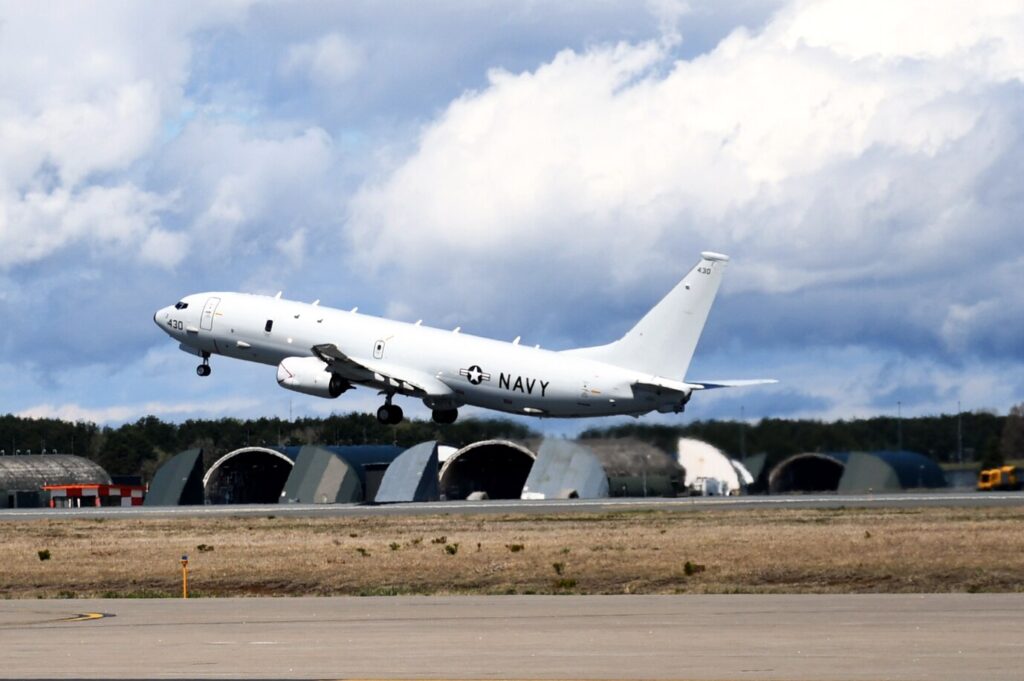
A P-8A Poseidon assigned to the “Red Lancers” of Patrol Squadron 10 takes off on a search and rescue mission flight. Photo credit: U.S. Navy | Mass Communication Specialist First Class Ashley Guire
The first P-8A Poseidon maritime patrol aircraft to be overhauled by L3Harris (Booth 937) is scheduled to be delivered back to the U.S. Navy this year, a company official said.
L3Harris was awarded an indefinite delivery/indefinite quantity contract in September 2024 from the Naval Air Systems Command (NAVAIR) for depot-level maintenance, overhaul, and repair of the Navy’s fleet of P-8As, which will number 135 upon completion of the service’s planned procurement, said Jason Lambert, president of Intelligence, Surveillance and Reconnaissance at L3Harris. The program is scheduled to continue through September 2029.
“NAVAIR’s No. 1 priority is aircraft availability, and it’s an honor for us at L3Harris to support the Navy to ensure the P-8 aircraft is mission-ready,” Lambert said.
Lambert said the company currently has four P-8As in its workflow, with a capability to induct a minimum of nine aircraft per year, and the potential capability to induct 12 aircraft the first year. The work will be accomplished at the company’s facility in Waco, Texas.
He said the contract allows processing foreign P-8 aircraft along with U.S. Navy aircraft.
“The Navy awarded the ID/IQ to both L3Harris and AAR,” he said. “AAR previously had this program. The Navy decided to go with a dual source, so the Navy determines the allocation of the aircraft across our two companies.
“L3 has provided decades of modification and sustainment support on the P-3 Orion, the predecessor of the P-8 platform across multiple customers including the U.S. Navy, NOAA, and the [defense] ministries of Brazil, New Zealand, and the Republic of Korea ,and we’re very honored to extend our long-lasting support to the U.S. Navy by supporting this next-generation Poseidon fleet,” Lambert said.
Sea-Air-Space: Textron Offers the Tsunami USV Family for Multi-Purpose Navy Use
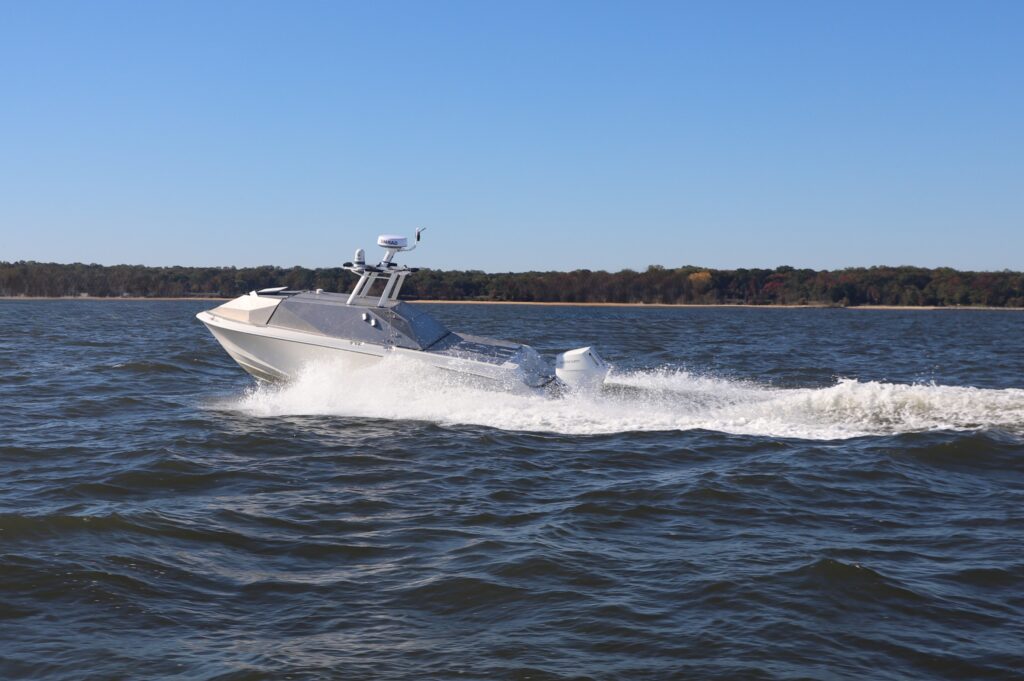
Tsunami, a small USV, is a joint effort by Textron Systems and Brunswick Corp. Photo credit: Textron Systems
Textron Systems (Booth 1827, D1), originator of the Common Unmanned Surface Vehicle (CUSV) in U.S. Navy service, has developed a less expensive USV that could be used for a variety of missions and could even be considered attritable.
Textron is teamed with Brunswick Corp., a small craft manufacturer, to offer Tsunami, family of deployable, small, scalable, gasoline-powered outboard-engine craft, with hull lengths ranging from 14 to 42 feet long. Certain of the models have a payload capacity of 1,000 pounds, ranges between 600 and 1,000 nautical miles, and operable in Sea State 4.
“We are the originator of the common uncrewed surface vehicle, the CUSV, for the Navy which was successfully adapted to become the Navy’s first unmanned surface vehicle program of record and which is being fielded to the littoral combat ship fleet now [for mine countermeasures],” said David A. Phillips, senior vice president, Air, Land & Sea Systems, Textron Systems, in a briefing to reporters. “Surface warfare that doesn’t necessarily require the power and the weight necessary in a mine countermeasure system.”
Phillips noted several mission sets that an inexpensive unmanned craft could take on, including port security, port surveillance, escort and training.
“We have been in constant collaboration with Navy and commercial customers as to what a system like this might bring them in terms of operational flexibility [and] emerging mission sets,” he said. We continue discussion with the Navy — all elements of the Navy to include fleet as well as our particular programs in which we work. And we’ve been hearing an increased expression of interest in a small, rapidly deployable, unmanned surface vehicle that can support a variety of missions beyond mine countermeasures.”
Brunswick, builder of recreational watercraft of such product lines as Boston Whaler, Bayliner and Mercury Marine, has craft adaptable to Textron’s vision and has established supply lines.
“Brunswick’s portfolio of reliable high-performance vessels — their watercraft, propulsion systems, control systems — and manufacturing capacity and their global footprint along with our mature autonomy technology and systems integration capability was really the perfect combination to allow us to develop an accessible, rapidly deployable, and what I call a modular open systems architecture oriented family of vehicles or systems,” Phillips said.
“Brunswick’s technologies are already in mass commercial production and globally available. That allows us to reduce costs, risk, and production time when integrating and ultimately delivering these vessels. Their global footprint and mature resilience supply chain provides our customers with an unmatched support and aftermarket service.”
Brunswick “has invested in and developed a built‑in drive-by-wire system for us to ramp our higher levels of operationally relevant autonomy that we’ve developed and delivered to the U.S. Navy and that we’ve proven through mine countermeasure unmanned surface vehicles and that we fielded operationally with the Navy and demonstrated through exercises like RIMPAC and FLEX,” he said.
Phillips said the Tsunami could be fielded rapidly.
“We recognize the need for a ready-now solution that harnesses the capability and capacity of the U.S. industrial base,” he said. “That’s important at being able to scale and being able to rapidly deploy systems when our customer wants them. … Speed. Speed to market. Speed to contract. Speed to delivery. Leveraging this mature production capability enables rapid production without the costs and risks of developing boutique manufacturing capability and scaling mass production. These watercraft are already in production.”
The Tsunami craft is adaptable to swarming tactics, according to Textron.
“We’ve also done some testing in that realm,” Phillips said. “Although I’m not going to go into certain mission scenarios, the swarm is important and controlling multiple systems is important. We’ve done that for many years with our aircraft systems. We understand swarming of systems. We also understand the complexity associated with that. We have designed this system and we have demonstrated this system to operate multiple watercraft. I won’t get into how many.”
The low cost of the Tsunami is key to the craft being attritable, Phillips said.
Asked by Seapower if the USVs used by Ukraine against the Russian navy were part of the inspiration for the Tsunami, Phillips replied that “it certainly informed us of that emergent need. … I am not presupposing what one of our customers might use our system for.”
Aircraft Carrier Suppliers Warn of Production Going Cold
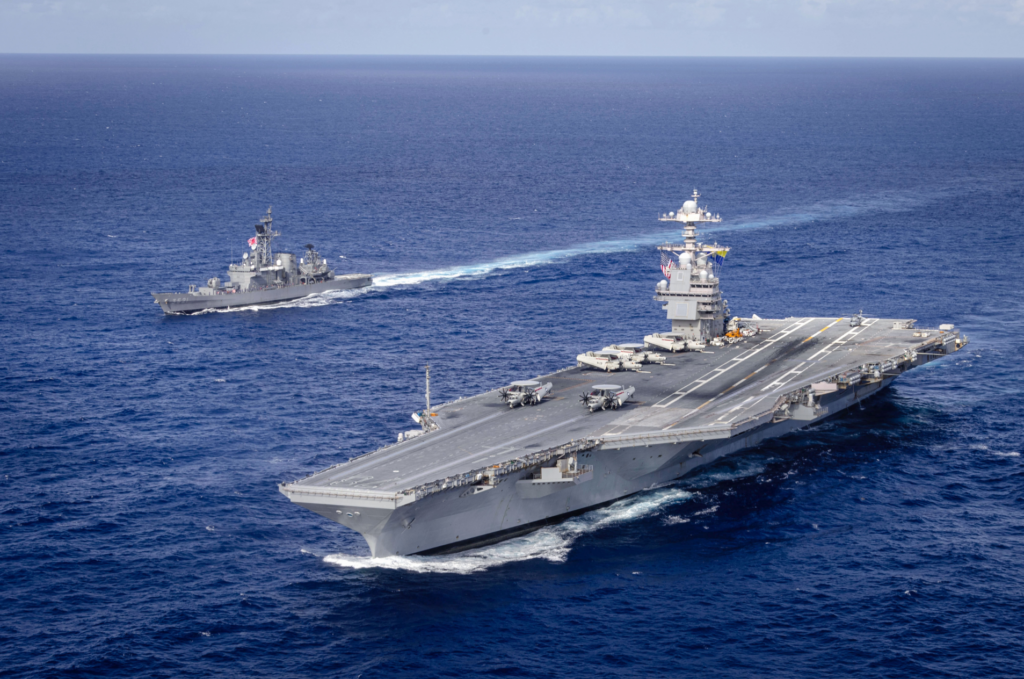
The world’s largest aircraft carrier, USS Gerald R. Ford (CVN 78), sails in formation with Japan Maritime Self Defense Force (JMSDF) Hatakaze-class guided missile destroyer JS Shimakaze (TV-3521) while conducting routine operations in the Atlantic Ocean, Sept. 23, 2024. (U.S. Navy photo by MC2 Jacob Mattingly)
By Richard R. Burgess, Senior Editor
ARLINGTON, Va. — The coalition of industrial base suppliers for aircraft carrier production is warning that some suppliers’ production lines are going “cold” or soon will do so in there is further delay in starting procurement for the next Gerald R. Ford-class aircraft carrier, (CVN 82).
The Aircraft Carrier Industrial Base Coalition (ACIBC) is looking for a $600 million commitment from the Congress in advance procurement toward the construction of CVN 82. Last week ACIBC leaders and members met with members of Congress to discuss carrier funding.
“We’re asking for $600 million of advance procurement funding so that we can start long-lead material and get that ball rolling [for CVN 82],” said Lisa Papini, chair of the ACIBC. “We’re looking for a commitment to start CVN 82 no later than Fiscal Year 2029.”
Papini said the situation is worse for suppliers this year than last.
“Last year when we were here, we were warning that companies in our coalition without a new ship award would start to go cold, specifically, people that are doing continuous production lines would start to have those production lines go cold in the near future,” she said. “This year we have companies that are saying they have gone cold, or they will be cold — and by cold, I mean that that production line has ceased continuous operation.”
According to an ACIBC fact sheet with the results of a survey of 219 suppliers, 73% of member critical or single-source material supply lines are cold or will go cold in 2026 without the advance funding. Those percentages would increase in 2027 and 2028 to 83% and 96%, respectively, without the advance funding. A majority of the suppliers also provide products and materials for submarine construction as well.
To deal with the business delays, suppliers are reassigning workforce to other business or exploring other business outside of shipbuilding, the fact sheet said.
Papini said that the worsening situation does not match with the nation’s demand for aircraft carriers around the world, noting that in recent years carrier deployments have been extended numerous times and that longer deployments result in more need for supplier support and maintenance.
“The companies who support and who provide products to the new construction [carriers], so CVN 82, are the companies who provide the service and parts to sustain carriers and overhaul carriers as well, so as production lines start to go cold, the ability to support carriers in service and support overhauls decreases,” Papini said. “We’re at this inflexion point.”
She stressed that the industrial base “has such a significant role in supporting the ships when they are in service, helping them achieve their actual service life, keeping them running. It’s the companies across the country who have supplied the equipment, the parts, the services when something needs repair.”
The ACIBC would like to see Congress authorizing a two-carrier procurement, CVN 82 along with CVN 83. CVN 80 and CVN 81 were procured in such a manner.
“We know that that’s the best way to procure ships, to specifically procure aircraft carriers — so a two-carrier buy with three years of advanced procurement funding for long-lead material and four-year centers,” Papini said.
The Navy has stated that the optimum procurement profile for CVNs is two-ship procurement with at least three years of advance procurement and construction at four-year intervals.
Navy Retires Last EP-3E Electronic Reconnaissance Aircraft
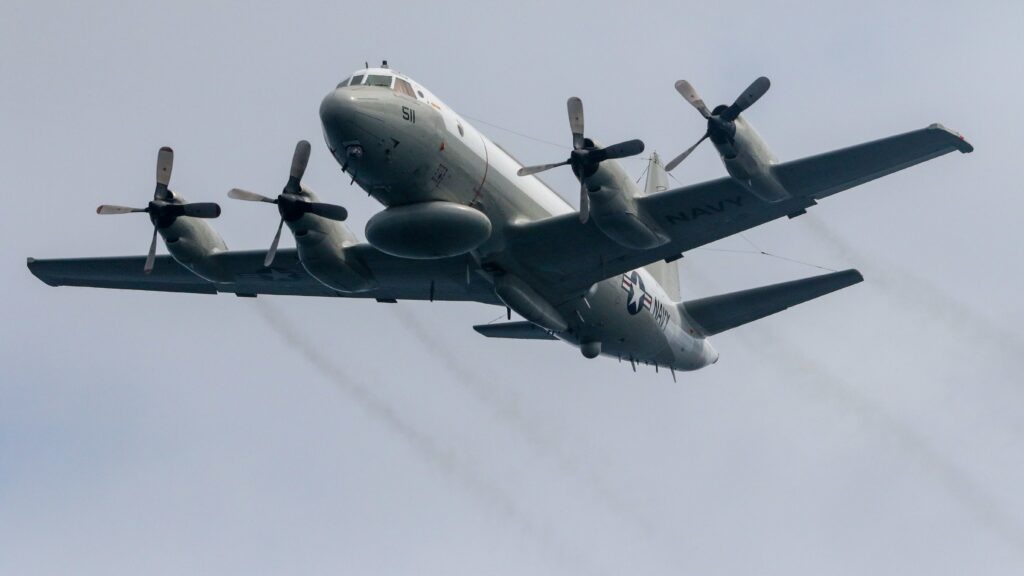
EAST CHINA SEA (Sept. 24, 2020) An EP-3E Airborne Reconnaissance Integrated Electronic System (ARIES) II, assigned to the “World Watchers” of Fleet Air Reconnaissance Squadron 1 (VQ-1), transits over the East China Sea. (U.S. Navy photo by MC3 Andrew Langholf)
By Richard R. Burgess, Senior Editor
ARLINGTON, Va. — The Navy has retired its last EP-3E Aries II electronic reconnaissance aircraft after the type’s 45 years of service to the fleet.
In an informal Feb. 12, 2025, ceremony, at Naval Air Station Whidbey Island, Washington, Fleet Air Reconnaissance Squadron One (VQ-1), the sole remaining operator of the EP-3E, farewelled the last EP-3E. The aircraft was flown away on Feb. 13 for the last time.
The aircraft, BuNo 159893, was the last of 26 EP-3Es that served the fleet beginning in 1970. Ten P-3A Orion patrol aircraft were converted to EP-3Es for operation by VQ-1 and VQ-1, joining two earlier EP-3B versions in service. This batch of EP-3Es were replaced beginning the 1990s by a new generation of EP-3Es converted from P-3C Orions, with ultimately 17 aircraft converted to sustain an operational fleet of 12 aircraft.
The EP-3E fleet provided multi-intelligence support to the fleets and to theater combatant commanders with near-real-time signals intelligence and full-motion video, the Naval Air Systems Command said. The aircraft was equipped with sensitive electronic receivers and high-gain dish antennas. The large crew was able to fuse the intelligence it collected with offboard intelligence and provide threat warning and situational awareness in support of suppression of enemy air defenses, anti-air warfare, anti-submarine warfare, and anti-surface warfare.
The EP-3E has been succeeded by the MQ-4C Triton high-altitude, long-endurance unmanned aerial vehicle operated by Unmanned Patrol Squadron 19.
VQ-1 has one P-3C remaining, which it used as a utility training and transport aircraft. The aircraft, BuNO 161588, will be retired in an informal ceremony to be held at NAS Whidbey Island on Feb. 20, 2025.
VQ-1 will hold its deactivation ceremony at Whidbey Island on March 28, 2025. The official date for the deactivation is March 31.
Marine Corps Updates F-35 Procurement, Transition Plan
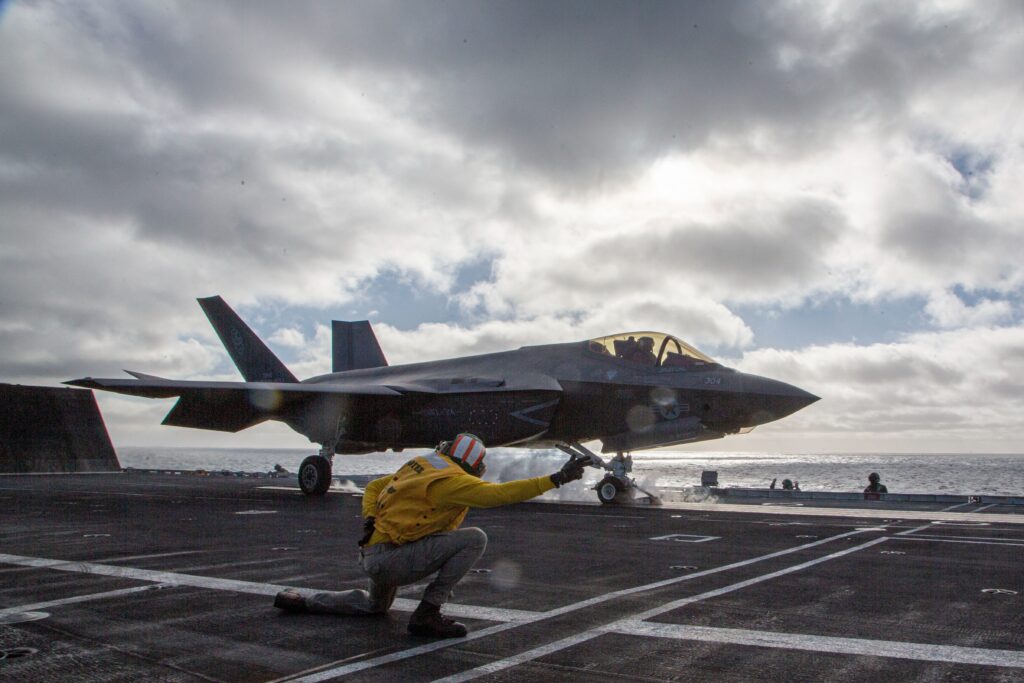
Marine Fighter Attack Squadron (VMFA) 314 launch and recover F-35C as they work to renew their carrier qualifications onboard the USS Abraham Lincoln (CVN 72) (U.S. Marine Corps photo by 1stLt. Charles Allen)
By Richard R. Burgess, Senior Editor
ARLINGTON, Va. — The U.S. Marine Corps has adjusted its procurement and transition plan for its F-35 Lightning II strike fighter fleet. While the overall program of record remains at 420 F-35s, the balance between the numbers of short takeoff and vertical landing F-35B and the carrier launch capable F-35C has changed, with the number of F-35Cs increasing and the number of F-35Bs decreasing.
According to the 2025 Marine Corps Aviation Plan released Feb. 3, the Corps plans to procure a total 280 F-35Bs and 140 F-35Cs, as compared with the earlier program of record of 353 F-35Bs and 67 F-35Cs. These numbers will allow the Corps to support 12 F-35B fighter-attack (VMFA) squadrons and eight F-35C VMFA squadrons.
Before, the Corps had planned to support only four F-35C squadrons, VMFAs 314, 311, 251, and 115. With the change in the procurement profile, four other F/A-18 Hornet squadrons also will make the transition to the F-35C: VMFAs 232 and 323 and reserve VMFAs 112 and 134.
Currently, all but two operational F-35 squadrons are allowed to be equipped with 10 aircraft, with the other two, both based at Marine Corps Air Station Iwakuni, Japan, being allowed 12 aircraft each. Under the new plan, all operational F-35 squadrons will be equipped with 12 aircraft each beginning in 2030.
The Marine Corps F-35C squadrons will continue to support the TACAIR Integration Plan, in which they deploy as units of Navy carrier airwings.
Lockheed Martin Offers Mk70 Launcher to Increase Lethality of LCS
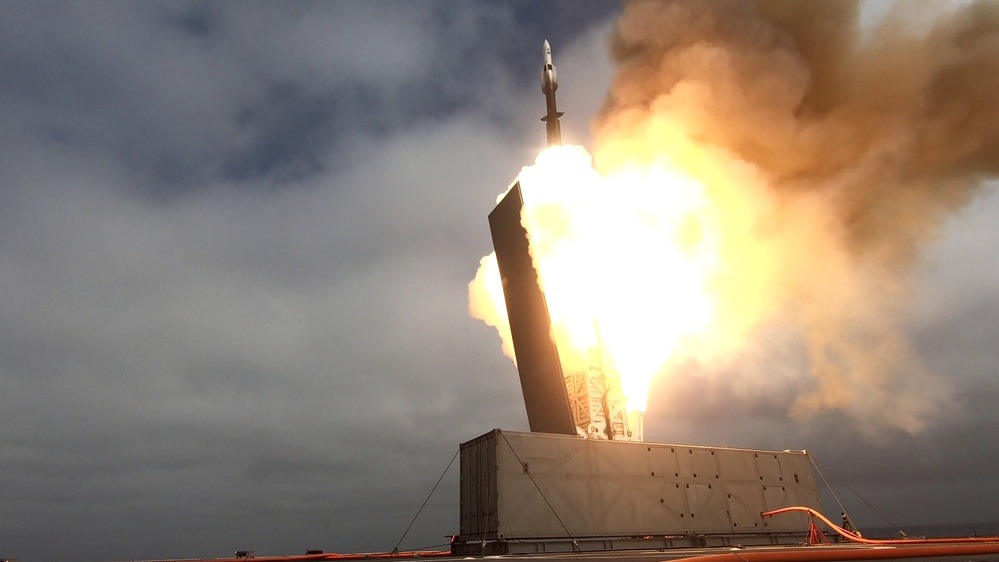
An SM-6 missile is launched from a containerized launcher on board USS Savannah (LCS 28) on Oct. 24, 2023. (U.S. Navy photo)
By Richard R. Burgess, Senior Editor
ARLINGTON, Va. — Lockheed Martin has adapted its Mk41 vertical missile launcher into a scalable containerized system than can be deployed on U.S. Navy ships, including the littoral combat ships (LCS) and non-traditional platforms of opportunity to increase their lethality with mid-range precision strike and air defense capabilities. company officials said.
The system, called the Mk70 Payload Delivery System, is a 40-foot-long ISO container in which four VLS cells can be fitted. The Mk70 system, designed for and deployed with the U.S. Army in a land-based configuration, can launch any type of missile certified for the Mk41, including the Tomahawk cruise missile, the various Standard surface-to-air missiles, the antisubmarine rocket, and the Evolved SeaSparrow missile. The Mk70 container is transportable on a C-17 cargo aircraft.
Ed Dobeck, director for launching systems at Lockheed Martin, told Seapower that the Mk70 was developed two years ago in concert with the Defense Department’s Strategic Capabilities Office to provide the Army with the ability to deploy and fire the Raytheon-built SM-6 Standard missile.
The same container can be secured on the flight deck or helicopter landing pad of a Navy ship using helicopter tie-down chains, occupying 400 square feet of a flight deck. Power from the ship’s electrical system can supply 400 volts to the Mk70. No modifications are required to the ship itself. The container can be installed within hours with a pier-side crane. A command shelter with virtual Aegis and Tomahawk control systems controls the launch of the missiles.
The flight deck of the Freedom-class LCS can accommodate three Mk70 containers, while the Independence-class LCS can accommodate four containers, Dobeck said. With one or more containers installed, the ships are unable to launch or land helicopters. The missile tubes can be reloaded horizontally, an advantage over the ship-installed Mk41’s need for vertical re-load by cranes.
Lockheed Martin has demonstrated containerized launch of SM-6 missiles from two Navy ships. An SM-6 missile was fired from the USS Savannah (LCS 28) in October 2023 and before that another was fired from the Overlord medium unmanned surface vessel Ranger during an exercise.
Dobeck said that the Navy has shown great interest in the Mk70 system, which already has been delivered to the Army. Two full batteries — totaling eight missile cells — have been delivered to the Army and two have been delivered to other customers. The Army has deployed the Mk70 to the Philippines
Amphibious Coalition Forecasts Benefits of Multi-Ship Amphib Ship Buy
By Richard R. Burgess, Senior Editor
ARLINGTON, Va. — The industry association for suppliers for the builder of U.S. Navy’s amphibious warfare fleet sees immediate benefits this year and the next one for its member companies, the association’s survey said.
In its annual survey of 219 member companies, the Amphibious Warfare Industrial Base Coalition (AWIBC) said that a majority of its member companies affirmed that the Navy’s announcement last year of a multi-ship buy will benefit their companies.
The survey focused on the August 2024 announcement by then-Secretary of the Navy Carlos Del Toro that the Navy would procure four amphibious warfare ships — one America-class amphibious assault ship (LHA) and three Flight II San Antonio-class amphibious transport dock ships (LPDs) in a bundle procurement according to the below schedule:
LPD 33 in FY25
LPD 34 in FY27
LHA 10 in FY27
LPD 35 in FY29
The four ships in the procurement would be built at the HII Ingalls Shipbuilding shipyard in Pascagoula, Mississippi.
“Our survey asked specifically about the impacts this bundle will have on the supplier base,” said Jack Feenick, a spokesman for the AWIBC. “We also included questions about the overall health of the industrial base, touching on key areas like workforce, training, inflation, and supply chain disruptions. Below are some of the key findings from our survey and attached is an infographic that provides some more insight on the data.”
Amphibious Warship Industrial Base Coalition (AWIBC) Survey
(Conducted survey from October – November 2024 from a sample of 219 total suppliers.)
65% of amphibious warship suppliers say that the bundle buy will lead to immediate benefits starting in 2025 or 2026.
82% of suppliers that support both amphibious ships and submarines agree that bundle buys benefit their capability to deliver on orders as well as their overall capacity.
52% say the bundle purchase will strengthen the shipbuilding industrial base to meet the demand of today and tomorrow
46% say the bundle purchase enables the hiring, retention, and training of a workforce
42% say the bundle purchase helps invest in equipment to ensure quality and on-time delivery
Consistent with findings from our survey last year, the top three challenges facing suppliers are:
Inflation
Workforce training and retention
Supply chain disruptions
Currently, only 10% of amphibious warship suppliers are operating at full capacity.
74% of suppliers who say they are sole-source/single-source supplier to the Navy are amphib suppliers.
Suppliers say that multi-ship procurements and earlier AP [advance procurement] funding are most likely factors to drive down material costs, help meet delivery schedules and improve their workforce and facilities.
Raytheon is Cranking Out SPY-6 Radars for the Fleet
By Richard R. Burgess, Senior Editor
ARLINGTON, Va. — Raytheon, a sector of RTX, is humming with production of its SPY-6 family of four naval radars as the first three variants are either operational or installed on ships and the fourth variant enters production.
Scott Spence, Raytheon’s vice president for Naval Integrated Solutions, told Seapower that the company is “now really cranking them out” — referring to production and delivery of shipsets of the radars from its Andover, Massachusetts, facility.
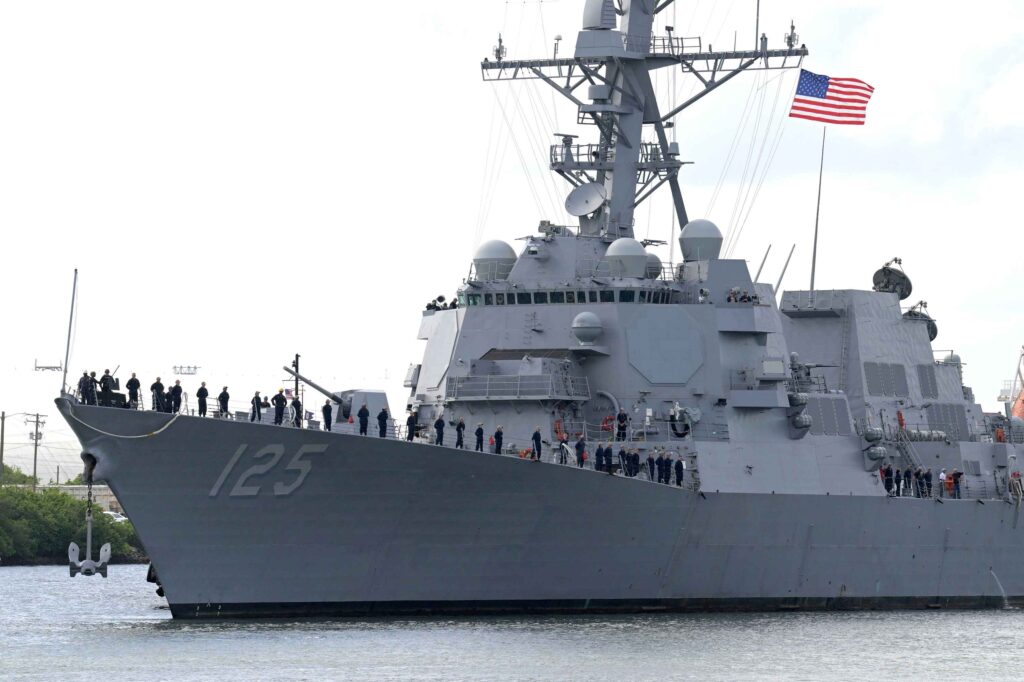
The SPY-6(V)1 Air and Missile Defense Radar, which became operational in 2024 on the Flight III Arleigh Burke-class guided-missile destroyer (DDG)USS Jack H. Lucas (DDG 125), is succeeding the SPY-1 as a sensor in new-production the Aegis Combat System and is the main sensor for the Flight III Arleigh Burke-class guided-missile destroyers (DDGs). Spence said that the flat-face fixed array(V)1 is in full-rate production and that Raytheon had delivered nine or ten shipsets so far for installation on the Flight III DDGs.
Spence said the Jack H. Lucas’s (V)6 has been going through integrated combat testing with the Aegis Baseline.
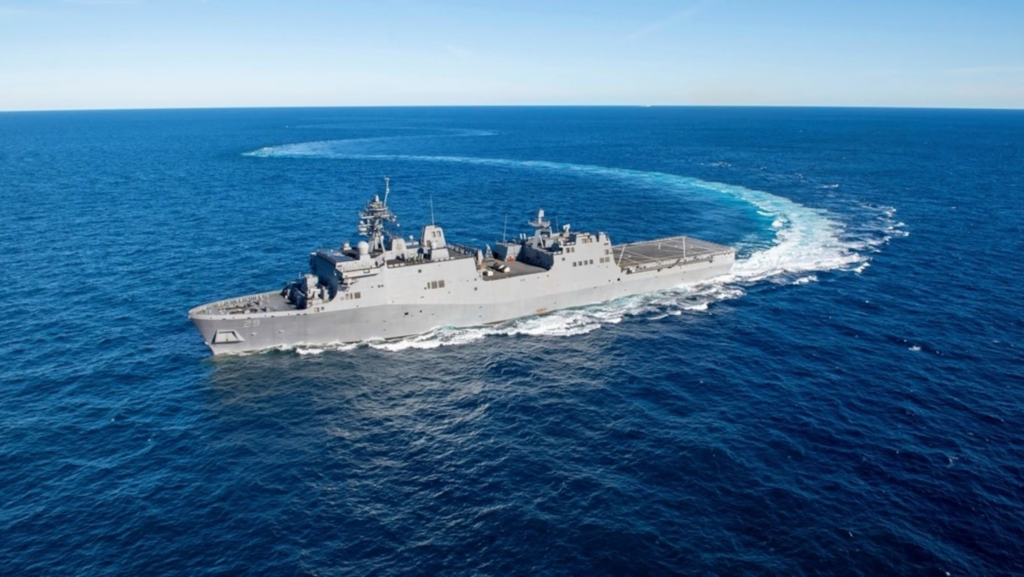
The SPY-6(V)2 Enterprise Air Search Radar (EASR) is the rotating version of the radar that will be installed on amphibious platform dock ships, amphibious assault ships, and Nimitz-class aircraft carriers, replacing the SPS-48 and SPS-49 radars. The radar has been installed on future San Antonio-class amphibious platform dock ship USS Richard M. McCool Jr. (LPD 29) and has been accepted by the Navy following the ship’s builder’s and acceptance trials.
The first SPY-6(V)3 EASR — which included three fixed-face arrays — has been installed on the future Gerald R. Ford-class aircraft carrier USS John F. Kennedy (CVN 79), which is scheduled for delivery to the fleet in 2025. The (V)3 was selected in lieu of the SPY-3 Dual Band Radar that is installed on the Gerald R. Ford (CVN 78).
The SPY-6(V)4 is on contract by the Navy for backfit onto Flight IIA Arleigh Burke-class DDGs. The (V)4 features four flat-face fixed arrays. The modularity of the system will ease the retrofit as the ships will have the same cooling and power systems of the (V)1. The Navy plans to equip 15 Flight IIA DDGs with the (V)4, the first being the USS Pinckney (DDG 91). Arrays are now being built for the (V)4.
Although unable to release details, Spence said that Raytheon continues to work “hand in glove” with the Navy to tweak the SPY-6 radars to be able to counter the latest threats. The lessons from the Navy’s combat with Houthi missiles and drones over the Red Sea over the last 14 months are being studied by Raytheon.
The SPY-6 “is clearly designed for that environment,” Spence said.
He also said that Raytheon has expand its supply chain to include companies in Japan to ensure reliable sources of some SPY-6 components.
Last summer year Raytheon entered contracts with MELCO (Mitsubishi Electric) and Sampa Kogyo to supply components of the SPY-6 for U.S. Navy ships and any potential future SPY-6(V) customers, said Briana Gabrys, a Raytheon spokeswoman.
EAST CHINA SEA (Sept. 24, 2020) An EP-3E Airborne Reconnaissance Integrated Electronic System (ARIES) II, assigned to the “World Watchers” of Fleet Air Reconnaissance Squadron 1 (VQ-1), transits over the East China Sea. (U.S. Navy photo by MC3 Andrew Langholf)
By Richard R. Burgess, Senior Editor
Oct. 8, 2024
ARINGTON, Va. — A planned homecoming ceremony for two U.S. Navy EP-3E electronic reconnaissance aircraft and their crews today has been postponed because of the Navy’s current operational commitments.
According to the Facebook account of Fleet Air Reconnaissance Squadron One (VQ-1), the ceremony was to welcome home the crews from the final operational deployments of VQ-1 and the EP-3E. The two crews were scheduled to return to the squadron’s home base of Naval Air Station Whidbey Island, Washington.
A Navy directive issued July 18, 2023, scheduled VQ-1’s de-activation for March 31, 2025, but that the squadron was to cease operations by Sept. 30, 2024. Apparently, operational commitments initially delayed the cessation to Oct. 8, 2024, and now have required continued operations to an undetermined date. The operational commitments likely are related to the hostilities in the Middle East.
According to an Oct. 8 statement to Seapower from the Navy’s maritime patrol reconnaissance program office, the last EP-3Es may not be retired until March 2025.
“Due to OPSEC [operations security] we cannot offer the number of aircraft, but there are sufficient aircraft to support the mission through the March 2025 date above,” the statement said.
The EP-3Es that have been retired and those that will be retired in the future will be delivered to the 309th Aerospace Maintenance and Regeneration Group (309th AMARG) at Davis-Monthan Air Force Base, Arizona, for storage.
The Lockheed-built EP-3Es are being replaced by the Northrop Grumman MQ-4C Triton high-altitude, long-endurance unmanned aerial vehicles. The Tritons have been operating from Guam and from NAS Sigonella, Sicily, and on Oct. 1, a third Triton site was established in the U.S. Fifth Fleet area of operations. The Navy directive also said that the foreign signals intelligence capability executed by EP-3Es would be assumed by a VUP [special projects patrol squadron].
In addition to the EP-3Es, the Navy operates a handful of P-3C, NP-3C, and NP-3D Orion aircraft flown by Air Test and Evaluation Squadron 30 (VX-30) at NAS Point Mugu, California, and by Scientific Development Squadron One (VXS-1) at NAS Patuxent River, Maryland.
Navy to Pursue a Block Buy of 4 Amphibious Warfare Ships
August 15, 2024
By Richard R. Burgess, Senior Editor
WASHINGTON – The secretary of the Navy has notified Congressional leaders that the Navy will pursue a block buy of four amphibious warfare ships — one America-class amphibious assault ship (LHA) and three San Antonio-class amphibious transport dock ships (LPDs) — through fiscal year (FY) 2029.
The move potentially would save U.S. taxpayers “nearly $1 billion through additional efficiencies,” said U.S. Senator Roger Wicker, R-Mississippi, the highest-ranking Republican on the Senate Armed Services Committee, who released the following statement in response:
“Today is a great day for American shipbuilding and our Navy’s ability to deter China in the years ahead,” Wicker said. “As I have long noted – including in my recent “Peace Through Strength” report – the multi-ship buy of warships is a cost-effective way to provide stability for the industrial base on key shipbuilding programs. I look forward to seeing these contracts through to their execution, and I believe that additional benefits could be obtained if we increase funding for material procurement in bulk.”
Specifically, the block-buy would encompass the following ships:
LPD 33 in FY25
LPD 34 in FY27
LHA 10 in FY27
LPD 35 in FY29
Paul Roden, chairman of the Amphibious Warfare Industrial Base Council, issued the following statement regarding the block-buy decision:
“Today is a historic day for the amphibious warship industrial base. Our suppliers have been advocating for a multi-ship buy for years. So, we are thrilled to see lawmakers, the Navy and Marine-Corps listen to our concerns and reach this deal, which will provide the predictable funding that our suppliers urgently need. Not only will this block buy save the taxpayers nearly $1 billion, but it will provide over 650 companies across 39 states with the stability we need to invest in our skilled workforce, get ahead of inflation and ensure on time deliveries. The companies of the amphibious warship industrial base are extremely proud of their contributions to our national security and will deliver the highest quality parts and services for these future amphibious warships.”
The three LPDs would be built in the Block II configuration, which features the Raytheon-built SPY-6(V)2 Enterprise Air-Search Radar.
The four ships in the procurement would be built at the HII Ingalls Shipbuilding shipyard in Pascagoula, Mississippi.