Navy, Marine Corps in Planning for Third Large-Scale Exercise

By Richard R. Burgess, Senior Editor 

ARLINGTON, Va.  — The U.S. Navy and Marine Corps are planning for execution later this month for Large-Scale Exercise (LSE) 2025, the third of such exercises since 2021. The LSE will largely be conducted through Live Virtual Construct (LVC) environment but will encompass units from around the world, including—for the first time—allies and partner nations. 

LSE 2025, scheduled to begin on August 30, will be conducted “nearly fully virtual” over 22 time zones, said Rear Admiral Kenneth Blackmon, vice commander, U.S. Fleet Forces Command, during a briefing to reporters on the exercise, pointing out that LVC allows for safer exercises and conserves resources. 

Approximately 880 personnel will be directly involved in the exercise, which will include personnel in six regional combatant commanders, U.S. Fleet Forces Command, the U.S. Pacific Fleet, Naval Forces Europe/Africa, Marine Forces Europe/Africa, seven numbered fleets, 10 maritime operations centers (MOCs), Marine Forces Pacific, II Marine Expeditionary Force operations center,  five carrier strike groups, two amphibious ready groups, the Office of the Chief of Naval Operations (OPNAV), various systems commands and type commanders, and Reserve Forces Command, said Capt. Captain Christopher Narducci, the exercise lead who briefed the details of the upcoming exercise. 

“This is the only naval exercise spanning all 10 Maritime Operations Centers (MOCs), incorporating both the Navy and Marine Corps worldwide to evaluate and address gaps and seams between fleets,” Blackmon said. Many exercises focus on a single fleet, but LSE raises the bar by requiring coordination across all fleets, providing critical reps and sets at the operational level.” 

Allied participation will include a NATO response cell, the Royal Canadian Navy, and the Japanese Maritime Self-Defense Force. 

The LSE is designed to exercise such aspects as the Global Maritime Response Plan (GMRP), global contested logistics and sustainment operations, reserve mobilization, and the wartime responsibilities of the type commanders.  

GMRP “is a new concept that is being developed right now,” Narducci said.  “It aims to accelerate our ability to generate forces in wartime or in a crisis scenario. GMRP is about getting more players on the field sooner.”  

Brigadier General Thomas M. Armas, deputy commander of U.S. Marine Corps Forces Command, also briefing reporters, said that the LSE would exercise the passing of carrier strike groups and amphibious ready groups from fleet to fleet. 

“This exercise provides an incredible opportunity to hone command and control across the most lethal amphibious task forces in the world, ensuring sea lanes remain open and global commerce flows freely, maintaining peace and stability worldwide,” Armas said. 
“Exercises like this help us identify and close gaps across multiple time zones, preparing our Amphibious Ready Groups (ARGs) and Carrier Strike Groups (CSGs) to seamlessly transition forces during crises. It’s challenging enough to operate within one time zone; coordinating across many, especially in adverse conditions, demands realistic practice. 

“Being able to rehearse these scenarios ensures we can guarantee the lethality and readiness our nation depends on,” he said. “When our ARGs are deployed around the world during times of crisis, exercises like LSE 25 ensure those forces are synchronized, on time, and on target. Practicing lethality guarantees we can execute it when needed.” 

Narducci said the Naval Warfare Development Center will be responsible for overall exercise control, assisted by six global distributed controllers and supported by 17 flag and general officers, including retired officers.  

The Navy Continuous Training Environment will be the network for the LSE, Narducci said. 


Airspace around Coast Guard Cutters Now Restricted for Drones

By Richard R. Burgess, Senior Editor 

ARLINGTON, Va. — The Federal Aviation Administration has declared the airspace in the vicinity of U.S. Coast Guard cutters to be restricted airspace to unmanned aerial systems (UAS). 

In a June 16 directive from Coast Guard Headquarters, the commandant of the Coast Guard announced the new policy that “explicit approval is required to fly UAS in the immediate vicinity of a Cutter.”  

All UAS are prohibited from flying “within a stand-off distance of 3,000 feet laterally and 1,000 feet above all Cutters operating, transiting, or at port within U.S. territorial waters,” the directive said. 

The directive applies to all Coast Guard cutters greater or equal to 65 feet in length, which is the length that distinguishes a cutter from a boat. 


‘All of Our Programs Are a Mess,’ SECNAV Said of Shipbuilding 

By Richard R. Burgess, Senior Editor 

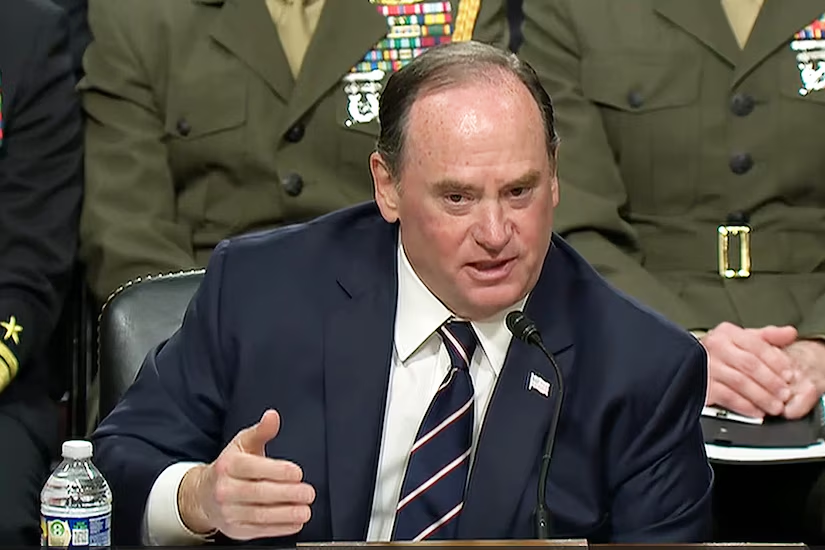
ARLINGTON, Va. — The Secretary of the Navy (SECNAV) told Congress that many major shipbuilding and other programs are behind schedule and above planned cost, and he is looking for possible long-term solutions to correct the situation and rebuild readiness for the challenges of the future. 

“All of our programs are a mess, to be honest,” said Navy Secretary John C. Phelan, who was testifying June 11 on Capitol Hill before the House Armed Services Committee along with Chief of Naval Operations James W. Philby and General Eric M. Smith, commandant of the Marine Corps.  

“We are behind schedule, over budget,” Phelan said. “Our best-performing one [program] is six months late and 57% over budget. … So, we are working very hard to get these fixed. The Navy has begun to make some rapid changes at the public shipyards, and we’ve been talking with Electric Boat and Huntington Ingalls [HII].” 

Of particular concern to the SECNAV are the Columbia-class ballistic-missile submarines and Virginia-class submarines, both classes of which are behind schedule. 

Schedule and cost issues also plague the Constellation-class frigate program, and some Arleigh Burke-class guided-missile destroyers are behind schedule. Many amphibious warfare ships are in poor condition, Navy officials said. 

“The United States Navy and Marine Corps are prepared and ready to fight and win, anytime and anywhere,” Phelan said. “However, our naval superiority is under threat. For too long we have allowed our shipbuilding industry to erode, hollowing out the very capacity we need to maintain credible naval deterrence. That must change.” 

Phelan said he has had conversations with shipbuilders in South Korea, noting that a modern guided-missile destroyer built in South Korea — “10 5 bigger than ours” — cost one third that of its U.S. counterpart.    

He said that rebuilding the maritime industrial base is a “national security imperative.” 


Marines for Los Angeles Trained in Crowd Control, Commandant Said 

By Richard R. Burgess, Senior Editor 

ARLINGTON, Va. — The Marines in the regiment being surged to protect federal buildings and personnel in Los Angeles are trained in crowd control, the commandant of the Marine Corps told Congress. 

“All Marines are trained in crowd control, embassy reinforcement, etc., so this is part of their training, sir,” said General Eric M. Smith, commandant of the Marine Corps, testifying June 10 on Capitol Hill before the Senate Armed Services Committee. “The standard Marine expeditionary unit — before they deploy — is trained, and this battalion is ready for that.” 

Smith was responding to questions from Sen. Richard Blumenthal, D-Connecticut, about the imminent deployment of Marines to Los Angeles in response to recent rioting from people protesting the enforcement actions of Immigration and Customs Enforcement (ICE) personnel in the city.  

The 700 Marines assigned to Los Angeles are from the 2nd Battalion, 7th Marine Regiment, 1st Marine Division, based at the Marine Air-Ground Combat Training Center at Twentynine Palms, California. 

The Marines were activated on June 9 by U.S. Northern Command. 

“The activation of the Marines is intended to provide Task Force 51 with adequate numbers of forces to provide continuous coverage of the area in support of the lead federal agency,” NORTHCOM said in a June 9 release. “Task Force 51 is U.S. Army North’s Contingency Command Post, which provides a rapidly deployable capability to partner with civil authorities and DoD entities in response to a Homeland Defense and Homeland Security Operations. It is commanded by Maj. Gen. Scott M. Sherman.”  

Task Force 51, which includes up to 2,100 personnel from the California National Guard, is has been trained “in de-escalation, crowd control, and standing rules for the use of force,” the NORTHCOM release said.  

“They are there at the SECEDEF’s [Secretary of Defense’s] direction to NORTHCOM [U.S. Northern Command],” Smith of the Marines in response to a question from Sen. Mike Rounds, R-South Dakota. “It’s one of our most ready battalions. They’re prepared to respond to lawful orders from the chain of command. They’re there to protect federal property and federal officers. 

Blumenthal asked about the equipment the Marines would have in Los Angeles and if the Marines would have arrest authority. 

“Sir, they have shields and batons,” Smith said. “They need not have arrest authority. They are there to protect federal property and federal personnel.” 

When Blumenthal expressed concern for the reputation of the Marines thrust into a civil disturbance, Smith replied, “I am not concerned. I have great faith in my Marines and their junior leaders and their more senior leaders to execute the lawful tasks that they are given.” 


Navy Selects Mobile, Ala., Company to Scrap World’s First Nuclear-Powered Aircraft Carrier

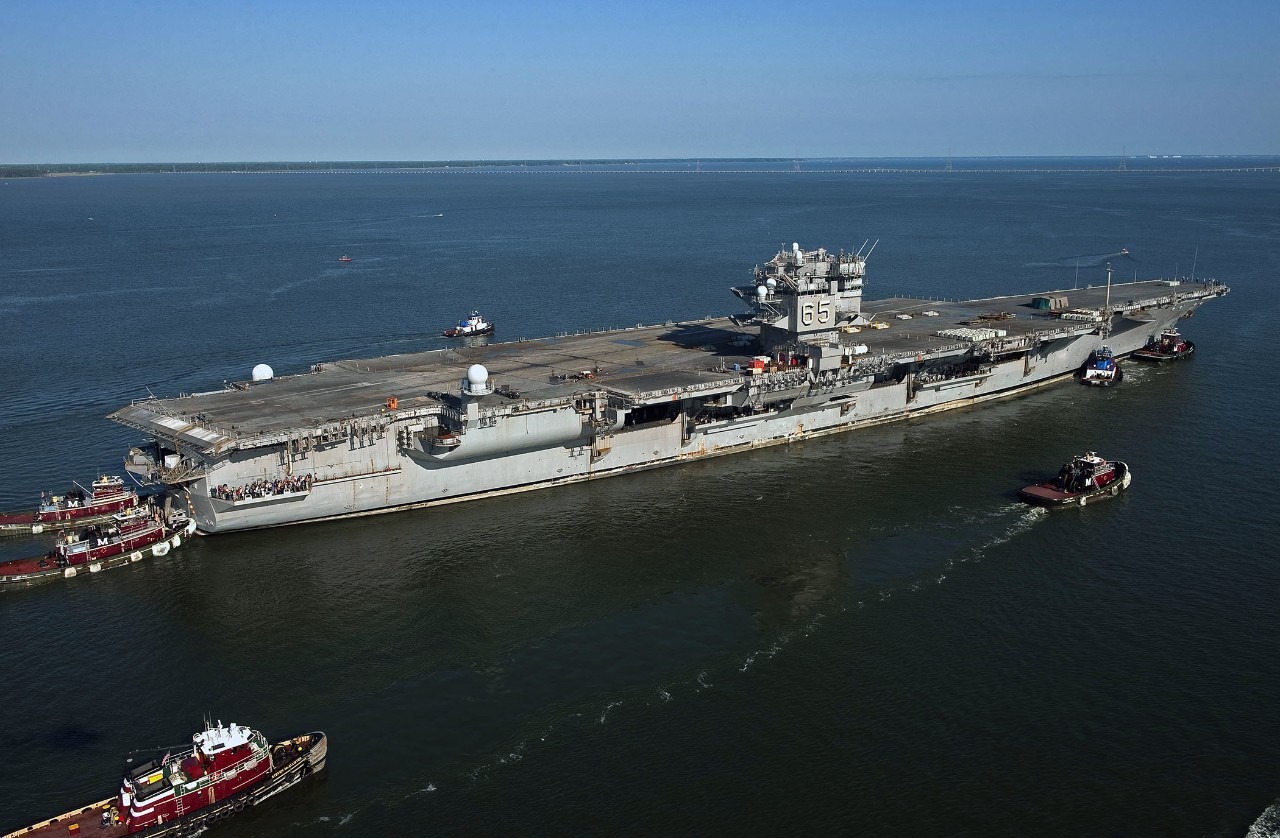
The nuclear-powered aircraft carrier ex-USS Enterprise is shown being moved to Newport News Shipbuilding in 2013 following its decommissioning in 2012. (NHHC) 

By Richard R. Burgess, Senior Editor 

ARLINGTON, Va. — The U.S. Navy has selected NorthStar Maritime Dismantlement Services LLC, a company with facilities in Mobile, Alabama, to scrap the former USS Enterprise (CVN 65), the Navy’s — and the world’s — first nuclear-powered aircraft carrier. 

The Defense Department said in a May 30 contract announcement that NorthStar, headquartered in Vernon, Vermont, was being awarded a $536.7 million firm-fixed-price contract from the Naval Sea Systems Command for “the dismantling, recycling, and disposal of Ex-Enterprise (CVN 65). 

“Under this contract CVN 65 will be dismantled in its entirety, and all resulting materials will be properly recycled or disposed of. Specifically, hazardous materials, including low-level radioactive waste, will be packaged and safely transported for disposal at authorized licensed sites,” the announcement said. “Work will be performed in Mobile, Alabama, and is expected to be completed by November 2029.” 

The Ex-Enterprise, commissioned in 1961, served the nation in numerous crises and conflicts, including the Cuban Missile Crisis, Vietnam War, and Operations Frequent Wind, Earnest Will, Desert Fox, Southern Watch, Enduring Freedom, and Iraqi Freedom.  

The carrier was deactivated in December 2012 and, when its nuclear reactors were defueled, it was decommissioned in February 2017. The hull remained at Newport News Shipbuilding at Newport News, Virginia, awaiting the Navy’s plans for disposal. 

“NorthStar is partnered with Modern American Recycling and Radiological Services, LLC (MARRS) in Mobile, Alabama, where the dismantlement work will take place,” the Naval Sea Systems Command said in a June 2 release posted on linkedin.com. “Waste Control Specialists LLC, of Andrews, Texas, will serve as the licensed facility for disposal of low-level radiological and mixed hazardous waste. Non-hazardous materials will be recycled or disposed of in accordance with all applicable federal, state, and local regulations.” 

The Navy’s selection of a commercial company to dismantle nuclear-powered ship is a change from its normal practice of scrapping nuclear-powered ships, which heretofore included nuclear-powered submarines and cruisers. In recent years, the Navy’s Puget Sound Naval Shipyard in Bremerton, Washington, has been the facility that has handled the tasks. 

“By leveraging private-sector expertise in commercial nuclear power plant decommissioning, the Navy is achieving an estimated $1 billion in cost savings compared to conducting the effort in public shipyards, the Navy release said. “This approach enables the Navy to prioritize public yard resources toward fleet readiness and modernization – while upholding its longstanding commitment to environmental stewardship and nuclear safety.” 


Navy Reserve Chief Looks Forward to KC-130J Aircraft 

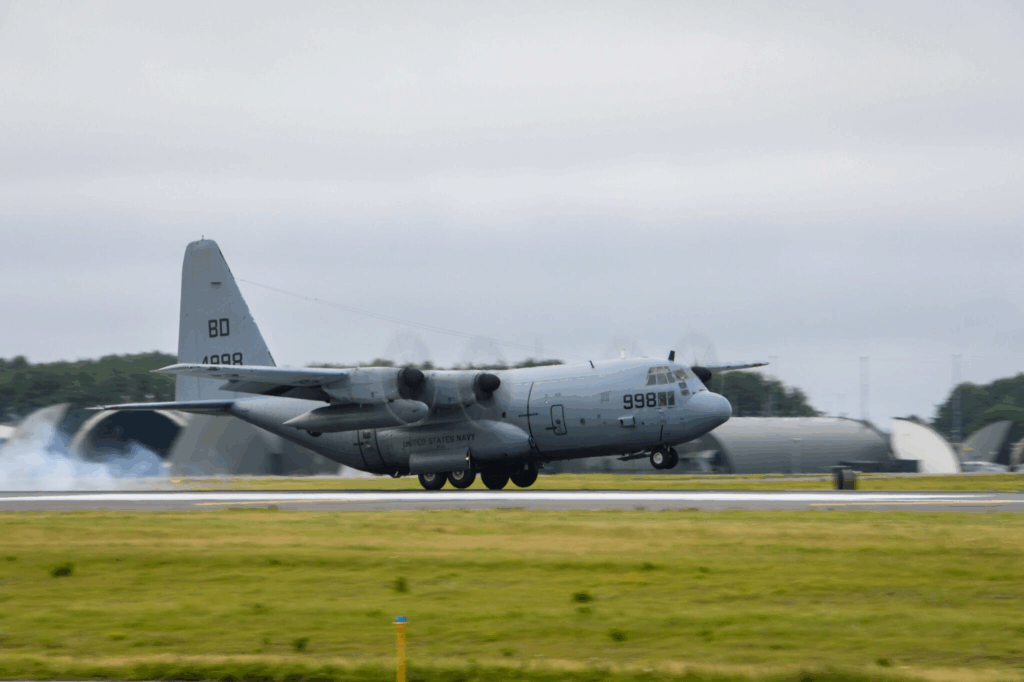
MISAWA, Japan (July 12, 2021) A C-130T Hercules, assigned to the Condors of Fleet Logistics Support Squadron (VR) 64, recovers at Naval Air Facility (NAF) Misawa. (U.S. Navy photo by Mass Communication Specialist 3rd Class Benjamin Ringers)

By Richard R. Burgess, Senior Editor 

ARLINGTON, Va. — The admiral in charge of the U.S. Navy Reserve Force expressed appreciation for congressional support in procuring KC-130J Super Hercules tanker/transport aircraft to modernize the force’s organic airlift fleet. 

“We are grateful for the strong bi-partisan alignment on this priority,” said Rear Admiral Nancy S. Lacore, chief of Navy Reserve, testifying May 20 before the House Appropriations Committee’s defense subcommittee. “We are grateful for the adds we got in 2024 [and] 2025 for the C-130. The C-130 is our number one equipment priority, and we are behind in that re-capitalization effort.” 

The Navy Reserve operates 27 C-130T/KC-130T Hercules aircraft with an average age of 34 years and a mission-capable rate of 40%. Lacore anticipates a mission-capable rate of 75% with a fleet of KC-130Js. 

We’re also anticipating a 75% mission-capable rate, which will go a long way,” Lacore said. “The plan was to be at 32 aircraft by 2030. We got one in 2024, two in 2025 and we’re super-grateful for them. Right now, in the out years, we need to be looking at six per year in order to get us to where we need to go.”  

Lacore said the C-130T Hercules “operates exclusively by the Reserve is the Navy’s only long-range, inter-theater airlift for oversize cargo. Its capability is in high demand from fleet commanders, particularly in the Indo-Pacific, playing a critical role in the contested logistics necessary to sustain a maritime fight. 

“For the past few months, Reserve C-130 crews have transported thousands of pounds of ordnance into the Red Sea fight, keeping our ships on station intercepting Houthi missiles, conduction precision strikes, and safeguarding global commerce,” she said. “When the fleet needs logistics, whether to deliver firepower or staying power, Navy Reserve answers the call.” 

She pointed out that the C-130T fleet “lacks the survivability necessary to operating in a contested environment. Recapitalizing with the KC-130J is critical to ensuring that we effectively and safely carry out the critical inter-theater logistics mission for the fleet in 2027 and well beyond that.” 

Lacore also noted the need for improved aerial refueling capability in the Pacific theater. 

“The PACFLT [U.S. Pacific Fleet] commander has already asked us to work on organic aerial refueling and we are doing that with the Tangos [KC-130Ts],” she said. “It’s a long haul; they’re not all plumbed for that, whereas the Juliets [KC-130Js] will come with that plumbing already established. We anticipate that at least two times the aerial refueling rate. And if we include ground refueling as well, we’re looking at probably eight times our refueling capability in theater, which is a huge win for us in the Pacific. 


Coast Guard to Reduce Flag Officer Positions by 25%

By Richard R. Burgess, Senior Editor 

ARLINGTON, Va. — The U.S. Coast Guard has been ordered to reduce the number of admirals by at least 25% before next year, the service announced. 

In a May 25 directive from Acting Commandant Adm. Kevin Lunday, the service announced that the reductions were part of its Force Design 2028 initiative.  

“As part of Force Design 2028, the Secretary of the Department of Homeland Security has determined that there is redundant executive oversight in our force structure which hinders efficient decision making and Service effectiveness,” The opening statement of the announcement said. 

“As a result, and consistent with similar efforts within the Department of Defense, the Secretary has ordered a reduction of no less than 25% of flag officer positions by 1 January 2026,” the announcement said. “The positions to be eliminated and the plan to reorganize the flag corps will be announced in separate correspondence.” 
 

The Coast Guard currently has approximately 45 flag officers. 

The service also has negated the results of its fiscal 2025 promotion board for the rank of rear admiral (lower Half) while folding opportunity in next year’s selection board. 
 

“The Secretary also disapproved the Promotion Year (PY) 2025 rear admiral (lower half) (RDML) selection board report after determining that the guidance to that board did not align with this Administration’s policies,” the announcement said. “The Secretary’s action also supports planning to reorganize the leadership structure. Officers who were considered by the PY25 RDML selection board and who are otherwise eligible, including those previously selected, will be considered by the PY26 RDML selection board that will convene under new guidance.” 


Sea-Air-Space: Readying our Platforms: Admirals Focus on 80% Combat Surge Ready

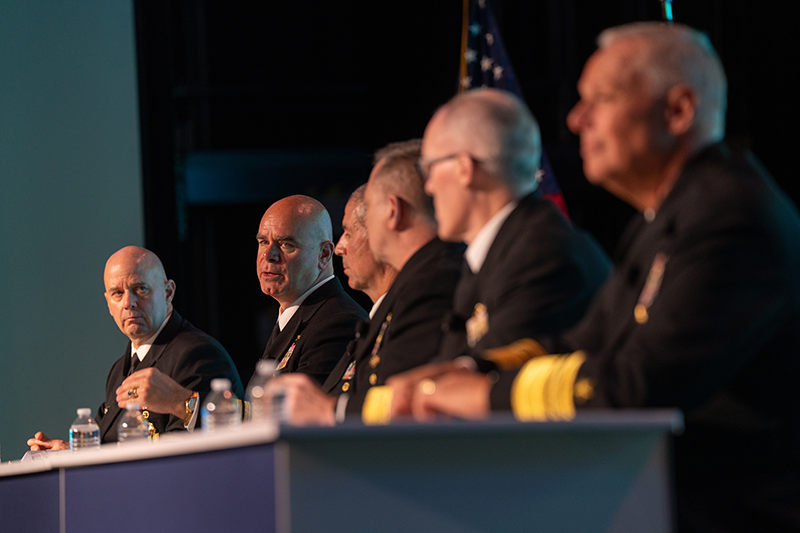
Admiral Jim Kilby, left, moderates the panel “Ready our Platforms” on April 7. Photo credit: Dan Goodrich

U.S. Navy type and system commanders discussed their efforts to achieve a combat surge readiness (CSR) of 80% during the opening panel of the Navy League’s 2025 Sea-Air-Space Expo in National Harbor, Maryland.

Speaking in an April 7 panel — moderated by Acting Chief of  Naval Operations Admiral Jim Kilby — were Vice Admiral Daniel Cheever, commander, Naval Air Forces; Vice Admiral Robert Gaucher, commander, Naval Submarine Forces; Vice Admiral Brendan McLane, commander, Naval Surface Forces; Vice Admiral Carl Chebi, commander, Naval Air Systems Command; and Vice Admiral James Downey, commander, Naval Sea Systems Command.

“Combat surge ready-certified units meet a minimum condition requirement for material condition, training, manning and munitions,” Kilby said, noting the type commanders on the panel were designated the single accountable officers “to ensure their respective forces achieve 80% CSR.”

Kilby laid out the task for his admirals to achieve 80% CSR despite the scheduling, materials, workforce, maintenance availabilities and operations tempo challenges for the fleet, necessary to ready the fleet to meet potential combat with potential adversaries such aa China.

He pointed out that the current drive for readiness began in 2018 when then-Defense Secretary James Mattis directed the service to turn around the dismal readiness of its F/A-18 Super Hornet strike fighter fleet of 250 ready jets and increase the number to 341, a level sustained during the years since. By changing its maintenance practices, the Navy achieved the goal in one year. With that inspiration, other Navy communities, such as the surface and submarine forces, have adopted changes to their maintenance and logistics practices to increase the readiness of warships and submarines.

Kilby said the CSR rates for submarines, surface warships and aircraft carriers today are 67%, 68%, and 70%, respectively.

Cheever noted achieving the 80% for Super Hornet strike fighters was an “all-hands effort all the time” and involved extensive partnering with the defense industry. He defined CSR as such: “If we go to war, we have everything we need.”

Chebi said the CSR effort has since expanded to included 22 other types of Navy and Marine Corps aircraft and that the effort to achieve the CSR goal was a “team effort” that had to be focused on data versus stories.

He recounted the Navy “had to be told to do that,” referring to the strike fighter readiness initiative, but that “we developed the playbook. It worked.”

He said the Navy still had challenges with improving CSR in joint programs because it cannot control all aspects of the initiatives.

McLane credited the aviation community with the inspiration for the surface community to similarly focus on readiness. His efforts include CASREP [casualty report, a term for systems degraded or broken] burn-down, restoring ship systems to full capability, and getting ship maintenance availabilities (repair periods) finished on time. An innovative approach to availabilities is to bring ships in more often for shorter period, a method that increases a ship’s likelihood of completion on time. A recent set of 100-day availabilities of were completed 100% of the time, he said.

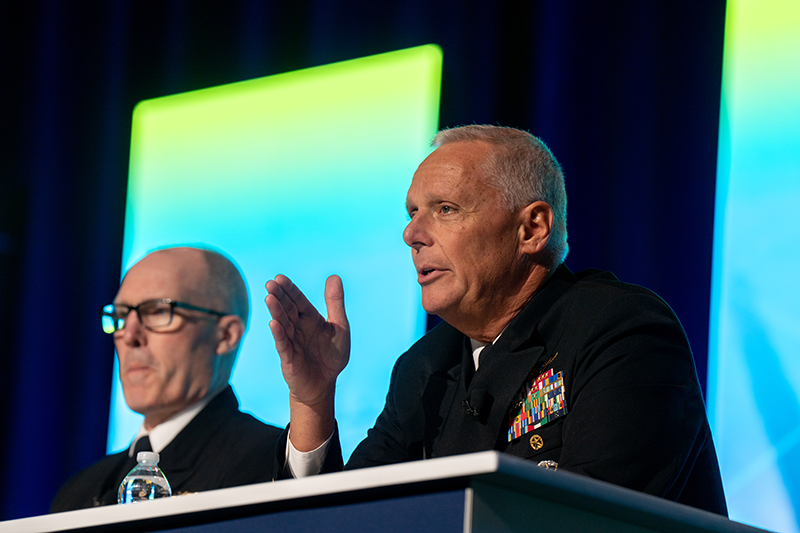
Vice Admiral Daniel Cheever makes a point during the morning panel on Monday. Photo credit: Dan Goodrich

Addressing problems with amphibious assault ship availabilities, McLane said a focus on planning 120 days in advance is inadequate, recommending locking in the plan 500 days in advance and awarding the contract 350 days in advance. Noting recent problems with quality assurance, he recommended involving the original equipment manufacturers rather than necessarily hiring the lowest bidder.

Ships Ahoy

Downey, speaking of new construction ships, noted 12 ships were delivered in 2024, and 92 ships were under contract, 56 of which were under construction. He said he is focused on planning milestones, trying to order materials two years ahead of the construction start of a ship. For improving availabilities, more predictive data are needed, he said.

Gaucher said his goals are to complete submarine availabilities on time and make them ready for combat. He noted the Navy’s four shipyards have room for 10 attack submarines in maintenance but currently have 17 submarines in or awaiting availabilities.

The “just-in-time” parts delivery concept does not work well in practice for the submarine force, he said, recommending instead a “just-in-case” stockpiling concept for parts.

Gaucher said the Navy’s shipyards need more structural engineers, not just mechanical and electrical engineers.

He also said the submarine force’s inventory of Mark 48 torpedoes has increased by two per boat, and he expects another increase by two within six months.


Sea-Air-Space: RTX’s Barracuda Mine Destructor in Ocean Testing

Raytheon has been putting its Barracuda mine neutralization system in autonomous mission testing. Photo credit: Raytheon

Raytheon, an RTX company (Booth 911), has been putting its Barracuda mine neutralization system in autonomous mission testing, the company said in an interview with Seapower.

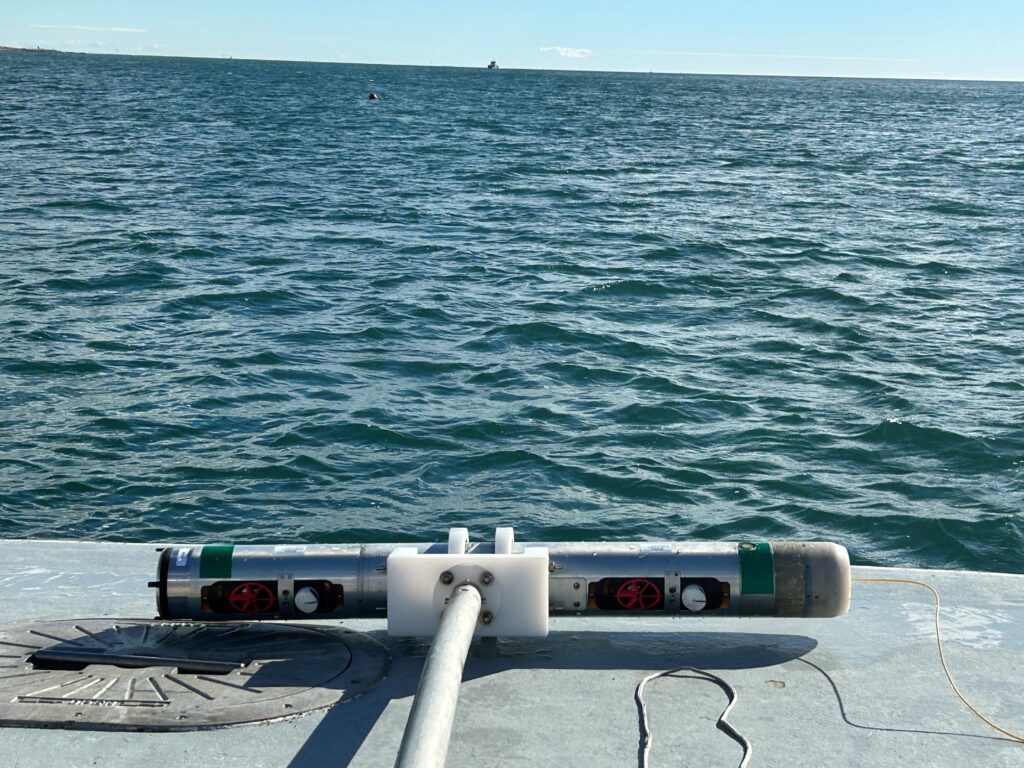
The Barracuda is a 26-pound, 48-inch-long anti-mine device housed in a tube the size of an A-size sonobuoy tube. When launched, the device is propelled by four small water jets that take the device to the datum of a suspected sea mine detected by the AQS-20C towed sonar. An acoustic communications data link buoy is released to which the device is tethered. Target updates, such as GPS coordinates, are transmitted to the device, which approaches the sea mine. A sonar and a camera mounted in the nose of the device enables a man-in-the-loop operator — for now — to confirm the mine. The device then is steered to the mine and detonated. Each Barracuda is a one-shot charge.

An engineering development model (EDM) of the of torpedo-like munition has been going through two months of contractor testing in Narragansett Bay, said Bill Guarini, Raytheon’s director for Requirements, Capabilities in the company’s Naval Systems and Sustainment Unit. For the tests so far, the Barracuda is tethered to its controlling craft.

The contractor testing will continue through 2025 into 2026, Guarini said, with tests against a variety of mine shapes, including bottom, tethered, and near-surface mines. Development Testing to begin in 2026 and Operational Testing to be conducted in 2027, with low-rate initial production also scheduled to begin that year. Raytheon will provide 85 EDMs of the Barracuda for the Navy’s tests.

The Barracuda is designed for both surface and air launch. The weapon will be deployed on the Mine Countermeasures Unmanned Surface Vehicle deployed on some Independence-class littoral combat ships. Separately from Raytheon, the Navy is having a Barracuda launcher developed for the MCM USV. A sonobuoy air-launch cannister also is a potential launcher for the Barracuda. 


Sea-Air-Space: Anduril Introduces Copperhead AUV-Launched Torpedoes

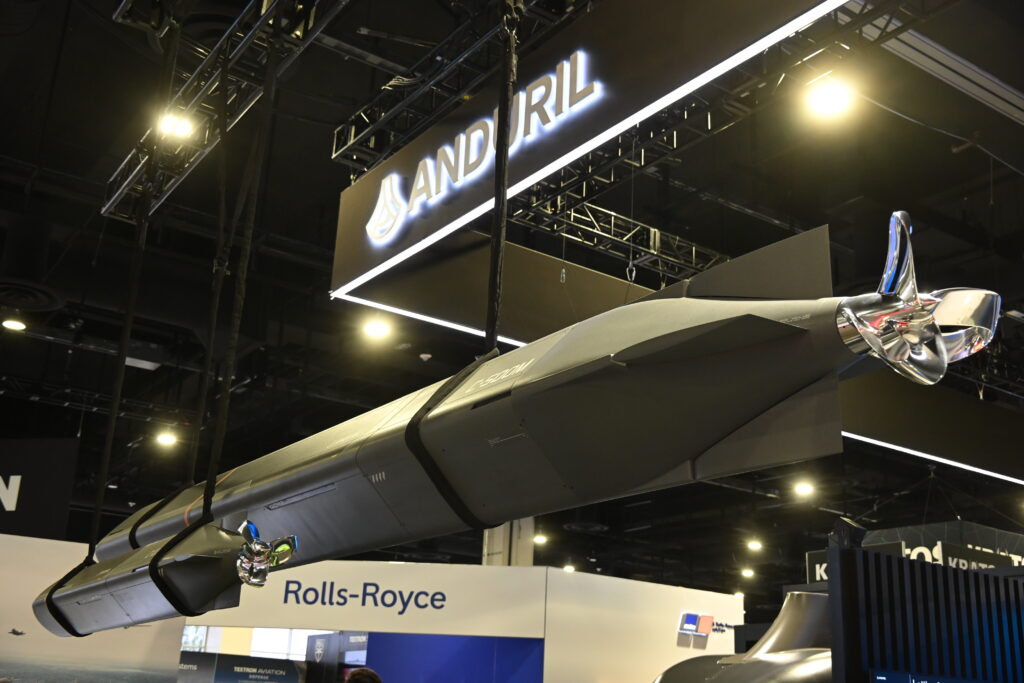
Anduril’s Copperhead AUVs on display above the company’s booth at Sea-Air-Space. Photo credit: Brett Davis

Anduril Industries (Booth 1623) took another step in advancing undersea warfare with the announcement of its Copperhead family of autonomous underwater vehicles (AUVs), including torpedoes, the first to be designed for launch from autonomous systems.

Anduril’s Copperhead AUV family currently includes two variants, a 12.75-inch diameter version with a dry weight payload of 100 pounds, and a 21-inch diameter with a dry weight payload of 500 pounds. These can be used for a variety of undersea missions, such as intelligence, surveillance, and reconnaissance, teaming with its Seabed Sentry sensor system, or locating objects such as a downed aircraft, said Shane Arnott, Anduril’s chief engineer, in an April 4 news conference. The Copperheads can carry a variety of sensors, such as sonar, magnetometers and chemical detectors.

Arnott said the Copperhead M version of either the 100 or 500 size is equipped with a warhead to serve as a torpedo. The company’s Dive-XL AUV can carry dozens of Copperhead 100-Ms of multiple Copperhead-500Ms, a company release said.

He said the Copperhead M can be produced in much greater quantities and at less cost than traditional torpedoes such as the Mark 48 and Mark 54 currently used by the U.S. Navy. The Copperhead, which can travel at speeds in excess of 30 knots, also can be deployed from a Group 4 or 5 unmanned aerial vehicle.

Arnott said the Copperhead already has been tested in water.