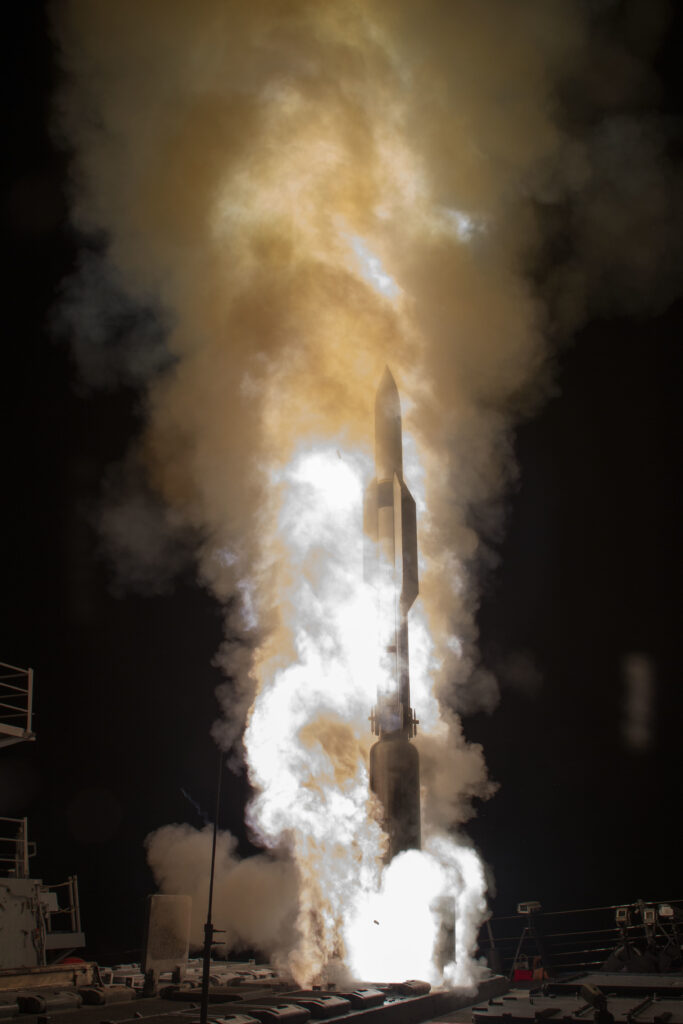
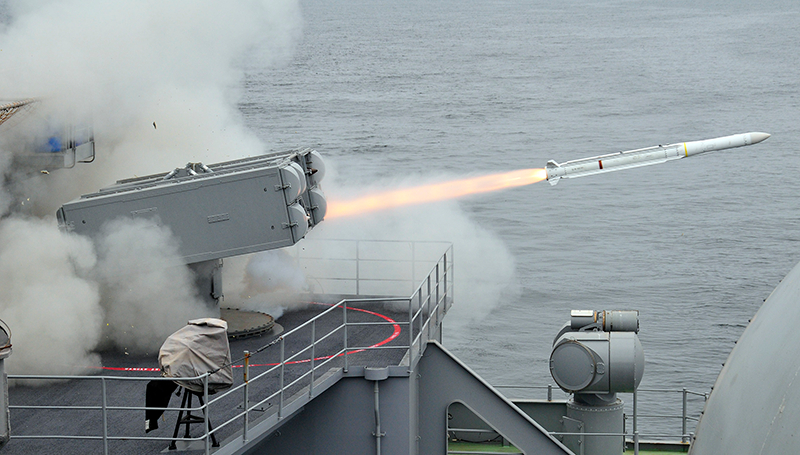
A Standard Missile-6 (SM-6) guided missile is launched from the USS John Paul Jones (DDG 53) during Flight Test Standard Missile-27 Event 2 in 2017. During the test, a medium-range ballistic missile target was successfully intercepted by SM-6 missiles fired from the USS John Paul Jones. Photo credit: Missile Defense Agency | Latonja Martin
ARLINGTON, Va. — The U.S. Navy has awarded Raytheon a $335 million contract modification to “exercise options and provide funding for the manufacturing, assembly, test, and delivery of Standard Missile-6 Tactical All-Up Rounds,” according to an April 30, 2026, Department of War contract announcement.
The SM-6, deployed on U.S. Navy guided-missile destroyers and cruisers, has featured heavily in combat in actions in the Middle East since 2024 against Houthi and Iranian missiles. The Navy has received funding to replenish and increase stocks of missiles to maintain readiness.
This contract modification, awarded April 24, is funded weapons procurement accounts for fiscal years 2025 and 2026.
“Standard Missile-6 is a critical, combat-proven system that provides a vital layer of protection for ships and Sailors — a capability that has never been more critical than it is today,” said Phil Jasper, president of Raytheon. “Contracts of this nature are an essential step in sustaining production, and we remain focused on enhancing our operations to meet unprecedented demand. To support this growth, Raytheon has invested nearly $900 million over the last three years to expand capacity at key sites, including Tucson, Arizona, and Huntsville, Alabama. These investments paired with the clear demand signal will help ensure we deliver these critical munitions at the speed of the mission.”
Raytheon Proposes Next-Generation Jammer for Ground- and Ship-Based Defense
By Richard R. Burgess, Senior Editor
ARLINGTON, Va. — Raytheon is demonstrating its Next-Generation Jammer Mid-Band (NGJ-MB) electronic attack arrays for ground-based or shipboard use, particularly in a counter-UAS (unmanned aerial system) role.
The NGJ-MB currently serves in the airborne electronic attack role on the Navy’s EA-18G Growler electronic attack aircraft. Raytheon is looking at expanding its use in other domains. One reason is to use non-kinetic solutions to save on ammunition.
“What we’re finding with high munitions usage, a lot of our customers are looking for non-kinetic options in products and capabilities to solve their problems,” said Camille Wilson, vice president for Requirements and Capabilities for the Raytheon Naval Power sector.
“From a defense perspective, we need a number of different solutions,” Wilson said.
She said that the NGJ-MB array itself can be used for such applications.
“We’ve explored one array up to two, three, four arrays depending on what effect you need, what electric power out you need,” Wilson said. “With one array I could do a myriad of different things. I could use it on a vehicle. I could use a smaller system. If I wanted more capability and more power out or coverage, I could add more arrays. The interesting thing about the land-based variation that we’re looking at is I don’t have the same power and cooling constraints as I do on the airborne side, so there’s a lot more that we could do with it. There are a lot more configurations that we could use those arrays for.”
Wilson was not at liberty to discuss “the full complement of capabilities for a ground-or-ship-based NGJ array, but what a lot of our customers are asking for is counter-UAS.”
She noted that software changes on the NGJ-MB would be required for the counter-UAS role, but that “taking something that is in production, TRL-9 [Technology Readiness Level 9], that we know works, can we make a few software tweaks and optimize for a different mission set?”
She said that in the counter-UAS role, the NGJ-MB could be used to jam or decoy drones.
Raytheon has a demonstration system and is actively demonstrating the ground-based electronic attack capability, Wilson said. “We have multiple U.S. Government and departments and entities [with which] we’re discussing options for deployment.
L3Harris Develops Torpedo Tube Launch and Recovery System for AUVs
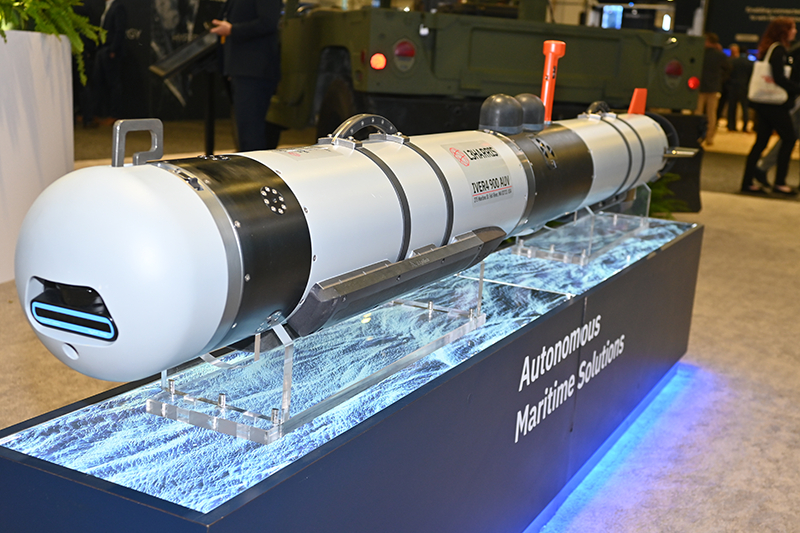
L3Harris’ Torpedo Tube Launch and Recovery system can launch and recover Iver4 900 uncrewed underwater vehicles, like the one shown here in the L3Harris booth, from submarine torpedo tubes. (Credit: Brett Davis)
By Richard R. Burgess, Senior Editor
ARLINGTON, Va. — The Navy’s requirement to develop a method of launching and — more challenging — recovering autonomous underwater vehicles from torpedo tubes of submarines is being met by L3Harris Technologies (Booth 937), which has been awarded an Other Transaction Authority contract from the Department of Defense’s Defense Innovation Unit to deliver the Torpedo Tube Launch and Recovery (TTLR) system.
The TTLR has demonstrated its ability to launch and recover Iver4 900 AUVs through attach submarine torpedo tubes.
“The Torpedo Tube Launch and Recovery system is not a future capability, it’s answering combatant commander needs today,” Nino DiCosmo, president, Maritime, Space & Mission Systems, L3Harris, said in a company release. “Our system is the first to successfully launch and recover AUVs from a submarine, providing commanders flexibility for persistent undersea operations and maintaining essential stealth.”
The Iver4 900 AUV is payload agnostic, said J.R. Gear, vice president and general manager of Integrated Systems and Encryption for L3Harris, in an interview, noting the system would be capable of missions such as seafloor mapping, counter-mine warfare and other intelligence, reconnaissance and surveillance missions.
“We try to build it with some modular interfaces that you could have one type of mission one day from a submarine and then swap out the sensor and swap out the batteries and [gain] maybe a little bit more range and endurance or whatever and tailor the vehicle for today’s mission,” he said. “Very adaptable.”
Gear was not at liberty to describe the details of how the AUV swims back into the torpedo tube, citing proprietary restrictions. But he did say the recovery is “completely autonomous.”
The TTLR includes a sleeve that fits inside the torpedo tube, called a SAFECAP, of Shock and Fire Enclosure, from which the IVER4 900 AUV swims out and is later recovered. Importantly, no structural modifications to the submarine are required.
“Whether it [the AUV] swims out with the nose out or backs out, it’s payload dependent on how it leaves,” Gear said. “It literally swims away, performs its mission, and then when it returns, it’s kind of a push of a button and it will swim back into that SAFECAP of the torpedo enclosure. We’ve tested this on several different types of submarines, and I think we’re the first also that have done this on both the United States Navy and the Royal Navy.”
Gear said the “submarine has to operate in an envelope that’s going to be compatible with the UUV. We can’t discuss that here but it’s very friendly to the mission. You put the SAFECAP in [the torpedo tube], the Iver goes in there with the guides, you lock it up and let it go, and it swims on out and does its thing autonomously. And when it’s finished with its mission, it comes back, and with a command, a single command, it will come back into the sub.”
The SAFECAP sleeve can be removed inside the submarine for the torpedo tube to be used for torpedoes or other payloads.
“The system delivers the first U.S. Navy submarine- and aviation-approved AUV lithium-ion battery technology, enabling longer-duration missions with hot-swap capability for continuous operations,” L3Harris said in a March 26 release. “TTLR’s interoperability across multiple submarine classes and allied platforms advances the Navy’s manned-unmanned teaming vision and demonstrates AUKUS Pillar 2 collaboration.”
Gear was not at liberty to discuss the value of the contract award or the quantity of the order. He did say a TTLR shipset includes two AUVs with a sustainment package that includes some payloads and spare parts. The TTLRs are being built at the company’s Fall River, Massachusetts, facility.
Gear declined to say when deliveries of the TTLR will begin, only, “we’ve been looking forward to this working with the Navy for a little while and ready to go if and when the Navy was ready. And so, they’re ready now. The pump is primed and we’re starting to execute on that contract.”
Bundle Buy a Welcome Investment, AWIBC Says
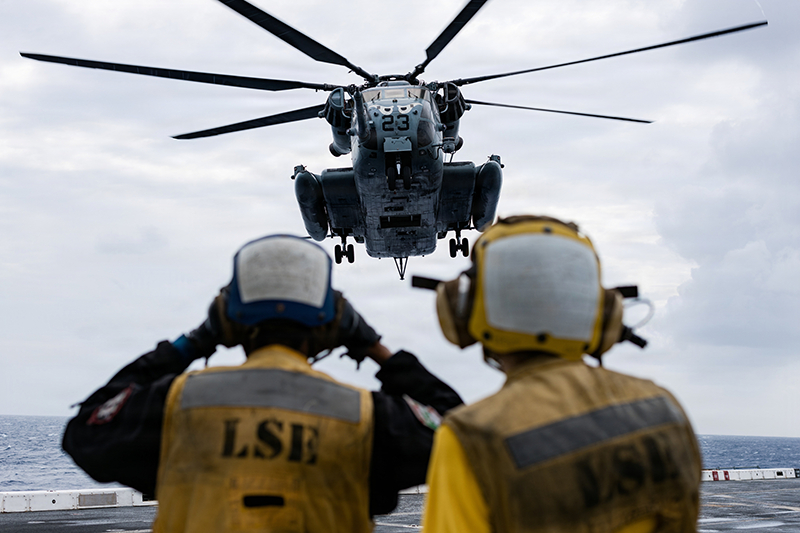
A CH-53E Super Stallion assigned to Marine Medium Tiltrotor Squadron (VMM) 163 (Reinforced), 11th Marine Expeditionary Unit, hovers over the flight deck of San Antonio-class amphibious transport dock ship USS Portland (LPD 27), during flight operations in the Pacific Ocean, April 10, 2026. CREDIT: U.S. Marine Corps | Lance Cpl. Luke Rodriguez
The Amphibious Warfare Industrial Base Coalition (AWIBC) is a trade coalition of suppliers of systems, components, parts, and services toward the construction and sustainment of the U.S. Navy’s amphibious warfare ships. Recently, Paul Roden, chair of the AWIBC, responded to questions below from Senior Editor Richard R. Burgess.
Has AWIBC membership increased or decreased over the last year?
RODEN: The Amphibious Warship Industrial Base Coalition is a robust and growing organization. We continue to see strong interest from suppliers who recognize the importance of a unified voice in advocating for the stability of our nation’s defense industrial base that supports the men and women of our Navy and Marine Corps.
Is the amphibious warship industrial base in better or worse shape than last year?
RODEN: We are incredibly grateful for recent funding in support of amphibious warships, including the multi-ship buy for LPD 33, LPD 34 and LPD 35 as well as LHA 10. However, our most recent survey data shows that less than 10% of our suppliers are operating at full capacity due to inconsistent demand signals. As this new funding is placed on contract, it will help rejuvenate production lines and inject much-needed stability into the industrial base.
With all of the efforts to shore up the shipbuilding workforce, how healthy is the workforce of the suppliers?
RODEN: The most critical factor in the health of the industrial base workforce is stable and predictable funding. Our survey data shows a direct link between inconsistent demand and the challenge of maintaining a skilled workforce. With a clear and consistent demand signal from the government, we can unlock the full capacity of a domestic industrial base that is 100% committed to delivering the ships our warfighters need.
How did the well-funded reconciliation law affect the amphibious warfare ship suppliers?
RODEN: The funding for the bundle buy was a significant and welcome investment. That funding is helping to rejuvenate idle production lines and inject much-needed stability across the amphibious warship industrial base. More than 50% of suppliers agree that the multi-ship buy has added predictability, helping plan for on-time deliveries. It was a crucial investment for the suppliers in our coalition and we are grateful for that support.
Are you seeing any improvements in amphibious warfare ship construction schedule stability?
RODEN: While the recent funding was a significant and welcome commitment, true schedule stability can only come from consistent and predictable funding through multi-year appropriations. To the extent that many of our suppliers support new construction across both amphibious ships and other critical naval assets, stable funding benefits the entire shipbuilding industrial base committed to delivering America’s maritime dominance.
Q&A: Fincantieri Marine Group CEO George Moutafis
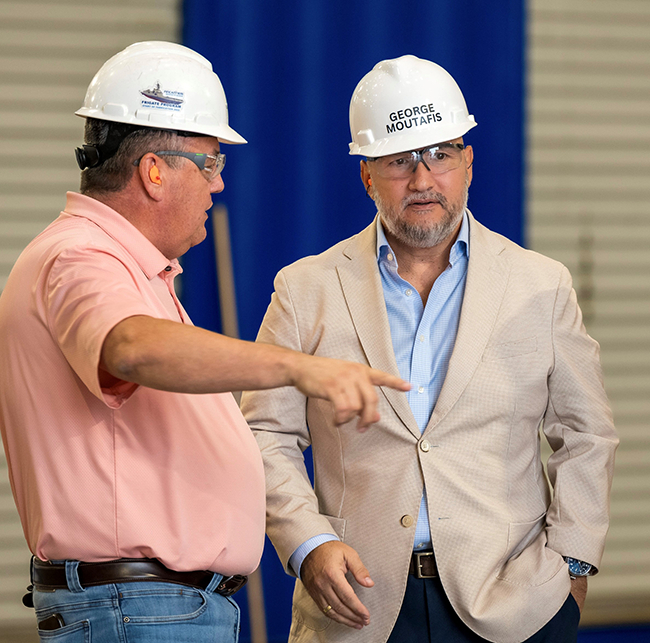
Fincantieri Marine Group CEO George Moutafis, right, tours company facilities. (CREDIT: Fincantieri Marine Group)
In February 2026, Fincantieri Marine Group (Booth 1223) issued the following release:
“As you may have seen in NAVSEA’s press release, the U.S. Navy tapped Fincantieri to build four of the first wave of Medium Landing Ships (LSMs) for the Marine Corps. Our $1B investment over the last 18 years to create concurrent production lines across our Wisconsin system of shipyards has positioned us to be a prime player in the American shipbuilding renaissance. This announcement represents a good start of follow-on workload, part of the framework agreed with the Navy to ensure stability following the announcement in November. Details are still being worked out between us and the Navy, and we will communicate any developments, as soon as they solidify. Our intent is to quickly build as many vessels as the Navy will trust us with, in the LSM class and other classes that our armed forces require, to contribute to our nation’s needs.”
Fincantieri Marine Group CEO George Moutafis later discussed the LSM program’s vessel construction management (VCM) concept with Senior Editor Richard R. Burgess.
The Vessel Construction Management concept proved successful with Philly Shipyards and its National Security Multi-Mission Vessel (NSMV) program. What advantages and disadvantages do you see with the VCM concept?
MOUTAFIS: Advantages: I trust our Navy wants to see whether this mechanism can deliver quality vessels fast, by streamlining oversight and creating unity of effort. Such benefits can be achieved if the concept is applied in its intended form:
A key aspect is to empower the VCM to make decisions on construction, favoring schedule, without compromising quality and without seeking constant guidance or approval from the Navy. When combined with a complete and final design and a commercial-type relationship between the VCM and shipbuilders, this can be truly powerful and harness efficiency in decision-making and speed.
So, overall, this concept is aimed at simplifying things. From that vantage point, this approach aligns perfectly with our goal of fast serial production of naval vessels, and we are ready to continue our partnership with the Navy and help them test this concept.
Disadvantages: More than disadvantages, it will be key for all parties involved (the Navy, the VCM, the shipbuilder(s) to embrace the concept, draw the relevant lines and collectively ensure we do not fall into mishaps of the past that might jeopardize what this concept is trying to achieve.
The U.S. Navy has issued a request for proposal for a vessel construction manager to oversee the acquisition of the new Medium Landing Ship. This strategy is designed to maximize commercial practices to accelerate delivery, improve cost discipline, and expand the U.S. shipbuilding industrial base, with a contract award anticipated for mid-2026. (CREDIT: Naval Sea Systems Command)
With the VCM chosen as the LSM program management concept, what changes will Marinette have to institute to accommodate the concept?
MOUTAFIS: We are ready. In Wisconsin we have a system of yards where we have executed successfully programs for our Navy, for our Coast Guard, but also for commercial customers, under a variety of contractual setups.
We will wait to see the details of how the Navy will position itself towards the program and how the VCM will seek to exercise oversight and work with us. We are ready to adjust to whatever those requirements are.
At first glance, an oversight and collaboration similar to the one witnessed during the NSMV program and a “build-to-print” design, for now, appear to alleviate some demands in terms of administration and engineering, allowing us to swiftly get into what we do best: swift serial construction … but it all remains to be seen.
What adjustments, if any, will be needed for your workforce as you shift from LCS production to the LSM?
MOUTAFIS: Using a “build-to-print” approach allows construction to happen quicker. Plus, it minimizes change and prevents extensive and time-consuming design iterations.
We will need to review all the technical details, but we do not foresee major adjustments to workforce. Our system-of-yards configuration ensures agility in the workforce, rendering them able to jump from Navy standards to commercial or ABS standards.
And with the right level of sustained demand signal, we will be able to improve efficiency and speed, which will be a win for all parties. Our system of yards can accommodate multiple parallel lines, almost concurrently.
How is Marinette fairing with the nationwide shortage of skilled shipyard workers?
MOUTAFIS: No doubt, shipbuilders and the related trades remain in high demand. We have expanded our recruiting efforts over the previous few years, and we are blessed to say that our efforts worked. Last year alone we hired nearly 800 employees and improved our retention by 50%.
Our Wisconsin operations saw positive feedback on several new initiatives over the previous 18 months, aimed at stabilizing the workforce. Efforts like cash bonuses to incentivize employee retention and tax-free subsidized childcare had a positive effect on our employees and our operations.
In years past Marinette had difficulty in retention of shipyard workers because of housing shortages in the region. Has that situation been alleviated to any degree?
MOUTAFIS: Yes, there has been a concerted effort by the local communities and developers to expand the number of local housing options that closely align to our growing workforce and their families. We believe this is less of an issue given the development and community support over the last couple of years in Northeast Wisconsin.
Is Marinette continuing with cooperative relationships with community colleges for workforce development? What is your assessment of the cooperation?
MOUTAFIS: Yes, we are continuing and seeking to expand our network of such collaborations. We have a continuously growing relationship with Northeast Wisconsin Technical College to not only reinforce the need to up-skill current employees, but also to introduce new technologies and digital tools to attract the shipbuilders of the next generation.
Imagine a not-so-distant future replete with examples of shipyard welders leveraging cobots (collaborative robots) to weld in places where it’s difficult for humans to easily work. That is the future of shipbuilding and why we’re equipping our employees with digital tools like exoskeletons for demanding and repetitive tasks and augmented and virtual reality that allows workers on the deckplates to communicate challenges directly to the engineering team using a wearable digital device.
Raytheon Doubled ESSM Production in 2025
An Evolved SeaSparrow Missile is launched from a Mk 29 launcher aboard USS Carl Vinson (CVN 70) in 2010. (CREDIT: U.S. Navy | Mass Communication Specialist 3rd Class Patrick Green)
By Richard R. Burgess, Senior Editor
Raytheon Missiles & Defense (Booth 911) doubled production of the Block II RIM-162 Evolved SeaSparrow Missile (ESSM) in 2025 as it addressed the increased demand from the U.S. Navy and its partners in the NATO consortium, a company official told Seapower.
“Last year, we produced over 350 ESSM missiles, which more than doubled what we were able to deliver in 2024,” said Misty Holmes, vice president for the Shipboard Organization within the Naval Power division. Her portfolio includes the ESSM, the Rolling Airframe Missile and the Standard family of surface-to-air missiles. She noted Raytheon delivered the 500th Block II version of the ESSM last September.
“We’re continuing to increase production this year to deliver over 400 all-up rounds, and we have a North Star in terms of our production capacity to go beyond 700 per year to meet that increased demand signal and service the needs of all of our customers’ navies,” Holmes said.
The ESSM, which became operational in 2004, is a short-to-medium shipboard surface -to-air missile deployed on several classes on U.S. Navy ships, including many guided-missile destroyers, aircraft carriers and amphibious assault ships. The missile is designed to counter advanced, highly maneuverable threats, and features a warhead specifically designed to defeat hardened anti-ship cruise missiles. In 2007, a surface-to-surface/anti-low-velocity air threat capability was introduced on the missile. The missile was developed by a consortium of 12 NATO nations and has been acquired by Japan through direct commercial sales.
“I believe that gives ESSM a unique and a distinct advantage in today’s munitions programs over those that are solely developed and managed by one nation,” Holmes said. “The consortium is NATO’s largest and most successful cooperative weapons project, and it’s been together for over 15 years supporting international military industrial cooperation.
The Block II ESSM, which became operational in 2020, features an active guidance system in addition to semi-active guidance, reducing the need for shipboard radar illumination.
“This particular capability does come with significant digital processing margin,” Holmes said, “[A]s we are focused on innovation, [we] can continue to upgrade this capability to keep it ahead of pace with the threat to ensure that we’re keeping our ships and our Sailors, both U.S. and international allies, safe and coming home.”
Recent conflicts in Ukraine and the Red Sea have spurred demand for such weapons as the ESSM, which was fired against Houthi missiles and drones during 2023 and 2024.
“I do see this as a multi-factor issue, Holmes said. “We are seeing increase in the defense budget across numerous of our customers largely in Europe as well as others due to the threats, the war in Ukraine, the realization of expenditures in the Red Sea and others. So, we are seeing that increased demand signal come in pretty globally.”
Holmes said Raytheon is focused on the increased demand signal.
“This production really does showcase exceptional program performance that has been heavily supported by a very robust supply chain that’s been meeting and exceeding targets, and that supply chain is extremely diverse and global, she said. “Our suppliers, in ESSM’s case, are not just suppliers, there are partners, international industrial-based partners. Two areas that have been really big on this production are our industrial partners delivering on their contracts to make all those components ready for integration, and then the dedicated action by the Raytheon factory teams to improve throughput and remain focused on the goal that we have to meet and exceed our production targets. We’ve been working on test efficiencies, optimization and throughput to ensure we can continue to improve on our delivery.”
Is Raytheon working on a Block III ESSM? Holmes would only say, “We are working on enhanced kinematics and maneuverability, things that will keep this weapon system ahead of the threat for the next few decades. But we’re eager to participate with the U.S. in the consortium in their next significant variant.
“We don’t sit back and rest on our laurels that what we’ve delivered is good enough,” she said. “We’re constantly adding capability to the suite of capabilities to make sure [that we are] staying ahead of the threat and those are investments we’re making in future ESSM capabilities as well in terms of funding new research and development ahead from government requirements.”
Navy Awards Marinette Marine $30 million Contract toward Medium Landing Ships
Navy Awards Marinette Marine $30 million Contract toward Medium Landing Ships
By Richard R. Burgess, Senior Editor
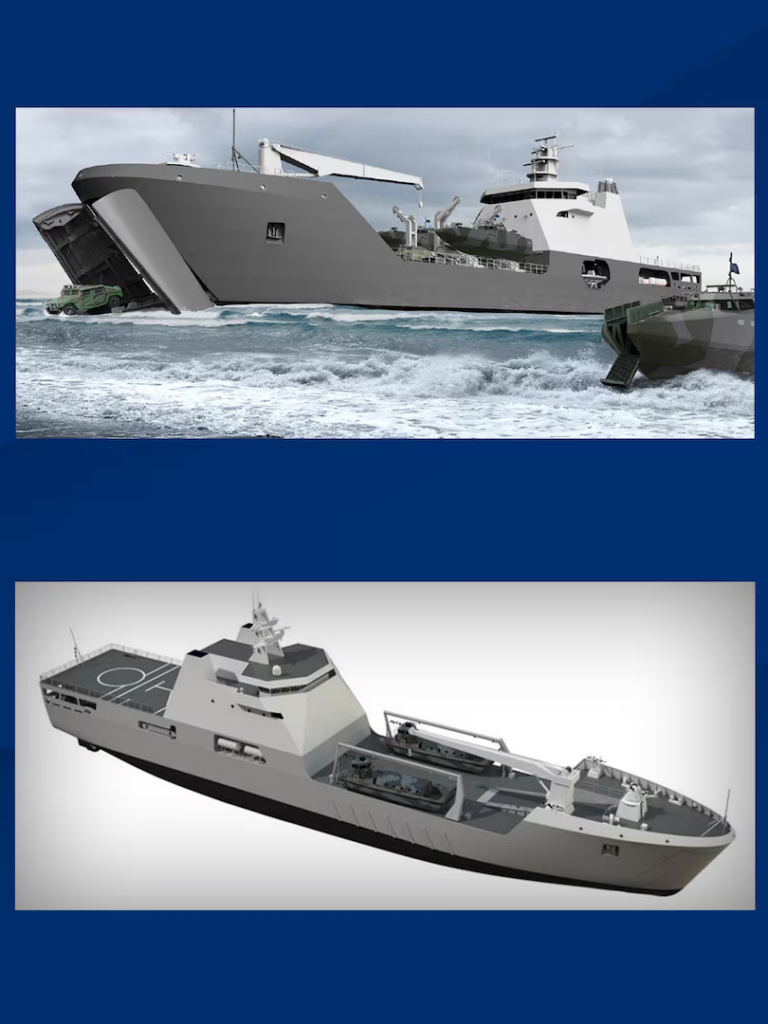
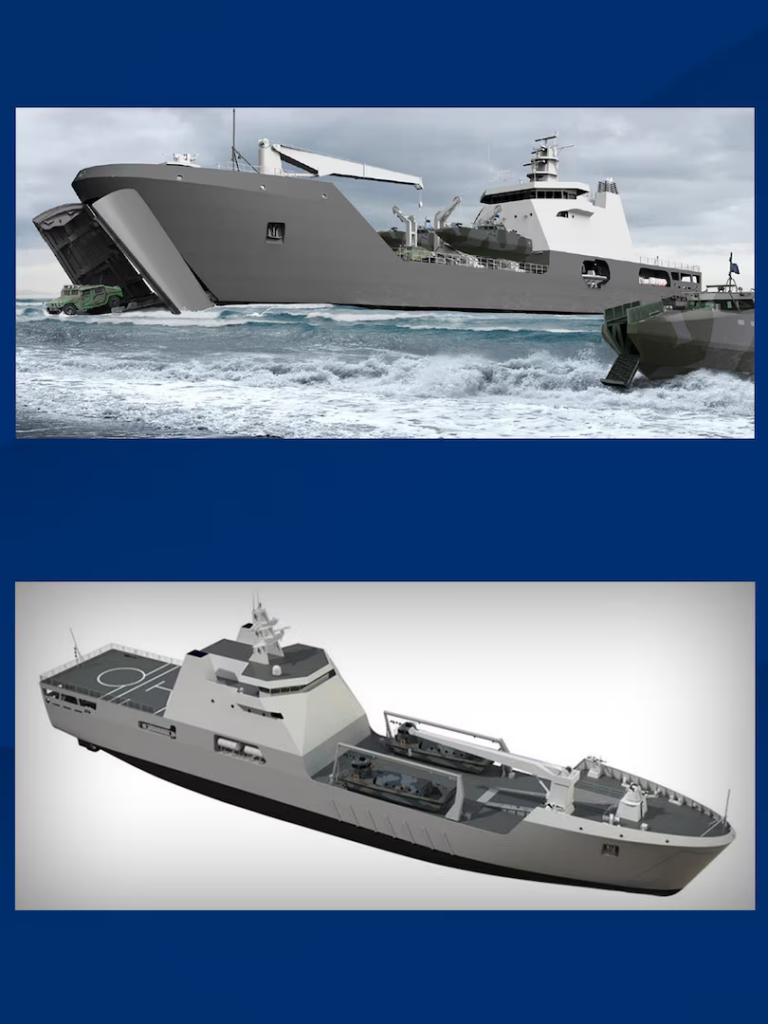
ARLINGTON, Va. — The U.S. Navy has awarded a contract to a shipbuilder for materials and engineering activities for the first four Block 1 medium landing ships (LSMs).
“Marinette Marine Corp., Marinette, Wisconsin, is awarded a $30,000,000 not-to-exceed undefinitized contract action for advance procurement of long lead time material and associated engineering and design activities in support of four Medium Landing Ship Block 1,” the Department of War said in an April 14 contract announcement.
Marinette Marine Corp. is a unit of Fincantieri Marine Group FMG), which also is building two Constellation-class guided-missile frigates for the U.S. Navy. The Naval Sea Systems Command obligated $15 million of fiscal 2025 funda at the time of the contract award.
The Navy plans to procure 35 LSMs to support the Marine Corps’ expeditionary advance base operations.
“Enhancing our maritime dominance depends on a modernized fleet and a strong industrial base, and today’s contract helps with both — it reduces schedule risk and enables our shipbuilders to rapidly transition to ship construction,” said Secretary of the Navy John C. Phelan in a post on X that also announced the contract award.
“Work will be performed in Marinette, Wisconsin (46%); De Pere, Wisconsin (39%); and Kenner, Louisiana (15%),” the Department of War’s announcement said. “Work is expected to be completed by September 2027.”
In December 2025, the Navy and Marine Corps jointly announced Damen Naval’s LST 100 landing ship would serve as the baseline to field a “proven, non-developmental design – would serve as the baseline to help rapidly field LSM capability,” according to the Naval Sea Systems Command. “The LSM will fill the capability gap between smaller, short-range landing craft and the Navy’s long-duration, multi-purpose amphibious warfare ships. It is essential for the maneuver and sustainment of Marine forces, providing the critical littoral mobility required in contested environments. The program will deliver a 35-ship fleet that enhances expeditionary agility and supports the Marine Corps’ concept of distributed maneuver and logistics.”
Key points made in Fincantieri’s follow-up email announcement included the following:
The contract supports long‑lead materials procurement and early engineering and production readiness activities, enabling a potential start of construction as early as Q4 2026.
The LSM program is a foundational element of U.S. Navy and Marine Corps force design, with up to 35 vessels planned; FMG is designated to build at least the initial four.
The award builds on more than $800 million in U.S. shipyard investments by Fincantieri over the past decade, supporting long‑term naval and industrial capacity.
Hegseth: Iranian Warship Sunk by U.S. Submarine Torpedo
By Richard R. Burgess, Senior Editor
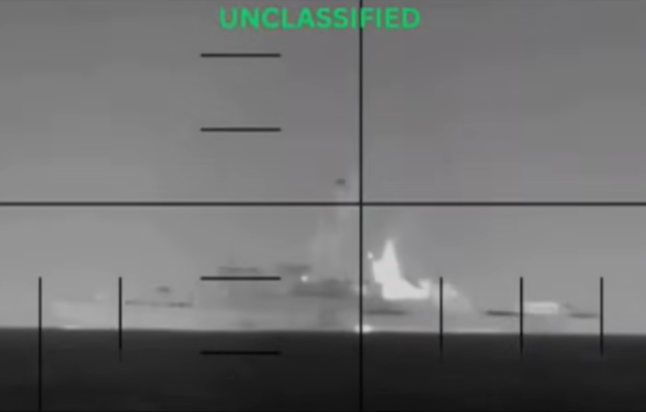
ARLINGTON, Va. — An Iranian warship has been sunk by a torpedo fired from a U.S. Navy submarine, the Secretary of War said. The action would be the first ship sunk by torpedo fired from a U.S. Navy ship since World War II.
Secretary of War Pete Hegseth said on March 4, 2026, that the Iranian ship was sunk in the Indian Ocean
According to the BBC, the sunken ship was the IRIS Dena, a guided-missile frigate that went down off the southern coast of Sri Lanka. The ship was one of six ships of the Moudge class.
According to Reuters, the Sri Lankan Navy rescued 32 people from the ship, of a crew estimated to number 180 members. At least 80 crew members died in the action.
The action represents the first sinking of an enemy warship by a U.S. submarine’s torpedo since World War II.
During the Falklands War, on May 2, 1982, the Royal Navy nuclear-powered attack submarine HMS Conqueror sank the Argentine Navy cruiser ARA Belgrano with a torpedo. The Belgrano was formerly the light cruiser USS Phoenix.
U.S. Navy submarines are armed with 21-inch Mark 48 21-inch diameter torpedoes.
Navy Announces 13 Fiscal 2026 Ship Retirements
By Richard R. Burgess, Senior Editor
ARLINGTON, Va. — The U.S. Navy has announced its plan to retire 13 ships during fiscal 2026, including two ships held over from last year.
In a Feb. 20 message released by Rear Admiral M. D. Behning, acting deputy chief of naval operations for Warfighting Requirements and Capabilities, the planned retirements included six warships and seven auxiliary ships. Most of the retirements are planned for the summer.
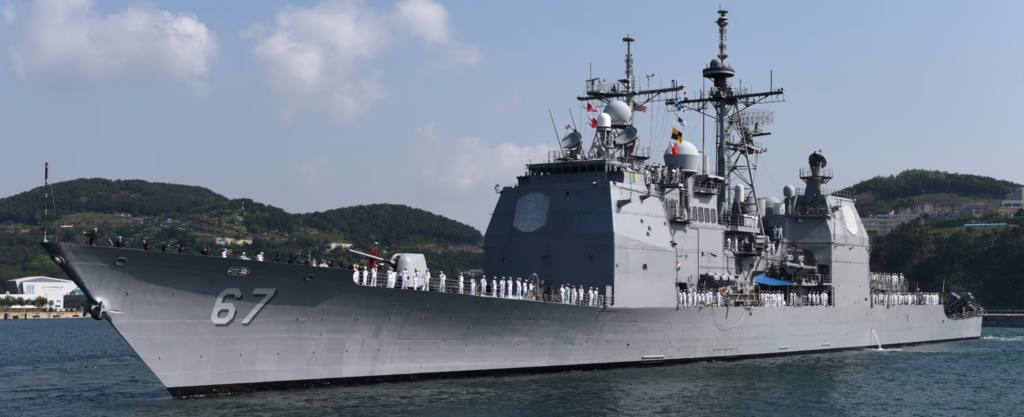
The two Ticonderoga-class guided missile cruisers on the list, USS Shiloh (CG 67) and USS Lake Erie (CG 70), originally were to be decommissioned in fiscal 2025. Shiloh had transferred to Pearl Harbor, Hawaii, from Yokosuka, Japan, but was kept in commission with the change in presidential administrations. Lake Erie was deployed to the U.S. 4th Fleet supporting Operation Southern Spear and had remain deployed as fiscal 2025 expired. The ships will be stored as support assets and their retirement by September will leave the fleet with five cruisers.
One Los Angeles-class attack submarine, Newport News (SSN 750), was inactivated in January. Its inactivation will be followed in August by that of USS Alexandria (SSN 757), leaving the fleet with 18 Los Angeles-class boats. The submarines will be scrapped.
One of the early Freedom-class littoral combat ships, USS Fort Worth (LCS 3), will be decommissioned by July and will be scrapped. A Whidbey Island-class dock landing ship, USS Germantown (LSD 42), will be decommissioned by September and retained as a support asset, leaving the fleet with five other ships of the class.
Three Henry J. Kaiser-class fleet replenishment oilers are being removed from service with Military Sealift Command in 2026: USNS Big Horn (T-AO 198) by March and USNS John Ericsson (T-AO 194) and Pecos (T-AO 197) by July. The Big Horn and Pecos are being transferred to the Maritime Administration, and the John Ericsson will be retained as a support asset. These retirements will leave the fleet with ten oilers of the class. The ships are being replaced by the John Lewis class T-AOs, which first deployed in 2025.
Three Watson-class large, medium-speed, roll-on/roll-off ships will be transferred to the Maritime Administration: USNS Pomeroy (T-AKR 316) by April, USNS Watkins (T-AKR 315) by July, and USNS Red Cloud (T-AKR 313) by September. The retirements will leave the Military Sealift Command with three ships of the class.
The singular VADM K.R. Wheeler (T-AG 5001) will be transferred from the Military Sealift Command to the Maritime Administration by July. It is equipped with an offshore petroleum distribution system uniquely designed to pump fuel ashore from up to eight miles.
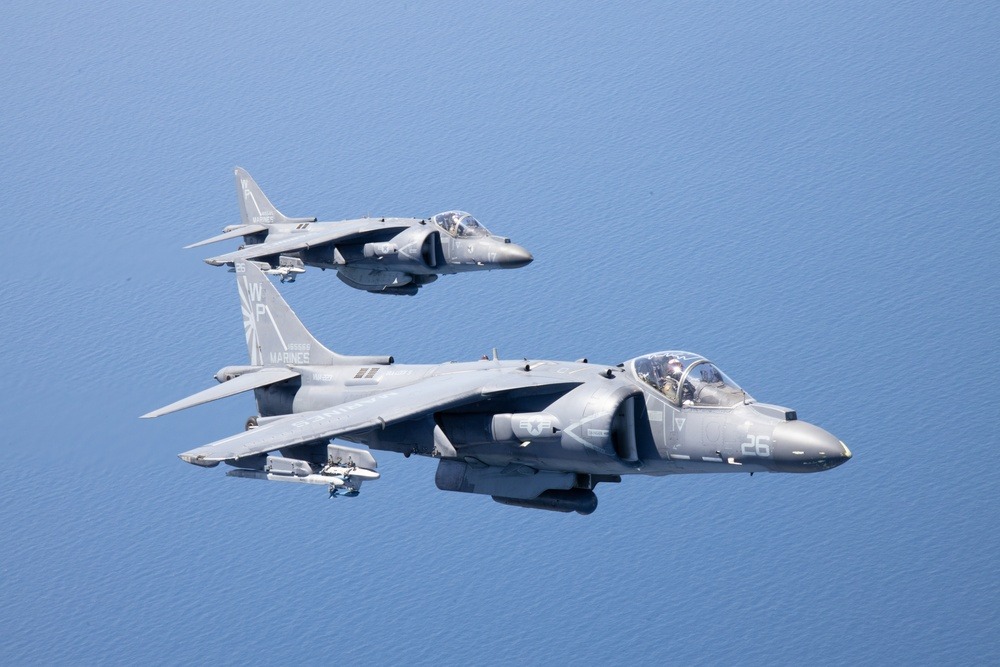
Marine Corps to Retire Last AV-8B Harrier IIs in June
ARLINGTON, Va. — The U.S. Marine Corps plans to retire its last Boeing AV-8B Harrier II vertical-takeoff and landing attack jets this summer, according to the 2026 Marine Corps Aviation Plan released Feb. 10, 2026.
The Corps operates only one remaining Marine attack squadron (VMA), VMA-223, which is based at Marine Corps Cherry Point, North Carolina. The squadron will conduct the last flight of a Harrier on June 3, during a series of ceremonies scheduled for June 1 through June 5.
VMA-223 currently has a detachment of AV-8Bs assigned to the 22nd Marine Expeditionary Unit deployed on board the amphibious assault ship USS Iwo Jima (LHD 7). The Iwo Jima has been operating in the U.S. Southern Command’s area of responsibility in support of Operations Southern Spear and Absolute Resolve. This is the last scheduled deployment of the AV-8B.
VMA-223 is scheduled to be redesignated a Marine fighter attack squadron in fiscal 2027 as it trains to fly the F-35B Lightning II short takeoff/vertical landing strike fighter.
The Marine Corps began flying Harriers in 1971, beginning with the AV-8A and later AV-8C versions. The much-improved AV-8B Harrier II version entered service in January 1985. Further upgrades resulted in the night-attack AV-8B(NA) version, with many further upgraded with radar as the AV-8B Harrier II Plus version.
AV-8Bs served in numerous combat operations, including Operations Desert Storm and Desert Shield, Operation Allied Force, Operation Odyssey Dawn, Operations Enduring Freedom and Iraqi Freedom, Operations Inherent Resolve and Resolute Support, and most recently in Operation Southern Spear.
“Equipped with precision-guided munitions (PGMs), an advanced LITENING targeting pod, and LINK-16, the Harrier has a distinguished legacy of destroying surface targets and escorting friendly aircraft, providing the Marine Corps with a relevant and survivable fight-tonight capability,” the aviation plan said.