Coast Guard District is Economic Nerve Center with Complex Northern Border Challenge
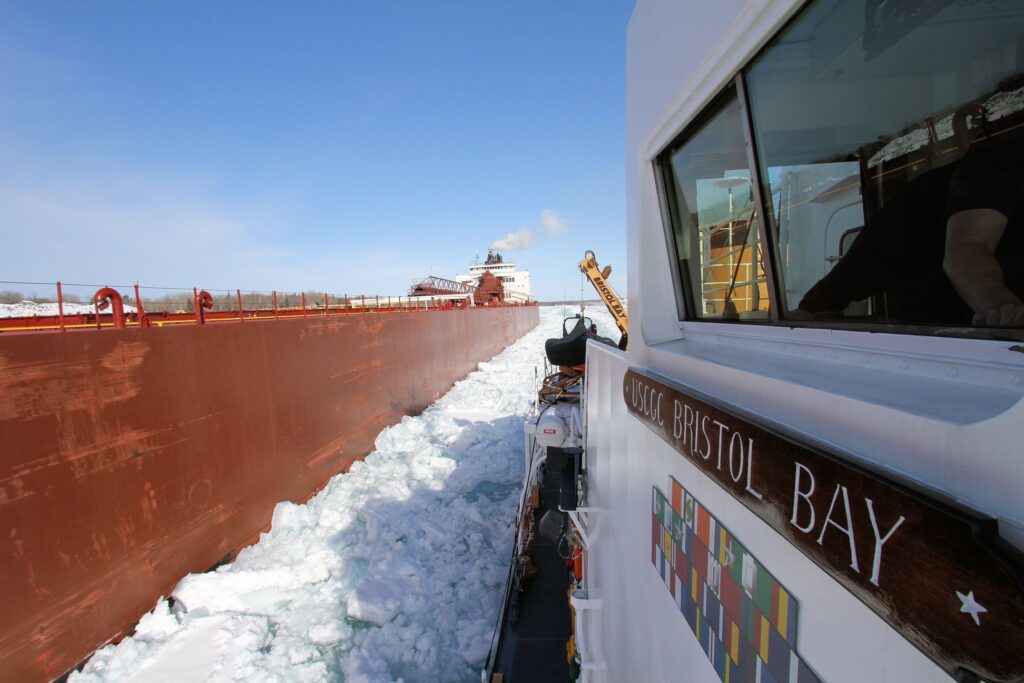
The crew of Coast Guard Cutter Bristol Bay, homeported in Detroit, assists the vessel James R. Barker at Rock Cut in the St. Marys River April 2, 2018. Bristol Bay worked the river to keep the waterway open. Photo credit: U.S. Coast Guard | Chief Petty Officer Nick Gould

Editor’s Note: Since this article first appeared in the July/August issue of Seapower, the 9th District has been renamed the Great Lakes District.

The 9th Coast Guard District, or D9 as it is known to the 5,000 people stationed at more than 78 units across five sectors, encompasses eight U.S. states and the five Great Lakes, including three of the world’s largest by surface area — Lake Superior, Lake Michigan and Lake Huron.

With 6,700 miles of shoreline and a 1,600-nautical-mile international border with Canada, the 9th District ensures safe passage each year for 80 million tons of bulk cargo — iron ore, taconite pellets, grain, salt, concrete and fertilizer — along a handful of vital shipping corridors. In D9, these waterways are essentially narrow passages; in the event of a marine casualty situation, bypasses are scarce. What’s more, 90% of the nation’s iron ore (taconite) comes from open-pit mines in Minnesota and Wisconsin on Lake Superior, where its shipping relies entirely on the Soo Locks, a complex of locks on the St. Marys River without which Lake Superior would be isolated from the rest of the Great Lakes.

Inside the 9th District is the 2,340-mile St. Lawrence Sea­way. The primary access route to North America’s heart­land, the seaway connects the Atlantic Ocean to the head of the Great Lakes. The route is the only navigable link for oceangoing vessels, including cruise ships, to reach the major inland ports of the Great Lakes, among them Ontar­io’s Port of Thunder Bay and the Port of Duluth-Superior.

D9 also has oversight of 5.5 million registered boaters with some of the busiest recreational boating activity in the world. Driving home the economic value of D9’s area of responsibility is the fact that America’s five great lakes contain 20% of the Earth’s fresh surface water, and 40 million Americans rely on the lakes for safe drinking water.

But there’s more: a “Hall-of-Fame” stat one might not expect, according to Rear Admiral Jon P. Hickey, the 9th District commander and senior Coast Guard commander for the Great Lakes and St. Lawrence Seaway.
“If you took the Great Lakes region, the eight states, the two Canadian provinces, the five lakes, and called that a nation, it would be the third-largest GDP in the world [after] the United States and China,” Hickey told Seapower. “The impact that this sector has, it’s real, it’s tangible. In the 9th District, we’re all about safety and security of these maritime regions, these lakes. It is a lifeblood of the U.S. economy.”

D9 is a thriving ecosystem in which all the moving parts — the multitude of lakes and waterways, the valuable cargo, the skilled workforce and the robust, if overworked, fleet — function seamlessly, usually without disruption and therefore, out of the public eye. None of the work is effortless, much less easy. Hickey described the “challenging” narrow passage along the St. Marys River, considered critical infrastructure by the Department of Homeland Security.

“That’s why we have the vessel traffic system. It is absolutely critical what these folks do to manage vessel traffic safely and securely in those waterways,” Hickey said. “You’ve got these … thousand footers [ships] going through there … carrying a product that’s essential to our economy, our security, and if anything were to go wrong, it’s likely [to] block the waterway. These are the things that keep me up at night. The idea of a marine casualty in the St. Marys River, the Detroit River, the St. Clair River because those are the single points of failure in the MTS,” or maritime transportation system.

The regulatory and security landscape surrounding maritime operations on the Great Lakes is nothing if not complex. With 1,600 nautical miles of maritime international border, Hickey said the long-standing cooperation with Canadian maritime authorities is crucial.

“We have an incredible partnership with [our Canadian partners],” Hickey said. “We call it ‘Shiprider,’ where they come on board our vessels, and we go on their vessels. So, it’s a seamless enforcement of Canadian and U.S. laws across that border. We’re ensuring the safety and security of our maritime transportation system, which on the Great Lakes is tantamount to our border. If you were to navigate from the Sioux Locks to Duluth, you would cross the Canadian and U.S. border, staying inside the channel, over 20 times.”

Unique to the 9th District is the Canadian and U.S. Laker fleet, which operates solely within the bounds of the Great Lakes and the St. Lawrence Seaway up to around Montreal, Hickey said. Made of Canadian and U.S. commercial cargo vessels designed for the transport of bulk commodities within the Great Lakes system, the Laker fleet is “not really considered international” and not subject to the same international regulations, such as SOLAS (International Convention for the Safety of Life at Sea), given they only operate within the internal waters of Canada and the U.S.

Meanwhile, the seasonal foreign trade routes through the St. Lawrence Seaway bring foreign flag vessels into the Great Lakes from mid-March to January every year. These vessels are subject to international regulations and must abide by SOLAS requirements because they are in U.S. and Canadian internal waters.

“We have to be very vigilant about … what’s coming in,” Hickey said. “Are they threats to our critical infrastructure, our safety, security? If they meet the threshold for a high-interest vessel, we are going to board them as soon as — or before — they get into the lakes. In the U.S. waters and in the seaway, we’re going to make sure we keep our American public safe and secure.”

Since January, D9 has allocated available operational capacity toward securing and defending the northern border, Hickey said. He said D9 is “leaning into” northern border concerns and intelligence, using resources on hand in anticipation of how border events elsewhere in the country play out.

“We’re also asking the questions of: ‘What would we need if we wanted to do more in the event that … illicit activity increases on the northern border as we continue to lock down the southern border?,’ that balloon effect,” he said. “We have really doubled down on our interagency coordination. [We are] making sure that illegal cross-border activity like drug trafficking and people trafficking is not happening, and we are as committed to that as we are to our search and rescue mission.”
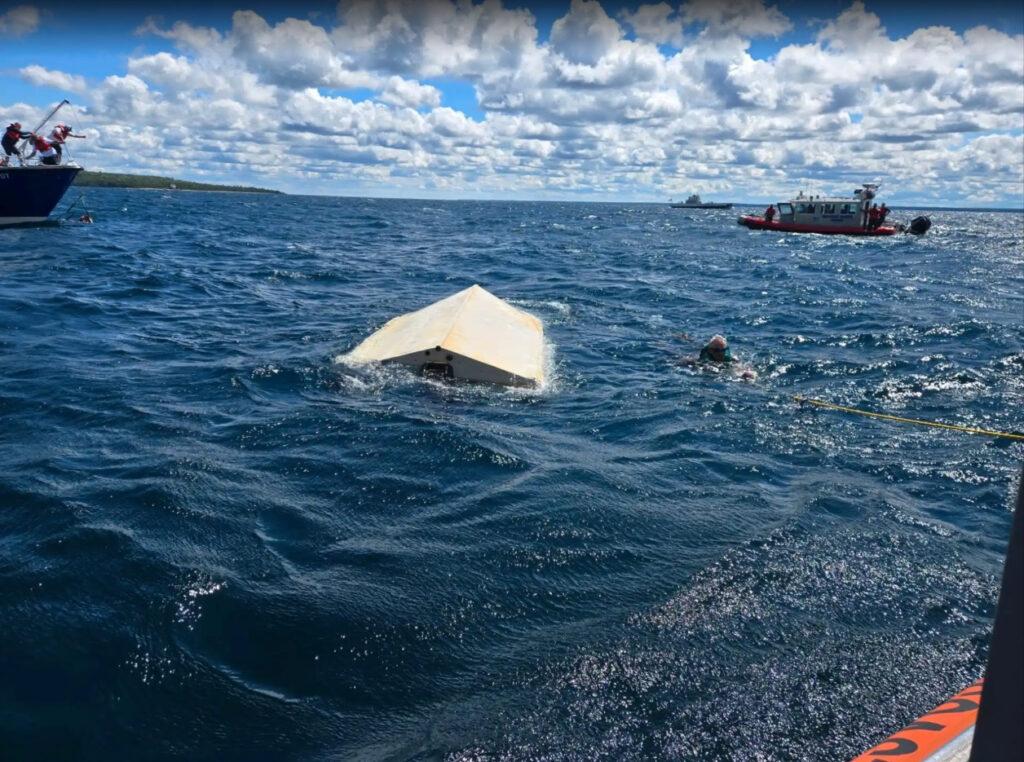
U.S. Coast Guard units coordinated with local partners in a response to a capsized vessel with five persons and a dog in the water off Mackinac Island, Michigan. (U.S. , in August 2024. Photo credit: U.S. Coast Guard Station St. Ignace

The 9th District does the second-most search and rescue cases after the 7th Coast Guard District in the Southeastern U.S. and Caribbean. In the past year, the people of D9 executed more than 2,000 SAR cases across the Great Lakes, Hickey said.

“We saved 873 lives,” he said. “I tell my people, if you save one life, you’ve impacted and changed the lives of everybody in their circle of trust, circle of love, friends, family and loved ones, for the rest of their lives. Search and rescue goes beyond just a mission. It is our special trust with the American public.”

Whether on behalf of recreational boating safety, icebreaking or the uneventful movement of critical bulk cargo, the D9’s Vessel Traffic Service teams rely on a healthy fleet of multimission cutters, response and patrol boats, and, by extension, U.S. Laker cargo vessels. This is not as easy as it sounds, according to Hickey, who said overdue maintenance and slow to no vessel recapitalization are ongoing challenges for VTS operations and overall readiness.

“Those VTS folks are like air traffic controllers. They maintain situational awareness,” Hickey said. “Our U.S. Laker fleet and the Canadian Laker fleet is old, and what we’re witnessing is an increase in our maritime casualties. I am concerned about the health of the fleet. We are in a downward readiness spiral … and it’s due to the perennial underinvestment in our Coast Guard. We have backlogs and maintenance across the board, whether it’s our cutter fleet, our boats, our aircraft or our shore infrastructure.”

In April 2025, DHS issued the Force Design 2028 report, which outlines plans for implementing transformational changes within the Coast Guard, including an overhaul of the agency’s acquisition and contracting system to expedite much-needed new ships. Shortly after the report’s release, Admiral Kevin Lunday, the acting commandant of the Coast Guard, told members of the House Armed Services Committee that efforts were underway and that production milestones outlined in Force Design 2028 are being met.

Hickey said the plans in Force Design 2028 can’t come soon enough. Citing last winter’s above-average ice season in the Great Lakes, he said it was the first time in a while the 9th District had been “stress-tested” with respect to the icebreaking mission. But, thanks to some excellent advanced planning by D9 district staff for maintenance and to complete aids to navigation, or ATONs, in the summer months, they were well prepared.

“We were able to cover down very, very well on the ice season. But, from my perspective, this plan to renew our fleet, our Coast Guard writ large, can’t come soon enough,” Hickey said. “When we talk about Force Design 2028 and recapitalizing the Coast Guard, the VTS system is part of that. We need to recapitalize that system. I am very grateful for the leadership of the administration to get after recapitalization and renewal of the Coast Guard, because it’s not sustainable.”

Daisy Khalifa is a journalist and publicist. With more than 25 years of professional, public affairs and writing experience in Washington, D.C., she recently relocated to the Minneapolis area. Khalifa has consulted and worked full-time in the federal government, for associations and for Fortune 500 companies, among them the Smithsonian Institution, MCI and Nextel Corp.

Adm. Caudle Relinquishes Command of U.S. Fleet Forces Command

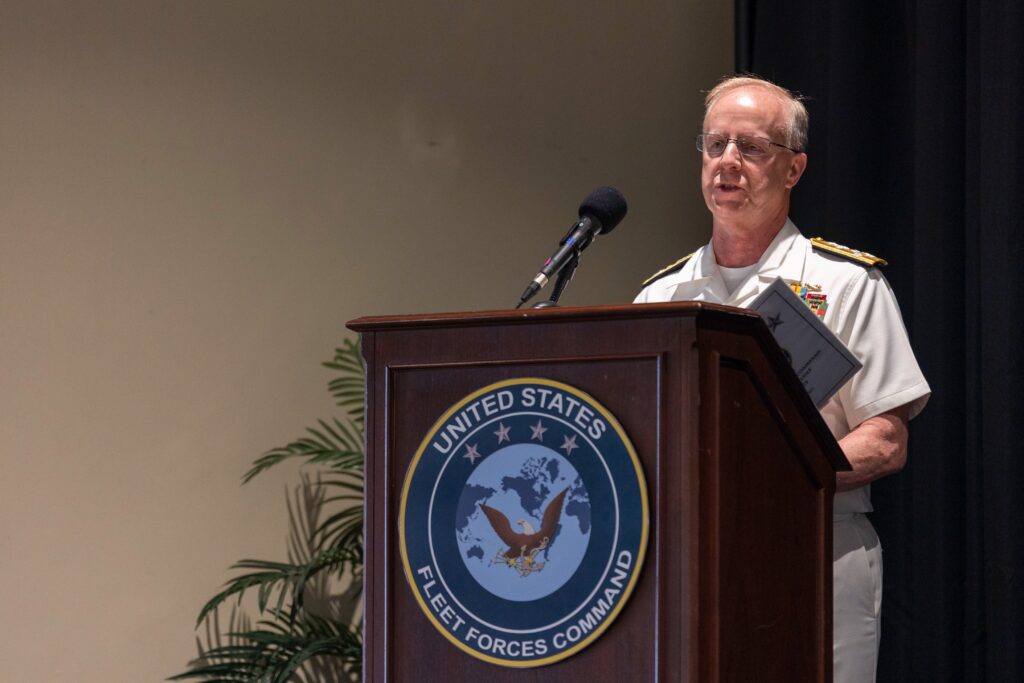
U.S. Navy Adm. Daryl Caudle, speaks during the relinquishment of command ceremony for U.S. Fleet Forces Command (USFFC) aboard Naval Station Norfolk on August 6, 2025. USFFC is responsible for manning, training, equipping and providing combat-ready forces forward to numbered fleets and combatant commanders around the globe. (U.S. Navy photo by Mass Communication Specialist 1st Class Nathan T. Beard/Released) 

Release From U.S. Fleet Forces Command

NORFOLK, Va. – Admiral Daryl L. Caudle relinquished command of U.S. Fleet Forces Command (USFFC) during a ceremony held aboard Naval Station Norfolk, Aug. 6, 2025. 
 
Presiding over the ceremony was U.S. Air Force Gen. Gregory Guillot, commander, North American Aerospace Defense Command and U.S. Northern Command, who praised Caudle’s visionary leadership, operational focus, and relentless dedication to enhancing Fleet readiness during a period of rising strategic competition. 
 
“For the last three and a half years, [Adm. Caudle] has served simultaneously in four critical positions – Joint Force Maritime Component Commander, Strategic; Commander, United States Naval Forces – Strategic Command; Commander, United States Naval Forces – Northern Command; and Commander, United States Fleet Forces Command,” said Guillot. “In each role, Admiral Caudle served with distinction – persistently advocating for modernization while emphasizing fleet readiness and wartime preparedness.” 
 
During his tenure, Caudle led a force of more than 138,000 Sailors, over 120 ships and submarines, 1,500 aircraft, seven task forces, and five carrier strike groups. His leadership was instrumental in key initiatives that reshaped the Navy’s approach to training, readiness, and force integration. 
 
Among his many accomplishments, he reshaped Atlantic Fleet operations through the One Atlantic initiative, breaking down legacy command-and-control silos and improving homeland defense while enhancing the Navy’s ability to respond to high-velocity threats in the Atlantic, Arctic, and high north. 
 
Caudle championed the development of Live, Virtual Environments, and Constructive Scenarios (LVC), culminating in the establishment of the Hefti Global LVC Operations Center in 2024. The state-of-the-art facility integrates live and simulated training environments, greatly enhancing warfighter preparedness in high-end conflict scenarios. 
 
Also, Caudle led the Navy’s participation in the Chief of Naval Operations-directed Large Scale Exercises 2023 and 2025, which spanned 22 time zones, component commands, U.S. numbered Fleets, and this year, for the first time, including allies and partners – marking the most extensive naval exercise in more than a generation. 
 
Caudle’s focus on homeland defense led to the creation of Maritime Command Elements East and West, streamlining command-and-control for maritime homeland defense and disaster response operations. 
 
Caudle drove combat-proven readiness across the Fleet, ensuring all deploying units met the highest standards of lethality and performance, demonstrated during major naval engagements in the Red Sea as part of Operations Prosperity Guardian and Poseidon Archer. 
 
In his remarks, Caudle expressed that his proudest accomplishment was the three-year effort that culminated in the Global Maritime Response Plan, a process that leverages combat surge ready units and response conditions to control our escalation of readiness and forces across the spectrum of conflict. 
 
“Leading this extraordinary team has been an honor,” Caudle said. “Your dedication, resilience, and pursuit of excellence have been the driving force behind everything Fleet Forces Command achieved in propelling our Navy forward. You are executing a vital role in force development, force generation and force employment, and that is no doubt a relentless effort.” 
 
As Caudle concludes a tour marked by historic achievements, he leaves behind a legacy of innovation, integration, and strategic foresight that will guide U.S. naval operations for years to come. 


Naval Research Hydrogen Tech Goes Tactical 

August 6, 2025 

Release From Nicholas E. M. Pasquini, U.S. Naval Research Laboratory Corporate Communications 

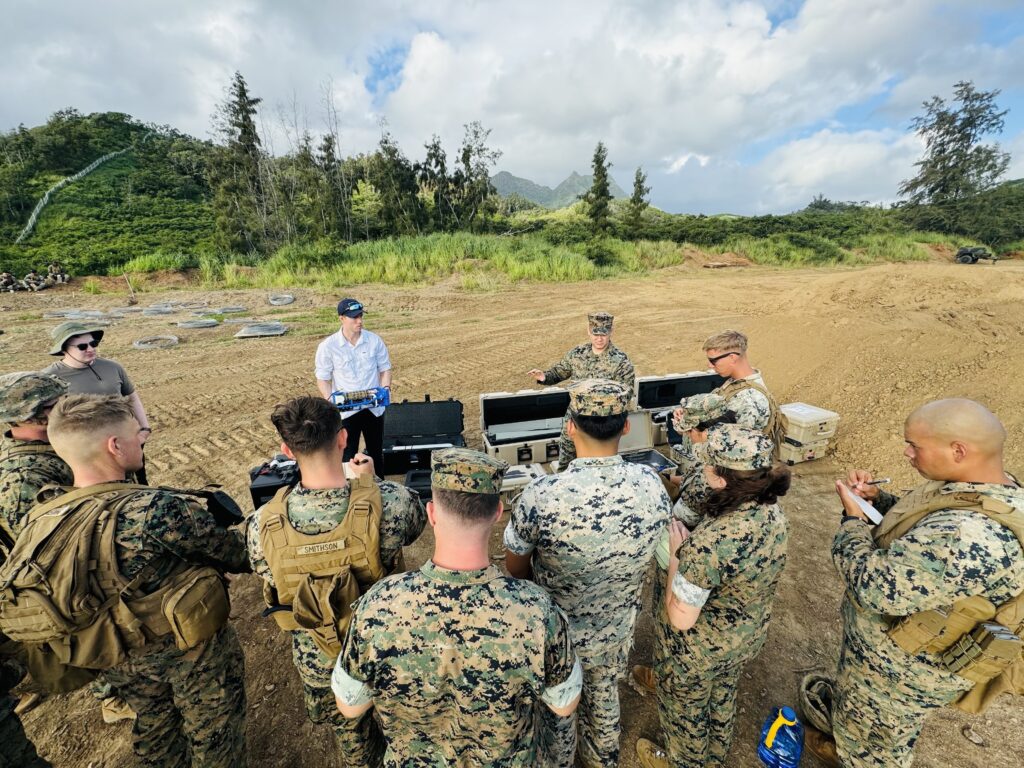
U.S. Naval Research Laboratory (NRL) has prototyped a Hydrogen Small Unit Power (H-SUP) system to reduce detectability and improve readiness of Marine Corps in expeditionary warfare operations. 

NRL’s H-SUP is a portable fuel cell electric generator with greater energy per weight than batteries and lower audible and thermal signatures than combustion generators. 
  
“This is more than a power system. It’s a capability that supports distributed operations and extends mission range. That’s strategic value,” said NRL Principal Investigator Kevin Cronin. “At NRL, we champion long-term modernization while working hand in glove with end-users across the services. Our investment today with the Marines in low-signature power intends to shape the future of how Marines fight – more independently, more efficiently, and with less logistical burden.” 
  
The use of hydrogen in key applications can lead to increased electrical efficiency and energy density, increased operational range, reduced thermal and audible signature, and reduced maintenance requirements; ultimately increasing lethality of the force and decreasing logistical sustainment requirements. 
  
“Warfighter feedback is a critical component of the technology development process and will be used to inform requirement definition and future research and development activities,” said Capt. Joshua Ashley, U.S. Marine Corps, Expeditionary Energy Office (E2O) Science and Technology Analyst. “The E2O serves as the link between the warfighter and the lab, providing feedback to refine the system and accelerate acquisition.” 
  
The Marine Corps established the E2O to conduct research and development in technologies, which can be the difference between mission success and failure, while reducing energy consumption with the goal of increasing reach, persistence, and lethality. E2O works closely with the combat and technology development communities and serves as the proponent for Expeditionary Energy in the force development process. 
  
“H-SUP isn’t just innovative – it increases lethality by keeping us powered and hard to find,” Ashley said. “We ensure this technology meets the needs of Marines on the ground – quiet, efficient, and reliable power that supports expeditionary operations.” 
 
By evaluating H-SUP in operational scenarios, the team is reducing risk and accelerating requirements development of technology that increases endurance and improves the autonomy of small units. 
  
H-SUP was field tested at Marine Corps Base Camp Lejeune in July 2022, Marine Corps Air Station Yuma in February 2025, Marine Corps Training Area Bellows in March 2025, an Army event at Fort Polk with the 101st Airborne in May 2025, and most recently at Marine Corps Air Ground Combat Center Twentynine Palms in May 2025. 
  
“Our mission at NRL is to advance science that solves today’s problems while anticipating tomorrow’s threats,” Cronin said. “Hydrogen fuel cells fit both categories.” 
  
NRL and E2O are translating feedback from Marines to refine the system for usability, survivability, and integration. This leads to adoption, not just prototypes. 
  
“My role at NRL is to turn advanced science into operational capability,” Cronin said. “We built H-SUP not just to work in the lab, but to serve Marines in the field. Through collaboration with partners and direct feedback from users, we’re pushing this from prototype to practical.” 
  
The fuel cell system in H-SUP was originally developed for use in unmanned vehicles. The high specific energy content of hydrogen enables increased range and endurance for those systems. This has been demonstrated in the Naval Air Warfare Center Aircraft Division’s H2 Stalker program, where this same fuel cell was integrated into the Stalker VXE30. 
 
H2 Stalker provides greater combined power and energy to weight than alternate Stalker VXE30 configurations, enabling improved range, endurance, and dash metrics compared to the baseline VXE30. H2 Stalker successfully completed multiple flight tests and demonstrations in various environmental conditions. 
 
“We’re pushing technology into the hands of warfighters through real partnerships with industry and acquisition commands,” Cronin said. “In addition, the fuel cell in the H-SUP can also be used to power unmanned aerial vehicles to extend mission endurance. Lastly, fuel cells can support multiple aspects of the U.S. Marine Corps concept of Expeditionary Advanced Base Operations.” 
 
NRL has developed fuel cell technology and the H-SUP system with sponsorship from the Office of Naval Research, Office of the Secretary of Defense Manufacturing Science and Technology Program, Naval Air Systems Command, and the USMC E2O; in addition to collaboration with industry partners, Northwest UAV and Noble Gas Systems. 
 
About the U.S. Naval Research Laboratory 
NRL is a scientific and engineering command dedicated to research that drives innovative advances for the U.S. Navy and Marine Corps from the seafloor to space and in the information domain. NRL is located in Washington, D.C. with major field sites in Stennis Space Center, Mississippi; Key West, Florida; Monterey, California, and employs approximately 3,000 civilian scientists, engineers and support personnel. 


E-130J Popular Name Announced for TACAMO Mission Aircraft 

The E-130J received its popular name designation, Phoenix II, in August 2025. The Phoenix II will be the Navy’s new Take Charge and Move Out (TACAMO) mission aircraft for decades to come. (Artist Rendering) 

Release From Naval Air Systems Command

NAS Patuxent River, Md. — The U.S. Navy’s Airborne Strategic Command, Control and Communications Program Office (PMA-271) and Strategic Communications Wing 1 (SCW-1) announced the official popular name for the Navy’s new Take Charge and Move Out (TACAMO) mission aircraft: E-130J Phoenix II. 

In October 2024, the placeholder name E-XX was officially designated as E-130J. As of today, the E-130J’s popular name has been designated as Phoenix II, representing the mythical bird whose ability is to be reborn and represents a symbol of immortality, resurrection, and renewal. 

This meaning of rebirth is a nod to the proven C-130 platform fulfilling the TACAMO mission since 1963-1993 via the EC-130Q.The E-130J Phoenix II will relieve the Navy’s E-6B Mercury fleet of the TACAMO mission. TACAMO is the vital connection for the president, secretary of defense and U.S. Strategic Command with naval ballistic missile forces. 

“Phoenix II is the ideal popular name as we take the E-130J TACAMO mission into its next phase,” said Capt. Roger Davis, PMA-271 program manager. “A phoenix is known for its resilience, exceptionally long lifespan, and its ability to transform and continue its purpose. The dedicated team at PMA-271 have committed to the ideals of TACAMO’s critical deterrence mission when executing this new platform; transforming the legacy mission aircraft into a new weapon system with unmatched survivability and longevity for this country.” 

SCW-1 squadrons home based out of Tinker Air Force Base, Oklahoma. They include the “Ironmen” of Fleet Air Reconnaissance Squadron (VQ) 3, “Shadows” of VQ-4 and “Roughnecks” of VQ-7. 

“I’m pleased that this very important program remains on track, and that we were able to leverage our community sailors and veterans through the process,” said Capt. Britt Windeler, commander of SCW-1. “I feel like Phoenix II is especially apt, as we are returning to our roots of executing the TACAMO mission on a C-130 variant.” 

The current platform, E-6B Mercury, is a communications relay and strategic airborne command post aircraft. It provides survivable, reliable, and endurable airborne Nuclear Command, Control, and Communications (NC3) for the president, secretary of defense and U.S. Strategic Command. The E-130J Phoenix II will recapitalize the aging E-6B Mercury fleet that has been in service for more than three decades. 

PMA-271 is part of Naval Air Systems Command (NAVAIR) with its headquarters at Naval Air Station Patuxent River, Maryland. Its mission is to deliver and support survivable, reliable and endurable airborne command, control and communications for the president, secretary of defense and U.S. Strategic Command. 

The mission of SCW-1 is to receive, verify and retransmit Emergency Action Messages (EAMs) to U.S. strategic forces. 


DoN Seeks Energy Resilience Solutions to Power Navy and Marine Corps Installations 

Release From SECNAV Public Affairs Office

WASHINGTON, D.C. – Today, the Department of the Navy, under the leadership of Secretary of the Navy John C. Phelan, announced a bold solicitation to industry for innovative, deployable energy solutions capable of powering Navy and Marine Corps installations with unmatched resilience, security and reliability. 

The solicitation, issued through the Center for Energy, Environment, and Demilitarization (CEED) Consortium under an Other Transaction Authority (OTA) agreement—seeks execution-ready prototypes that will modernize energy infrastructure, safeguard mission-critical operations and ensure uninterrupted power in any operating environment. 

“President Trump’s commitment to unleashing American energy innovation is powering the Navy into a new era,” said Secretary Phelan. “We are calling on America’s most capable innovators to deliver advanced, installation-scale energy solutions, ranging from small modular nuclear reactors to cutting-edge storage and generation technologies that can deliver power with 99.9% availability, even if the public grid goes dark. This is about warfighting readiness, mission assurance, and making sure our bases remain operational under any circumstances.” 

Prototype concepts should focus on: 

  • Modernizing Energy Infrastructure: Deploy advanced, resilient energy systems at Navy, Marine Corps, and other DoD installations. 

  • 99.9% Mission Availability: Deliver power systems capable of sustaining operations without interruption during public grid failures. 

  • Powering High-Demand Data Centers: Ensure generation systems, particularly SMRs are capable of supporting data centers that power advanced AI systems, which require substantially higher and continuous energy output than traditional facilities. 

  • Advanced On-Site Generation: Integrate next-generation small modular nuclear reactors, geothermal, battery storage, and other dispatchable energy technologies. 

  • Resilience Against All Threats: Build systems hardened against natural disasters, cyberattacks, and grid instability. 

  • Innovative Financing: Employ alternative capital structures to accelerate deployment and reduce reliance on traditional appropriated funding. 

The OTA pathway gives the Navy the speed and flexibility needed to work directly with industry leaders, moving from concept to deployment faster than traditional acquisition methods allow. The Department is seeking solutions from both traditional defense contractors and non-traditional energy innovators that can be rapidly mobilized, require minimal permitting, and are ready for immediate execution. 

“Energy resilience is warfighting resilience,” said Secretary Phelan. “If a hurricane knocks out the local grid, our ships still sail. If a cyberattack takes down civilian power, our bases stay online. That’s the standard and we’re setting it now.” 

This opportunity is available exclusively to CEED Consortium members.  

Full details of the solicitation are available at https://cmgcorp.org/cmg-opportunities/


Coast Guard Announces ‘Chief Petty Officer Class’ for New Waterways Commerce Cutters

Release From U.S. Coast Guard Headquarters

WASHINGTON — The U.S. Coast Guard announced today that its new fleet of Waterways Commerce Cutters (WCC) will be designated as the “Chief Petty Officer Class.” Each cutter will be named in honor of a Coast Guard Chief Petty Officer, recognizing the profound impact and legacy of these leaders within the Service. 

These cutters will replace the Coast Guard’s aging river tender fleet, facilitating the safe, secure and reliable flow of commerce throughout the nation’s Marine Transportation System (MTS). With America’s MTS supporting $5.4 trillion of economic activity, the WCCs will maintain aids to navigation that enable safe movement of food, energy, consumer goods, and raw materials between producers and consumers. Through their stewardship of the MTS, including our vital system of aids to navigation, the WCC fleet will play a critical role in advancing America’s economic security and protecting vital ports and waterways.  

The Coast Guard has received initial approval to produce the first eight WCCs, supported by historic investments made possible through President Trump’s One Big Beautiful Bill Act. The legislation provides nearly $25 billion – the largest single funding commitment in Coast Guard history – including $162 million to accelerate production rates and deliver three cutters ahead of schedule. These modernization efforts are aligned with Force Design 2028, a blueprint introduced by Secretary of Homeland Security Kristi Noem to transform the Coast Guard into a more agile, capable and responsive force.    

The announcement comes on National Lighthouse Day, underscoring the Service’s long-standing role in safeguarding maritime commerce and navigation. Since 1789, Coast Guard missions have been linked to protecting safe passage across America’s waterways, a legacy that continues today with the WCC fleet. 

“Since 1920, Chief Petty Officers and the Chiefs Mess have driven Coast Guard readiness and operational excellence,” said Master Chief Petty Officer of the Coast Guard Phillip Waldron. “These new cutters and their crews will build on that legacy, ensuring maritime commerce flows safely and we continue to control, secure and defend our inland ports and waterways and Marine Transportation System.”  

The Coast Guard maintains nearly 45,000 navigational aids nationwide. This new class of cutters – supported by historic recapitalization efforts and guided by Force Design 2028 – will be instrumental in continuing these vital operations, ensuring safe and efficient waterways and a stronger, more ready and capable Coast Guard for generations to come.  


Marines Demo Range of Long Range UAS for Future Operations 

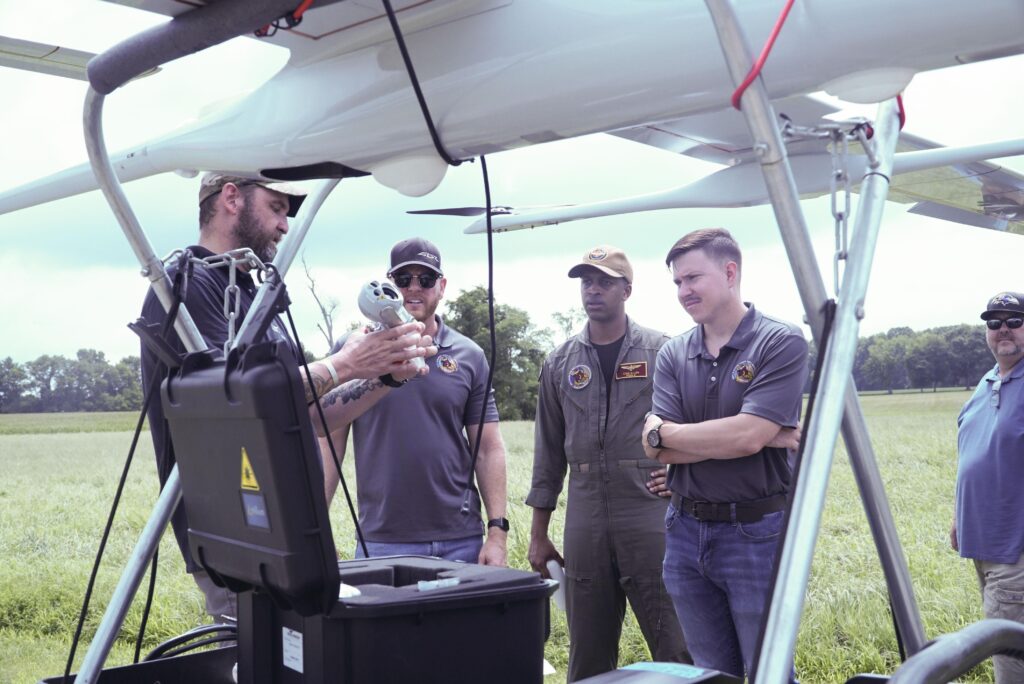
UAS operators from Kraus Hamdani exhibit its system during a Marine Corps demo in Southern Maryland in July. The company was one of five vendors who participated in the event to showcase their Group 2 unmanned systems. (U.S. Navy photo) 

Releasee From Naval Air Systems Command

NAS PATUXENT RIVER, Md. — The Navy and Marine Corps Small Tactical Unmanned Aircraft Systems (PMA-263) program team put Long Range Tactical (LRT) systems through their paces during a two-week technical demonstration in Chaptico, Maryland in mid-July. 

Five vendors attended the event to help inform the Marine Corpsof the functions and capabilities available on the commercialmarket for the Family of Small UAS (FoSUAS). The five systems evaluated include: AeroVironment P550, Kraus-Hamdani K1000 ULE Block II, Aurora Skiron X, Edge Autonomy Stalker LRT, and Vector Longbow. 

All systems are fixed wing, vertical take-off and landing Group 2 unmanned systems. In addition to basic measurements, the vendors collected performance data for ease of operation, audibility, range, and endurance while carrying the maximum payload requirement of seven pounds. 

PMA-263’s FoSUAS team, in partnership with the University of Maryland (UMD) UAS test site, evaluated each system against a standard test card to determine its suitability for the MarineCorps LRT requirements. UMD’s team of evaluators are experienced drone pilots, experts in their field and some, have military service, including program director Jim Alexander. 

“This is a great relationship for the University of Maryland and PMA-263,” said Alexander, who has worked with the program office for nine years for technical evaluation events like the LRT tech demonstration. “Our job is to serve as an impartial third party; but in the process, we get to learn new systems, and the Navy is able to collect a lot of data in a short amount of time.” 

The Small UAS Capabilities and the Deputy Commandant for Plans, Policies and Operations team and PMA-263’s team attended the event and had the opportunity to engage directly with the participating vendors and to observe the flight demonstrations.  

“Flight demonstration events like this are a critical market research function for the PMA and help us to validate performance data reported by vendors,” said Olivia Douglass, PMA-263 FoSUAS Integrated Product Team lead. “We would love to see all the vendors meet the requirements; it translates into options for the government and options for the end users. We want to see industry taking an interest in recognizing end user requirements and using that as a driving factor in improving their systems.” 

PMA-263 will use University of Maryland UAS test site’s assessment data and observer feedback from the event to inform the program’s priorities for follow-on engineering assessments, potential for operational testing, and inclusion of new platforms within the FoSUAS programs of record. 


Austal USA Starts Construction on Second OPC for Coast Guard

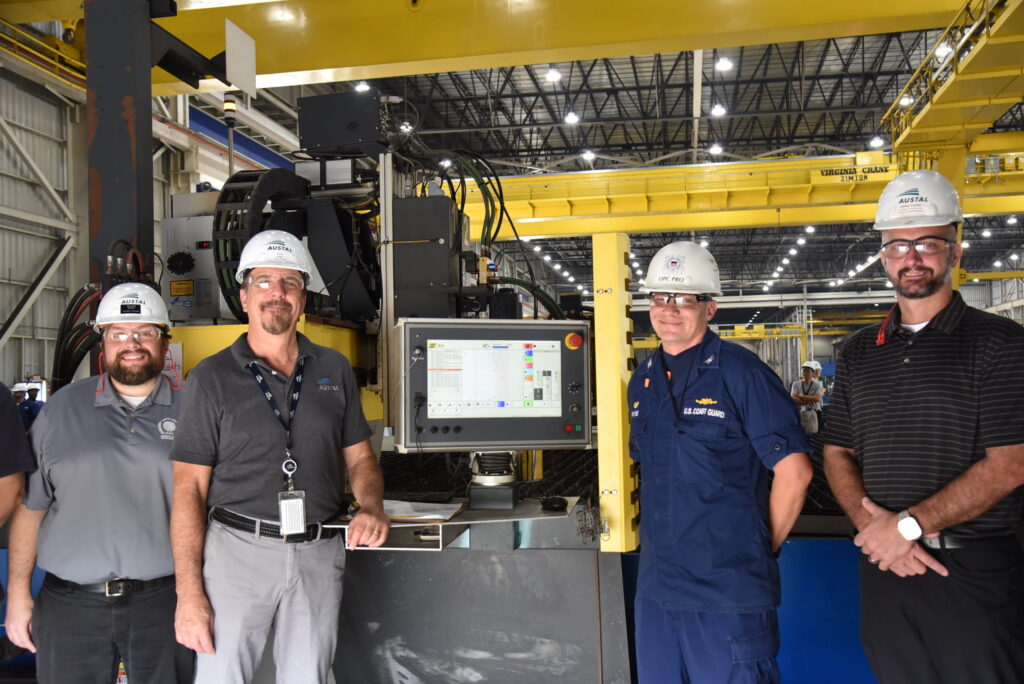
MOBILE, Ala. –  Austal USA started construction on its second Heritage-class Offshore Patrol Cutter (OPC), Icarus (WMSM 920).  Like Pickering (WMSM 919), Icarus is being built at the company’s Mobile, Ala. ship manufacturing facility as part of a contract that includes options for up to 11 cutters with a potential value of $3.3 billion.  

“Construction on the first OPC is well underway and we are excited to begin building our second OPC, Icarus,” commented, Harley Combs, vice president surface programs. “Our steel production line is running smoothly with all of the steel modules under construction for Pickering.” 

To accommodate Austal USA’s unique build strategy, the engineering and production teams collaborated to optimize the stage 1 OPC hull structure design to reduce weight, resulting in a more efficient build process and increasing the life expectancy of the vessel.  The Austal USA team also developed a 3-D model for the cutter early in the design process. This allowed each module to be outfitted to a significantly higher percentage than industry benchmarks.   

Icarus is the second USCG cutter to bear the name. The first Icarus, WPC 110, was commissioned in 1932 and was the first Coast Guard ship to sink an enemy submarine during World War II and the first to bring foreign POWs to America since the War of 1812.   

The 360-foot OPC will provide the majority of the Coast Guard’s offshore presence conducting a variety of missions including law enforcement, drug and migrant interdiction, and search and rescue.  With a range of 10,200 nautical miles at 14 knots and a 60-day endurance period, each OPC will be capable of deploying independently or as part of task groups, serving as a mobile command and control platform for surge operations such as hurricane response, mass migration incidents and other events. The cutters will also support Arctic objectives by helping regulate and protect emerging commerce and energy exploration in Alaska. 

Including Icarus, Austal USA has seven ships under construction.  A new assembly building will be used to support the final assembly of the Offshore Patrol Cutters is under completion.  When complete the building  will provide 192,000 square feet of new covered manufacturing space.  The building will consist of three bays, two of which are specifically designed to erect the OPC. 


Coast Guard Offloads $88M in Illicit Drugs Interdicted in the Eastern Pacific 

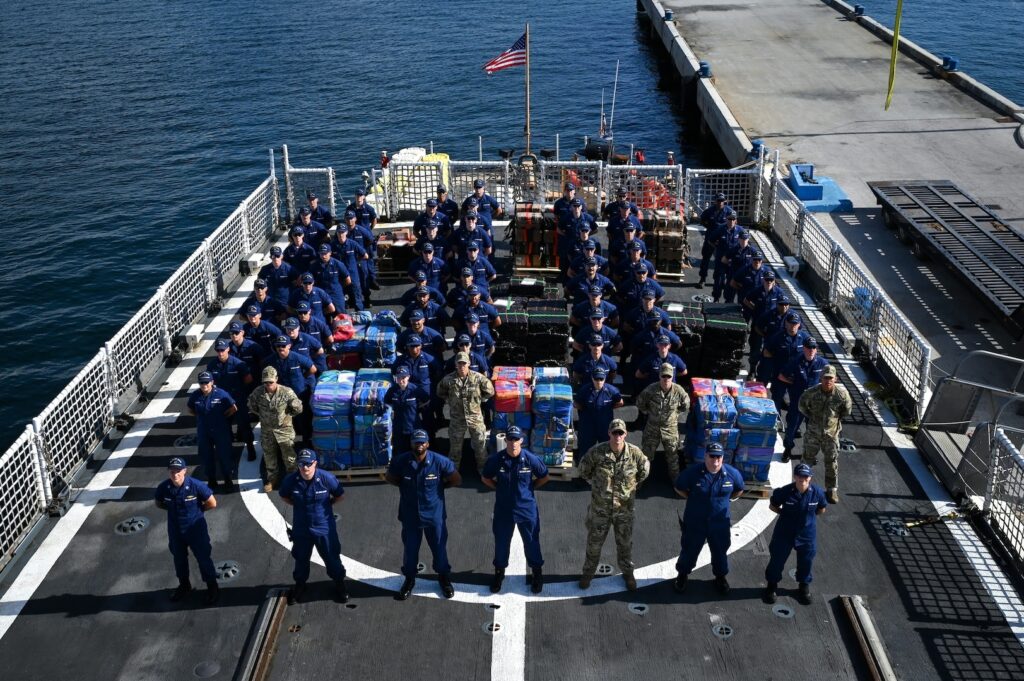
The crew of the U.S. Coast Guard Cutter Escanaba standing at parade rest on the flight deck at Port Everglades, Florida, August 5, 2025. The seized contraband was transferred to partner agencies for accountability and destruction. (U.S. Coast Guard photo by Petty Officer 3rd Class Jessica Walker) 

Release From U.S. Coast Guard Southeast District

MIAMI – U.S. Coast Guard Cutter Escanaba’s crew offloaded approximately 11,922 pounds of cocaine worth an estimated $88.2 million, Tuesday, at Port Everglades.  

The seized contraband was the result of three separate interdictions in the eastern Pacific by the crew of the Escanaba, Pacific Area Tactical Law Enforcement Team, and embarked Coast Guard Helicopter Interdiction Tactical Squadron aircrew.  

“The professionalism and cohesiveness of our team on board were the biggest contributors to our operational successes,” said Petty Officer Third Class Nadia Sands, an Operations Specialist in the cutter’s Combat Information Center. “This crew and command routinely embody the spirit of ‘One Team, One Dream’ and that spirit will continue to drive us to achieving our goals of protecting our borders and countering transnational criminal actors in the region.”  

The following assets and crews were involved in the interdiction operations:    

  • U.S. Coast Guard Cutter Escanaba (WMEC 907)   

  • U.S. Coast Guard Helicopter Interdiction Tactical Squadron  

  • U.S. Coast Guard Pacific Area Tactical Law Enforcement Team  

Detecting and interdicting illicit drug traffickers on the high seas involves significant coordination. Joint Interagency Task Force-South conducts the detection and monitoring of aerial and maritime transit of illegal drugs. Once an interdiction becomes imminent, the law enforcement phase of the operation begins, and control of the operation shifts to the U.S. Coast Guard for the interdiction and apprehension phases. Interdictions in the Eastern Pacific Ocean are performed by members of the U.S. Coast Guard under the authority and control of the Southwest Coast Guard District, headquartered in Alameda, California.    

Escanaba is a 270-foot Famous-class medium endurance cutter homeported in Portsmouth, Virginia, under U.S. Coast Guard Atlantic Area Command.    

For breaking news, follow us on X (formerly Twitter). For additional information, find us on Facebook and follow us on Instagram.    

Make a difference on land, at sea or in the air with the Coast Guard. Visit GoCoastGuard.com to learn more about active duty and reserve, officer and enlisted opportunities. Information on how to apply to the U.S. Coast Guard Academy can be found here.   


Exail Partners With U.S. Key Player to Supply 100 Navigation Systems for Naval UUVs 

LINCOLN, R. I.) July 30, 2025 — Exail, a leading provider of navigation solutions, has secured a new contract with a U.S.-based global defense player. The agreement involves the delivery of 100 Phins Compact Inertial Navigation Systems (INS) to equip Unmanned Underwater Vehicles (UUVs). 

Offering highly precise navigation capabilities, the Phins Compact INS ensures reliable performance in demanding environments and remains resilient to external signal disruptions. Its compact design enables rapid integration, allowing UUVs to carry out missions with flexibility and efficiency, even in dynamic and unpredictable maritime defense scenarios. 

“We are grateful for our client’s trust in Exail technology. We are confident that our INS will deliver the precision and robustness required for UUVs to operate effectively across varied environments,” said Carlos Lopes, Sales Director at Exail. “Over the years, we’ve worked closely with our customers to develop a navigation suite that truly meets defense challenges. Today, our INS is a global benchmark in subsea navigation.” 

This contract strengthens Exail’s global leadership in subsea navigation, with its INS technology trusted by over 50 navies and widely deployed on a broad range of subsea autonomous vehicles worldwide. It also represents a key milestone in the company’s expanding presence in the United States, supporting defense programs with proven, high-performance solutions.