Data Link Solutions Awarded $248M Navy Contract to Deliver Tactical Radio System 

From BAE Systems, Jan. 28, 2026 

Software-defined radio designed to run complex Link 16 waveform delivers enhanced command and control (C2) capabilities 

WAYNE, N.J. — January 28, 2026 – The U.S. Navy has awarded Data Link Solutions, a joint venture between BAE Systems and Collins Aerospace, an RTX business, a $248 million production contract to deliver hundreds of Multifunctional Information Distribution System Joint Tactical Radio System (MIDS JTRS) terminals for U.S. forces and allies.  

The system provides situational awareness and enables jam-resistant Link 16 connectivity with line-of-sight voice, video, and data communications for sea, ground, and air assets in dynamic operational environments. Finding the quickest and most secure path, MIDS JTRS enables the sharing of relative position and targeting data among joint forces and allows warfighters to make well-informed decisions swiftly in contested scenarios.  

“This contract demonstrates the ongoing need to equip our warfighters with a high-performing, secure command and control solution and our commitment to deliver at the speed of need,” said Brian Shadiack, director of Data Link Solutions. “With increased production capacity, we will provide hundreds of MIDS JTRS radio terminals for more than 45 U.S. and international platform types, including unmanned aerial vehicles and armored C2 ground vehicles.” 

MIDS JTRS is a four-channel, software-defined radio designed to run the complex Link 16 waveform and up to three additional communication protocols. Link 16 is a standardized communications system used by NATO, the U.S., and its allies and partner nations to share real-time tactical data. It is a scalable and flexible solution to tailor networks to mission needs. In addition to Link 16 compatibility, MIDS JTRS’ advanced Tactical Targeting Networking Technology offers a low latency, high communications waveform capability that provides critical platform connectivity and throughput within contested environments. The Department of War is fielding MIDS JTRS on the F-15, F-16, F/A-18, and F-22 aircraft, as well as maritime vessels and ground command and control assets. 

Data Link Solutions is a leading supplier of Link 16 terminals and software, as well as logistics and support services for air-, land-, and sea-based platforms. With more than 25 years of experience providing affordable, high-performance, and high-reliability data link terminals for forces, the organization has delivered over 9,000 Link 16 systems worldwide to more than 50 nations. 

Work on the MIDS JTRS program takes place in Wayne, New Jersey, and Cedar Rapids, Iowa. 


Singapore, Denmark Plan to Join the P-8 Poseidon Club

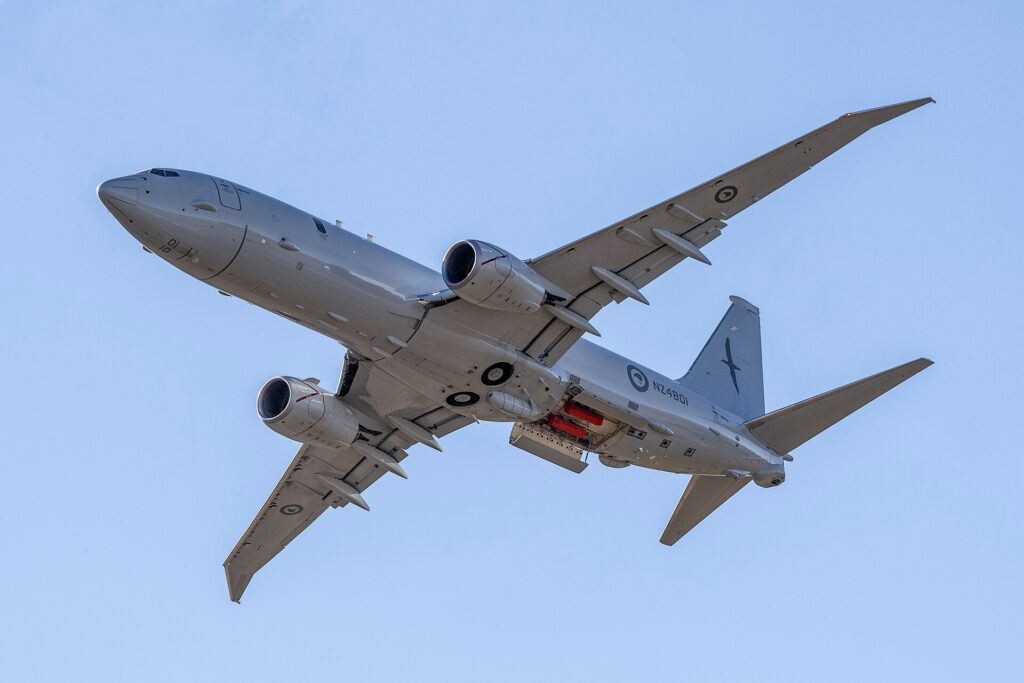
A New Zealand Defence Force P-8A Poseidon maritime patrol aircraft. (Photo credit: Defence Public Affairs, Corporal Naomi James)

By Richard R. Burgess, Senior Editor 

ARLINGTON, Va. — In recent weeks two more nations have been approved by the U.S. State Department for possible procurement of Boeing-built P-8 Poseidon maritime patrol aircraft (MPA).  

The Defense Security Cooperation Agency (DSCA) has announced that Denmark and Singapore each have been approved by the U.S. State Department for possible Foreign Military Sales of three and four P-8A aircraft, respectively. 

The procurement of the four P-8As and associated systems and support services for Singapore is estimated to total $2.316 billion. The sale also would include MK54 lightweight tordedoes  drawn from existing U.S. Navy stocks, the DSCA announced on Jan. 20, 2026.  

Earlier, the DSCA announced on Dec. 29, 2025, the State Department approved the possible sale of three P-8As and associated systems and support to Denmark. The value of the sale is estimated at $1.8 billion.  

The Defense Security Cooperation Agency delivered the required certification notifying Congress, the agency said. 

Interestingly, the two nations have not traditionally operated long-range MPA. The acquisitions will strengthen the anti-submarine and surface warfare capabilities of allies of the United States and NATO allies. 

The P-8A is operated by seven armed forces including the U.S. Navy, Royal Australian Air Force, Royal Air Force, Royal Norwegian Air Force, New Zealand Defence Force, Republic of Korea Navy, and German Navy. The Royal Canadian Air Force also has P-8As on order. All of these except the Royal Air Force previously operated versions or derivatives of the P-3 Orion. India also operates a similar version of the Poseidon purchased by direct commercial sale, the P-8I Neptune. 


Philippines, U.S. Conduct Bilateral Maritime Cooperative Activity

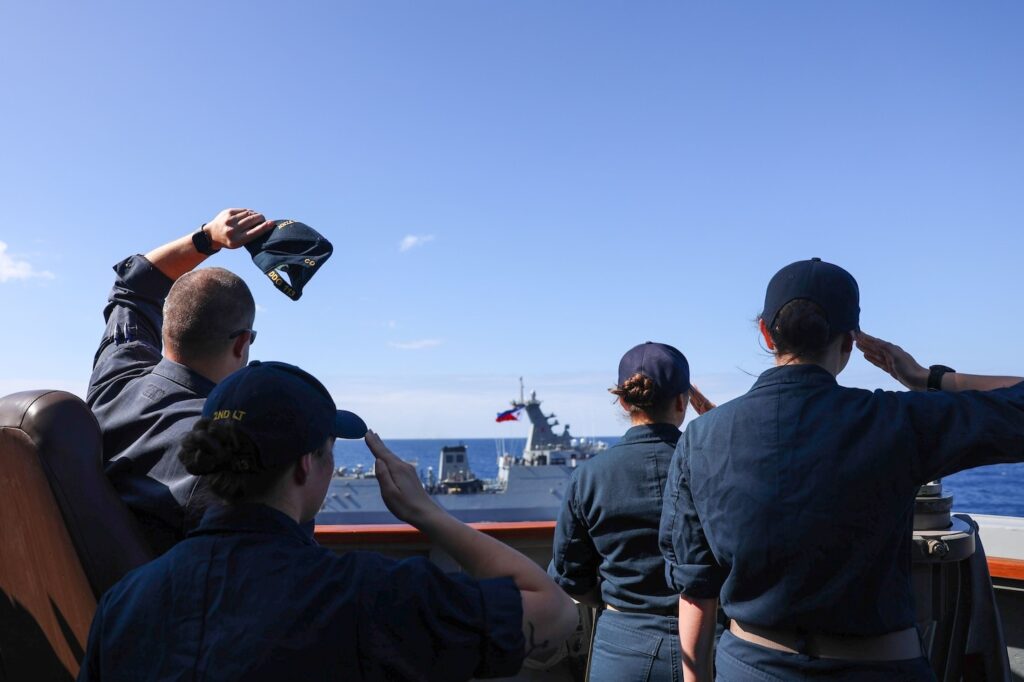
SOUTH CHINA SEA (Jan. 26, 2026) — U.S. Navy Sailors aboard Arleigh Burke-class guided-missile destroyer USS John Finn (DDG 113) wave at the Philippine Navy Jose Rizal-class frigate BRP Antonio Luna (FF151) during the Maritime Cooperative Activity (MCA) in the Philippines’ Exclusive Economic Zone, Jan. 26, 2026. (U.S. Navy photo by MC2 Alexandria Esteban) 

By U.S. 7th Fleet Public Affairs, Jan. 27, 2026 

SOUTH CHINA SEA   –  The Armed Forces of the Philippines (AFP) and the U.S. Navy conducted a bilateral Maritime Cooperative Activity (MCA) within the Philippines’ Exclusive Economic Zone, demonstrating a collective commitment to strengthen regional and international cooperation in support of a free and open Indo-Pacific, Jan. 25-26, 2026. 

MCAs are conducted in a manner consistent with international law and with due regard to the safety, navigational rights and freedoms of all nations. 

This MCA continues to build on interoperability between the AFP and U.S. Navy through maneuver exercises, replenishment-at-sea evolutions, communications checks, and shared maritime domain awareness. 

Participating units included U.S. Navy Arleigh Burke-class guided-missile destroyer USS John Finn (DDG 113), P-8A Poseidon maritime patrol and reconnaissance aircraft assigned to Patrol Squadron (VP) 45, Philippine Navy Jose Rizal-class guided-missile frigate BRP Antonio Luna (FF151), Philippine Air Force FA-50 aircraft, A-29 Super Tucano aircraft, and Philippine Coast Guard offshore patrol vessel BRP Gabriela Silang (OPV 8301) with embarked AW109. 

The U.S., along with our allies and partners, upholds the right to freedom of navigation and overflight and other lawful uses of the sea and international airspace, as well as respect to the maritime rights under international law.   

U.S. 7th Fleet, the Navy’s largest forward-deployed numbered fleet, routinely interacts and operates with allies and partners in preserving a free and open Indo-Pacific region. 


USS Wichita Crew Completes Critical Repairs at Sea, Sustains Mission Readiness

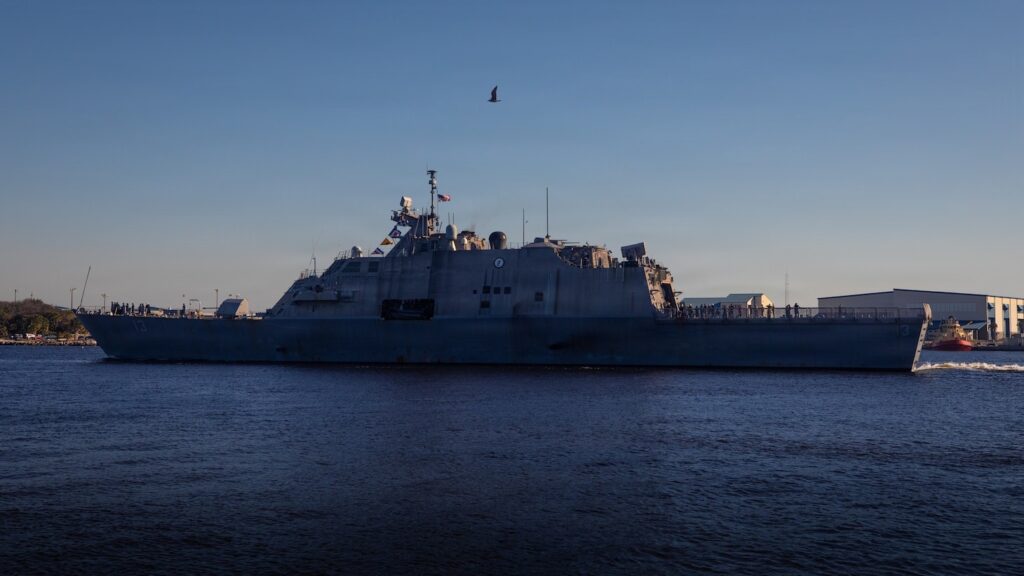
MAYPORT, Fla. (Nov. 14, 2025) – The Freedom-variant littoral combat ship USS Wichita (LCS 13) departs Naval Station Mayport, Florida, to support U.S. Northern Command (USNORTHCOM) southern border operations, Nov. 14. (U.S. Navy photo by MC1 Brandon J. Vinson) 

Release From U.S. Fleet Forces Command

CARIBBEAN SEA (Jan. 26, 2026) – Sailors aboard the Freedom-variant littoral combat ship USS Wichita (LCS 13) recently completed a series of critical engineering repairs while deployed, demonstrating the growing self-sufficiency and technical expertise of the Littoral Combat Ship force. 

While operating in the U.S. Fourth Fleet area of operations, Wichita Sailors repaired key ship systems, including a ship’s service diesel generator (SSDG), a main propulsion diesel engine (MPDE), and supporting auxiliary equipment. These efforts allowed the warship to remain fully mission capable. 

Repairs of this scope were previously conducted during shipyard availabilities; however, through dedicated training, strict adherence to technical documentation, and a drive to master their craft, Wichita Sailors demonstrated the importance of ownership and self-sufficiency in sustaining operational readiness. 

“Our primary task is to maintain and operate the engineering plant in a consistently high state of readiness in order to support the ship’s mission as an instrument of national policy,” said Lt. Brandon Cravey, Wichita’s chief engineer. “Our weekly engineering evolutions and damage control drills allow us to respond quickly and efficiently to a wide variety of casualties. We must be ready to answer all bells.” 

The most significant repair began when watchstanders identified an abnormal lube oil leak on one of the ship’s diesel generators. Acting quickly, Sailors secured the engine and isolated the issue before it could escalate into a more serious casualty. 

Engineering teams conducted a detailed inspection, identified a failed component, and completed repairs within 24 hours—restoring full electrical generating capability without disrupting operations. Advance planning by Wichita’s engineering and supply teams ensured high-demand spare parts were available onboard, reducing reliance on shore-based support and shortening repair timelines. 

In a separate instance, Sailors repaired a failing heating element on one of the ship’s main propulsion diesel engines. Working closely with Littoral Combat Ship Squadron Two and the Navy logistics enterprise, the crew completed the repair within 72 hours with no impact to operational tasking. 

Cmdr. Travis Snover, Wichita’s commanding officer, said the crew’s success reflects a broader cultural shift across the LCS community. “To say I’m proud of Wichita’s engineering team would be an understatement,” Snover said. “Their initiative, professional curiosity, and commitment to mastering their equipment are the enablers of our success at sea. With maintenance requirements becoming less reliant on contracted shore side support in the LCS community, it is imperative that Wichita Sailors take ownership of our equipment and learn to recognize the signs and symptoms of potential failure. We, as a team onboard Wichita, have made ownership the foundation of our culture and strive to demonstrate that Sailors at sea, when provided the necessary tools, parts, and materials, can ensure that each and every ship is ready on arrival when we are called to stand the watch.” 

USS Wichita departed Naval Station Mayport in October 2025 for a regularly scheduled deployment with an embarked Coast Guard Law Enforcement Detachment, supporting missions assigned by U.S. Fourth Fleet and U.S. Second Fleet. 


USS Cincinnati arrives in Ream Naval Base 

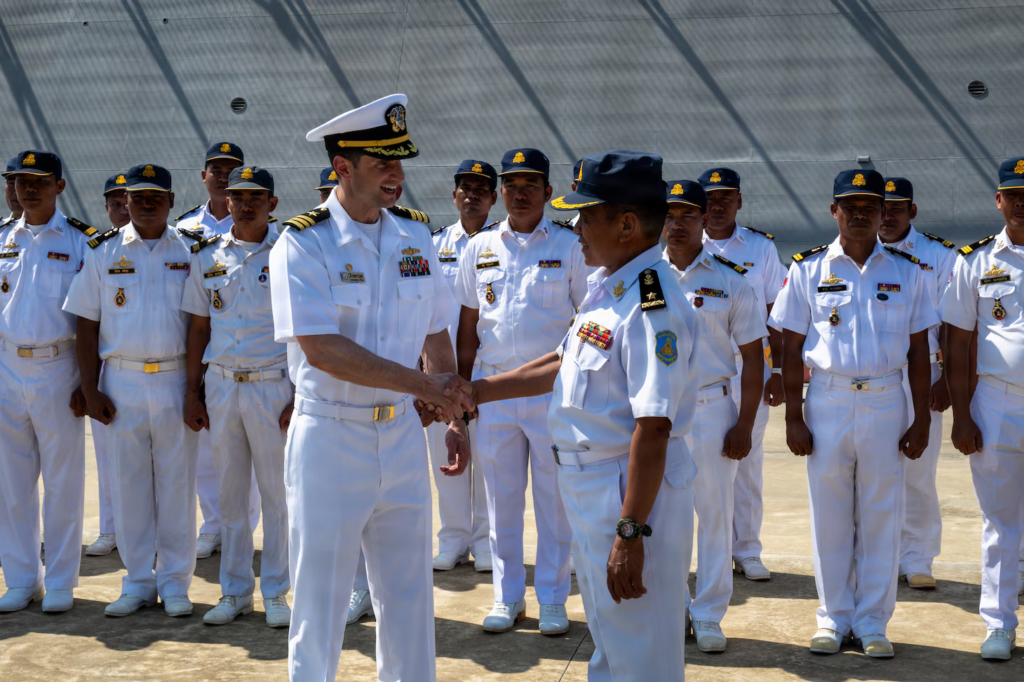
REAM NAVAL BASE, Cambodia (Jan. 24, 2026) A Royal Cambodian Navy Delegation welcomes Independence-Variant littoral combat ship USS Cincinnati (LCS 20) to Ream Naval Base, Cambodia, Jan. 24. Cincinnati is operating in the U.S. 7th Fleet area of operations to ensure maritime security and stability in the Indo-Pacific region. (U.S. Navy photo by MC2 Class Nicholas Rodriguez) 

By Destroyer Squadron 7 Public Affairs, Jan. 24, 2026 

REAM NAVAL BASE, Cambodia  –  Independence-variant littoral combat ship USS Cincinnati (LCS 20) arrived in Ream Naval Base for a temporary port visit, Jan. 24, 2026. 
 
Cincinnati’s visit to Cambodia celebrates the continued partnership between the United States and Cambodia, reaffirming our shared commitment to regional security, peace and prosperity. While in port, the crew will conduct ship tours, hold subject matter expert exchanges, and meet with key leaders to further enhance maritime partnership between the two nations. 
 
“It is an honor to be welcomed by the Cambodian people at Ream Naval Base,” said Capt. Matt Scarlett, commodore, Destroyer Squadron (DESRON) 7. “We are always excited to work alongside our partners and continue to build a free and open Indo-Pacific for all nations.” 
 
This visit also demonstrates the deepening cooperation and expanding friendship between the U.S. and Royal Cambodian navies. Cambodia and the United States work shoulder-to-shoulder to uphold a free and open Indo-Pacific. 
 
As we mark the 250th anniversary of the founding of the United States, we reflect not only on our ideals, but also on the enduring role of diplomacy in shaping our nation’s journey and global impact. This visit is a testament to our long-standing partnership with Cambodia and our shared vision for the future. Cincinnati’s visit also follows Independence-variant littoral combat ship USS Savannah’s (LCS 28) port visit to the Kingdom of Cambodia in December 2024. 
 
As the U.S. Navy’s forward-deployed DESRON in Southeast Asia, DESRON 7 serves as the primary tactical commander of littoral combat ships deployed to the U.S. 7th Fleet area of responsibility. 
 
U.S. 7th Fleet, the Navy’s largest forward-deployed numbered fleet, routinely interacts and operates with allies and partners in preserving a free and open Indo-Pacific region. 


War Department Releases New Defense Strategy 

ARLINGTON, Va. – The U.S. Department of War released the 2026 National Defense Strategy (NDS) on Jan. 23, 2026.  

The New NDS can be read here: 

https://media.defense.gov/2026/Jan/23/2003864773/-1/-1/0/2026-NATIONAL-DEFENSE-STRATEGY.PDF


Integer Unveils DIGIT: Next-Gen Predictive Intelligence for Maritime Missions 

From Integer Technologies, Jan 26, 2026   

Mission-aware software fuses physics-based digital twins and real-time data to anticipate risk and deliver mission success for autonomous and human decision-makers.  

COLUMBIA, S.C., January 26, 2026 — Integer Technologies, a leading provider of predictive intelligence and mission-level planning for naval vessels that enables better, faster, and more responsive decision-making, today announced the launch of its DIGIT Mission Assurance Platform, engineered to secure decision advantage for autonomous and human-in-the-loop operations across the distributed maritime battlespace.   

Built to thrive in denied, degraded, intermittent, and limited (DDIL) environments, DIGIT fuses high-fidelity digital twins with real-time environmental forecasting, empowering operators to assess, coordinate, and adapt mission plans at the tactical edge. By integrating real-time sensor data with physics-based models, platforms adapt automatically to evolving threats; and with persistent situational awareness, a continuous heartbeat of mission and vessel health gives operators critical state awareness for both manned and unmanned platforms even when traditional communication links are severed.   

“The next generation of defense technology will be defined by software that can anticipate, not just respond,” said Duke Hartman, Integer co-founder and Chief Executive Officer. “From platform-level introspection to global fleet orchestration, DIGIT provides the software architecture to win the fight. It represents a fundamental shift toward mission-aware technology, giving operators and autonomous systems the foresight to make confident decisions to deliver successful mission outcomes.”   

DIGIT is scalable, interoperable, and adaptable, with the ability to support manned and unmanned surface and underwater vehicles, including the recently announced guided missile battleship and the future frigate. From a single vessel to an entire Golden Fleet, DIGIT gives operators the ultimate decision advantage: the ability to foresee failure and adapt at machine speed. DIGIT will launch with three modules to support the warfighter’s specific mission needs:   

  • DIGIT COMMAND – The multi-agent mission manager designed for the shore-side commander. It feeds existing command and control (C2) with a decision-support layer that compliments the power of DIGIT across an entire theater of operations. 

  • DIGIT CORE – The introspective perception, planning, and resolution framework onboard a physical platform. DIGIT CORE delivers high-fidelity control over internal systems, enabling a level of precision that enhances human decision-making and platform responsiveness. This includes integrating real-time data with onboard modeling and simulation to continuously assess a craft’s propulsion and power systems, identify anomalies, and recommend corrective actions, expanding beyond traditional health monitoring to provide predictive, mission-level planning.  

  • DIGIT UxV – The dynamic mission planning layer for unmanned underwater vehicles (UUVs) and unmanned surface vehicles (USVs), engineered to transform autonomous platforms from simple executors into resilient, adaptive, and mission-aware agents, even when communications become difficult or impossible. DIGIT UxV models the interaction between the platform and the environment, providing the decision advantage necessary for mission success.  

“DIGIT was purpose-built for mission assurance,” said Josh Knight, Ph.D., Integer co-founder and Chief Operating Officer. “It’s not just about monitoring systems; it’s about understanding how changes impact the entire mission. Our DIGIT software provides that operational context, allowing teams to adapt quickly and preserve mission effectiveness under real-world constraints.”   

Integer’s DIGIT is currently supporting U.S. Navy UxV efforts, including mission assurance work for the Metron-developed Lancet™ long-range, multi-mission unmanned undersea vehicle. For more information about DIGIT, visit www.integer-tech.com/digit or email [email protected].   


Shore Boss Assesses Readiness, Quality of Life at NSA Singapore 

From Commander, Navy Installations Command Public Affairs, 23 January 2026 

SINGAPORE — Vice Adm. Scott Gray, commander, Navy Installations Command (CNIC), visited Naval Support Activity (NSA) Singapore Jan. 23, 2026, continuing a series of engagements across the Indo-Pacific focused on strengthening shore readiness and operational support to the fleet. 

The visit supported a broader effort to evaluate how Navy installations enable global power projection, sustain forward forces and remove friction for operational commanders. 

While in Singapore, Gray met with Rear Adm. Todd Cimicata, commander, Logistics Group Western Pacific and Task Force 73, and Capt. Silas Bouyer, commanding officer, Singapore Area Coordinator (SAC), to discuss installation capabilities, regional logistics posture and infrastructure priorities. 

“NSA Singapore is one of those places where the mission never slows down, and the margin for error is small,” said Gray. “I’m here to see firsthand what our teams need to keep ships moving, keep Sailors supported and keep the fleet ready to respond at speed.” 

Gray toured key areas of the installation, including SAC unaccompanied housing facilities, which primarily house junior enlisted Sailors when they are ashore. As part of the Secretary of War’s Barracks Task Force initiative and the Navy’s “Sailors First” principle, CNIC continues to drive improvements in barracks safety, habitability and cleanliness across the shore enterprise. 

“If a Sailor can’t rest, reset and feel good about where they live, it shows up in the mission,” said Gray. “These walkthroughs are about spotting real issues, holding ourselves accountable and making sure our standards match what our people deserve.” 

Gray also visited Changi Naval Base, where he toured the pier complex, ship repair facilities and Destroyer Squadron 7 spaces. The discussions centered on the strategic value of forward-positioned logistics and maintenance hubs in sustaining naval forces throughout the Indo-Pacific. 

“When maintenance, parts, fuel and people come together seamlessly overseas, commanders gain options and flexibility,” said Gray.  “That advantage only exists if we continue to invest, modernize and operate with urgency and discipline.” 

CNIC enables and sustains naval forces from the shore by designing and delivering integrated shore capabilities to the fleet, fighter and family. Gray oversees 10 Navy regions and 70 installations worldwide. 

CNFJ/RJ’s primary responsibility is to provide shore readiness to the fleet, liaise with the Japanese government and strengthen ties with the Japan Maritime Self-Defense Force. Navy Region Japan manages installations in Atsugi, Misawa, Okinawa, Sasebo, Yokosuka, Diego Garcia and Singapore. 


U.S. Coast Guard Cutter Polar Star Marks 50 years of Service, Begins Operation Deep Freeze 2026 

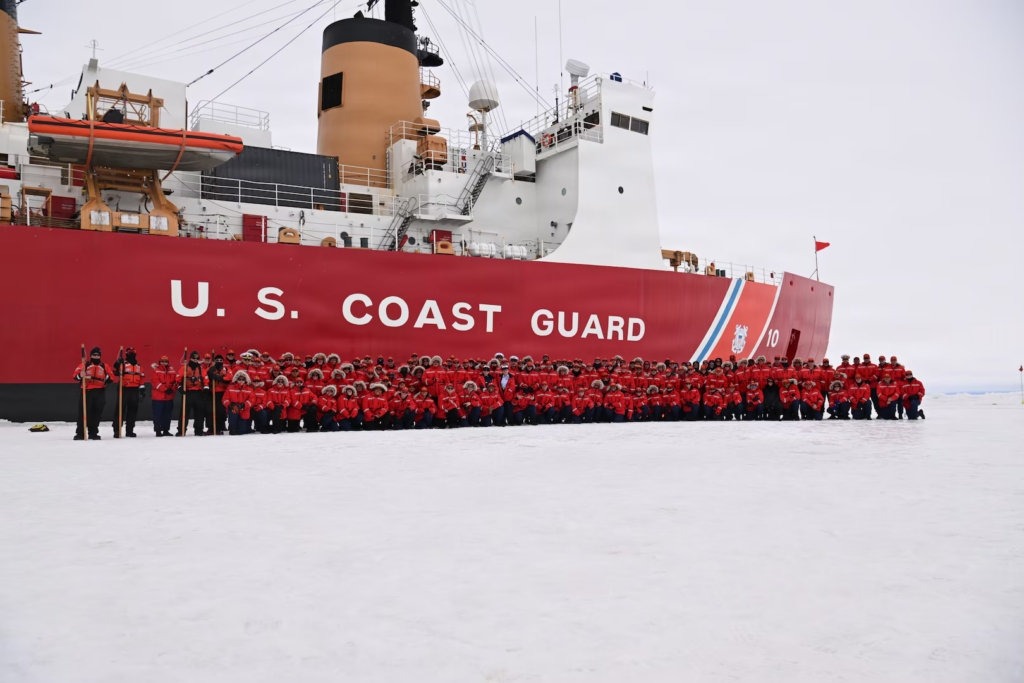
https://www.news.uscg.mil/Press-Releases/Article/4385905/us-coast-guard-cutter-polar-star-marks-50-years-of-service-begins-operation-dee/Caption: USCGC Polar Star (WAGB 10) crew members pose for a group photo while the cutter sits hove-to in the Ross Sea during Operation Deep Freeze 2026, Jan. 12, 2026. The cutter turned 50 years old on Jan. 17, 2026 amid Operation Deep Freeze, which is a joint service, inter-agency support operation for the National Science Foundation that manages the United States Antarctic Program. (U.S. Coast Guard photo by Petty Officer 2nd Class Christopher Bokum)

From U.S. Coast Guard Pacific Area, Jan. 23, 2026 

SOUTHERN OCEAN — The U.S. Coast Guard Cutter Polar Star (WAGB 10) began icebreaking operations in the Southern Ocean in support of Operation Deep Freeze 2026 and marked its 50th year of commissioned service Saturday by freeing and escorting a cruise ship trapped in pack ice. 

The Australian-owned cruise ship Scenic Eclipse II contacted Polar Star at approximately 11 p.m., local time Friday after becoming beset in pack ice roughly eight nautical miles from McMurdo Sound. Polar Star’s crew conducted two close passes to break the vessel free, then escorted it approximately four nautical miles to open water. 

Polar Star departed Seattle in November for its 29th deployment to Antarctica in support of Operation Deep Freeze. 

Operation Deep Freeze provides logistical support for the U.S. Antarctic Program, which is managed by the National Science Foundation. The mission includes strategic and tactical airlift, airdrop, aeromedical evacuation, search and rescue, sealift, seaport access, bulk fuel supply, cargo handling, and other transportation requirements. These efforts enable critical scientific research in one of the most remote regions on Earth. 

Polar Star’s role in Operation Deep Freeze includes breaking a navigable channel through miles of dense Antarctic ice to allow fuel and cargo deliveries essential for sustaining research stations and operations. 

Commissioned Jan. 17, 1976, Polar Star is the nation’s only active heavy icebreaker and has served as a cornerstone of U.S. presence in the polar regions. For five decades, the cutter has executed missions ranging from Antarctic resupply and search and rescue to environmental protection and national defense. 

As the cutter transits the Southern Ocean en route to Antarctica, its crew reflects on a half-century of service defined by resilience, adaptability and dedication. 

“I am constantly amazed at this crew’s tremendous energy and enthusiasm,” said Capt. Jeff Rasnake, Polar Star’s commanding officer. “Despite the many challenges associated with getting and keeping this ship on mission, they remain eternally positive and committed to meeting the high standards we’ve set for ourselves.” 

Throughout its service life, Polar Star has completed dozens of Operation Deep Freeze missions and numerous Arctic deployments, defending U.S. sovereignty, securing critical shipping lanes, protecting energy and mineral resources, and countering our adversaries’ presence in the polar regions. Despite its age, the cutter continues to demonstrate unmatched heavy icebreaking capability, routinely operating in conditions few vessels can navigate. 

“At 50 years old, Polar Star remains the world’s most capable non-nuclear icebreaker,” said Cmdr. Samuel Blase, Polar Star’s executive officer. “That’s a testament to the crews that have maintained it over the decades. With years of service left to give, Polar Star will continue to guide the way in the high latitudes well into the future.” 

As the cutter undertakes another demanding deployment, its 50th anniversary underscores both the ship’s enduring capabilities and the professionalism of its crew. 

“While the term ‘historic’ has lost meaning through overuse, there is no doubt that this is an amazing ship,” said Rasnake. “Polar Star’s 50 years of service in the polar regions puts it in the discussion with other great Coast Guard icebreakers such as USCGC Glacier, whose record of Operation Deep Freeze deployments Polar Star matches this year.” 

As Polar Star presses south through freezing seas and thickening ice, the crew carries forward a proud tradition of service. The 50th anniversary serves as both a celebration of the past and a reminder of the cutter’s ongoing role at the forefront of U.S. polar operations. 


CTF 68 Builds Maritime Advantage with NATO Allies During Exercise Freezing Winds 2025

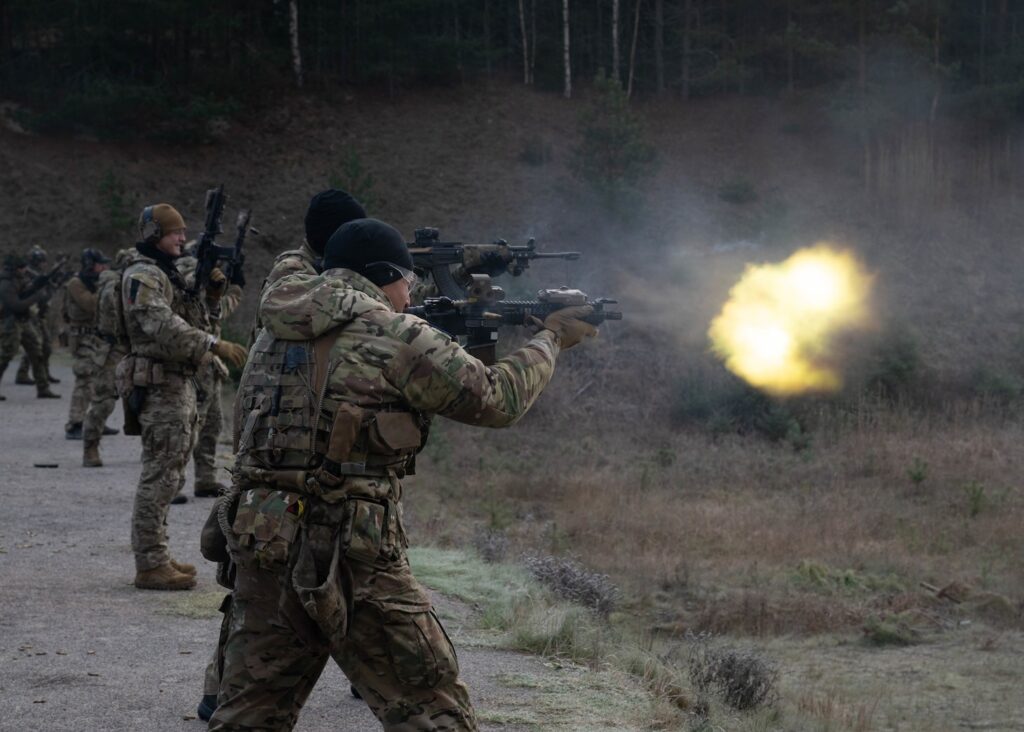
UPINNIEMI, Finland (Nov. 25, 2025) U.S. Navy explosive ordnance disposal technicians from Explosive Ordnance Disposal Mobile 8, Commander Task Group 68.1, and Finnish Navy sailors conduct a live-fire exercise as a part of Freezing Winds 25 in Upinniemi, Finland, Nov. 25, 2025. (U.S. Navy Photo by MC2 Juan J. Ruiz-Lazcano) 

By Commander, Task Force 68 Public Affairs

BALTIC SEA  –  U.S. Navy expeditionary forces assigned to Commander, Naval Expeditionary Combat Forces Europe-Africa/Commander, Task Force 68 (CTF 68) recently concluded operations in support of Exercise Freezing Winds 2025, a Finnish-led multinational training event designed to bolster collective readiness, interoperability, and security across the North Baltic Sea. 

Operating in concert with NATO Allies and U.S. Marines from Marine Rotational Force – Europe, CTF 68 contributed command and control, explosive ordnance disposal, and maritime logistics support across multiple domains. The exercise served as a proving ground for joint force operations in cold-weather environments and underscored the U.S. Navy’s commitment to enhancing allied maritime security throughout the Baltic region. 

“Operating alongside our NATO Allies and U.S. Marines in the challenging conditions of the Baltic Sea sharpens our readiness and reinforces our shared commitment to collective defense,” said Capt. Jeremy Wheat, commodore of Task Force 68. “This exercise strengthens our ability to respond as a unified force, no matter the environment or mission.” 

A key focus during Freezing Winds was improving freedom of movement in contested environments, which was made possible in part by the efforts of explosive ordnance disposal technicians from Explosive Ordnance Disposal Mobile Unit (EODMU) 8, assigned to Task Group 68.1. Their role involved simulated route clearance, underwater searches, and demolition operations near critical infrastructure and maritime logistics nodes. All of which were part of scenarios designed to test real-world response to sea mines and unexploded ordnance in congested littorals. 

“Our role during Freezing Winds was to ensure freedom of movement by mitigating explosive threats along resupply corridors and maritime infrastructure, especially in areas affected by simulated mining and unexploded ordnance,” said Lt. Luke Robertson, platoon officer-in-charge from TG 68.1. “Training with NATO Allies in these conditions enhances our ability to operate forward and respond to real-world threats in complex environments.” 

To support these clearance efforts and maintain the tempo of operations, logistics teams from Navy Cargo Handling Battalion (NCHB) 5, assigned to Task Group 68.5, provided the connective tissue needed to move fuel, cargo, and personnel across the battlespace. Supporting the combined force, TG 68.5 conducted cargo handling, aerial port coordination, and fuel delivery under freezing conditions proving the battalion’s capacity to sustain forward-deployed operations in the High North. 

“Our mission was to provide combat service support by moving fuel, cargo, and munitions anywhere they’re needed from high-latitude airfields to expeditionary seaports,” said Lt. Michael Flickinger, TG 68.5 site officer-in-charge. “The environment was challenging, but working side-by-side with Finnish and U.S. Marine logistics teams allowed us to validate scalable, mobile support concepts.” 

Exercise Freezing Winds 2025 also contributed to NATO’s broader effort to boost defense readiness across the Baltic Sea, a vital region for global commerce and energy transit. The inclusion of expeditionary units from CTF 68 added a crucial logistics and access-focused dimension to high-end naval and amphibious training. 

“The ability of our expeditionary units to integrate into Allied operations, as demonstrated in Freezing Winds, is what makes CTF 68 so unique,” Wheat added. “We bring scalable, responsive capability that extends the reach and impact of the entire naval force.” 

Wheat said that in an era marked by renewed focus on strategic deterrence in the High North, exercises like Freezing Winds enabled CTF 68 to contribute directly to integrated defense posture and the Alliance’s maritime advantage. 

Exercise Freezing Winds 2025 demonstrated the value of persistent, forward-deployed presence and reinforced the importance of logistics, access, and integration as enablers of joint and allied maritime advantage. “Through exercises like Freezing Winds, CTF 68 continues to maintain a persistent, forward-deployed presence delivering scalable expeditionary capabilities that advance Alliance readiness and regional stability,” said Wheat. 

Commander, Task Force 68 commands all Navy Expeditionary Combat Forces in Europe and Africa and provides critical capabilities including logistics, explosive ordnance disposal, maritime engineering, port operations, and expeditionary security in support of U.S. 6th Fleet and NATO objectives.